
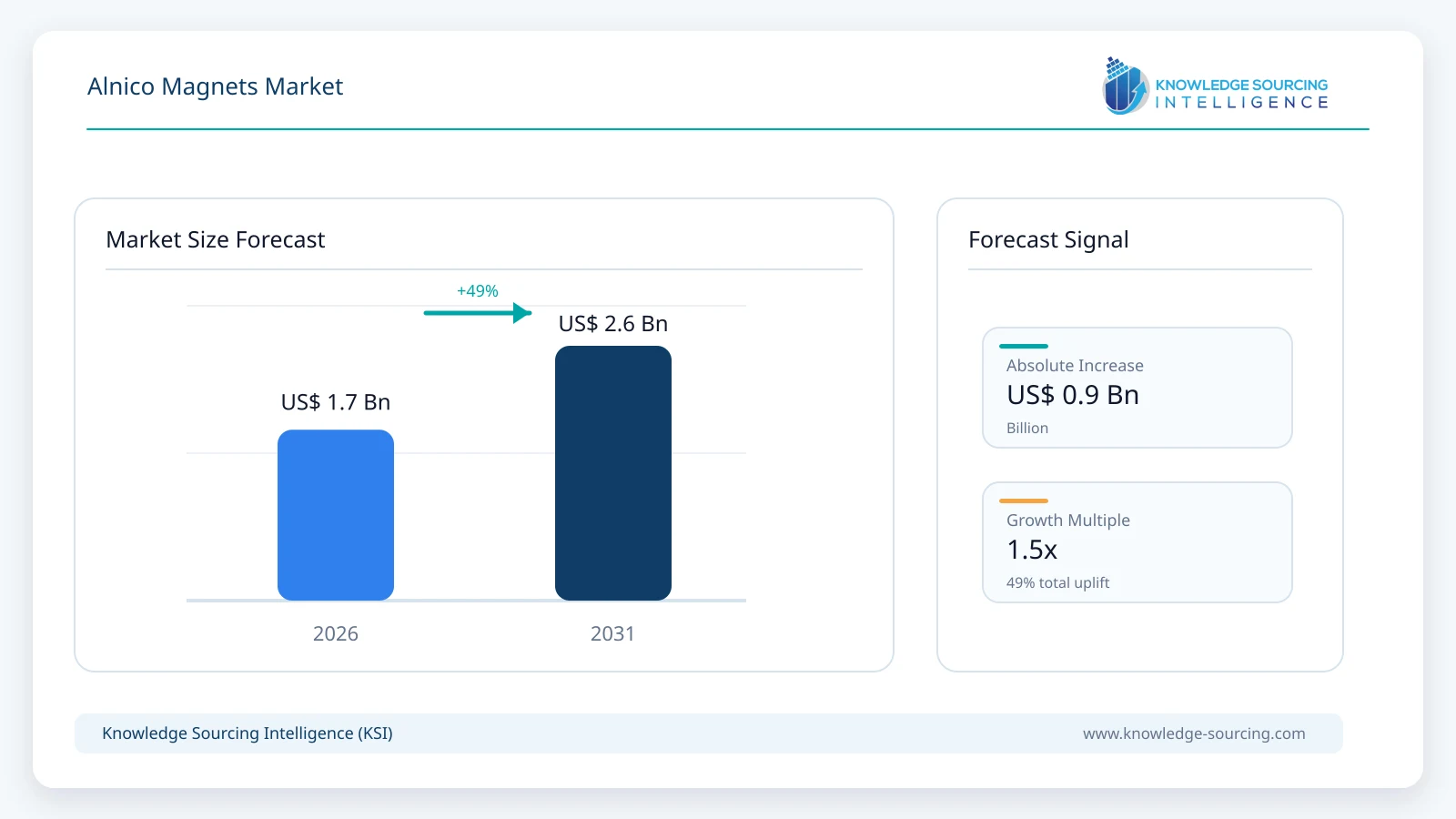
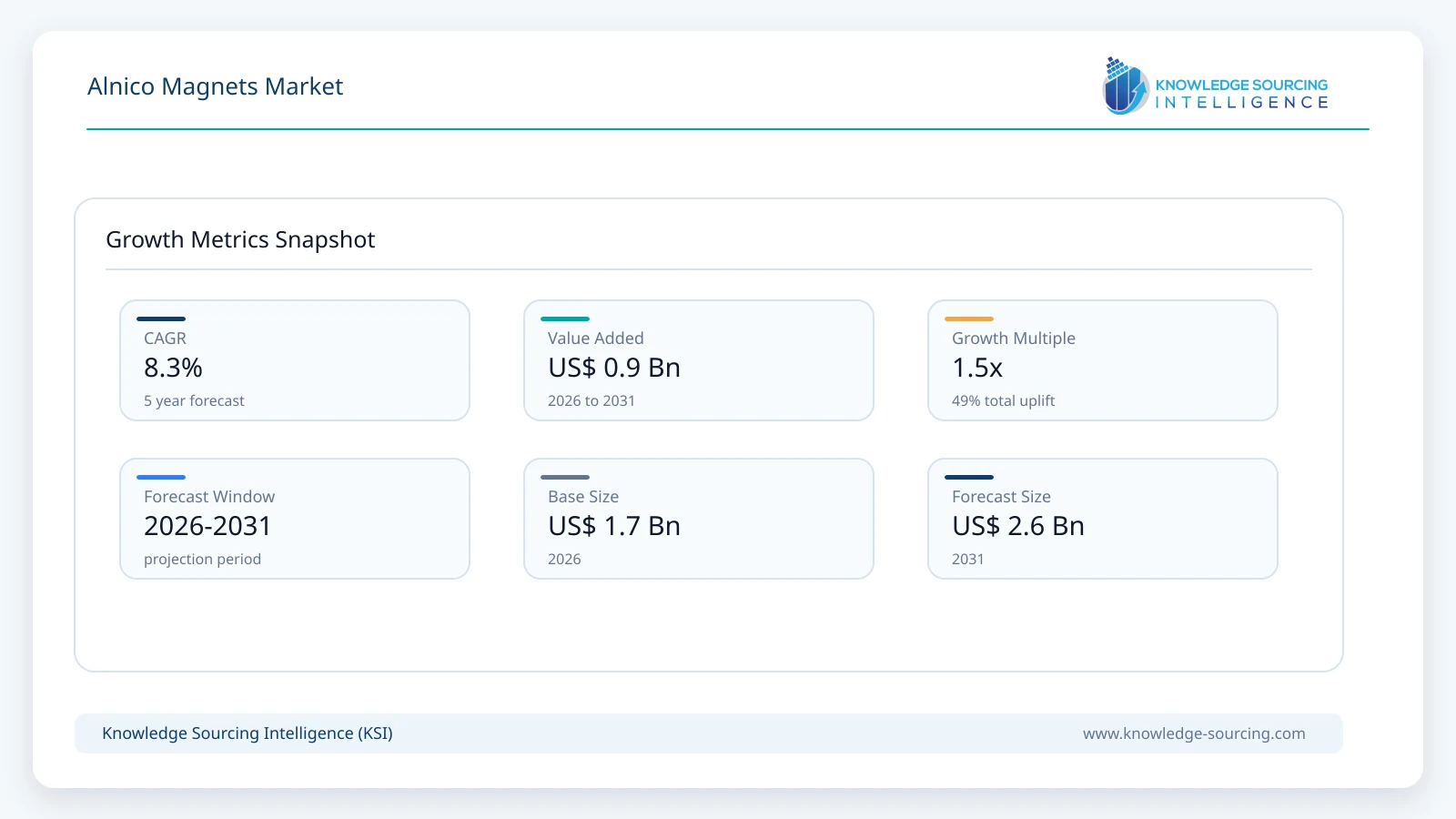
The Alnico Magnets market is forecast to grow at a CAGR of 8.3%, reaching USD 2.58 billion in 2031 from USD 1.73 billion in 2026.
Highlights:
- 1Automotive production, advanced sensing, industrial equipment, and high-temperature applications continue to support demand for Alnico magnets, particularly where thermal stability and resistance to demagnetization are more important than maximum magnetic energy density.
- 2Government-backed automotive manufacturing and electric mobility programs are strengthening the broader market for permanent magnets, sensors, motors, and other magnetic components used across the vehicle value chain.
- 3Alnico remains differentiated by its high operating-temperature capability, low reversible temperature coefficient, corrosion resistance, and availability across multiple grades and magnetic configurations.
- 4Asia Pacific remains an important manufacturing and consumption region for permanent magnets, while North American manufacturers are increasing attention on resilient, non-rare-earth magnet supply chains for high-temperature and strategic applications.
Alnico magnets, commonly written as AlNiCo, are permanent magnets based primarily on iron, aluminum, nickel, and cobalt, with some grades containing additional elements such as copper and titanium. Their combination of magnetic stability, high-temperature performance, and resistance to corrosion gives them a distinct position within the permanent magnet industry. Unlike neodymium-iron-boron magnets, which are selected primarily for very high magnetic energy density, Alnico is frequently selected where operating temperature, dimensional stability, and resistance to demagnetization are important design considerations. Arnold Magnetic Technologies identifies Alnico as an alloy family whose major constituents are iron, aluminum, nickel, and cobalt, with copper and titanium included in some compositions. The company also reports a low reversible temperature coefficient of approximately 0.02% per degree Celsius.
Alnico magnets are manufactured mainly through casting and, for applicable grades and suppliers, powder-metallurgy-based sintering. The manufacturing route, alloy composition, heat-treatment conditions, magnetic orientation, and final magnetization influence the resulting magnetic properties. Adams Magnetic Products explains that Alnico performance is developed through heat treatment and that anisotropic grades are heat-treated in a magnetic field to establish a preferred direction of magnetic orientation. Isotropic grades can be magnetized in different directions because they are not oriented during heat treatment.
The market therefore extends beyond basic magnet production. It includes specialized components used in motors, generators, sensors, instrumentation, relays, controls, speakers, microphones, guitar pickups, magnetos, magnetic separators, holding devices, and selected aerospace, automotive, medical, industrial, and electronic applications. Dexter Magnetic Technologies notes that Alnico can operate at temperatures as high as approximately 550°C depending on grade and identifies automotive and aircraft sensors among applications suited to its temperature characteristics.
Alnico Magnets Market Growth Drivers:
Increasing automotive production and electrification
The automotive industry remains an important demand center for Alnico magnets because permanent magnets are incorporated into sensors, motors, generators, actuators, ignition systems, and other magnetic components. The relevance of the automotive sector is expanding as vehicle manufacturers increase production of electronically controlled vehicles and electric and hybrid platforms. Alnico is not necessarily the preferred magnet material for every traction-motor design because rare-earth magnets can provide substantially higher energy density. However, its high-temperature stability and resistance to demagnetization can make it attractive for selected sensors, actuators, motors, and other components where thermal performance is a primary consideration.
Government data demonstrates the scale of the automotive manufacturing base supporting this demand. According to India's Ministry of Heavy Industries, automobile production during January to December 2025 reached 53.8 lakh passenger vehicles, 11.1 lakh commercial vehicles, 12.2 lakh three-wheelers, and 255.0 lakh two-wheelers. The same government release states that the automotive sector contributes nearly 15% of India's GST revenue collections and supports an estimated 30 million jobs across the automotive value chain.
Electrification is adding another layer of demand for magnetic components and advanced vehicle electronics. India's Ministry of Heavy Industries reported that EV registrations represented 6.1% of two-wheeler registrations, 2.6% of passenger-vehicle registrations, 0.9% of commercial-vehicle registrations, and 57.3% of three-wheeler registrations in 2024-25. Although these figures do not represent Alnico consumption directly, they demonstrate the expanding vehicle-electrification ecosystem in which motors, sensors, electronic controls, and magnetic components are increasingly required.
The policy environment is also supporting domestic automotive manufacturing. In July 2026, India's Ministry of Heavy Industries reported that the Production Linked Incentive scheme for automobiles and auto components had attracted investment of Rs. 44,326 crore and generated 67,820 jobs as of March 31, 2026. The scheme has a budgetary outlay of Rs. 25,938 crore and is designed to strengthen manufacturing capabilities for advanced automotive technology products, including electric vehicles.
These developments support the broader demand environment for permanent magnets and magnetic components. For Alnico suppliers, the opportunity is particularly relevant in applications requiring stable performance at elevated temperatures rather than simply the highest magnetic energy product.
High-temperature stability and resistance to demagnetization
Alnico's principal competitive advantage is its ability to maintain useful magnetic performance at temperatures where several alternative permanent magnet materials become more constrained. Dexter Magnetic Technologies reports maximum operating temperatures of approximately 450°C to 550°C across its listed Alnico grades, with Curie temperatures generally ranging from about 760°C to 860°C. The same source notes that Alnico grades 2, 5, and 8 are among the most widely used grades in its portfolio.
Arnold Magnetic Technologies similarly describes Alnico as having a low reversible temperature coefficient and high-temperature stability. The company's current Alnico portfolio includes multiple cast grades, including Alnico 2, 3, 4, 5, 6, 8, 8B, 8H, 8HE, and 9, alongside specialized materials and custom assemblies.
This performance profile creates opportunities in applications exposed to heat, magnetic cycling, vibration, and demanding operating environments. Automotive sensing, aerospace instrumentation, industrial machinery, magnetic holding equipment, and selected electronic devices can benefit from a magnet material that maintains predictable magnetic behavior over a broad temperature range.
Expansion of scientific, industrial, and sensing applications
Alnico magnets continue to be used in scientific instruments, magnetic sensors, laboratory equipment, instrumentation, and specialized industrial devices. Their availability in multiple grades, shapes, and magnetic configurations enables engineers to select a material according to required magnetic output, operating temperature, geometry, and demagnetization resistance.
The growing use of sensors across automotive, industrial automation, aerospace, instrumentation, and electronics creates an additional addressable application base. In these applications, the objective is often not to maximize the magnetic energy product. Instead, designers may prioritize repeatable magnetic characteristics, thermal stability, mechanical integration, and long operating life. This supports the continued use of Alnico in specialized sensor and instrumentation designs even as newer permanent magnet technologies compete strongly in high-energy applications.
Industrial magnetic holding and separation equipment also provides a stable application base. Adams Magnetic Products, for example, identifies Alnico channel magnets for holding applications and for removing tramp iron from material streams carrying grains, plastics, glass, minerals, and other granular products. Its current product information specifically identifies these channel magnets as cast Alnico 5.
Alnico Magnets Market Key Players and Products:
The Alnico magnet industry is specialized, with competition centered on material expertise, grade availability, manufacturing capabilities, customization, magnetization technology, quality control, and the ability to serve demanding applications. The following companies have current evidence of Alnico-related products or capabilities:
Arnold Magnetic Technologies offers cast Alnico magnets and custom assemblies across multiple grades and configurations, including bars, rods, rings, horseshoes, rotors, cylinders, C-shaped magnets, and custom components. Its Alnico manufacturing operation is located in Woodstock, Illinois, and the company's quality page identifies ISO 9001 and AS 9100 certifications for its Alnico operation.
Adams Magnetic Products Co. supplies Alnico magnets in different grades and configurations and provides products for holding, separation, sensing, and other industrial applications. Its technical information identifies Alnico alloys containing aluminum, nickel, cobalt, copper, and iron, with certain grades incorporating titanium and other alloying additions.
Dexter Magnetic Technologies lists Alnico alongside ceramic hard ferrite, neodymium-iron-boron, samarium cobalt, and other permanent magnet materials. Its Alnico portfolio includes cast and sintered grades and supports applications requiring high temperature performance, magnetic stability, and specialized magnetic designs.
Xiamen Kings Magnet Co., Ltd. is positioned in the permanent magnet industry and offers Alnico among its magnet product categories. Its relevance to the market is particularly associated with the wider Asian permanent magnet manufacturing ecosystem.
Stanford Magnets offers Alnico magnet products as part of its permanent magnet portfolio, supporting applications that require the material's thermal and magnetic characteristics.
Competitive differentiation is increasingly influenced by supply-chain resilience as well as product performance. Arnold Magnetic Technologies stated in a 2026 supply-chain update that it produces Alnico magnets in the United States and that its Alnico production has zero dependence upon China. The company also highlighted the increasing strategic relevance of Alnico and samarium cobalt for high-reliability, high-temperature applications during its 2026 North American Rare Earths Conference participation.
In June 2026, the U.S. Department of Energy's Advanced Research Projects Agency-Energy announced $72 million for early-stage research and development projects intended to strengthen domestic magnet manufacturing and critical-mineral supply chains. The program is part of a broader $100 million critical-minerals and materials innovation initiative announced in 2025. Although the funding is not dedicated exclusively to Alnico, it reflects a broader policy shift toward domestic magnet manufacturing and alternative magnet technologies, creating a favorable strategic environment for non-rare-earth magnet materials.
Alnico Magnets Market Restraints:
Lower magnetic energy density than rare-earth magnets
The principal technical limitation of Alnico is its relatively low coercivity compared with modern rare-earth permanent magnets. Dexter Magnetic Technologies explicitly notes that Alnico has lower coercivity than newer permanent magnet materials. This characteristic means that Alnico can be susceptible to demagnetization when exposed to unfavorable magnetic circuits, strong opposing fields, or unsuitable geometric configurations.
As a result, Alnico is not automatically suitable for compact, high-power-density applications where designers require the maximum possible magnetic energy product. Neodymium-iron-boron magnets can provide considerably higher energy density and are therefore preferred in many compact motors, actuators, sensors, and other applications. The market opportunity for Alnico consequently depends on performance requirements rather than simply magnet strength.
The lower coercivity can be mitigated through appropriate grade selection, magnetic circuit design, geometry, and magnetization after assembly. Arnold notes that the efficient use of Alnico can involve magnetization after assembly with the pole pieces in the final magnetic circuit. This highlights the importance of engineering expertise in achieving the intended performance.
Manufacturing complexity and higher application-specific costs
Alnico magnets can require specialized casting, heat treatment, orientation, machining, grinding, and magnetization processes. The material is relatively hard and brittle, which can limit conventional machining options and make complicated geometries more difficult or costly to manufacture. Arnold describes Alnico as coarse-grained, hard, and brittle and recommends simple shapes where possible.
These characteristics can increase production costs when compared with simpler magnet materials or can make Alnico less attractive in high-volume, highly cost-sensitive applications. Designers may also choose alternative materials when the required magnetic performance can be achieved at lower cost. Consequently, Alnico tends to compete most effectively where its specific thermal, corrosion, magnetic-stability, or application characteristics justify the additional manufacturing requirements.
Supply-chain conditions for alloying elements can also influence costs. The 2026 U.S. Geological Survey Mineral Commodity Summaries reported estimated global nickel mine production of approximately 3.9 million metric tons in 2025, representing a 5% increase from 2024, with Indonesia accounting for much of the increase.
Cobalt is another strategically relevant input. USGS reported that the Democratic Republic of the Congo accounted for an estimated 73% of global mined cobalt production in 2025, while Indonesia accounted for approximately 14%. USGS also reported that the Democratic Republic of the Congo introduced cobalt export restrictions and quotas, highlighting the potential for policy changes to affect global cobalt availability and pricing.
Although Alnico demand represents only one part of global nickel and cobalt consumption, volatility in these material supply chains can influence manufacturing economics and encourage producers to optimize alloy compositions, improve material utilization, and strengthen sourcing strategies.
Alnico Magnets Market Segmentation Analysis:
By Manufacturing Process
Manufacturing process is a significant segmentation factor because casting and sintering produce different combinations of geometry, magnetic properties, mechanical characteristics, and production economics. Cast Alnico remains particularly important for established industrial grades and larger or specialized shapes. Adams explains that its cast Alnico grades are developed through controlled heat treatment and magnetic-field orientation where required.
Sintered Alnico is produced through powder-metallurgy techniques involving the mixing and compaction of metal powders before subsequent processing. The route can provide dimensional and manufacturing advantages for suitable geometries. However, product availability varies among manufacturers. For example, Arnold Magnetic Technologies announced that it would discontinue its sintered Alnico product offering at the end of 2024 following the relocation and expansion of its Alnico operation. This is an important market-development point because it demonstrates that the manufacturing-process segment should not assume that every major supplier offers both routes on an ongoing basis.
From a market perspective, casting is expected to remain strategically important because of the broad availability of cast grades and the ability to produce application-specific magnetic components. Sintering will continue to serve selected applications where its manufacturing characteristics provide a competitive advantage, but the competitive landscape is increasingly supplier-specific. Market analysis should therefore distinguish between total industry availability and individual manufacturer capabilities rather than treating cast and sintered Alnico as interchangeable products.
By Grade
Grade is a more meaningful commercial and technical segmentation for the Alnico market than individual alloying elements. Alnico grades differ in cobalt content, magnetic properties, coercivity, energy product, orientation, and temperature performance. Arnold's current product information lists cast grades including Alnico 2, 3, 4, 5, 6, 8, 8B, 8H, 8HE, and 9, while Adams provides technical data for cast and sintered Alnico 2, 3, 5, 5-7, 8, and 9.
Alnico 5 is especially important for applications requiring a combination of comparatively high magnetic output and established manufacturing availability. Alnico 8 offers higher coercivity and is useful where resistance to demagnetizing fields is more important. Dexter identifies grades 2, 5, and 8 as among the most popular grades in its Alnico portfolio.
The grade segment therefore allows manufacturers and end users to evaluate the market according to actual performance requirements. Lower-grade materials can be appropriate for applications where high magnetic output is not necessary, while higher-coercivity grades can provide advantages in compact magnetic circuits or applications exposed to demagnetizing conditions.
Renewable energy and industrial power infrastructure provide an opportunity for expansion.
The expansion of renewable power infrastructure creates a broader opportunity for permanent magnets used in generators, sensors, actuators, monitoring equipment, and industrial electrical systems. Alnico should not be positioned as the dominant magnet material for every renewable-energy generator because modern generator designs can use different permanent magnet technologies or electromagnets depending on system requirements. Nevertheless, its temperature stability and magnetic characteristics can support selected high-temperature and specialized applications.
India's Ministry of New and Renewable Energy reported that cumulative installed renewable energy capacity reached 291.73 GW as of July 31, 2026, including 164.59 GW of solar capacity and 58.14 GW of wind capacity. The ministry also reported 52.06 GW of large hydro capacity, bringing total renewable capacity including large hydro to approximately 343.79 GW.
These figures indicate a rapidly expanding installed base of renewable-energy infrastructure. The resulting demand for generators, electrical equipment, sensors, controls, and maintenance systems provides an addressable ecosystem for specialized magnetic components. The opportunity for Alnico will be strongest in applications where high-temperature stability and long-term magnetic reliability outweigh the need for maximum magnetic energy density.
Geographical Analysis:
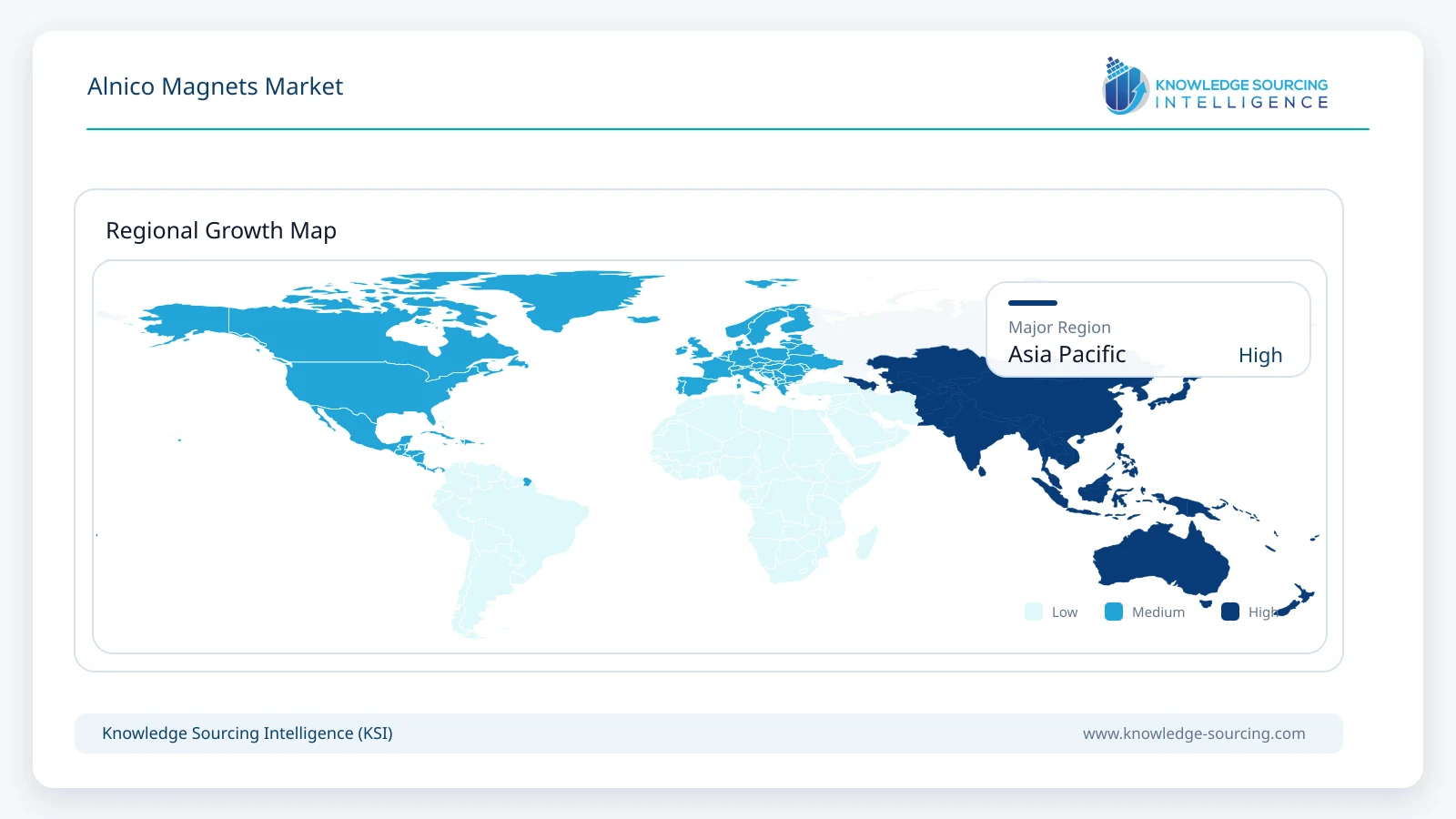
Asia Pacific remains a prominent Alnico magnets market
Asia Pacific is expected to remain an important region for the Alnico magnets market because of its large manufacturing base, extensive electronics and automotive industries, established permanent magnet supply chains, and significant industrial equipment production. China, Japan, South Korea, and India provide important demand and manufacturing ecosystems, while Southeast Asian economies are becoming increasingly relevant to diversified electronics and industrial supply chains.
China remains particularly important to the global magnet industry because of its broad manufacturing ecosystem and established position in permanent magnet production. However, the Alnico market should not be described simply as a China-dominated rare-earth magnet market. Alnico is a non-rare-earth magnet family, and its competitive dynamics are influenced by specialized manufacturers in North America, Europe, and Asia as well as by the availability of nickel, cobalt, aluminum, and iron inputs.
Supply-chain diversification is becoming increasingly important in the broader magnet industry. Arnold Magnetic Technologies stated in its 2026 supply-chain commentary that it manufactures Alnico magnets in the United States without dependence on China for its Alnico production. The company also highlighted the strategic importance of Alnico for high-reliability and high-temperature applications during its 2026 industry conference participation.
India is also strengthening its automotive and industrial manufacturing base. The Ministry of Heavy Industries reported 2025 production of 255.0 lakh two-wheelers, 53.8 lakh passenger vehicles, 12.2 lakh three-wheelers, and 11.1 lakh commercial vehicles. The government's automotive PLI program has additionally attracted substantial investment and employment, strengthening the domestic advanced-automotive manufacturing ecosystem.
Current Indian EV adoption also supports the broader magnetic-component ecosystem. The PM E-DRIVE dashboard showed more than 7.33 lakh registered or temporarily registered electric two-wheelers and more than 2,000 registered or temporarily registered electric three-wheelers in the 2026-27 program data as of August 23, 2026, although these figures represent PM E-DRIVE program records and should not be interpreted as total Indian EV registrations.
Overall, Asia Pacific's combination of vehicle manufacturing, electronics production, industrial automation, renewable-energy deployment, and permanent-magnet supply-chain capabilities is expected to sustain its importance in the Alnico magnets market. At the same time, North America is gaining strategic importance as manufacturers and policymakers focus on resilient domestic magnet supply chains and alternative materials. The U.S. Department of Energy's June 2026 announcement of $72 million for domestic critical-mineral and magnet-manufacturing research further demonstrates the strategic importance of strengthening magnet supply chains.
For market participants, the competitive opportunity is therefore shifting from simple volume-based magnet production toward application-specific engineering. Suppliers capable of providing appropriate Alnico grades, precision geometries, controlled heat treatment, magnetic orientation, custom assemblies, and reliable supply are better positioned to serve aerospace, automotive, instrumentation, industrial, and high-temperature applications.
The Alnico magnets market is consequently expected to develop as a specialized permanent-magnet segment rather than as a direct substitute for high-energy rare-earth magnets across all applications. Growth through 2031 will depend on automotive and industrial production, sensing and instrumentation requirements, renewable-energy infrastructure, high-temperature equipment, scientific and electronic applications, and the strategic value of non-rare-earth magnet technologies. The combination of established Alnico manufacturing expertise and renewed attention to resilient magnet supply chains provides a favorable foundation for market expansion over the forecast period.
Alnico Magnets Market Key Developments:
April 2026: Arnold Magnetic Technologies participated in the North American Rare Earths Conference, where its April 17 presentation highlighted Alnico magnets as strategically important for reliable, high-temperature applications.
March 2026: Adams Magnetic Products appointed Marc McClure as Marketing Manager, strengthening marketing and technical-content capabilities supporting its industrial OEM and engineered magnetic-solutions portfolio, including Alnico products.
January 2026: Arnold Magnetic Technologies continued Alnico magnet production at its Woodstock, Illinois facility, supporting U.S.-based supply and reducing dependence on Chinese sources amid global permanent-magnet supply-chain concerns.
Alnico Magnets Market Scope:
| Report Metric | Details |
|---|---|
| Total Market Size in 2026 | USD 1.73 billion |
| Total Market Size in 2031 | USD 2.58 billion |
| Forecast Unit | Billion |
| Growth Rate | 8.3% |
| Study Period | 2021 to 2031 |
| Historical Data | 2021 to 2024 |
| Base Year | 2025 |
| Forecast Period | 2026 – 2031 |
| Segmentation | Manufacturing Process, Grade, Application, End-User, Geography |
| Companies |
|
Market Segmentation
By Manufacturing Process
By Grade
By Application
By End-user
By Geography
Table of Contents
1. EXECUTIVE SUMMARY
2. MARKET SNAPSHOT
2.1. Market Overview
2.2. Market Definition
2.3. Scope of the Study
2.4. Market Segmentation
3. BUSINESS LANDSCAPE
3.1. Market Drivers
3.2. Market Restraints
3.3. Market Opportunities
3.4. Porter’s Five Forces Analysis
3.5. Industry Value Chain Analysis
3.6. Supply Chain Analysis
3.7. Policies and Regulations
3.8. Strategic Recommendations
4. TECHNOLOGICAL OUTLOOK
4.1. Alnico Alloy Composition and Grades
4.2. Cast Alnico Technology
4.3. Sintered Alnico Technology
4.4. Heat Treatment and Magnetic Orientation
4.5. Isotropic and Anisotropic Alnico
4.6. Magnetization and Finishing Technologies
5. ALNICO MAGNETS MARKET BY MANUFACTURING PROCESS
5.1. Introduction
5.2. Sintering
5.3. Casting
6. ALNICO MAGNETS MARKET BY GRADE
6.1. Introduction
6.2. Alnico 2
6.3. Alnico 3
6.4. Alnico 4
6.5. Alnico 5
6.6. Alnico 6
6.7. Alnico 8
6.8. Alnico 9
6.9. Others
7. ALNICO MAGNETS MARKET BY APPLICATION
7.1. Introduction
7.2. Electric Motors and Generators
7.3. Sensors and Instrumentation
7.4. Relays and Controls
7.5. Speakers, Microphones, and Guitar Pickups
7.6. Magnetos and Ignition Systems
7.7. Medical Instruments
7.8. Magnetic Separators and Holding Devices
7.9. Electronic and Security Devices
7.10. Others
8. ALNICO MAGNETS MARKET BY END-USER
8.1. Introduction
8.2. Automotive
8.3. Aerospace and Defense
8.4. Medical and Healthcare
8.5. Electrical and Electronics
8.6. Industrial Manufacturing
8.7. Energy and Power
8.8. Consumer Goods
8.9. Others
9. ALNICO MAGNETS MARKET BY GEOGRAPHY
9.1. Introduction
9.2. North America
9.2.1. United States
9.2.2. Canada
9.2.3. Mexico
9.3. South America
9.3.1. Brazil
9.3.2. Argentina
9.3.3. Others
9.4. Europe
9.4.1. Germany
9.4.2. France
9.4.3. United Kingdom
9.4.4. Spain
9.4.5. Italy
9.4.6. Others
9.5. Middle East and Africa
9.5.1. Saudi Arabia
9.5.2. United Arab Emirates
9.5.3. Israel
9.5.4. Others
9.6. Asia Pacific
9.6.1. China
9.6.2. India
9.6.3. Japan
9.6.4. South Korea
9.6.5. Indonesia
9.6.6. Thailand
9.6.7. Others
10. COMPETITIVE ENVIRONMENT AND ANALYSIS
10.1. Major Players and Strategy Analysis
10.2. Market Share Analysis
10.3. Mergers, Acquisitions, Agreements, and Collaborations
10.4. Competitive Dashboard
10.5. Product and Manufacturing Capability Analysis
11. COMPANY PROFILES
11.1. QIANGSHENG MAGNETS CO., LTD
11.2. Master Magnetics, Inc.
11.3. Adams Magnetic Products Co.
11.4. Arnold Magnetic Technologies
11.5. Ningbo Newland Magnet Industry Co., Ltd.
11.6. Dexter Magnetic Technologies, Inc.
11.7. Xiamen Kings Magnet Co., Ltd.
11.8. Stanford Magnets
11.9. Eneflux-Armtek Magnetics (EAM)
11.10. Permanent Magnetics Ltd. (Taparia Group)
12. APPENDIX
12.1. Currency
12.2. Assumptions
12.3. Base Year and Forecast Period
12.4. Key Takeaways for Stakeholders
12.5. Research Methodology
12.6. Abbreviations
LIST OF FIGURES
LIST OF TABLES
Navigate
Trusted by the world's leading organizations











