
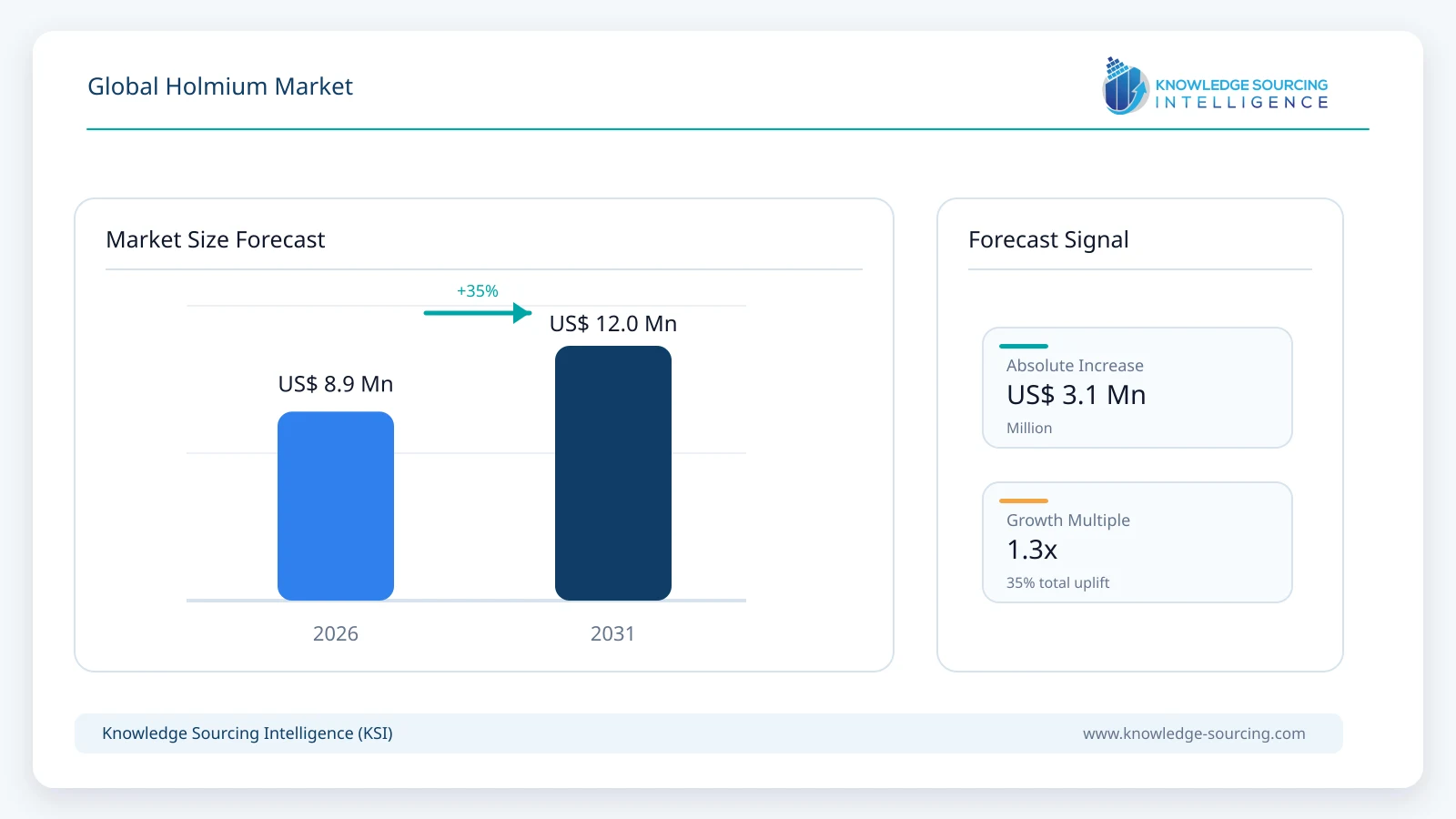
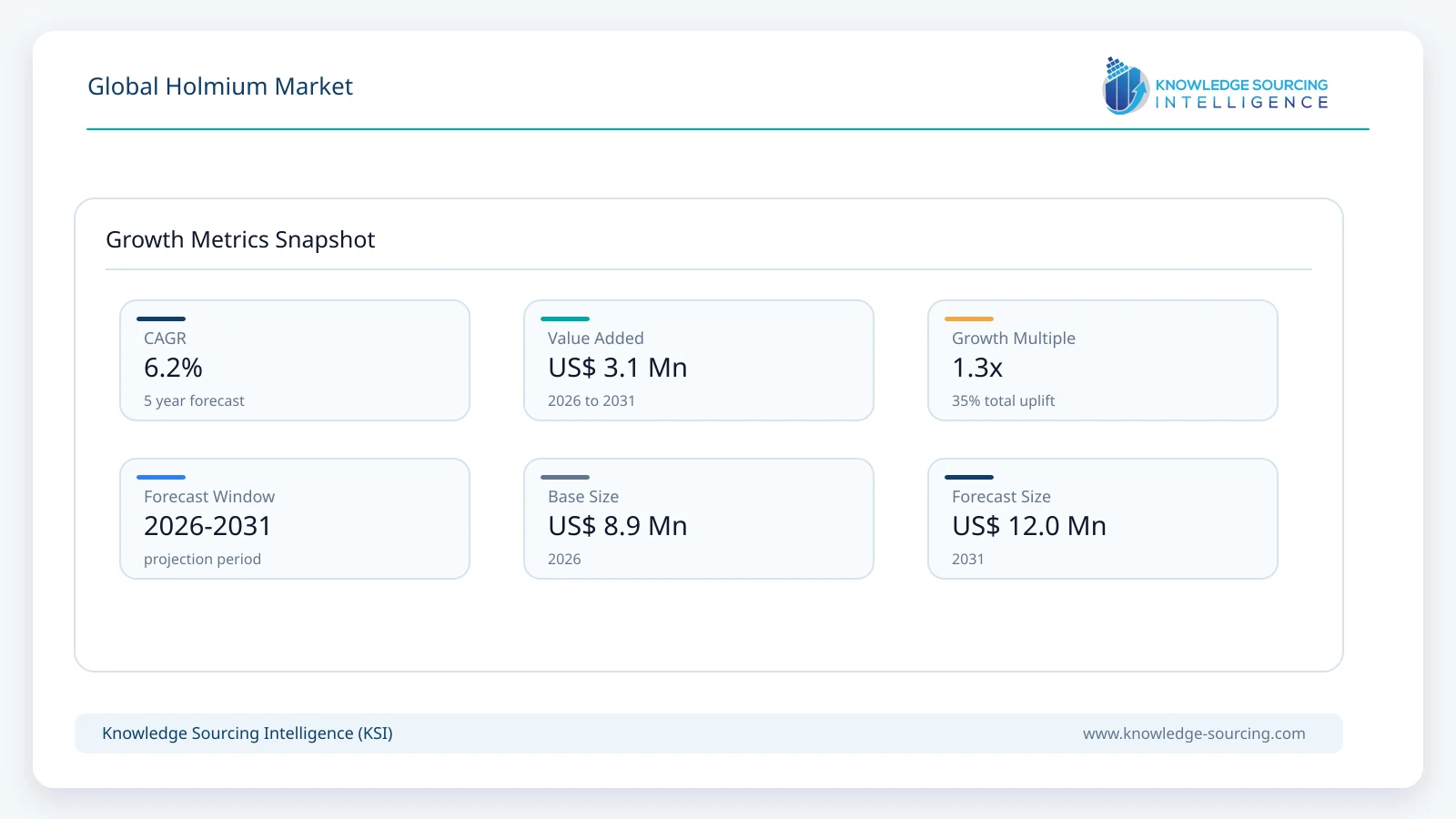
The global Holmium Market is set to expand at a CAGR of 6.16%, growing from USD 8.9 million in 2026 to USD 12.0 million by 2031.
Highlights:
- 1Holmium oxide accounts for approximately 58% of global holmium market value in 2026 and remains the primary commercial form used across laser, optical and specialty material applications.
- 2Solid-state lasers account for approximately 38% of market value in 2026, supported by established medical and specialist photonics applications.
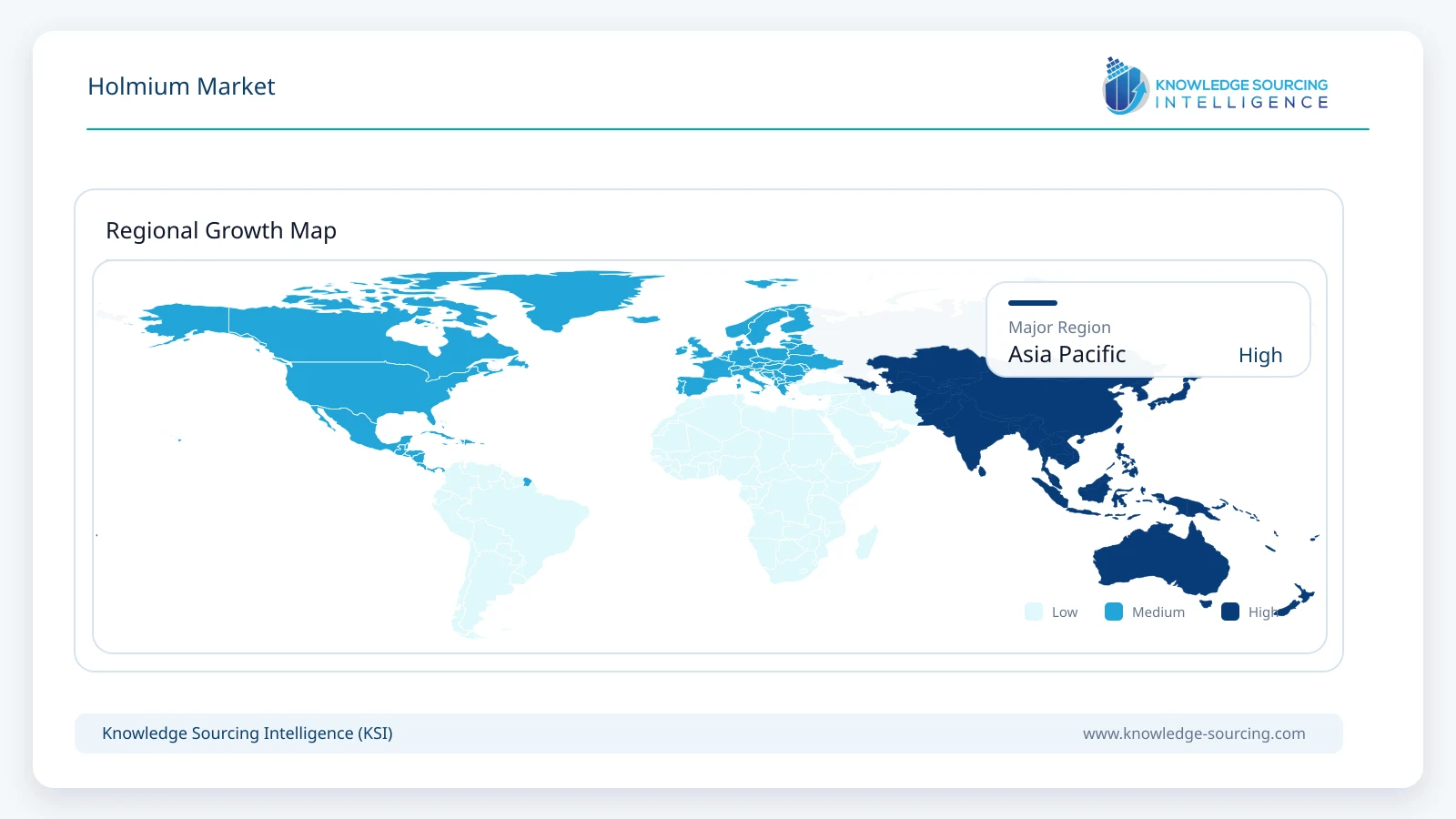
- 3Asia Pacific represents approximately 52% of global holmium market value in 2026 due to its concentration of rare-earth processing and downstream manufacturing.
- 4Holmium metal is projected to grow at approximately 7.2% annually through 2031 as specialty magnetic, scientific and advanced-material applications expand.
Holmium is a heavy rare-earth element used in specialized applications where its magnetic, optical and spectroscopic characteristics provide specific performance advantages. It is commercially available primarily as holmium oxide, metal and specialty compounds, with oxide remaining the most widely used form because it provides a stable feedstock for laser materials, optical products, ceramics and further chemical conversion.
Demand continues to be supported by solid-state laser applications in medical procedures and specialist photonics. Holmium compounds are also used in optical spectrophotometer calibration, specialty glass and ceramics, magnetic materials and scientific applications. The U.S. Geological Survey identifies holmium among the heavy rare earths used in industrial and medical lasers, high-strength magnets, fiber optics and scientific equipment. The average U.S. price of minimum 99.5% purity holmium oxide was approximately USD 70 per kilogram in 2025, illustrating the comparatively high value associated with purified heavy rare-earth products.
Material purity is particularly important in these applications. Thermo Fisher Scientific supplies holmium oxide at purities reaching 99.995% rare-earth-oxide basis, while commercial suppliers also offer high-purity halides, acetates, nitrates and analytical standards. The market therefore depends less on large-volume consumption than on the ability of suppliers to provide repeatable composition, trace-element control and application-specific materials.
Market Trends
Heavy Rare-Earth Supply Is Gradually Diversifying
The heavy rare-earth supply chain remains concentrated, but new processing investment is creating additional sources outside China. This is particularly relevant to holmium because it is generally recovered alongside other rare-earth elements rather than produced through dedicated holmium mining operations. The economics and technical capability of broader rare-earth separation facilities therefore determine how much holmium reaches the market in commercially usable form.
Lynas Rare Earths expanded its heavy rare-earth product range to include holmium concentrate alongside separated dysprosium and terbium and other mixed heavy rare-earth streams. The company processes material from its Mt Weld resource through facilities in Australia and Malaysia, providing an alternative supply chain outside China.
Heavy rare-earth processing investment is also increasing in the United States. Energy Fuels began construction of additional commercial-scale heavy rare-earth processing capacity at its White Mesa Mill in Utah in July 2026. The initial commercial focus is on higher-demand heavy rare earths such as dysprosium and terbium, but expansion of mixed heavy rare-earth processing increases the potential for recovery of smaller-volume elements within the same feed streams.
High-Purity Products Are Becoming More Important
Holmium demand is increasingly differentiated by purity rather than simply by elemental content. Optical, photonic and analytical applications require controlled levels of other rare-earth impurities, making high-purity products substantially more valuable than material destined for less demanding uses.
Thermo Fisher’s current product range includes holmium oxide grades reaching 99.995% purity as well as bromide, nitrate, acetate and other holmium compounds. Its REacton rare-earth range is supplied with lot-specific certification and low impurity levels for research and advanced industrial applications.
Analytical applications create another specialized niche. Holmium compounds provide well-defined absorption characteristics and are used for wavelength calibration of spectrophotometric equipment. This use requires consistency and traceability rather than large physical quantities, reinforcing the market’s orientation toward premium specialty products.
Supply Security Is Receiving Greater Attention
Holmium became more visible within critical-mineral policy during 2025 when China announced export controls covering several medium and heavy rare-earth elements, including holmium. The additional controls were subsequently suspended until November 10, 2026.
The temporary measures highlighted the dependence of downstream users on a concentrated processing system. Even small-volume materials can become strategically important when alternative qualified suppliers are limited. Buyers in medical, defense, optical and scientific applications may therefore place greater emphasis on traceable supply, geographic diversification and material qualification.
The result is likely to be gradual rather than a sudden increase in holmium consumption. New processing projects are primarily justified by larger rare-earth markets, but holmium benefits indirectly when those investments create the separation capability needed to commercialize additional heavy rare-earth streams.
Market Drivers
Continued Use of Holmium in Medical Laser Systems
Medical lasers remain one of the most commercially important uses of holmium. Holmium laser systems are used in surgical applications including stone fragmentation and soft-tissue procedures because their wavelength interacts strongly with water-containing tissue and can deliver controlled energy through optical fibers.
Current regulatory activity indicates that the technology remains commercially active. In March 2026, the U.S. FDA determined Guangzhou Potent Medical Equipment’s Holmium Laser Therapeutic Apparatus to be substantially equivalent through the 510(k) pathway. The system is intended for surgical applications that include incision, ablation, coagulation and stone fragmentation across several medical specialties.
An additional holmium laser system from the same manufacturer received a U.S. decision earlier in 2026, further demonstrating continued product development around the technology. The amount of holmium incorporated into each system is limited, but laser-grade applications require high-quality materials and provide a recurring demand base across medical-device manufacturing and replacement equipment.
Expansion of Heavy Rare-Earth Processing Capacity
Holmium availability is tied closely to investment in the broader heavy rare-earth industry. Commercial processors generally recover multiple rare-earth elements from common mineral feedstocks and progressively separate them into individual oxides or concentrates.
USGS reported that several companies were developing commercial-scale heavy rare-earth processing and refining capability in the United States during 2025, although sustained large-scale production had not yet been established. New capacity can therefore affect the holmium market even when the initial investment case is based on other rare-earth elements.
Lynas already includes holmium concentrate within its expanded heavy rare-earth product range, while Energy Fuels is building additional separation capacity in the United States. These developments improve the possibility of qualifying alternative sources for customers that currently depend heavily on established Asian suppliers.
Specialty Optical, Magnetic and Scientific Applications
Holmium also maintains demand across several smaller technical applications. Its compounds are used in specialty glasses, photonic materials and calibration standards, while the element’s magnetic properties support selected advanced magnetic and research applications.
These markets are individually small, but together they provide useful diversification away from a single end use. Optical calibration is particularly stable because holmium’s characteristic absorption spectrum provides a repeatable reference for checking spectrophotometer wavelength accuracy. Specialty suppliers continue to offer holmium standards and compounds for laboratory and instrumentation markets.
The element is also used in scientific and advanced-material research where specific magnetic or optical behaviour is required. These applications typically consume small amounts but support premium pricing because material specification is more important than bulk tonnage.
Market Restraints
Supply Remains Dependent on Broader Rare-Earth Economics
Holmium is not generally mined as a standalone commercial product. It is recovered from minerals containing multiple rare-earth elements and becomes available only after several stages of separation. Producers therefore make investment decisions based primarily on the economics of the entire rare-earth stream rather than demand for holmium alone.
USGS indicates that commercial-scale heavy rare-earth production outside established processing centres remains limited despite increasing development activity. This creates a structural constraint for a small market because customers cannot necessarily stimulate new supply simply by accepting a higher price for holmium.
Price volatility can also complicate procurement. Changes in rare-earth mining activity, processing capacity and trade policy can affect availability even when underlying holmium demand itself changes only modestly. Buyers requiring high-purity material therefore place significant importance on supplier qualification and inventory planning.
Alternative Technologies Limit Expansion in Some Applications
Holmium retains strong technical positions in several applications, but it faces substitution where alternative technologies can provide comparable performance. Medical laser markets increasingly include thulium-based technologies alongside established holmium systems, while optical and magnetic applications may use other rare-earth elements where their performance characteristics are suitable.
This does not eliminate demand for holmium because certain applications depend on its specific spectral and magnetic properties. It does, however, limit broad penetration into applications where less expensive or more readily available materials can provide an adequate result.
The market consequently remains focused on technically differentiated uses rather than expanding into large-volume commodity applications.
Segment Analysis
By Form: Holmium Oxide
Holmium oxide remains the principal commercial form and is projected to reach approximately USD 6.8 million by 2031. Its position reflects its chemical stability and versatility as a starting material for high-purity compounds, laser materials, ceramics, specialty glass and optical applications.
Commercial availability also supports the segment. High-purity oxide is supplied by major laboratory and specialty-material companies in multiple grades, allowing users to select purity according to application requirements. Thermo Fisher’s holmium oxide specifications demonstrate the degree of control available for applications requiring tightly restricted contamination by other rare-earth elements.
Metal and halide forms remain important for narrower applications, but oxide continues to offer the broadest downstream usability. Its ability to function both as an end-use material and as a precursor for further chemical processing supports its leading position through 2031.
By Application: Solid-State Lasers
Solid-state laser applications are projected to reach approximately USD 4.9 million by 2031. Medical laser systems remain the largest commercial use within the segment, particularly in urological procedures and other surgical applications where holmium laser technology already has an established installed base.
Current FDA clearances demonstrate continued development of new holmium laser systems rather than a market dependent entirely on legacy equipment. Holmium compounds also retain specialist roles in photonic and research laser materials where wavelength characteristics determine material selection.
Magnets, nuclear applications and glass and ceramic uses provide additional demand, but laser systems remain particularly important because they combine mature medical applications with continuing equipment development and high material-purity requirements.
Regional Outlook
Asia Pacific
Asia Pacific remains the largest regional market and is projected to reach approximately USD 6.5 million by 2031. The region’s position reflects the concentration of rare-earth separation capacity as well as significant medical-device, electronics, optical-material and specialty-chemical manufacturing.
China remains particularly important to the upstream supply chain. Its 2025 decision to introduce additional controls covering holmium demonstrated the country’s role in medium and heavy rare-earth processing, even though implementation of those additional measures was subsequently suspended.
Australia and Malaysia are also becoming more relevant through Lynas Rare Earths. The company has expanded its heavy rare-earth product portfolio to include holmium concentrate and provides an integrated alternative supply route from Australian feedstock through downstream processing.
Asia Pacific consequently combines upstream material availability with a substantial downstream manufacturing base, supporting its leading market position through the forecast period.
Competitive Environment and Analysis
The holmium market includes integrated rare-earth processors, high-purity materials companies, laboratory chemical suppliers and specialist analytical-material providers. Competitive positioning differs substantially from large-volume rare-earth markets because relatively small quantities of holmium are consumed and customer requirements frequently centre on purity, documentation and reliable delivery.
Lynas Rare Earths has strengthened its position within heavy rare earths by expanding its product portfolio to include holmium concentrate. Energy Fuels is building additional heavy rare-earth separation capacity in the United States, creating another potential source within a more geographically diversified processing chain.
Specialty suppliers including Thermo Fisher Scientific, American Elements, Stanford Advanced Materials, HEFA Rare Earth Canada and other materials companies compete through oxide purity, metal quality and availability of different compounds and particle forms. Analytical-material suppliers such as Inorganic Ventures address an even more specialized market where certification and traceability are central purchasing requirements.
Competition through 2031 is therefore expected to revolve around reliable access to feedstock, high-purity separation capability, product consistency and supply-chain traceability. Companies able to qualify with customers in medical, optical and scientific applications can maintain durable positions because changing material suppliers may require additional testing and validation.
Recent Developments
July 2026: Energy Fuels began construction of a commercial-scale heavy rare-earth processing expansion at its White Mesa Mill in Utah, increasing non-Chinese separation capacity for heavy rare-earth materials.
March 2026: The U.S. FDA cleared Guangzhou Potent Medical Equipment’s Holmium Laser Therapeutic Apparatus through the 510(k) process for surgical applications including stone fragmentation and soft-tissue procedures.
January 2026: Another Holmium Laser Therapeutic Apparatus from Guangzhou Potent Medical Equipment received a U.S. substantial-equivalence determination, expanding the manufacturer’s approved holmium laser portfolio.
November 2025: China suspended several rare-earth export-control measures announced in October, including the additional measure covering holmium, with the suspension scheduled through November 2026.
October 2025: China announced additional export-control requirements covering five medium and heavy rare-earth elements, including holmium, bringing greater attention to supply-chain concentration.
Market Outlook
The global holmium market is forecast to increase from USD 8.9 million in 2026 to USD 12.0 million in 2031 at a CAGR of 6.16%. Growth remains centered on specialized applications rather than a large increase in commodity consumption, with purity, consistency and supply reliability continuing to influence commercial value.
Holmium oxide remains the principal commercial form through 2031 because of its versatility across lasers, optical products, ceramics and downstream compound production. Medical and specialist solid-state lasers continue to represent the largest application, supported by an established technology base and ongoing introduction of new systems.
Asia Pacific remains central to the market because it combines rare-earth separation capability with downstream manufacturing. Investment in additional processing capacity in Australia, Malaysia and the United States gradually increases supply-chain diversity, although the commercial economics of holmium continue to depend on the wider heavy rare-earth industry.
The market remains relatively small in absolute value, but the technical importance of holmium in selected applications supports continued demand for high-purity materials. Suppliers able to combine reliable sourcing with consistent specifications and application-level technical support are positioned most strongly as customers place greater emphasis on qualified and traceable rare-earth supply chains.
Holmium Market Scope
| Report Metric | Details |
|---|---|
| Total Market Size in 2026 | USD 8.9 million |
| Total Market Size in 2031 | USD 12.0 million |
| Forecast Unit | Million |
| Growth Rate | 6.16% |
| Study Period | 2021 to 2031 |
| Historical Data | 2021 to 2024 |
| Base Year | 2025 |
| Forecast Period | 2026 – 2031 |
| Segmentation | Form, Application, Geography |
| Companies |
|
Market Segmentation
By Form
Oxide
Halides
Metal
Others
By Application
Magnets
Nuclear Reactors
Solid-State Lasers
Glass and Ceramics
By Geography
North America
United States
Canada
Mexico
South America
Brazil
Argentina
Others
Europe
Germany
United Kingdom
France
Others
Middle East and Africa
Saudi Arabia
UAE
South Africa
Others
Asia Pacific
China
India
Japan
South Korea
Australia
Others
Table of Contents
1. INTRODUCTION
1.1. Market Overview
1.2. Market Definition
1.3. Scope of the Study
1.4. Market Segmentation
1.5. Currency
1.6. Assumptions
1.7. Base and Forecast Years
1.8. Key Benefits to Stakeholders
2. RESEARCH METHODOLOGY
2.1. Research Design
2.2. Secondary Research
2.3. Market Estimation
2.4. Segment Modelling
2.5. Data Triangulation and Validation
3. EXECUTIVE SUMMARY
3.1. Key Findings
3.2. Holmium Market Size, 2026-2031
3.3. Form Outlook
3.4. Application Outlook
3.5. Regional Opportunity Summary
4. MARKET DYNAMICS
4.1. Market Drivers
4.1.1. Continued Use of Holmium in Medical Laser Systems
4.1.2. Expansion of Heavy Rare-Earth Processing Capacity
4.1.3. Specialty Optical, Magnetic and Scientific Applications
4.2. Market Restraints
4.2.1. Dependence on Broader Rare-Earth Supply Economics
4.2.2. Competition from Alternative Technologies
4.3. Porter’s Five Forces Analysis
4.4. Industry Value Chain Analysis
4.5. Rare-Earth Trade and Supply Environment
5. TECHNOLOGICAL OUTLOOK
5.1. High-Purity Holmium Oxide
5.2. Holmium-Doped Laser Materials
5.3. Optical Calibration Standards
5.4. Specialty Magnetic Applications
5.5. Heavy Rare-Earth Separation Technologies
6. HOLMIUM MARKET BY FORM
6.1. Oxide
6.2. Halides
6.3. Metal
6.4. Others
7. HOLMIUM MARKET BY APPLICATION
7.1. Magnets
7.2. Nuclear Reactors
7.3. Solid-State Lasers
7.4. Glass and Ceramics
8. HOLMIUM MARKET BY GEOGRAPHY
8.1. North America
8.1.1. United States
8.1.2. Canada
8.1.3. Mexico
8.2. South America
8.2.1. Brazil
8.2.2. Argentina
8.2.3. Others
8.3. Europe
8.3.1. Germany
8.3.2. United Kingdom
8.3.3. France
8.3.4. Others
8.4. Middle East and Africa
8.4.1. Saudi Arabia
8.4.2. UAE
8.4.3. South Africa
8.4.4. Others
8.5. Asia Pacific
8.5.1. China
8.5.2. India
8.5.3. Japan
8.5.4. South Korea
8.5.5. Australia
8.5.6. Others
9. COMPETITIVE ENVIRONMENT AND ANALYSIS
9.1. Major Players and Strategy Analysis
9.2. Market Share Analysis
9.3. Mergers, Acquisitions, Agreements, and Collaborations
9.4. Competitive Dashboard
10. COMPANY PROFILES
10.1. Lynas Rare Earths Ltd.
10.2. Energy Fuels Inc.
10.3. Thermo Fisher Scientific Inc.
10.4. American Elements
10.5. Stanford Advanced Materials
10.6. HEFA Rare Earth Canada Co., Ltd.
10.7. METALL RARE EARTH LIMITED
10.8. Inorganic Ventures
10.9. Goodfellow
10.10. Canada Rare Earth Corporation
10.11. ProChem, Inc.
10.12. Noah Chemicals
10.13. Ereztech LLC
10.14. MSE Supplies LLC
10.15. Merck KGaA / Sigma-Aldrich
11. APPENDIX
Navigate
Trusted by the world's leading organizations











