
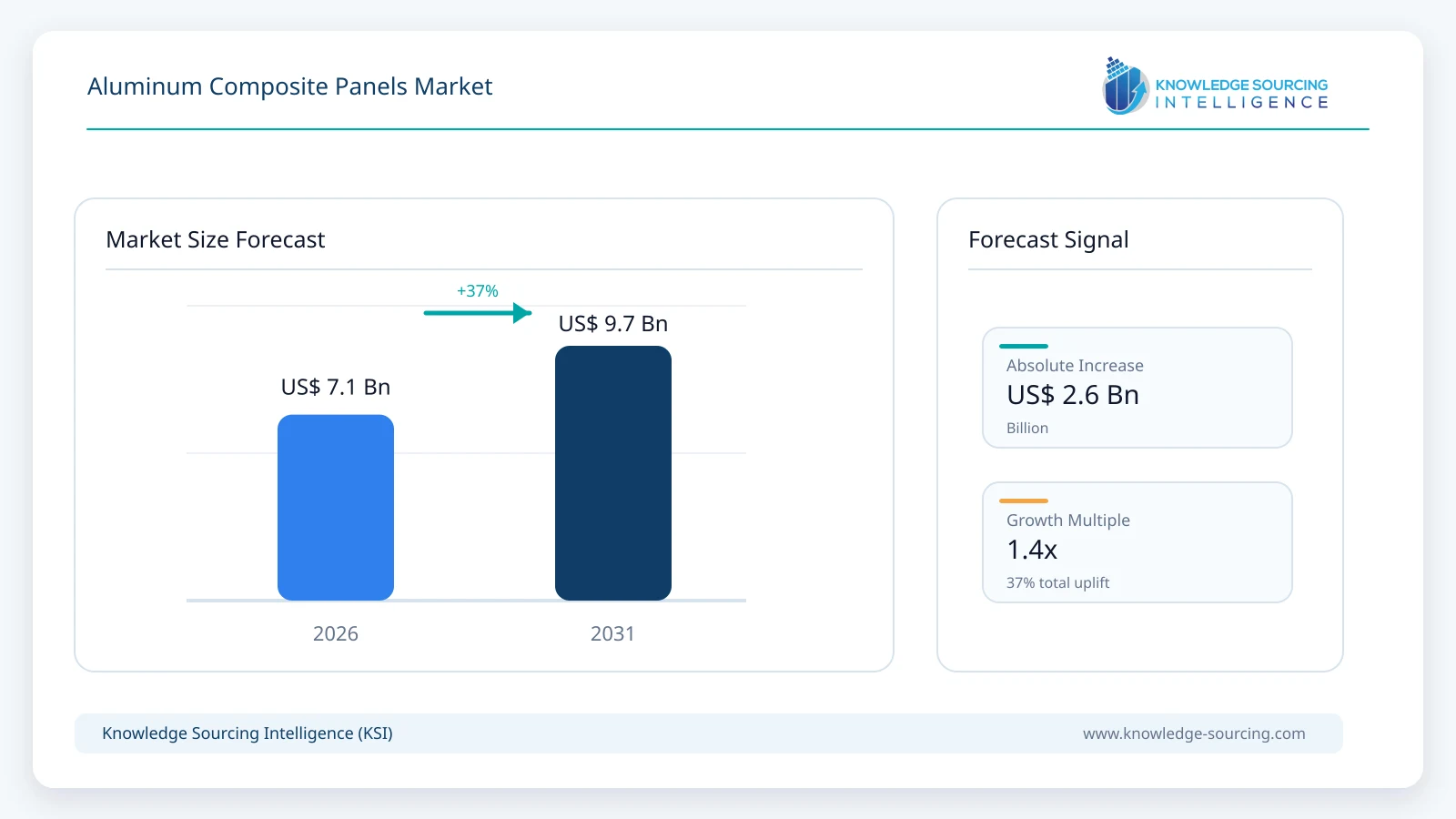
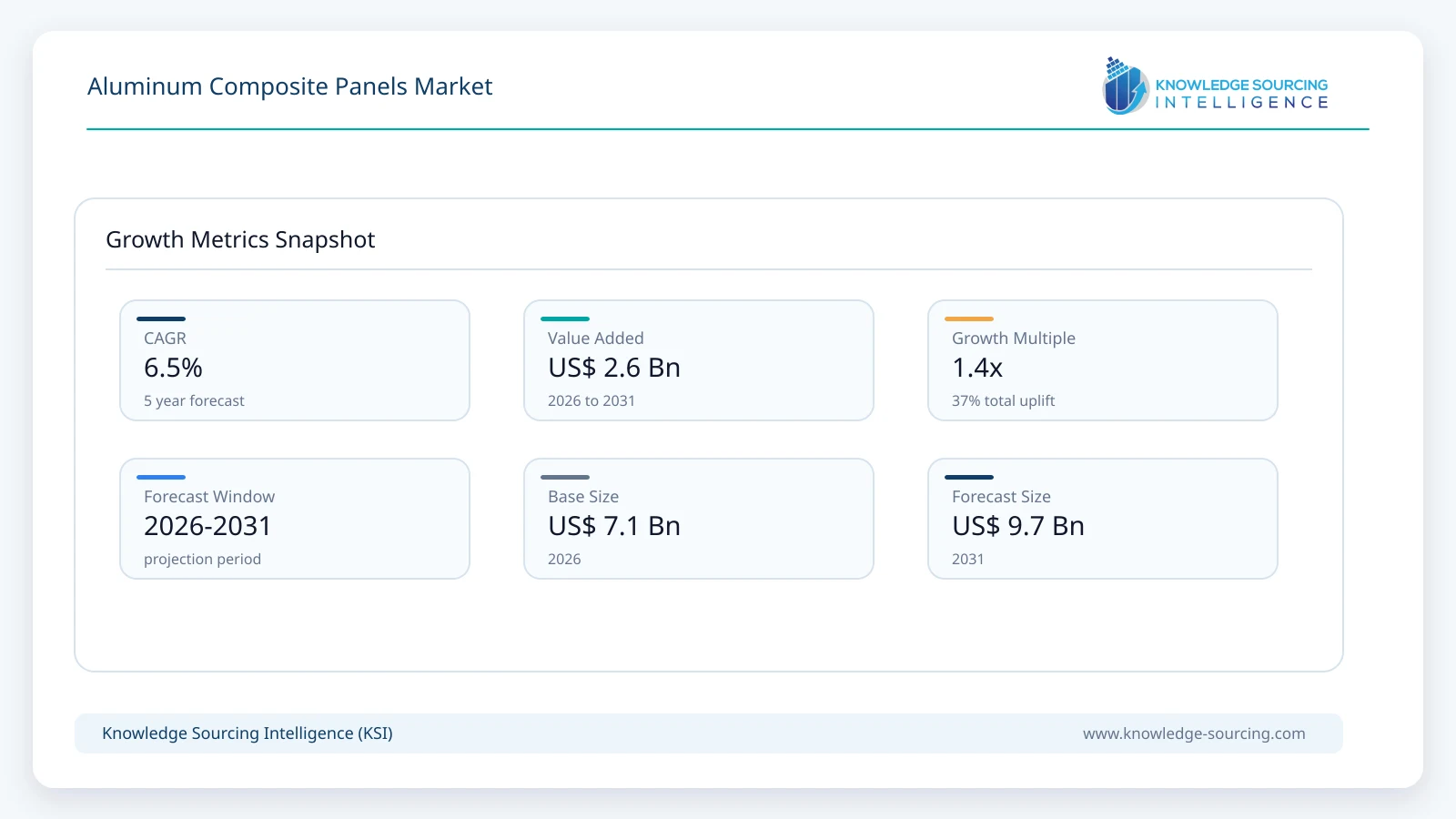
The Aluminum Composite Panels Market is forecast to grow at a CAGR of 6.5%, reaching USD 9.74 billion in 2030 from USD 7.11 billion in 2025.
Highlights:
- 1Regulatory CompulsionStringent fire safety mandates in Europe and India are forcing manufacturers to discontinue standard PE-core production, shifting 100% of high-rise demand toward FR-rated and A2-grade non-combustible panels.
- 2Aesthetic EvolutionArchitects are increasingly demanding low-gloss and organic finishes, which is driving the launch of matte-series panels that mimic natural stone and clay without the weight penalties of heavy masonry.
- 3Coating LongevityThe rising frequency of extreme weather events is accelerating the adoption of PVDF (Polyvinylidene Fluoride) coatings, as these systems provide up to 20 years of UV resistance compared to the 5-8 year lifespan of polyester alternatives.
- 4Transit LightweightingThe transportation sector is integrating aluminum composite skins into electric buses and high-speed rail to offset battery and hydrogen tank weights, thereby extending vehicle range and structural efficiency.
Demand drivers for aluminum composite panels (ACP) center on the escalating requirement for lightweight, high-performance building envelopes in rapid urbanization zones. The market exhibits a heavy dependency on the construction sector’s adoption of ventilated facade systems, which utilize the panels to improve thermal insulation and moisture management. Regulatory influence acts as a primary market shaper, with immediate enforcement of quality control orders such as India’s S.O. 1319(E) dated March 2026, mandating IS 17682:2021 certification for all architectural ACP. This strategic importance is further amplified by the panels' role in sustainable building; the high recyclability of aluminum components assists developers in achieving LEED and BREEAM certifications.
Market Dynamics
Drivers
Urban Infrastructure Expansion: Rapid commercial development in emerging economies increases the demand for quick-install cladding solutions that offer consistent aesthetic quality across large-scale projects.
Fire Safety Compliance: New building codes, such as the mandatory ISI marking in India effective as of 2026, ensure that only verified fire-retardant panels enter the supply chain, bolstering buyer confidence in composite materials.
Sustainable Renovation Waves: Government-led initiatives like the EU Green Deal are funding the over-cladding of older buildings, where lightweight ACP provides an energy-efficient thermal envelope without requiring structural reinforcement.
Digital Signage Proliferation: The growth of Out-of-Home (OOH) advertising is driving the demand for specialized, digitally-printable ACP that supports high-resolution graphics and long-term outdoor exposure.
Restraints and Opportunities
Raw Material Volatility: Fluctuations in global aluminum prices create pricing pressure for manufacturers, often resulting in narrow margins for standard-grade panel products.
Installation Skill Gaps: The complexity of installing high-performance rainscreen systems creates a bottleneck, as improper sealing or mounting can lead to moisture ingress and reduced panel longevity.
Opportunity: Anti-Bacterial Coatings: Rising hygiene awareness in healthcare construction is opening a niche for silver-ion-embedded ACP surfaces that actively inhibit microbial growth on interior wall partitions.
Opportunity: Photovoltaic Integration: The development of Building Integrated Photovoltaics (BIPV) offers a path for ACP to evolve from passive cladding into active energy-generating components of the building skin.
Supply Chain Analysis
The supply chain for aluminum composite panels is transitioning toward a more vertically integrated model to mitigate the risks associated with raw material price swings. Primary aluminum smelters provide the foundational coils, which manufacturers then treat with specialized coatings like PVDF (Kynar 500) or FEVE before the lamination process. Demand is currently shifting toward local fabrication hubs, as the bulkiness of completed panels makes long-distance shipping cost-prohibitive. Consequently, major players like 3A Composites and Mitsubishi Chemical are expanding their regional finishing lines to provide just-in-time delivery to project sites. These manufacturers are also implementing closed-loop recycling programs, where off-cuts from the fabrication process are returned to the smelter. The final stage of the chain involves specialized installers who must verify project-level compliance with fire safety standards such as NFPA 285 or EN 13501-1. Any disruption in the supply of high-grade mineral cores poses a significant constraint, as standard polyethylene cores no longer meet the compliance requirements for most commercial tenders.
Government Regulations
Regulation / Standard | Region | Description |
IS 17682:2021 / S.O. 1319(E) | India | Mandates immediate BIS certification and ISI marking for all ACP used in building facades and signage (Effective March 2026). |
EN 13501-1 | Europe | Classifies fire performance of construction products; driving the shift toward A2 (non-combustible) and B (limited combustibility) cores. |
NFPA 285 | USA | Standard fire test method for evaluation of fire propagation characteristics of exterior wall assemblies containing combustible components. |
AAMA 2605 | Global | High-performance specification for architectural coatings; sets the benchmark for PVDF and FEVE weatherability and color retention. |
Key Developments
April 14, 2026: 3A Composites Americas launched the ALUCOBOND® PLUS Matte Series, introducing seven organic finishes (including Ecru and Eclipse) to meet architectural demand for reduced gloss and sophisticated, stone-like aesthetics in building envelopes.
March 2026: The Indian Department for Promotion of Industry and Internal Trade (DPIIT) enforced the Aluminum and Aluminum Alloy Products (Quality Control) Order, 2026, making it illegal to manufacture or import non-BIS-certified aluminum composite panels.
December 2025: Hoover Treated Wood Products expanded into the aluminum composite material market by acquiring Arconic Architectural Products. This move launched Hoover Architectural Solutions, integrating Reynobond panels into their portfolio.
January 2025: Viva launched Solid X, featuring India’s first pre-coated, ready-to-install solid aluminum panels. This launch aimed to redefine architectural facades by combining enhanced structural strength with sustainable, versatile design.
Market Segmentation
By Core Type
The mechanical performance and safety profile of an aluminum composite panel depend fundamentally on its core composition. Standard Polyethylene (PE) cores represent the traditional market baseline, yet their high combustibility is leading to a rapid contraction in their use for exterior applications. Regulatory bodies are continuously tightening the restrictions on PE cores, particularly for buildings exceeding specific height thresholds. Consequently, demand is shifting toward Fire Resistant (FR) cores, which utilize mineral-filled thermoplastic resins to inhibit flame spread. These FR-rated panels are becoming the mandatory specification for mid-rise commercial developments where safety and insurance compliance are paramount. Furthermore, the market is witnessing a surge in the adoption of Aluminum cores (including honeycomb and corrugated structures), which offer true non-combustibility (Class A2/A1). This transition is occurring because architects require materials that provide the same lightweight benefits as traditional ACP while meeting the absolute zero-flame-spread requirements of high-density urban zones. The outcome of these pressures is a structural market bifurcation: PE cores are relegated to low-risk signage and interior projects, while mineral and aluminum cores dominate the architectural facade landscape.
By Coating Type
Surface coatings determine the longevity and aesthetic stability of aluminum composite panels under environmental stress. Polyester (PE) coatings serve as a cost-effective solution for interior decoration and short-term signage, where UV exposure is minimal. However, the relatively low chemical resistance of polyester leads to rapid chalking and fading when used in outdoor environments. To counter this, demand is migrating toward PVDF (Polyvinylidene Fluoride) coatings, which utilize a 70% fluoropolymer resin to achieve superior UV stability. Architects are specifying PVDF for high-rise projects because it maintains color integrity for over two decades, even in high-pollution or coastal areas. Simultaneously, FEVE (Fluoroethylene Vinyl Ether) coatings are emerging as a premium alternative that supports a wider range of gloss levels and more vibrant colors than PVDF. This flexibility allows for the creation of landmark buildings with high-gloss, metallic, or intensely colored facades that do not sacrifice durability. The structural outcome is a market where high-performance fluoropolymer coatings (PVDF and FEVE) now constitute the majority of revenue share in the architectural segment, while polyester is used almost exclusively for budget-sensitive, indoor applications.
By End-Use Industry
The Building and Construction sector remains the primary driver of the aluminum composite panels market, utilizing the material for both new builds and complex renovation projects. Large-scale urbanization in Asia and the Middle East is creating a sustained need for facade materials that can be installed rapidly without the heavy labor requirements of traditional brick or stone. However, the market is also finding significant growth in the Transportation industry, where manufacturers are seeking ways to reduce vehicle mass. Commercial bus and rail car producers are increasingly substituting traditional steel panels with aluminum composites for exterior skins and interior partitions. This shift is accelerating because lightweighting is critical for the efficiency of electric and hydrogen-powered transit fleets. In the Advertising sector, the move toward high-resolution digital printing is forcing a change in substrate requirements. Signage providers are demanding ultra-flat, high-stability ACP that can withstand long-term outdoor exposure without warping. As a result, the market is moving away from generic, thin-gauge panels toward specialized, application-specific composites that offer optimized strength for transit or superior surface tension for printing.
Regional Analysis
Asia Pacific
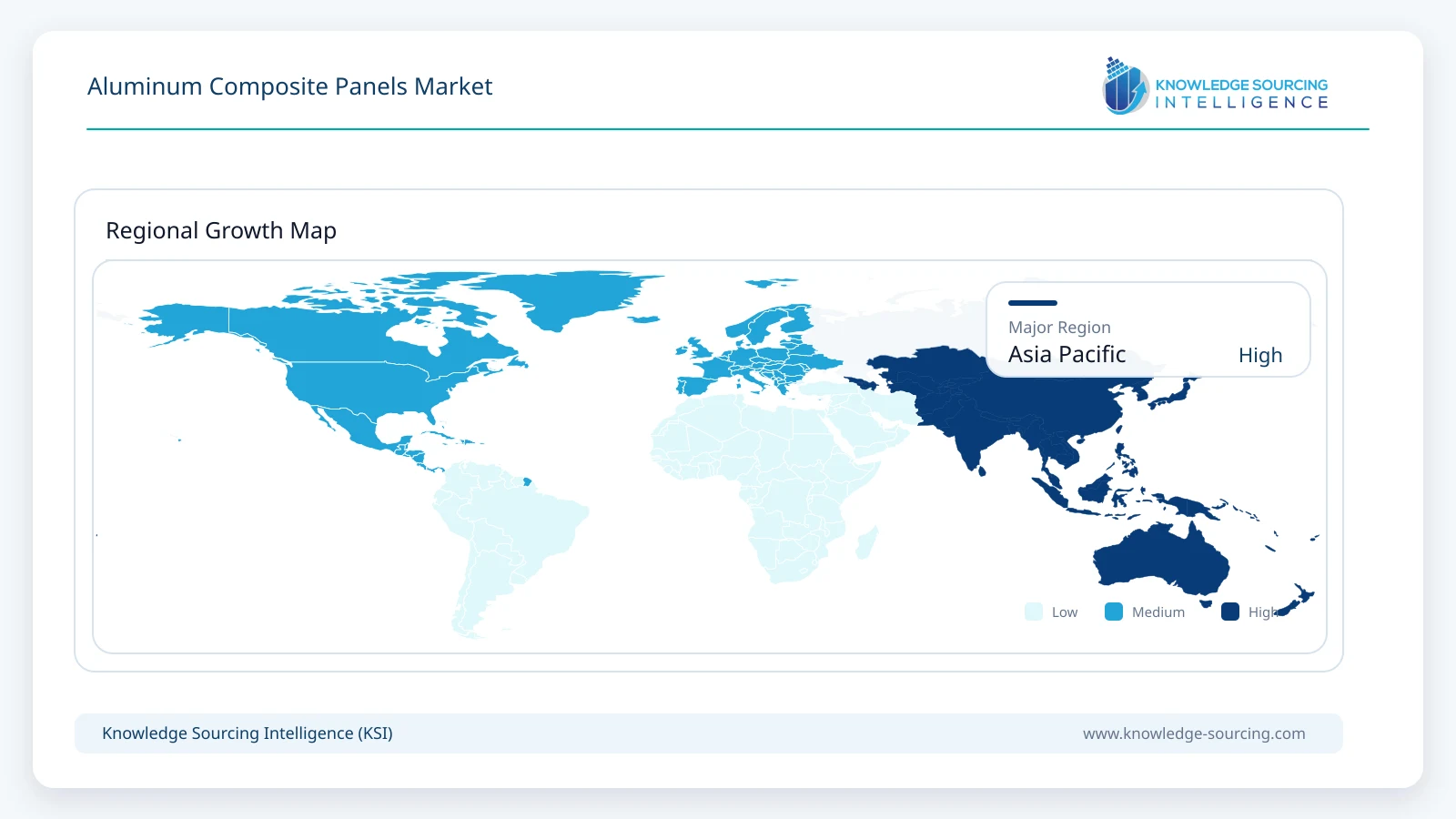
Asia Pacific stands as the most significant region for the aluminum composite panels market, driven by the sheer volume of high-rise construction and industrial expansion in China and India. The region's market structure is currently undergoing a massive regulatory overhaul. In India, the immediate enforcement of BIS certification in March 2026 is forcing hundreds of unorganized manufacturers to either upgrade their testing facilities or exit the market. This move is intended to eliminate substandard, fire-prone panels from the supply chain, thereby protecting large-scale infrastructure investments. China continues to be a dominant production hub, but domestic demand is shifting toward higher-quality FR and A2-rated panels as the government prioritizes urban safety in "megacity" developments. In Southeast Asian markets like Vietnam and Indonesia, the demand for ACP is growing in the retail and commercial sectors, where rapid brand rollouts require consistent, easy-to-install facade solutions. The outcome of these regional shifts is a professionalization of the market, where certified, high-performance panels are replacing cheap, non-rated alternatives.
North America and Europe
In North America, the market is increasingly focused on the premium architectural segment and the renovation of existing commercial stock. The demand in the United States is shifting toward high-end finishes and custom aesthetics, as evidenced by 3A Composites' launch of the Matte Series in 2026. Architects are moving away from the "metallic look" of the early 2000s and are requesting materials that offer the warmth of natural textures with the performance of aluminum. In Europe, the market is heavily influenced by the EU Green Deal, which is driving the "Renovation Wave" across the continent. Public and private buildings are undergoing over-cladding to meet new energy efficiency standards, and lightweight ACP is the preferred material for these retrofits because it does not require significant structural strengthening of old foundations. Tightening fire regulations post-Grenfell continue to exert pressure on the market, with A2 and non-combustible cores now being the default specification for all multi-story residential projects. Consequently, the European market is seeing a phase-out of combustible materials in favor of highly-engineered, safety-certified composite systems.
List of Companies
3A Composites
Jyi Shyang Industrial Co. Ltd
Arconic
Alstrong Enterprises India Pvt. Ltd
Alubond USA
Mitsubishi Chemical
Alumax Industrial Co. Ltd
Yaret Industrial Group
Alucoil SA
Euro Panel Products Pvt. Ltd
Company Profiles
3A Composites
What makes 3A Composites strategically distinct is its pioneering role in the development of the ALUCOBOND® brand and its focus on "design-forward" innovation. The company maintains a strong competitive advantage by aligning its product launches with evolving architectural trends, such as the 2026 Matte Series. 3A Composites utilizes a vertically integrated R&D process to ensure that its panels meet the highest fire safety standards (including IBC and NFPA 285) while offering nearly unlimited custom finish capabilities.
Arconic
Arconic is strategically distinct due to its deep integration into the global aluminum supply chain and its focus on high-performance structural cladding. The company specializes in Reynobond® and Reynolux® products, which are engineered for extreme durability and consistency across global projects. Arconic leverages its metallurgical expertise to produce panels with superior flatness and rigidity, making them a preferred choice for large-scale corporate headquarters and public infrastructure.
Mitsubishi Chemical
Mitsubishi Chemical is strategically distinct for its leadership in high-performance coating technologies and its ALPOLIC® division’s focus on specialty finishes. The company is actively expanding its footprint in the interior decoration market with realistic wood and stone patterns, such as the 2025 Timber Series. Mitsubishi Chemical’s commitment to sustainability is reflected in its advanced recycling initiatives and the production of panels with high recycled aluminum content, catering to the growing demand for green building materials.
Analyst View
The aluminum composite panels market is entering a phase of mandatory professionalization. As global fire safety regulations and environmental standards converge, the survival of manufacturers depends entirely on their ability to supply certified, non-combustible, and highly durable solutions.
Aluminum Composite Panels Market Scope:
| Report Metric | Details |
|---|---|
| Total Market Size in 2026 | USD 7.11 billion |
| Total Market Size in 2031 | USD 9.74 billion |
| Forecast Unit | USD Billion |
| Growth Rate | 6.5% |
| Study Period | 2021 to 2031 |
| Historical Data | 2021 to 2024 |
| Base Year | 2025 |
| Forecast Period | 2026 – 2031 |
| Segmentation | Core Type, Coating Type, End-use Industry, Geography |
| Companies |
|
Market Segmentation
By Core Type
PE (Polyethylene) Core
FR (Fire Resistant) Core
Aluminum Core
By Coating Type
PVDF
FEVE
Other
By End-Use Industry
Building and Construction
Advertising
Transportation
By Geography
North America
USA
Canada
Mexico
South America
Brazil
Argentina
Others
Europe
United Kingdom
Germany
France
Spain
Others
Middle East and Africa
Saudi Arabia
UAE
Others
Asia Pacific
China
Japan
India
South Korea
Taiwan
Others
Table of Contents
1. EXECUTIVE SUMMARY
2. MARKET SNAPSHOT
2.1. Market Overview
2.2. Market Definition
2.3. Scope of the Study
2.4. Market Segmentation
3. BUSINESS LANDSCAPE
3.1. Market Drivers
3.2. Market Restraints
3.3. Market Opportunities
3.4. Porter’s Five Forces Analysis
3.5. Industry Value Chain Analysis
3.6. Policies and Regulations
3.7. Strategic Recommendations
4. TECHNOLOGICAL OUTLOOK
5. ALUMINUM COMPOSITE PANEL MARKET BY CORE TYPE
5.1. Introduction
5.2. PE (Polyethylene) core
5.3. FR (Fire resistant) core
5.4. Aluminum core
6. ALUMINUM COMPOSITE PANEL MARKET BY COATING TYPE
6.1. Introduction
6.2. PVDF
6.3. FEVE
6.4. Other
7. ALUMINUM COMPOSITE PANEL MARKET BY END-USE INDUSTRY
7.1. Introduction
7.2. Building and Construction
7.3. Advertising
7.4. Transportation
8. ALUMINUM COMPOSITE PANEL MARKET BY GEOGRAPHY
8.1. Introduction
8.2. North America
8.2.1. By Core Type
8.2.2. By Coating Type
8.2.3. By End-Use Industry
8.2.4. By Country
8.2.4.1. USA
8.2.4.2. Canada
8.2.4.3. Mexico
8.3. South America
8.3.1. By Core Type
8.3.2. By Coating Type
8.3.3. By End-Use Industry
8.3.4. By Country
8.3.4.1. Brazil
8.3.4.2. Argentina
8.3.4.3. Others
8.4. Europe
8.4.1. By Core Type
8.4.2. By Coating Type
8.4.3. By End-Use Industry
8.4.4. By Country
8.4.4.1. United Kingdom
8.4.4.2. Germany
8.4.4.3. France
8.4.4.4. Spain
8.4.4.5. Others
8.5. Middle East and Africa
8.5.1. By Core Type
8.5.2. By Coating Type
8.5.3. By End-Use Industry
8.5.4. By Country
8.5.4.1. Saudi Arabia
8.5.4.2. UAE
8.5.4.3. Others
8.6. Asia Pacific
8.6.1. By Core Type
8.6.2. By Coating Type
8.6.3. By End-Use Industry
8.6.4. By Country
8.6.4.1. China
8.6.4.2. Japan
8.6.4.3. India
8.6.4.4. South Korea
8.6.4.5. Taiwan
8.6.4.6. Others
9. COMPETITIVE ENVIRONMENT AND ANALYSIS
9.1. Major Players and Strategy Analysis
9.2. Market Share Analysis
9.3. Mergers, Acquisitions, Agreements, and Collaborations
9.4. Competitive Dashboard
10. COMPANY PROFILES
10.2. Jyi Shyang Industrial Co. Ltd
10.3. Arconic
10.4. Alstrong Enterprises India Pvt. Ltd
10.5. Alubond USA
10.6. Mitsubishi Chemical
10.7. Alumax Industrial Co. Ltd
10.8. Yaret Industrial Group
10.9. Alucoil SA
10.10. Euro Panel Products Pvt. Ltd
11. APPENDIX
11.1. Currency
11.2. Assumptions
11.3. Base and Forecast Years Timeline
11.4. Key Benefits for the Stakeholders
11.5. Research Methodology
11.6. Abbreviations
LIST OF FIGURES
LIST OF TABLES
Navigate
Trusted by the world's leading organizations











