
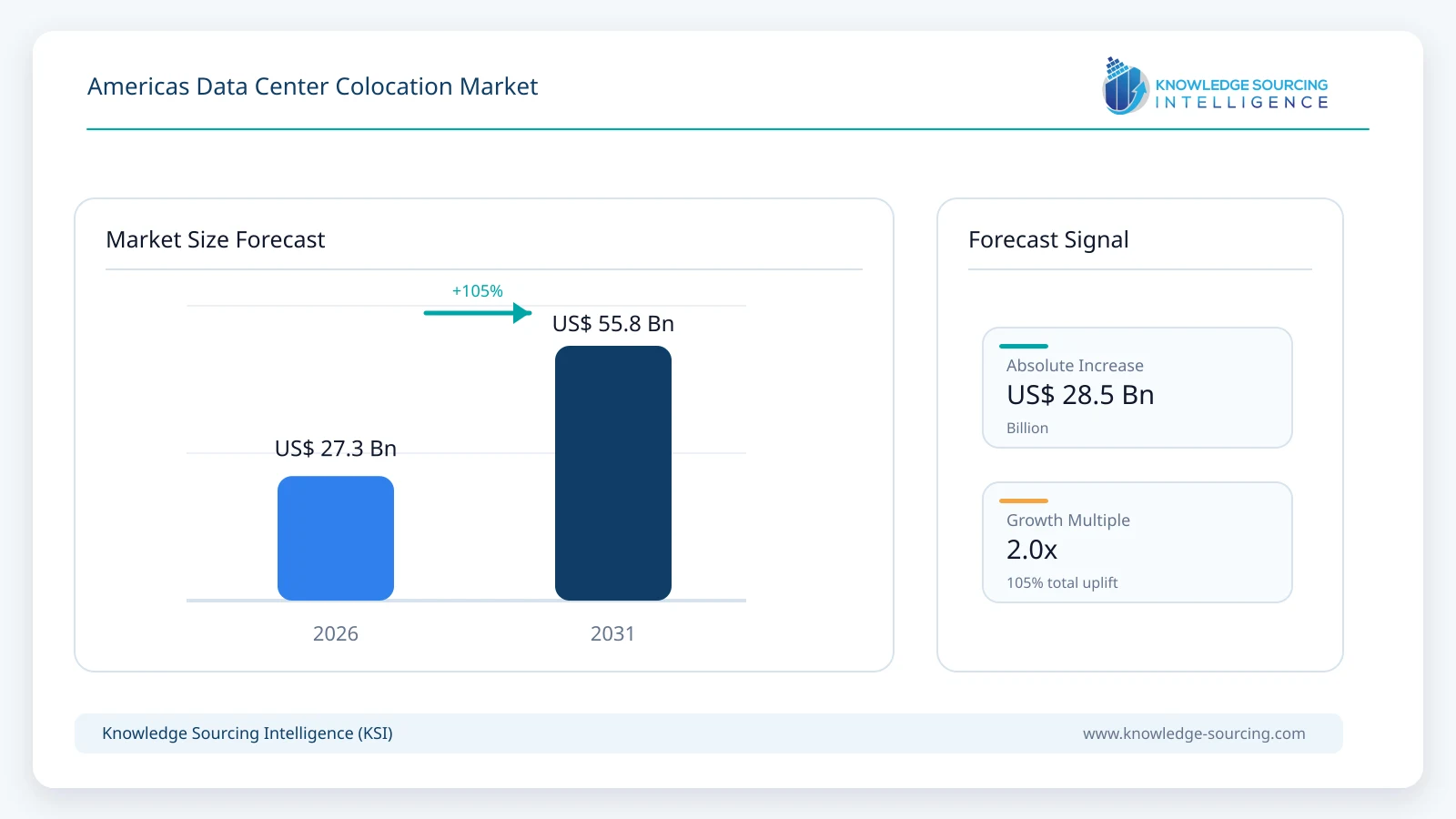
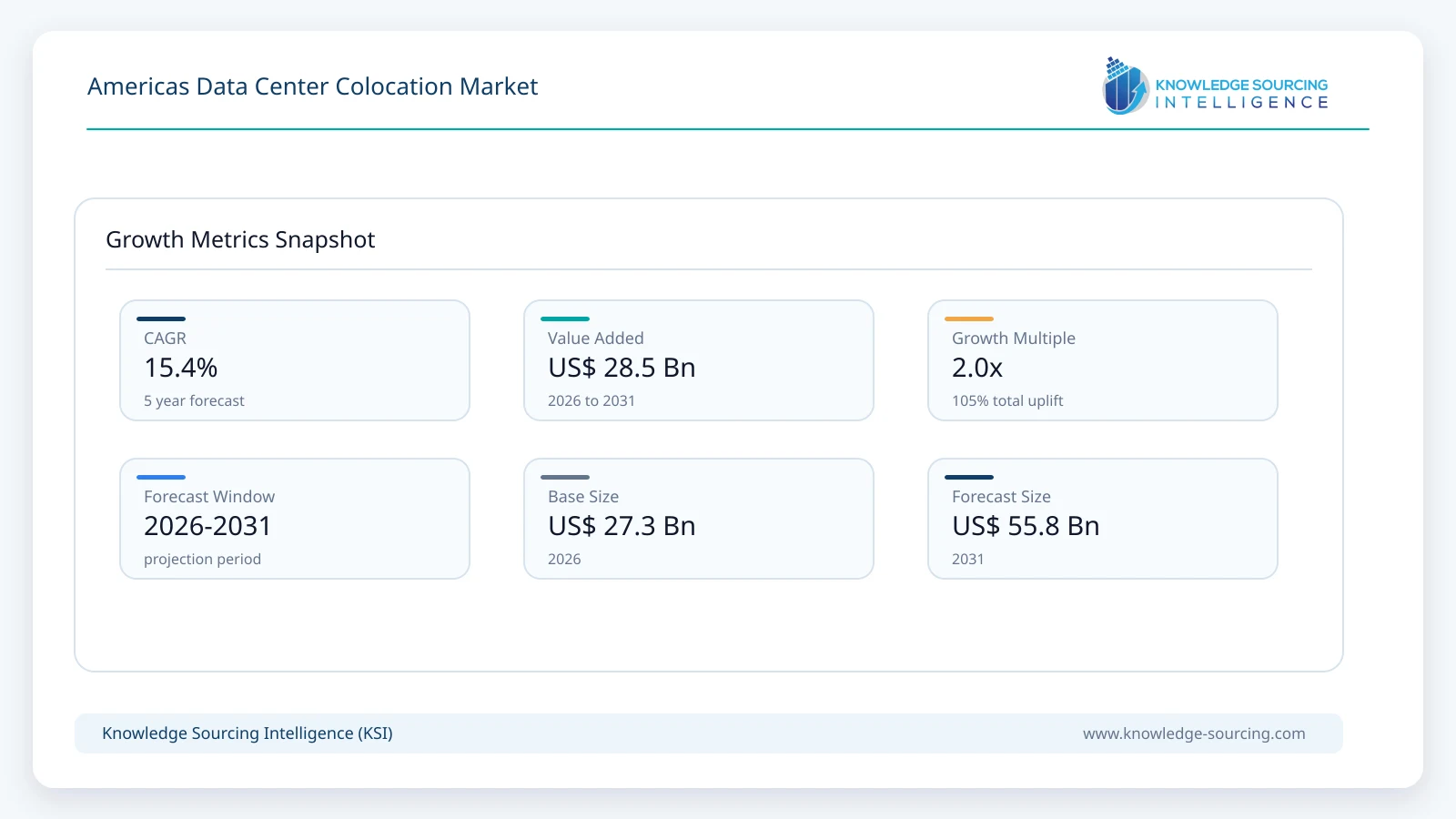
The Americas Data Center Colocation Market is projected to grow at a CAGR of 15.4%, from USD 27.26 billion in 2026 to USD 55.79 billion in 2031.
Highlights:
- 1Retail colocation accounts for approximately 57% of market revenue in 2026, although wholesale colocation is growing faster as cloud and AI infrastructure customers require larger dedicated power blocks.
- 2IT and telecommunications represent approximately 30% of demand, supported by cloud infrastructure, network services, digital platforms and high-performance computing.
- 3The United States accounts for close to four-fifths of the Americas market, supported by the scale of its cloud, AI, telecommunications and enterprise infrastructure ecosystem.
- 4U.S. data centers could account for approximately 11.8% of total U.S. electricity consumption by 2030, demonstrating how power supply is becoming a central constraint on future capacity.
- 5Large operators are building development pipelines in gigawatts rather than only adding individual facilities, changing the economics of power procurement and campus development.
- 6Brazil, Mexico, Chile and Colombia are attracting continued operator investment as Latin American cloud, connectivity and AI infrastructure develops.
- 7High-density electrical infrastructure, liquid cooling and software-defined interconnection are becoming important differentiators between conventional colocation capacity and infrastructure capable of supporting future AI workloads.
The market covers third-party facilities providing data center space, electrical capacity, cooling, physical security, connectivity and related infrastructure to enterprises, telecommunications operators, cloud platforms, digital-service companies and other users across North America and Latin America.
Data center colocation in the Americas is moving from a conventional outsourced-server-space business toward an integrated digital-infrastructure model in which power availability, cooling architecture, interconnection density and development capacity increasingly determine competitive positioning. Enterprises still use colocation to avoid building proprietary facilities and to support disaster recovery, security and hybrid IT environments. However, a growing portion of incremental infrastructure demand originates from cloud companies, artificial intelligence workloads, digital platforms and enterprises operating across several cloud and physical environments. This broadens the colocation value proposition beyond racks and floor space toward access to an engineered environment that can provide electricity, thermal management and network connectivity at a scale individual enterprises may find difficult to reproduce.
Operator investment provides direct evidence of this transition. Digital Realty reported 310 data centers globally at the end of 2025, including 118 in the United States, three in Canada and 36 in Latin America, while its land and development pipeline could accommodate more than 3,500 MW of additional capacity at that point. Equinix reported 52 active major development projects across 35 metropolitan areas as of January 2026 and had surpassed 500,000 interconnections across its global platform. These operating footprints show that leading colocation companies are increasingly combining traditional retail colocation, interconnection and large-scale development rather than concentrating on a single infrastructure model.
Electricity has simultaneously become a strategic input to market expansion. Lawrence Berkeley National Laboratory’s 2025 update estimates that U.S. data centers could consume approximately 11.8% of national electricity by 2030, with modeled scenarios ranging from 9.5% to 15.3%. The U.S. Energy Information Administration expects electricity sales to continue reaching new highs during 2026 and 2027, identifying data center development and manufacturing activity as important contributors to commercial and industrial load growth. As a result, a site’s ability to secure reliable power within the required deployment period can be more commercially important than simply possessing developable land.
Market Drivers
Accelerating electricity demand is increasing the value of secured data center power
The strongest structural driver for colocation is the increasing difficulty of delivering large quantities of electricity on the same timeline on which customers want computing capacity. In July 2026, the U.S. Department of Energy’s draft National Transmission Needs Study identified data centers, manufacturing and other large loads as major contributors to the need for additional transmission infrastructure. This creates an advantage for colocation providers that have already secured utility capacity, transmission access, substations or powered land. Customers can deploy workloads within an existing infrastructure pipeline rather than separately navigating land acquisition, electrical interconnection, construction and cooling-system development. The value proposition therefore increasingly becomes speed to usable power, particularly for customers whose AI and cloud investments cannot wait several years for a new proprietary facility to be developed.
AI infrastructure is increasing demand for high-density colocation
Artificial intelligence is creating infrastructure requirements significantly beyond those of conventional enterprise computing. GPU clusters concentrate substantially greater electrical and thermal load within each rack, increasing the importance of liquid cooling, redundant power architecture and purpose-built high-density data halls. The U.S. Department of Energy is funding advanced cooling systems under the COOLERCHIPS program specifically to address high-power AI data centers, including development work targeting future heat loads as high as one megawatt per rack. This shift strengthens the colocation proposition for organizations that want to deploy AI infrastructure without redesigning older enterprise facilities. It also creates a quality distinction within the existing colocation stock because available floor space does not necessarily mean that the facility can accommodate the electrical and cooling requirements of high-density hardware.
Hybrid cloud architecture continues to support carrier-neutral colocation
Public-cloud adoption has not eliminated the need for physical data center infrastructure. Large organizations increasingly operate applications across public clouds, private infrastructure, software platforms and dedicated systems, creating demand for secure connectivity between these environments. Carrier-neutral colocation facilities can provide direct connections to cloud providers, telecommunications carriers, internet exchanges and business partners while reducing dependence on public internet routing. Equinix reported more than 500,000 interconnections across its platform by the end of 2025, illustrating the scale at which connectivity has become a product alongside physical infrastructure. Providers with established interconnection ecosystems therefore compete differently from commodity facilities because customers gain access not only to power and racks but also to a network of cloud and connectivity partners.
Hyperscale development is expanding the addressable wholesale colocation market
Major cloud and AI infrastructure companies increasingly require capacity measured in tens or hundreds of megawatts rather than individual racks. This is encouraging operators to secure large development campuses and phase capacity according to customer requirements. Digital Realty’s June 2026 acquisition of approximately 1,440 acres near Kansas City for around USD 475 million, capable of supporting up to 2 GW of utility power, illustrates how the development model is changing. The company also reported additional development capacity in Atlanta and significant Northern Virginia investments during 2026. Large powered campuses allow operators to support multi-phase customer expansions while distributing the cost of electrical and common infrastructure across larger developments. Wholesale colocation consequently gains importance even though retail remains the larger revenue segment at the beginning of the forecast period.
Latin American infrastructure investment is broadening regional growth
Latin America is providing a second growth route beyond the U.S. market as international and regional operators expand capacity in Brazil, Mexico, Chile and Colombia. Equinix’s development schedule includes a new SP7 facility in São Paulo and an xScale facility in Mexico City, while its 2025 filing also identified projects in Bogotá and Rio de Janeiro. Cirion is constructing its RIO2 site in Rio de Janeiro in phases and has expanded infrastructure in Santiago, Lima, São Paulo, Bogotá and other markets. Ascenty reported a footprint of 40 facilities across Brazil, Chile, Mexico and Colombia in 2026. These investments indicate that regional colocation demand is becoming sufficiently broad to support both interconnected enterprise facilities and larger AI or cloud deployments rather than remaining concentrated exclusively in one metropolitan cluster.
Market Restraints and Challenges
Transmission and large-load interconnection can delay capacity delivery
Power availability is also the market’s principal constraint. Data center projects can secure customers, financing and suitable land while still facing uncertainty over when utilities can energize the required capacity. In June 2026, the Federal Energy Regulatory Commission ordered all six regional grid operators under its jurisdiction to justify or reform the rules governing how data centers and other large energy users connect to the grid. FERC’s action specifically reflects concerns over the speed, reliability and cost allocation of large-load interconnection. This means that development pipelines based primarily on land acreage should not automatically be treated as future supply. Capacity becomes commercially meaningful only when developers can demonstrate a credible path to electrical service, permitting, cooling infrastructure and network connectivity.
Existing facilities can require substantial modification for AI workloads
High-density AI infrastructure cannot always be added to conventional colocation facilities simply by installing different servers. Direct-to-chip liquid cooling can require new facility piping, coolant distribution units, redundant loops, modified heat-rejection systems and coordination between the customer, equipment manufacturer and data center operator. Equinix describes current high-density AI environments as exceeding 200 kW per rack, compared with the substantially lower densities around which traditional facilities were commonly designed. Retrofitting older facilities can therefore require material capital expenditure and may reduce the amount of existing floor space that can economically accommodate future high-density workloads. This creates a growing difference between nominal data center capacity and capacity that is genuinely AI-ready.
Large-campus development materially increases capital exposure
The scale of new development introduces financial risk even when long-term demand remains strong. Powered land, substations, transmission equipment, buildings, generators, cooling systems and networking infrastructure can require investment years before a campus reaches full utilization. Digital Realty’s Kansas City transaction demonstrates that hundreds of millions of dollars can be committed before the subsequent facility phases are constructed. Operators therefore need to sequence development according to contracted demand while protecting themselves against customer delays, utility changes and shifts in hardware requirements. Larger sites offer significant long-term capacity advantages but also increase the consequences of incorrectly forecasting the timing and location of demand.
Concentration among hyperscale customers increases contractual risk
Cloud and AI customers can absorb exceptionally large amounts of capacity and provide long-term revenue visibility, but the same dynamic can increase customer concentration. A small number of large customers can account for substantial portions of a campus and may negotiate customized technical specifications, expansion rights or commercial terms. Providers must therefore balance the attractiveness of anchor hyperscale deployments with diversification across customers and services. Retail colocation, connectivity and enterprise customers remain strategically valuable partly because they create a broader revenue base even when individual contracts are considerably smaller.
Grid affordability and local acceptance are becoming part of site selection
Large data center loads increasingly affect discussions about transmission investment, electricity affordability and how the cost of new infrastructure should be allocated. FERC’s 2026 large-load proceedings explicitly include consumer protection and cost allocation alongside speed of interconnection, demonstrating that data center development is becoming a broader energy-policy issue. Local concerns can also extend to backup generation, land use and water consumption. Operators consequently need to evaluate regulatory and community conditions earlier in site selection instead of treating power procurement as a purely technical utility negotiation.
Major Segment Analysis
By Colocation Type
Retail colocation accounts for approximately 57% of market revenue in 2026, supported by enterprise requirements for racks, cages, private suites, hybrid infrastructure and direct connectivity to cloud and network providers. It remains the larger segment through 2031 because enterprise customers continue to require flexible deployments and interconnected infrastructure even as cloud adoption increases.
Wholesale colocation grows faster during the forecast period as AI companies, cloud platforms and digital-service providers require larger blocks of dedicated electrical capacity. The distinction between retail and wholesale is also becoming less rigid as major operators build platforms that combine interconnected metropolitan facilities with hyperscale campuses. Wholesale therefore gains share through 2031 without displacing the underlying enterprise requirement for retail colocation.
By Enterprise Size
Large enterprises account for more than half of demand and retain the leading position through the forecast period. Their infrastructure requirements typically span several applications and locations and can include private computing environments, public-cloud connections, business continuity, security and regulatory requirements. Large organizations also have greater requirements for geographically diverse capacity and high-bandwidth interconnection.
Medium-sized enterprises are increasing their participation as managed infrastructure and cloud-connectivity services make colocation easier to consume without maintaining large internal facility teams. Small enterprises remain comparatively limited as direct colocation customers because a greater proportion of their computing requirements is delivered indirectly through cloud, software and managed-service providers.
By Industry Vertical
IT and telecommunications account for approximately 30% of market demand in 2026 and remain the largest industry group through 2031. Cloud services, telecommunications networks, content infrastructure and digital platforms require scalable power and dense connectivity, while AI is increasing the infrastructure intensity of portions of the technology sector.
BFSI remains another important customer category because banks, payment companies and insurers require resilient computing infrastructure, disaster recovery, controlled connectivity and auditable security. Healthcare, manufacturing, government and energy customers continue to expand their use of colocation as more operational and regulated workloads move toward hybrid infrastructure.
Regional Analysis
The United States accounts for close to four-fifths of Americas colocation revenue in 2026 and remains the largest market through 2031. The scale of cloud services, AI infrastructure, enterprise computing and telecommunications creates demand across established metropolitan clusters and newer power-oriented campuses. Government evidence also indicates that data center development is becoming sufficiently important to affect national electricity-demand and transmission planning, reinforcing the scale of future infrastructure requirements.
Large operator pipelines remain substantial. Digital Realty reported 118 U.S. data centers at the end of 2025 and substantial additional developable capacity, while Equinix’s announced Americas development program includes expansions in Washington, Silicon Valley, Chicago, Dallas, Miami and other metropolitan areas. New development is increasingly determined by the combination of power availability and connectivity rather than proximity to historic data center clusters alone.
Canada represents a smaller but established market, with Toronto and Montreal providing important enterprise, financial-services, cloud and connectivity hubs. Equinix continues to invest in both markets, including development capacity in Toronto and Montreal. The country’s power mix and cross-border business integration support colocation demand, while the smaller domestic population limits its absolute scale relative to the United States.
Mexico is becoming increasingly important to the Americas data center network. The country combines domestic cloud and enterprise demand with integration into North American manufacturing and telecommunications infrastructure. Equinix has scheduled its MX3x xScale facility in Mexico City for 2027 after additional investment in the country, illustrating the progression from conventional enterprise colocation toward larger cloud-oriented infrastructure.
Brazil remains the principal South American market and an important base for cloud, financial-services and content infrastructure. Equinix is adding capacity in São Paulo and Rio de Janeiro, while Cirion is developing RIO2 and regional operators including Ascenty, Elea and Scala continue to invest in Brazilian infrastructure. Elea’s announced Rio AI City project provides potential expansion capacity on a gigawatt scale, illustrating how Brazilian development is beginning to include infrastructure specifically intended for future AI and hyperscale demand.
Chile and Colombia remain smaller than Brazil but increasingly relevant within regional infrastructure strategies. Equinix and Ascenty have both expanded into these markets, while Cirion operates interconnected facilities across multiple South American countries. Their continued development supports the gradual reduction of the Americas market’s dependence on U.S. revenue even though the United States remains dominant throughout the forecast period.
Technology Outlook
High-Density Power and Liquid Cooling
AI infrastructure is increasing the importance of direct liquid cooling and other high-density thermal-management technologies. New facilities increasingly need to accommodate both conventional enterprise infrastructure and substantially denser GPU deployments without requiring major redesign. Operators that establish liquid-cooling capability, suitable power-distribution architecture and flexible data-hall designs are therefore positioned to serve a wider range of workloads as hardware requirements evolve.
Software-Defined Interconnection
Colocation connectivity is moving beyond physical cross-connects toward software-defined networking between cloud platforms, customers and facilities. In April 2026, CoreSite introduced 100 Gbps Ethernet Virtual Circuits on its Open Cloud Exchange platform, increasing the bandwidth available through its software-defined interconnection service. These capabilities allow customers to modify connectivity more rapidly and make mature carrier-neutral facilities increasingly valuable as digital ecosystems rather than simply physical hosting locations.
Intelligent Power and On-Site Energy Systems
Increasing grid constraints are encouraging operators to evaluate batteries, microgrids, on-site generation and more sophisticated power-management systems. The U.S. Department of Energy has highlighted microgrids as one route for supporting large data center loads where conventional distribution or transmission expansion cannot match required deployment timelines. These systems do not eliminate the need for grid access, but they can increase resilience, improve flexibility and reduce dependence on a single supply pathway.
Recent Developments
June 2026: Digital Realty announced its acquisition of approximately 1,440 acres at Astra Enterprise Park near Kansas City for around USD 475 million. The site is expected to support up to 2 GW of utility power for future hyperscale development and strengthens the company’s U.S. AI and cloud development pipeline.
May 2026: Vertical Data and Ascenty announced a partnership to deploy AI infrastructure across Ascenty’s footprint in Brazil, Chile, Mexico and Colombia. The partnership combines Ascenty’s regional data center platform with AI hardware, financing and managed infrastructure capabilities.
April 2026: CoreSite launched 100 Gbps Ethernet Virtual Circuits on its Open Cloud Exchange platform, increasing software-defined bandwidth for cloud, AI and hybrid infrastructure customers across its ecosystem.
2026: Equinix opened SV18 in Silicon Valley and continued an Americas development program that includes additional capacity in São Paulo, Mexico City, Bogotá, Rio de Janeiro, Washington and other metropolitan areas.
Competitive Landscape
Competition in the Americas data center colocation market increasingly depends on the combination of secured electrical capacity, high-density infrastructure, network ecosystems and the ability to deliver new capacity in several metropolitan markets. Equinix maintains a strong carrier-neutral retail and interconnection position, while Digital Realty combines interconnected colocation with large hyperscale development. QTS, Vantage Data Centers, STACK Infrastructure, CyrusOne and Aligned Data Centers participate strongly in larger cloud and hyperscale infrastructure, while CoreSite, Flexential, DataBank, Cologix and Centersquare maintain significant positions in interconnected enterprise environments.
Latin America has developed a complementary regional group of infrastructure providers. Ascenty operates across Brazil, Chile, Mexico and Colombia, while Cirion combines data center capacity with an extensive regional fiber and cloud-connectivity platform. Scala Data Centers, Elea Data Centers and ODATA, now part of Aligned Data Centers, are expanding hyperscale and AI-oriented infrastructure, particularly in Brazil and other major regional markets. Competitive differentiation through 2031 is expected to depend less on facility count alone and more on the amount of realistically deliverable power, the density that can be supported, direct connectivity to cloud ecosystems and the ability to expand customers across multiple locations.
Analyst View
The Americas data center colocation market should increasingly be evaluated in terms of usable and deliverable power rather than nominal building capacity. A large land parcel or proposed campus does not automatically translate into future supply. Electrical interconnection, transmission availability, substations, permitting and network connectivity determine whether capacity can actually become commercially available. The emergence of large-load interconnection as a formal FERC and DOE policy issue in 2026 demonstrates that electricity infrastructure has moved from being one operating input among many to one of the central determinants of data center expansion.
A second structural change is the separation between conventional colocation facilities and infrastructure capable of supporting future AI hardware. High-density computing affects electrical distribution and thermal management throughout the facility, meaning that older buildings cannot necessarily be upgraded economically for every new workload. This creates potential pricing and utilization differences within existing inventories. AI-ready capacity should therefore not be measured only according to floor area or rack count, while conventional facilities remain economically relevant for enterprise, network and less power-intensive applications.
Retail colocation remains strategically important despite the visibility of hyperscale campus investment. Enterprises continue to require hybrid infrastructure, secure network connectivity, disaster recovery and direct access to multiple cloud providers. These services also create network effects around established carrier-neutral facilities that are difficult for newly constructed remote campuses to replicate. Wholesale colocation grows faster, but the likely market structure is convergence rather than replacement, with major providers combining large-scale power campuses and interconnected metropolitan facilities.
Latin America provides the most significant regional diversification opportunity. Brazil remains the primary market, but investment in Mexico, Chile and Colombia indicates that demand is broadening geographically. International operators are adding facilities alongside regional companies, while AI infrastructure is beginning to feature more prominently in development plans.
Americas Data Center Colocation Market Scope
| Report Metric | Details |
|---|---|
| Total Market Size in 2026 | USD 27.26 billion |
| Total Market Size in 2031 | USD 55.79 billion |
| Forecast Unit | Billion |
| Growth Rate | 15.4% |
| Study Period | 2021 to 2031 |
| Historical Data | 2021 to 2024 |
| Base Year | 2025 |
| Forecast Period | 2026 – 2031 |
| Segmentation | Colocation Type, Enterprise Size, Industry Vertical, Geography |
| Companies |
|
Market Segmentation
By Colocation Type
Retail Colocation
Wholesale Colocation
By Enterprise Size
Small Enterprises
Medium Enterprises
Large Enterprises
By Industry Vertical
Banking, Financial Services and Insurance
IT and Telecommunications
Manufacturing
Healthcare
Government and Public Sector
Energy and Utilities
Media and Entertainment
Others
By Geography
United States
Canada
Mexico
Brazil
Argentina
Others
Table of Contents
1. EXECUTIVE SUMMARY
2. MARKET SNAPSHOT
2.1. Market Overview
2.2. Market Definition
2.3. Scope of the Study
2.4. Market Segmentation
2.5. Key Market Indicators
3. BUSINESS LANDSCAPE
3.1. Market Drivers
3.2. Market Restraints and Challenges
3.3. Market Opportunities
3.4. Power Availability and Large-Load Interconnection Analysis
3.5. Porter’s Five Forces Analysis
3.6. Industry Value Chain Analysis
3.7. Regulatory and Data Governance Environment
3.8. Strategic Recommendations
4. TECHNOLOGY OUTLOOK
4.1. High-Density Power and Liquid Cooling
4.2. Software-Defined Interconnection
4.3. Intelligent Power and On-Site Energy Systems
5. AMERICAS DATA CENTER COLOCATION MARKET BY COLOCATION TYPE
5.1. Introduction
5.2. Retail Colocation
5.3. Wholesale Colocation
6. AMERICAS DATA CENTER COLOCATION MARKET BY ENTERPRISE SIZE
6.1. Introduction
6.2. Small Enterprises
6.3. Medium Enterprises
6.4. Large Enterprises
7. AMERICAS DATA CENTER COLOCATION MARKET BY INDUSTRY VERTICAL
7.1. Introduction
7.2. Banking, Financial Services and Insurance
7.3. IT and Telecommunications
7.4. Manufacturing
7.5. Healthcare
7.6. Government and Public Sector
7.7. Energy and Utilities
7.8. Media and Entertainment
7.9. Others
8. AMERICAS DATA CENTER COLOCATION MARKET BY GEOGRAPHY
8.1. Introduction
8.2. United States
8.3. Canada
8.4. Mexico
8.5. Brazil
8.6. Argentina
8.7. Others
9. COMPETITIVE ENVIRONMENT AND ANALYSIS
9.1. Competitive Positioning
9.2. Capacity and Geographic Footprint Analysis
9.3. AI-Ready Infrastructure and Interconnection Benchmarking
9.4. Market Share Analysis
9.5. Strategic Developments
9.6. Competitive Dashboard
10. COMPANY PROFILES
10.1. Equinix, Inc.
10.2. Digital Realty Trust, Inc.
10.3. QTS Data Centers
10.4. CoreSite
10.5. Centersquare
10.6. Flexential
10.7. Vantage Data Centers
10.8. Aligned Data Centers / ODATA
10.9. Ascenty
10.10. Scala Data Centers
10.11. Elea Data Centers
10.12. Cirion Technologies
11. ANALYST VIEW
12. APPENDIX
12.1. Research Methodology
12.2. Market Estimation and Assumptions
12.3. Definitions and Abbreviations
Navigate
Trusted by the world's leading organizations











