
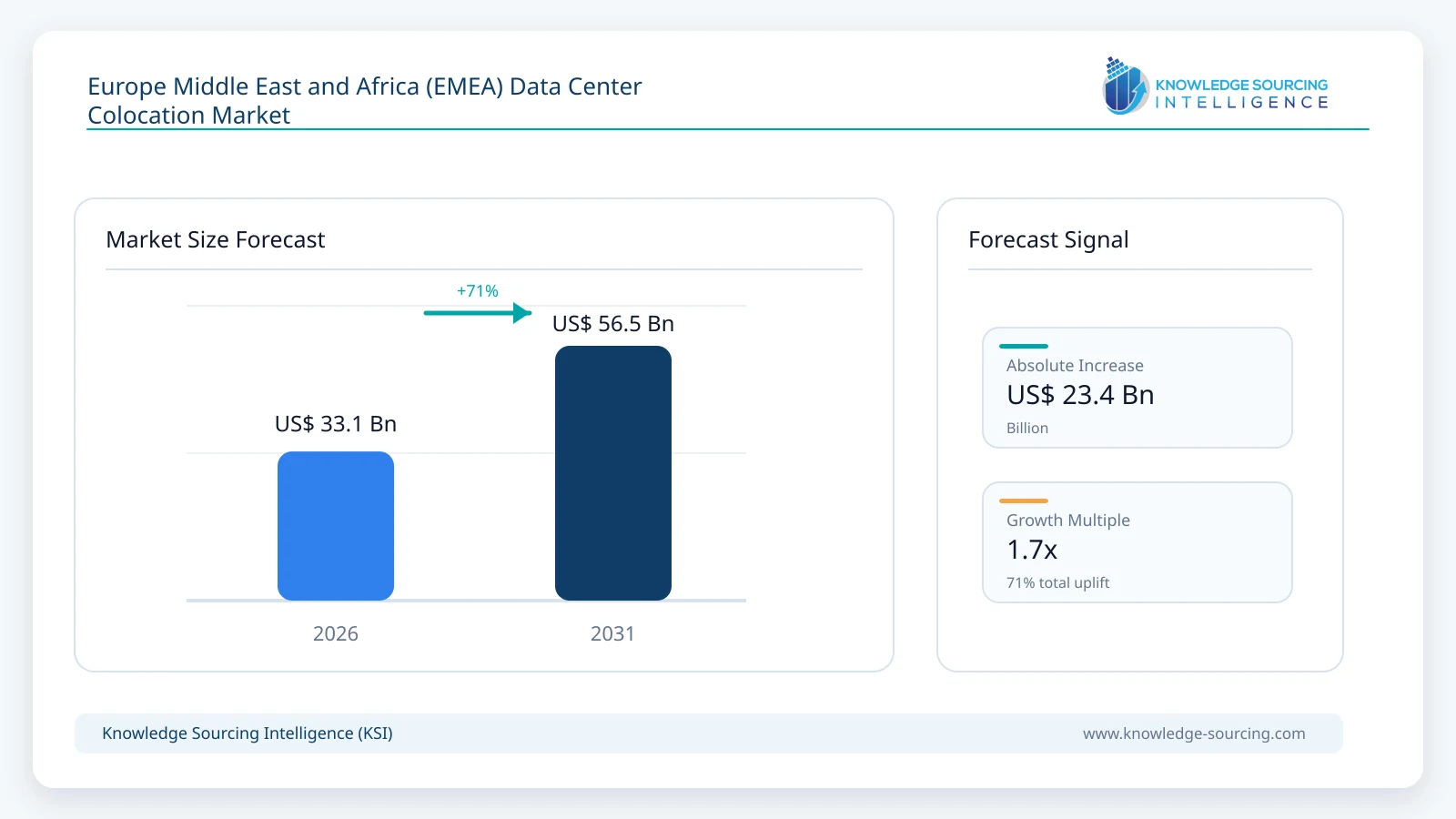
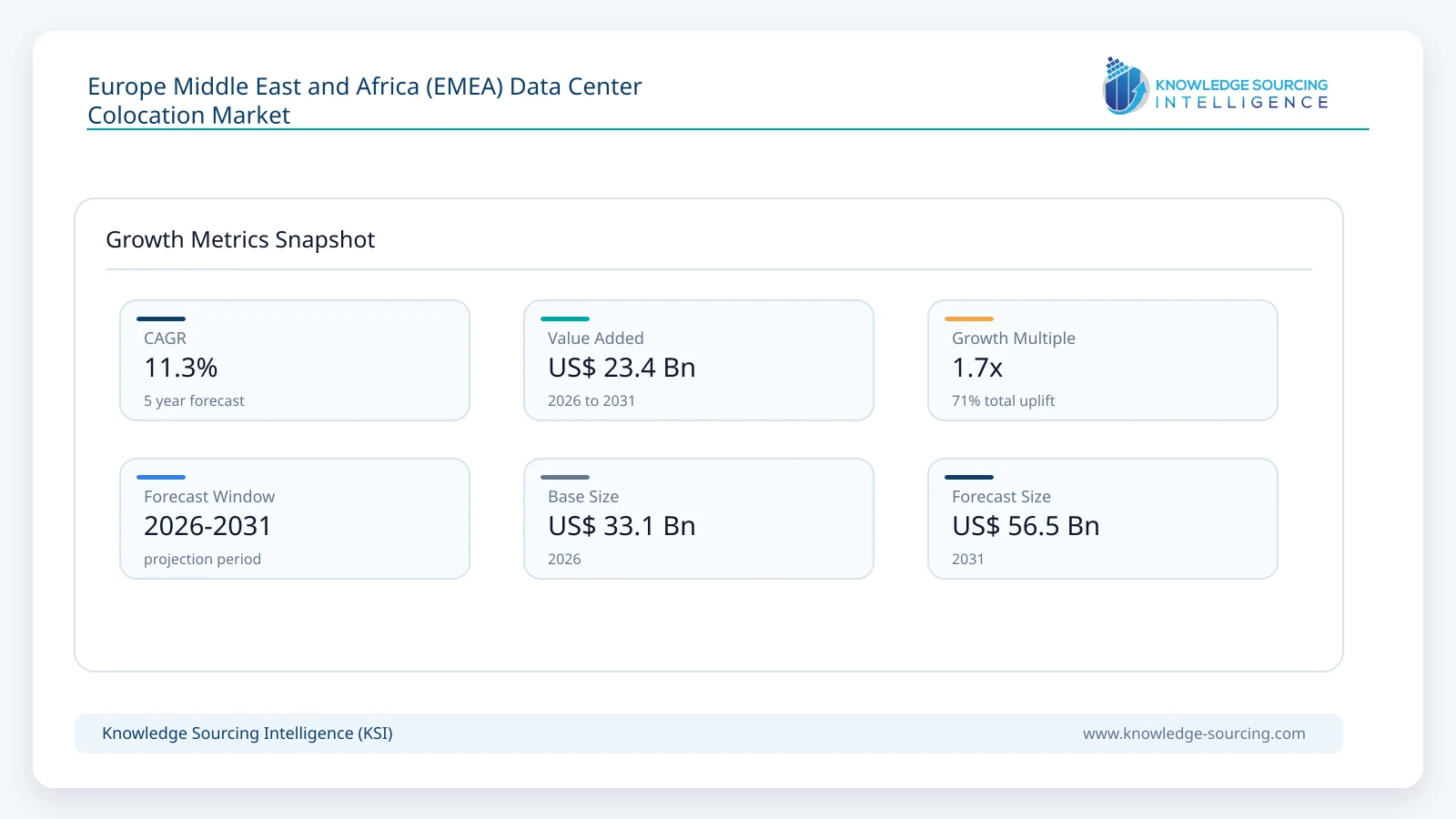
The Europe, Middle East and Africa (EMEA) Data Center Colocation Market is projected to grow at a CAGR of 11.3%, from USD 33.1 billion in 2026 to USD 56.5 billion in 2031.
Highlights:
- 1Wholesale colocation accounts for an estimated 53.4% of EMEA market revenue in 2026, supported by hyperscale cloud, artificial intelligence and large dedicated infrastructure deployments.
- 2IT and telecommunications account for an estimated 32.8% of market demand in 2026, reflecting substantial infrastructure requirements from cloud platforms, telecommunications operators, digital services and AI-related computing.
- 3Large enterprises remain the largest direct customer group as multinational organizations increasingly combine colocation, private infrastructure and public cloud environments.
- 4The European Union aims to triple its data center capacity by 2035 as part of its cloud and AI infrastructure strategy.
- 5Data centers account for approximately 2.5% of EU electricity consumption, making grid availability, efficiency and energy-system integration increasingly important to facility development.
- 6Southern European markets are receiving greater investment as Madrid, Milan and Lisbon combine increasing cloud demand with international fiber and subsea connectivity.
- 7Saudi Arabia and the UAE are developing larger cloud, sovereign digital and AI infrastructure ecosystems, while South Africa remains the principal commercial data center market in sub-Saharan Africa.
- 8Liquid cooling, high-density electrical systems, energy reuse and software-defined interconnection are becoming important differentiators between conventional colocation capacity and infrastructure capable of supporting future AI workloads.
The market covers third-party data center facilities providing customers with physical space, electrical capacity, cooling, security, connectivity and related infrastructure across Europe, the Middle East and Africa.
The EMEA data center colocation market combines highly developed European interconnection hubs with faster-growing digital infrastructure markets across Southern Europe, the Middle East and Africa. London, Frankfurt, Amsterdam, Paris and Dublin remain important because of their concentrations of multinational enterprises, telecommunications networks, cloud platforms and financial institutions. However, development is becoming geographically broader as operators seek markets with available electricity, suitable land and international connectivity. Madrid, Milan and Lisbon are attracting increasing investment, while cloud and AI infrastructure expansion is supporting new capacity in the Gulf and selected African markets.
The competitive model is also changing. Retail colocation continues to address enterprise requirements for racks, cages, private suites, disaster recovery and cloud connectivity, while hyperscale and AI customers increasingly contract entire data halls or multi-megawatt blocks of capacity. Digital Realty reported 113 data centers in Europe and 16 in Africa at the end of 2025, while its global land and development portfolio could accommodate more than 3,500 MW of additional capacity. Equinix ended 2025 with 280 facilities globally and had 52 major development projects underway across 35 metropolitan areas in January 2026. These portfolios illustrate how leading operators are increasingly combining interconnected metropolitan facilities with larger development campuses rather than relying exclusively on either retail or wholesale colocation.
The electricity requirement associated with further expansion is becoming substantial. The European Commission stated in June 2026 that installed EU data center capacity is expected to increase from approximately 12 GW in 2025 to around 28 GW by 2030. This growth coincides with broader electrification of transport, buildings and industry, making grid connection and transmission availability central to site selection. Operators with secured electrical capacity can therefore possess a structural advantage even when competing against companies with comparable real estate footprints.
Market Drivers
Secured electrical capacity is becoming a primary competitive advantage
Data center development requires large quantities of reliable electricity, and AI-related projects can require individual power connections comparable with major industrial facilities. The European Commission expects installed data center capacity to increase sharply through 2030, while connection requests are becoming larger and more concentrated geographically. Consequently, customers increasingly value colocation providers that can demonstrate a credible power-delivery schedule rather than merely future land availability. This benefits operators that have secured utility connections, substations or phased campus capacity ahead of demand. Large customers can deploy computing infrastructure more quickly through an established colocation platform than by independently acquiring land, obtaining electrical connections and developing a proprietary data center.
AI is increasing demand for facilities designed around high-density infrastructure
Artificial intelligence is changing the relationship between computing capacity and physical data center space. GPU-based systems place considerably greater loads on electrical distribution and cooling infrastructure than conventional enterprise servers, creating demand for facilities designed for direct liquid cooling and higher rack densities. Existing data halls may contain available physical space while lacking sufficient power or heat-removal capability to accommodate AI deployments economically. This creates an opportunity for new colocation facilities designed specifically around higher-density computing and for established providers capable of retrofitting selected facilities without compromising existing customer operations. AI therefore increases market demand not simply through additional servers but through the requirement for a different class of usable infrastructure.
Continued hybrid-cloud adoption supports interconnected retail facilities
Large enterprises increasingly combine public cloud services with private infrastructure, SaaS platforms, regulated databases and legacy applications rather than moving every workload into a single cloud environment. Carrier-neutral colocation facilities provide direct connectivity between these environments while avoiding dependence on public internet routing for critical traffic. Equinix surpassed 500,000 interconnections globally in 2025, demonstrating the scale at which physical and virtual interconnection has become a core component of colocation rather than an ancillary service. Facilities with dense carrier, cloud and enterprise ecosystems can consequently maintain strong strategic value even when newer campuses provide greater quantities of wholesale power.
Southern Europe is benefiting from international connectivity and new capacity
The regional market is broadening beyond the traditional Western European data center hubs. Lisbon is becoming increasingly significant because of subsea routes linking Europe with North America, South America and Africa. Digital Realty entered Portugal in March 2026 through the acquisition of a Lisbon facility capable of supporting up to 2.4 MW of IT load, while the company identified 16 subsea cables landing in Portugal. The operator also announced its entry into Milan during March 2026, extending a Mediterranean platform that includes markets such as Athens and Marseille. These investments indicate that Southern European locations increasingly support independent cloud, content and interconnection demand rather than functioning only as secondary disaster-recovery markets.
Large-scale private investment is accelerating European capacity development
Capital availability for data center development remains strong where power and customer demand can be secured. DATA4 announced a EUR 5 billion investment in June 2026 to develop a new campus at Escaudain in Northern France, describing it as the company’s largest French data center project. Vantage Data Centers and Altarea announced another major French development near Bordeaux in February 2026 after securing a 400 MW power connection. AtlasEdge subsequently closed a EUR 1.2 billion financing facility in May 2026 to support further European expansion. These developments illustrate how data center projects are evolving into industrial-scale infrastructure investments and provide additional capacity outside the most constrained legacy hubs.
Middle Eastern and African digital infrastructure is widening the EMEA opportunity
The Middle East is attracting increased cloud, AI and sovereign digital infrastructure investment, particularly in the UAE and Saudi Arabia. These markets offer substantial government-backed technology investment and growing demand for locally hosted computing capacity. Africa remains smaller but is developing several commercially important hubs. The South African government reported in February 2026 that 55 data centers had already been built in the country and more than ZAR 50 billion of digital-infrastructure investment was expected over the following three years. Nigeria is also developing larger carrier-neutral facilities, with Rack Centre’s Lagos campus offering 13.5 MW of total IT power and AI-ready data halls.
Market Restraints and Challenges
Grid constraints can delay otherwise viable projects
Electricity availability is becoming one of the principal limitations on new European data center capacity. Land, financing and customer commitments do not guarantee that a facility can be energized within the required deployment period. Transmission upgrades, substations and high-capacity grid connections can require longer development periods than the data center buildings themselves. The issue becomes more significant as individual AI campuses request hundreds of megawatts of capacity. Operators are consequently moving toward markets where utilities can provide credible delivery schedules and increasingly securing power infrastructure before committing to full campus construction.
Older facilities require significant investment to accommodate high-density AI
The installed European colocation base contains many facilities designed around lower-density enterprise computing. AI deployments can require modifications to power distribution, UPS systems, cooling loops and heat-rejection equipment rather than simply installing different racks. Retrofitting operational facilities can be capital-intensive and may disrupt existing customers. This produces a widening distinction between conventional colocation space and infrastructure genuinely capable of supporting high-density workloads. Operators must therefore decide whether individual facilities should be upgraded for AI, retained for traditional enterprise workloads or redeveloped over a longer period.
EU sustainability reporting increases operating requirements
European operators are subject to increasingly detailed reporting requirements. Commission Delegated Regulation (EU) 2024/1364 requires data centers with installed IT power demand of at least 500 kW to provide defined information and performance indicators to the European database on data centers. The framework includes energy, water and sustainability indicators and forms part of the development of a common Union rating scheme. Greater transparency could strengthen the position of efficient operators, but it also requires consistent measurement systems and adds compliance complexity for companies operating large portfolios across multiple member states.
Larger campuses increase capital and execution exposure
The shift toward hundreds of megawatts of planned capacity changes project economics. Operators must commit capital to land, substations, mechanical systems and phased building construction while customer deployment schedules can change according to cloud and AI infrastructure requirements. DATA4’s EUR 5 billion Escaudain project and Vantage’s planned campus with a secured 400 MW connection illustrate the scale at which new facilities are being planned. Large campuses provide operating leverage when demand materializes, but they also increase the consequences of construction delays, changing utility conditions or concentration around a limited number of hyperscale customers.
EMEA requires substantially different infrastructure strategies by location
The EMEA region does not represent a uniform operating environment. Western Europe provides mature fiber and enterprise ecosystems but increasingly faces grid and permitting pressure. Gulf markets can support large modern facilities but require intensive cooling under high ambient temperatures. African markets offer strong long-term digital demand but can face greater challenges involving utility reliability, power cost and supporting infrastructure. Providers therefore cannot simply replicate one facility model throughout EMEA. Cooling design, energy sourcing, redundancy and connectivity strategy need to reflect individual market conditions.
Major Segment Analysis
By Colocation Type
Wholesale colocation is projected to record a 13.0% CAGR between 2026 and 2031, above the overall EMEA market growth rate. Hyperscale cloud platforms, AI infrastructure providers and large digital companies increasingly require dedicated data halls and multi-megawatt deployments rather than individual racks. Large wholesale contracts also provide operators with greater visibility when planning phased campus development and securing project financing.
Retail colocation remains strategically important because enterprise customers continue to require private infrastructure, carrier connectivity, disaster recovery and direct cloud access. Network-dense metropolitan facilities can maintain considerable pricing and customer-retention advantages because their connectivity ecosystems cannot be recreated simply by constructing lower-cost capacity elsewhere. Wholesale therefore gains market share through 2031 without eliminating the role of interconnected retail facilities.
By Enterprise Size
Large enterprises account for an estimated 59.6% of EMEA colocation revenue in 2026. Their leading position reflects broader requirements for geographically distributed infrastructure, regulatory compliance, disaster recovery and connectivity between public clouds and private systems. Financial institutions, telecommunications operators, multinational manufacturers and technology companies frequently deploy infrastructure across several facilities rather than relying on a single corporate data center.
Medium enterprises are expected to expand their use of colocation faster as managed infrastructure and cloud connectivity reduce the requirement for large internal data center teams. Small businesses remain comparatively limited as direct customers because a larger share of their computing requirements is consumed through SaaS, public cloud and managed-service providers.
By End User
IT and telecommunications are projected to generate approximately USD 19.67 billion of EMEA colocation revenue by 2031. Cloud platforms, telecommunications operators, digital-content companies and AI infrastructure providers require scalable electrical capacity and dense network connectivity, making them important customers across both wholesale and carrier-neutral colocation.
BFSI remains another substantial customer segment because financial institutions require resilient computing environments, low-latency connectivity, disaster recovery and controlled security. Manufacturing, healthcare, government, energy and media demand also expands through the forecast period as operational and regulated workloads migrate toward hybrid infrastructure.
Regional Analysis
Europe remains the largest component of the EMEA market through 2031, but development is becoming geographically broader. London, Frankfurt, Amsterdam and Paris retain significant cloud, financial-services and interconnection ecosystems, while Madrid, Milan, Lisbon and other markets increasingly attract operators seeking additional power and connectivity options. The European Commission’s policy objective to materially increase regional data center capacity further supports development beyond the traditional hub structure.
France is becoming particularly important for large AI-oriented infrastructure projects. DATA4’s Escaudain project represents a EUR 5 billion investment, while the Vantage and Altarea campus near Bordeaux has already secured a 400 MW connection. Paris remains an established connectivity market, but these projects demonstrate that future French capacity is spreading toward locations where industrial-scale electricity and land can be assembled.
Spain, Italy and Portugal are also becoming more significant. Equinix opened MD5 in Madrid during Q2 2026, Digital Realty announced its entry into Milan in March 2026 and acquired a Lisbon facility scheduled to be ready for service in early 2027. International fiber routes and comparatively newer capacity pipelines improve the strategic position of these markets within Southern Europe.
The Middle East represents a faster-growing component of the regional market, led by the UAE and Saudi Arabia. Government digitalization, cloud-region development, AI investment and requirements for locally hosted infrastructure are creating demand for larger facilities. International operators increasingly compete alongside regional platforms, while sovereign-cloud and AI requirements support capacity designed for higher density and stronger domestic control over data infrastructure.
Africa remains smaller in revenue terms but has several increasingly important commercial markets. South Africa has the strongest established ecosystem and continues to attract infrastructure investment, while Nigeria is developing as a West African carrier-neutral hub. Kenya and other East African markets provide additional longer-term opportunities as cloud availability, subsea connectivity and enterprise digitalization improve. Power reliability remains an important differentiator, increasing the value of professional colocation facilities capable of providing resilient infrastructure.
Technology Outlook
High-Density Power and Liquid Cooling
Liquid cooling is becoming increasingly important as rack densities rise with GPU deployment. New facilities increasingly need to support combinations of conventional air-cooled infrastructure and high-density direct-to-chip liquid cooling without restricting future flexibility. Operators that incorporate appropriate power distribution, pipework and heat-rejection systems during initial construction should have an advantage over facilities requiring extensive retrofits later.
Energy Integration and Heat Reuse
European energy policy is increasing attention on the relationship between data centers and surrounding electricity and heating systems. Greater reporting transparency, high electricity requirements and wider electrification encourage operators to improve PUE, increase renewable-energy sourcing and explore heat-reuse opportunities. These capabilities are moving from sustainability features toward operating considerations that can influence permitting, customer procurement and long-term site economics.
Software-Defined Interconnection
Carrier-neutral operators are increasingly extending physical cross-connect ecosystems with software-defined connectivity between customers, cloud platforms and facilities. This allows enterprises to provision connections more rapidly and use several cloud or network providers from the same colocation environment. Interconnection therefore remains a key source of differentiation for mature metropolitan facilities even as larger hyperscale campuses account for more physical capacity.
Recent Developments
June 2026: DATA4 announced a EUR 5 billion investment to develop its largest French data center campus at Escaudain in Northern France. The development is intended to support European cloud and AI demand and forms part of the company’s wider European expansion strategy.
May 2026: AtlasEdge completed a EUR 1.2 billion financing facility, comprising EUR 738 million of committed debt and a further EUR 500 million uncommitted accordion, to support expansion across high-growth European data center markets.
March 2026: Digital Realty announced its entry into Portugal through the acquisition of a Lisbon data center capable of supporting up to 2.4 MW of IT load, strengthening its Southern European interconnection platform.
March 2026: Digital Realty announced land acquisitions supporting its entry into Milan, extending its Mediterranean data center platform and adding Italy to its development pipeline.
February 2026: Vantage Data Centers and Altarea announced plans for a large AI and cloud campus near Bordeaux after securing a 400 MW power connection, marking Vantage’s entry into the French market.
Competitive Landscape
Competition is increasingly based on the ability to provide a combination of secured electricity, scalable capacity, network connectivity and high-density infrastructure. Equinix remains strongly positioned in interconnected carrier-neutral colocation, while Digital Realty combines metropolitan interconnection with substantial hyperscale development capacity. NTT Global Data Centers, CyrusOne, Vantage Data Centers, Iron Mountain Data Centers, STACK Infrastructure and Colt Data Centre Services provide significant capacity across established European markets.
A second group of operators is expanding through regional specialization and faster-growing metropolitan areas. DATA4 is undertaking large campus developments across continental Europe, while AtlasEdge is concentrating on markets outside the traditional FLAP-D hubs. Kao Data has developed a position around high-performance computing and AI infrastructure in the United Kingdom, while maincubes continues to expand its continental European footprint.
The Middle East and Africa have increasingly distinct competitive environments. Khazna Data Centers, Gulf Data Hub and regional telecommunications-linked providers are expanding Gulf infrastructure, while Africa Data Centres, Rack Centre and international operators serve growing enterprise, cloud and connectivity requirements across Africa. Competition through 2031 is therefore expected to become increasingly geographically diversified as large European operators expand into secondary markets and regional companies develop greater scale.
Analyst View
The EMEA colocation market is increasingly becoming an energy infrastructure market as well as a digital infrastructure market. The difference between a proposed campus and commercially usable capacity is determined by whether power can actually be delivered when customers require it. The expected increase in EU installed data center capacity from approximately 12 GW in 2025 to around 28 GW by 2030 makes this distinction increasingly important. Operators controlling credible utility connections should therefore possess an advantage over developers whose pipelines are primarily based on undeveloped land.
AI creates a second structural distinction between facilities. Conventional data halls remain economically useful for enterprise computing, network infrastructure and cloud connectivity, but not every existing facility can support high-density GPU deployments without extensive modifications. Facilities designed around liquid cooling and higher electrical density should capture a disproportionate part of incremental AI demand, while operators with older buildings need to determine selectively where retrofits produce an acceptable return.
Retail and wholesale colocation should consequently be viewed as complementary rather than competing models. Wholesale gains market share as hyperscalers and AI companies require larger dedicated deployments, while retail facilities maintain value through cloud connectivity, carrier ecosystems and hybrid enterprise infrastructure. Providers capable of combining large-scale development capacity with established metropolitan interconnection should therefore be particularly well positioned.
Geographically, the strongest change is the widening of the market beyond traditional Western European hubs. Southern Europe is attracting greater investment, the Gulf is developing large cloud and AI infrastructure ecosystems, and African capacity is becoming more commercially relevant. The market’s projected expansion from USD 33.09 billion in 2026 to USD 56.53 billion in 2031 is consequently supported by both modernization of mature European infrastructure and the build-out of newer regional ecosystems.
EMEA Data Center Colocation Market Scope
| Report Metric | Details |
|---|---|
| Total Market Size in 2026 | USD 33.1 billion |
| Total Market Size in 2031 | USD 56.5 billion |
| Forecast Unit | Billion |
| Growth Rate | 11.3% |
| Study Period | 2021 to 2031 |
| Historical Data | 2021 to 2024 |
| Base Year | 2025 |
| Forecast Period | 2026 – 2031 |
| Segmentation | Colocation Type, Enterprise Size, End-User, Geography |
| Companies |
|
Market Segmentation
By Colocation Type
Retail Colocation
Wholesale Colocation
By Enterprise Size
Small Enterprises
Medium Enterprises
Large Enterprises
By End User
IT & Telecommunications
Banking, Financial Services and Insurance
Manufacturing
Healthcare
Government & Public Sector
Energy & Utilities
Media & Entertainment
Others
By Geography
Germany
United Kingdom
France
Netherlands
Ireland
Italy
Spain
Saudi Arabia
United Arab Emirates
South Africa
Rest of EMEA
Table of Contents
1. EXECUTIVE SUMMARY
2. MARKET SNAPSHOT
2.1. Market Overview
2.2. Market Definition
2.3. Scope of the Study
2.4. Market Segmentation
2.5. Key Market Indicators
3. BUSINESS LANDSCAPE
3.1. Market Drivers
3.2. Market Restraints and Challenges
3.3. Market Opportunities
3.4. Power Availability and Grid Connection Analysis
3.5. Regulatory and Sustainability Environment
3.6. Porter’s Five Forces Analysis
3.7. Industry Value Chain Analysis
3.8. Strategic Recommendations
4. TECHNOLOGY OUTLOOK
4.1. High-Density Power and Liquid Cooling
4.2. Energy Integration and Heat Reuse
4.3. Software-Defined Interconnection
5. EMEA DATA CENTER COLOCATION MARKET BY COLOCATION TYPE
5.1. Introduction
5.2. Retail Colocation
5.3. Wholesale Colocation
6. EMEA DATA CENTER COLOCATION MARKET BY ENTERPRISE SIZE
6.1. Introduction
6.2. Small Enterprises
6.3. Medium Enterprises
6.4. Large Enterprises
7. EMEA DATA CENTER COLOCATION MARKET BY END USER
7.1. Introduction
7.2. IT & Telecommunications
7.3. Banking, Financial Services and Insurance
7.4. Manufacturing
7.5. Healthcare
7.6. Government & Public Sector
7.7. Energy & Utilities
7.8. Media & Entertainment
7.9. Others
8. EMEA DATA CENTER COLOCATION MARKET BY GEOGRAPHY
8.1. Introduction
8.2. Germany
8.3. United Kingdom
8.4. France
8.5. Netherlands
8.6. Ireland
8.7. Italy
8.8. Spain
8.9. Saudi Arabia
8.10. United Arab Emirates
8.11. South Africa
8.12. Rest of EMEA
9. COMPETITIVE ENVIRONMENT AND ANALYSIS
9.1. Competitive Positioning
9.2. Capacity and Geographic Footprint Analysis
9.3. AI-Ready Infrastructure and Interconnection Benchmarking
9.4. Market Share Analysis
9.5. Strategic Investments and Developments
9.6. Competitive Dashboard
10. COMPANY PROFILES
10.1. Equinix, Inc.
10.2. Digital Realty Trust, Inc.
10.3. NTT Global Data Centers
10.4. Iron Mountain Data Centers
10.5. CyrusOne
10.6. Vantage Data Centers
10.7. STACK Infrastructure
10.8. DATA4 Group
10.9. AtlasEdge Data Centres
10.10. Colt Data Centre Services
10.11. KDDI Corporation
10.12. Global Switch
10.13. Kao Data
10.14. maincubes
10.15. EdgeConneX
10.16. Khazna Data Centers
10.17. Gulf Data Hub
10.18. Africa Data Centres
10.19. Rack Centre
10.20. Equinix Africa
11. ANALYST VIEW
12. APPENDIX
12.1. Research Methodology
12.2. Market Estimation and Assumptions
12.3. Definitions and Abbreviations
Navigate
Trusted by the world's leading organizations











