
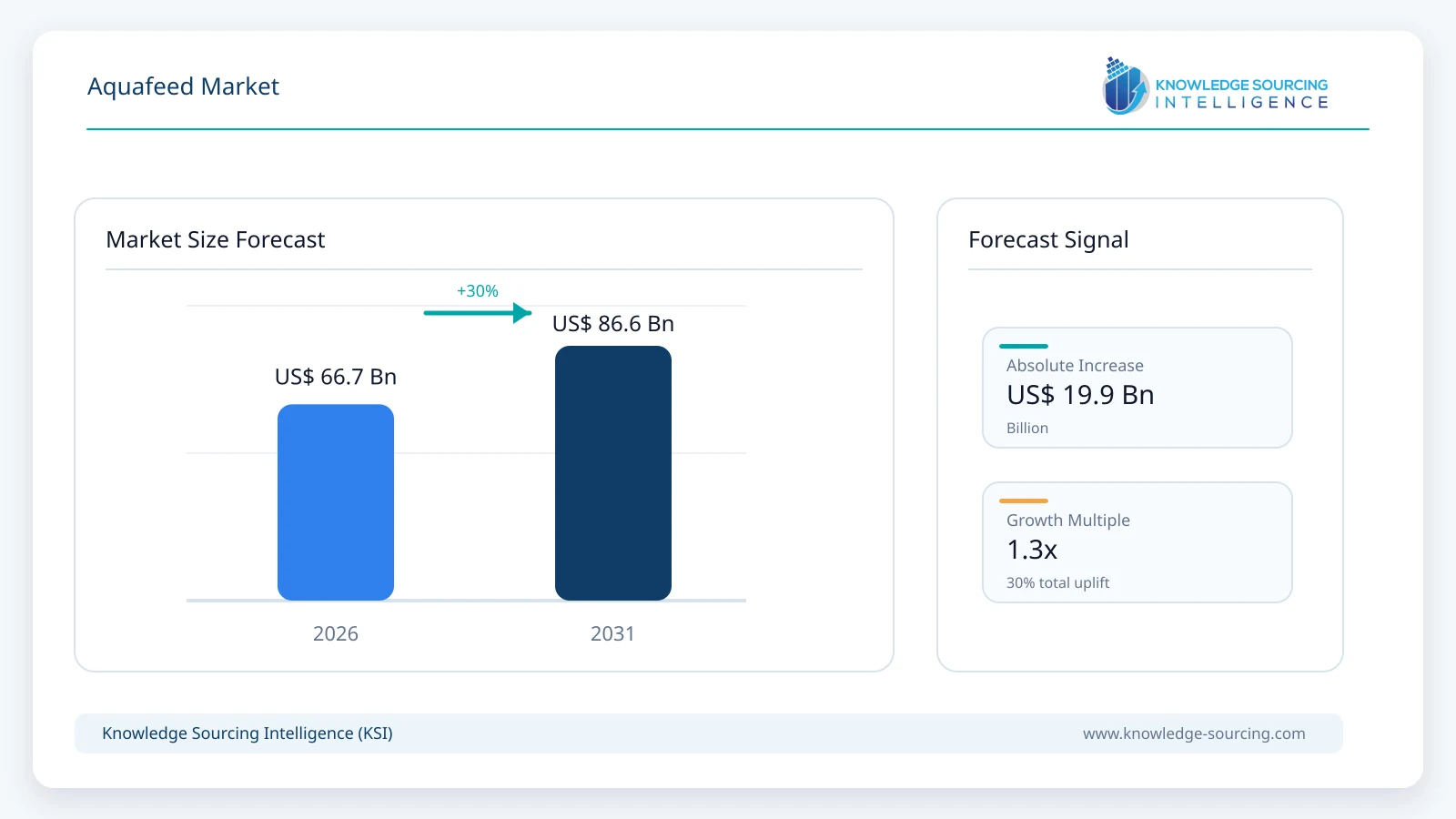
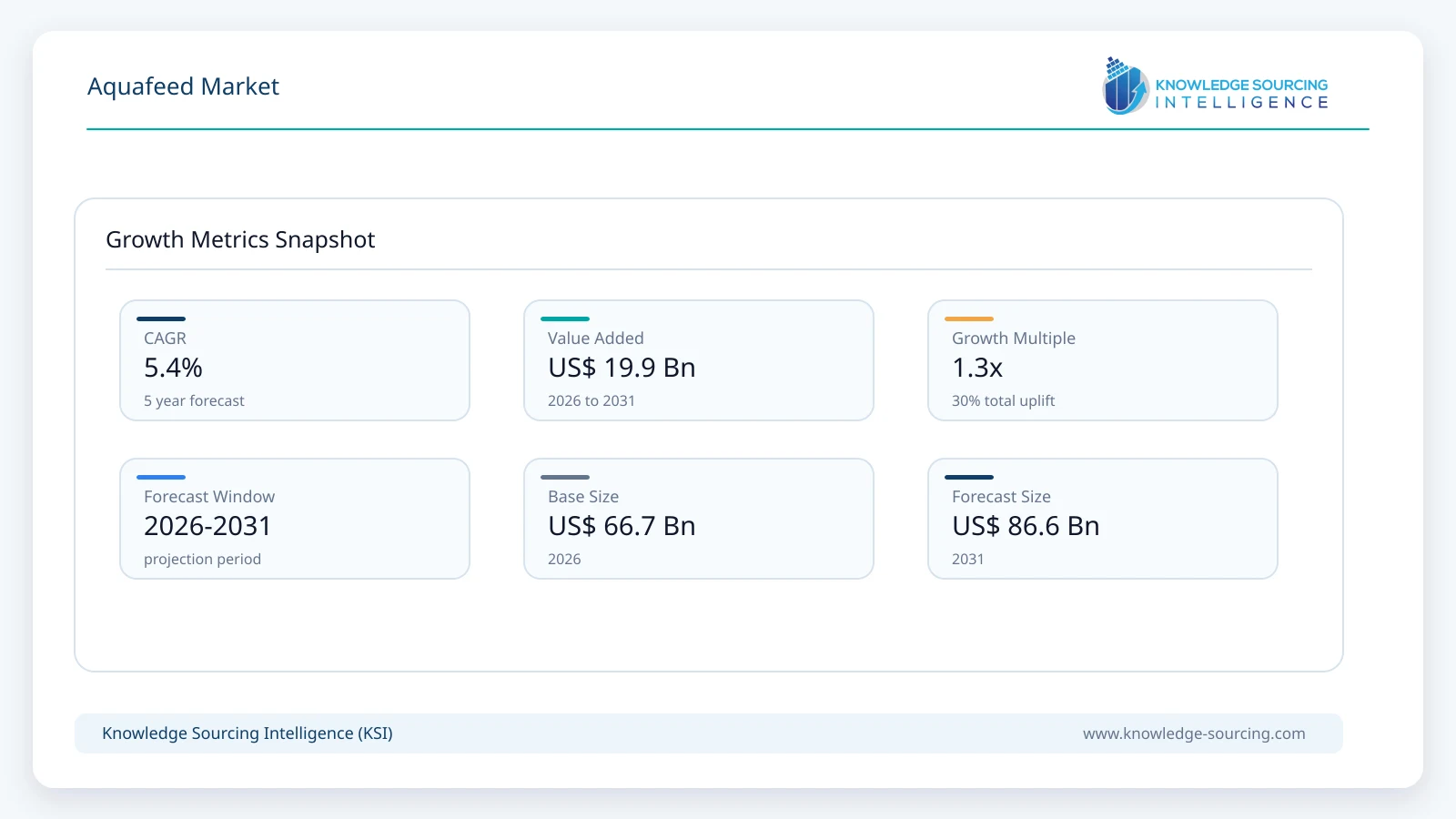
The aquafeed market is forecast to expand at a CAGR of 5.4%, reaching USD 86.6 billion in 2031 from USD 66.7 billion in 2026.
Highlights:
- 1Fish feed accounts for an estimated 64% of market value in 2026.
- 2Plant-based formulations are gaining importance as producers optimise digestible nutrient supply.
- 3Extruded pellets are central to specialised fish diets and waste-reduction requirements.
- 4Asia Pacific dominates purchases across major fish and shrimp farming economies.
- 5African aquafeed adoption is increasing where commercial diets replace farm-mixed feed.
- 6Certification and hatchery nutrition are strengthening differentiation among established feed manufacturers.
Aquafeed includes commercially manufactured complete and supplementary diets used to raise farmed finfish, shrimp and other fed aquatic animals from hatchery to harvest. Products encompass extruded or pressed pellets, crumbles, powdered starter feeds and liquid hatchery nutrition, with formulation influenced by species, water conditions and stage of growth. Feed manufacturers supply farmers and integrated aquaculture groups through mills, distributors and direct contracts.
China, India, Vietnam, Indonesia and Thailand sustain a large warmwater production base, while Norway, Chile, the United Kingdom and Canada anchor high-value salmon diets. Cargill, Skretting, BioMar, Charoen Pokphand Foods and other specialist manufacturers compete through nutrition performance, ingredient purchasing, manufacturing control and farm support. Producers able to document feed conversion, survival and traceable raw materials can defend a premium, although farmers remain highly exposed to feed costs.
Market Overview
The FAO’s State of World Fisheries and Aquaculture 2026 reported that aquaculture supplied 103 million tonnes of aquatic animals in 2024, exceeding 100 million tonnes for the first time. Commercial feed demand does not track all of that biomass: shellfish grown on natural plankton and extensive pond fish fed with on-farm materials have different purchased-feed requirements from salmon, marine finfish and intensive shrimp. The economic centre of the aquafeed market is the feed-conversion relationship between formulated diets, growth rates, mortality and the farm-gate value of seafood.
Alltech's 2025 Agri-Food Outlook measured 52.97 million tonnes of aquaculture feed production during 2024, with Asia Pacific accounting for 37.07 million tonnes. The same data recorded a year-on-year decline in global feed tonnage despite broader long-term aquaculture growth. That divergence reflects changes in biology, stocking, farm economics and production methods; it also makes value growth dependent on product mix and feed performance, not simply on more cultivated fish.
Cargill reported sales of 2.07 million tonnes of aquafeed from its disclosed operation in 2025, while BioMar disclosed material volumes across salmon, shrimp and selected-species feeds. Their activities illustrate how large international producers combine formulation research, dedicated milling and customer services. Marine-derived proteins and oils remain important for certain fatty-acid and palatability requirements, but plant protein, novel lipids, functional ingredients and refined nutrient specifications are changing the purchasing mix across regions.
Market Trends
Formulation Is Moving Towards Nutrient Utilisation
BioMar's October 2026 BioRetain introduction puts attention on the proportion of supplied nutrients retained in the farmed animal rather than only on crude protein percentages. Commercial diets increasingly balance digestible amino acids, energy, lipids and micronutrients for the species and water temperature. Such programmes have to prove results across feed batches and farming conditions: a theoretical improvement in nutrient availability has little value if palatability or pellet stability deteriorates.
This change alters feed-maker economics because the producer can reformulate using a wider ingredient pool while seeking consistent growth outcomes. It favours suppliers with feeding trials, laboratory capacity and procurement flexibility, especially when marine oils, fishmeal or soybean derivatives face price swings.
Shrimp Hatchery Nutrition Is Becoming More Specialised
Skretting introduced InVita, Ignis and Optiline Starters for shrimp producers in Ecuador in October 2026, extending the product range across larval, post-larval and nursery stages. Hatcheries need very different particle sizes, dispersal characteristics and nutrient profiles from grow-out ponds; a feed that remains suspended at an appropriate depth can affect intake and water quality.
Small hatchery quantities represent a limited share of global tonnage but can command a different value per kilogram than commodity grow-out pellets. This supports dedicated production systems, microbial control, testing and technical relationships with hatchery operators rather than a single recipe distributed across all life stages.
Feed Traceability Is Becoming a Commercial Qualification
BioMar's July 2026 ASC certification at its Viet-Uc operation extended certified aquafeed production into Asia, followed by certification of its Greek plant in September. The standard addresses raw-material responsibility and social and environmental controls alongside manufacturing practices. For producers selling into certified seafood chains, auditable input sourcing has become part of feed-supplier approval.
Compliance can require supplier documentation, segregation controls and traceable purchases of marine and terrestrial ingredients. Feed mills lacking these systems may still supply domestic customers, but export-oriented farms have an incentive to favour manufacturers able to support their certification obligations.
Feed Processing Is Adapting to New Farming Systems
Pellet durability, sinking rate and fine-particle loss matter differently in open-water cages, pond systems and recirculating aquaculture. Cargill described a specialised feed launched in early 2026 for closed salmon farms, where faecal stability and water treatment requirements can affect feed selection. Extrusion conditions and physical pellet properties therefore influence water management as well as nutrition.
Equipment upgrades and research capacity create advantages for larger feed makers, although performance differences need to be verified under farm conditions. For farmers, the purchasing decision typically weighs feed conversion, survival and maintenance cost against a higher per-tonne feed price.
Segment Analysis
By Additive: Amino Acid
Amino-acid-balanced nutrition underpins feed formulations for farmed salmon, tilapia and shrimp, because digestible lysine, methionine and other indispensable amino acids must match each species' growth needs. Deficiencies can constrain protein deposition even when a diet meets its headline crude-protein target. Feed developers increasingly use digestibility tests and targeted supplementation to compensate for variable plant proteins.
The amino-acid-led category is expected to approach USD 19.92 billion by 2031. Growth reflects higher nutritional precision in complete feeds rather than a comparable standalone market for feed-grade amino acids. Producers that can maintain amino-acid availability while reducing expensive marine raw materials are better positioned in competitive, cost-sensitive farming markets.
By Type: Fish
Fish feeds represent the largest species category because salmonids, tilapia, carp, catfish and marine finfish collectively span high-value formulated diets and high-volume warmwater production. The category is estimated to generate roughly USD 54.55 billion in 2031. Salmon feed sells at a different unit price from basic carp or tilapia pellets, making species composition important when translating production tonnage into value.
Cargill's EWOS business and BioMar's salmon segment concentrate on demanding coldwater diets, while suppliers across Asia compete in tropical freshwater feeds. Broad fish-feed demand is resilient, but margin and revenue expansion rely on customers adopting stage-specific feeds and on manufacturers achieving reliable delivery, nutritional consistency and farm support.
By Ingredient Source: Plant-Based
Plant-based proteins and energy sources form the principal ingredient base for much of commercial aquafeed, particularly high-volume warmwater fish and shrimp diets. Soy, cereals and their processed fractions provide scale, but nutritional quality varies with fibre, antinutritional factors and amino-acid digestibility. Marine-origin products are still added to many predominantly terrestrial formulations for palatability, key fatty acids and physiological performance.
Plant-based-dominant formulations are expected to account for around USD 68.41 billion of market value in 2031. The change in sourcing does not imply that marine ingredients will disappear. More exact diet formulation, validated processing methods and access to responsibly sourced alternatives will determine whether cost savings persist without compromising survival and growth.
By Feed Type: Extruded Pellets
Extruded pellets are projected to account for about 52% of market revenue in 2031. Producers can adjust density, expansion, moisture and particle characteristics to match floating or sinking behaviour, enabling use across freshwater fish, marine species and specialised farm systems. Extrusion is capital- and energy-intensive, yet well-controlled pellets can reduce fines and feed losses.
BioMar's announced expansion in Wuxi broadens access to specialist nursery and high-value species feeds rather than increasing standard pellet capacity alone. The economics of extrusion are particularly attractive when farms can measure the value of consistent feed conversion, product handling and reduced waste. Crumbles and powdered products remain important for early-stage fish and shrimp despite their smaller revenue pools.
Market Drivers
Expansion of Feed-Dependent Aquaculture
FAO's June 2026 assessment identified aquaculture as the principal source of growth in aquatic animal production. Intensive salmon cages, shrimp ponds and commercial tilapia operations purchase nutritionally complete diets throughout the production cycle, supporting recurring demand for feed ingredients, milling and logistics. The pace of additional feed purchases depends on the species farmed and the degree to which farms transition from natural food or farm-made mixtures.
Asia's large existing industry provides scale, while new warmwater operations in Africa and parts of Latin America can add feed volumes from a smaller base. Producers that offer dependable local availability and technical support are better placed to capture this transition than those relying only on a low quoted price.
Greater Attention to Feed Conversion and Survival
Feed typically represents a substantial operating expense for fish and shrimp farmers, so small changes in conversion efficiency can affect margins materially. Feed producers use digestibility testing, ingredient specifications and species-specific amino-acid profiles to reduce waste and support animal growth. Nutrition is particularly valuable during transfer, temperature changes and early life stages, when mortality can erase gains from lower feed costs.
Commercial adoption depends on replicated performance under farm conditions, not on laboratory nutrient claims. Larger companies combine trial programmes with on-farm services, while smaller regional producers compete through local recipes and rapid delivery.
Broader Availability of Alternative Ingredient Systems
Fluctuations in fishmeal and marine oil supply encourage inclusion of soybean derivatives, cereal proteins, microbial ingredients and other qualified raw materials. Changing recipes requires balancing digestible amino acids and lipids while checking contaminants and feed stability. BioMar's nutrient-utilisation approach and Cargill's ingredient sourcing programmes illustrate the importance of the formulator's technical capability.
A wider qualified ingredient base can reduce exposure to single-source disruptions and help buyers meet environmental requirements. However, substitution remains species- and growth-stage-specific, so the market does not shift uniformly towards one raw-material source.
Hatchery and Specialty Feed Product Development
Larval fish and shrimp require finely controlled feed particles and targeted nutrient delivery, while broodstock and recovery diets often need higher-value formulations. Skretting's LifeStart launch in Ecuador provides a recent example of suppliers extending beyond grow-out pellets into more specialised product categories.
These offerings create differentiated price points and increase the importance of manufacturing hygiene, analytical testing and trial support. Their influence on value can be disproportionately large relative to feed tonnage, though hatchery products remain smaller than mainstream grow-out diets.
Certification and Export-Market Requirements
Major seafood buyers increasingly scrutinise feed origins, environmental performance and responsible raw-material purchasing. ASC Feed certification at BioMar's Vietnamese and Greek factories demonstrates how feed producers respond to conditions imposed along export-oriented value chains. Traceability also affects marine ingredient sourcing and the documentation of terrestrial commodities.
Manufacturers with verifiable practices gain an advantage when supplying farms seeking market access and longer-term customer contracts. Adoption remains uneven where domestic prices dominate purchasing decisions, but certification can shape specifications for higher-value fish and shrimp production.
Market Restraints
Volatile Marine and Agricultural Input Costs
Fishmeal, fish oil, soybean products, wheat and other feed inputs face different supply cycles. Marine raw materials depend on regulated wild-catch fisheries and processing yields, while land-based crops face weather, logistics and trade-policy risks. Feed suppliers cannot always pass sudden cost increases to farmers without disrupting purchasing or pushing buyers towards cheaper rations.
Margins are vulnerable where feed prices are reset frequently but customers operate on fixed harvest schedules. More formulation flexibility mitigates the exposure, though abrupt substitutions can reduce palatability or digestibility if not fully validated.
Aquatic Disease and Farm Production Interruptions
Shrimp disease events, sea lice pressure and fish health incidents can reduce stocking, feeding days or harvest volumes. In some regions, farmers respond by delaying restocking even when feed factories remain available. Alltech's 2024 survey also illustrated how biological and climatic setbacks can cause feed-tonnage declines while aquaculture retains a positive longer-term outlook.
Feed makers face exposure through lower plant utilisation and slower receivables, not merely through short-term sales volume. Geographical diversification and specialised health feeds can provide resilience but cannot remove biological production risk.
Feed Efficiency Versus Initial Purchase Price
Smaller producers often compare feed invoices rather than total cost per kilogram of harvested fish. Higher-performance rations may reduce conversion losses, yet the advantage varies with fish strain, farm management and water quality. A premium formula that performs well in one farm environment may not achieve the same result elsewhere.
Suppliers must therefore demonstrate farm-level economics through practical trials and consistent batches. Where credit availability is limited, low-cost feeds may retain share despite the potential advantage of more advanced nutrition.
Regulatory and Certification Complexity
Approvals for feed additives, veterinary substances, novel proteins and functional claims differ by country. Antibiotic inclusion, in particular, may be restricted or tightly governed by veterinary rules, residue limits and market-access standards. A formulation acceptable for one export chain may require revision before use in another production territory.
Additional traceability, testing and segregation measures increase the cost of serving regulated buyers. International feed companies can spread compliance overhead across sites, whereas smaller manufacturers may find repeated product registration and audit expense more difficult to absorb.
Manufacturing, Water Quality and Logistics Constraints
Moisture control, extrusion performance, storage temperature and pellet integrity affect both feed stability and farm results. Long transport distances in tropical climates can degrade sensitive ingredients, and poorly handled feed can contribute to fines, nutrient leaching and pond-water deterioration. Hatchery diets require tighter production control than standard grow-out pellets.
Capacity expansion must be matched to species demand and reliable distribution rather than only to headline aquaculture output. In markets with fragmented farms, distribution and customer support can absorb resources comparable to those needed for additional milling capacity.
Regional Outlook
Asia Pacific
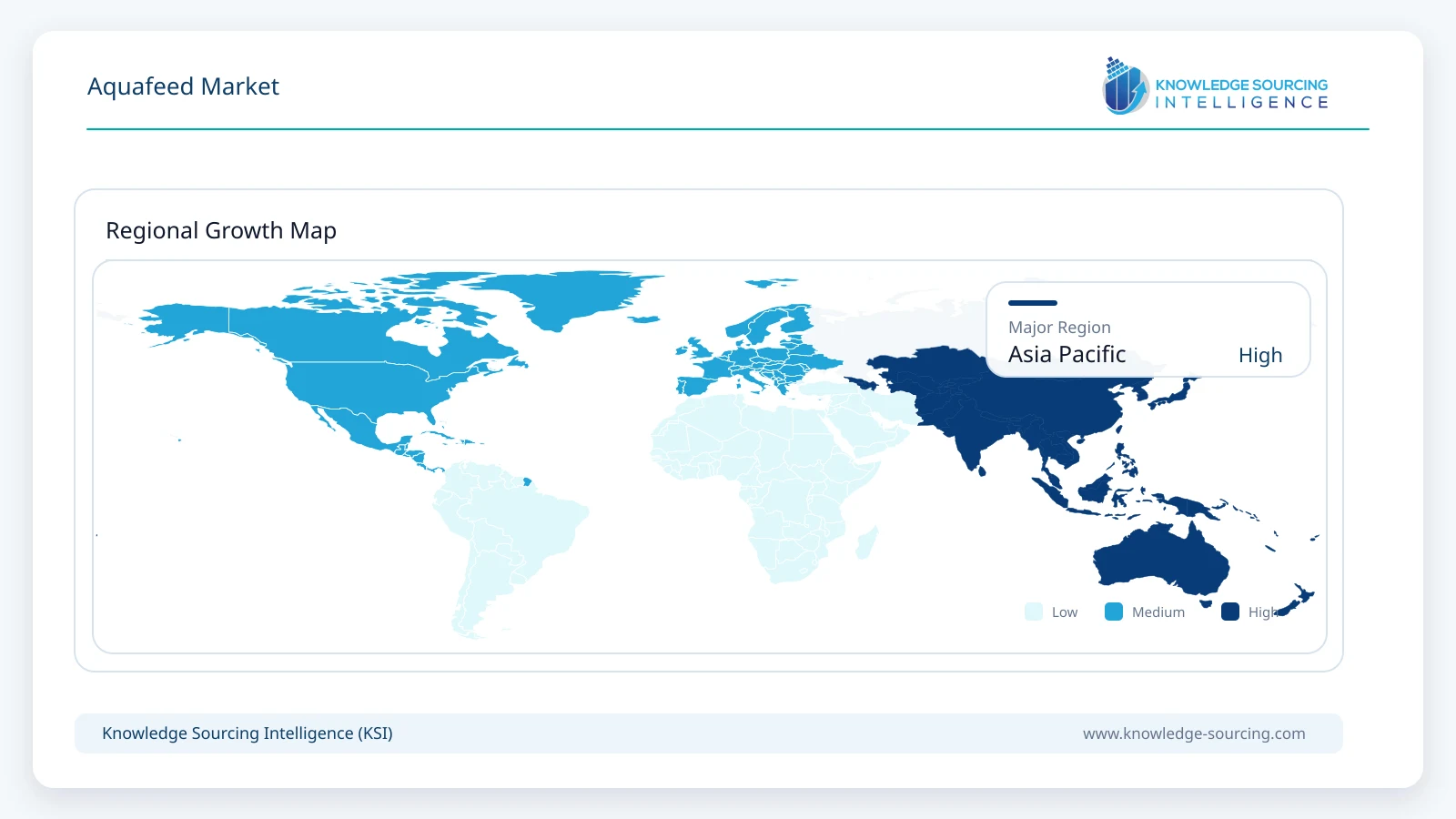
Asia Pacific is expected to represent about 65.5% of aquafeed revenue in 2026, reflecting its extensive farmed fish and shrimp production in China, India, Vietnam, Indonesia and Thailand. The region's volume dominance is documented by Alltech, which measured 37.07 million tonnes of aquafeed production during 2024. Warmwater farms buy large amounts of cost-sensitive feeds, while marine finfish, hatchery and high-density production create demand for more specialised diets.
China remains the core feed-manufacturing centre, though short-term farm margins and disease pressures can interrupt throughput. BioMar's Wuxi expansion and Viet-Uc certification show investment in higher-value nutrition and traceability rather than reliance on tonnage alone. Regional revenue growth will depend on stocking recovery, improved feed efficiency and the mix between locally formulated commodity rations and high-performance feeds.
Middle East and Africa
Commercial feed demand in the Middle East and Africa is forecast to rise at approximately 9.7% a year through 2031 from a relatively small base. Alltech reported a 9.1% increase in African aquafeed tonnage in 2024, although Middle Eastern volumes declined slightly. Egypt's established tilapia industry provides a substantial existing market, while Nigeria, Kenya and other African countries offer opportunities as commercial diets substitute for on-farm mixing.
Feed availability, access to finance and hatchery quality will determine how quickly that potential translates into sales. WorldFish's African feed research is targeting affordability and species-specific nutrient requirements, reflecting the practical limits to high-cost imported diets. Expansion in this region is expected to be uneven across countries and does not challenge Asia Pacific's leadership during the forecast period.
Competitive Landscape
Cargill, Skretting and BioMar compete at the higher end of international aquafeed supply through species-specific research, controlled manufacturing and farm service. Cargill operates a substantial global aquaculture nutrition business, while Skretting combines broad fish and shrimp feed lines with health and early-life products. BioMar's public segment disclosures illustrate significant differentiation between salmon, shrimp and selected-species diets and the importance of serving farmers at different product price points.
Charoen Pokphand Foods, Guangdong Haid Group, Tongwei, New Hope Liuhe, Grobest, Avanti Feeds, Thai Union Feedmill, De Heus, Ridley/Primo and Alltech Coppens participate in defined species or regional feed markets. Competitive strength depends on mill proximity, input procurement, credit terms and nutritional consistency as much as on a large manufacturing footprint. Companies with both feed and farming operations may enjoy demand visibility, although their integrated farm output should not be mistaken for separate third-party feed sales.
Ingredient diversification and certification are becoming more important to supplier selection. International companies can invest in traceability and product trials, whereas local competitors often retain an advantage through distribution reach and diets adapted to local water conditions. No single company should be assigned a global market share without a comparable, audited revenue base spanning all commercial aquafeed categories.
Recent Developments
21 October 2026: Skretting launched InVita, Ignis and Optiline Starters in Ecuador, extending early-life shrimp nutrition from larval stages into nursery feeding.
15 October 2026: BioMar introduced BioRetain, a feed-formulation approach focused on nutrient utilisation and raw-material flexibility.
16 September 2026: ADM opened its Tianjin hatchery and nursery aquafeed facility in China with approximately 5,000 tonnes of annual design capacity.
22 July 2026: BioMar Viet-Uc received ASC Feed certification for its Vietnamese fish and shrimp feed manufacturing operation.
11 June 2026: ADM Bern Aqua received Best Aquaculture Practices certification at its Olen, Belgium, mill serving fish and shrimp hatcheries.
11 February 2026: BioMar disclosed plans to add a second production line in Wuxi, China, targeting expanded specialty and nursery feed capacity during 2026.
Market Outlook
The balance of aquafeed growth through 2031 is likely to shift towards higher feed conversion, specialised hatchery diets and formulations that use a broader selection of verified ingredients. Producers that can combine reproducible farm performance with stable supply chains should be better positioned than those competing only on mill capacity. Fish feed will remain the principal revenue category, while sophisticated shrimp and early-stage products generate differentiated pricing opportunities.
Asia Pacific will retain scale leadership, but margin improvement there depends on farming economics and access to more productive formulations. The Middle East and Africa offers faster percentage growth from a smaller base, subject to hatchery, credit and logistics development. Demand for certification, farm support and traceable sourcing should reinforce relationships between feed manufacturers and higher-value export-oriented farms without eliminating local low-cost competitors.
Aquafeed Market Scope
| Report Metric | Details |
|---|---|
| Total Market Size in 2026 | USD 66.7 billion |
| Total Market Size in 2031 | USD 86.6 billion |
| Forecast Unit | Billion |
| Growth Rate | 5.4% |
| Study Period | 2021 to 2031 |
| Historical Data | 2021 to 2024 |
| Base Year | 2025 |
| Forecast Period | 2026 – 2031 |
| Segmentation | Additive, Type, Ingredient Source, Feed Type, Geography |
| Companies |
|
| Customization Scope | 15% Free Customization included with purchase — Request Custom Breakdown → |
| Sample & Data Access | PDF Sample, Excel Databook & Analyst Briefing — Download Free Sample → |
Market Segmentation
By Additive
Amino Acid
Vitamins & Minerals
Antibiotics & Antimicrobials
Feed Acidifiers & pH Regulators
Others
By Type
Fish
Mollusks
Crustaceans
Others
By Ingredient Source
Marine-Based
Plant-Based
By Feed Type
Extruded Pellets
Crumble
Powdered Feed
Liquid Feed
By Geography
Asia Pacific
China
India
Indonesia
Vietnam
Thailand
Japan
South Korea
Taiwan
Others
South America
Ecuador
Chile
Brazil
Argentina
Others
Europe
Norway
United Kingdom
Germany
France
Italy
Spain
Others
Middle East and Africa
Egypt
Nigeria
Saudi Arabia
United Arab Emirates
Others
North America
United States
Canada
Mexico
Table of Contents
1. EXECUTIVE SUMMARY
2. MARKET SNAPSHOT
2.1. Market Overview
2.2. Market Definition
2.3. Scope of the Study
2.4. Market Segmentation
3. BUSINESS LANDSCAPE
3.1. Market Drivers
3.1.1. Expansion of Feed-Dependent Aquaculture
3.1.2. Greater Attention to Feed Conversion and Survival
3.1.3. Broader Availability of Alternative Ingredient Systems
3.1.4. Hatchery and Specialty Feed Product Development
3.1.5. Certification and Export-Market Requirements
3.2. Market Restraints
3.2.1. Volatile Marine and Agricultural Input Costs
3.2.2. Aquatic Disease and Farm Production Interruptions
3.2.3. Feed Efficiency Versus Initial Purchase Price
3.2.4. Regulatory and Certification Complexity
3.2.5. Manufacturing, Water Quality and Logistics Constraints
3.3. Market Opportunities
3.4. Porter’s Five Forces Analysis
3.5. Industry Value Chain Analysis
3.6. Policies and Regulations
3.7. Strategic Recommendations
4. TECHNOLOGICAL OUTLOOK
4.1. Species-Specific Nutrition
4.2. Alternative Marine and Terrestrial Ingredients
4.3. Pellet Processing and Nutrient Retention
4.4. Hatchery and Functional Feed Development
5. AQUAFEED MARKET BY ADDITIVE
5.1. Introduction
5.2. Amino Acid
5.3. Vitamins & Minerals
5.4. Antibiotics & Antimicrobials
5.5. Feed Acidifiers & pH Regulators
5.6. Others
6. AQUAFEED MARKET BY TYPE
6.1. Introduction
6.2. Fish
6.3. Mollusks
6.4. Crustaceans
6.5. Others
7. AQUAFEED MARKET BY INGREDIENT SOURCE
7.1. Introduction
7.2. Marine-Based
7.3. Plant-Based
8. AQUAFEED MARKET BY FEED TYPE
8.1. Introduction
8.2. Extruded Pellets
8.3. Crumble
8.4. Powdered Feed
8.5. Liquid Feed
9. AQUAFEED MARKET BY GEOGRAPHY
9.1. Introduction
9.2. Asia Pacific
9.2.1. China
9.2.2. India
9.2.3. Indonesia
9.2.4. Vietnam
9.2.5. Thailand
9.2.6. Japan
9.2.7. South Korea
9.2.8. Taiwan
9.2.9. Others
9.3. South America
9.3.1. Ecuador
9.3.2. Chile
9.3.3. Brazil
9.3.4. Argentina
9.3.5. Others
9.4. Europe
9.4.1. Norway
9.4.2. United Kingdom
9.4.3. Germany
9.4.4. France
9.4.5. Italy
9.4.6. Spain
9.4.7. Others
9.5. Middle East and Africa
9.5.1. Egypt
9.5.2. Nigeria
9.5.3. Saudi Arabia
9.5.4. United Arab Emirates
9.5.5. Others
9.6. North America
9.6.1. United States
9.6.2. Canada
9.6.3. Mexico
10. COMPETITIVE ENVIRONMENT AND ANALYSIS
10.1. Major Players and Strategy Analysis
10.2. Market Share Analysis
10.3. Mergers, Acquisitions, Agreements and Collaborations
10.4. Competitive Dashboard
11. COMPANY PROFILES
11.1. Cargill, Incorporated
11.2. Nutreco N.V. (Skretting)
11.3. BioMar Group
11.4. Charoen Pokphand Foods Public Company Limited
11.5. Guangdong Haid Group Co., Ltd.
11.6. Tongwei Co., Ltd.
11.7. New Hope Liuhe Co., Ltd.
11.8. Grobest Group
11.9. Avanti Feeds Limited
11.10. Thai Union Feedmill Public Company Limited
11.11. De Heus Animal Nutrition
11.12. Alltech Coppens
12. APPENDIX
12.1. Currency
12.2. Assumptions
12.3. Base and Forecast Years
12.4. Key Benefits for Stakeholders
12.5. Research Methodology
12.6. Abbreviations





Frequently asked questions
What is the forecasted Aquafeed Market value by 2031?
The Aquafeed Market is forecast to reach USD 86.6 billion by 2031, growing at 5.4% CAGR.
Which aquafeed segment holds the largest market value in 2026?
Fish feed accounts for an estimated 64% of the market value in 2026.
Which region is projected to dominate aquafeed purchases?
Asia Pacific dominates purchases across major fish and shrimp farming economies.
What key ingredient trend is important in aquafeed formulations?
Plant-based formulations are gaining importance to optimize digestible nutrient supply.
Who are some of the major companies in the Aquafeed Market?
Cargill, Skretting, BioMar, and Charoen Pokphand Foods are specialist manufacturers.
What is strengthening differentiation among established aquafeed manufacturers?
Certification and hatchery nutrition strengthen differentiation among established feed manufacturers.
Cite this report
Knowledge Sourcing Intelligence. (Oct 2026). Aquafeed Market - Strategic Insights and Forecasts (2026-2031). https://www.knowledge-sourcing.com/report/aquafeed-market