
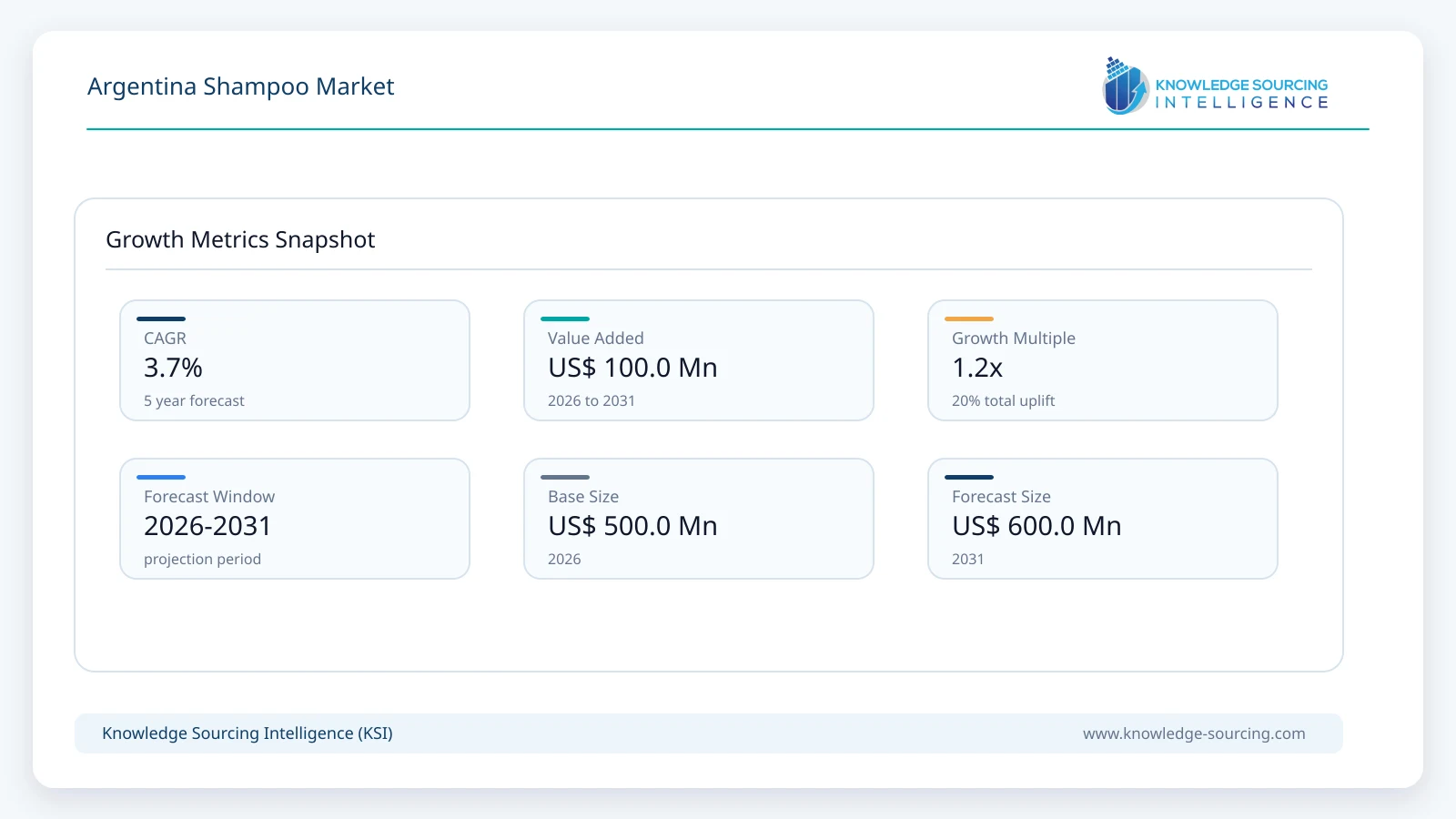
The Argentina Shampoo Market is forecast to grow at a CAGR of 3.7%, reaching USD 600.0 million in 2031 from USD 500.0 million in 2026.
Highlights:
- 1Regular shampoos retain the broadest consumer base through routine household replenishment and mass retail.
- 2Household purchasing represents approximately 92% of 2026 shampoo market value.
- 3Specialist scalp-care formulations strengthen differentiation without displacing conventional cleansing products.
- 4Online stores gain reach through assortment breadth, product comparison and recurring promotional events.
- 5Buenos Aires leads national demand, while Córdoba records faster modeled growth over the forecast period.
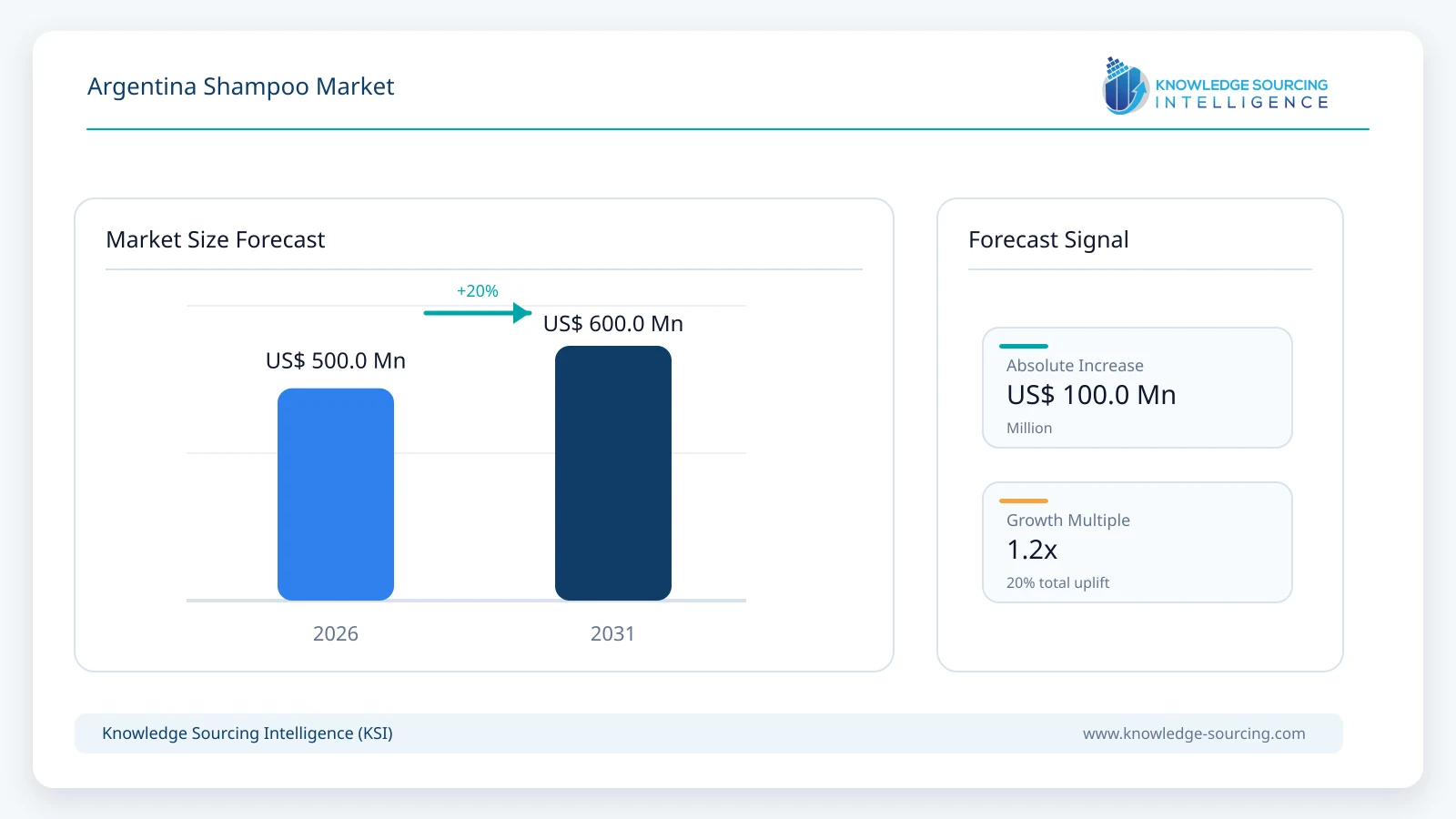
The Argentina shampoo market comprises packaged products primarily used to cleanse the scalp and hair, including conventional cosmetic shampoos, anti-dandruff preparations, and other specialty shampoos sold through retail or professional channels. Household purchases generate the bulk of demand, but salons, hospitality establishments and other commercial users buy professional packs and repeat-use supplies. Shampoo revenue is considered at finished-product market value, excluding conditioners, masks, hair dyes, styling products and other treatments that are not principally shampoos.
Brand owners compete by hair type, perceived efficacy, pack size and promotional price. Unilever’s Dove, Sedal/Sunsilk and TRESemmé, L’Oréal’s Elvive and professional lines, P&G’s Pantene and Head & Shoulders, and Natura’s Lumina portfolio illustrate different approaches to mass, treatment and salon-inspired positioning. Domestic producers serve specialized formulations and contract-manufacturing requirements. Continued competition between established brands, pharmacy-led specialist ranges and lower-priced alternatives will shape both value growth and the mix of products sold.
Market Overview
Argentina’s shampoo market is shaped as much by purchasing-power discipline as by formulation innovation. Household hair washing is a recurring necessity, but consumers can move between brands, package sizes and retail formats when real incomes are pressured. INDEC’s April 2026 supermarket survey reported a year-on-year rise of 25.2% in nominal sales for the combined cleaning and perfumery category, a broad grouping that does not isolate shampoo or establish equivalent real-volume growth. The distinction matters because nominal retail sales can rise while the volume of individual personal-care products changes more slowly.
Manufacturers maintain contrasting positions in the market. Unilever and L’Oréal offer wide portfolios spanning everyday cleansing, anti-frizz, damage repair and premium professional products; P&G targets hair strength and scalp-care needs through Pantene and Head & Shoulders. Natura’s locally available Lumina shampoos and refill packs show how a differentiated offer can combine treatment claims with lower-packaging-use formats. Argentine producer Capilatis lists dedicated anti-dandruff, anti-hair-fall and neutral-pH products, while Algabo operates a domestic cosmetics manufacturing and distribution platform, providing alternatives outside the multinational brand ecosystem.
Regulatory and distribution conditions influence product economics. ANMAT’s 2026 updates to cosmetic-ingredient restrictions affect how companies formulate or relabel anti-dandruff and other specialist products, while establishment and import-declaration procedures alter compliance workflows without removing safety obligations. CACE reported 181.5 million online orders across Argentine e-commerce in the first half of 2026, confirming digital shopping activity across product categories rather than a shampoo-specific channel share. Producers still have to win repeat purchases through cleaning performance, price competitiveness and dependable availability across stores and online listings.
Market Trends
Scalp-Care Claims Are Becoming More Technical
Anti-dandruff, anti-hair-fall and sensitive-scalp shampoos increasingly compete on claims linked to active ingredients and targeted conditions rather than fragrance alone. Capilatis markets shampoos for dandruff and hair-fall concerns, while multinational hair-care producers are investing in fibre-repair and scalp science. These products can command greater attention from consumers who have already defined a specific hair or scalp problem, but benefit claims must remain consistent with the product’s regulatory classification.
ANMAT updated the permissible conditions for ingredients used in rinse-off anti-dandruff products in May 2026, including zinc pyrithione and climbazole. This directly affects formulation assessment and technical documentation, particularly for multinational suppliers managing multiple Latin American labels. Regulatory consistency can support broader product availability, although reformulation and testing expenditure may raise the cost of introducing specialist lines.
Repair and Performance Formulas Are Broadening the Premium Tier
Hair repair is moving from occasional salon treatments into daily shampoo ranges built around proteins, strengthening systems and targeted cleansing. L’Oréal’s Elvive franchise and P&G’s Pantene line illustrate the competitive use of familiar product families to support new treatment-oriented claims. Unilever has similarly emphasized fibre-repair science in Dove and introduced more technically positioned TRESemmé products internationally, illustrating an innovation pipeline rather than evidence that all international releases are available locally.
Premiumisation remains conditional on spending power. A household may purchase a more expensive shampoo for a specific need while retaining a lower-priced alternative for everyday use. Manufacturers therefore need an accessible entry price, credible product benefits and a clear distinction between shampoo and companion treatments; selling a combined hair-care routine does not make all products part of shampoo revenue.
Digital Discovery Is Reshaping Assortment Competition
Argentina’s e-commerce growth gives shampoo suppliers an additional route to consumers who want to compare formulations, pack sizes and discounts without relying on a single local store’s inventory. CACE’s mid-2026 study reported growth in digital order volumes across the economy, with personal-care products among the prominent categories by units sold. The market implication is greater visibility for niche and treatment-led brands as well as new pressure on established mass brands to manage prices consistently.
Online sales do not automatically eliminate physical distribution costs. Fulfilment fees, payment terms and promotional subsidies can absorb part of the margin advantage, especially for low-value single packs. Larger multipacks, refill pouches and recurring orders can improve delivery economics, while pharmacies and supermarkets remain important for immediate replenishment.
Packaging Choices Are Tied to Refill Economics
Packaging differentiation is most useful when it changes the value proposition for consumers or the production cost for suppliers. Natura’s Lumina offer includes refill formats for selected shampoos, giving consumers an alternative to repeated rigid-bottle purchases. Global manufacturers also continue working on recycled-plastic formats, but claims about packaging improvement should be attributed to the specific market or rollout rather than assumed to apply uniformly to Argentina.
Refills require stable formulations, recognizable branding, and packaging that protects the product during distribution. If pouches are inconvenient to handle or priced too close to complete bottles, uptake may remain limited. The stronger commercial case is a combination of lower material usage, visible savings, and reliable availability in the same retail channels where the parent shampoo brand is sold.
Segment Analysis
By Product: Non-Medicated/Regular Shampoo
Non-medicated and regular shampoos contribute an estimated 88% of market value in 2026, supported by frequent household use and a much wider range of affordable alternatives than therapeutic or specialist products. Shelf space is spread across anti-frizz, moisturising, smoothing and everyday cleansing variants, allowing established manufacturers to defend volume by offering different formulations within recognizable brand families. Regular products are also the main entry point for retailer promotions and value-size packs.
Their forecast revenue reaches approximately USD 516 million in 2031, even as some incremental spending moves toward more specialized scalp and damage-repair products. Suppliers can retain leadership by improving routine-use formulations and sustaining price ladders rather than treating premium shampoos as a replacement for mass-market demand. Specialist products may gain value share faster, but the basic cleansing occasion remains the category’s largest commercial foundation.
By Application: Household
Household users represent the main point of consumption because shampoo is purchased for repeated personal use across family members and age groups. Supermarkets, neighborhood shops, pharmacies, direct-selling catalogs and digital storefronts compete for these purchases. Pack sizes and frequency vary with family composition, hair-washing habits and purchasing power, while commercial use is concentrated in salons, hotels and selected institutional settings.
The household segment is projected at approximately USD 540 million in 2031. Its large base does not imply identical consumer preferences: affordable routine shampoos compete alongside targeted anti-dandruff products and premium hair-care ranges, often within the same household. Manufacturers able to maintain multiple price tiers and consistent distribution are better placed to capture category value without depending exclusively on promotional spikes.
By Distribution Channel: Hypermarkets/Supermarkets
Hypermarkets and supermarkets remain the largest single formal retail channel in the market, with estimated sales of USD 230 million in 2026. Their advantage comes from established procurement arrangements, prominent shelf placement and the ability to bundle shampoos with broader household-shopping occasions. Consumers can compare prices, bottle sizes and familiar brands at the point of sale, making visible promotional conditions an important input to product selection.
By 2031, this channel is expected to retain substantial revenue even as its relative position is moderated by online stores and alternative neighborhood formats. INDEC’s supermarket data provide a useful view of broader cleaning and perfumery purchasing conditions but do not supply shampoo-only shares. Retail suppliers must consequently manage discounts, inventory availability and premium shelf positioning without equating the growth of the entire supermarket category with shampoo growth.
By Manufacturers: Multinational
Multinational-owned shampoo portfolios are estimated to account for 70% of market value in 2026. Unilever, L’Oréal, P&G and Henkel benefit from international product-development capabilities, brand investment and relationships with large Argentine retailers. The model assigns their finished-product sales to this category irrespective of whether particular items are manufactured locally or imported, avoiding the double-counting that would arise from combining brand revenue with contract-manufacturer turnover.
The competitive advantage is not confined to advertising expenditure. Large suppliers can cover entry, mid-market and specialist price points while sustaining ingredient research, regulatory documentation and retail trade support. Domestic companies and retailer-owned labels remain relevant because they can focus on local pricing needs and shorter production runs, narrowing the gap when consumers prioritize affordability over brand provenance.
Market Drivers
Recurring Personal-Hygiene Consumption
Shampoo benefits from repeated household use rather than a discretionary one-time purchase. Even when consumers trade down between brands or reduce the frequency of premium purchases, basic cleansing remains a routine need. Producers therefore have a relatively predictable base of replenishment occasions compared with more optional hair-styling categories.
Value growth depends on the interaction of actual packs sold, pack size and realized prices. Affordable ranges, smaller packs and family formats can defend volume when consumer budgets tighten; targeted formulas provide a second path to value growth when purchasing conditions improve.
Wider Availability Across Retail Formats
Argentina’s mix of organized supermarkets, neighborhood shops, pharmacies and beauty stores broadens the range of occasions when shampoo can be purchased. Established mass brands benefit from repeated exposure across locations, while specialist domestic producers can pursue pharmacies or direct-to-consumer distribution where their positioning is more credible.
Availability has a measurable commercial effect because shampoo is easy to substitute when a preferred product is out of stock. Manufacturers that improve replenishment, regional wholesaler coverage, and affordable assortment can protect sales without needing a large change in underlying hair-washing frequency.
Consumer Interest in Targeted Hair Care
Hair-loss concerns, scalp condition, and damage from coloring create distinct product needs within an otherwise mature cleansing category. Capilatis offers shampoos for particular scalp and hair characteristics, while international brands continue developing repair- and anti-dandruff-oriented ranges. These product choices allow manufacturers to distinguish prices and performance claims.
Demand is not uniform across all treatment propositions. Claims must remain credible, ingredients acceptable under current regulation, and performance understandable to purchasers. Commercial gains are most likely where a targeted shampoo provides a straightforward benefit while remaining practical for repeated use.
Growth in Online Personal-Care Purchases
Digital shopping allows consumers to review technical descriptions, compare specialized shampoos and select refill options outside the local store’s assortment. CACE reported a rise in online orders in the first half of 2026, reinforcing the reach of digital retail in Argentina, though the figure covers many merchandise categories.
For shampoo manufacturers, the direct opportunity is improved discovery and broader geographic coverage rather than the entire countrywide e-commerce growth rate. Product bundles and reorder-friendly formats can make shipping more economical, while online reviews heighten the importance of consistent performance.
Domestic Manufacturing and Portfolio Breadth
Argentine manufacturers such as Algabo and Capilatis show that product formulation and brand development are not restricted to international companies. Local manufacturing capacity can shorten some supply chains and support pack adaptations suited to domestic distribution, provided key ingredients and packaging remain available.
Domestic producers can serve both differentiated botanical or scalp-care niches and more price-sensitive shoppers. Their competitiveness depends on manufacturing efficiency, regulatory compliance and access to retail partners, not simply on the local origin of a formulation.
Market Restraints
Weak Purchasing Power and High Promotional Dependence
Argentine households face fluctuating real purchasing power, making price and immediate availability central to shampoo choice. A premium product can lose volume if its price gap widens relative to mass brands or store labels. This creates pressure to spend on promotions even when the producer’s input costs are rising.
The constraint is especially strong for everyday cleansing products, where switching costs are low. Suppliers must balance introductory offers with durable margins and avoid using broad nominal retail-sales growth as evidence of stronger real shampoo consumption.
Imported Ingredients and Exchange-Rate Exposure
Shampoo formulations use surfactants, conditioning agents, fragrances, preservatives and packaging components that can face imported-input exposure. Currency movements and changes in import costs can therefore affect finished-product pricing and working capital even for locally manufactured brands.
Manufacturers have limited ability to reformulate established products instantly: ingredient substitution requires compatibility testing and may change fragrance, viscosity, or conditioning performance. Persistent cost volatility narrows the room for stable price ladders and long-term retailer agreements.
Product-Claim and Ingredient Compliance
Anti-dandruff and other specialized shampoos face detailed ingredient conditions and requirements for permissible consumer claims. ANMAT’s 2026 updates to MERCOSUR-aligned substance lists affect formulation evaluation and label decisions. Suppliers with multiple regional variants must determine whether one formulation remains suitable for all intended markets.
Compliance can increase testing, documentation and product-adjustment costs, particularly for smaller manufacturers. Streamlined establishment processes do not eliminate applicable good manufacturing practices or the responsibility to ensure finished cosmetics are safe.
Shelf-Space Competition and Substitution
Large supermarkets allocate shelf space across major branded portfolios, value labels and limited promotional features. A new shampoo variant therefore competes not only against products from other manufacturers but also against multiple variants owned by the same supplier. Strong brand recognition may not guarantee incremental distribution.
Retail concentration can magnify trade-promotion costs and make smaller formats less economic to distribute. Local niche brands may rely on pharmacies or online stores, where marketing expense and fulfilment costs create different pressures on profitability.
Higher Cost of Specialist Formulations and Packaging
Premium active ingredients, botanical extracts and more complex packaging raise product-development and quality-control requirements. Refill options introduce separate material and handling considerations; they are not automatically cheaper to deliver once conversion costs and logistics are considered.
Consumers may appreciate specialist claims or lower-plastic formats without paying a proportionate premium. Manufacturers must demonstrate visible value through performance, convenience or per-use economics to justify a meaningful increase in price.
Regional Outlook
Buenos Aires
Buenos Aires, including the City of Buenos Aires and the surrounding province within this market allocation, represents an estimated 47% of national shampoo value in 2026. The concentration follows its population scale, dense organized retail network and large base of pharmacies, salons and specialist beauty outlets. Consumers in the metropolitan area can move across premium, mass and direct-selling channels, while major brand owners gain distribution efficiency from concentrated demand.
Regional market value is projected at approximately USD 277 million by 2031, retaining the largest national position even as faster development elsewhere slightly reduces its share. High retail competition makes promotional execution and assortment differentiation especially important; large volumes do not necessarily translate into the highest growth rate. Buenos Aires also serves as a distribution gateway for suppliers reaching the interior through national wholesale and e-commerce networks.
Córdoba
Córdoba is projected to be the fastest-growing individually modeled provincial market, expanding at approximately 6.6% annually from 2026 to 2031. Its urban population, significant commercial centers and expanding access to organized distribution support greater assortment penetration. The opportunity includes both mainstream products distributed through chains and specialist hair-care ranges available in pharmacies and online listings.
Córdoba’s estimated share of national market value rises from 9.6% in 2026 to 11.0% in 2031. The shift reflects distribution gains and gradual trading up rather than an assumption that hair-washing frequency can increase indefinitely. Suppliers may capture additional value through localized stock availability, affordable premium formats and professional retail partnerships, while competitive prices remain essential outside the largest urban centers.
Competitive Landscape
Unilever, L’Oréal and P&G compete through brand portfolios that cover routine cleansing, scalp benefits, repair and premium positioning. Unilever owns Dove, Sedal/Sunsilk and TRESemmé, while L’Oréal operates Elvive and professional hair-care franchises and P&G supplies Pantene and Head & Shoulders. These manufacturers can renew products through international research capabilities, but Argentine retail performance also depends on pack pricing, import arrangements and channel coverage. Henkel participates through Schwarzkopf hair-care expertise, although not every international innovation is necessarily sold locally.
Natura competes through specialized Lumina shampoos, an established direct and digital retail proposition and refill availability in Argentina. Capilatis offers a more targeted local range spanning anti-dandruff, neutral-pH and hair-fall-oriented products. Algabo and Laboratorios Hedaly represent manufacturing capacity and a different route to finished-product supply, including third-party formulations where relevant. The market should not treat TRESemmé as a separate competing company from Unilever, nor count third-party manufacturing service revenue on top of the finished shampoo sale.
Recent Developments
22 October 2026: L’Oréal reported its nine-month 2026 sales results, identifying hair care among the company’s growth drivers and citing Elvive within the Consumer Products business. The statement demonstrates supplier innovation and commercial momentum internationally, without disclosing a separate Argentina shampoo result.
23 July 2026: Unilever released its first-half 2026 results and reported high-single-digit growth in Hair Care, supported by Dove’s Fibre Repair innovations and improved performance from Sunsilk and Clear. The update concerns the company’s international portfolio rather than a disclosed Argentina-only launch.
5 March 2026: Henkel launched the Schwarzkopf KERATÎME shampoo and care range in the United States, introducing Multiplex Bonding Technology within a mass-premium retail arrangement. The release indicates the manufacturer’s formulation direction; Argentine availability was not established by the announcement.
25 February 2026: Procter & Gamble introduced the Pantene Abundant & Strong shampoo-led system, built around an antioxidant formulation and scalp-care positioning. The producer’s announcement was from North America and does not establish Argentine sales of that exact line.
1 December 2025: Unilever described the launch of Dove DermaCare scalp-focused products in Mexico, using dermatologist-developed formulas for hair and scalp needs. This demonstrates its shampoo innovation strategy but does not establish availability of the same formulations in Argentina.
Market Outlook
Everyday shampoos should continue to dominate Argentine hair-care cleansing sales, supported by frequent replenishment and wide access through physical retail. The principal change is likely to occur within the product mix: anti-dandruff, hair-repair and treatment-led shampoos offer room for higher value per purchase, while standard products remain sensitive to affordability. Producers that avoid excessive line proliferation and maintain recognizable price differences between ranges will be better positioned to balance volume and margin.
Online retail and refill-oriented formats will expand the choices available to consumers, although adoption will depend on the delivered price and practical convenience. Domestic manufacturing supports market adaptability, while multinational brands contribute research, marketing and wide distribution capabilities. The most durable competitive advantage will combine dependable availability, clearly differentiated formulation performance and packaging economics that remain credible under changing consumer budgets.
Argentina Shampoo Market Scope:
| Report Metric | Details |
|---|---|
| Total Market Size in 2026 | USD 500.0 million |
| Total Market Size in 2031 | USD 600.0 million |
| Forecast Unit | Million |
| Growth Rate | 3.7% |
| Study Period | 2021 to 2031 |
| Historical Data | 2021 to 2024 |
| Base Year | 2025 |
| Forecast Period | 2026 – 2031 |
| Segmentation | Product, Application, Distribution Channel, Manufacturers |
| Companies |
|
| Customization Scope | 15% Free Customization included with purchase — Request Custom Breakdown → |
| Sample & Data Access | PDF Sample, Excel Databook & Analyst Briefing — Download Free Sample → |
Market Segmentation
By Product
Medicated/Special-Purpose
Non-Medicated/Regular
By Application
Household
Commercial
By Distribution Channel
Hypermarkets/Supermarkets
Convenience Stores
Online Stores
Others
By Manufacturers
Private Label
Toll Manufacturing
Multinational
By Geography
San Luis
Buenos Aires
Corrientes
Córdoba
Santa Fe
Others
Table of Contents
1. EXECUTIVE SUMMARY
2. MARKET SNAPSHOT
2.1. Market Overview
2.2. Market Definition
2.3. Scope of the Study
2.4. Market Segmentation
3. BUSINESS LANDSCAPE
3.1. Market Drivers
3.1.1. Recurring Personal-Hygiene Consumption
3.1.2. Wider Availability Across Retail Formats
3.1.3. Consumer Interest in Targeted Hair Care
3.1.4. Growth in Online Personal-Care Purchases
3.1.5. Domestic Manufacturing and Portfolio Breadth
3.2. Market Restraints
3.2.1. Weak Purchasing Power and High Promotional Dependence
3.2.2. Imported Ingredients and Exchange-Rate Exposure
3.2.3. Product-Claim and Ingredient Compliance
3.2.4. Shelf-Space Competition and Substitution
3.2.5. Higher Cost of Specialist Formulations and Packaging
3.3. Market Opportunities
3.4. Porter’s Five Forces Analysis
3.5. Industry Value Chain Analysis
3.6. Policies and Regulations
3.7. Strategic Recommendations
4. TECHNOLOGICAL OUTLOOK
4.1. Scalp-Care and Anti-Dandruff Formulations
4.2. Hair-Fibre Repair and Conditioning Chemistry
4.3. Refill and Packaging Formats
5. ARGENTINA SHAMPOO MARKET BY PRODUCT
5.1. Introduction
5.2. Medicated/Special-Purpose
5.3. Non-Medicated/Regular
6. ARGENTINA SHAMPOO MARKET BY APPLICATION
6.1. Introduction
6.2. Household
6.3. Commercial
7. ARGENTINA SHAMPOO MARKET BY DISTRIBUTION CHANNEL
7.1. Introduction
7.2. Hypermarkets/Supermarkets
7.3. Convenience Stores
7.4. Online Stores
7.5. Others
8. ARGENTINA SHAMPOO MARKET BY MANUFACTURERS
8.1. Introduction
8.2. Private Label
8.3. Toll Manufacturing
8.4. Multinational
9. ARGENTINA SHAMPOO MARKET BY GEOGRAPHY
9.1. Introduction
9.2. San Luis
9.3. Buenos Aires
9.4. Corrientes
9.5. Córdoba
9.6. Santa Fe
9.7. Others
10. COMPETITIVE ENVIRONMENT AND ANALYSIS
10.1. Major Players and Strategy Analysis
10.2. Market Share Analysis
10.3. Mergers, Acquisitions, Agreements and Collaborations
10.4. Competitive Dashboard
11. COMPANY PROFILES
11.1. Unilever PLC
11.2. L’Oréal S.A.
11.3. The Procter & Gamble Company
11.4. Henkel AG & Co. KGaA
11.5. Natura Cosméticos S.A.
11.6. Capilatis S.A.
11.7. Algabo S.A.
11.8. Laboratorios Hedaly S.A.
12. APPENDIX
12.1. Currency
12.2. Assumptions
12.3. Base and Forecast Years Timeline
12.4. Key Benefits for Stakeholders
12.5. Research Methodology
12.6. Abbreviations





Frequently asked questions
What is the forecasted growth rate for the Argentina Shampoo Market?
The Argentina Shampoo Market is forecast to grow at a 3.7% CAGR (2026-2031).
What is the projected market value of Argentina's shampoo market by 2031?
The Argentina Shampoo Market is projected to reach USD 600.0 million by 2031.
Which consumer segment drives the majority of demand in the market?
Household purchases generate the bulk of demand, approximately 92%.
Which Argentine city leads demand and which shows the fastest growth?
Buenos Aires leads demand; Córdoba records faster modeled growth.
Who are the major brand owners competing in the Argentina shampoo market?
Unilever, L'Oréal, P&G, and Natura are key brand owners.
What are the primary factors shaping the Argentina shampoo market?
Purchasing-power, formulation innovation, and brand competition shape the market.
Cite this report
Knowledge Sourcing Intelligence. (Oct 2026). Argentina Shampoo Market - Strategic Insights and Forecasts (2026-2031). https://www.knowledge-sourcing.com/report/argentina-shampoo-market