Beam Expander Market - Strategic Insights and Forecasts (2026-2031)
Beam Expander Market Size, Share, Forecasts and Trends Analysis By Optical Design (Galilean, Keplerian, Reflective), By Configuration (Fixed Magnification, Variable / Zoom, Motorized), By Application (Measurement and Testing Devices, Optical Communication Devices, Laser Delivery and Processing Systems, Remote Sensing and LiDAR, Medical and Scientific Systems, Others), By End User (Industrial Manufacturing, Semiconductor and Electronics, Aerospace and Defense, Telecommunication and Datacom, Healthcare and Life Sciences, Research and Metrology, Others), and Region
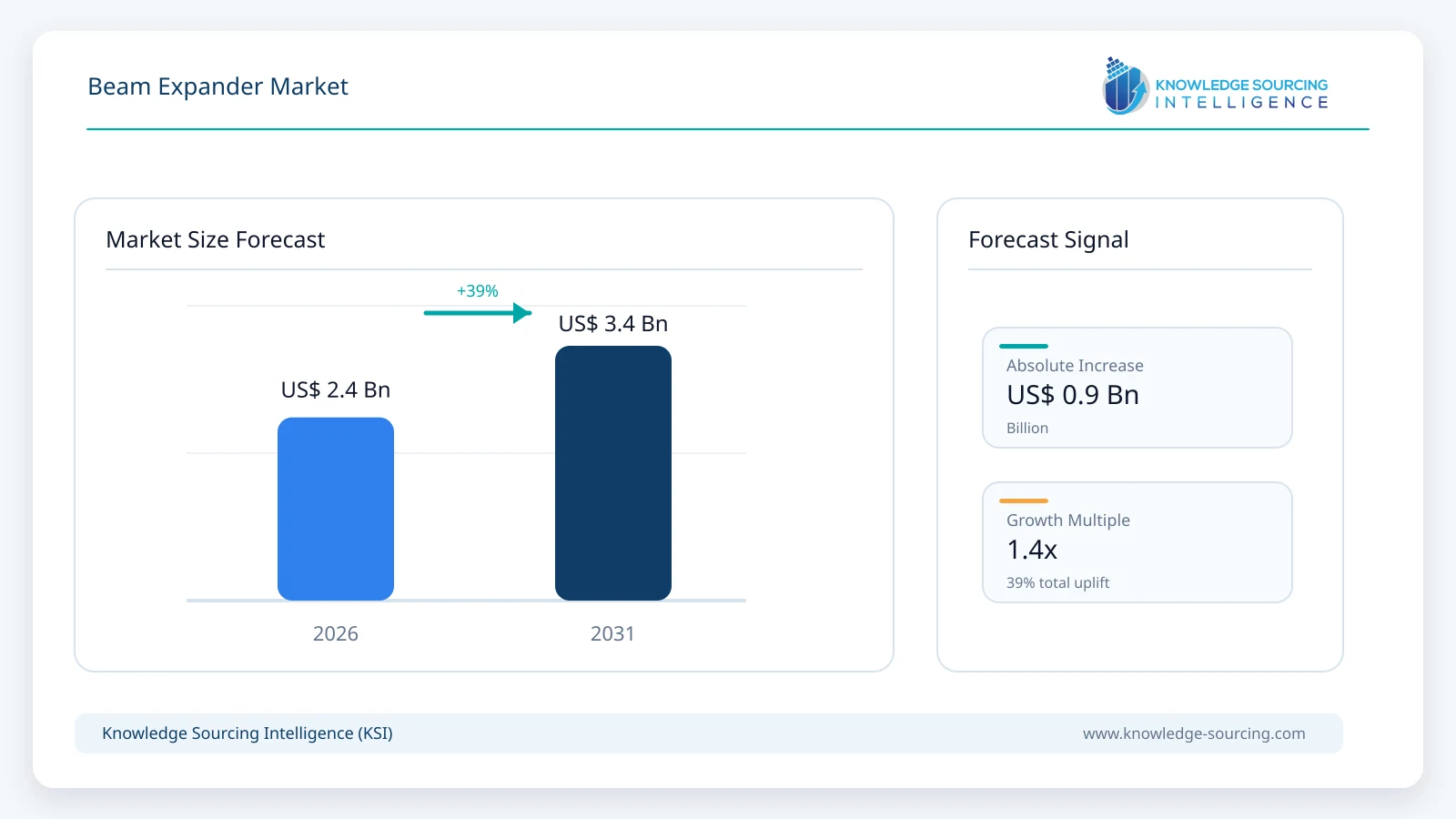
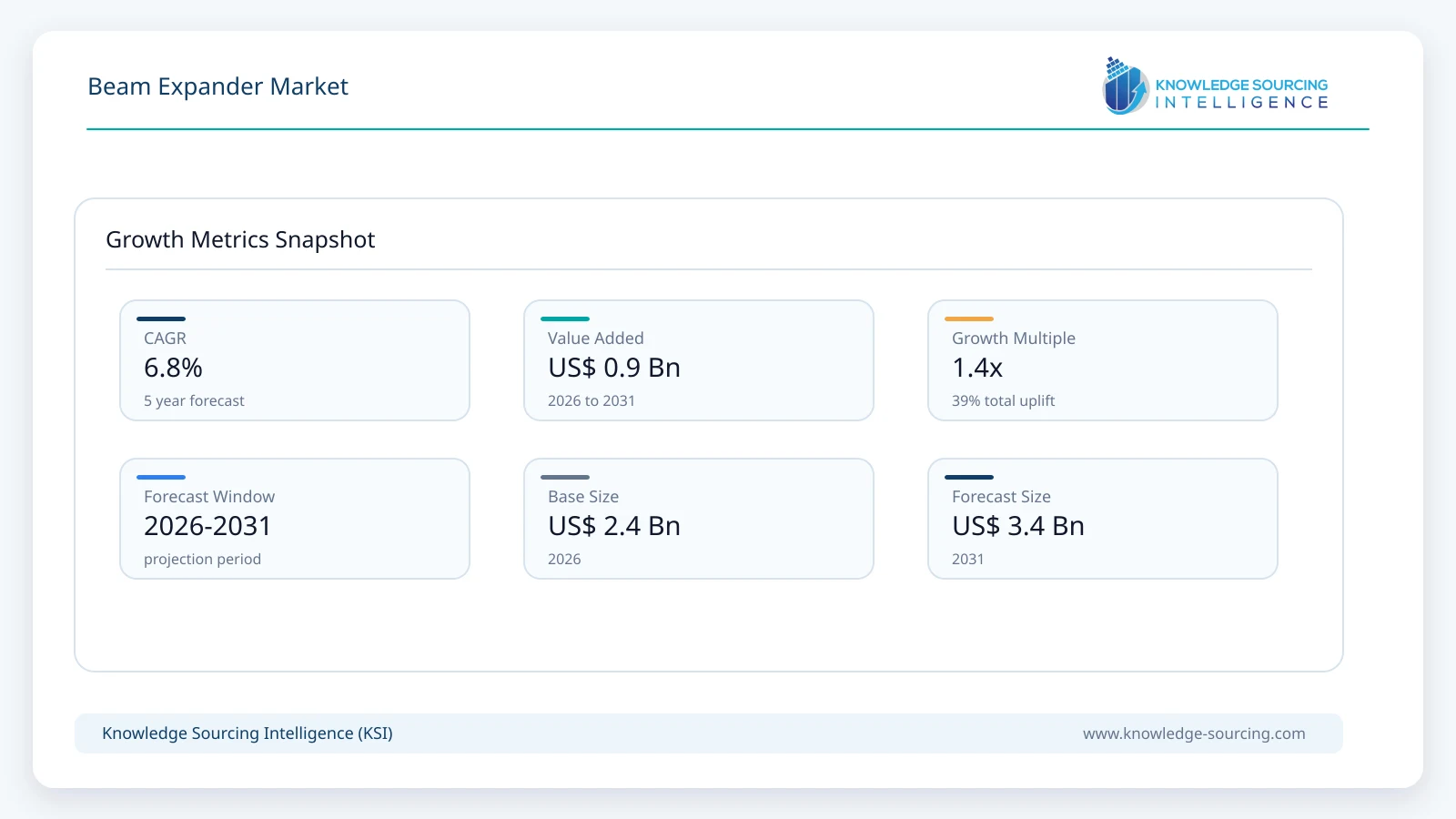
The global beam expander market is forecast to grow at a CAGR of 6.8%, reaching USD 3.38 billion in 2031 from USD 2.43 billion in 2026.
Highlights:
1
Galilean architectures account for approximately 60% of global beam-expander revenue in 2026.
2
Variable and motorized beam expanders are projected to grow at approximately 8.6% annually through 2031.
3
Laser delivery and processing systems generate about USD 0.91 billion of market value in 2026.
4
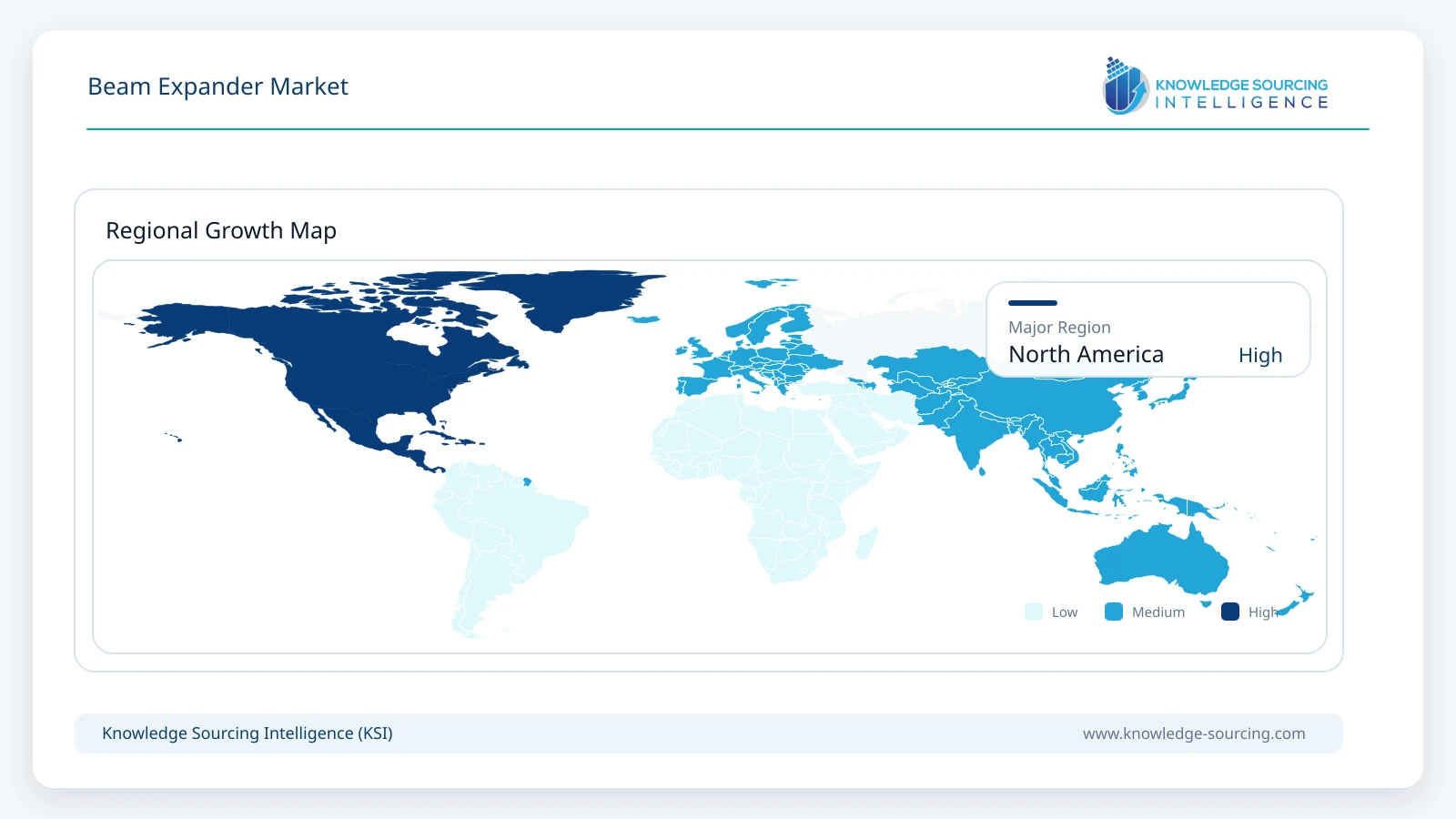
North America accounts for approximately one-third of global beam-expander revenue in 2026.
5
High-power UV, ultrafast and CO2 laser systems are raising coating and thermal-performance requirements.
6
Reflective and software-controlled beam expanders are broadening use beyond conventional fixed-magnification optics.
Market Overview
A beam expander operates as a telescope in the laser beam path. Galilean designs use a negative and positive optical group and avoid an internal focal point, which makes them compact and attractive for high-power or pulsed laser systems. Keplerian designs use two positive groups with an intermediate focus and can support spatial filtering or larger expansion ratios, but the internal focus can create higher local power density. Reflective beam expanders use mirrors rather than refractive lenses and are increasingly relevant where users need achromatic performance, very broad wavelength coverage or reduced thermal sensitivity. Across these designs, commercial selection depends on wavelength, input aperture, expansion ratio, wavefront error, pointing stability, laser-induced damage threshold and mechanical integration.
The product mix extends from low-cost fixed-magnification optics used in laboratories to motorized zoom assemblies integrated into OEM laser machines. Thorlabs offers fixed and zoom units across UV, visible, near-infrared and mid-infrared bands, while Jenoptik supplies fixed, manual variable and motorized systems for laser material processing. Sill Optics, Optogama, Altechna and other suppliers have expanded toward software-controlled or high-power configurations. This differentiation matters because the beam expander is becoming a process-control element rather than a passive accessory in automated laser equipment, especially when machines switch materials, focal geometries or process recipes.
Market Trends
Motorized and variable beam expanders are moving from laboratory flexibility into production systems
Variable-magnification designs historically served prototyping and research because users could determine the required expansion ratio without swapping optics. The same capability is now valuable in production equipment that must change recipes or accommodate different laser parameters. Edmund Optics expanded its Gemma variable-beam-expander portfolio in January 2026 with 1x-3x and 2x-8x continuous-magnification models designed without an internal focus. Jenoptik and Optogama offer motorized systems with software interfaces, while Sill Optics provides electrical magnification and divergence adjustment. As machine builders add closed-loop controls and automated setup, repeatability and pointing stability during lens motion are becoming as important as static wavefront quality.
High-power UV, ultrafast and broadband lasers are pushing new optical materials and architectures
Shorter wavelengths and higher peak powers place severe demands on coatings, fused-silica quality, contamination control and internal beam diameter. Altechna highlighted these constraints in a June 2026 design study for variable beam expanders used with high-average-power ultrafast UV lasers, where low wavefront error and high laser-induced damage threshold are critical. Sill Optics has introduced zinc-selenide zoom expanders for 9.3 and 10.6 micrometer CO2 lasers, while Edmund Optics has broadened reflective beam-expander offerings covering UV through infrared wavelengths. This shift increases average selling values because customers are paying for coating performance, thermal stability and integration engineering rather than only magnification.
Market Drivers
Precision laser processing and semiconductor manufacturing expand the addressable equipment base
Industrial and semiconductor laser systems require controlled beam diameter before the beam enters scanners, F-theta lenses, focusing optics or inspection assemblies. Expanding the beam can reduce divergence and enable a smaller focused spot, directly supporting cutting, marking, welding, micromachining, wafer processing and metrology. The underlying capital-equipment cycle strengthened in 2026: SEMI forecasts semiconductor manufacturing equipment sales of USD 165.9 billion, including USD 143.9 billion of wafer-fab equipment. IPG Photonics also reported that materials processing represented 85% of fourth-quarter 2025 revenue and grew 17% year on year, led by welding, marking, additive manufacturing and cleaning. Not every laser system uses a discrete beam expander, but the growth of precision optical paths increases the number of platforms where beam conditioning becomes necessary.
Higher optical power and process flexibility increase value per installed beam-delivery system
The commercial opportunity is also improving through specification intensity. Modern fiber, ultrafast, UV and CO2 laser systems require optics with higher damage thresholds, lower absorption and more stable pointing than conventional low-power laboratory systems. Suppliers therefore sell fused-silica assemblies, ZnSe optics, specialized anti-reflection coatings and motorized mechanics at prices well above simple fixed glass expanders. TRUMPF reported a 7% rise in group order intake for fiscal 2025/26 after a multi-year downturn, indicating stabilization in the broader industrial laser and machine-tool environment. As users demand faster changeovers and tighter process windows, automated divergence and magnification control can shift a beam expander from a low-value accessory toward an engineered subsystem within the laser platform.
Market Restraint
Application-specific qualification and integration reduce standardization across laser platforms
Beam expanders are highly sensitive to wavelength, input beam size, divergence, power density, pulse duration and the optical aperture of the downstream system. A product qualified for a 1064 nm nanosecond laser cannot automatically be transferred to a 355 nm ultrafast platform or a 10.6 micrometer CO2 system. High-power applications may require different substrate materials, coatings and internal geometries, while motorized units add calibration, software and mechanical-lifetime requirements. This limits true commodity standardization and lengthens OEM qualification cycles. It also exposes suppliers to cyclical demand from capital-equipment customers. In lower-power applications, users can build simple two-lens telescope assemblies internally or select lower-cost catalog optics, which constrains pricing for basic fixed-magnification products even as advanced systems command higher values.
Segment Analysis
By Optical Design - Galilean
Galilean beam expanders remain the largest optical-design segment and are projected to generate approximately USD 1.95 billion in market revenue by 2031. Their scale reflects compact length, the absence of an internal focus and broad suitability for fixed, zoom and motorized configurations. They are extensively offered for 355 nm, 532 nm, 1030-1080 nm and other common industrial laser wavelengths by suppliers including Thorlabs, Jenoptik, EKSMA Optics and Optogama. Keplerian systems remain relevant where spatial filtering or specific image-quality requirements justify the internal focal plane. Reflective beam expanders are smaller in current revenue but are gaining attention for tunable, ultrafast and broadband sources because mirror-based designs avoid chromatic focal shifts.
By Configuration - Variable and Motorized Beam Expanders
Variable and motorized beam expanders are the fastest-growing configuration group as laser equipment becomes more programmable. Continuous magnification lets system builders optimize spot size or scanner fill without replacing the optical train, while motorized divergence control supports automated calibration and recipe changeovers. Edmund Optics, Jenoptik, Sill Optics, Altechna, Optogama and Special Optics all offer adjustable designs, illustrating that the feature has moved well beyond niche laboratory use. Fixed-magnification systems will remain the larger installed base because they are simpler, lower cost and well suited to stable production recipes, but variable systems capture higher value per unit and are expected to outpace overall market growth through 2031.
By Application - Laser Delivery and Processing Systems
Laser delivery and processing systems are the largest application, supported by marking, cutting, welding, drilling, additive manufacturing, micromachining and semiconductor-related processing. Beam expanders are used to match the laser output to scanning and focusing optics and to control the focused spot produced by the downstream lens. Jenoptik specifically positions its beam expanders for cutting, welding and engraving of metals, polymers and ceramics, while Special Optics targets micromachining, scribing, solar-cell cutting and micro-drilling. Measurement and testing remains another important application because interferometers, beam profilers and optical benches require controlled beam diameter and collimation, while remote sensing and communications provide more specialized demand.
By End User - Industrial Manufacturing
Industrial manufacturing is projected to remain the largest end-user group, reaching approximately USD 1.15 billion in beam-expander revenue by 2031. The segment includes machinery and laser-system OEMs as well as factories using lasers for metal processing, electronics, automotive, battery, medical-device and precision-component manufacturing. Semiconductor and electronics applications are expected to grow faster than the overall industrial average because leading-edge fabrication, advanced packaging and display manufacturing rely on increasingly precise laser and optical systems. Aerospace and defense remains a high-specification segment for lidar, range finding, targeting and directed optical systems, while healthcare and research support smaller but premium applications at specialized wavelengths.
By Geography - North America
North America is projected to approach USD 1.05 billion in beam-expander revenue by 2031. The region combines a large installed base of laser equipment, semiconductor and photonics research, aerospace and defense programs, medical-device manufacturing and major optical-component suppliers. Thorlabs, Edmund Optics, MKS Instruments through Newport, Coherent, Micro Laser Systems, Lambda Research Optics and Special Optics provide broad domestic supply and engineering support. Asia Pacific is expected to grow faster as semiconductor equipment, electronics, battery manufacturing and industrial laser deployment expand in China, Taiwan, South Korea, Japan and Southeast Asia. Europe remains a major technology center through Jenoptik, Sill Optics, EKSMA Optics, Altechna and Optogama.
Competitive Environment
Competition combines broad catalog suppliers with specialist laser-optics manufacturers. Thorlabs and Edmund Optics compete through large off-the-shelf portfolios and short lead times, while MKS Instruments/Newport combines catalog optics with wider laser and photonics integration. Jenoptik and Sill Optics emphasize precision laser-processing optics, including high-power and motorized products. European specialists such as EKSMA Optics, Altechna and Optogama compete through custom coatings, high laser-induced damage thresholds and OEM-oriented engineering. Coherent retains a position in CO2 and infrared beam-delivery optics, while Special Optics and Lambda Research Optics target custom and high-power assemblies.
Supplier differentiation increasingly centers on wavefront error, pointing stability, damage threshold, internal-reflection control and the ability to maintain collimation as magnification changes. Mechanical design is also becoming more important because rotating lens groups can introduce beam wander in precision systems. Vendors are therefore using sliding lens mechanisms, fixed-length housings and closed-loop motorized motion. Customization remains commercially important because OEMs often need non-standard apertures, coatings, magnification ranges or mounting interfaces. This favors suppliers that control optical design, coating and assembly in-house and can move from prototype quantities to repeat OEM production without changing the qualified optical prescription.
Recent Developments
June 2026: Altechna published a high-average-power ultrafast UV variable-beam-expander design focused on high damage threshold, low wavefront error and long-term stability for demanding industrial and scientific systems.
January 2026: Edmund Optics expanded its TECHSPEC Gemma variable beam expander portfolio with 1x-3x and 2x-8x continuous-magnification configurations for higher-power laser beam delivery and production integration.
January 2025: Sill Optics launched zinc-selenide zoom beam expanders for 9.3 micrometer and 10.6 micrometer CO2 lasers, bringing high-power LWIR beam expansion into its standard product portfolio.
July 2024: Sill Optics introduced a motorized beam expander for high-power lasers, extending automated magnification control into applications previously served mainly by manual zoom optics.
Beam Expander Market Scope:
Report Metric
Details
Total Market Size in 2026
USD 2.43 billion
Total Market Size in 2031
USD 3.38 billion
Forecast Unit
Billion
Growth Rate
6.8%
Study Period
2021 to 2031
Historical Data
2021 to 2024
Base Year
2025
Forecast Period
2026 – 2031
Segmentation
Optical Design, Configuration, Application, End User
Companies
Thorlabs Inc.
MKS Instruments Inc. (Newport)
Edmund Optics Inc.
Jenoptik AG
Sill Optics GmbH & Co. KG
Excelitas Technologies Corp. (Qioptiq)
EKSMA Optics
Altechna
Optogama UAB
Market Segmentation
By Optical Design
Galilean
Keplerian
Reflective
By Configuration
Fixed Magnification
Variable / Zoom
Motorized
By Application
Measurement and Testing Devices
Optical Communication Devices
Laser Delivery and Processing Systems
Remote Sensing and LiDAR
Medical and Scientific Systems
Others
By End User
Industrial Manufacturing
Semiconductor and Electronics
Aerospace and Defense
Telecommunication and Datacom
Healthcare and Life Sciences
Research and Metrology
Others
By Geography
North America
USA
Canada
Mexico
South America
Brazil
Argentina
Others
Europe
Germany
France
United Kingdom
Spain
Italy
Others
Middle East and Africa
Saudi Arabia
UAE
Israel
Others
Asia Pacific
China
India
Japan
South Korea
Taiwan
Thailand
Others
Table of Contents
1. EXECUTIVE SUMMARY
2. MARKET SNAPSHOT
2.1. Market Overview
2.2. Market Definition
2.3. Market Segmentation
3. BUSINESS LANDSCAPE
3.1. Market Drivers
3.1.1. Precision Laser Processing and Semiconductor Manufacturing Expand the Addressable Equipment Base
3.1.2. Higher Optical Power and Process Flexibility Increase Value per Installed Beam-Delivery System
3.2. Market Restraint
3.2.1. Application-Specific Qualification and Integration Reduce Standardization Across Laser Platforms
3.3. Market Opportunities
3.4. Porter's Five Forces Analysis
3.5. Industry Value Chain Analysis
3.6. Policies and Regulations
3.7. Strategic Recommendations
4. TECHNOLOGICAL OUTLOOK
4.1. High-Damage-Threshold Coatings
4.2. Motorized Magnification and Divergence Control
4.3. Reflective and Achromatic Beam Expansion
4.4. UV, Ultrafast and CO2 Beam-Delivery Optics
5. BEAM EXPANDER MARKET BY OPTICAL DESIGN
5.1. Introduction
5.2. Galilean
5.3. Keplerian
5.4. Reflective
6. BEAM EXPANDER MARKET BY CONFIGURATION
6.1. Introduction
6.2. Fixed Magnification
6.3. Variable / Zoom
6.4. Motorized
7. BEAM EXPANDER MARKET BY APPLICATION
7.1. Introduction
7.2. Measurement and Testing Devices
7.3. Optical Communication Devices
7.4. Laser Delivery and Processing Systems
7.5. Remote Sensing and LiDAR
7.6. Medical and Scientific Systems
7.7. Others
8. BEAM EXPANDER MARKET BY END USER
8.1. Introduction
8.2. Industrial Manufacturing
8.3. Semiconductor and Electronics
8.4. Aerospace and Defense
8.5. Telecommunication and Datacom
8.6. Healthcare and Life Sciences
8.7. Research and Metrology
8.8. Others
9. BEAM EXPANDER MARKET BY GEOGRAPHY
9.1. Introduction
9.2. North America
9.2.1. USA
9.2.2. Canada
9.2.3. Mexico
9.3. South America
9.3.1. Brazil
9.3.2. Argentina
9.3.3. Others
9.4. Europe
9.4.1. Germany
9.4.2. France
9.4.3. United Kingdom
9.4.4. Spain
9.4.5. Italy
9.4.6. Others
9.5. Middle East and Africa
9.5.1. Saudi Arabia
9.5.2. UAE
9.5.3. Israel
9.5.4. Others
9.6. Asia Pacific
9.6.1. China
9.6.2. India
9.6.3. Japan
9.6.4. South Korea
9.6.5. Taiwan
9.6.6. Thailand
9.6.7. Others
10. COMPETITIVE ENVIRONMENT AND ANALYSIS
10.1. Major Players and Strategy Analysis
10.2. Market Share Analysis
10.3. Mergers, Acquisitions, Agreements and Collaborations