
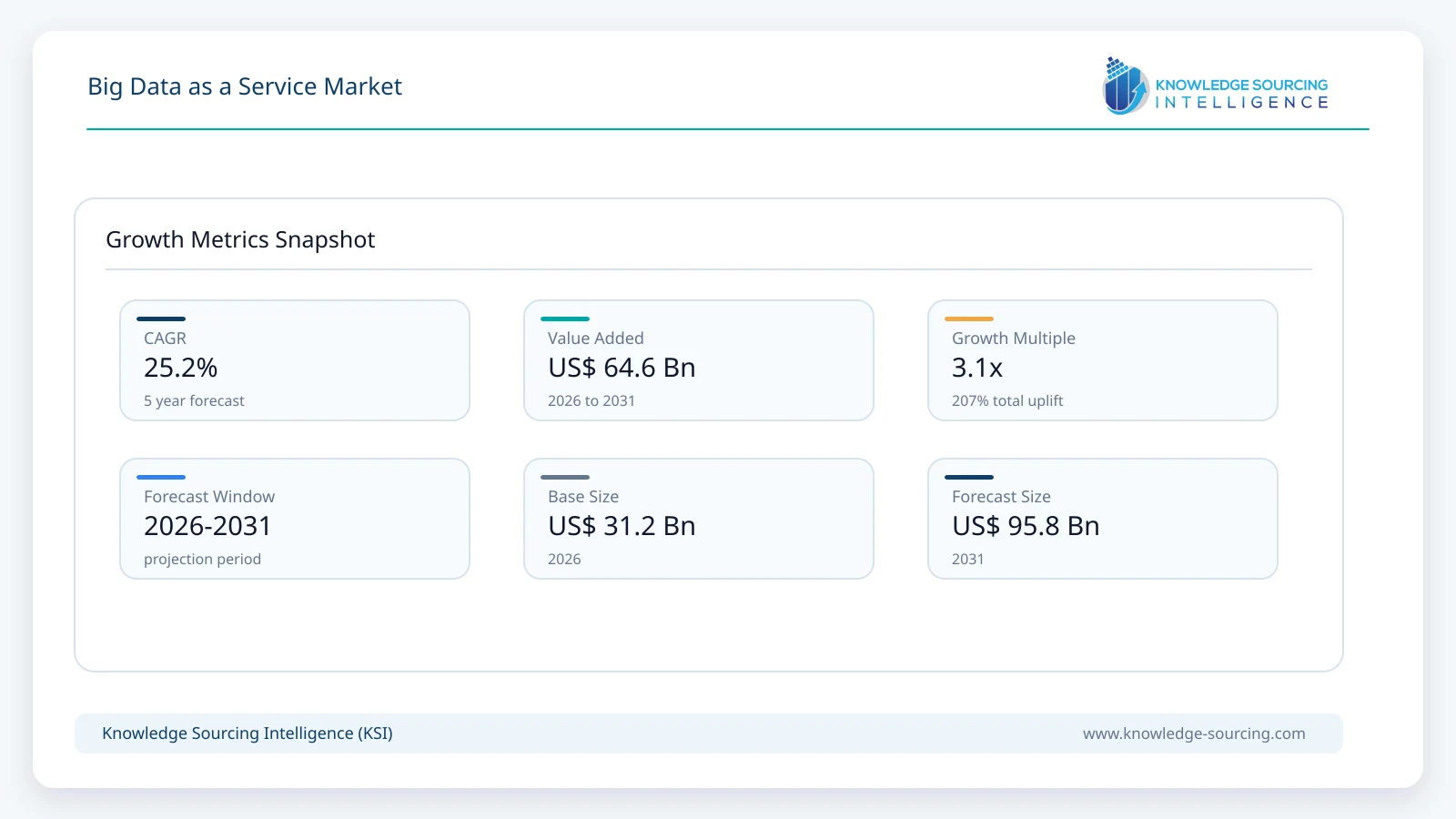
The Big Data as a Service (BDaaS) Market is forecast to grow at a CAGR of 25.17%, reaching USD 95.77 billion in 2031 from USD 31.17 billion in 2026.
Highlights:
- 1Rising enterprise demand for scalable analytics and AI-ready data platforms remains the primary purchasing catalyst.
- 2Public cloud deployment represents the leading commercial opportunity because of flexible pricing and rapid implementation.
- 3Asia Pacific continues attracting substantial investment through cloud infrastructure expansion and enterprise digitization initiatives.
- 4Integrated AI, automation, and real-time analytics capabilities are becoming important procurement criteria.
- 5Data governance, cybersecurity, and privacy regulations continue influencing platform selection and deployment strategies.
- 6Competition increasingly focuses on platform integration, managed services, and multi-cloud interoperability rather than infrastructure pricing alone.
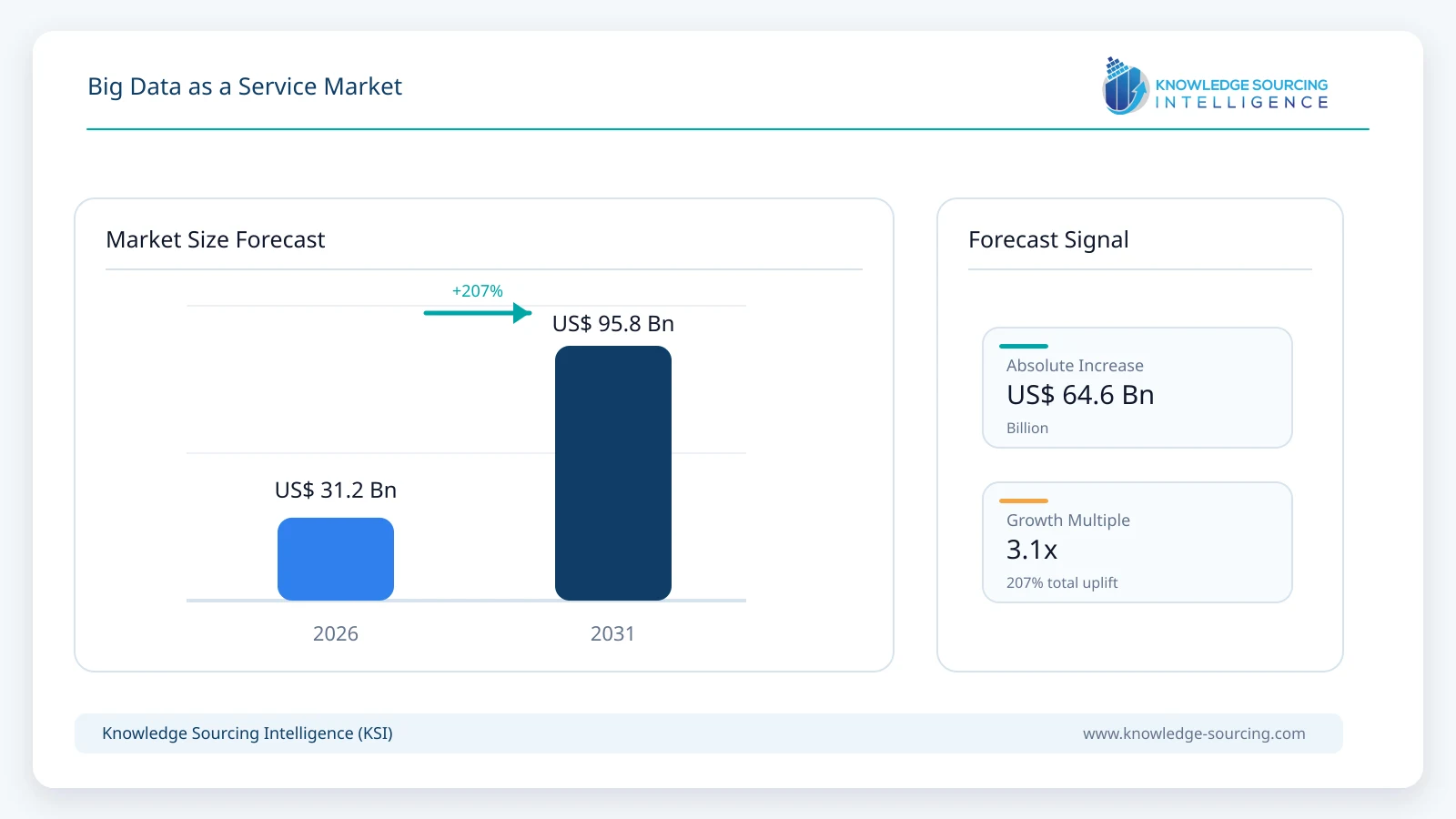
The Big Data as a Service (BDaaS) market comprises cloud-delivered platforms and managed services that enable organizations to store, process, analyze, govern, and monetize large and complex datasets without maintaining extensive on-premises infrastructure. These services combine scalable computing resources, data lakes, analytics engines, machine learning capabilities, security controls, and managed operations into subscription-based delivery models. Organizations across financial services, healthcare, manufacturing, telecommunications, retail, media, and public administration increasingly rely on BDaaS to support operational decision-making, customer analytics, fraud detection, predictive maintenance, and regulatory reporting.
Demand is being shaped by the expanding volume of structured and unstructured enterprise data generated through connected devices, enterprise applications, digital commerce, industrial automation, and cloud-native software. Organizations are under pressure to convert these data assets into measurable business outcomes while limiting capital expenditure and reducing infrastructure management complexity. Subscription-based data platforms provide procurement flexibility, allowing enterprises to scale computing resources according to workload rather than investing in dedicated hardware.
Buyer priorities have shifted beyond storage capacity toward integrated analytics, governance, cybersecurity, interoperability, and artificial intelligence readiness. Procurement teams increasingly evaluate providers on data sovereignty capabilities, workload portability, multi-cloud compatibility, service-level agreements, and compliance certifications. Enterprises also seek managed services that reduce internal administration while supporting business intelligence, advanced analytics, and AI model development.
The supplier landscape consists of global cloud infrastructure providers, enterprise software vendors, analytics platform developers, and managed service companies. Competition extends beyond pricing to include ecosystem partnerships, developer tools, workload optimization, integrated security, and industry-specific data solutions. Vendors continue investing in cloud-native architectures and unified data platforms capable of supporting analytical and transactional workloads within a common environment.
Hybrid deployment strategies are becoming more common as organizations retain sensitive workloads in private environments while expanding analytical capacity through public cloud resources. This approach is particularly attractive for regulated industries balancing compliance obligations with the need for scalable computing performance.
Market Drivers
Enterprise adoption of AI and advanced analytics
Organizations require large, well-governed datasets to train machine learning models, automate business processes, and improve operational forecasting. BDaaS platforms simplify data preparation, storage, and analytics while providing scalable computing resources for AI workloads. Buyers increasingly prefer integrated platforms that combine data engineering, analytics, governance, and AI services within a unified environment. Vendors continue expanding native AI capabilities and pre-built industry solutions to shorten implementation timelines and improve customer retention.
Growth in cloud-first enterprise IT strategies
Many enterprises have adopted cloud-first procurement policies to reduce infrastructure ownership costs and improve operational flexibility. As workloads migrate to cloud environments, organizations seek managed data services capable of supporting business continuity, disaster recovery, and workload scalability. Service providers respond by expanding regional cloud infrastructure, improving workload portability, and offering flexible consumption models that align operational expenses with business growth.
Expanding regulatory reporting and governance requirements
Industries such as banking, healthcare, insurance, telecommunications, and government generate substantial volumes of regulated information requiring secure storage, traceability, and audit readiness. BDaaS platforms increasingly incorporate governance frameworks, encryption, identity management, and compliance monitoring. Organizations invest in these capabilities to simplify regulatory reporting while reducing administrative burden and operational risk.
Rising adoption of IoT and connected infrastructure
Industrial facilities, smart cities, connected vehicles, and digital manufacturing environments continuously generate high-frequency operational data. Processing these datasets requires scalable infrastructure capable of ingesting and analyzing information in near real time. Managed cloud-based data platforms provide cost-effective processing capacity while supporting predictive maintenance, asset optimization, and operational intelligence.
Market Restraints and Challenges
Data sovereignty and cross-border compliance
National regulations governing personal and sensitive information continue influencing cloud procurement decisions. Organizations operating across multiple jurisdictions must ensure compliance with regional data residency requirements. These obligations may increase deployment complexity and encourage hybrid architectures, particularly within financial services and public sector organizations.
Integration with legacy enterprise systems
Many enterprises continue operating older databases, enterprise resource planning platforms, and industry-specific applications that were not designed for cloud-native environments. Integrating these systems with modern analytics platforms often requires extensive migration planning, data cleansing, and application modernization. These implementation costs may delay purchasing decisions.
Escalating cybersecurity risks
Large centralized data environments remain attractive targets for cyberattacks. Organizations increasingly evaluate encryption standards, access management, incident response capabilities, and continuous monitoring before selecting providers. Suppliers must invest heavily in security certifications, threat intelligence, and infrastructure resilience, increasing operating costs while maintaining competitive pricing.
Cost optimization and workload predictability
Although consumption-based pricing provides flexibility, enterprises managing variable analytical workloads may experience budget uncertainty. Organizations increasingly implement workload governance, resource monitoring, and financial management tools to optimize cloud spending. Providers are responding with enhanced cost visibility and automated resource allocation capabilities.
Major Segment Analysis
Public Cloud Deployment
Public cloud deployment represents the most commercially significant segment because it offers rapid implementation, virtually unlimited scalability, and predictable subscription-based pricing. Organizations adopting cloud-native business models can quickly provision storage, analytics engines, and AI services without investing in dedicated infrastructure. This procurement approach is particularly attractive for businesses experiencing fluctuating analytical workloads or seasonal demand.
Large enterprises increasingly combine public cloud platforms with existing enterprise applications to accelerate innovation while reducing capital expenditure. Small and medium-sized businesses benefit from enterprise-grade analytics capabilities that would otherwise require substantial internal investment. Buyers typically evaluate vendors based on platform reliability, security certifications, geographic availability, ecosystem integration, and workload performance rather than infrastructure capacity alone.
Competition within this segment centers on integrated data platforms, managed services, AI functionality, developer productivity, and industry-specific solutions. Vendors continue expanding regional data center capacity and strengthening interoperability across multiple cloud environments to support enterprise modernization initiatives.
Regional Analysis
North America
North America remains a leading market due to extensive enterprise cloud adoption, mature digital infrastructure, and high investment in artificial intelligence. Financial institutions, healthcare providers, technology companies, retailers, and government agencies continue expanding cloud-based analytics programs. Strong venture investment and established hyperscale cloud ecosystems further strengthen regional demand. However, cybersecurity expectations and evolving privacy regulations require continuous investment in governance capabilities.
Europe
European demand is influenced by strict data protection requirements, sustainability objectives, and industrial digitization initiatives. Organizations prioritize data governance, regional hosting, and regulatory compliance when selecting service providers. Manufacturing, financial services, automotive, and public administration represent major demand contributors. Multi-cloud deployment strategies remain common to balance operational flexibility with regulatory obligations.
Asia Pacific
Asia Pacific presents substantial commercial opportunities supported by enterprise modernization, expanding internet penetration, digital payment adoption, and government-supported cloud initiatives. China, India, Japan, South Korea, Australia, and Southeast Asian economies continue investing in cloud infrastructure and AI capabilities. Manufacturing, telecommunications, e-commerce, and financial technology companies increasingly require scalable analytics platforms to manage expanding digital operations.
Middle East & Africa
Governments across the Gulf region continue investing in smart city projects, digital government programs, and cloud infrastructure modernization. Financial institutions, energy companies, and telecommunications providers are adopting managed data services to improve operational efficiency. Adoption remains uneven across the broader region because infrastructure maturity, digital skills availability, and regulatory consistency vary considerably.
South America
Brazil leads regional demand through financial services modernization, retail digitization, and expanding enterprise cloud investment. Argentina and other regional economies are gradually increasing cloud adoption despite macroeconomic uncertainty. Organizations prioritize cost efficiency, managed services, and flexible deployment models as they modernize legacy IT environments.
Competitive Landscape
The BDaaS market combines hyperscale cloud providers, enterprise technology vendors, analytics platform specialists, and managed service providers. Competition increasingly depends on delivering integrated ecosystems rather than standalone infrastructure. Suppliers differentiate through unified analytics platforms, AI integration, governance capabilities, cybersecurity, workload optimization, and global cloud availability.
Strategic partnerships with system integrators, software developers, cybersecurity firms, and enterprise application providers remain important for expanding customer reach. Vendors also continue investing in regional infrastructure to address data residency requirements and improve service performance. Product roadmaps increasingly emphasize automation, unified data management, AI-assisted analytics, industry-specific templates, and cross-cloud interoperability. Companies operating in this competitive environment include Amazon Web Services, Inc., Microsoft Corporation, Oracle Corporation, Snowflake Inc., Hewlett Packard Enterprise Development LP, Wipro Limited, Lumen Technologies, Inc., and Innovative Routines International (IRI), Inc.
Recent Developments
June 2026: Snowflake expanded its AI Data Cloud capabilities by introducing additional enterprise AI features supporting governed data access and model development. The enhancement strengthens enterprise AI adoption while improving platform competitiveness.
February 2026: Databricks released Databricks Runtime 18.1 and Databricks Runtime 18.1 ML (Beta), powered by Apache Spark 4.1.0, strengthening large-scale cloud-native data engineering, analytics, and AI workloads for enterprise customers.
November 2025: Oracle announced expanded distributed cloud and sovereign cloud capabilities for enterprise customers requiring regional compliance and secure data management. The initiative supports regulated industries adopting cloud-based analytics.
Regulatory and Policy Environment
Regulatory frameworks continue shaping purchasing decisions across the BDaaS market. Data protection regulations, including the European Union's General Data Protection Regulation (GDPR), require organizations to maintain transparent governance, secure processing, and appropriate cross-border data controls. Financial institutions, healthcare providers, and government agencies frequently apply additional sector-specific compliance requirements relating to record retention, cybersecurity, and operational resilience.
International cybersecurity standards such as ISO/IEC 27001 and cloud security certifications increasingly influence supplier selection during enterprise procurement. Governments across Asia Pacific, Europe, and the Middle East continue supporting national cloud strategies and digital public infrastructure initiatives that encourage enterprise cloud adoption while emphasizing domestic data governance. These regulatory developments encourage investment in sovereign cloud infrastructure, encryption technologies, identity management, and continuous compliance monitoring.
Outlook and Strategic Implications
Over the 2026–2031 period, procurement decisions will increasingly prioritize integrated platforms capable of supporting analytics, artificial intelligence, governance, and security within unified cloud environments. Organizations are expected to reduce fragmented data architectures in favor of consolidated platforms that simplify operations while improving data accessibility and policy enforcement.
Investment priorities will focus on hybrid and multi-cloud architectures, automated governance, AI-enabled analytics, and industry-specific solutions. Enterprises will also expand spending on managed services to address skills shortages and reduce operational complexity. Vendors capable of combining scalable infrastructure with compliance expertise, workload portability, and advanced analytics functionality are likely to strengthen competitive positioning.
Commercial risks remain associated with cybersecurity threats, evolving privacy regulations, cloud cost management, and integration complexity. Nevertheless, sustained enterprise investment in AI, connected infrastructure, digital commerce, and data-driven decision-making is expected to maintain long-term demand for scalable, managed big data services. Success in this market will depend on balancing performance, governance, interoperability, regulatory compliance, and total cost of ownership while addressing increasingly sophisticated enterprise data requirements.
Big Data as a Service Market Scope
| Report Metric | Details |
|---|---|
| Total Market Size in 2026 | USD 31.17 billion |
| Total Market Size in 2031 | USD 95.77 billion |
| Forecast Unit | Billion |
| Growth Rate | 25.17% |
| Study Period | 2021 to 2031 |
| Historical Data | 2021 to 2024 |
| Base Year | 2025 |
| Forecast Period | 2026 – 2031 |
| Segmentation | Deployment, End-User, Geography |
| Companies |
|
Market Segmentation
By Deployment
- Public Cloud
- Private Cloud
- Hybrid Cloud
By End-User
- BFSI
- IT & Telecommunications
- Healthcare
- Retail & E-commerce
- Manufacturing
- Government & Public Sector
- Media & Entertainment
- Others
By Geography
- North America
- United States
- Canada
- Mexico
- South America
- Brazil
- Argentina
- Others
- Europe
- Germany
- United Kingdom
- France
- Italy
- Spain
- Others
- Middle East and Africa
- Saudi Arabia
- United Arab Emirates
- South Africa
- Others
- Asia Pacific
- China
- Japan
- India
- South Korea
- Australia
- Taiwan
- Thailand
- Others
Table of Contents
1. INTRODUCTION
1.1. Market Overview
1.2. Market Definition
1.3. Market Segmentation
1.4. Research Scope
2. RESEARCH METHODOLOGY
2.1. Research Data
2.2. Assumptions
3. EXECUTIVE SUMMARY
3.1. Research Highlights
4. MARKET DYNAMICS
4.1. Market Drivers
4.2. Market Restraints
4.3. Porter's Five Forces Analysis
4.3.1. Bargaining Power of Suppliers
4.3.2. Bargaining Power of Buyers
4.3.3. Threat of New Entrants
4.3.4. Threat of Substitutes
4.3.5. Competitive Rivalry in the Industry
4.4. Industry Value Chain Analysis
5. BIG DATA AS A SERVICE MARKET BY DEPLOYMENT
5.1. Introduction
5.2. Public Cloud
5.3. Private Cloud
5.4. Hybrid Cloud
6. BIG DATA AS A SERVICE MARKET BY END-USER
6.1. Introduction
6.2. BFSI
6.3. IT & Telecommunications
6.4. Healthcare
6.5. Retail & E-commerce
6.6. Manufacturing
6.7. Government & Public Sector
6.8. Media & Entertainment
6.9. Others
7. BIG DATA AS A SERVICE MARKET BY GEOGRAPHY
7.1. Introduction
7.2. North America
7.2.1. United States
7.2.2. Canada
7.2.3. Mexico
7.3. South America
7.3.1. Brazil
7.3.2. Argentina
7.3.3. Others
7.4. Europe
7.4.1. Germany
7.4.2. United Kingdom
7.4.3. France
7.4.4. Italy
7.4.5. Spain
7.4.6. Others
7.5. Middle East and Africa
7.5.1. Saudi Arabia
7.5.2. United Arab Emirates
7.5.3. South Africa
7.5.4. Others
7.6. Asia Pacific
7.6.1. China
7.6.2. Japan
7.6.3. India
7.6.4. South Korea
7.6.5. Australia
7.6.6. Taiwan
7.6.7. Thailand
7.6.8. Others
8. COMPETITIVE ENVIRONMENT AND ANALYSIS
8.1. Major Players and Strategy Analysis
8.2. Emerging Players and Market Lucrativeness
8.3. Mergers, Acquisitions, Agreements, and Collaborations
8.4. Vendor Competitiveness Matrix
9. COMPANY PROFILES
9.1. Amazon Web Services, Inc.
9.2. Microsoft Corporation
9.3. Oracle Corporation
9.4. Snowflake Inc.
9.5. Hewlett Packard Enterprise Development LP
9.6. Wipro Limited
9.7. Lumen Technologies, Inc.
9.8. Innovative Routines International (IRI), Inc.
Navigate
Trusted by the world's leading organizations











