
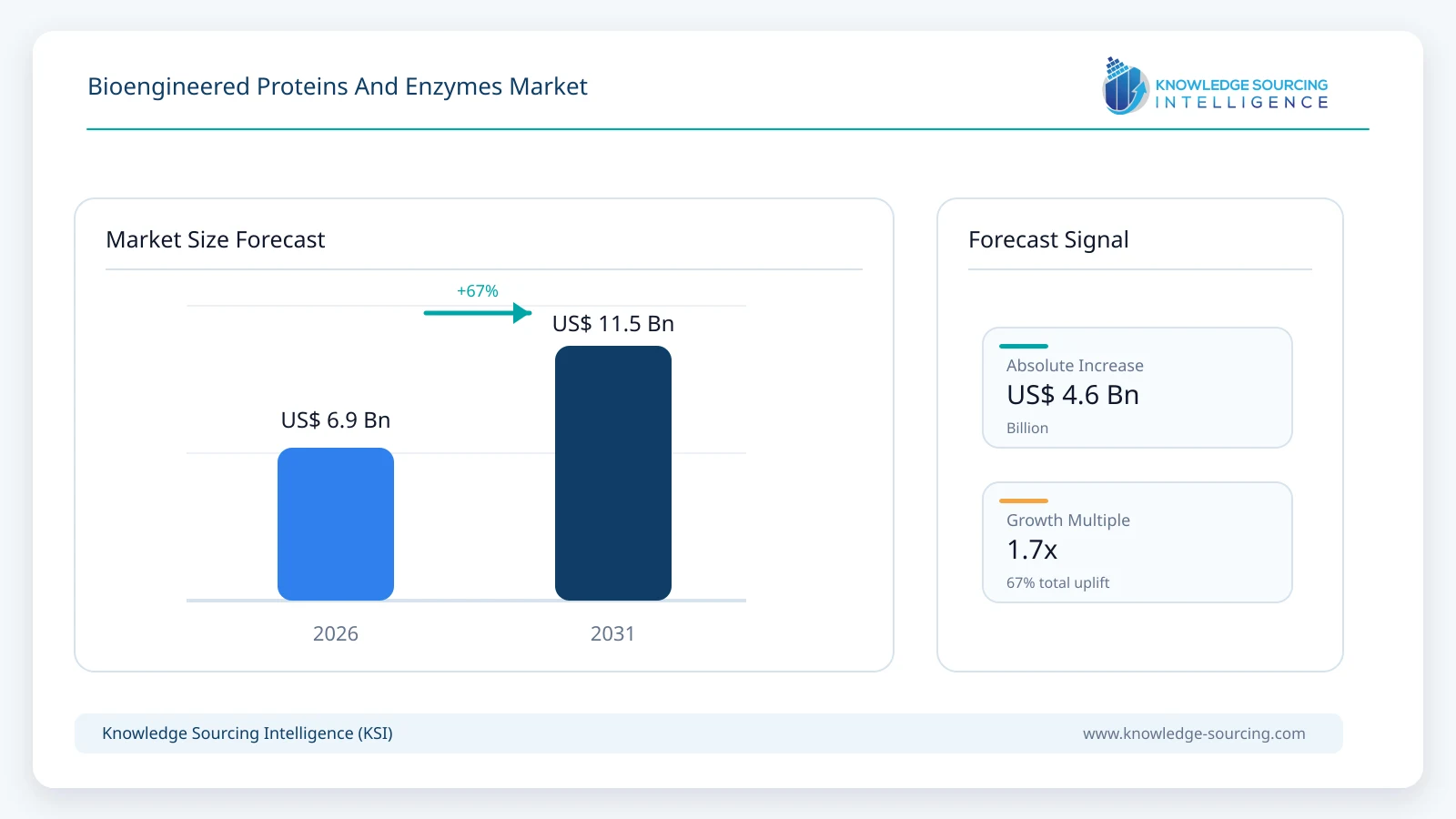
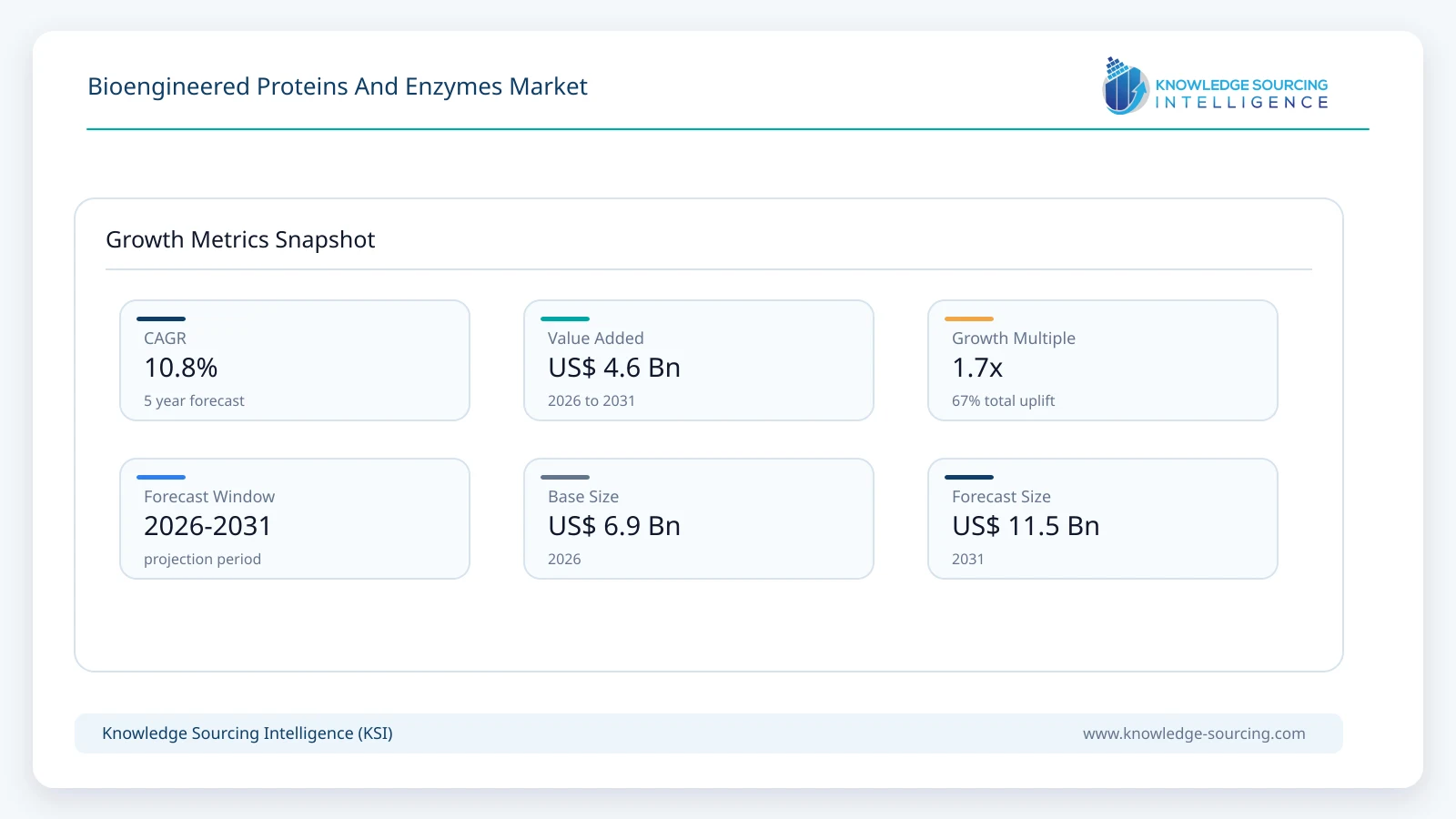
The Bioengineered Proteins and Enzymes market is expected to grow at a CAGR of 10.8%, reaching USD 11.5 billion in 2031 from USD 6.9 billion in 2026.
Highlights:
- 1Advances in recombinant DNA technology, synthetic biology, CRISPR gene editing, and AI-powered protein modeling are rapidly changing the way high-performance, application-specific proteins and enzymes are developed.
- 2Biopharmaceutical applications are a significant part of the revenue, driven by the continuous production of monoclonal antibodies, recombinant hormones, and therapeutic enzymes used in treating oncology, autoimmune, metabolic, and rare diseases.
- 3Industrial enzymes have become increasingly popular as they help increase the efficiency of processes, lower energy consumption, and replace toxic chemical catalysts, thus supporting global sustainability and green chemistry initiatives.
- 4One factor that is driving innovation and commercialization of the next-generation engineered biomolecules is the growing investments from biotechnology companies, pharmaceutical companies, and government research programs.
The Bioengineered Proteins and Enzymes market is growing due to the rapid development of recombinant DNA technology, synthetic biology, and precision fermentation. These technological innovations allow the production of large quantities of high-purity biomolecules engineered for specific applications and supplied to a wide range of industries.
Bioengineered proteins such as monoclonal antibodies, cytokines, and therapeutic enzymes are increasingly incorporated into pharmaceuticals for targeted therapies, cancer treatments, metabolic disorder management, and rare disease therapies. On the other hand, the use of bioengineered enzymes is revolutionizing industries such as food & beverages, detergents, biofuels, agriculture, and textiles, all benefiting from the higher catalytic efficiency, better stability, and sustainability of these enzymes.
Biopharmaceutical pipeline growth, especially in monoclonal antibodies and biosimilars, alongside increased spending on biologics manufacturing facilities, is driving the demand for highly optimized expression systems such as *E. coli*, yeast, CHO cells, and cell-free platforms. Furthermore, AI-based protein design, CRISPR gene editing, and high-throughput screening technologies combined are pushing the next generation of enzymes with higher thermostability, substrate specificity, and lower environmental footprints to the market much faster.
Market Dynamics
Market Drivers
Growing Demand for Advanced Biologics and Targeted Therapies: The growing global incidence of chronic diseases such as cancer, diabetes, autoimmune disorders, and rare genetic conditions is one of the primary factors substantially increasing the demand for bioengineered proteins, including monoclonal antibodies, recombinant hormones, cytokines, and therapeutic enzymes. At the same time, the development of personalized medicine and precision therapeutics is leading to a rapid increase in the use of highly specific, engineered biomolecules with better efficacy and fewer side effects.
Technological Advancements in Protein Engineering and Synthetic Biology: Progress in recombinant DNA technology, directed evolution, CRISPR-Cas gene editing, and AI-based protein structure prediction tools (e.g., DeepMind) has accelerated the design of proteins in terms of both speed and accuracy. By leveraging such tools, one can now create enzymes that exhibit heightened properties such as thermal stability, affinity to the target molecule, catalytic rate, and resistance to harsh industrial environments.
Expansion of Industrial Biotechnology Applications: Industries like food & beverages, detergents, textiles, pulp & paper, animal feed, and biofuels have seen a rise in the use of bioengineered enzymes instead of conventional chemical catalysts. One of the main reasons for their popularity among producers is their potential to enhance production efficiency, reduce energy usage, and limit waste production simultaneously.
Rising Focus on Sustainability and Green Chemistry: With the proliferation of global environmental regulations and corporate sustainability initiatives, industrial sectors are increasingly inclined towards the use of eco-friendly production methods. The use of bioengineered enzymes is in line with the concept of green chemistry. It helps to reduce the generation of toxic byproducts, lower the release of greenhouse gases, and facilitate the use of biodegradable processing alternatives.
Market Restraints and Opportunities
High Research & Development Costs: The discovery, development, and commercialization of bioengineered proteins and enzymes involve substantial investment in advanced labs, expert staff, bioreactors, and analytical systems. Furthermore, long development times and high failure rates raise the total project risk and capital burden.
Complex Regulatory Frameworks: Biopharmaceutical proteins and therapeutic enzymes must comply with stringent regulatory approvals from authorities such as the U.S. FDA and EMA. Extensive clinical trials, quality validation, and biosafety assessments can delay product launches and increase compliance costs.
Manufacturing and Scalability Challenges: Large-scale protein expression and purification can face yield limitations, contamination risks, batch variability, and stability issues. Scaling from laboratory to commercial production while maintaining consistency and cost efficiency remains a technical hurdle.
Advancements in Cell-Free and Synthetic Biology Platforms: New manufacturing technologies such as cell-free protein synthesis and next-generation expression systems are opening possibilities for rapid, scalable, and flexible production models.
Key Developments
August 2026: Novonesis launched DeniBrite™, a consolidated enzymatic biobleaching platform combining established enzyme technologies to help denim formulators and laundries reduce reliance on conventional bleaching chemistries.
June 2026: BASF and Bota Biosciences launched SkinNexus™ Collag3n, a recombinant, yeast-fermented Collagen III fragment with a 100% human-identical sequence for personal care applications.
April 2026: BASF introduced SkinNexus™ Collag3n globally at in-cosmetics Global, commercializing the AI-developed recombinant Collagen III fragment created with Bota Biosciences for cosmetic formulations.
February 2026: Novonesis confirmed continued investment in advanced protein solutions and precision-protein capabilities, supporting microorganism-based production and scale-up of high-value proteins for health and nutrition applications.
September 2025: Ridge Biotechnologies will launch AI-enabled Targeted Drug Design and Precision Enzyme technologies. These technologies will enable precision medicine development and the production of custom enzymes. Ridge Biotechnologies has $25 million in seed financing for AI-enabled precision enzyme and targeted drug design.
Market Segmentation
By Product Type: Recombinant Proteins Segment Analysis
The fastest-growing areas of recombinant protein development are biopharmaceutical development, personalized medicine, and new therapies. These proteins, such as monoclonal antibodies and cytokines, offer alternative methods for treating cancer, autoimmune disorders, and metabolic disorders. Rapid developments in expression technology and the increased number of clinical pipeline products for biologic agents are creating significant demand for them. Additionally, with the increased availability of biosimilars and all the research associated with pandemics helps to drive growth in the use of recombinant proteins both during commercial production and in life science research.
By Application: Biopharmaceuticals Segment Analysis
The biopharmaceutical industry is the leading sector and development area for bioengineered proteins and enzymes. The increased usage of targeted therapies is driving biopharmaceutical companies to continue their substantial investments in utilizing bioengineered proteins and enzymes in drug discovery, producing biologics, and employing them as therapeutics. These conditions position the biopharmaceutical sector as the recipient of significant R&D funding.
Regional Analysis
North America Market Analysis
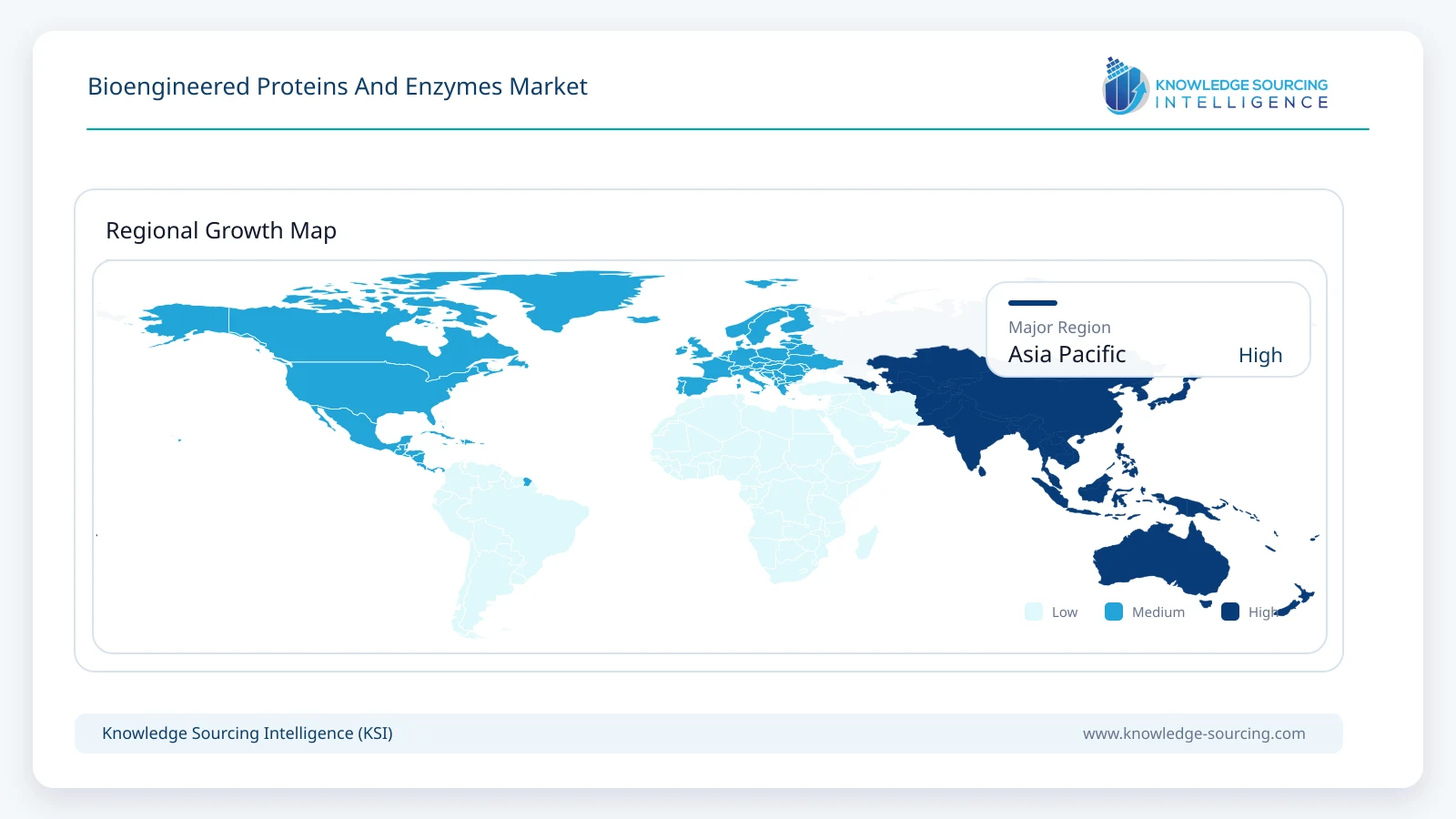
North America is leading the bioengineered proteins and enzymes market primarily due to its highly developed biotechnology ecosystem, ample R&D funding, and the presence of top biopharmaceutical companies. The United States is the major contributor to the region, driven by its advanced biologics manufacturing infrastructure, high healthcare expenditure, and ongoing innovation in synthetic biology and protein engineering. Favorable regulatory environments and partnerships between universities and biotech companies are additional factors that help reinforce the growth of the region. Additionally, the rising demand for monoclonal antibodies, gene therapies, and industrial enzymes in the production of food and biofuels is also playing a vital role in the market growth.
South America Market Analysis
The growth of the South American bioengineered proteins & enzymes market is consistent with its strong agricultural foundations, growth in food processing, and continued growth of biopharmaceuticals. The largest market for this sector in South America is Brazil due to its large-scale bioethanol production, substantial livestock production, and increasing investments in biotechnology. The already-established fermentation infrastructure in Brazil creates significant demand for industrial enzymes used in biofuels, feed for animals, and food processing.
Europe Market Analysis
The European market is being driven by new product developments. There is also significant government funding for biotechnological research and development, and there are stringent sustainability regulations in place to promote enzyme-based production processes. Countries such as Germany, the UK, France, and Switzerland are major contributors to the overall industry within the region, owing to their advanced pharmaceutical manufacturing capabilities and strong emphasis on developing sustainable production practices using green chemistry principles. The focus on the region's environmental and circular economy initiatives is helping to increase the use of engineered enzymes in many different types of industries.
Middle East and Africa Market Analysis
The Middle East & Africa region shows gradual growth driven by investments in healthcare modernization and the diversification of industrial sectors. Countries in the Gulf Cooperation Council (GCC) are investing in biotechnology and pharmaceutical manufacturing to reduce import dependence. While the market is still developing, rising adoption of bio-based industrial processes and increasing research collaborations present long-term growth potential.
Asia Pacific Market Analysis
The Asia-Pacific region is rapidly increasing its market size for Bioengineered Enzymes and Proteins owing to increased biomanufacturing capacity, growing healthcare investments, and favorable government policies in nations such as China, India, Japan, South Korea, and Singapore. The growth in the space is primarily due to cost-effective principles of production and increased contract development and manufacturing activity, and significant demand for biologics and their equivalents. Furthermore, there are also significant opportunities for the region, stemming from the growth of its industrial sector and the adoption of enzyme-based products within agriculture and food processing.
List of Major Companies
Thermo Fisher Scientific Inc.
Merck KGaA
Bio-Techne Corporation
Abcam plc
GenScript Biotech Corporation
Sino Biological Inc.
Novonesis
Codexis, Inc.
BASF SE
Advanced Enzyme Technologies Ltd.
Thermo Fisher Scientific Inc.
Thermo Fisher Scientific Inc. is a global supplier of scientific instrumentation, reagents, consumables, and services that support all areas of research and manufacturing within the biotechnology and pharmaceutical sectors, as well as academia and industry. The company is heavily involved with the production of engineered proteins and enzymes in the biotechnology sector and has an extensive catalog of products for recombinant proteins, engineered enzymes, and bioprocessing solutions used for drug discovery, therapeutic development, diagnostic testing, and applications related to industrial biotechnology. Thermo Fisher's products support multiple aspects of the biomanufacturing process, such as protein expression, purification, and quality control, making them one of the most significant suppliers of products for research laboratories and commercial manufacturers around the world.
Bio-Techne Corporation
Bio-Techne Corporation is a global biotechnology company dedicated to designing and delivering quality-approved bioengineered proteins, cytokines, growth factors, and enzyme reagents used in life sciences research and biopharmaceuticals. Its products are used across many critical applications for drug development, cell culture, immunology, and proteomics, allowing researchers and manufacturers to work with validated, stable biomolecules to produce high-quality biopharmaceuticals, thereby making Bio-Techne a key participant in the global market for bioengineered proteins and enzymes. Bio-Techne's broad range of products includes recombinant proteins, engineered enzymes, and assay kits that are used in academic, industrial, and clinical laboratory environments around the world.
Bioengineered Proteins And Enzymes Market Scope:
| Report Metric | Details |
|---|---|
| Total Market Size in 2026 | USD 6.9 billion |
| Total Market Size in 2031 | USD 11.5 billion |
| Forecast Unit | Billion |
| Growth Rate | 10.8% |
| Study Period | 2021 to 2031 |
| Historical Data | 2021 to 2024 |
| Base Year | 2025 |
| Forecast Period | 2026 – 2031 |
| Segmentation | Product Type, Application, End-user, Geography |
| Companies |
|
Market Segmentation
By Product Type
By Application
By End-user
By Geography
Table of Contents
1. EXECUTIVE SUMMARY
2. MARKET SNAPSHOT
2.1. Market Overview
2.2. Market Definition
2.3. Scope of the Study
2.4. Market Segmentation
3. BUSINESS LANDSCAPE
3.1. Market Drivers
3.2. Market Restraints
3.3. Market Opportunities
3.4. Porter’s Five Forces Analysis
3.5. Industry Value Chain Analysis
3.6. Policies and Regulations
3.7. Strategic Recommendations
3.8. Product Pipeline Analysis
3.9. Incidence and Prevalence Analysis
3.10. Patent Analysis
4. TECHNOLOGICAL OUTLOOK
5. BIOENGINEERED PROTEINS AND ENZYMES MARKET BY PRODUCT TYPE
5.1. Introduction
5.2. Recombinant Proteins
5.3. Therapeutic Proteins
5.4. Industrial Enzymes
5.5. Diagnostic Enzymes
5.6. Specialty Proteins
5.7. Biosimilars
6. BIOENGINEERED PROTEINS AND ENZYMES MARKET BY APPLICATION
6.1. Introduction
6.2. Biopharmaceuticals
6.3. Diagnostics & Research
6.4. Food & Beverages
6.5. Animal Feed & Nutrition
6.6. Biofuels & Energy
6.7. Detergents & Textiles
6.8. Agriculture & Crop Protection
6.9. Cosmetics & Personal Care
6.10. Environmental Biotechnology
7. BIOENGINEERED PROTEINS AND ENZYMES MARKET BY END-USER
7.1. Introduction
7.2. Pharmaceutical & Biotechnology Companies
7.3. Contract Research and Manufacturing Organizations (CROs/CDMOs)
7.4. Academic and Research Institutions
7.5. Industrial Manufacturers
7.6. Food & Beverage Manufacturers
7.7. Agriculture & Livestock Firms
8. BIOENGINEERED PROTEINS AND ENZYMES MARKET BY GEOGRAPHY
8.1. Introduction
8.2. North America
8.2.1. USA
8.2.2. Canada
8.2.3. Mexico
8.3. South America
8.3.1. Brazil
8.3.2. Argentina
8.3.3. Others
8.4. Europe
8.4.1. United Kingdom
8.4.2. Germany
8.4.3. France
8.4.4. Spain
8.4.5. Others
8.5. Middle East and Africa
8.5.1. Saudi Arabia
8.5.2. UAE
8.5.3. Others
8.6. Asia Pacific
8.6.1. China
8.6.2. India
8.6.3. Japan
8.6.4. South Korea
8.6.5. Indonesia
8.6.6. Thailand
8.6.7. Others
9. COMPETITIVE ENVIRONMENT AND ANALYSIS
9.1. Major Players and Strategy Analysis
9.2. Market Share Analysis
9.3. Mergers, Acquisitions, Agreements, and Collaborations
9.4. Competitive Dashboard
10. COMPANY PROFILES
10.1. Thermo Fisher Scientific Inc.
10.2. Merck KGaA
10.3. Bio-Techne Corporation
10.4. Abcam plc
10.5. GenScript Biotech Corporation
10.6. Sino Biological Inc.
10.7. Novonesis
10.8. Codexis, Inc.
10.9. BASF SE
10.10. Advanced Enzyme Technologies Ltd.
11. APPENDIX
11.1. Currency
11.2. Assumptions
11.3. Base and Forecast Years Timeline
11.4. Key benefits for the stakeholders
11.5. Research Methodology
11.6. Abbreviations
Navigate
Trusted by the world's leading organizations











