
The blockchain AI market is expected to grow steadily over the forecasted timeframe.
Highlights:
- 1Growing enterprise demand for trusted AI systems is accelerating blockchain integration across regulated industries.
- 2Fraud detection and risk management remains one of the most commercially attractive application segments due to financial crime prevention requirements.
- 3North America maintains strong market demand through enterprise technology investments, venture funding, and supportive innovation ecosystems.
- 4AI-enabled smart contracts and decentralized identity solutions are becoming important enterprise purchasing priorities.
- 5Data governance regulations and cybersecurity requirements are encouraging organizations to adopt secure distributed architectures.
- 6Competition increasingly centers on integrated enterprise platforms, cloud capabilities, strategic partnerships, and industry-specific implementation expertise.
The Blockchain AI Market comprises software platforms, infrastructure, and professional services that integrate artificial intelligence with blockchain networks to improve data integrity, automation, decentralized decision-making, and trusted digital transactions. The convergence of these technologies addresses a long-standing enterprise challenge: enabling AI systems to access reliable, tamper-resistant data while maintaining transparency, traceability, and security across complex business processes. Organizations are adopting blockchain-enabled AI solutions to strengthen data governance, automate contractual workflows, improve predictive analytics, and support decentralized digital ecosystems across industries.
Enterprise demand is primarily driven by organizations seeking verifiable AI outputs, secure data-sharing frameworks, and automated operational processes. Traditional AI models often depend on centralized datasets, creating concerns around data ownership, auditability, and model transparency. Blockchain introduces immutable records, distributed consensus, and programmable smart contracts that improve confidence in AI-generated decisions. This combination is particularly valuable for industries handling regulated information, financial transactions, healthcare records, intellectual property, and supply chain documentation.
Commercial adoption is expanding as organizations modernize enterprise infrastructure while responding to stricter cybersecurity requirements and regulatory expectations. Financial institutions are investing in blockchain AI platforms for fraud detection, digital identity verification, anti-money laundering monitoring, and automated compliance. Manufacturers are deploying AI-enabled blockchain networks to improve product traceability, supplier verification, predictive maintenance, and inventory optimization. Healthcare providers are evaluating decentralized patient data platforms that permit secure information exchange while supporting AI-assisted diagnostics and clinical decision support.
Purchasing decisions increasingly prioritize interoperability, cybersecurity resilience, scalability, governance capabilities, and compatibility with existing enterprise software. Buyers also evaluate vendor expertise in blockchain architecture, AI model deployment, cloud infrastructure, and regulatory compliance before committing to long-term implementations. Procurement cycles frequently involve proof-of-concept projects, particularly in industries where legacy information systems remain operational.
Cloud deployment continues to attract substantial enterprise spending because organizations seek flexible computing resources for AI training while reducing infrastructure management costs. However, highly regulated sectors such as government, banking, and critical infrastructure continue to maintain demand for on-premises deployments where sensitive information must remain under direct organizational control.
Technology suppliers compete by combining AI development frameworks, blockchain platforms, cybersecurity capabilities, cloud infrastructure, and industry-specific implementation expertise. Partnerships between cloud providers, enterprise software vendors, blockchain developers, and consulting organizations are shaping commercial deployment models across global markets.
Market Drivers
Rising enterprise demand for trusted AI decision-making
Organizations increasingly require AI systems capable of producing transparent, explainable, and verifiable outputs. Blockchain creates immutable records that allow businesses to validate data origins and model decisions throughout the AI lifecycle. This capability is particularly valuable for financial institutions, healthcare organizations, and government agencies where auditability influences procurement decisions. Vendors are responding by embedding blockchain-based verification layers into enterprise AI platforms, creating additional recurring software and implementation revenue.
Expansion of decentralized digital identity and cybersecurity initiatives
Identity fraud, credential theft, and unauthorized data access continue to generate financial losses across industries. Enterprises are investing in decentralized identity systems that combine blockchain-based credential management with AI-powered authentication and behavioral analytics. Organizations purchasing these solutions seek reduced fraud exposure, improved regulatory compliance, and simplified identity verification across digital services. Suppliers compete through interoperability, cryptographic security, and enterprise integration capabilities.
Increasing investment in intelligent supply chain management
Global supply chains require greater visibility following disruptions experienced across manufacturing, logistics, and international trade. Blockchain enables trusted product tracking, while AI analyzes operational data to improve inventory planning, supplier performance, and transportation efficiency. Manufacturers, retailers, and logistics providers increasingly procure integrated platforms that reduce manual verification while supporting predictive operational planning. Commercial demand extends beyond traceability into procurement optimization and sustainability reporting.
Growth in enterprise smart contract adoption
Businesses are automating contractual execution using blockchain-based smart contracts combined with AI-driven monitoring and decision support. Financial services, insurance providers, logistics companies, and digital asset operators increasingly automate routine workflows that previously required manual validation. Technology vendors benefit from higher consulting revenue, platform licensing opportunities, and ongoing maintenance contracts as organizations expand deployment across multiple business functions.
Market Restraints and Challenges
Integration complexity with legacy enterprise systems
Many organizations continue operating legacy enterprise resource planning, customer management, and transactional systems that were not designed for decentralized architectures. Integrating blockchain AI platforms often requires customized software development, extended implementation timelines, and specialized technical expertise. These factors increase project costs and delay return on investment, particularly for large enterprises operating across multiple jurisdictions. Vendors increasingly offer modular deployment models and integration services to reduce implementation risk.
Regulatory uncertainty across digital assets and AI governance
Although governments continue developing AI governance frameworks and blockchain-related regulations, policy consistency remains limited across jurisdictions. Organizations operating internationally must satisfy varying requirements covering data protection, digital identity, algorithmic accountability, and distributed ledger technologies. Regulatory uncertainty affects procurement decisions, particularly for financial institutions and healthcare organizations managing highly sensitive information.
High computational and infrastructure requirements
Training sophisticated AI models while maintaining distributed blockchain networks requires considerable computing resources and energy consumption. Organizations evaluating enterprise-scale deployments must balance processing performance, cybersecurity, and operating expenses. Cloud infrastructure providers continue introducing optimized architectures that reduce computational costs, but infrastructure investment remains an important purchasing consideration.
Limited availability of multidisciplinary expertise
Successful deployment requires professionals with expertise spanning artificial intelligence, blockchain engineering, cybersecurity, enterprise integration, and regulatory compliance. Many organizations face recruitment challenges due to limited availability of experienced specialists. Service providers increasingly expand consulting, managed services, and implementation partnerships to address enterprise capability gaps.
Major Segment Analysis
Fraud Detection and Risk Management
Fraud detection and risk management represents one of the most commercially valuable application segments because organizations increasingly require secure, automated systems capable of identifying suspicious activity while maintaining complete transaction integrity. Financial institutions, payment processors, insurers, digital asset platforms, and government agencies remain among the largest buyers due to rising financial crime risks and tightening regulatory oversight.
Blockchain strengthens this application by creating immutable transaction records that improve data reliability for AI models. Artificial intelligence analyzes transactional behavior, identifies anomalies, evaluates fraud patterns, and supports real-time risk assessment without relying exclusively on centralized databases. This combination improves investigation efficiency while reducing false-positive alerts that increase operational costs.
Enterprise buyers prioritize scalable platforms supporting real-time analytics, regulatory reporting, integration with existing compliance infrastructure, and secure cross-organizational data sharing. Vendors compete through model accuracy, cybersecurity performance, cloud deployment flexibility, and industry-specific fraud detection capabilities. Commercial opportunities continue expanding as digital payments, decentralized finance applications, and cross-border transactions increase worldwide.
Regional Analysis
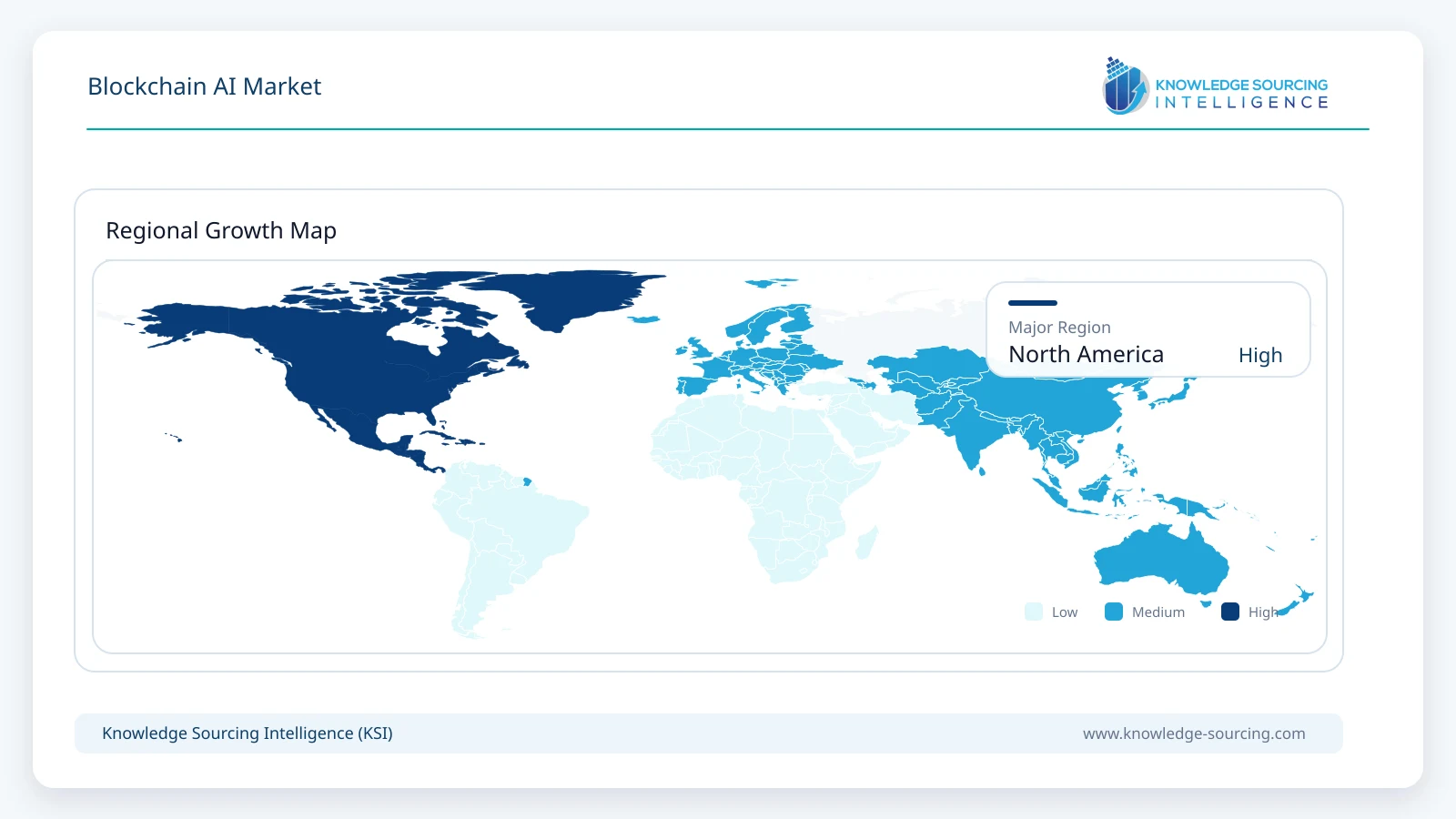
North America
North America maintains a leading position due to strong enterprise technology investment, mature cloud infrastructure, active venture capital funding, and extensive AI research capabilities. Financial institutions, healthcare organizations, manufacturers, and government agencies continue expanding blockchain AI deployments for cybersecurity, regulatory compliance, and operational automation. The United States benefits from a large ecosystem of cloud providers, enterprise software companies, and technology startups, while Canada supports commercialization through AI research programs and digital innovation initiatives.
Europe
European demand is shaped by stringent data protection regulations, expanding AI governance frameworks, and industrial modernization initiatives. Manufacturers, financial institutions, and public sector organizations increasingly evaluate blockchain AI platforms supporting secure data exchange and transparent AI governance. Enterprise buyers emphasize compliance, interoperability, and sustainability objectives alongside cybersecurity performance.
Asia Pacific
Asia Pacific represents the fastest-expanding adoption environment due to digital infrastructure investment, manufacturing expansion, fintech innovation, and government-supported AI development strategies. China, India, Japan, and South Korea continue investing in industrial automation, smart manufacturing, financial technology, and digital public services. Large enterprise populations and expanding cloud adoption create favorable commercial conditions, although regulatory diversity remains a challenge across regional markets.
Middle East & Africa
Governments across the Gulf region continue investing in digital government initiatives, smart city development, and AI adoption strategies that support blockchain-enabled services. Financial services, energy infrastructure, and public administration represent important commercial sectors. Adoption remains uneven across Africa because infrastructure availability, digital connectivity, and skilled workforce capacity vary significantly between countries.
South America
Brazil leads regional adoption through financial technology expansion, banking modernization, and digital government initiatives. Organizations increasingly evaluate blockchain AI solutions for payment security, identity verification, and supply chain visibility. Economic volatility, investment constraints, and varying regulatory maturity continue influencing enterprise procurement decisions across the broader region.
Competitive Landscape
Competition within the Blockchain AI Market combines global enterprise technology providers with specialized blockchain developers and AI-focused software companies. IBM, Microsoft Corporation, Amazon Web Services, Inc., Oracle Corporation, Fetch.ai, SingularityNET, Ocean Protocol Foundation Ltd., NetObjex, LeewayHertz, and Bext Holdings Inc. compete through differing technology strategies rather than direct product standardization.
Large cloud and enterprise software vendors emphasize integrated platforms combining AI development environments, blockchain services, cybersecurity capabilities, and enterprise infrastructure. Specialized blockchain companies differentiate themselves through decentralized AI frameworks, digital asset ecosystems, secure data marketplaces, and autonomous software agents. Consulting capabilities, industry-specific implementation expertise, ecosystem partnerships, and interoperability with existing enterprise software increasingly influence purchasing decisions. Geographic expansion continues through strategic alliances, cloud marketplace distribution, developer ecosystems, and enterprise implementation partners.
Recent Developments
June 2026: Blockchain.com launched 24/7 Institutional Perpetuals through its OTC desk, expanding institutional digital asset trading capabilities with continuous market access across crypto, equities, commodities, foreign exchange, and tokenized assets.
June 2026: QoreChain announced the launch of its AI-native, quantum-safe Layer 1 blockchain Mainnet, integrating protocol-level artificial intelligence, post-quantum cryptography, and triple virtual machine (VM) architecture for decentralized AI applications.
March 2026: BlockchAIn Inc. completed its business combination with Signing Day Sports, creating a publicly listed digital infrastructure company focused on high-performance computing (HPC) and AI hosting for blockchain-enabled workloads.
March 2026: IBM expanded its enterprise AI governance capabilities by strengthening integration between watsonx governance tools and blockchain-enabled data traceability initiatives. The development supports enterprise compliance and improves AI auditability.
Regulatory and Policy Environment
Governments are establishing regulatory frameworks governing artificial intelligence, cybersecurity, digital identity, and distributed ledger technologies. The European Union's AI Act introduces risk-based obligations affecting enterprise AI deployment, while the General Data Protection Regulation continues shaping data governance practices. Organizations implementing blockchain AI solutions must ensure compliance with privacy requirements, algorithmic transparency obligations, cybersecurity controls, and sector-specific regulations.
Financial institutions remain subject to anti-money laundering requirements, know-your-customer obligations, and operational resilience standards that encourage secure digital identity and transaction monitoring solutions. Healthcare organizations must satisfy national health information privacy regulations while maintaining secure patient data management. International standardization efforts led by organizations such as ISO continue supporting interoperability, information security, and blockchain governance, improving enterprise confidence in long-term technology investments.
Outlook and Strategic Implications
Enterprise investment will increasingly favor integrated platforms capable of combining trusted data infrastructure, explainable AI, cybersecurity, and regulatory compliance within unified operating environments. Procurement decisions are expected to prioritize interoperability with existing enterprise applications, scalable cloud deployment, secure data governance, and measurable operational benefits rather than experimental blockchain implementations.
Technology suppliers are likely to expand strategic alliances connecting AI software, blockchain infrastructure, cloud computing, cybersecurity, and consulting services. Industry-specific solutions addressing financial crime prevention, decentralized identity, healthcare information exchange, and intelligent supply chain management are expected to receive stronger commercial attention than generic platform offerings.
Organizations evaluating investments will continue balancing innovation opportunities against implementation complexity, regulatory uncertainty, and infrastructure costs. Suppliers capable of demonstrating measurable business outcomes, regulatory readiness, enterprise scalability, and integration expertise are expected to strengthen their competitive position as blockchain and artificial intelligence become increasingly interconnected components of enterprise digital infrastructure.
Blockchain AI Market Scope
| Report Metric | Details |
|---|---|
| Forecast Unit | Billion |
| Study Period | 2021 to 2031 |
| Historical Data | 2021 to 2024 |
| Base Year | 2025 |
| Forecast Period | 2026 – 2031 |
| Segmentation | Component, Application, Deployment, End-User, Geography |
| Companies |
|
Market Segmentation
By Component
By Application
By Deployment
By End-user
By Geography
Table of Contents
1. EXECUTIVE SUMMARY
2. MARKET SNAPSHOT
2.1. Market Overview
2.2. Market Definition
2.3. Scope of the Study
2.4. Market Segmentation
3. BUSINESS LANDSCAPE
3.1. Market Drivers
3.2. Market Restraints
3.3. Market Opportunities
3.4. Porter’s Five Forces Analysis
3.5. Industry Value Chain Analysis
3.6. Policies and Regulations
3.7. Strategic Recommendations
4. TECHNOLOGICAL OUTLOOK
5. BLOCKCHAIN AI MARKET BY COMPONENT
5.1. Introduction
5.2. Platform
5.3. Services
6. BLOCKCHAIN AI MARKET BY APPLICATION
6.1. Introduction
6.2. Supply Chain Management
6.3. Fraud Detection and Risk Management
6.4. Identity Management
6.5. Smart Contract Development
6.6. Asset Tokenization
6.7. Data Sharing and Analytics
6.8. Healthcare
6.9. Financial Services
6.10. Others
7. BLOCKCHAIN AI MARKET BY DEPLOYMENT
7.1. Introduction
7.2. Cloud
7.3. On-Premises
8. BLOCKCHAIN AI MARKET BY END-USER
8.1. Introduction
8.2. Manufacturing
8.3. Energy & Utilities
8.4. Transportation & Logistics
8.5. Healthcare
8.6. BFSI
8.7. IT & Telecommunication
8.8. Government
8.9. Retail & E-commerce
8.10. Others
9. BLOCKCHAIN AI MARKET BY GEOGRAPHY
9.1. Introduction
9.2. North America
9.2.1. USA
9.2.2. Canada
9.2.3. Mexico
9.3. South America
9.3.1. Brazil
9.3.2. Argentina
9.3.3. Others
9.4. Europe
9.4.1. United Kingdom
9.4.2. Germany
9.4.3. France
9.4.4. Italy
9.4.5. Spain
9.4.6. Others
9.5. Middle East & Africa
9.5.1. Saudi Arabia
9.5.2. UAE
9.5.3. Others
9.6. Asia Pacific
9.6.1. China
9.6.2. India
9.6.3. Japan
9.6.4. South Korea
9.6.5. Thailand
9.6.6. Others
10. COMPETITIVE ENVIRONMENT AND ANALYSIS
10.1. Major Players and Strategy Analysis
10.2. Market Share Analysis
10.3. Mergers, Acquisitions, Agreements, and Collaborations
10.4. Competitive Dashboard
11. COMPANY PROFILES
11.1. IBM
11.2. Microsoft Corporation
11.3. Amazon Web Services, Inc.
11.4. Oracle Corporation
11.5. Fetch.ai
11.6. SingularityNET
11.7. Ocean Protocol Foundation Ltd.
11.8. NetObjex
11.9. LeewayHertz
11.10. Bext Holdings Inc.
12. APPENDIX
12.1. Currency
12.2. Assumptions
12.3. Base and Forecast Years Timeline
12.4. Key Benefits for Stakeholders
12.5. Research Methodology
12.6. Abbreviations
Navigate
Trusted by the world's leading organizations











