
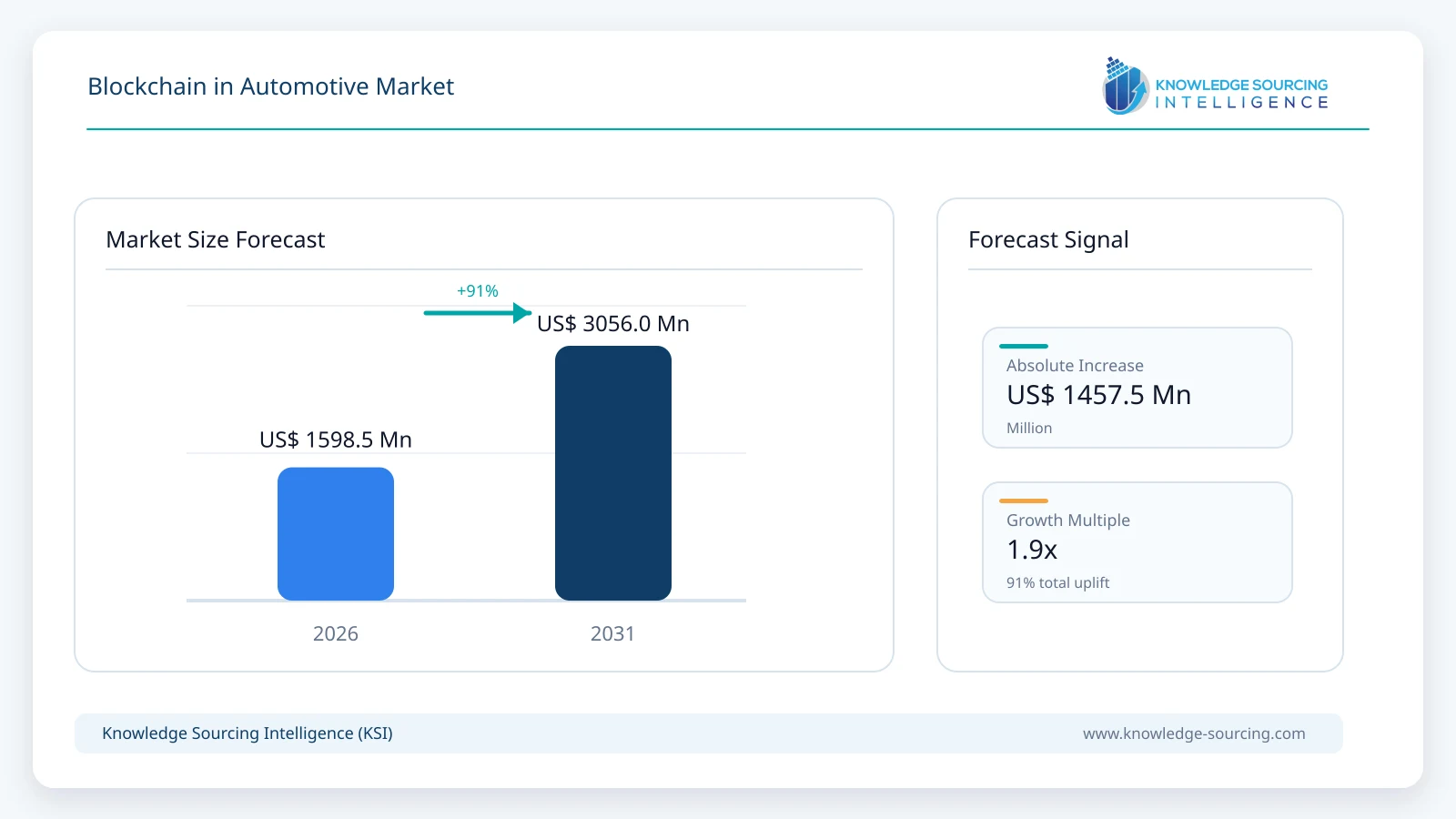
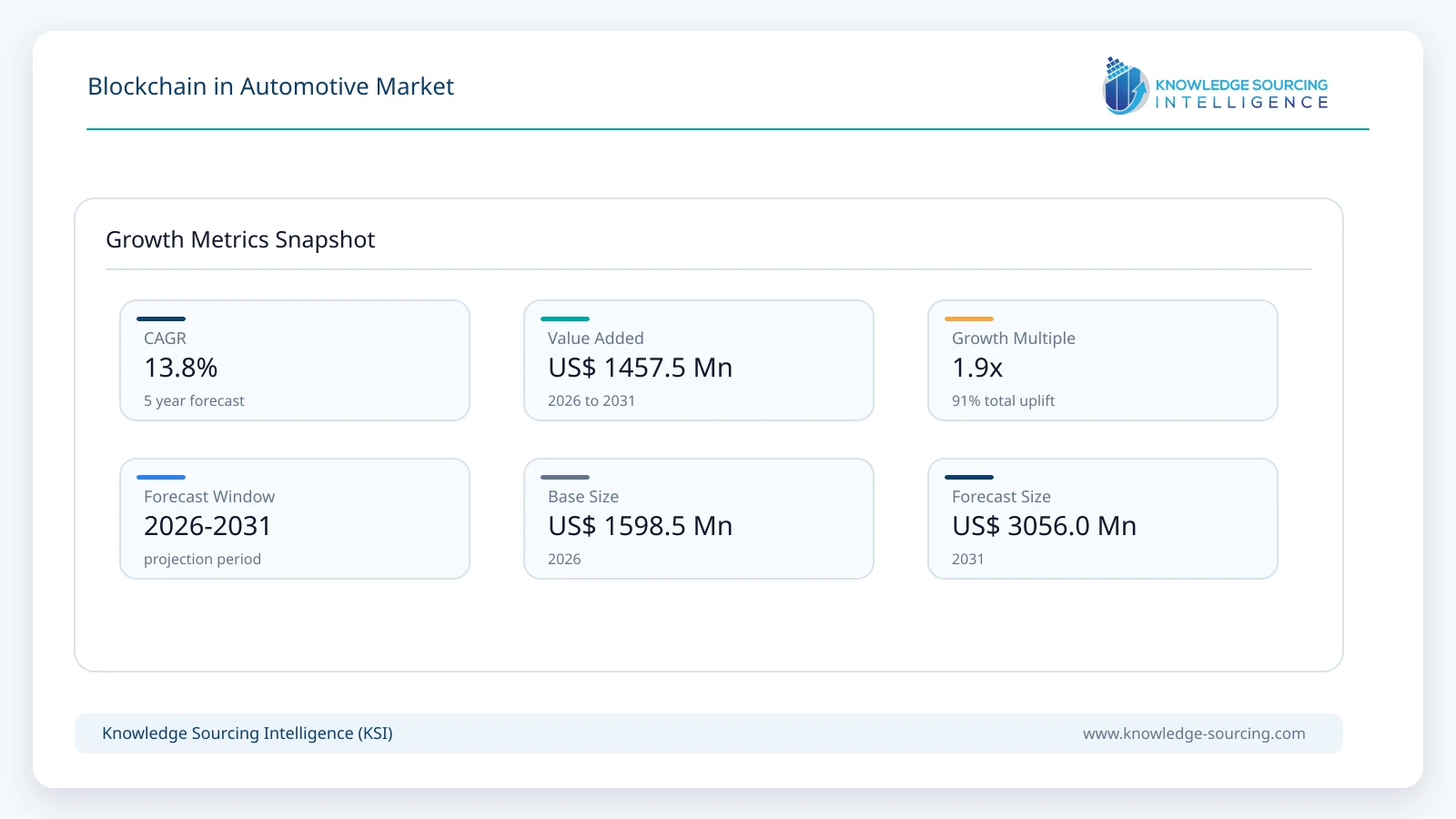
The Blockchain in Automotive Market will increase from USD 1,598.5 million in 2026 to USD 3,056.0 million by 2031, reflecting a 13.8% CAGR during the forecast period.
Highlights:
- 1Automotive supply-chain traceability is creating demand for shared transaction records across OEMs, suppliers, logistics providers, and regulators.
- 2Blockchain solutions for supply chain management and traceability represent a commercially important application because they address multi-party data reconciliation and provenance.
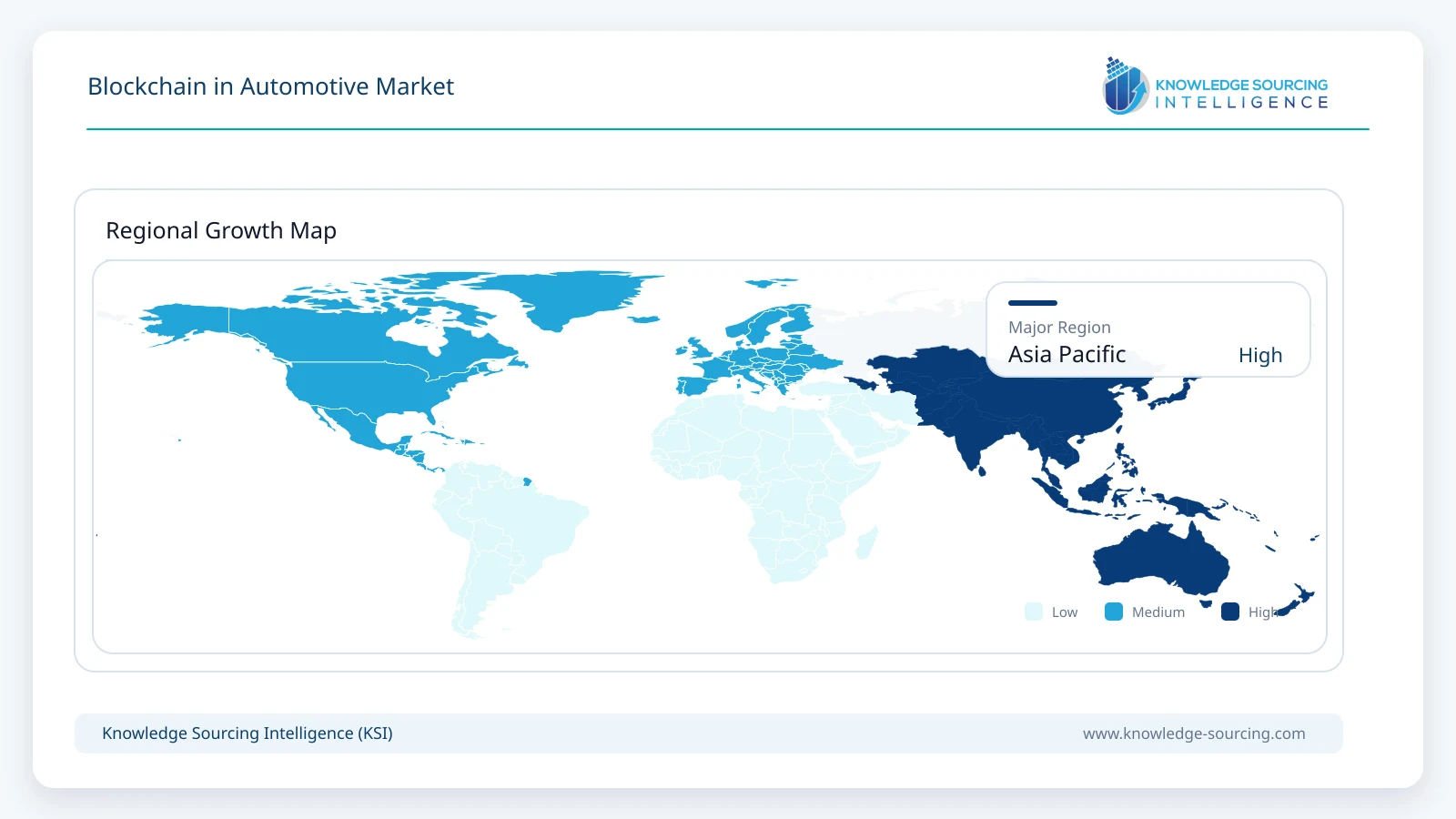
- 3Asia Pacific offers substantial adoption potential through large vehicle manufacturing ecosystems, supplier networks, EV production, and technology investment.
- 4Permissioned and consortium blockchain architectures are more commercially suitable than unrestricted public networks for sensitive automotive transactions.
- 5Battery passports, cybersecurity requirements, software-update governance, and sustainability reporting are increasing the value of verifiable vehicle and component data.
- 6Competition is extending beyond blockchain infrastructure toward integrated platforms combining cloud, ERP, IoT, analytics, cybersecurity, and industry-specific applications.
The Blockchain in Automotive Market covers the deployment of distributed ledger technology, smart contracts, tokenized records, and blockchain-enabled services across automotive manufacturing, supply chains, vehicle transactions, mobility operations, after-sales processes, insurance, financing, charging, and connected-vehicle ecosystems. The market includes blockchain platforms, application-specific solutions, and professional services required to design, integrate, deploy, operate, and maintain blockchain networks for automotive stakeholders.
Unlike conventional enterprise databases, blockchain applications become commercially relevant when multiple independent organizations need to maintain a common, auditable record without giving one participant unilateral control over the underlying transaction history. Automotive supply chains present this condition at scale. OEMs, Tier-1 suppliers, Tier-2 suppliers, logistics providers, dealers, insurers, financiers, regulators, repair networks, and customers exchange information but often retain separate systems. The resulting reconciliation burden creates costs around provenance, warranty validation, compliance evidence, logistics handoffs, parts authentication, and financial settlement.
The strongest commercial rationale therefore comes from multi-party processes rather than from blockchain as a standalone infrastructure technology. Automotive buyers are more likely to approve blockchain expenditure when it replaces duplicated reconciliation, establishes reliable chain-of-custody records, automates contractual events, or supports regulatory reporting. IBM's automotive work, for example, identifies vehicle identification, ownership, warranties, mileage, leases, loans, parts, service information, and supply-chain records as potential blockchain use cases. Its automotive logistics work also identifies vehicle location, custody events, transport documentation, damage records, customs documents, and insurance evidence as areas where a shared ledger can improve coordination.
The demand environment is shifting from blockchain experimentation toward targeted enterprise applications with identifiable operating benefits. Procurement teams increasingly assess solutions according to integration requirements, transaction throughput, data governance, cybersecurity, interoperability, partner onboarding, regulatory compliance, and total cost of ownership. Permissioned architectures are particularly relevant because automotive companies need to restrict sensitive commercial information while allowing authorized suppliers, logistics companies, insurers, financiers, and regulators to verify selected records.
Revenue generation in this market is consequently distributed across several layers. Platform providers monetize infrastructure and enterprise software; solution vendors generate revenue from applications for traceability, payments, logistics, warranty, and data management; and service providers earn through consulting, systems integration, network deployment, customization, migration, and ongoing support. The commercial model also increasingly combines blockchain with cloud computing, IoT, artificial intelligence, enterprise resource planning, telematics, digital identity, and connected-vehicle systems.
Automotive supply-chain complexity remains an important source of demand. A modern vehicle incorporates thousands of components sourced through multi-tier supplier networks, while compliance information may need to be retained and exchanged across multiple jurisdictions. IBM's Renault XCEED case demonstrates how blockchain can be applied to component compliance documentation, with the solution designed to share verified information among manufacturers and suppliers while preserving permission controls.
The market also benefits from the increasing importance of traceability for batteries and critical raw materials. Electric vehicles connect automotive companies to mineral sourcing, battery manufacturing, recycling, carbon accounting, and circular-economy requirements. The European Commission's Digital Batteries Passport framework will require relevant battery information to be maintained and made accessible through a digital passport from February 2027, creating an additional incentive for automotive and battery supply-chain participants to strengthen structured, verifiable data infrastructure.
Market Drivers
Rising Need for Multi-Tier Supply Chain Traceability
Automotive manufacturing depends on information moving across suppliers that frequently operate different enterprise systems, jurisdictions, and data standards. Procurement teams require reliable visibility into component origin, certification, shipment status, quality records, and compliance evidence, particularly where a single component can affect vehicle safety or regulatory approval.
Blockchain can create a shared transaction history among authorized participants without requiring every company to abandon its internal ERP or supply-chain platform. This makes the technology commercially relevant when organizations need a common record rather than another isolated database. Oracle's automotive blockchain materials identify applications including manufacturing, transportation, service, provenance, counterfeit-part reduction, compliance management, and supply-chain exception handling.
Demand is therefore strongest where reconciliation costs are high and the number of participating organizations is large. OEMs can use blockchain to establish common records with suppliers, while suppliers gain a standardized mechanism for proving delivery, certification, and component history. Solution providers compete by reducing integration complexity and demonstrating compatibility with existing ERP, IoT, logistics, and procurement systems.
Growing Requirements for Battery and Critical-Material Provenance
Electrification is expanding the importance of traceability beyond finished vehicles and conventional components. Battery manufacturers and automotive OEMs increasingly need reliable information about raw-material origin, processing, transportation, battery production, performance, recycling, and sustainability attributes.
The European Union's battery passport requirements provide a clear regulatory example. The European Commission states that the battery passport will cover relevant electric-vehicle batteries and provide information including identification, technical characteristics, economic operators, performance, durability, repair, reuse, recycling, sustainability, and circularity. The passport becomes mandatory for relevant categories from February 2027.
This creates procurement demand for infrastructure capable of maintaining trustworthy records across organizational boundaries. Blockchain is not the only technology capable of supporting such systems, but its auditability and distributed governance can make it suitable for selected chain-of-custody applications. Vendors therefore compete on data integrity, integration capability, scalability, identity management, and compliance support rather than blockchain functionality alone.
Expansion of Connected Vehicles and Machine-to-Machine Transactions
Connected vehicles generate opportunities for transactions involving tolls, charging, parking, entertainment, mobility services, insurance, and vehicle-to-infrastructure interactions. As vehicles become more capable of identifying themselves and communicating with external systems, payment authorization can shift from driver-initiated activity toward automated transactions.
In July 2026, AWS published an automotive architecture using blockchain-based micropayments for road tolls, EV charging, and in-vehicle services. The design combines vehicle-side applications, AWS services, AI agents, and blockchain settlement mechanisms. The commercial implication is that blockchain is being evaluated not only for record keeping but also for machine-initiated transactions where small-value payments and automated settlement are relevant.
For OEMs and mobility providers, the economic question is whether transaction costs, interoperability, identity management, and regulatory requirements can be addressed at sufficient scale. Suppliers that provide integrated payment, identity, cloud, and blockchain capabilities can therefore compete for a broader share of connected-mobility technology budgets.
Stronger Requirements for Cybersecurity and Software Governance
Connected and software-defined vehicles require manufacturers to document cybersecurity controls, software versions, update processes, and risk-management procedures. UNECE Regulations No. 155 and No. 156 establish international requirements covering vehicle cybersecurity and software-update management systems. The framework includes risk management, monitoring, incident response, software identification, update integrity, and documentation.
Blockchain can contribute to specific audit and integrity requirements by maintaining verifiable records of events, software versions, approvals, or authorized transactions. It does not replace cybersecurity controls, but it can form part of a broader evidence architecture.
The commercial driver is therefore compliance-related rather than technology-led. Automotive organizations are willing to invest where immutable or independently verifiable records reduce audit effort, improve accountability, or demonstrate control over critical processes. Technology suppliers must consequently integrate blockchain with cybersecurity and vehicle software-management systems.
Rising Cost of Manual Reconciliation and After-Sales Administration
Warranty processing, parts authentication, vehicle logistics, insurance claims, financing, and ownership transfers frequently involve information held by several parties. Differences between records can delay settlement and create disputes over responsibility.
Blockchain-based workflows can establish a shared chronology for events such as component installation, vehicle transfer, damage inspection, warranty eligibility, and service completion. IBM's automotive logistics work identifies vehicle handoffs, transport events, damage documentation, customs information, and insurance evidence as potential blockchain-enabled records.
The commercial benefit depends on the volume and frequency of transactions. Large OEMs, fleet operators, logistics companies, and insurers have greater incentives to automate reconciliation because administrative savings accumulate across high transaction volumes. Providers therefore need to demonstrate measurable reductions in disputes, processing time, fraud exposure, and manual documentation.
Market Restraints and Challenges
High Integration Complexity
Blockchain networks must interact with ERP, procurement, manufacturing execution, logistics, telematics, IoT, CRM, financial, and identity systems. Automotive organizations rarely replace these systems solely to adopt blockchain. Instead, blockchain must operate as an additional layer within an existing technology environment.
This increases implementation costs and extends deployment timelines. Buyers must evaluate APIs, data models, identity management, cybersecurity, cloud architecture, and interoperability before approving a project. Vendors can mitigate this restraint through pre-integrated connectors, modular architectures, managed services, and standardized interfaces.
Network-Participation Dependency
The value of a blockchain application depends on participation by multiple parties. An OEM cannot obtain full supply-chain traceability if only its own facilities record transactions while suppliers continue using disconnected systems.
Supplier onboarding is therefore a commercial challenge. Smaller Tier-2 and Tier-3 suppliers may lack the technical resources or financial incentive to participate. Providers must make onboarding inexpensive and straightforward while demonstrating value to every participant. Permissioned consortium models can help because access rights and responsibilities can be defined according to the role of each organization.
Data Quality Remains a Fundamental Risk
Blockchain can protect the integrity of information after it is recorded, but it cannot automatically confirm that the original information is accurate. Incorrect supplier data, fraudulent sensor readings, misidentified components, or incomplete documentation can still enter a blockchain network.
This makes data capture, identity verification, IoT integration, inspection processes, and governance essential. Automotive buyers therefore increasingly evaluate blockchain together with trusted data sources rather than as an independent solution.
Scalability, Cost, and Transaction Economics
Automotive ecosystems can generate very large transaction volumes. A blockchain architecture must process data at the speed required by manufacturing, logistics, connected vehicles, and financial operations without creating excessive infrastructure costs.
Public networks may also introduce governance, privacy, transaction-fee, and performance concerns that are difficult to reconcile with enterprise automotive requirements. As a result, permissioned, consortium, or hybrid designs are generally more appropriate for many commercial applications. Providers must demonstrate predictable operating costs and performance under production conditions.
Regulatory and Data-Governance Differences
Automotive companies operate across multiple jurisdictions with different requirements concerning data protection, cybersecurity, financial transactions, vehicle records, and cross-border information transfers. A blockchain network spanning several countries must determine where data is stored, who can access it, how identities are verified, and how records are handled under local law.
The issue is particularly important when blockchain records contain personally identifiable information or commercially sensitive data. Automotive buyers therefore favor architectures that separate sensitive information from shared transaction proofs and provide granular access controls.
Major Segment Analysis
Supply Chain Management and Traceability
Supply Chain Management and Traceability represents a commercially important application because automotive manufacturing combines high component volumes with extensive multi-tier relationships. The economic case is strongest where companies need to establish provenance, verify compliance, track custody, reduce disputes, and coordinate events across organizations that do not share a single database.
OEM procurement departments are the principal buyers, but adoption decisions typically involve supply-chain, quality, compliance, IT, finance, and manufacturing functions. Suppliers participate when the network improves order visibility, certification exchange, payment processing, or dispute resolution. Logistics providers benefit from common records covering pickup, transportation, warehouse entry, delivery, damage, and customs events.
The application is particularly relevant to batteries and other components subject to origin, sustainability, safety, or regulatory requirements. Blockchain can record authenticated events while detailed documents remain in enterprise systems or controlled repositories. This architecture allows participants to verify the existence and integrity of records without exposing commercially sensitive information to every network participant.
Competitive differentiation in this segment depends less on the ledger itself and more on implementation capability. Providers must integrate blockchain with ERP, procurement, IoT, RFID, telematics, document management, analytics, and identity systems. Oracle, for example, describes blockchain applications for automotive supply chains involving provenance, authenticity, compliance, smart contracts, and integration with enterprise systems.
IBM's XCEED example demonstrates another model in which blockchain supports automotive component compliance across multiple suppliers. The platform was designed to allow authorized participants to exchange compliance information while maintaining control over data access.
Revenue opportunities consequently extend beyond software licenses. Consulting, integration, partner onboarding, network governance, data migration, cybersecurity, managed services, and ongoing support can account for a substantial portion of project expenditure. This favors vendors with established enterprise relationships and automotive systems expertise.
Regional Analysis
North America
North American demand is supported by large automotive OEMs, extensive supplier networks, connected-vehicle development, financial services, insurance, logistics, and cloud infrastructure. The United States is particularly important because automotive companies, technology providers, financial institutions, and mobility platforms can fund blockchain pilots across several business functions.
Buyer priorities center on measurable operating benefits, cybersecurity, interoperability, and integration with established enterprise systems. Large organizations are more likely to pursue private or consortium architectures because supply-chain information and vehicle data require controlled access.
Canada provides opportunities through automotive manufacturing, mobility technology, and cross-border supply-chain relationships, while Mexico's position in North American vehicle production creates demand for component traceability, logistics visibility, and supplier documentation.
The principal constraint is the need to demonstrate a clear return on investment. Buyers are unlikely to deploy blockchain solely because it is technically feasible. Projects must address measurable reconciliation, compliance, fraud, or transaction problems.
Europe
Europe has a strong structural case for blockchain in automotive applications because automotive manufacturers operate across dense cross-border supply networks while facing detailed sustainability, circularity, product, cybersecurity, and data requirements.
The EU battery passport is particularly relevant. The European Commission's August 2026 guidance provides stakeholders with updated information on data points that will apply when battery passport requirements begin in February 2027.
Germany, France, Italy, Spain, and the United Kingdom represent important demand centers because of their automotive production, supplier ecosystems, technology industries, and regulatory activity. European buyers are likely to prioritize permissioned networks, provenance systems, sustainability records, and interoperability with industrial data ecosystems.
Competition is also shaped by industry-wide initiatives designed to improve data exchange between automotive organizations. BMW Group described Catena-X in December 2025 as an open data ecosystem intended to connect international supply chains and support secure, standardized, data-sovereign information exchange. While Catena-X is not itself a blockchain market, its development illustrates the importance European OEMs place on shared supply-chain data infrastructure.
Asia Pacific
Asia Pacific offers substantial demand potential because it combines large vehicle-production volumes, extensive supplier networks, EV manufacturing, electronics capabilities, and expanding connected-mobility infrastructure.
China is important because of its vehicle manufacturing scale, battery ecosystem, and domestic technology capabilities. Japan combines established OEMs with advanced manufacturing, mobility, and technology infrastructure. South Korea and Taiwan contribute strong electronics and semiconductor ecosystems, while India is becoming increasingly important as an automotive manufacturing and technology-services center. Indonesia and Thailand provide additional opportunities through vehicle manufacturing and regional supply chains.
Purchasing decisions in the region vary considerably by country. Large OEMs and multinational suppliers are more likely to deploy enterprise-grade blockchain networks, while smaller suppliers may prefer managed platforms that reduce infrastructure and technical requirements.
The region's principal challenge is ecosystem fragmentation. Different national standards, enterprise architectures, regulatory environments, and supplier capabilities can make cross-border blockchain networks difficult to operate. Providers that offer localization, integration services, and multilingual partner onboarding can therefore gain an advantage.
Middle East and Africa
The Middle East and Africa market remains smaller than North America, Europe, and Asia Pacific but offers targeted opportunities in vehicle logistics, fleet management, financing, government vehicle records, smart mobility, and connected infrastructure.
Saudi Arabia and the United Arab Emirates are important because of investments in smart-city infrastructure, digital government services, mobility systems, and technology platforms. Blockchain applications are more likely to develop around specific government, logistics, financial, and mobility programs than through broad adoption across the entire automotive supply chain.
The main constraints include fragmented supplier ecosystems, differing regulatory environments, and uneven technology infrastructure. Vendors must demonstrate clear business cases and typically need strong local implementation partners.
South America
Brazil represents the largest opportunity in South America because of its automotive manufacturing base, logistics network, financial infrastructure, and large domestic vehicle market. Blockchain applications can address vehicle traceability, parts provenance, logistics documentation, financing, insurance, and fleet operations.
Argentina and other markets provide narrower opportunities, particularly in fleet management, vehicle finance, logistics, and supply-chain applications. Economic volatility and investment constraints can delay large technology projects, making subscription-based and managed blockchain services more attractive than major infrastructure deployments.
Competitive Landscape
The competitive structure includes global cloud and enterprise-technology companies, consulting and systems-integration providers, blockchain specialists, and distributed-ledger technology companies. The supplied competitive set includes IBM, Microsoft, Amazon Web Services (AWS), Oracle, SAP, BigchainDB, Accenture, Tech Mahindra, ConsenSys, R3, and XAIN.
Competition is based on different capabilities rather than a single product category. IBM, Microsoft, AWS, Oracle, and SAP can compete through enterprise software, cloud infrastructure, data integration, and existing relationships with large industrial customers. Specialist blockchain companies such as BigchainDB, ConsenSys, R3, and XAIN can differentiate through distributed-ledger expertise and specialized architectures.
Consulting and integration companies such as Accenture and Tech Mahindra compete by combining blockchain with enterprise transformation, automotive engineering, cybersecurity, cloud, analytics, and managed services. This is commercially important because automotive customers often require implementation across legacy systems rather than a standalone blockchain deployment.
Technology positioning is also shifting toward combinations of blockchain with AI, IoT, digital identity, cloud infrastructure, and smart contracts. AWS's 2026 automotive blockchain payment architecture illustrates this direction by combining blockchain settlement with cloud-based AI agents and vehicle applications.
Tech Mahindra has also maintained blockchain capabilities within its manufacturing technology portfolio and demonstrated blockchain-based warranty applications with Samsung SDS.
The market therefore favors vendors that can provide complete deployment ecosystems. Partnerships are important because no single provider necessarily controls the OEM, supplier, logistics, financial, regulatory, and technology relationships required for a production network.
Recent Developments
August 2026: The European Commission published updated guidance for preparations for the Digital Batteries Passport, clarifying applicable data points ahead of the February 2027 requirements. Commercial relevance: automotive and battery supply chains need stronger traceability, data governance, and interoperable digital records, supporting demand for technologies capable of maintaining verifiable provenance.
July 2026: AWS published an automotive architecture for blockchain-based agentic payments covering road tolls, EV charging, and in-vehicle services. Commercial relevance: the development expands blockchain's potential automotive role from supply-chain records toward machine-initiated transactions and automated settlement.
April 2026: SMX launched its Digital Material Passport Platform, using blockchain-backed records to track and tokenize materials across supply chains, supporting traceability relevant to automotive components and recycling.
March 2026: Agora Data announced that its originated auto loans became publicly available on Figure’s blockchain-native marketplace, enabling qualified participants to access tokenized automotive loan assets.
Regulatory and Policy Environment
Automotive blockchain adoption is influenced by several overlapping regulatory areas rather than by a single blockchain-specific automotive regulation.
Cybersecurity is one of the most important. UNECE Regulation No. 155 establishes requirements related to vehicle cybersecurity and cybersecurity management systems, while Regulation No. 156 covers software updates and software-update management systems. The regulations require manufacturers to establish processes for risk assessment, monitoring, incident management, software identification, update integrity, and documentation.
UNECE continues to review these frameworks. In 2025, a workshop addressed implementation of UN Regulations No. 155 and 156 for multistage vehicles, while 2026 working documents proposed further amendments concerning cybersecurity and software updates.
Battery regulation is another major influence. Under the EU Batteries Regulation, the digital battery passport will apply to relevant electric-vehicle batteries placed on the EU market from February 2027. The system is designed to make information on battery identification, performance, durability, repair, reuse, recycling, sustainability, and circularity accessible to authorized stakeholders.
These requirements do not mandate blockchain. They instead create a regulatory need for reliable, accessible, auditable, and structured data. Blockchain vendors must therefore position their technology as one component of a broader compliance architecture.
Data-protection legislation also affects architecture decisions. Automotive blockchain systems should avoid placing unnecessary personal or sensitive information directly on immutable ledgers. Permission controls, off-chain storage, cryptographic proofs, identity management, and selective data access are therefore important design considerations.
Financial applications introduce additional requirements. Blockchain-enabled vehicle financing, insurance, payment, charging, and tokenized ownership systems may fall under financial-services, payment, consumer-protection, anti-money-laundering, and digital-asset regulations depending on the jurisdiction and transaction structure.
Outlook and Strategic Implications
The 2026–2031 outlook for blockchain in automotive will depend less on broad blockchain adoption and more on the conversion of narrowly defined use cases into production networks. Supply-chain traceability is likely to remain a principal commercial application because it directly addresses multi-party coordination, provenance, compliance, and auditability.
Investment priorities are expected to favor permissioned and consortium architectures that allow OEMs and suppliers to share selected information without exposing confidential commercial data. Hybrid models may also become more relevant where enterprises require controlled internal records while connecting selected proofs or transactions to external networks.
Procurement teams will increasingly evaluate blockchain as part of broader technology programs rather than as an independent purchase. Vendors that integrate blockchain with ERP, cloud, IoT, AI, cybersecurity, identity, telematics, and data platforms will have a stronger opportunity to participate in large automotive transformation budgets.
Battery traceability is likely to become a particularly important procurement theme. The European battery passport creates a concrete compliance deadline, while similar requirements for sustainability, circularity, and responsible sourcing can influence other regions. Automotive companies will need systems that connect raw-material records with battery production, vehicle identification, maintenance, reuse, and recycling information. Blockchain can serve selected functions within this chain when multiple parties require a shared and auditable record.
Vehicle logistics also offers a practical commercial pathway. Finished vehicles pass through manufacturers, carriers, ports, storage compounds, dealers, and customers. A shared record of custody, condition, documentation, and delivery can reduce disputes and improve accountability. IBM's automotive logistics work illustrates how such networks can incorporate transport events, damage evidence, customs records, and insurance documentation.
Connected-vehicle payments represent a longer-term opportunity. AWS's July 2026 architecture demonstrates how blockchain can support automated payments for tolls, charging, and in-vehicle services. The business case will depend on transaction economics, regulatory acceptance, identity management, interoperability, and consumer trust.
Competitive differentiation will increasingly shift from blockchain infrastructure toward industry-specific implementation. Automotive buyers will favor suppliers capable of integrating distributed ledgers into existing procurement, manufacturing, logistics, warranty, finance, and vehicle-data systems. Professional services will remain important because network governance, partner onboarding, data migration, cybersecurity, and integration determine whether pilot projects can reach production scale.
The principal risks remain interoperability, ecosystem participation, data quality, cybersecurity, regulatory fragmentation, scalability, and unclear return on investment. Successful projects will therefore begin with processes where the cost of fragmented information is measurable and where multiple parties have a shared economic incentive to participate.
Strategically, automotive OEMs should prioritize applications with defined ownership of data, measurable reconciliation costs, clear governance, and identifiable participating organizations. Technology providers should build modular architectures that allow customers to introduce blockchain selectively rather than redesign entire enterprise systems.
Over the next five years, the market is likely to become more application-driven. Supply-chain provenance, battery traceability, logistics, warranty, financial transactions, vehicle identity, and connected-mobility payments can each develop at different adoption rates. The strongest commercial opportunities will emerge where blockchain provides a practical mechanism for trusted multi-party coordination and where regulatory or financial requirements make reliable transaction histories economically valuable.
Blockchain in Automotive Market Scope:
| Report Metric | Details |
|---|---|
| Total Market Size in 2026 | USD 1,598.5 million |
| Total Market Size in 2031 | USD 3,056.0 million |
| Forecast Unit | Million |
| Growth Rate | 13.8% |
| Study Period | 2021 to 2031 |
| Historical Data | 2021 to 2024 |
| Base Year | 2025 |
| Forecast Period | 2026 – 2031 |
| Segmentation | Component, Blockchain Type, Vehicle Type, End User, , Geography |
| Companies |
|
Market Segmentation
By Component
By Blockchain Type
By Application
By Vehicle Type
By End User
By Geography
Table of Contents
1. EXECUTIVE SUMMARY
2. MARKET SNAPSHOT
2.1. Market Overview
2.2. Market Definition
2.3. Scope of the Study
2.4. Market Segmentation
3. BUSINESS LANDSCAPE
3.1. Market Drivers
3.2. Market Restraints
3.3. Market Opportunities
3.4. Porter’s Five Forces Analysis
3.5. Industry Value Chain Analysis
3.6. Policies and Regulations
3.7. Strategic Recommendations
4. TECHNOLOGICAL OUTLOOK
4.1. Distributed Ledger Technology
4.2. Smart Contracts
4.3. Digital Identity and Authentication
4.4. Blockchain and Internet of Things
4.5. Blockchain and Connected Vehicles
4.6. Blockchain and Autonomous Vehicles
4.7. Blockchain-Based Payments
4.8. Data Privacy and Cybersecurity
4.9. Interoperability and Scalability
5. BLOCKCHAIN IN AUTOMOTIVE MARKET BY COMPONENT
5.1. Introduction
5.2. Blockchain Platforms
5.3. Blockchain Solutions
5.4. Blockchain Services
5.4.1. Consulting
5.4.2. Integration and Deployment
5.4.3. Support and Maintenance
6. BLOCKCHAIN IN AUTOMOTIVE MARKET BY BLOCKCHAIN TYPE
6.1. Introduction
6.2. Public Blockchain
6.3. Private Blockchain
6.4. Consortium and Permissioned Blockchain
6.5. Hybrid Blockchain
7. BLOCKCHAIN IN AUTOMOTIVE MARKET BY APPLICATION
7.1. Introduction
7.2. Supply Chain Management and Traceability
7.3. Vehicle Identity and Data Management
7.4. Parts Authentication and Provenance
7.5. Warranty and After-Sales Management
7.6. Vehicle Logistics and Fleet Management
7.7. Payments and Financial Transactions
7.8. Insurance and Claims Management
7.9. Vehicle Ownership and Financing
7.10. Charging and Energy Transactions
7.11. Connected and Autonomous Vehicle Data Management
7.12. Other Applications
8. BLOCKCHAIN IN AUTOMOTIVE MARKET BY VEHICLE TYPE
8.1. Introduction
8.2. Passenger Vehicles
8.3. Commercial Vehicles
8.4. Two-Wheelers
8.5. Other Vehicle Types
9. BLOCKCHAIN IN AUTOMOTIVE MARKET BY END USER
9.1. Introduction
9.2. Automotive OEMs
9.3. Tier-1 and Tier-2 Suppliers
9.4. Fleet Operators
9.5. Mobility Service Providers
9.6. Insurance Providers
9.7. Financial Institutions
9.8. Government and Regulatory Organizations
10. BLOCKCHAIN IN AUTOMOTIVE MARKET BY GEOGRAPHY
10.1. Introduction
10.2. North America
10.2.1. By Component
10.2.2. By Blockchain Type
10.2.3. By Application
10.2.4. By Vehicle Type
10.2.5. By End User
10.2.6. By Country
10.2.6.1. United States
10.2.6.2. Canada
10.2.6.3. Mexico
10.3. South America
10.3.1. By Component
10.3.2. By Blockchain Type
10.3.3. By Application
10.3.4. By Vehicle Type
10.3.5. By End User
10.3.6. By Country
10.3.6.1. Brazil
10.3.6.2. Argentina
10.3.6.3. Others
10.4. Europe
10.4.1. By Component
10.4.2. By Blockchain Type
10.4.3. By Application
10.4.4. By Vehicle Type
10.4.5. By End User
10.4.6. By Country
10.4.6.1. United Kingdom
10.4.6.2. Germany
10.4.6.3. France
10.4.6.4. Italy
10.4.6.5. Spain
10.4.6.6. Others
10.5. Middle East and Africa
10.5.1. By Component
10.5.2. By Blockchain Type
10.5.3. By Application
10.5.4. By Vehicle Type
10.5.5. By End User
10.5.6. By Country
10.5.6.1. Saudi Arabia
10.5.6.2. United Arab Emirates
10.5.6.3. Others
10.6. Asia Pacific
10.6.1. By Component
10.6.2. By Blockchain Type
10.6.3. By Application
10.6.4. By Vehicle Type
10.6.5. By End User
10.6.6. By Country
10.6.6.1. Japan
10.6.6.2. China
10.6.6.3. India
10.6.6.4. South Korea
10.6.6.5. Taiwan
10.6.6.6. Indonesia
10.6.6.7. Thailand
10.6.6.8. Others
11. COMPETITIVE ENVIRONMENT AND ANALYSIS
11.1. Major Players and Strategy Analysis
11.2. Competitive Positioning Analysis
11.3. Mergers, Acquisitions, Agreements, and Collaborations
11.4. Competitive Dashboard
12. COMPANY PROFILES
12.1. IBM
12.2. Microsoft
12.3. Amazon Web Services (AWS)
12.4. Oracle
12.5. SAP
12.6. BigchainDB
12.7. Accenture
12.8. Tech Mahindra
12.9. ConsenSys
12.10. R3
12.11. XAIN
13. RESEARCH METHODOLOGY
LIST OF FIGURES
LIST OF TABLES
Navigate
Trusted by the world's leading organizations











