
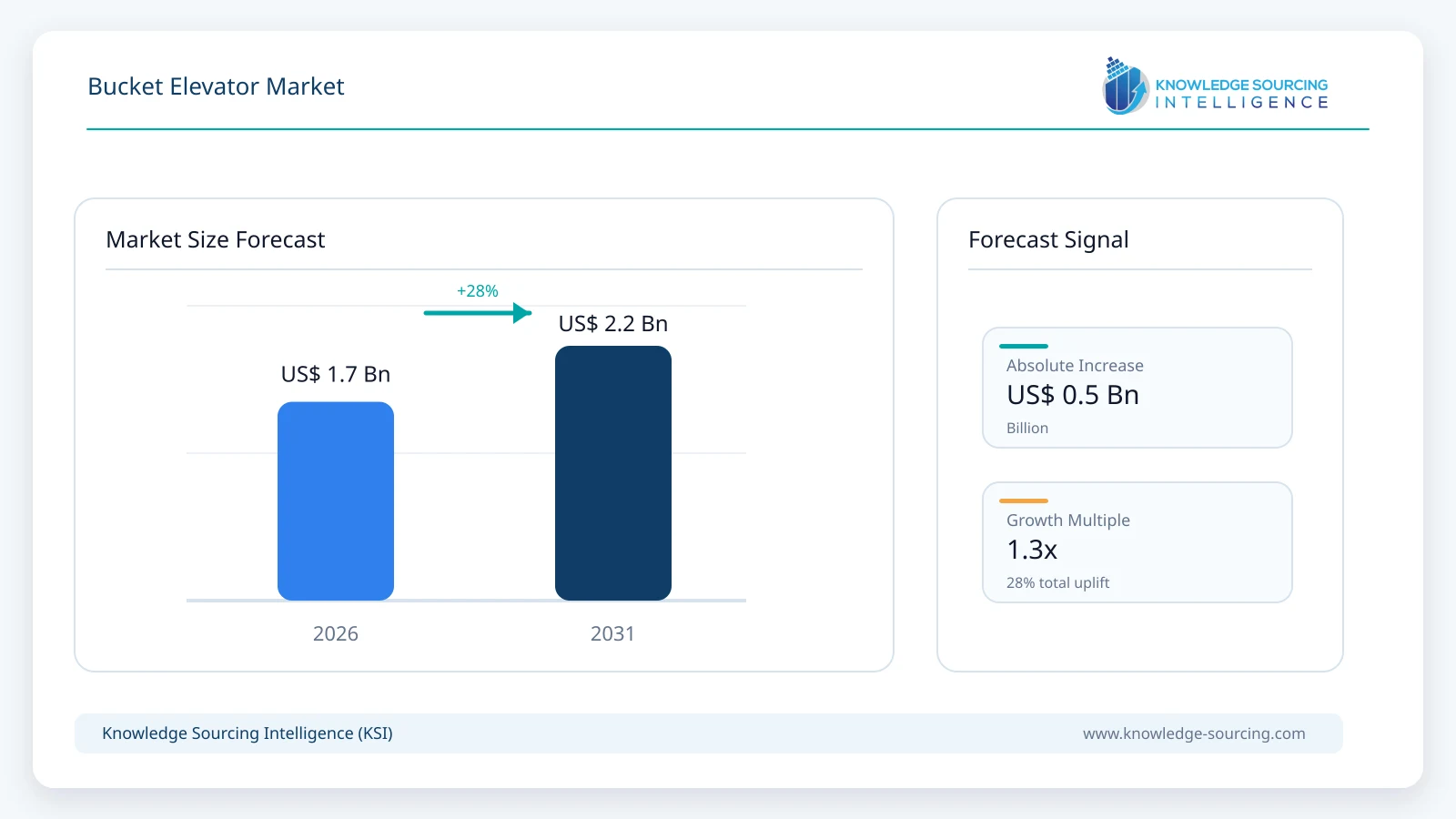
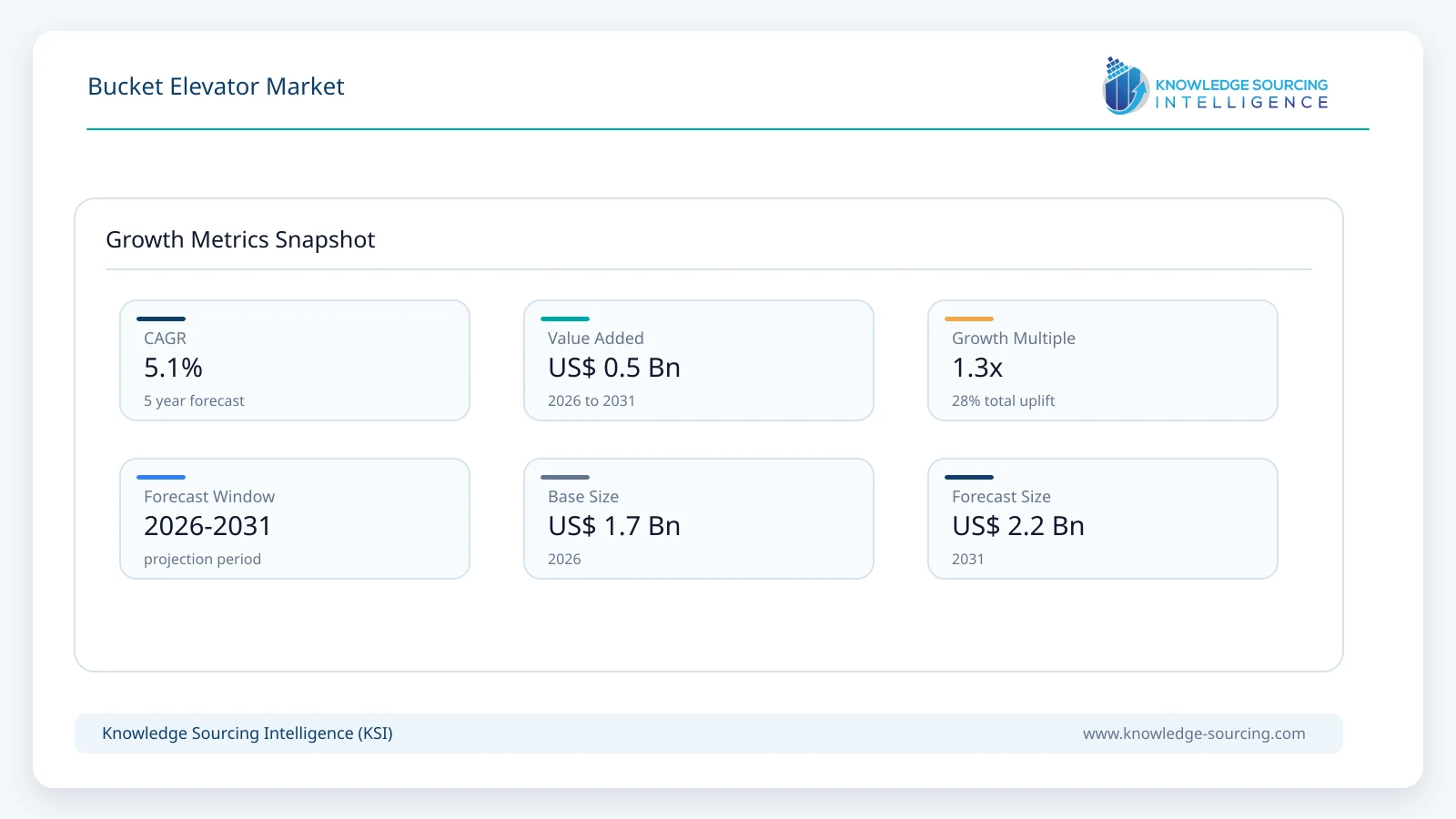
The Bucket Elevator Market is forecast to grow at a CAGR of 5.1%, reaching USD 2.23 billion in 2031 from USD 1.74 billion in 2026.
Highlights:
- 1Agricultural infrastructure is supporting equipment demand, particularly through grain storage, processing, seed handling, and farm-to-market infrastructure investments.
- 2Industrial material characteristics are shaping elevator specifications, with abrasion, temperature, corrosion, bulk density, and particle size influencing belt, chain, and bucket selection.
- 3Asia Pacific offers important project opportunities, supported by agricultural processing, food manufacturing, minerals, fertilizers, and industrial infrastructure investment.
- 4Safety and condition monitoring are becoming stronger procurement criteria, particularly where combustible dust or high-duty operation creates operational risks.
- 5Digital monitoring is expanding the value proposition, with suppliers adding diagnostic and condition-monitoring capabilities to reduce unplanned downtime.
- 6Competition is application-driven, with suppliers differentiating through engineering capability, sanitary design, heavy-duty construction, customization, geographic service coverage, and lifecycle support.
The Bucket Elevator Market covers equipment used to move bulk solid materials vertically through buckets attached to belts or chains. These systems serve as an important connection between receiving, processing, storage, packaging, and dispatch operations where conventional horizontal conveying cannot meet plant-layout or elevation requirements. ISO 7190 classifies bucket elevators according to construction, bucket path, discharge arrangement, and driving-medium system, while ISO 5050 specifies characteristics for vertical bucket elevators using calibrated round steel link chains. Both standards remain current following recent confirmation reviews.
Demand is closely linked to capital expenditure in industries that handle large quantities of dry, free-flowing solids. Agriculture remains a foundational application because grain, seed, feed, and other commodities frequently move between receiving pits, cleaners, dryers, silos, and loading systems. Industrial users also require vertical conveying for fertilizers, minerals, chemicals, cement-related materials, biomass, food ingredients, and other bulk products. The equipment becomes particularly valuable where floor space is constrained and material must be lifted over substantial vertical distances.
The commercial importance of a bucket elevator comes from its ability to combine high throughput with a relatively compact footprint. Unlike inclined conveying systems, vertical elevators can reduce the amount of floor area required for material transfer. This characteristic matters when buyers are expanding an existing facility rather than constructing a greenfield plant. Replacement projects can therefore generate demand even when overall production capacity remains broadly unchanged.
Buyer decisions are strongly application-specific. Procurement teams typically evaluate throughput, lift height, material density, particle size, abrasiveness, temperature, moisture, corrosiveness, dust characteristics, discharge requirements, maintenance access, and expected operating hours. The choice between belt and chain construction also depends on load conditions and material properties. FEECO, for example, offers centrifugal and continuous designs across belt and chain configurations and states that its equipment is engineered around material characteristics, required horsepower, and elevator height.
Safety increasingly influences the specification process, particularly in grain, food, chemical, and other dust-generating applications. In the United States, OSHA's grain-handling requirements specifically address bucket-elevator inspection access, belt alignment, motion detection, bearing monitoring, conductive belts, and maintenance practices. These requirements make safety equipment part of the purchasing specification rather than an optional after-sales consideration.
The market therefore consists of more than equipment sales. Revenue opportunities extend across engineering, system integration, installation, modernization, replacement components, maintenance, inspection, controls, monitoring equipment, and aftermarket services. Suppliers with the ability to engineer complete conveying arrangements can compete for larger project values, while specialist manufacturers can secure orders through sanitary construction, customized configurations, high-temperature handling, abrasive-material capability, or compact designs.
Market Drivers
Expansion of Grain Storage and Agricultural Processing Infrastructure
Agricultural supply chains generate recurring requirements for vertical movement because grains and seeds often pass through multiple elevation points before storage or processing. Receiving systems, cleaning equipment, dryers, silos, processing lines, and dispatch facilities all create opportunities for vertical conveying equipment.
India illustrates the scale of this infrastructure requirement. Government data indicates that foodgrain production reached 357.73 million metric tonnes in 2024-25, while storage and agricultural marketing infrastructure programs continue to support additional capacity. By June 2025, 49,796 storage infrastructure projects had been sanctioned across 27 states under agricultural marketing infrastructure initiatives.
For elevator suppliers, the commercial implication is important. Demand does not depend solely on additional grain production. New warehouses, processing plants, seed facilities, dryers, and decentralized storage projects create equipment requirements around the existing agricultural output base. Buyers also increasingly evaluate the ability of suppliers to integrate elevators with cleaners, conveyors, feeders, silos, and dust-control systems.
This favors vendors capable of providing engineered packages rather than standalone machines. Agricultural customers generally prioritize dependable operation during seasonal peaks because equipment downtime during harvesting or dispatch periods can create bottlenecks across the wider handling system.
Investment in Food Processing and Value-Added Production
Food processors require controlled movement of grains, cereals, ingredients, nuts, confectionery products, pet food, and other bulk materials between processing and packaging stages. Vertical conveying becomes commercially attractive when plants need to maximize usable floor area while maintaining hygienic handling.
Government initiatives are supporting additional food-processing infrastructure in major production regions. India's Ministry of Food Processing Industries reported continued investment through PMKSY, PLISFPI, and PMFME, while processed food's share of agricultural exports increased from 13.7% in 2014-15 to 20.4% in 2024-25.
This investment changes elevator specifications. Food processors are less willing to accept equipment that creates difficult cleaning points or exposes products to contamination risks. Stainless-steel construction, washdown capability, inspection access, gentle handling, and integration with packaging equipment can therefore command greater commercial importance than maximum throughput alone.
The resulting demand environment supports specialized equipment suppliers serving food and packaging applications. Frazier & Son, for instance, emphasizes sanitary bucket elevator designs, stainless-steel construction, washdown-ready configurations, multiple discharge arrangements, and integration with packaging equipment.
Expansion of Mineral, Fertilizer, and Bulk Industrial Processing
Mining, minerals, fertilizer, and chemical operations require equipment capable of handling materials that can be abrasive, hot, corrosive, dusty, or heavy. Bucket elevators are useful when processing plants need to move materials vertically between crushers, dryers, screens, storage systems, granulation equipment, and dispatch facilities.
The investment case is particularly strong when material handling becomes a bottleneck within a high-throughput process. A failure in vertical conveying can interrupt upstream and downstream equipment, making reliability a central purchasing criterion.
Critical-mineral supply chains also require substantial investment in new mines, processing facilities, and refining capacity. The International Energy Agency's 2025 assessment identified supply-chain concentration, price volatility, and investment requirements as important issues affecting mineral security. It estimated that around USD 500 billion of additional mining capital investment would be required through 2040 under its Stated Policies Scenario.
For bucket elevator manufacturers, the implication is not a direct one-to-one relationship between mineral demand and equipment sales. Instead, mining and processing investment creates project opportunities where vertical material transfer is part of new or expanded plant infrastructure. Suppliers that can handle abrasive and high-temperature materials have an advantage in these applications.
Demand for Compact Material-Handling Systems
Plant operators increasingly examine equipment footprint when expanding facilities. Land and building costs can make large inclined conveyors unattractive, especially when an existing plant already contains fixed processing equipment.
Bucket elevators provide a vertical transfer route within a relatively narrow footprint. FEECO identifies small spatial footprint as one of the equipment's principal advantages and offers designs for materials ranging from powders to heavy solids such as iron ore pellets.
This creates a replacement and retrofit opportunity in addition to greenfield demand. Existing plants can replace aging elevators or modify them to increase throughput without redesigning the entire material-flow arrangement. Suppliers therefore compete on engineering adaptability as much as on basic conveying capacity.
Increasing Attention to Equipment Monitoring and Reliability
Unplanned downtime has a disproportionate effect in continuous processing operations because a single conveying failure can stop several connected machines. Buyers consequently place greater value on monitoring systems that identify belt misalignment, abnormal speed, bearing temperature, vibration, and other early indicators.
BEUMER Group has expanded this proposition through its BEUMER Guardian solution, introduced at FachPack and Powtech in September 2025. The company stated that the system uses data diagnostics for process optimization, condition monitoring, and maintenance, including conveying technology and bucket elevators.
The commercial effect is a shift from equipment procurement toward lifecycle performance. Suppliers can differentiate through monitoring, maintenance support, spare parts, remote diagnostics, and service agreements rather than competing only on initial equipment price.
Market Restraints and Challenges
High Consequences of Incorrect Equipment Specification
Bucket elevators operate within tightly connected material-handling systems. Incorrect selection of bucket capacity, belt or chain type, speed, discharge arrangement, or drive system can create spillage, product degradation, excessive wear, or insufficient throughput.
The root problem is that material properties differ substantially between applications. Grain behaves differently from fertilizer, iron ore, chemicals, or food ingredients. Abrasive particles can accelerate wear, while sticky materials can interfere with discharge and cleaning.
Buyers therefore face higher engineering costs when material characteristics are uncertain. Suppliers mitigate this risk through material testing, application engineering, customized bucket selection, and system simulations. The commercial consequence is that technically capable vendors can defend margins more effectively than suppliers competing solely on standardized equipment pricing.
Dust Explosion and Workplace Safety Requirements
Combustible dust presents one of the most important operational challenges in grain and food-processing facilities. OSHA identifies bucket elevators as equipment requiring specific controls in grain-handling environments, including motion detection, belt alignment monitoring, inspection access, and bearing monitoring.
European installations face comparable requirements under explosive-atmosphere legislation. ATEX Directive 2014/34/EU establishes requirements for equipment and protective systems intended for potentially explosive atmospheres, including those involving combustible dust. The European Commission specifically identifies flour mills and mines among relevant applications.
These requirements increase engineering and certification costs. However, they also create opportunities for suppliers that can incorporate monitoring, explosion protection, dust containment, appropriate electrical equipment, and documented compliance into complete systems.
Maintenance and Wear in Heavy-Duty Applications
Elevators handling abrasive minerals, fertilizers, or high-temperature materials experience mechanical wear in buckets, belts, chains, bearings, pulleys, and fasteners. Maintenance requirements can become particularly demanding when elevators operate continuously.
The affected stakeholders include plant operators, maintenance contractors, equipment manufacturers, and engineering companies. Buyers may initially compare equipment on purchase price, but total cost of ownership can be more important where downtime is expensive.
Suppliers address this challenge through reinforced construction, wear-resistant components, accessible inspection points, improved bucket attachment systems, condition monitoring, and replacement parts. BEUMER, for example, offers heavy-duty belt elevators for abrasive bulk materials and monitoring systems for belt misalignment, speed, and filling levels.
Capital Budget Sensitivity
Bucket elevators are often purchased as components of broader plant projects. When fertilizer, mining, food-processing, or agricultural projects face financing constraints, material-handling equipment can be deferred alongside other capital items.
This creates uneven order patterns for manufacturers. Project timing can depend on customer financing, permitting, commodity prices, plant expansion decisions, and construction schedules. Suppliers with aftermarket businesses and replacement demand can partially offset fluctuations in large project orders.
Supply-Chain and Installation Complexity
Large industrial elevators require steel structures, belts, chains, buckets, drives, bearings, motors, electrical components, controls, and ancillary equipment. International projects add transportation, customs, installation, and commissioning considerations.
Long delivery times for critical components can affect project schedules. Buyers therefore increasingly value regional manufacturing and service capabilities. The commercial advantage goes to suppliers that can combine centralized engineering with localized production, installation, spare-parts availability, and technical support.
Major Segment Analysis: Agriculture Application
Agriculture is a commercially important application because bucket elevators are embedded within grain, seed, feed, storage, drying, cleaning, and processing systems. The equipment's role is functional rather than discretionary: once a facility adopts vertical bulk handling, the elevator becomes part of the material-flow architecture.
Demand comes from grain terminals, storage facilities, feed mills, seed processors, grain cleaning plants, rice mills, flour mills, and agricultural commodity handlers. Buyers typically prioritize throughput consistency, low product damage, dust control, inspection access, reliability during seasonal peaks, and compatibility with upstream and downstream equipment.
Agricultural buyers also have distinct procurement behavior. Large grain-handling facilities often evaluate equipment based on throughput and reliability because a conveying bottleneck can restrict the utilization of expensive storage and processing assets. Smaller processors may give greater weight to purchase price, ease of maintenance, local service, and availability of replacement components.
The type of elevator depends on the material and process. Centrifugal designs are suitable where higher-speed discharge is required and materials can tolerate the handling characteristics of the system. Continuous elevators are better suited to applications where controlled discharge and gentler handling are important. Belt and chain selection then depends on capacity, material properties, operating conditions, and expected wear.
The agricultural application also benefits from storage infrastructure investment. India's government reported record 2024-25 foodgrain production and continued expansion of storage and agricultural marketing infrastructure. The country's Agriculture Infrastructure Fund, Agricultural Marketing Infrastructure scheme, PMKSY, and grain-storage initiatives are supporting investments that can require mechanical conveying equipment.
Seed processing represents another specialized opportunity. Cimbria's equipment portfolio includes low-speed bucket elevators used in seed-processing lines, and its 2025 work with VNR Seeds formed part of a major Indian seed-processing infrastructure project.
For suppliers, agricultural demand rewards dependable standard equipment but also favors customization. Elevator height, bucket size, speed, discharge configuration, dust control, access, and integration with dryers or cleaners must frequently be adapted to individual facilities.
Revenue potential therefore extends beyond the initial elevator sale. Agricultural operators require replacement buckets, belts, bearings, pulleys, drives, controls, inspections, and maintenance. Suppliers with established installed bases can build recurring aftermarket revenue while using new-project orders to expand their customer base.
Regional Analysis
North America
North America has a mature bulk-handling infrastructure base across grain, food processing, fertilizer, minerals, and industrial manufacturing. Demand is supported by replacement cycles, plant modernization, capacity expansion, and safety-driven upgrades.
The United States has particularly detailed regulatory requirements for grain-handling facilities. OSHA requires specific controls for inside bucket elevators, including motion detection, belt alignment monitoring, inspection access, and bearing-condition monitoring.
This regulatory environment raises equipment specifications and supports demand for compliant replacement systems. Buyers also value local engineering, rapid spare-parts supply, and service availability because seasonal agricultural operations have limited tolerance for extended downtime.
Canada presents opportunities in grain handling, mining, fertilizer, food processing, and export-oriented bulk infrastructure. Mexico offers demand associated with food processing, agriculture, cement, mining, and industrial manufacturing. Across the region, replacement and modernization are likely to remain important sources of demand alongside new capacity.
Europe
Europe combines established agricultural processing with major chemical, food, mining, cement, and industrial sectors. Equipment procurement is strongly influenced by safety, energy efficiency, environmental controls, machinery compliance, and dust-explosion requirements.
ATEX requirements are particularly relevant to elevators handling combustible dust. The European Commission states that ATEX Directive 2014/34/EU covers equipment and protective systems intended for potentially explosive atmospheres, including applications involving mines and flour mills.
Germany remains an important industrial equipment market, while France, the United Kingdom, Spain, and other European countries provide opportunities across food, agriculture, chemicals, and bulk materials. The region's mature industrial base means modernization and replacement can be as important as greenfield capacity.
Suppliers compete through engineering quality, certification support, energy consumption, service coverage, and the ability to integrate monitoring and safety systems into existing plants.
Asia Pacific
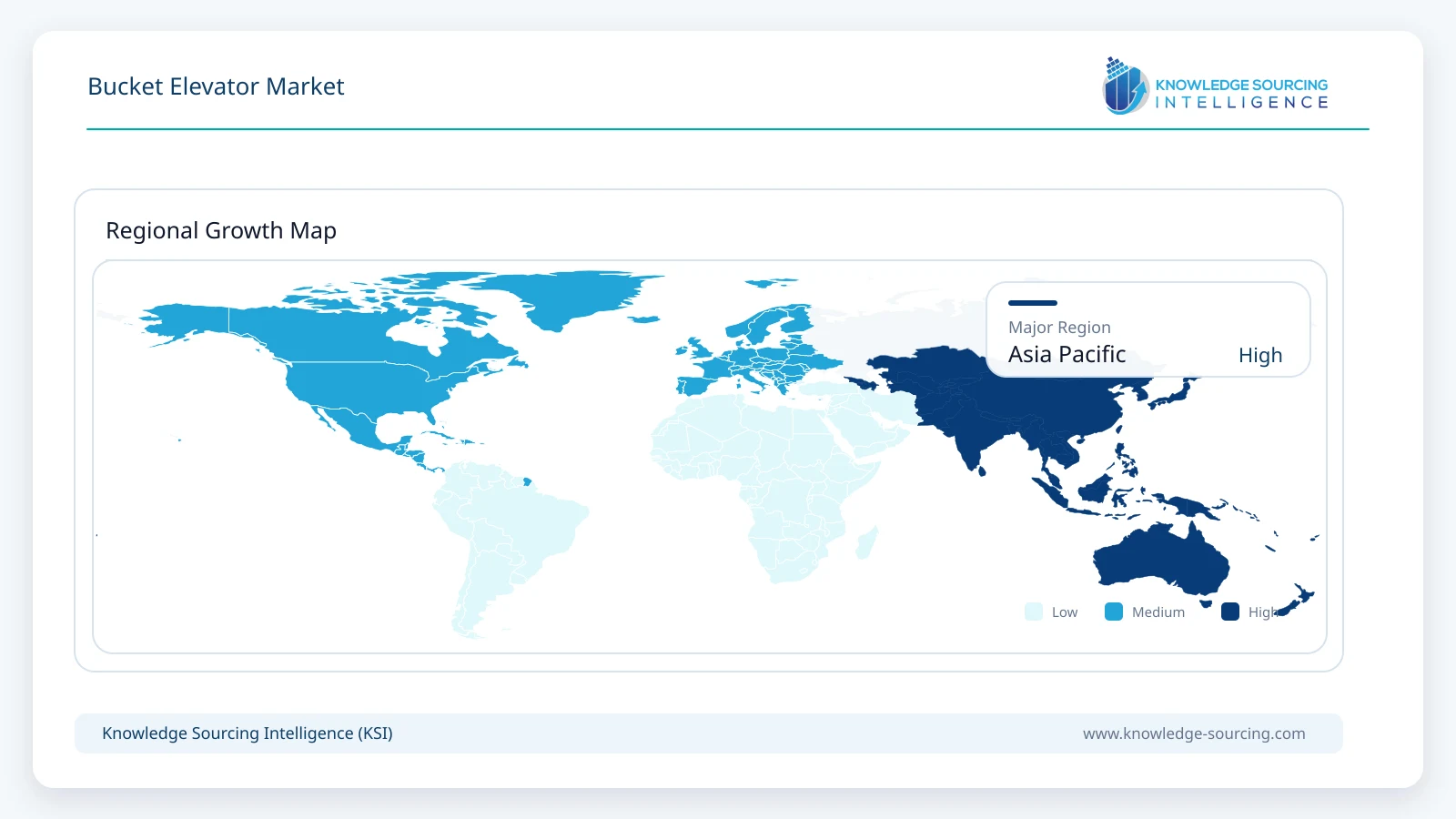
Asia Pacific offers broad demand potential because it combines large agricultural production with expanding food processing, fertilizer, chemicals, minerals, and industrial infrastructure.
China represents a major manufacturing and industrial market, while India provides substantial opportunities in grain storage, food processing, seed processing, fertilizers, minerals, and power-related material handling. Japan and South Korea have mature industrial sectors where reliability, automation, compact equipment, and replacement demand are important. Indonesia and Thailand offer additional agricultural and food-processing opportunities.
India's infrastructure pipeline is particularly relevant. Government data indicates record foodgrain production and continued investment in storage and processing infrastructure.
Regional procurement is increasingly influenced by local manufacturing and service availability. BEUMER's opening of manufacturing facilities in China and India demonstrates how suppliers are strengthening regional production capability to serve major industrial markets.
Middle East and Africa
Demand in the Middle East is connected to grain import handling, food security infrastructure, fertilizers, minerals, cement, and industrial processing. Large facilities often require high-capacity conveying systems because bulk materials may move through ports, storage terminals, processing plants, and distribution infrastructure.
Saudi Arabia and the United Arab Emirates have particularly relevant food-security and industrial diversification priorities. The broader region also has fertilizer and mining assets that require heavy-duty material-handling systems.
Africa presents a more fragmented opportunity. Agricultural processing, grain storage, mining, cement, and fertilizer projects can generate demand, but project financing, infrastructure availability, imported equipment costs, and maintenance capabilities can constrain adoption.
Suppliers that provide complete engineering and commissioning services can be better positioned where local technical resources are limited.
South America
South America has strong agricultural and mining foundations, making Brazil particularly relevant to grain, oilseed, sugar, fertilizer, and mineral handling. Argentina also has significant agricultural processing activity, while other countries contribute mining and commodity-handling opportunities.
Demand depends heavily on investment cycles in commodity production and processing. Elevator purchases are often tied to new storage facilities, processing expansions, port infrastructure, and modernization programs.
Currency volatility and financing conditions can influence equipment procurement. Buyers therefore assess total installed cost, operating reliability, local support, and access to replacement components. Suppliers able to provide durable systems with predictable maintenance requirements can strengthen their position in these markets.
Competitive Landscape
The competitive structure includes equipment specialists, bulk-material-handling companies, agricultural equipment suppliers, and engineered-system providers. The supplied competitive set includes Martin Sprocket & Gear, Inc., Frazier & Son, FEECO International, Inc., Sweet Manufacturing Company, BEUMER Group, Cimbria, Guttridge, and Rieco Industries Limited.
Competition is primarily application-driven rather than based on a single standardized product. Agricultural customers may prioritize throughput, reliability, and integration with grain-handling systems, while food processors place greater weight on sanitation and product protection. Mining and mineral customers place greater emphasis on abrasion resistance, capacity, service life, and structural durability.
The suppliers also differ in commercial positioning. FEECO offers multiple centrifugal and continuous belt and chain configurations and emphasizes customized engineering around material properties and operating requirements. BEUMER positions its equipment toward high-capacity and demanding applications, including mining and cement, with belt and central-chain systems and condition-monitoring capabilities.
Frazier & Son is more strongly associated with sanitary and customized conveying applications for food and packaging. Its recent product literature highlights multiple discharge, indexing, washdown, stainless-steel, and integrated conveying configurations.
Sweet Manufacturing operates within agricultural and industrial material handling, while its integration into the Behlen family in February 2025 expanded its relationship with a broader grain-storage and handling ecosystem.
Cimbria has a strong agricultural processing orientation, including seed and grain systems. Its work in India demonstrates how bucket elevators can form part of broader engineered seed-processing lines rather than being purchased as isolated equipment.
Rieco Industries serves several bulk-material-intensive sectors, including power, cement, minerals, chemicals, food, fertilizer, steel, and agrochemicals. Its broader engineering model allows conveying equipment to be incorporated into larger industrial process solutions.
Martin Sprocket & Gear and Guttridge add further competition across material-handling and agricultural equipment applications. Overall, supplier differentiation is increasingly linked to engineering capability, lifecycle service, regional manufacturing, material expertise, safety integration, and the ability to deliver complete handling systems.
Recent Developments
August 2026: AGI announced three new farmyard products for Farm Progress Show 2026, including a new bucket elevator within its 2027 LCX4 product lineup for grain-handling operations.
July 2026: Pewag launched its new conveyor chains and components catalog, featuring a dedicated bucket-elevator configurator that helps engineers select chains based on discharge method, speed, chain type, and attachments.
June 2026: Frazier & Son announced its participation in PACK EXPO 2026, where it planned to showcase sanitary bucket conveying solutions and live equipment demonstrations. The activity reinforces its focus on food-processing and packaging applications requiring customized sanitary conveying.
February 2026: AGI launched its new AGI Bucket Elevator at GEAPS Exchange 2026, introducing easier component access, external adjustments, improved inspection access, and maintenance features designed to reduce downtime and confined-space work.
December 2025: BEUMER Group inaugurated a new manufacturing facility in Jhajjar, Haryana, backed by an INR 2 billion investment. The plant expands regional manufacturing capacity for sectors including cement and minerals and strengthens the company's ability to serve Indian projects.
Regulatory and Policy Environment
Regulation affects bucket elevators primarily through workplace safety, machinery safety, dust control, hazardous-area requirements, and material-handling standards.
In the United States, OSHA's 29 CFR 1910.272 establishes requirements for grain-handling facilities. For inside bucket elevators, the standard addresses access for inspection and cleaning, conductive belts and lagging, bearing monitoring, motion detection, belt alignment, and restrictions on jogging choked legs.
These requirements have direct commercial consequences. Elevator manufacturers supplying grain facilities must account for monitoring and inspection provisions during engineering. Operators must also maintain equipment and manage ignition sources, which creates recurring demand for service, inspection, replacement components, and safety upgrades.
In Europe, ATEX Directive 2014/34/EU applies to equipment and protective systems intended for potentially explosive atmospheres. Requirements address equipment designed for environments containing combustible dust and establish conformity assessment requirements before products enter the EU market.
The United Kingdom applies the Dangerous Substances and Explosive Atmospheres Regulations 2002, which require employers to assess dangerous substances, control fire and explosion risks, classify areas where explosive atmospheres may occur, and prevent ignition sources. HSE specifically identifies grain and flour among dust-related applications.
Internationally, ISO 7190 provides a classification framework for bucket elevators, while ISO 5050 specifies characteristics for vertical elevators using calibrated round steel link chains. ISO 7149 also includes special safety rules covering bucket elevators within continuous handling equipment.
Policy support for agricultural and food-processing infrastructure can also influence equipment demand indirectly. India's PMKSY, PLISFPI, PMFME, Agriculture Infrastructure Fund, and agricultural marketing infrastructure initiatives support storage, processing, and supply-chain development, creating project opportunities for material-handling equipment suppliers.
Outlook and Strategic Implications
The next five years are likely to be shaped by replacement demand, agricultural infrastructure investment, food-processing capacity, mineral-processing projects, and modernization of existing bulk-handling systems. Buyers will increasingly evaluate elevators as part of an integrated material-flow system rather than as standalone mechanical equipment.
Procurement priorities are likely to move toward lifecycle economics. Initial purchase price remains important, particularly for smaller agricultural facilities, but large industrial operators have stronger incentives to evaluate maintenance frequency, service life, energy consumption, spare-parts availability, inspection requirements, and downtime exposure.
Equipment configuration will remain application-specific. Belt elevators should retain an important position where lower investment cost, quieter operation, and suitable handling characteristics are attractive. Chain elevators will remain relevant for demanding applications involving heavier loads, high temperatures, or difficult materials. The commercial opportunity lies in matching the equipment configuration to material characteristics rather than promoting one configuration universally.
Technology adoption will increasingly involve monitoring and maintenance intelligence. BEUMER's BEUMER Guardian initiative illustrates the direction of the industry, where diagnostic information is connected to maintenance and process-performance decisions. Future differentiation is likely to involve speed monitoring, belt alignment, bearing condition, vibration, filling levels, and service alerts.
Regional manufacturing will also become strategically important. BEUMER's investments in India and China demonstrate the value of locating production closer to major industrial markets. Regional manufacturing can reduce delivery times, simplify service logistics, and improve responsiveness to customized project requirements.
Agriculture remains one of the clearest demand anchors. Continued investment in grain storage, seed processing, food processing, and supply-chain infrastructure creates equipment requirements beyond primary agricultural production. India's record foodgrain output and ongoing storage investments provide a clear example of how public infrastructure priorities can generate downstream material-handling demand.
Food processing will create a separate opportunity for sanitary and product-sensitive elevator designs. Buyers handling fragile or contamination-sensitive products will continue to prioritize cleanability, stainless-steel construction, controlled product transfer, and integration with weighing and packaging systems. This favors suppliers with specialized engineering capabilities rather than commodity equipment positioning.
Mining and mineral-processing projects offer higher-value opportunities but carry greater technical requirements. Abrasive materials, high temperatures, long conveying distances, and high throughput can increase equipment complexity and lifecycle service requirements. Suppliers capable of engineering for these conditions can compete on total operating cost rather than equipment price alone.
Regulation will remain a commercial differentiator. Safety requirements relating to combustible dust, explosion prevention, monitoring, inspection, and hazardous areas increase the specification burden but also create replacement and modernization opportunities. Suppliers that provide documented compliance and integrated safety systems can reduce the engineering burden for plant operators.
The main risks include delayed industrial capital expenditure, commodity-price volatility, financing constraints, raw-material cost fluctuations, project delays, and prolonged replacement cycles. Agricultural customers can also be sensitive to seasonal income and commodity prices, while mining projects may experience lengthy permitting and financing periods.
Strategically, suppliers should prioritize application engineering, regional service infrastructure, aftermarket parts, condition monitoring, and system integration. Standardized products can protect manufacturing efficiency, but customization remains commercially important because elevator requirements vary significantly by material and process.
Over the 2026-2031 period, the strongest opportunities should therefore emerge where vertical conveying is connected to capacity expansion, plant modernization, storage infrastructure, food-processing investment, mineral processing, and regulatory-driven equipment upgrades. The market's competitive advantage will increasingly depend on reliability, application fit, compliance, lifecycle support, and the ability to integrate the elevator into a larger automated bulk-material-handling system.
Bucket Elevator Market Scope:
| Report Metric | Details |
|---|---|
| Total Market Size in 2026 | USD 1.74 billion |
| Total Market Size in 2031 | USD 2.23 billion |
| Forecast Unit | Billion |
| Growth Rate | 5.1% |
| Study Period | 2021 to 2031 |
| Historical Data | 2021 to 2024 |
| Base Year | 2025 |
| Forecast Period | 2026 – 2031 |
| Segmentation | Type, Configuration, Bucket Material, Application, Geography |
| Companies |
|
Market Segmentation
By Type
By Configuration
By Bucket Material
By Application
By Geography
Table of Contents
1. EXECUTIVE SUMMARY
2. MARKET SNAPSHOT
2.1. Market Overview
2.2. Market Definition
2.3. Scope of the Study
2.4. Market Segmentation
3. BUSINESS LANDSCAPE
3.1. Market Drivers
3.2. Market Restraints
3.3. Market Opportunities
3.4. Porter’s Five Forces Analysis
3.5. Industry Value Chain Analysis
3.6. Policies and Regulations
3.7. Strategic Recommendations
4. TECHNOLOGICAL OUTLOOK
5. BUCKET ELEVATOR MARKET BY TYPE
5.1. Introduction
5.2. Centrifugal Bucket Elevator
5.3. Continuous Bucket Elevator
6. BUCKET ELEVATOR MARKET BY CONFIGURATION
6.1. Introduction
6.2. Belt
6.3. Chain
7. BUCKET ELEVATOR MARKET BY BUCKET MATERIAL
7.1. Introduction
7.2. Metallic
7.3. Non-Metallic
8. BUCKET ELEVATOR MARKET BY APPLICATION
8.1. Introduction
8.2. Agriculture
8.3. Chemicals and Fertilizers
8.4. Food and Beverage
8.5. Mining and Minerals
8.6. Energy and Power
8.7. Pulp and Paper
8.8. Others
9. BUCKET ELEVATOR MARKET BY GEOGRAPHY
9.1. Introduction
9.2. North America
9.2.1. United States
9.2.2. Canada
9.2.3. Mexico
9.3. South America
9.3.1. Brazil
9.3.2. Argentina
9.3.3. Others
9.4. Europe
9.4.1. Germany
9.4.2. France
9.4.3. United Kingdom
9.4.4. Spain
9.4.5. Others
9.5. Middle East and Africa
9.5.1. Saudi Arabia
9.5.2. United Arab Emirates
9.5.3. Others
9.6. Asia Pacific
9.6.1. China
9.6.2. India
9.6.3. Japan
9.6.4. South Korea
9.6.5. Indonesia
9.6.6. Thailand
9.6.7. Others
10. COMPETITIVE ENVIRONMENT AND ANALYSIS
10.1. Major Players and Strategy Analysis
10.2. Market Share Analysis
10.3. Mergers, Acquisitions, Agreements, and Collaborations
10.4. Competitive Dashboard
11. COMPANY PROFILES
11.1. Martin Sprocket & Gear, Inc.
11.2. Frazier & Son
11.3. FEECO International, Inc.
11.4. Sweet Manufacturing Company
11.5. BEUMER Group
11.6. Cimbria
11.7. Guttridge
11.8. Rieco Industries Limited
12. APPENDIX
12.1. Currency
12.2. Assumptions
12.3. Base and Forecast Years Timeline
12.4. Key Benefits for the Stakeholders
12.5. Research Methodology
12.6. Abbreviations
LIST OF FIGURES
LIST OF TABLES
Navigate
Trusted by the world's leading organizations











