
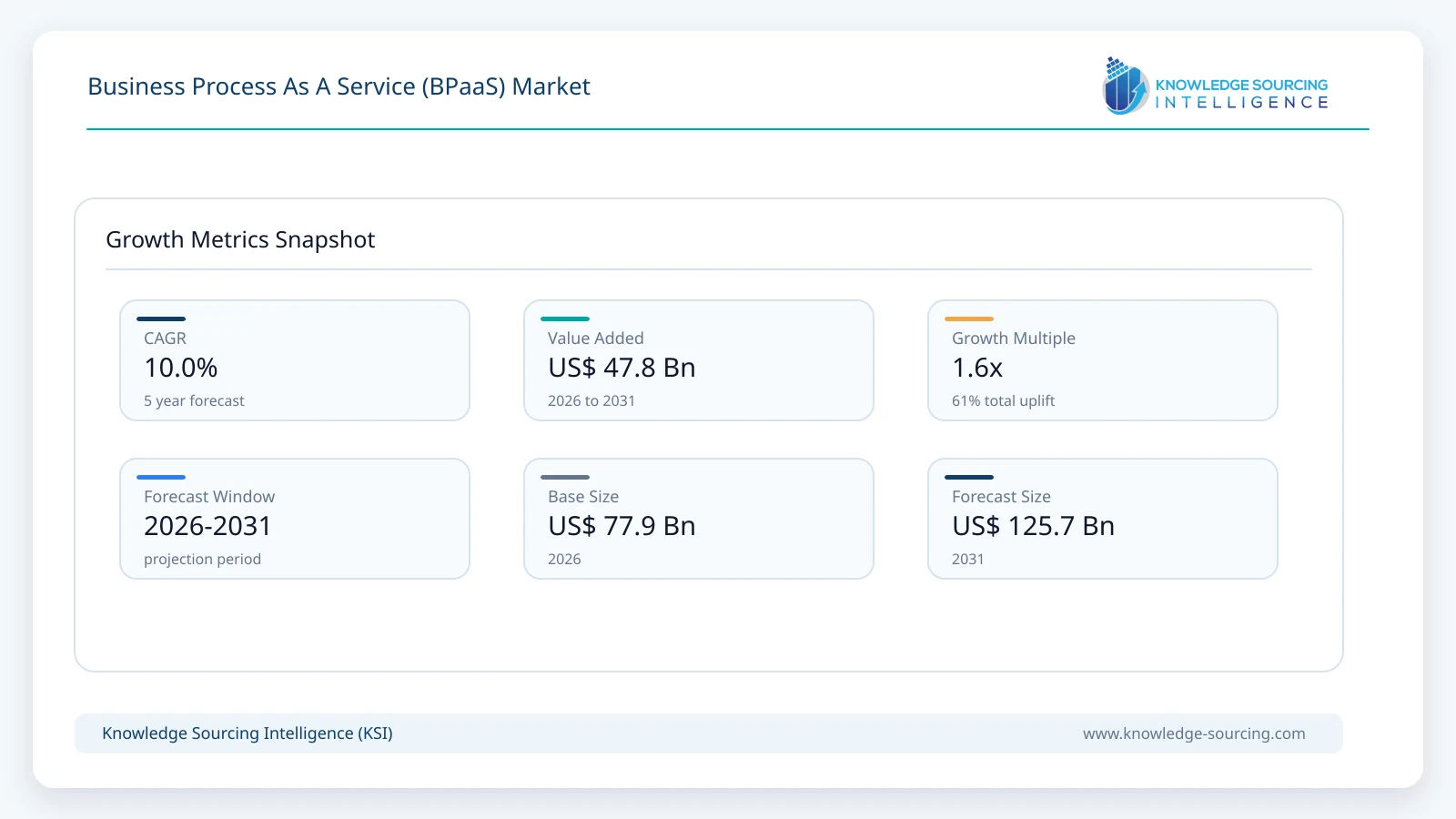
The Business Process As A Service (BPaaS) Market is forecast to grow at a CAGR of 10.04%, reaching USD 125.70 billion in 2031 from USD 77.91 billion in 2026.
Highlights:
- 1Growing enterprise demand for operational efficiency and cloud-based process delivery remains the primary demand catalyst.
- 2Finance and Accounting represents one of the most commercially important business process segments because of its high transaction volumes and compliance requirements.
- 3Asia Pacific offers substantial expansion opportunities as enterprises accelerate cloud adoption and shared service modernization.
- 4Artificial intelligence, robotic process automation, and intelligent workflow orchestration are improving process accuracy and reducing manual intervention.
- 5Data protection regulations and industry-specific compliance requirements increasingly influence vendor selection and contract structures.
- 6Competition is shifting toward integrated platforms combining consulting, automation technologies, cybersecurity, and industry-specific operational expertise.
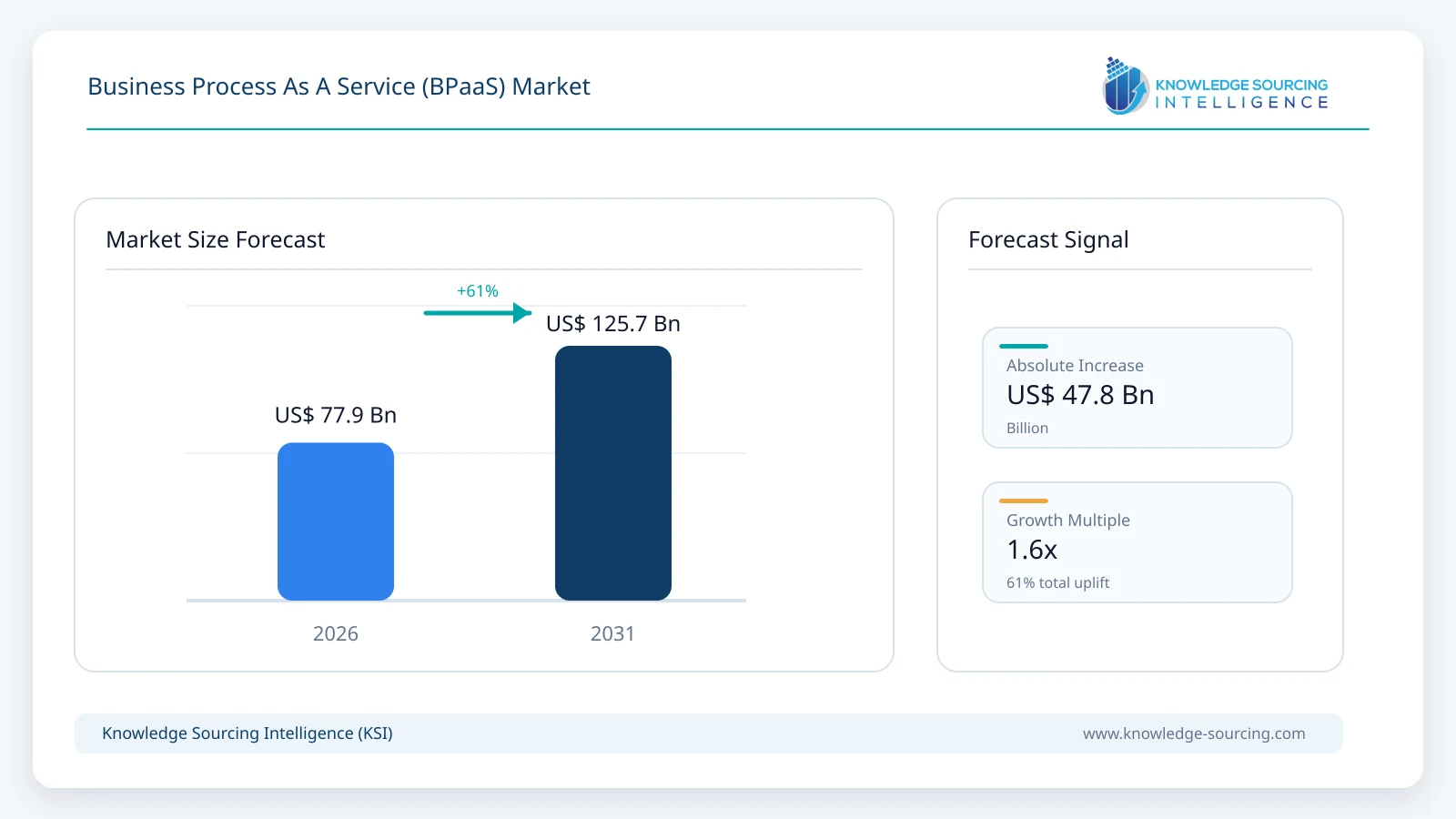
Business Process as a Service (BPaaS) refers to the delivery of standardized or configurable business processes through cloud-based platforms using subscription or consumption-based commercial models. The market covers outsourced business functions such as human resource management, finance and accounting, customer service, procurement, supply chain operations, and sales support, supported by workflow automation, analytics, artificial intelligence (AI), robotic process automation (RPA), and application programming interfaces (APIs). Organizations increasingly view BPaaS as a means of improving operational consistency while reducing dependence on on-premise business process infrastructure.
Demand is being shaped by enterprises seeking measurable improvements in cost efficiency, process standardization, and operational flexibility. Rather than outsourcing labor-intensive activities alone, buyers increasingly expect providers to deliver measurable business outcomes through integrated platforms, process expertise, and automation capabilities. Procurement decisions therefore extend beyond pricing and include scalability, cybersecurity controls, regulatory compliance, service-level agreements, industry expertise, and the provider's ability to integrate with existing enterprise applications.
The industry structure continues to favor large technology services firms with broad delivery networks, cloud partnerships, and consulting capabilities. However, specialization has become an important competitive factor as organizations seek industry-specific process expertise for sectors including banking, healthcare, telecommunications, manufacturing, and retail. Providers are investing in AI-assisted workflow management, intelligent document processing, predictive analytics, and low-code automation to improve service quality while maintaining competitive pricing.
Small and medium-sized enterprises increasingly represent an attractive customer segment because subscription-based BPaaS solutions reduce capital expenditure requirements and simplify access to enterprise-grade business processes. Large enterprises, meanwhile, continue to modernize legacy shared service centers by migrating selected business functions to cloud-native operating models. This combination of enterprise modernization and SME adoption supports sustained demand across developed and emerging economies.
The market also reflects changing workforce strategies. Organizations continue to address skilled labor shortages, rising administrative costs, and expanding compliance obligations by transferring non-core operational activities to external providers. Buyers increasingly expect continuous process improvement rather than fixed outsourcing arrangements, encouraging providers to combine consulting, technology implementation, and managed services within unified BPaaS offerings.
Market Drivers
Enterprise demand for operational cost optimization
Organizations continue to examine operating expenses associated with administrative functions that generate limited competitive differentiation. Finance operations, payroll processing, procurement administration, and customer support often involve repetitive workflows suitable for standardized cloud delivery. Buyers increasingly compare total operating costs rather than initial outsourcing fees, encouraging adoption of BPaaS models that combine software, infrastructure, and managed services under predictable pricing arrangements.
Service providers respond by integrating automation, standardized workflows, and centralized delivery centers that improve process consistency while lowering transaction costs. This strengthens long-term customer relationships and supports recurring subscription revenue.
Expansion of cloud-based enterprise applications
The adoption of enterprise resource planning, customer relationship management, and human capital management platforms has simplified integration between business applications and BPaaS services. Organizations replacing legacy systems frequently evaluate outsourced process delivery simultaneously, allowing implementation projects to include process redesign alongside technology modernization.
Technology vendors and service providers increasingly collaborate to develop preconfigured industry templates that reduce deployment complexity. Faster implementation timelines improve purchasing confidence among enterprises seeking measurable operational improvements.
Rising compliance and reporting requirements
Financial reporting, payroll administration, procurement governance, and employee record management are subject to expanding regulatory oversight across multiple jurisdictions. Organizations require standardized processes capable of maintaining documentation, audit trails, and data governance throughout business operations.
BPaaS providers invest in compliance expertise, security certifications, and automated monitoring capabilities to address these requirements. This shifts compliance management from fragmented internal teams toward specialized service providers with broader regulatory experience.
Artificial intelligence improving process efficiency
Artificial intelligence is expanding beyond chatbots into document classification, invoice processing, demand forecasting, contract analysis, and workflow recommendations. Buyers increasingly evaluate providers according to automation maturity rather than workforce scale alone.
Commercially, AI allows providers to improve service margins while offering faster processing, improved accuracy, and enhanced customer experiences. The result is stronger differentiation in competitive procurement processes.
Market Restraints and Challenges
Data privacy and cybersecurity concerns
Business processes frequently involve sensitive employee, customer, financial, and operational information. Organizations operating across regulated industries remain cautious about transferring critical business functions to external cloud environments.
Providers continue investing in encryption, identity management, zero-trust security architectures, and independent compliance certifications. Nevertheless, cybersecurity remains a major purchasing consideration capable of extending procurement cycles.
Integration with legacy enterprise environments
Many organizations continue operating customized enterprise applications developed over several decades. Integrating these systems with standardized BPaaS platforms can require extensive customization, increasing implementation costs and delaying expected returns.
Service providers increasingly develop API-based integration frameworks and migration methodologies, but integration complexity remains an important adoption barrier for highly customized enterprises.
Organizational resistance to process standardization
Business units often maintain unique workflows developed around local operating requirements. Standardizing these processes may encounter resistance from employees concerned about operational changes or reduced managerial control.
Successful implementations therefore require change management, executive sponsorship, and continuous stakeholder engagement alongside technology deployment.
Pricing pressure and competitive intensity
Large global providers compete aggressively on pricing while simultaneously investing in automation, cloud infrastructure, and industry expertise. Customers increasingly expect productivity improvements without proportional increases in service fees.
Maintaining profitability therefore depends upon operational efficiency, automation adoption, and long-term customer retention rather than labor-based delivery alone.
Major Segment Analysis
Finance and Accounting
Finance and Accounting represents one of the most commercially significant BPaaS segments because virtually every organization manages recurring financial transactions requiring accuracy, regulatory compliance, and standardized reporting. Activities including accounts payable, accounts receivable, general ledger management, tax support, expense processing, financial reconciliation, and financial reporting are well suited to cloud-based operating models supported by automation technologies.
Buyer priorities emphasize reliability, processing accuracy, audit readiness, and integration with enterprise financial systems. Procurement teams frequently evaluate service providers according to regulatory expertise, data security capabilities, reporting flexibility, and automation maturity. Industry-specific knowledge is particularly important for regulated sectors such as banking, insurance, healthcare, and public administration.
Competitive differentiation increasingly depends upon intelligent invoice processing, predictive financial analytics, automated reconciliation, and AI-assisted exception management. Providers capable of combining finance expertise with advanced workflow automation improve customer retention while expanding higher-value advisory services. Consequently, Finance and Accounting continues generating substantial recurring revenue opportunities within the broader BPaaS market.
Regional Analysis
North America
North America remains a leading market due to extensive enterprise cloud adoption, mature outsourcing practices, and strong investment in AI-enabled business operations. Financial services, healthcare, telecommunications, and retail organizations continue modernizing shared service operations while emphasizing cybersecurity, regulatory compliance, and operational resilience. Competition remains intense among established global providers with broad consulting and technology capabilities.
Europe
European demand is influenced by stringent data protection regulations, sustainability reporting requirements, and cross-border business operations. Organizations prioritize providers capable of maintaining regulatory compliance while supporting multilingual operations across multiple jurisdictions. Manufacturing, financial services, and government sectors continue investing in standardized digital business processes despite economic uncertainty affecting technology budgets.
Asia Pacific
Asia Pacific continues attracting investment through expanding enterprise digitalization, rising cloud infrastructure deployment, and growing demand from SMEs. India, China, Japan, Australia, and South Korea represent important markets for both service delivery and customer adoption. Organizations increasingly seek scalable business process solutions supporting regional expansion without substantial internal administrative investments.
Middle East & Africa
Government modernization initiatives, financial sector expansion, and economic diversification programs contribute to BPaaS demand across selected Middle Eastern economies. Cloud adoption continues improving although regulatory frameworks and digital infrastructure maturity vary across countries. Public sector modernization and financial services remain important growth contributors.
South America
Brazil and Argentina represent the largest regional opportunities, supported by gradual enterprise cloud adoption and increasing demand for cost-efficient business operations. Economic volatility influences investment timing, encouraging organizations to prioritize subscription-based operational models with lower upfront capital commitments. Regulatory complexity also supports demand for specialized compliance-oriented BPaaS services.
Competitive Landscape
Competition within the BPaaS market reflects a combination of technology capabilities, consulting expertise, global delivery infrastructure, and industry specialization. Leading providers include Accenture plc, Capgemini SE, Cognizant Technology Solutions Corporation, EXL Service Holdings, Inc., International Business Machines Corporation (IBM), Fujitsu Limited, HCLTech, Genpact Limited, Tata Consultancy Services Limited, and Wipro Limited.
Competitive positioning increasingly depends upon integrated service portfolios combining consulting, cloud migration, process redesign, AI-enabled automation, analytics, and cybersecurity capabilities. Strategic partnerships with major cloud platform providers strengthen implementation capabilities while expanding industry-specific solutions.
Providers continue expanding geographically through regional delivery centers and localized compliance expertise. Investment priorities include generative AI integration, intelligent automation, industry-specific process frameworks, and outcome-based commercial models designed to improve customer retention and contract expansion opportunities.
Recent Developments
May 2026: Accenture expanded its AI Refinery capabilities with new enterprise AI process services integrated with major cloud ecosystems. Commercial relevance: strengthens AI-enabled business process automation for enterprise clients.
May 2026: Workday and Google Cloud expanded their strategic partnership to integrate AI agents for HR and finance workflows, allowing employees to execute business processes directly through Gemini Enterprise with secure governance.
April 2026: Wipro launched its dedicated AI-Native Business & Platforms Unit to develop enterprise-grade agentic AI solutions, strengthening AI-driven business process services and accelerating outcome-based enterprise transformation offerings.
Regulatory and Policy Environment
The BPaaS market operates within a regulatory framework emphasizing data protection, cybersecurity, financial reporting, and operational resilience. Data privacy regulations such as the European Union's General Data Protection Regulation (GDPR) influence how providers collect, process, store, and transfer customer information across jurisdictions. Similar privacy frameworks adopted in multiple countries continue increasing compliance obligations for service providers.
Financial institutions, healthcare organizations, and public sector agencies frequently require additional compliance with industry-specific regulations governing record retention, operational controls, and audit reporting. Buyers therefore prioritize providers maintaining internationally recognized security certifications and structured governance frameworks.
Governments also continue promoting cloud adoption through digital public service initiatives and national digital economy programs, supporting wider acceptance of cloud-based business process delivery. Compliance capabilities increasingly influence procurement decisions alongside operational performance and pricing.
Outlook and Strategic Implications
The BPaaS market is expected to develop through greater integration of AI, intelligent automation, predictive analytics, and cloud-native enterprise applications. Buyers are likely to prioritize measurable business outcomes rather than conventional outsourcing metrics, encouraging providers to offer performance-based commercial models supported by continuous process optimization.
Investment activity will increasingly focus on AI governance, cybersecurity, industry-specific automation, and platform interoperability. Organizations are expected to consolidate technology vendors and service providers to simplify operational management while improving data visibility across enterprise functions.
Competitive differentiation will depend upon automation maturity, regulatory expertise, implementation capability, and the ability to support complex multinational operating environments. Providers combining technology innovation with deep industry knowledge are expected to strengthen customer retention and expand long-term managed service engagements.
Potential risks include evolving cybersecurity threats, regulatory fragmentation, integration complexity, and continued pricing pressure. Nevertheless, organizations seeking operational efficiency, scalable administrative capabilities, and improved process consistency are expected to sustain investment in BPaaS solutions throughout the forecast period.
Business Process As A Service (BPaaS) Market Scope
| Report Metric | Details |
|---|---|
| Total Market Size in 2026 | USD 77.91 billion |
| Total Market Size in 2031 | USD 125.70 billion |
| Forecast Unit | Billion |
| Growth Rate | 10.04% |
| Study Period | 2021 to 2031 |
| Historical Data | 2021 to 2024 |
| Base Year | 2025 |
| Forecast Period | 2026 – 2031 |
| Segmentation | Business Process, Organization Size, End-User Industry, Geography |
| Companies |
|
Market Segmentation
By Business Process
- Human Resource Management
- Finance and Accounting
- Sales and Marketing
- Customer Service and Support
- Procurement and Supply Chain Management
- Others
By Organization Size
- Small and Medium-sized Enterprises (SMEs)
- Large Enterprises
By End-User Industry
- BFSI
- IT and Telecommunications
- Manufacturing
- Retail and E-commerce
- Healthcare
- Government and Public Sector
- Others
By Geography
- North America
- United States
- Canada
- Mexico
- South America
- Brazil
- Argentina
- Others
- Europe
- United Kingdom
- Germany
- France
- Spain
- Italy
- Others
- Middle East and Africa
- Saudi Arabia
- United Arab Emirates
- South Africa
- Others
- Asia Pacific
- China
- Japan
- India
- Australia
- South Korea
- Others
Table of Contents
1. INTRODUCTION
1.1. Market Overview
1.2. Market Definition
1.3. Scope of the Study
1.4. Currency
1.5. Assumptions
1.6. Base and Forecast Years Timeline
2. RESEARCH METHODOLOGY
2.1. Research Design
2.2. Secondary Sources
3. KEY FINDINGS
4. MARKET DYNAMICS
4.1. Market Segmentation
4.2. Market Drivers
4.3. Market Restraints
4.4. Market Opportunities
4.5. Porter's Five Forces Analysis
4.5.1. Bargaining Power of Suppliers
4.5.2. Bargaining Power of Buyers
4.5.3. Threat of New Entrants
4.5.4. Threat of Substitutes
4.5.5. Competitive Rivalry in the Industry
4.6. Life Cycle Analysis - Regional Snapshot
4.7. Market Attractiveness
5. BUSINESS PROCESS AS A SERVICE (BPAAS) MARKET BY BUSINESS PROCESS
5.1. Human Resource Management
5.2. Finance and Accounting
5.3. Sales and Marketing
5.4. Customer Service and Support
5.5. Procurement and Supply Chain Management
5.6. Others
6. BUSINESS PROCESS AS A SERVICE (BPAAS) MARKET BY ORGANIZATION SIZE
6.1. Small and Medium-sized Enterprises (SMEs)
6.2. Large Enterprises
7. BUSINESS PROCESS AS A SERVICE (BPAAS) MARKET BY END-USER INDUSTRY
7.1. BFSI
7.2. IT and Telecommunications
7.3. Manufacturing
7.4. Retail and E-commerce
7.5. Healthcare
7.6. Government and Public Sector
7.7. Others
8. BUSINESS PROCESS AS A SERVICE (BPAAS) MARKET BY GEOGRAPHY
8.1. North America
8.1.1. United States
8.1.2. Canada
8.1.3. Mexico
8.2. South America
8.2.1. Brazil
8.2.2. Argentina
8.2.3. Others
8.3. Europe
8.3.1. United Kingdom
8.3.2. Germany
8.3.3. France
8.3.4. Spain
8.3.5. Italy
8.3.6. Others
8.4. Middle East and Africa
8.4.1. Saudi Arabia
8.4.2. United Arab Emirates
8.4.3. South Africa
8.4.4. Others
8.5. Asia Pacific
8.5.1. China
8.5.2. Japan
8.5.3. India
8.5.4. Australia
8.5.5. South Korea
8.5.6. Others
9. COMPETITIVE INTELLIGENCE
9.1. Competitive Benchmarking and Analysis
9.2. Recent Investments and Deals
9.3. Strategies of Key Players
10. COMPANY PROFILES
10.1. Accenture plc
10.2. Capgemini SE
10.3. Cognizant Technology Solutions Corporation
10.4. EXL Service Holdings, Inc.
10.5. International Business Machines Corporation (IBM)
10.6. Fujitsu Limited
10.7. HCLTech
10.8. Genpact Limited
10.9. Tata Consultancy Services Limited
10.10. Wipro Limited
LIST OF FIGURES
LIST OF TABLES
Navigate
Trusted by the world's leading organizations











