
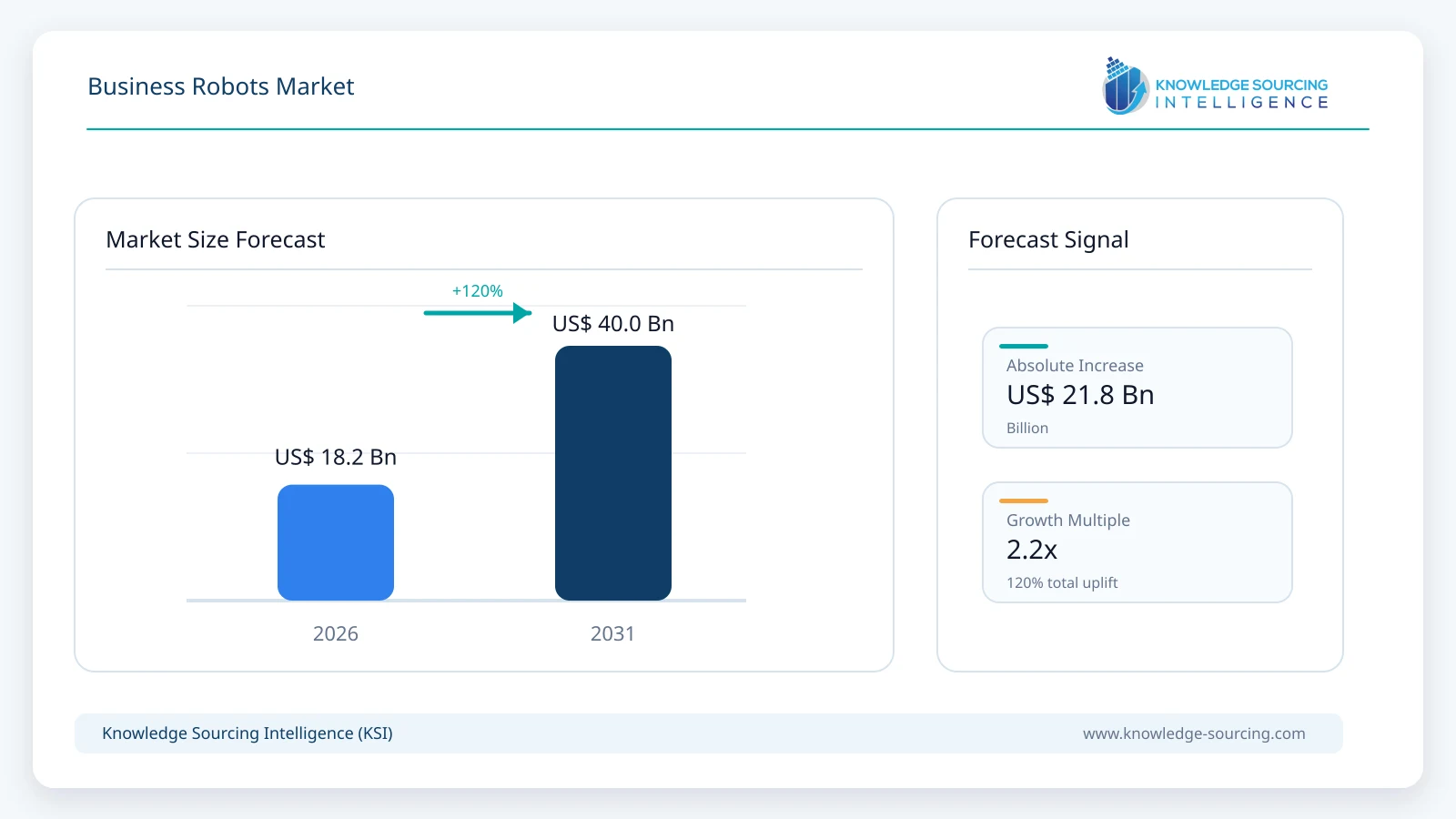
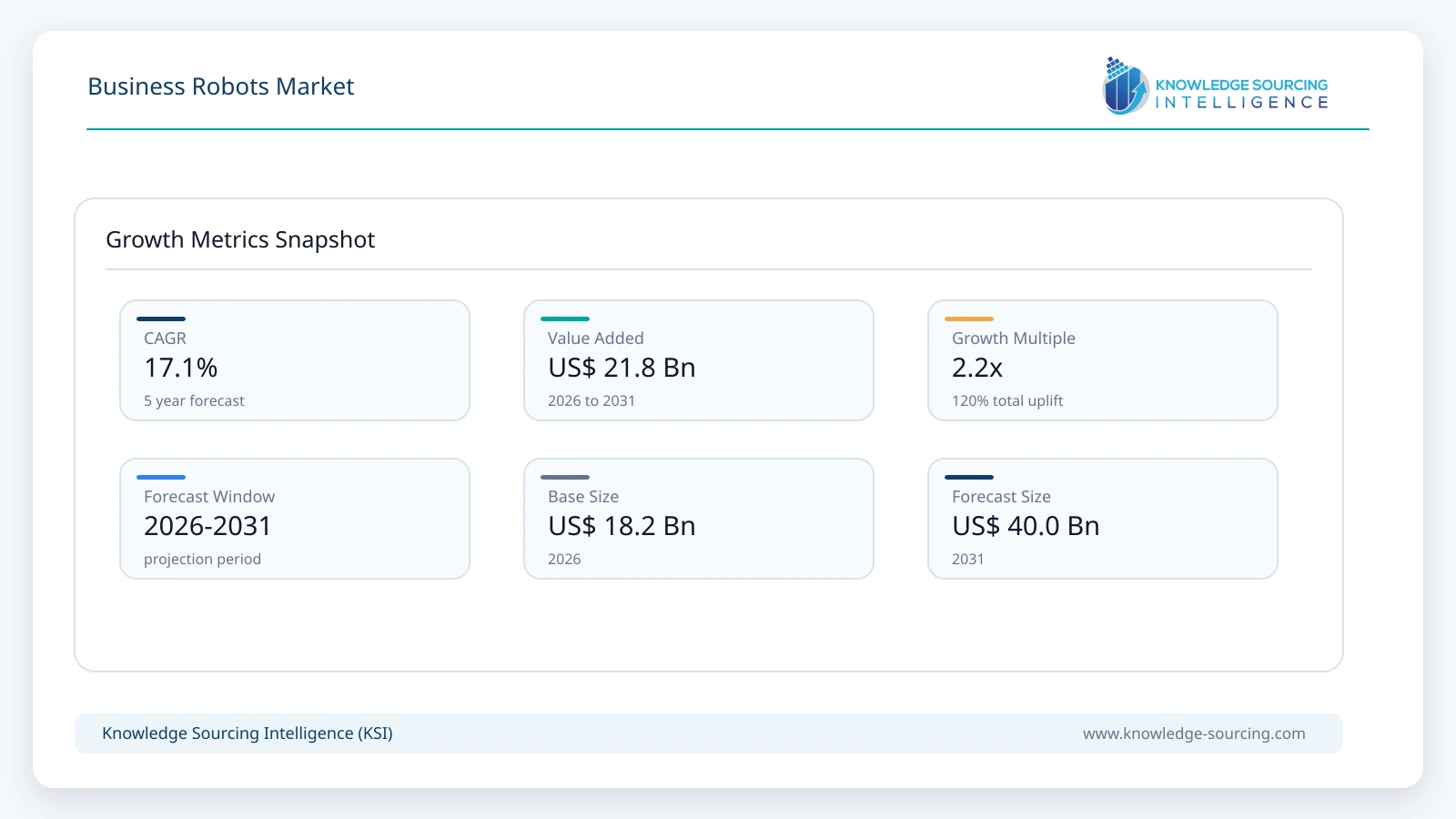
The Business Robots Market is forecast to grow at a CAGR of 17.1%, reaching USD 40.0 billion in 2031 from USD 18.2 billion in 2026.
Highlights:
- 1Growing manufacturing labor shortages and higher production efficiency requirements continue to stimulate industrial robot procurement across multiple sectors.
- 2Articulated robots represent one of the most commercially important product categories due to their versatility across welding, assembly, and material handling applications.
- 3Asia Pacific remains the largest investment destination because of extensive manufacturing capacity expansion and government-backed industrial modernization initiatives.
- 4Machine vision, AI-assisted programming, and predictive maintenance are improving robot utilization and reducing deployment complexity.
- 5Industrial safety regulations and manufacturing quality standards encourage greater automation adoption across regulated industries.
- 6Competition increasingly centers on complete automation ecosystems that combine robotics, software integration, lifecycle services, and engineering support.
The business robots market comprises programmable robotic systems deployed across commercial manufacturing and industrial operations to automate repetitive, hazardous, and precision-dependent tasks. These systems include articulated, SCARA, Cartesian, cylindrical, parallel, and polar robots integrated with controllers, sensors, servo drives, vision systems, and end effectors to perform applications ranging from assembly and welding to material handling, inspection, and packaging. The market serves industries including automotive, electronics, pharmaceuticals, food and beverage, chemicals, metal processing, and logistics, where productivity, product consistency, and operational efficiency remain primary purchasing objectives.
Demand for business robots is being shaped by structural changes in manufacturing economics rather than short-term production cycles. Persistent labor shortages in skilled manufacturing occupations, rising wage costs in developed economies, stricter workplace safety requirements, and increasing production complexity are encouraging manufacturers to automate processes that were previously labor-intensive. Buyers are no longer evaluating robotic systems solely on acquisition cost; instead, procurement decisions increasingly emphasize lifecycle operating costs, programming flexibility, maintenance support, cybersecurity, integration capability, and compatibility with factory digital infrastructure.
Manufacturing companies are also redesigning production systems to accommodate greater product customization and shorter product life cycles. This transition favors robotic platforms capable of rapid reconfiguration and high repeatability. Automotive manufacturers continue to account for substantial investment because of their extensive use of robotic welding, painting, and assembly. However, electronics manufacturers, pharmaceutical companies, and logistics operators are expanding adoption as miniaturization, regulatory compliance, and fulfillment speed require higher process consistency.
Another important characteristic of the market is the growing integration of machine vision, artificial intelligence-assisted programming, digital twins, and industrial connectivity. These technologies reduce commissioning time while enabling predictive maintenance and real-time quality control. System integrators therefore play an essential role by combining robotic hardware with software, sensors, conveyors, and manufacturing execution systems into complete automation solutions. Consequently, suppliers compete not only through robot performance but also through engineering capabilities, service networks, and application expertise.
Market Drivers
Manufacturing workforce shortages and labor cost inflation
Manufacturers across automotive, electronics, logistics, and metal fabrication continue to encounter difficulty recruiting and retaining skilled production workers. Aging workforces in several developed economies and rising labor expenses have increased the financial attractiveness of robotic automation. Buyers increasingly calculate return on investment based on labor substitution, reduced overtime costs, improved production stability, and lower defect rates. Suppliers have responded by developing easier programming interfaces and standardized automation cells that reduce implementation complexity for manufacturers with limited robotics expertise.
Rising quality requirements across industrial production
Industries operating under stringent quality specifications require repeatable manufacturing processes capable of maintaining consistent tolerances. Automotive, electronics, and pharmaceutical manufacturers increasingly deploy robotic inspection, dispensing, assembly, and handling systems to reduce process variability. Vision-guided robots, integrated measurement systems, and automated inspection technologies improve traceability while minimizing human error. This has strengthened demand for robotic systems equipped with advanced sensing capabilities and data collection functions that support quality management systems.
Expansion of warehouse automation and intralogistics
Growth in e-commerce, omnichannel distribution, and regional manufacturing has accelerated investment in automated warehouses. Distribution centers seek faster order fulfillment, reduced picking errors, and improved operational efficiency under fluctuating demand conditions. Robotic palletizing, packaging, sorting, and material handling systems enable continuous operations while improving workplace safety. Robot suppliers increasingly collaborate with warehouse automation providers to deliver integrated logistics solutions combining robotic arms, conveyors, vision systems, and warehouse management software.
Government support for industrial modernization
Several countries continue implementing industrial modernization strategies that encourage factory automation, digital manufacturing, and advanced production technologies. Tax incentives, manufacturing investment programs, workforce development initiatives, and research funding reduce financial barriers for automation projects. Such policies encourage manufacturers to replace aging equipment with robotics that support productivity improvement, export competitiveness, and domestic manufacturing resilience.
Market Restraints and Challenges
High implementation and integration costs
Purchasing industrial robots represents only part of the overall investment. Integration engineering, facility modifications, employee training, programming, safety systems, and production downtime during installation substantially increase project costs. Small and medium-sized manufacturers often delay automation projects because expected financial returns remain uncertain, particularly in low-volume production environments. Suppliers increasingly address this challenge through modular automation platforms, financing programs, and robotics-as-a-service offerings.
Limited technical workforce for deployment and maintenance
Successful robotic implementation requires experienced automation engineers, programmers, maintenance technicians, and systems integrators. Many regions continue experiencing shortages of these specialized professionals, extending deployment schedules and increasing service costs. Manufacturers are mitigating this constraint by investing in workforce training, simplified programming environments, and remote technical support capabilities.
Cybersecurity risks in connected manufacturing
Industrial robots are becoming more connected through industrial networks, cloud analytics, and production management systems. Greater connectivity creates additional cybersecurity risks affecting operational continuity and intellectual property protection. Buyers increasingly require suppliers to demonstrate compliance with industrial cybersecurity standards while providing secure software updates, network segmentation capabilities, and long-term technical support.
Demand cyclicality in capital-intensive industries
Robot purchases are closely linked to manufacturing investment cycles. Automotive, electronics, and heavy industrial sectors may postpone automation investments during periods of economic uncertainty or reduced capital expenditure. Suppliers therefore diversify their customer base across industries to reduce exposure to sector-specific investment fluctuations.
Major Segment Analysis
Articulated Robots
Articulated robots represent one of the most commercially important segments because they combine flexibility, payload capacity, and multi-axis movement suitable for numerous industrial applications. Manufacturers select articulated robots for welding, painting, assembly, machine tending, palletizing, and material handling where production lines require adaptable automation rather than dedicated single-purpose equipment.
Buyer demand is driven by production flexibility. Automotive manufacturers frequently modify vehicle platforms, electronics producers introduce shorter product cycles, and contract manufacturers manage varying customer requirements. Multi-axis articulated robots enable manufacturers to reprogram operations without extensive hardware replacement, improving capital utilization over the equipment lifecycle.
Competition within this segment increasingly extends beyond mechanical performance. Customers evaluate programming simplicity, compatibility with machine vision, simulation software, predictive maintenance capabilities, safety functions, and global after-sales support. Suppliers offering complete engineering services, application libraries, and digital integration capabilities strengthen customer retention while generating recurring service revenue through maintenance contracts, software upgrades, and replacement components.
Regional Analysis
North America
North America continues to generate steady demand through automotive production, aerospace manufacturing, food processing, pharmaceuticals, and warehouse automation. Manufacturers prioritize productivity improvements, labor substitution, and production reshoring initiatives. Industrial automation investment remains supported by ongoing modernization of manufacturing facilities and increased adoption of digital manufacturing technologies. However, skilled labor shortages for automation engineering remain a notable implementation challenge.
Europe
European demand is supported by advanced manufacturing industries emphasizing precision, energy efficiency, and regulatory compliance. Automotive, machinery, and pharmaceutical manufacturers continue investing in robotics to maintain production competitiveness despite relatively high labor costs. Sustainability objectives and workplace safety regulations further encourage automation investments, although slower industrial output in certain sectors may influence purchasing timing.
Asia Pacific
Asia Pacific represents the largest regional market due to its extensive manufacturing base and continuous industrial expansion. China, Japan, South Korea, Taiwan, and India remain major centers for electronics, automotive, machinery, and component manufacturing. Government industrial policies supporting smart manufacturing, semiconductor production, and factory modernization continue stimulating robotic investments. Domestic robot manufacturers are also strengthening regional competition through localized production and cost-efficient solutions.
Middle East and Africa
Industrial diversification strategies, logistics infrastructure investment, and manufacturing development programs support gradual adoption of business robots across the Middle East and Africa. Food processing, petrochemicals, pharmaceuticals, and logistics represent important application areas. Market expansion remains constrained by limited technical expertise and varying industrial maturity across countries.
South America
South American demand is concentrated within automotive manufacturing, food processing, mining-related industries, and packaging operations. Investment decisions remain sensitive to macroeconomic conditions and industrial capital expenditure. Nevertheless, manufacturers seeking export competitiveness continue evaluating automation projects that improve production consistency and reduce operating costs.
Competitive Landscape
The business robots market exhibits competition among established global automation companies with broad product portfolios, engineering capabilities, and international service networks. ABB Ltd., FANUC Corporation, Mitsubishi Electric Corporation, Nachi-Fujikoshi Corp., Yaskawa Electric Corporation, DENSO Corporation, KUKA AG, Kawasaki Heavy Industries, Ltd., Seiko Epson Corporation, and OMRON Corporation compete through application expertise, software integration, machine vision capabilities, lifecycle support, and geographic reach.
Competitive differentiation increasingly depends on complete automation ecosystems rather than standalone robotic hardware. Suppliers invest in AI-assisted programming, digital twin technologies, collaborative automation, predictive maintenance software, and integrated factory connectivity. Strategic partnerships with system integrators, software developers, and manufacturing technology providers expand solution capabilities while strengthening customer relationships across multiple industrial sectors.
Recent Developments
June 2026: Collaborative Robotics introduced the second-generation Proxie mobile collaborative robot, featuring autonomous task execution, bimanual manipulation, and deployment without IT integration, based on extensive production use across manufacturing, logistics, and healthcare environments.
April 2026: ABB Robotics and NVIDIA announced an AI robotics partnership, introducing RobotStudio HyperReality to enable virtual robot training and faster deployment of autonomous industrial robots, with commercial availability planned for later in 2026.
March 2026: Hyundai Motor Group launched the MobED Alliance at Automation World 2026 to accelerate commercialization of its MobED mobile robot platform through partnerships with industry, suppliers, and public organizations targeting multiple business applications.
February 2026: Faraday Future Intelligent Electric officially launched three commercial robotics product lines, FF Futurist, FF Master, and FX Aegis, at the NADA Show, opening sales and pre-orders while preparing initial customer deliveries.
Regulatory and Policy Environment
The regulatory environment influencing the business robots market extends beyond machinery safety to include workplace protection, cybersecurity, industrial interoperability, and manufacturing quality requirements. International standards such as ISO 10218 governing industrial robot safety and ISO/TS 15066 for collaborative robot applications establish operational requirements for manufacturers deploying robotic systems. Compliance with machinery safety directives, risk assessment procedures, emergency stop requirements, and protective guarding remains essential during implementation.
Governments continue supporting industrial automation through manufacturing modernization initiatives, productivity improvement programs, tax incentives, and research funding. Industrial cybersecurity frameworks are becoming increasingly relevant as connected robots exchange operational data through factory networks and cloud platforms. Environmental policies encouraging energy-efficient manufacturing equipment also influence procurement decisions, prompting suppliers to improve robot energy consumption and lifecycle sustainability.
Outlook and Strategic Implications
Business robot demand is expected to remain supported by structural manufacturing trends including workforce shortages, production flexibility requirements, quality assurance expectations, and continued industrial automation investment. Buyers are expected to prioritize robotic systems capable of supporting mixed-product manufacturing, rapid reconfiguration, predictive maintenance, and seamless integration with digital production platforms.
Procurement strategies will increasingly evaluate total cost of ownership rather than purchase price alone. Service availability, software functionality, cybersecurity protection, engineering support, and upgrade capability are likely to influence supplier selection as much as hardware performance. Manufacturers capable of delivering integrated automation solutions combining robotics, artificial intelligence, machine vision, simulation, and lifecycle services are expected to strengthen competitive positioning.
Investment opportunities are likely to expand beyond traditional automotive manufacturing into pharmaceuticals, food processing, logistics, electronics, and medium-sized industrial enterprises. At the same time, implementation costs, skilled workforce availability, cybersecurity requirements, and economic uncertainty will continue influencing purchasing decisions. Companies that balance technological innovation with simplified deployment, reliable after-sales support, and application-specific expertise are expected to capture a larger share of future business robot investments.
Business Robots Market Scope
| Report Metric | Details |
|---|---|
| Total Market Size in 2026 | USD 18.2 billion |
| Total Market Size in 2031 | USD 40.0 billion |
| Forecast Unit | Billion |
| Growth Rate | 17.1% |
| Study Period | 2021 to 2031 |
| Historical Data | 2021 to 2024 |
| Base Year | 2025 |
| Forecast Period | 2026 – 2031 |
| Segmentation | Type, Component, Industry, Application, Geography |
| Companies |
|
Market Segmentation
By Type
- Articulated Robots
- SCARA Robots
- Cartesian Robots
- Cylindrical Robots
- Parallel Robots
- Polar Robots
- Others
By Component
- Sensors
- Controllers
- Robotic Arms
- End Effectors
- Servo Motors and Drives
- Vision Systems
- Power Supply
- Others
By Industry
- Automotive
- Electrical and Electronics
- Food and Beverage
- Pharmaceuticals
- Chemical
- Metal and Machinery
- Logistics and Warehousing
- Others
By Application
- Material Handling
- Assembly and Disassembly
- Welding and Soldering
- Processing
- Inspection and Quality Testing
- Packaging and Palletizing
- Others
By Geography
- North America
- United States
- Canada
- Mexico
- South America
- Brazil
- Argentina
- Others
- Europe
- United Kingdom
- Germany
- France
- Italy
- Spain
- Others
- Middle East and Africa
- Saudi Arabia
- UAE
- South Africa
- Israel
- Others
- Asia Pacific
- China
- Japan
- India
- South Korea
- Taiwan
- Australia
- Others
Table of Contents
1. INTRODUCTION
1.1. Market Overview
1.2. Market Definition
1.3. Scope of the Study
1.4. Market Segmentation
1.5. Currency
1.6. Assumptions
1.7. Base and Forecast Years Timeline
1.8. Key Benefits for Stakeholders
2. RESEARCH METHODOLOGY
2.1. Research Design
2.2. Research Process
3. EXECUTIVE SUMMARY
3.1. Key Findings
4. MARKET DYNAMICS
4.1. Market Drivers
4.2. Market Restraints
4.3. Porter's Five Forces Analysis
4.3.1. Bargaining Power of Suppliers
4.3.2. Bargaining Power of Buyers
4.3.3. Threat of New Entrants
4.3.4. Threat of Substitutes
4.3.5. Competitive Rivalry in the Industry
4.4. Industry Value Chain Analysis
4.5. Analyst View
5. BUSINESS ROBOTS MARKET BY TYPE
5.1. Introduction
5.2. Articulated Robots
5.3. SCARA Robots
5.4. Cartesian Robots
5.5. Cylindrical Robots
5.6. Parallel Robots
5.7. Polar Robots
5.8. Others
6. BUSINESS ROBOTS MARKET BY COMPONENT
6.1. Introduction
6.2. Sensors
6.3. Controllers
6.4. Robotic Arms
6.5. End Effectors
6.6. Servo Motors and Drives
6.7. Vision Systems
6.8. Power Supply
6.9. Others
7. BUSINESS ROBOTS MARKET BY INDUSTRY
7.1. Introduction
7.2. Automotive
7.3. Electrical and Electronics
7.4. Food and Beverage
7.5. Pharmaceuticals
7.6. Chemical
7.7. Metal and Machinery
7.8. Logistics and Warehousing
7.9. Others
8. BUSINESS ROBOTS MARKET BY APPLICATION
8.1. Introduction
8.2. Material Handling
8.3. Assembly and Disassembly
8.4. Welding and Soldering
8.5. Processing
8.6. Inspection and Quality Testing
8.7. Packaging and Palletizing
8.8. Others
9. BUSINESS ROBOTS MARKET BY GEOGRAPHY
9.1. Introduction
9.2. North America
9.2.1. By Type
9.2.2. By Component
9.2.3. By Industry
9.2.4. By Application
9.2.5. By Country
9.2.5.1. United States
9.2.5.2. Canada
9.2.5.3. Mexico
9.3. South America
9.3.1. By Type
9.3.2. By Component
9.3.3. By Industry
9.3.4. By Application
9.3.5. By Country
9.3.5.1. Brazil
9.3.5.2. Argentina
9.3.5.3. Others
9.4. Europe
9.4.1. By Type
9.4.2. By Component
9.4.3. By Industry
9.4.4. By Application
9.4.5. By Country
9.4.5.1. United Kingdom
9.4.5.2. Germany
9.4.5.3. France
9.4.5.4. Italy
9.4.5.5. Spain
9.4.5.6. Others
9.5. Middle East and Africa
9.5.1. By Type
9.5.2. By Component
9.5.3. By Industry
9.5.4. By Application
9.5.5. By Country
9.5.5.1. Saudi Arabia
9.5.5.2. UAE
9.5.5.3. South Africa
9.5.5.4. Israel
9.5.5.5. Others
9.6. Asia Pacific
9.6.1. By Type
9.6.2. By Component
9.6.3. By Industry
9.6.4. By Application
9.6.5. By Country
9.6.5.1. China
9.6.5.2. Japan
9.6.5.3. India
9.6.5.4. South Korea
9.6.5.5. Taiwan
9.6.5.6. Australia
9.6.5.7. Others
10. COMPETITIVE ENVIRONMENT AND ANALYSIS
10.1. Major Players and Strategy Analysis
10.2. Market Share Analysis
10.3. Mergers, Acquisitions, Agreements, and Collaborations
10.4. Competitive Dashboard
11. COMPANY PROFILES
11.1. ABB Ltd.
11.2. FANUC Corporation
11.3. Mitsubishi Electric Corporation
11.4. Nachi-Fujikoshi Corp.
11.5. Yaskawa Electric Corporation
11.6. DENSO Corporation
11.7. KUKA AG
11.8. Kawasaki Heavy Industries, Ltd.
11.9. Seiko Epson Corporation
11.10. OMRON Corporation
Navigate
Trusted by the world's leading organizations











