
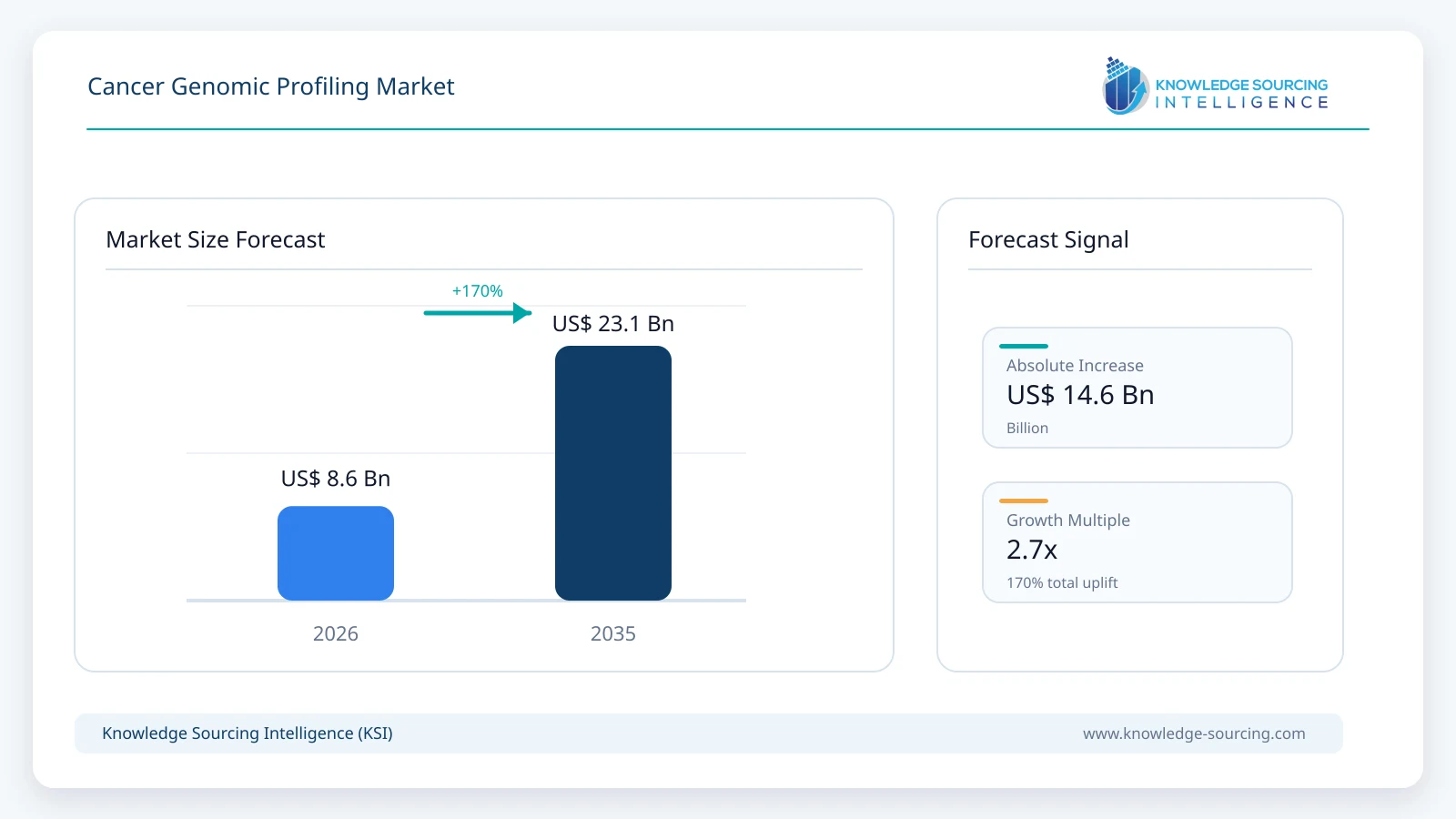
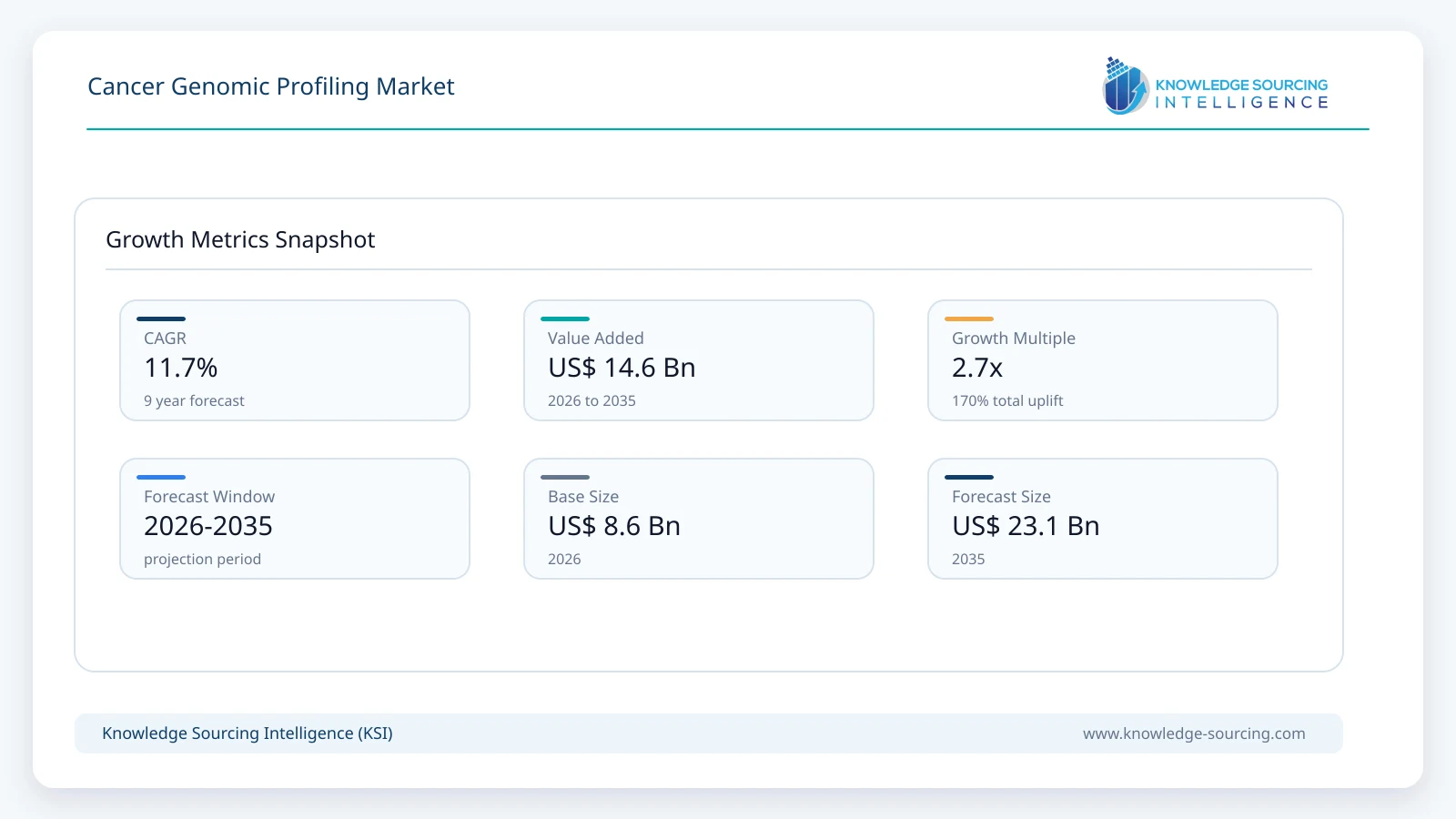
The Cancer Genomic Profiling Market is set to reach USD 23.14 billion in 2035, growing at a CAGR of 11.7 % from USD 8.58 billion in 2026.
Highlights:
- 1Next-generation sequencing remains the dominant technology for comprehensive genomic profiling due to its high sensitivity and multiplexing capability.
- 2Precision oncology and companion diagnostics are significantly increasing demand for comprehensive genomic testing across solid tumors and hematological malignancies.
- 3Liquid biopsy and AI-powered bioinformatics are expanding clinical applications beyond tissue-based genomic profiling.
- 4North America leads the global market, while Asia-Pacific is expected to register the fastest growth during the forecast period.
The market is benefiting from increasing integration of MRD testing into clinical trials, regulatory recognition of MRD as an important clinical endpoint, and growing reimbursement support for hematological malignancies. Pharmaceutical companies are increasingly incorporating MRD biomarkers into drug development programs, while diagnostic companies continue expanding assay sensitivity and automation. North America leads the global market owing to strong adoption of precision medicine and advanced molecular diagnostics, whereas Asia-Pacific is anticipated to witness the fastest growth through expanding oncology infrastructure and genomic testing capabilities.
Market Drivers
Growing adoption of precision oncology increases demand for comprehensive genomic profiling to identify actionable mutations and personalize cancer treatment strategies.
Rapid advancements in next-generation sequencing technologies improve diagnostic accuracy, throughput, affordability, and accessibility across clinical laboratories worldwide.
Expanding approvals of targeted therapies and companion diagnostics accelerate routine genomic testing in oncology clinical practice and research.
Rising global cancer incidence and increasing biomarker-driven treatment approaches strengthen demand for comprehensive molecular profiling solutions.
Market Restraints
High costs of genomic sequencing platforms and bioinformatics infrastructure limit adoption among smaller hospitals and diagnostic laboratories.
Limited reimbursement coverage for comprehensive genomic profiling remains a barrier in several emerging healthcare markets.
Complex genomic data interpretation requires specialized expertise and advanced bioinformatics capabilities, restricting widespread clinical implementation.
Variability in regulatory requirements across countries delays commercialization and global adoption of advanced genomic profiling technologies.
Market Opportunities
Expansion of liquid biopsy technologies creates new opportunities for minimally invasive comprehensive genomic profiling and longitudinal disease monitoring.
Artificial intelligence integration enhances genomic data interpretation, clinical decision support, and precision oncology workflow efficiency.
Emerging markets present significant growth opportunities through expanding molecular diagnostic infrastructure and precision medicine initiatives.
Increasing pharmaceutical collaborations for biomarker discovery and companion diagnostics continue accelerating market innovation and commercialization.
Disease & Epidemiology Analysis
Cancer remains one of the leading causes of morbidity and mortality globally, with rising incidence driven by population aging, lifestyle changes, environmental risk factors, and improved detection. Increasing prevalence of solid tumors and hematological malignancies has significantly expanded demand for genomic profiling technologies capable of identifying clinically actionable mutations. Comprehensive genomic profiling enables precision treatment selection, predicts therapeutic response, supports disease monitoring, and identifies resistance mechanisms, making it an essential component of modern oncology care. Growing awareness of personalized medicine continues driving adoption of advanced genomic diagnostics across healthcare systems worldwide.
Government Regulatory Landscape Table
Region | Regulatory Authority | Regulatory Focus |
United States | FDA | Regulates companion diagnostics, NGS assays, genomic profiling tests, analytical validation, and precision oncology diagnostics. |
European Union | European Commission (IVDR) | Oversees clinical evidence, quality management, conformity assessment, and post-market surveillance for genomic diagnostics. |
Japan | PMDA & MHLW | Regulates genomic sequencing platforms, companion diagnostics, molecular oncology testing, and clinical validation. |
China | NMPA | Governs approval, manufacturing quality, clinical performance evaluation, and commercialization of genomic diagnostic technologies. |
Market Segmentation
By Product
Instruments account for a substantial share of the cancer genomic profiling market as high-throughput sequencing systems, PCR instruments, and genomic analyzers form the foundation of molecular testing laboratories. Reagents & consumables represent the largest revenue-generating segment due to recurring demand for sequencing kits, extraction reagents, library preparation kits, and assay consumables. Software & bioinformatics is the fastest-growing segment as laboratories increasingly adopt artificial intelligence, cloud-based analytics, and advanced genomic interpretation platforms for precision oncology.
By Technology
Next-Generation Sequencing (NGS) dominates the technology landscape because of its ability to simultaneously analyze multiple genomic alterations with high sensitivity and throughput. Polymerase Chain Reaction (PCR) remains widely utilized for targeted mutation detection and companion diagnostics, while Fluorescence In Situ Hybridization (FISH) continues serving an important role in chromosomal abnormality analysis. Microarray technology supports gene expression profiling, whereas Sanger sequencing remains valuable for confirmatory testing and validation of genomic variants.
By Sample Type
Tissue samples remain the gold standard for comprehensive genomic profiling due to their ability to provide high-quality DNA and complete tumor characterization. Blood samples are witnessing the fastest growth as liquid biopsy technologies enable minimally invasive genomic testing, treatment monitoring, and recurrence detection. Bone marrow samples continue playing a critical role in hematological malignancies, while other sample types, including cytology specimens and body fluids, are expanding as genomic technologies become more sensitive.
Regional Analysis
North America
North America leads the cancer genomic profiling market owing to advanced precision oncology infrastructure, widespread NGS adoption, favorable reimbursement policies, and extensive pharmaceutical research collaborations.
Europe
Europe maintains strong market growth through expanding genomic medicine initiatives, increasing companion diagnostic adoption, supportive regulatory frameworks, and national precision healthcare programs.
Asia-Pacific
Asia-Pacific is projected to register the fastest growth driven by increasing cancer incidence, expanding sequencing capacity, government investments in genomics, and improving healthcare infrastructure.
South America
South America continues to experience gradual adoption as oncology centers expand molecular diagnostic capabilities and governments increase investments in cancer care infrastructure.
Middle East & Africa
The Middle East & Africa market is growing steadily through healthcare modernization, improving access to genomic testing, and increasing precision medicine initiatives.
Rest of the World
The Rest of the World demonstrates moderate growth supported by expanding molecular diagnostic laboratories, improving genomic research capabilities, and increasing awareness of personalized oncology.
Regulatory Landscape
Cancer genomic profiling is regulated through stringent quality, safety, and clinical performance requirements established by regulatory authorities including the FDA, European authorities under IVDR, PMDA, and NMPA. Regulatory agencies increasingly support companion diagnostics and next-generation sequencing platforms that demonstrate strong analytical validity and clinical utility. Growing emphasis on laboratory accreditation, genomic data quality, post-market surveillance, and standardized reporting continues strengthening confidence in genomic testing while accelerating regulatory approvals for precision oncology diagnostics.
Pipeline Analysis
The cancer genomic profiling pipeline is advancing through ultra-high-throughput sequencing systems, long-read sequencing technologies, multi-omics platforms, AI-powered genomic interpretation, single-cell sequencing, spatial transcriptomics, liquid biopsy innovations, methylation profiling, integrated companion diagnostics, and cloud-based bioinformatics solutions. These technologies aim to improve diagnostic accuracy, identify actionable mutations earlier, optimize targeted therapy selection, and enhance personalized cancer management.
Reimbursement Landscape
Reimbursement for cancer genomic profiling continues expanding as precision medicine becomes integrated into routine oncology care. Medicare and commercial insurers increasingly reimburse comprehensive genomic profiling and companion diagnostics for multiple solid tumors and hematological malignancies supported by clinical guidelines. European countries continue broadening reimbursement through national genomic medicine programs, while emerging markets are gradually improving funding mechanisms as evidence supporting cost-effectiveness and personalized treatment outcomes continues to strengthen.
Competitive Landscape
F. Hoffmann-La Roche Ltd.
Roche develops comprehensive molecular diagnostics, companion diagnostics, sequencing technologies, and precision oncology solutions supporting genomic profiling.
Illumina, Inc.
Illumina is a global leader in next-generation sequencing platforms enabling comprehensive cancer genomic profiling and precision medicine.
Thermo Fisher Scientific Inc.
Thermo Fisher Scientific provides sequencing systems, PCR technologies, genomic analysis solutions, and oncology research platforms.
QIAGEN N.V.
QIAGEN develops molecular diagnostics, sample preparation technologies, PCR assays, and bioinformatics solutions supporting genomic testing.
Agilent Technologies, Inc.
Agilent delivers genomics instrumentation, molecular assays, automation technologies, and bioinformatics solutions for oncology diagnostics.
Danaher Corporation
Danaher provides advanced genomics platforms, molecular diagnostic technologies, sequencing solutions, and laboratory automation systems.
Guardant Health, Inc.
Guardant Health specializes in liquid biopsy, comprehensive genomic profiling, and precision oncology testing for advanced cancer management.
Exact Sciences Corporation
Exact Sciences develops molecular cancer diagnostics, genomic profiling technologies, and precision oncology testing solutions.
Foundation Medicine, Inc.
Foundation Medicine specializes in comprehensive genomic profiling, companion diagnostics, and precision oncology testing for personalized cancer treatment.
Key Developments
January 2026: Illumina expanded oncology sequencing capabilities with enhanced comprehensive genomic profiling workflows.
December 2025: Roche strengthened its precision oncology portfolio through expanded companion diagnostic collaborations.
November 2025: Thermo Fisher Scientific introduced advanced NGS workflow solutions for clinical oncology laboratories.
October 2025: Guardant Health expanded liquid biopsy applications supporting comprehensive genomic profiling.
Strategic Insights and Future Market Outlook
The global cancer genomic profiling market is expected to witness strong growth through 2035 as precision oncology increasingly becomes the standard of care across multiple cancer types. Continuous advances in next-generation sequencing, artificial intelligence, liquid biopsy, multi-omics technologies, and bioinformatics will significantly improve the speed, accuracy, and clinical utility of genomic testing. Expanding regulatory approvals, broader reimbursement coverage, increasing pharmaceutical collaborations, and growing adoption of companion diagnostics will further accelerate market expansion. Comprehensive genomic profiling will play a central role in personalized treatment selection, biomarker discovery, therapy monitoring, and precision oncology clinical trials worldwide.
Cancer Genomic Profiling Market Scope:
| Report Metric | Details |
|---|---|
| Total Market Size in 2026 | USD 8.58 billion |
| Total Market Size in 2035 | USD 23.14 billion |
| Forecast Unit | USD Billion |
| Growth Rate | 11.7 % |
| Study Period | 2021 to 2035 |
| Historical Data | 2021 to 2024 |
| Base Year | 2025 |
| Forecast Period | 2026 – 2035 |
| Segmentation | Profiling Type, Technology, End User, Geography |
| Companies |
|
Market Segmentation
Profiling Type
Technology
End User
Geography
- North America
- South America
- Europe
- Middle East and Africa
- Asia Pacific
Table of Contents
1. EXECUTIVE SUMMARY
1.1 Market Snapshot
1.2 Key Findings
1.3 Analyst Insights
1.4 Strategic Recommendations
2. RESEARCH METHODOLOGY
2.1 Research Design
2.2 Data Collection Methodology
2.3 Market Size Estimation
2.4 Forecasting Model
2.5 Assumptions & Limitations
3. GLOBAL CANCER GENOMIC PROFILING MARKET OVERVIEW, SIZE & FORECAST
3.1 Market Definition & Scope
3.2 Industry Overview
3.3 Evolution of Cancer Genomic Profiling
3.4 Key Market Trends
3.5 Historical Market Size Analysis (2021–2025)
3.6 Market Forecast (2026–2035)
3.7 Cancer Patient Population Analysis
3.8 Genomic Testing Volume Analysis
3.9 Precision Oncology Adoption Analysis
3.10 Clinical Workflow Analysis
4. MARKET DYNAMICS
4.1 Market Drivers
4.2 Market Restraints
4.3 Market Opportunities
4.4 Market Challenges
5. INDUSTRY LANDSCAPE
5.1 Industry Value Chain Analysis
5.2 Pricing Analysis
5.3 Reimbursement Landscape
6. INNOVATION LANDSCAPE
6.1 Emerging Technologies
6.2 Product Innovation
6.3 Comprehensive Genomic Profiling Advancements
6.4 Artificial Intelligence in Genomic Data Interpretation
6.5 Multi-Omics Integration
6.6 Liquid Biopsy-Based Genomic Profiling
6.7 Technology Roadmap
7. REGULATORY LANDSCAPE
7.1 Regulatory Framework
7.2 Approval Pathways
7.3 Compliance Requirements
8. GLOBAL CANCER GENOMIC PROFILING MARKET LANDSCAPE ANALYSIS
8.1 Analysis by Profiling Type
8.1.1 Comprehensive Genomic Profiling
8.1.2 Targeted Gene Panel Profiling
8.1.3 Whole Exome Sequencing (WES)
8.1.4 Whole Genome Sequencing (WGS)
8.2 Analysis by Technology
8.2.1 Next-Generation Sequencing (NGS)
8.2.2 Polymerase Chain Reaction (PCR)
8.2.3 Fluorescence In Situ Hybridization (FISH)
8.2.4 Microarray
8.2.5 Sanger Sequencing
8.3 Analysis by Biomarker Type
8.3.1 Single Nucleotide Variants (SNVs)
8.3.2 Copy Number Variations (CNVs)
8.3.3 Gene Fusions
8.3.4 Microsatellite Instability (MSI)
8.3.5 Tumor Mutational Burden (TMB)
8.4 Analysis by Clinical Application
8.4.1 Therapy Selection
8.4.2 Companion Diagnostics
8.4.3 Prognostic Assessment
8.4.4 Disease Monitoring
8.4.5 Clinical Research
9. GLOBAL CANCER GENOMIC PROFILING MARKET SEGMENT ANALYSIS (2021–2035)
9.1 By Product
9.1.1 Instruments
9.1.2 Reagents & Consumables
9.1.3 Software & Bioinformatics
9.2 By Technology
9.2.1 Next-Generation Sequencing (NGS)
9.2.2 Polymerase Chain Reaction (PCR)
9.2.3 Fluorescence In Situ Hybridization (FISH)
9.2.4 Microarray
9.2.5 Sanger Sequencing
9.2.6 Other Technologies
9.3 By Sample Type
9.3.1 Tissue Samples
9.3.2 Blood Samples
9.3.3 Bone Marrow Samples
9.3.4 Other Sample Types
9.4 By End User
9.4.1 Hospitals
9.4.2 Diagnostic Laboratories
9.4.3 Cancer Centers
9.4.4 Academic & Research Institutes
10. GLOBAL CANCER GENOMIC PROFILING MARKET GEOGRAPHICAL ANALYSIS (2021–2035)
10.1 North America
10.2 Europe
10.3 Asia-Pacific
10.4 South America
10.5 Middle East & Africa
11. GLOBAL CANCER GENOMIC PROFILING MARKET COUNTRY ANALYSIS (2021–2035)
11.1 United States
11.2 Canada
11.3 Germany
11.4 United Kingdom
11.5 France
11.6 Italy
11.7 Spain
11.8 Japan
11.9 China
11.10 South Korea
11.11 India
11.12 Australia
11.13 Brazil
11.14 Mexico
11.15 Saudi Arabia
11.16 South Africa
12. COMPETITIVE LANDSCAPE
12.1 Market Share Analysis
12.2 Strategic Developments
12.3 Mergers & Acquisitions, Partnerships & Collaborations
12.4 Product Launches
13. COMPANY PROFILES
13.1 F. Hoffmann-La Roche Ltd.
13.1.1 Company Overview
13.1.2 Financials
13.1.3 Product Portfolio
13.1.4 Recent Developments
13.2 Illumina, Inc.
13.2.1 Company Overview
13.2.2 Financials
13.2.3 Product Portfolio
13.2.4 Recent Developments
13.3 Thermo Fisher Scientific Inc.
13.3.1 Company Overview
13.3.2 Financials
13.3.3 Product Portfolio
13.3.4 Recent Developments
13.4 QIAGEN N.V.
13.4.1 Company Overview
13.4.2 Financials
13.4.3 Product Portfolio
13.4.4 Recent Developments
13.5 Agilent Technologies, Inc.
13.5.1 Company Overview
13.5.2 Financials
13.5.3 Product Portfolio
13.5.4 Recent Developments
13.6 Danaher Corporation
13.6.1 Company Overview
13.6.2 Financials
13.6.3 Product Portfolio
13.6.4 Recent Developments
13.7 Guardant Health, Inc.
13.7.1 Company Overview
13.7.2 Financials
13.7.3 Product Portfolio
13.7.4 Recent Developments
13.8 Exact Sciences Corporation
13.8.1 Company Overview
13.8.2 Financials
13.8.3 Product Portfolio
13.8.4 Recent Developments
13.9 Foundation Medicine, Inc.
13.9.1 Company Overview
13.9.2 Financials
13.9.3 Product Portfolio
13.9.4 Recent Developments
13.10 Tempus AI, Inc.
13.10.1 Company Overview
13.10.2 Financials
13.10.3 Product Portfolio
13.10.4 Recent Developments
13.11 NeoGenomics Laboratories, Inc.
13.11.1 Company Overview
13.11.2 Financials
13.11.3 Product Portfolio
13.11.4 Recent Developments
13.12 Personalis, Inc.
13.12.1 Company Overview
13.12.2 Financials
13.12.3 Product Portfolio
13.12.4 Recent Developments
13.13 Caris Life Sciences
13.13.1 Company Overview
13.13.2 Financials
13.13.3 Product Portfolio
13.13.4 Recent Developments
13.14 Bio-Rad Laboratories, Inc.
13.14.1 Company Overview
13.14.2 Financials
13.14.3 Product Portfolio
13.14.4 Recent Developments
13.15 Abbott Laboratories
13.15.1 Company Overview
13.15.2 Financials
13.15.3 Product Portfolio
13.15.4 Recent Developments
14. GLOBAL CANCER GENOMIC PROFILING MARKET COMMERCIAL FORECAST ANALYSIS
14.1 Comprehensive Genomic Profiling (CGP) Tests
14.2 Targeted Gene Panel Tests
14.3 Whole Exome Sequencing (WES)
14.4 Whole Genome Sequencing (WGS)
14.5 Liquid Biopsy-Based Genomic Profiling
14.6 Companion Diagnostic Genomic Tests
14.7 Bioinformatics and Genomic Interpretation Solutions
15. INVESTMENT & FUNDING ANALYSIS
15.1 Venture Capital Trends
15.2 Government Funding
15.3 R&D Investments
16. FUTURE OUTLOOK
16.1 Key Growth Opportunities
16.2 Future Industry Trends
Navigate
Trusted by the world's leading organizations











