
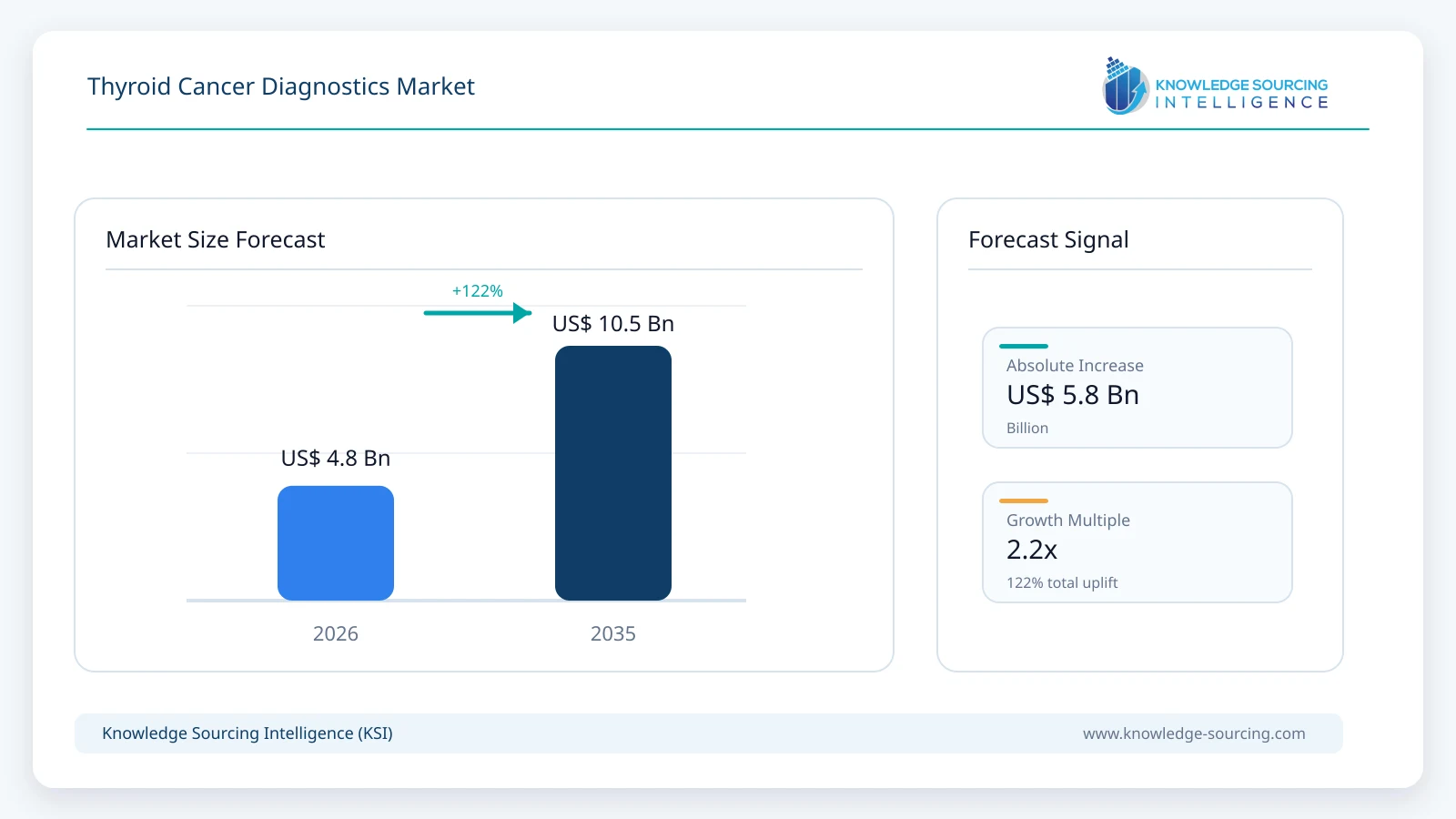
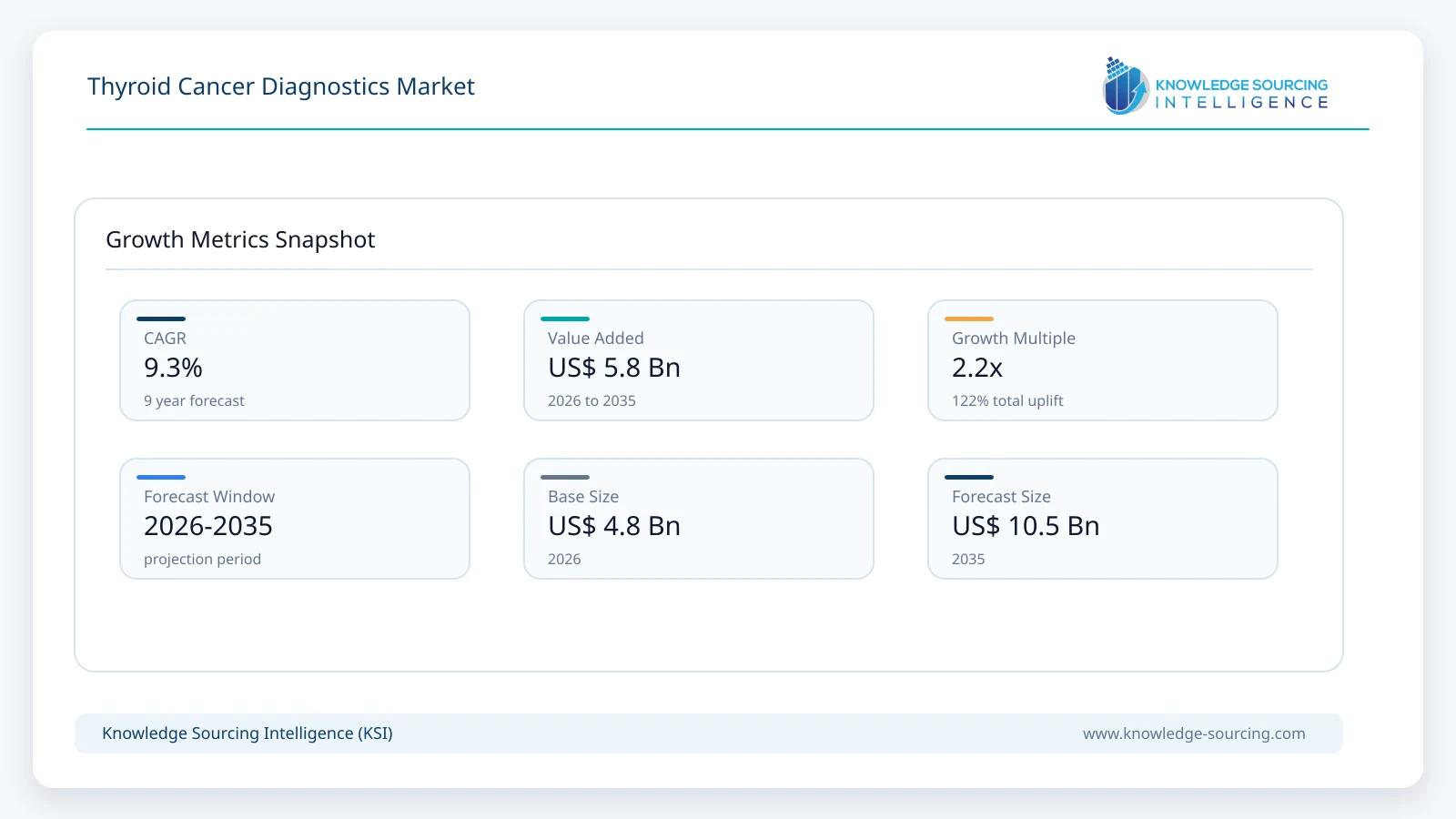
The Thyroid Cancer Diagnostics Market is set to reach USD 10.54 billion in 2035, growing at a CAGR of 9.3% from USD 4.75 billion in 2026.
Highlights:
- 1Rising global incidence of thyroid cancer is increasing demand for early and accurate diagnostic technologies.
- 2Molecular diagnostics and genomic biomarker testing are transforming thyroid cancer diagnosis and treatment selection.
- 3Artificial intelligence, digital pathology, and next-generation sequencing are improving diagnostic efficiency and clinical outcomes.
- 4Expanding precision oncology programs and companion diagnostics are creating long-term market growth opportunities.
Hospitals, cancer centers, and diagnostic laboratories are increasingly integrating next-generation sequencing (NGS), polymerase chain reaction (PCR), immunohistochemistry (IHC), and gene expression profiling into routine clinical practice. The availability of targeted therapies for genetically defined thyroid cancers has also accelerated demand for companion diagnostics and comprehensive genomic profiling.
North America currently leads the market owing to strong healthcare infrastructure, favorable reimbursement, and widespread adoption of precision medicine. Asia-Pacific is projected to witness the fastest growth due to increasing healthcare investments, expanding cancer screening programs, and improving access to advanced molecular diagnostics.
Market Drivers
Increasing global incidence of bladder cancer.
Rising global thyroid cancer incidence increases demand for early diagnosis, advanced molecular testing, and accurate biomarker-based precision oncology solutions worldwide.
Growing adoption of next-generation sequencing and genomic profiling improves diagnostic accuracy, personalized treatment selection, and clinical decision-making across healthcare systems.
Increasing awareness of early cancer detection encourages routine thyroid screening, boosting utilization of imaging, cytopathology, and molecular diagnostic technologies globally.
Continuous advancements in digital pathology, artificial intelligence, and companion diagnostics enhance workflow efficiency, diagnostic confidence, and patient management outcomes.
Market Restraints
High costs of molecular diagnostic tests and genomic sequencing limit widespread adoption, particularly across low- and middle-income healthcare markets.
Limited reimbursement coverage for advanced genomic diagnostics restricts patient access and slows adoption of precision oncology technologies in several regions.
Shortage of skilled molecular pathologists and specialized laboratory professionals affects diagnostic capacity, interpretation accuracy, and implementation of advanced testing.
Stringent regulatory approval requirements increase development timelines, compliance costs, and commercialization challenges for innovative thyroid diagnostic technologies.
Market Opportunities
Expanding liquid biopsy technologies offer minimally invasive diagnostic solutions, supporting early detection, disease monitoring, and personalized treatment planning initiatives.
Increasing integration of artificial intelligence into pathology improves diagnostic efficiency, workflow automation, and interpretation consistency across clinical laboratories worldwide.
Growing healthcare investments in emerging economies expand access to advanced oncology diagnostics, supporting significant long-term market growth opportunities globally.
Development of novel molecular biomarkers enables improved risk stratification, precision medicine adoption, and companion diagnostic opportunities for targeted therapies.
Disease & Epidemiology Analysis
The thyroid cancer diagnostics market is regulated by agencies including the U.S. Food and Drug Administration (FDA), European regulatory authorities operating under the In Vitro Diagnostic Regulation (IVDR), Japan's Pharmaceuticals and Medical Devices Agency (PMDA), and China's National Medical Products Administration (NMPA). Regulatory approval requires comprehensive analytical validation, clinical performance evaluation, manufacturing quality compliance, and post-market surveillance. Regulatory focus has increasingly shifted toward molecular diagnostics, gene expression profiling, companion diagnostics, next-generation sequencing panels, and artificial intelligence-enabled pathology platforms to ensure diagnostic accuracy, clinical utility, and patient safety.
Government Regulatory Landscape Table
Region/Country | Regulatory Authority | Regulatory Focus |
United States | U.S. Food and Drug Administration (FDA) | Regulates molecular diagnostics, companion diagnostics, genomic testing, pathology systems, and thyroid cancer biomarker assays through analytical validation and clinical performance requirements. |
European Union | European Commission (IVDR) & National Competent Authorities | Oversees conformity assessment, clinical evidence, quality management systems, companion diagnostics, and post-market surveillance for in vitro diagnostic devices. |
Japan | Pharmaceuticals and Medical Devices Agency (PMDA) & Ministry of Health, Labour and Welfare (MHLW) | Regulates oncology diagnostic technologies through safety evaluation, clinical validation, manufacturing quality, and regulatory approval processes. |
China | National Medical Products Administration (NMPA) | Governs registration, clinical validation, manufacturing quality, molecular diagnostic assays, and commercialization of thyroid cancer diagnostic technologies. |
Market Segmentation
By Diagnostic Modality
Imaging diagnostics account for a significant share of the thyroid cancer diagnostics market as ultrasound remains the primary tool for thyroid nodule evaluation and risk assessment. Cytopathology continues to play a central role through fine needle aspiration (FNA)-based diagnosis, while molecular diagnostics represent the fastest-growing segment owing to increasing adoption of genomic profiling and precision oncology. Histopathology remains essential for definitive diagnosis, tumor classification, and postoperative evaluation.
By Technology
Fine Needle Aspiration (FNA) remains the gold standard for initial evaluation of suspicious thyroid nodules due to its high diagnostic accuracy and minimally invasive nature. Immunohistochemistry supports tumor characterization and differential diagnosis, while PCR-based assays enable mutation detection. Next-generation sequencing is experiencing rapid growth through comprehensive genomic profiling, and gene expression profiling is increasingly utilized to improve risk stratification and reduce unnecessary thyroid surgeries.
By Biomarker
BRAF mutation testing represents the largest biomarker segment because of its strong association with papillary thyroid carcinoma and therapeutic decision-making. RAS mutation analysis supports diagnosis of follicular-patterned thyroid lesions, while RET gene alteration testing is becoming increasingly important for precision oncology and targeted therapy selection. TERT promoter mutations provide valuable prognostic information, and emerging biomarker panels continue improving diagnostic accuracy and personalized treatment planning.
Regional Analysis
North America
North America dominates the thyroid cancer diagnostics market owing to advanced molecular diagnostic capabilities, widespread adoption of genomic testing, favorable reimbursement policies, and strong implementation of precision oncology programs.
Europe
Europe maintains a substantial market share through established pathology infrastructure, increasing adoption of molecular diagnostics, supportive regulatory frameworks, and expanding utilization of personalized medicine.
Asia-Pacific
Asia-Pacific is expected to register the fastest market growth due to rising thyroid cancer incidence, expanding healthcare infrastructure, growing awareness regarding early diagnosis, and increasing adoption of advanced molecular testing technologies.
South America
South America is witnessing steady market growth supported by improving oncology services, increasing healthcare investments, and expanding availability of advanced diagnostic technologies.
Middle East & Africa
The Middle East & Africa market continues to expand through healthcare modernization initiatives, increasing investment in specialized cancer care, and improving access to molecular diagnostic services.
Rest of the World
The Rest of the World is experiencing gradual growth supported by expanding diagnostic laboratory infrastructure, improved access to precision oncology, and increasing implementation of cancer screening initiatives.
Regulatory Landscape
The thyroid cancer diagnostics market is regulated by agencies including the U.S. Food and Drug Administration (FDA), European regulatory authorities operating under the In Vitro Diagnostic Regulation (IVDR), Japan's Pharmaceuticals and Medical Devices Agency (PMDA), and China's National Medical Products Administration (NMPA). Regulatory approval requires comprehensive analytical validation, clinical performance evaluation, manufacturing quality compliance, and post-market surveillance. Regulatory focus has increasingly shifted toward molecular diagnostics, gene expression profiling, companion diagnostics, next-generation sequencing panels, and artificial intelligence-enabled pathology platforms to ensure diagnostic accuracy, clinical utility, and patient safety.
Pipeline Analysis
The thyroid cancer diagnostics pipeline is advancing through development of liquid biopsy technologies, circulating tumor DNA (ctDNA) assays, next-generation sequencing panels, expanded gene expression classifiers, artificial intelligence-assisted cytopathology, digital pathology platforms, multiplex molecular biomarker panels, proteomic profiling, and companion diagnostics supporting targeted therapies. These innovations aim to improve diagnosis of indeterminate thyroid nodules, enhance molecular risk stratification, reduce unnecessary surgeries, and optimize personalized treatment selection.
Reimbursement Landscape
Reimbursement for thyroid cancer diagnostics is well established for ultrasound imaging, fine needle aspiration, cytopathology, histopathology, and standard laboratory testing across developed healthcare systems. Medicare, Medicaid, and private insurers in the United States increasingly reimburse molecular diagnostics, gene expression profiling, and companion diagnostics when supported by clinical evidence and professional guidelines. European healthcare systems provide reimbursement for essential thyroid cancer diagnostic procedures through national health services, while coverage for genomic profiling continues expanding alongside precision oncology adoption. Emerging markets are progressively strengthening reimbursement through national cancer programs and healthcare modernization initiatives.
Competitive Landscape
Thermo Fisher Scientific Inc.
Thermo Fisher Scientific provides PCR technologies, sequencing platforms, molecular diagnostics, and precision oncology solutions supporting thyroid cancer testing.
Danaher Corporation
Danaher offers genomics technologies, molecular diagnostics, laboratory automation, and precision medicine solutions supporting oncology diagnostics.
Agilent Technologies, Inc.
Agilent specializes in pathology solutions, immunohistochemistry assays, genomic technologies, and companion diagnostics supporting thyroid cancer diagnosis.
Illumina, Inc.
Illumina is a leading provider of next-generation sequencing platforms enabling comprehensive genomic profiling and biomarker discovery for thyroid cancer.
QIAGEN N.V.
QIAGEN develops molecular diagnostic assays, PCR technologies, sample preparation systems, and companion diagnostics supporting personalized oncology.
Abbott Laboratories
Abbott provides immunoassays, clinical chemistry systems, molecular diagnostics, and laboratory testing solutions supporting oncology diagnostics.
Siemens Healthineers AG
Siemens Healthineers develops advanced imaging systems, laboratory diagnostics, artificial intelligence-enabled healthcare technologies, and digital diagnostic solutions.
Bio-Rad Laboratories, Inc.
Bio-Rad develops digital PCR systems, molecular diagnostics, immunoassays, and laboratory quality control solutions supporting cancer testing.
Key Developments
January 2026: Guardant Health expanded its liquid biopsy portfolio with enhanced genomic profiling capabilities for solid tumors.
December 2025: Veracyte advanced its genomic testing portfolio through continued expansion of molecular diagnostic applications for thyroid disease.
November 2025: Roche introduced enhanced companion diagnostic solutions supporting precision oncology.
October 2025: Illumina expanded next-generation sequencing applications for comprehensive oncology genomic profiling.
Strategic Insights and Future Market Outlook
The global thyroid cancer diagnostics market is expected to grow steadily through 2035 as precision oncology, genomic medicine, and molecular risk stratification become increasingly integrated into routine thyroid cancer management. Continued innovation in next-generation sequencing, gene expression profiling, liquid biopsy, digital pathology, and artificial intelligence-assisted diagnostics will improve diagnostic accuracy while reducing unnecessary surgical interventions. Strategic collaborations among diagnostic manufacturers, biotechnology companies, pharmaceutical firms, and research institutions will accelerate commercialization of next-generation molecular diagnostic solutions. As personalized medicine continues to evolve, advanced biomarker-driven diagnostics will play an increasingly important role in early diagnosis, treatment selection, prognosis assessment, and long-term management of thyroid cancer patients.
Thyroid Cancer Diagnostics Market Scope:
| Report Metric | Details |
|---|---|
| Total Market Size in 2026 | USD 4.75 billion |
| Total Market Size in 2035 | USD 10.54 billion |
| Forecast Unit | USD Billion |
| Growth Rate | 9.3 % |
| Study Period | 2021 to 2035 |
| Historical Data | 2021 to 2024 |
| Base Year | 2025 |
| Forecast Period | 2026 – 2035 |
| Segmentation | Product, Technology, End User, Geography |
| Companies |
|
Market Segmentation
Product
Technology
End User
Geography
- North America
- South America
- Europe
- Middle East and Africa
- Asia Pacific
Table of Contents
1. EXECUTIVE SUMMARY
1.1 Market Snapshot
1.2 Key Findings
1.3 Analyst Insights
1.4 Strategic Recommendations
2. RESEARCH METHODOLOGY
2.1 Research Design
2.2 Data Collection Methodology
2.3 Market Size Estimation
2.4 Forecasting Model
2.5 Assumptions & Limitations
3. GLOBAL THYROID CANCER DIAGNOSTICS MARKET OVERVIEW, SIZE & FORECAST
3.1 Market Definition & Scope
3.2 Disease Overview
3.3 Disease Evolution and Diagnostic Landscape
3.4 Key Market Trends
3.5 Historical Market Size Analysis (2021–2025)
3.6 Market Forecast (2026–2035)
3.7 Disease Prevalence Analysis
3.8 Diagnosed Patient Population Analysis
3.9 Thyroid Cancer Diagnostic Testing Volume Analysis
3.10 Patient Diagnostic Pathway Analysis
4. MARKET DYNAMICS
4.1 Market Drivers
4.2 Market Restraints
4.3 Market Opportunities
4.4 Market Challenges
5. INDUSTRY LANDSCAPE
5.1 Industry Value Chain Analysis
5.2 Pricing Analysis
5.3 Reimbursement Landscape
6. INNOVATION LANDSCAPE
6.1 Emerging Technologies
6.2 Product Innovation
6.3 Molecular Diagnostic Panels
6.4 Artificial Intelligence in Thyroid Nodule Assessment
6.5 Genomic Biomarker Development
6.6 Liquid Biopsy Technologies
6.7 Technology Roadmap
7. REGULATORY LANDSCAPE
7.1 Regulatory Framework
7.2 Approval Pathways
7.3 Compliance Requirements
8. GLOBAL THYROID CANCER DIAGNOSTICS MARKET LANDSCAPE ANALYSIS
8.1 Analysis by Diagnostic Modality
8.1.1 Imaging Diagnostics
8.1.2 Cytopathology
8.1.3 Molecular Diagnostics
8.1.4 Histopathology
8.2 Analysis by Technology
8.2.1 Fine Needle Aspiration (FNA)
8.2.2 Immunohistochemistry (IHC)
8.2.3 Polymerase Chain Reaction (PCR)
8.2.4 Next-Generation Sequencing (NGS)
8.2.5 Gene Expression Profiling
8.3 Analysis by Biomarker
8.3.1 BRAF Mutation
8.3.2 RAS Mutation
8.3.3 RET Gene Alterations
8.3.4 TERT Promoter Mutation
8.3.5 Other Biomarkers
8.4 Analysis by Clinical Application
8.4.1 Thyroid Nodule Evaluation
8.4.2 Cancer Diagnosis
8.4.3 Risk Stratification
8.4.4 Treatment Selection
8.4.5 Disease Monitoring
9. GLOBAL THYROID CANCER DIAGNOSTICS MARKET SEGMENT ANALYSIS (2021–2035)
9.1 By Product
9.1.1 Instruments
9.1.2 Reagents & Consumables
9.1.3 Software
9.2 By Technology
9.2.1 Fine Needle Aspiration (FNA)
9.2.2 Immunohistochemistry (IHC)
9.2.3 Polymerase Chain Reaction (PCR)
9.2.4 Next-Generation Sequencing (NGS)
9.2.5 Gene Expression Profiling
9.2.6 Other Technologies
9.3 By End User
9.3.1 Hospitals
9.3.2 Diagnostic Laboratories
9.3.3 Cancer Centers
9.3.4 Academic & Research Institutes
10. GLOBAL THYROID CANCER DIAGNOSTICS MARKET GEOGRAPHICAL ANALYSIS (2021–2035)
10.1 North America
10.2 Europe
10.3 Asia-Pacific
10.4 South America
10.5 Middle East & Africa
11. GLOBAL THYROID CANCER DIAGNOSTICS MARKET COUNTRY ANALYSIS (2021–2035)
11.1 United States
11.2 Canada
11.3 Germany
11.4 United Kingdom
11.5 France
11.6 Italy
11.7 Spain
11.8 Japan
11.9 China
11.10 South Korea
11.11 India
11.12 Australia
11.13 Brazil
11.14 Mexico
11.15 Saudi Arabia
11.16 South Africa
12. COMPETITIVE LANDSCAPE
12.1 Market Share Analysis
12.2 Strategic Developments
12.3 Mergers & Acquisitions, Partnerships & Collaborations
12.4 Product Launches
13. COMPANY PROFILES
13.1 F. Hoffmann-La Roche Ltd.
13.1.1 Company Overview
13.1.2 Financials
13.1.3 Product Portfolio
13.1.4 Recent Developments
13.2 Thermo Fisher Scientific Inc.
13.2.1 Company Overview
13.2.2 Financials
13.2.3 Product Portfolio
13.2.4 Recent Developments
13.3 Danaher Corporation
13.3.1 Company Overview
13.3.2 Financials
13.3.3 Product Portfolio
13.3.4 Recent Developments
13.4 Agilent Technologies, Inc.
13.4.1 Company Overview
13.4.2 Financials
13.4.3 Product Portfolio
13.4.4 Recent Developments
13.5 Illumina, Inc.
13.5.1 Company Overview
13.5.2 Financials
13.5.3 Product Portfolio
13.5.4 Recent Developments
13.6 QIAGEN N.V.
13.6.1 Company Overview
13.6.2 Financials
13.6.3 Product Portfolio
13.6.4 Recent Developments
13.7 Abbott Laboratories
13.7.1 Company Overview
13.7.2 Financials
13.7.3 Product Portfolio
13.7.4 Recent Developments
13.8 Siemens Healthineers AG
13.8.1 Company Overview
13.8.2 Financials
13.8.3 Product Portfolio
13.8.4 Recent Developments
13.9 Bio-Rad Laboratories, Inc.
13.9.1 Company Overview
13.9.2 Financials
13.9.3 Product Portfolio
13.9.4 Recent Developments
13.10 bioMérieux
13.10.1 Company Overview
13.10.2 Financials
13.10.3 Product Portfolio
13.10.4 Recent Developments
13.11 Veracyte, Inc.
13.11.1 Company Overview
13.11.2 Financials
13.11.3 Product Portfolio
13.11.4 Recent Developments
13.12 Exact Sciences Corporation
13.12.1 Company Overview
13.12.2 Financials
13.12.3 Product Portfolio
13.12.4 Recent Developments
13.13 Guardant Health, Inc.
13.13.1 Company Overview
13.13.2 Financials
13.13.3 Product Portfolio
13.13.4 Recent Developments
13.14 Leica Biosystems
13.14.1 Company Overview
13.14.2 Financials
13.14.3 Product Portfolio
13.14.4 Recent Developments
13.15 Fujifilm Holdings Corporation
13.15.1 Company Overview
13.15.2 Financials
13.15.3 Product Portfolio
13.15.4 Recent Developments
14. GLOBAL THYROID CANCER DIAGNOSTICS MARKET COMMERCIAL FORECAST ANALYSIS
14.1 Fine Needle Aspiration (FNA)-Based Diagnostics
14.2 Molecular Diagnostic Panels
14.3 Gene Expression Classifier Tests
14.4 Next-Generation Sequencing (NGS)-Based Tests
14.5 Immunohistochemistry (IHC)-Based Diagnostics
14.6 Liquid Biopsy Tests
14.7 Imaging Diagnostics
15. INVESTMENT & FUNDING ANALYSIS
15.1 Venture Capital Trends
15.2 Government Funding
15.3 R&D Investments
16. FUTURE OUTLOOK
16.1 Key Growth Opportunities
16.2 Future Industry Trends
Navigate
Trusted by the world's leading organizations











