
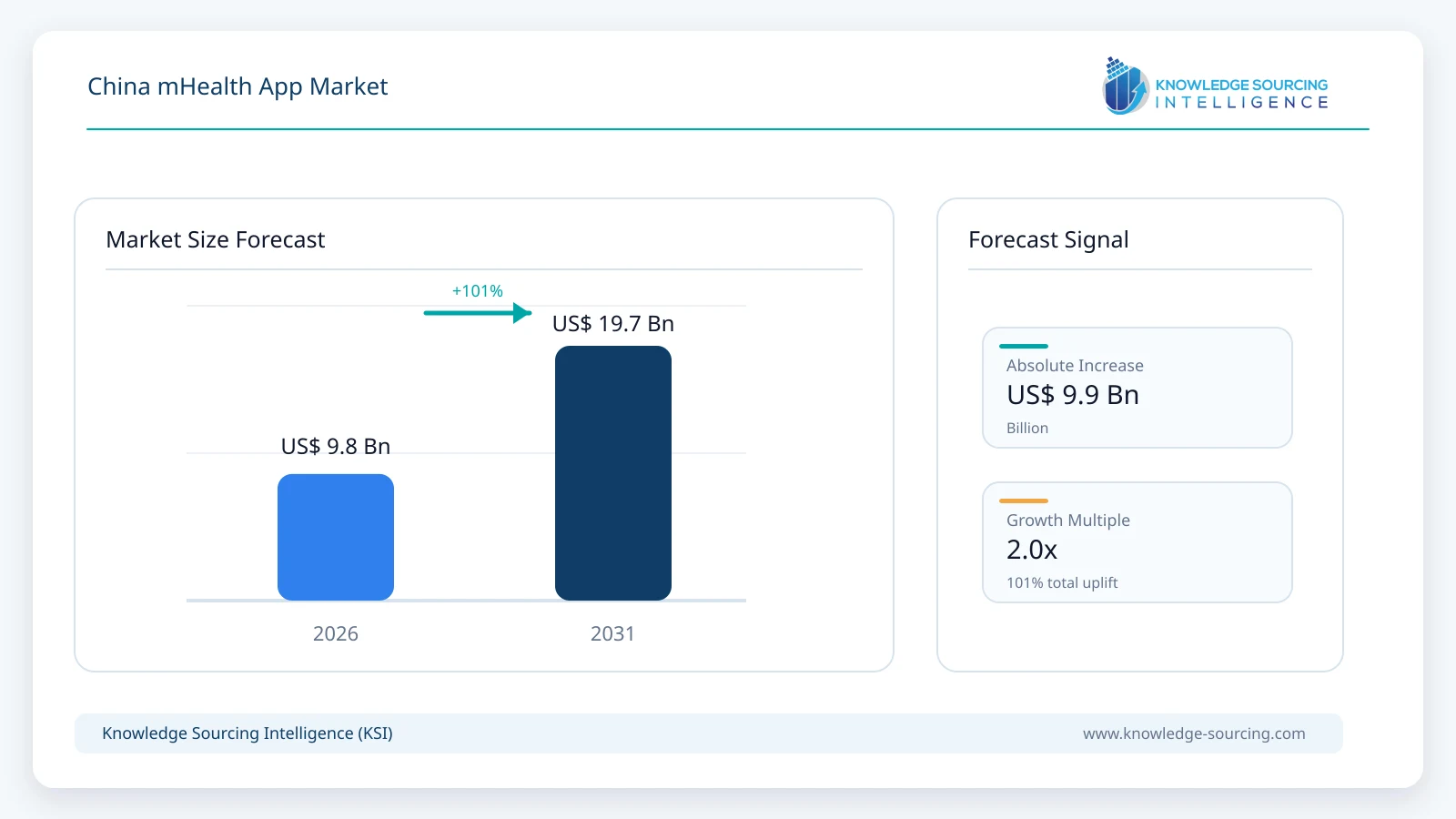
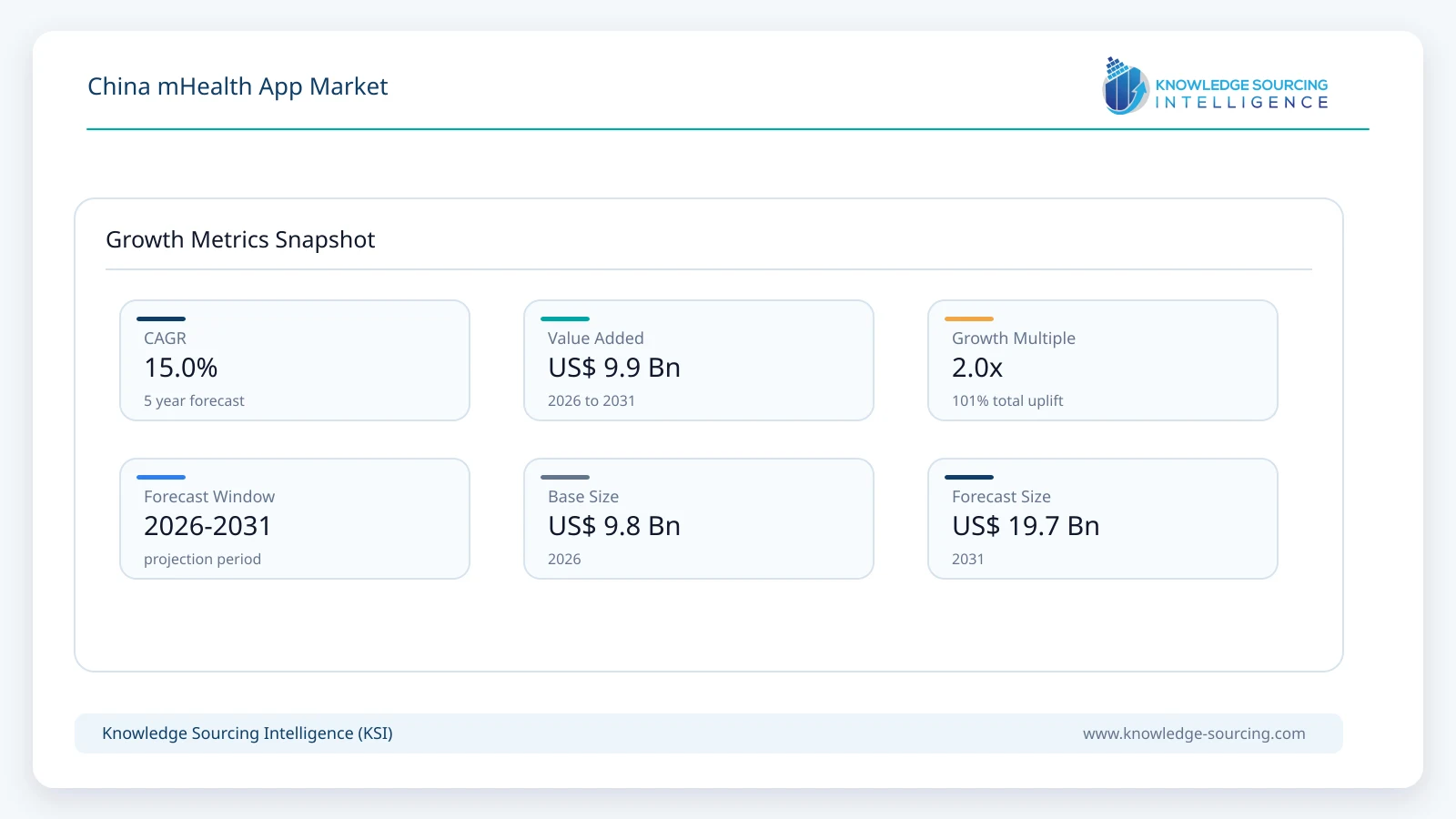
The China mHealth app market is expected to grow at a CAGR of 15.0%, rising from USD 9.80 billion in 2026 to USD 19.72 billion in 2031.
Highlights:
- 1Consultation and care-navigation apps account for approximately 34% of China mHealth app revenue in 2026.
- 2Chronic-disease management applications are projected to grow at approximately 17.8% annually through 2031.
- 3Consumer-facing applications generate about USD 6.37 billion of market value in 2026.
- 4Eastern and coastal China account for approximately 58% of market revenue in 2026.
- 5Internet medical-service users reached 411 million in 2025, equivalent to 36.5% of China's internet population.
- 6AI-assisted triage, family-doctor services and insurance-linked health management are becoming core platform functions.
Market Overview
mHealth apps in China sit within a broader digital-health ecosystem that includes internet hospitals, e-pharmacies, insurers, public medical-insurance platforms, hospitals and technology companies. Mobile applications are commonly used to book appointments, conduct online consultations, receive prescriptions, access test results, manage chronic conditions, communicate with family doctors, and use insurance or payment services. The largest platforms increasingly combine these functions rather than operating as single-purpose apps.
The user base is already large. The National Data Administration reported that internet medical services reached 411 million users in 2025, while China's national medical-insurance platform had 660 million verified users and more than 1.25 billion people had activated the medical-insurance code by the end of 2025. Nationwide internet hospitals were handling more than 100 million visits annually by 2025. These public and commercial systems are complementary: government platforms provide identity, reimbursement and administrative infrastructure, while commercial mHealth apps add consultation, pharmacy, disease-management, employer and insurance-linked services.
Commercial revenue models vary. Platforms can charge consultation fees, membership fees, software or platform-service fees, enterprise-health-management fees, advertising or lead-generation fees, and commissions associated with healthcare transactions. Pharmaceutical sales are excluded from this market where the platform acts primarily as a retailer because those transactions represent product value rather than mHealth application revenue. This prevents companies such as JD Health and Alibaba Health from being counted at their full reported corporate revenue when much of that revenue comes from medicine and health-product commerce.
Market Trends
AI Is Moving From Symptom Checking to Embedded Care Workflow
Artificial intelligence is being integrated into consultation, triage, and disease-management workflows rather than remaining a standalone chatbot function. Ping An reported nearly 12 million annual AI Doctor users in 2025 and more than 9.7 million users in the first half of 2026. The company uses AI across prevention, diagnosis, treatment, and rehabilitation and combines automated services with human doctors. Similar functions are appearing across hospital apps and internet-health platforms, including intelligent pre-consultation, report interpretation, medication reminders, and follow-up. This reduces the marginal cost of handling routine interactions while increasing the volume of users that can be supported by a platform.
Insurance and Healthcare Apps Are Becoming More Closely Integrated
Medical-insurance digitization is increasing the utility of health apps. China's national medical-insurance information platform supports online service applications, electronic insurance codes, cross-provincial settlement, and drug traceability. By the end of 2025, more than 1.25 billion people had activated the medical-insurance code, and 660 million users were registered on the integrated medical-insurance service platform. Commercial insurers are also embedding health services into their customer apps. Ping An's health and senior-care services were used by 18.3 million life-insurance customers in 2025, linking insurance coverage, family-doctor access and care navigation in a single ecosystem.
Platforms Are Shifting Toward Disease Management and Recurring Membership
The market is moving away from one-time online consultations toward recurring health-management relationships. Chronic conditions such as diabetes, hypertension, cardiovascular disease, and respiratory disorders require repeated monitoring, medication support, and follow-up, making them better suited to subscription or membership models. Ping An Family Doctor exceeded 14 million members in 2024, with members using the service an average of five times during the year. JD Health has also emphasized integrated consultation, pharmaceutical, and service pathways, indicating that large platforms increasingly view longitudinal patient management as more valuable than isolated consultations.
Market Drivers
Large Mobile-Internet Penetration Supports Nationwide Digital Health Access
China had 1.125 billion internet users at the end of 2025, including 1.121 billion mobile internet users, according to the National Bureau of Statistics. The country also had 1.204 billion 5G mobile-phone subscribers and 4.84 million 5G base stations. This infrastructure lowers the distribution barrier for healthcare apps and allows video consultation, remote monitoring, and digital records to reach users outside large metropolitan hospitals. The addressable market is particularly large because mobile penetration is no longer concentrated only in higher-income urban consumers.
Healthcare System Digitization Is Normalizing App-Based Access
Digital access is becoming part of mainstream healthcare delivery rather than a parallel consumer service. China's primary-level healthcare institutions handled 5.56 billion patient visits in 2025, while local governments continue to develop remote-diagnosis platforms and family-doctor apps. A National Health Commission example published in 2026 described a county platform using a family-doctor app for contracting, follow-up, and health management alongside AI diagnostic assistance. As hospital and primary-care workflows become digitized, consumers increasingly expect appointment booking, consultation, insurance, and follow-up functions to be accessible through mobile interfaces.
Market Restraint
Regulation, Data Protection and Monetization Limits Constrain Platform Economics
Healthcare apps handle sensitive medical and personal data and operate within a regulated medical-services environment. Platforms must comply with China's Personal Information Protection Law, Data Security Law, Cybersecurity Law, and sector-specific rules governing internet diagnosis and prescription activity. Clinical functions generally require licensed medical institutions and qualified physicians, limiting the ability of ordinary consumer apps to expand directly into diagnosis and treatment. Monetization is also constrained because many users expect basic appointment, insurance, and public-health functions to be free, while reimbursement and pricing rules limit what can be charged for some services. As a result, user scale does not translate directly into revenue, and platforms rely on memberships, enterprise contracts, insurance partnerships or adjacent healthcare transactions to improve economics.
Segment Analysis
By Application - Consultation and Care Navigation
Consultation and care-navigation apps remain the largest application category because they are the entry point for many digital-health journeys. Functions include appointment booking, symptom triage, online physician consultation, prescription support, referral, and follow-up. Ping An Good Doctor, JD Health, and hospital-owned apps all participate in this area. The category is gradually becoming more integrated with pharmacy, insurance, and chronic-care services, reducing the distinction between consultation apps and broader health-management platforms.
By Application - Chronic Disease Management
Chronic-disease applications are expanding faster as platforms move toward longitudinal patient relationships. These apps combine monitoring, medication reminders, physician follow-up, health education and, increasingly, connected devices. Growth is supported by the high burden of hypertension, diabetes, and cardiovascular disease and by government efforts to strengthen primary-level care. Disease-management services also provide a clearer recurring revenue model than occasional consultation because patients require repeated interactions over months or years.
By User Type - Consumer Applications
Consumer-facing applications remain the largest revenue pool because China has hundreds of millions of internet-health users and a large base of mobile-insurance and hospital-app users. Consumer apps cover consultations, pharmacy access, wellness, medical records, insurance claims, and disease management. Enterprise and institutional applications are smaller in user count but are growing through employer health programs, insurer partnerships, and hospital digitalization projects. These business-to-business channels can produce more predictable contract revenue than purely consumer traffic.
By Region - Eastern and Coastal China
Eastern and coastal provinces remain the largest market because they combine high smartphone penetration, stronger household purchasing power, dense hospital networks and headquarters of major digital-health companies. Beijing, Shanghai, Guangdong, Zhejiang and Jiangsu are important adoption centers for commercial internet-health services. Growth is increasingly spreading inland as 5G infrastructure, medical-insurance digitization and county-level remote-care programs improve access, but monetization remains higher in large urban markets.
Competitive Environment
Competition is divided among large healthcare platforms, insurer-linked ecosystems, hospital apps and technology companies. JD Health has one of the largest consumer-health user bases, reporting 217.7 million annual active users in 2025, although its corporate revenue includes substantial pharmaceutical and health-product sales that fall outside the mHealth app definition used here. Ping An Health competes through family-doctor membership, online consultation and integration with Ping An's insurance customers. Alibaba Health operates a broad digital-health and pharmaceutical platform, while WeDoctor, Haodf.com, Chunyu Doctor and other specialists compete in consultation, referral and physician-access services.
Differentiation is moving toward integrated care pathways, AI capability and access to medical resources. Platforms with insurer relationships can combine payment and health-management services, while large e-commerce companies can connect consultation with medicine fulfillment. Hospital apps retain advantages in appointment booking and access to specific medical institutions. Independent platforms must therefore compete through specialist networks, user experience, chronic-care programs or enterprise contracts rather than relying only on basic online consultation.
Recent Developments
August 2026: Ping An reported that its AI Doctor had served more than 9.7 million users in the first half of 2026, while Ping An Good Doctor generated RMB 2.484 billion in first-half revenue.
July 2026: The National Healthcare Security Administration reported more than 1.25 billion medical-insurance code activations and 660 million verified users of the national integrated insurance-service platform by the end of 2025.
April 2026: The China Internet Network Information Center (CNNIC) reported 411 million internet-medical users in 2025, representing 36.5% of the country's internet population.
March 2026: JD Health reported 217.7 million annual active users for 2025 and continued expanding its integrated consultation, pharmaceutical and health-service model.
March 2026: China's National Health Commission highlighted county-level medical community digital reforms and AI-empowered primary-care platforms as part of its ongoing expansion of digital healthcare services under the nation's 15th Five-Year Plan (2026–2030).
China mHealth App Market Scope:
| Report Metric | Details |
|---|---|
| Total Market Size in 2026 | USD 9.80 billion |
| Total Market Size in 2031 | USD 19.72 billion |
| Forecast Unit | Billion |
| Growth Rate | 15.0% |
| Study Period | 2021 to 2031 |
| Historical Data | 2021 to 2024 |
| Base Year | 2025 |
| Forecast Period | 2026 – 2031 |
| Segmentation | Application, User Type, Business Model, Region |
| Companies |
|
| Customization Scope | 15% Free Customization included with purchase — Request Custom Breakdown → |
| Sample & Data Access | PDF Sample, Excel Databook & Analyst Briefing — Download Free Sample → |
Market Segmentation
By Application
Consultation and Care Navigation
Chronic Disease Management
Medication and Pharmacy Support
Fitness and Wellness
Women's Health and Other Applications
By User Type
Consumers
Healthcare Providers
Insurers and Employers
Other Institutional Users
By Business Model
Subscription and Membership
Transaction and Consultation Fees
Enterprise and Platform Services
Advertising and Other Models
By Region
Eastern and Coastal China
Central China
Western China
Northeast China
Table of Contents
1. EXECUTIVE SUMMARY
2. MARKET SNAPSHOT
2.1. Market Overview
2.2. Market Definition
2.3. Market Segmentation
3. BUSINESS LANDSCAPE
3.1. Market Drivers
3.1.1. Large Mobile-Internet Penetration Supports Nationwide Digital Health Access
3.1.2. Healthcare System Digitization Is Normalizing App-Based Access
3.2. Market Restraint
3.2.1. Regulation, Data Protection and Monetization Limits Constrain Platform Economics
3.3. Market Opportunities
3.4. Porter's Five Forces Analysis
3.5. Industry Value Chain Analysis
3.6. Policies and Regulations
3.7. Strategic Recommendations
4. TECHNOLOGICAL OUTLOOK
4.1. AI-Assisted Triage and Consultation
4.2. Remote Patient Monitoring
4.3. Digital Therapeutics and Disease Management
4.4. Medical-Insurance and Identity Integration
5. CHINA MHEALTH APP MARKET BY APPLICATION
5.1. Introduction
5.2. Consultation and Care Navigation
5.3. Chronic Disease Management
5.4. Medication and Pharmacy Support
5.5. Fitness and Wellness
5.6. Women's Health and Other Applications
6. CHINA MHEALTH APP MARKET BY USER TYPE
6.1. Introduction
6.2. Consumers
6.3. Healthcare Providers
6.4. Insurers and Employers
6.5. Other Institutional Users
7. CHINA MHEALTH APP MARKET BY BUSINESS MODEL
7.1. Introduction
7.2. Subscription and Membership
7.3. Transaction and Consultation Fees
7.4. Enterprise and Platform Services
7.5. Advertising and Other Models
8. CHINA MHEALTH APP MARKET BY REGION
8.1. Introduction
8.2. Eastern and Coastal China
8.3. Central China
8.4. Western China
8.5. Northeast China
9. COMPETITIVE ENVIRONMENT AND ANALYSIS
9.1. Major Players and Strategy Analysis
9.2. Market Share Analysis
9.3. Mergers, Acquisitions, Agreements and Collaborations
9.4. Competitive Dashboard
10. COMPANY PROFILES
10.1. JD Health International Inc.
10.2. Ping An Healthcare and Technology Company Limited (Ping An Good Doctor)
10.3. Alibaba Health Information Technology Limited
10.4. WeDoctor Holdings
10.5. Beijing Haodf Online Hospital (Haodf.com)
10.6. Chunyu Doctor
10.7. Tencent Healthcare
10.8. Baidu Health
10.9. Medlinker
10.10. 111, Inc.
10.11. DXY (Dingxiangyuan)
10.12. Miaoshou Doctor
10.13. Wecare Health
10.14. Yidu Tech Inc.
10.15. ClouDr Group Limited
11. APPENDIX
11.1. Currency
11.2. Assumptions
11.3. Base and Forecast Years Timeline
11.4. Key Benefits for Stakeholders
11.5. Research Methodology
11.6. Abbreviations





Frequently asked questions
What is the projected growth rate for China's mHealth app market?
The China mHealth App Market is projected to grow at a 15.0% CAGR through 2031.
What was the market value of China's mHealth apps in 2026?
China's mHealth app market was valued at USD 9.80 billion in 2026.
Which mHealth app segment generated the most revenue in China in 2026?
Consultation and care-navigation apps accounted for 34% of revenue in 2026.
Which mHealth app segment is projected for the fastest growth?
Chronic-disease management apps project 17.8% annual growth.
Which regions contribute most to China's mHealth app market revenue?
Eastern and coastal China account for 58% of market revenue in 2026.
What are the new core functions for mHealth platforms in China?
AI-assisted triage, family-doctor services, and insurance-linked health management are core.
Cite this report
Knowledge Sourcing Intelligence. (Sep 2026). China mHealth App Market - Strategic Insights and Forecasts (2025-2030). https://www.knowledge-sourcing.com/report/china-mhealth-app-market