
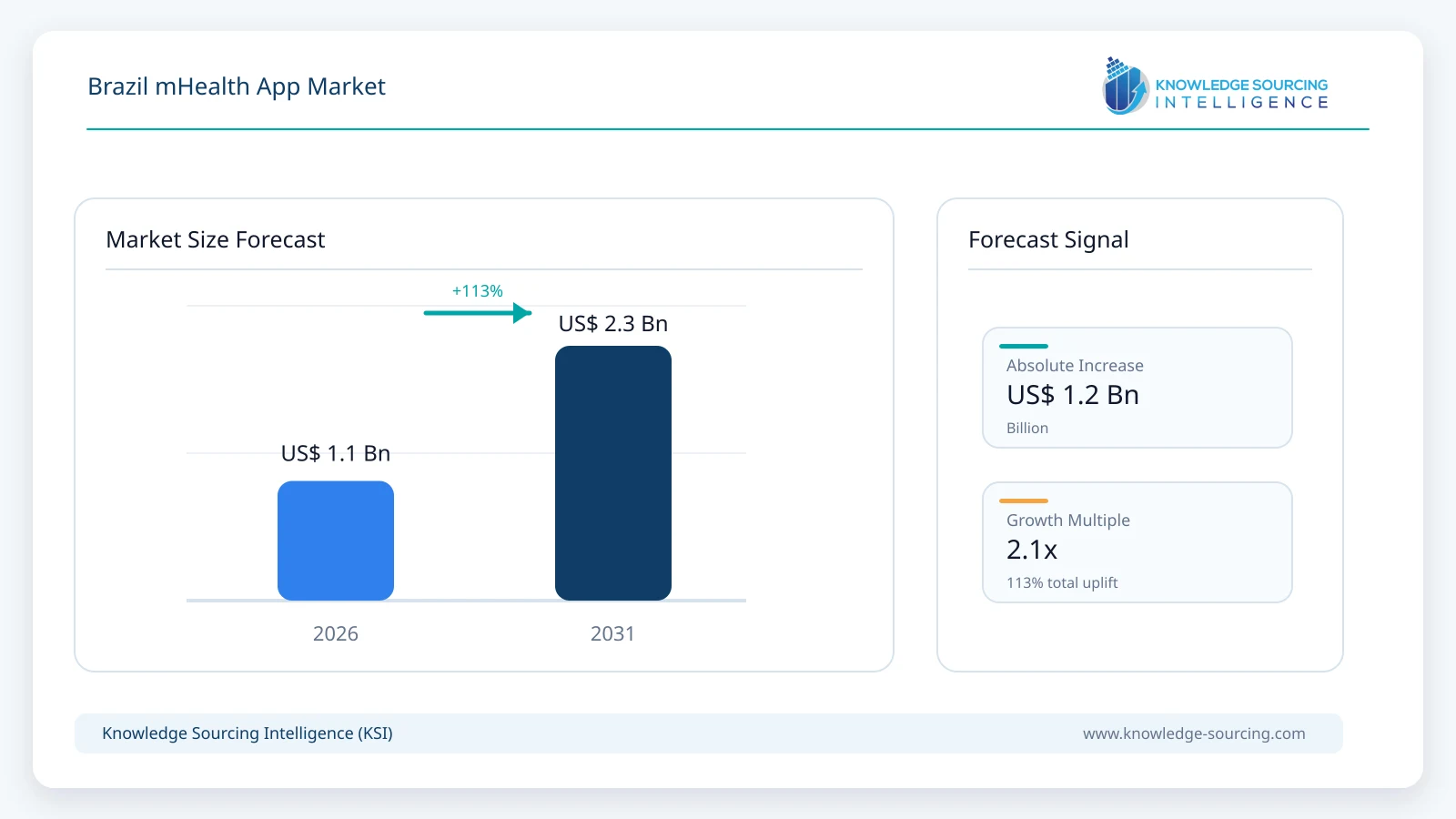
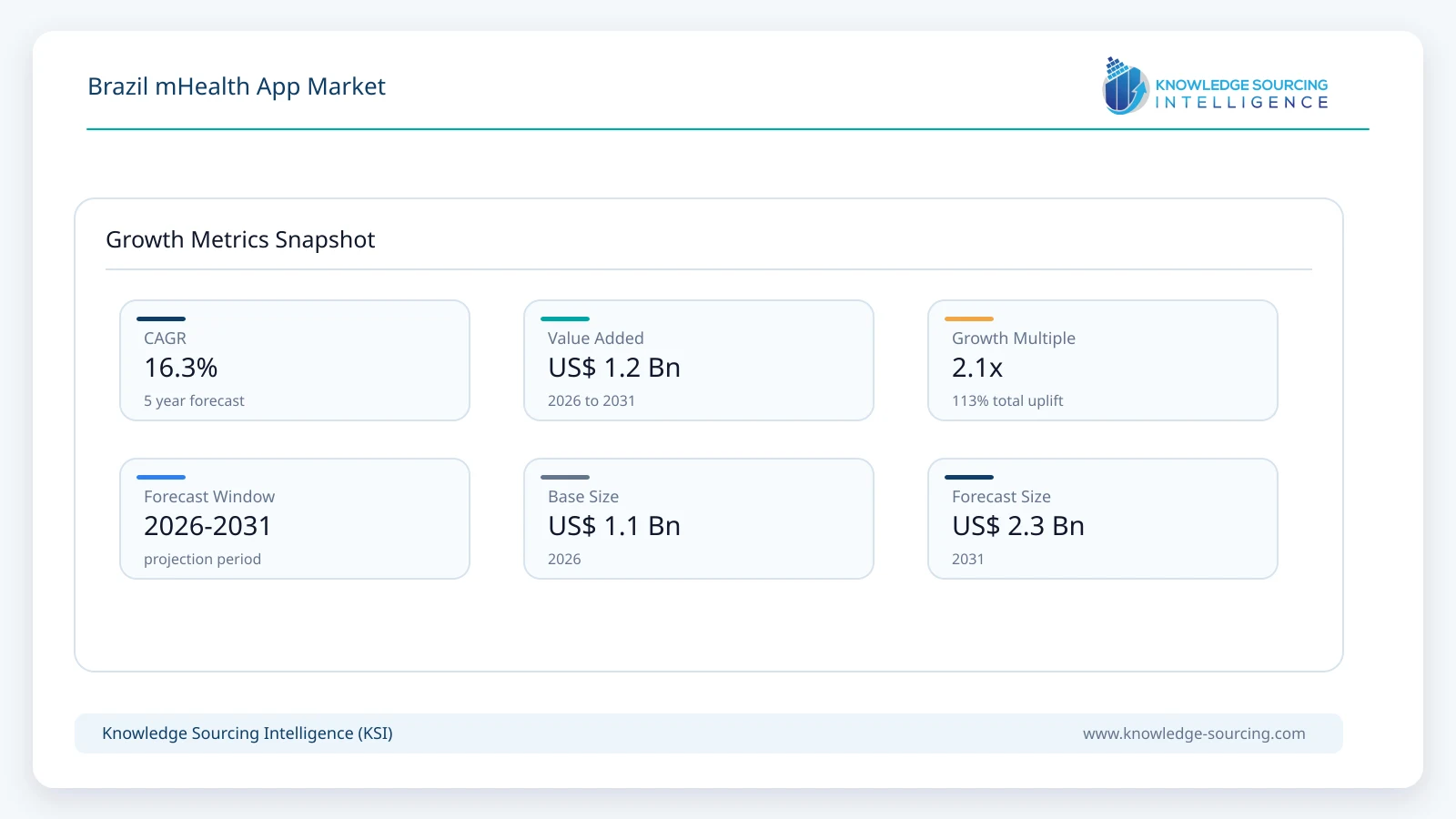
The Brazil mHealth App Market is forecast to grow at a CAGR of approximately 16.3%, increasing from USD 1.08 billion in 2026 to USD 2.30 billion by 2031.
Highlights:
- 1Chronic-care management applications account for approximately 29% of 2026 market revenue.
- 2Remote monitoring and consultation services represent approximately 42% of 2026 market value.
- 3Glucose-monitoring-linked applications form the largest wearable-device-linked category in 2026.
- 4Brazil had 168.7 million internet users aged 10 years or older in 2025.
- 5Private medical plans covered about 53.1 million beneficiaries by mid-2026.
- 6Meu SUS Digital is expanding from health-record access into scheduling, screening and telehealth.
Mobile health in Brazil now spans both consumer wellness and clinically connected care. The commercial market includes applications used for chronic-care management, women's health, weight management, medication support, personal health records, virtual consultation, remote monitoring and connected-device data. Fitness and wellbeing platforms are also increasingly sold through employers and health-benefit programs rather than only through direct consumer subscriptions. Brazil's connectivity base materially lowers distribution barriers: the Brazilian Institute of Geography and Statistics reported that 90.5% of people aged 10 years or older used the internet in 2025, while 89.8% owned a personal mobile phone. At household level, internet access reached 95.0% and mobile-phone ownership reached 97.4%.
Public digital health infrastructure is creating an additional adoption layer. Meu SUS Digital provides access to vaccination records, medicines, examinations, appointments and other health information, while integration with the Rede Nacional de Dados em Saúde (RNDS) supports standardized data exchange. During 2026, the Ministry of Health expanded online scheduling integration, added mini-apps for mental-health and prevention services, and used mobile notifications to connect users with public-health programs. This does not turn every public digital interaction into commercial app revenue, but it normalizes mobile healthcare use and encourages private providers, insurers, employers and device companies to build services around the same expectations of digital access and continuity.
The private market provides a second growth engine. Brazil had more than 53 million beneficiaries in private medical plans by mid-2026, creating a large population for insurer and employer-sponsored mobile care. Conexa reported 38 million people covered by its platform in 2026 and highlighted millions of virtual consultations, while Wellhub continued to expand app-based fitness, therapy, nutrition, sleep and wellness benefits across major employers. These models reduce dependence on one-time consumer app purchases because revenue can be embedded in health-plan contracts, corporate benefits, subscriptions and connected-device ecosystems.
Selected Segment Estimates
Dimension | Selected Subsegment | 2026 Indicator | Forecast Interpretation |
Application | Chronic-care management | ~29% share | Diabetes, cardiovascular risk and long-term condition management support recurring app engagement. |
Wearable device linkage | Glucose meters / CGM | ~26% share | Connected glucose data creates frequent app interaction and stronger clinical utility than passive tracking. |
Services | Remote monitoring and consultation | ~42% share | Teleconsultation and longitudinal monitoring increasingly sit inside insurer, employer and provider workflows. |
Market Dynamics
Smartphone and Internet Reach Support Broad Mobile Health Access
Brazil's digital access is no longer limited to metropolitan or high-income users. Internet usage exceeded 90% of the population aged 10 years or older in 2025, and personal mobile-phone ownership reached almost 90% across the same population. The reduction in the urban-rural internet gap also expands the addressable market for services that can complement physical care in remote areas. For mHealth providers, the opportunity is increasingly less about persuading consumers to adopt smartphones and more about offering trusted services that justify repeated use, integrate with clinical workflows and function reliably across different connectivity conditions.
Telehealth and Public Digital Services Expand the Role of the Health App
Mobile healthcare in Brazil is moving beyond passive information access. The Ministry of Health has integrated online appointment scheduling with Meu SUS Digital where municipalities support the function, introduced mental-health mini-apps and expanded telehealth services through the same mobile entry point. In August 2026, separate initiatives offered capacity for up to 100,000 monthly tele-mental-health appointments for people affected by gambling-related problems and another 100,000 monthly appointments for women in specific high-need groups. This evolution strengthens user expectations that a health app should connect directly to care rather than only display content.
Connected Devices and Chronic-Care Workflows Increase Clinical App Value
Applications linked to glucose monitors, blood-pressure devices, cardiac monitoring, fitness wearables and medication workflows have stronger retention potential because they receive repeated data rather than depending entirely on manual user input. Brazil's expanding continuous glucose monitoring and remote-care ecosystem illustrates the commercial direction: mobile applications increasingly act as the interface connecting patient-generated data with clinicians, caregivers and health-plan programs. Chronic-care applications are therefore positioned to grow faster than generic health-information apps, particularly when reimbursement, employer sponsorship or device subscriptions reduce direct consumer payment friction.
Market Restraints
Engagement and Willingness to Pay Remain Uneven
High download volumes do not automatically translate into durable revenue. Fitness, nutrition, medication and symptom-tracking apps face intense competition from free alternatives and operating-system health platforms. Consumer engagement often falls after the first weeks of use unless the application is linked to a care program, employer benefit, connected device or recurring clinical need. Providers increasingly need to demonstrate measurable outcomes such as appointment conversion, reduced avoidable utilization, medication adherence or health-plan cost savings rather than relying on app-store visibility alone.
Privacy, Clinical Validation and Integration Increase Development Complexity
Health applications handle sensitive personal information and therefore operate under Brazil's General Data Protection Law and sector-specific healthcare requirements. Applications that move from general wellness into diagnostic or medical-device functions can also face additional regulatory expectations. Integration with providers, insurers and the RNDS ecosystem requires secure identity, interoperability and consent management. These requirements favor scaled platforms and specialized clinical applications but increase development and compliance costs for smaller entrants.
Segment Analysis
By Application - Chronic-Care Management
Chronic-care management is the largest application segment, accounting for approximately 29% of Brazil mHealth app revenue in 2026. The category covers digital programs that support diabetes, hypertension, cardiovascular risk, obesity and other long-term conditions through monitoring, coaching, medication reminders and clinician communication. Its commercial importance reflects recurring use: unlike episodic symptom-checking applications, chronic-care platforms can remain active for months or years and are increasingly purchased by employers, health plans and provider networks. Connected glucose monitoring is particularly important because frequent sensor data makes the app central to day-to-day disease management.
By Wearable Device - Glucose Monitoring
Applications connected to glucose meters and continuous glucose monitoring systems form the largest wearable-device-linked segment in 2026. Brazil has a substantial diabetes population and growing access to sensor-based monitoring, supporting apps that display glucose trends, alerts, treatment data and shareable reports. The app layer also increases the value of the underlying device by connecting data with caregivers and healthcare professionals. Cardiac and blood-pressure monitoring applications remain important secondary categories, while body-temperature, respiratory and neurological monitoring are more specialized.
By Service - Remote Monitoring and Consultation
Remote monitoring and consultation services account for approximately 42% of 2026 market revenue. This category has expanded beyond stand-alone video visits into integrated virtual primary care, mental health, specialist access and follow-up. Conexa reported that its platform reached 38 million people covered in Brazil in 2026, demonstrating the scale that business-to-business health-plan and employer distribution can achieve. Public-sector telehealth expansion through Meu SUS Digital reinforces the same behavior pattern, while private platforms compete on availability, clinical network depth, response time, continuity and integration with benefits or medical records.
Market and Demand Indicators
Indicator | Latest Development | Market Impact |
Internet access | 168.7 million Brazilians aged 10+ used the internet in 2025. | Creates a broad digital-health addressable base beyond major metropolitan areas. |
Mobile ownership | 167.4 million people aged 10+ had a personal mobile phone in 2025. | Supports direct delivery of consultation, monitoring, wellness and health-record services. |
Private health plans | About 53.1 million medical-plan beneficiaries in mid-2026. | Provides a large B2B2C channel for insurer-funded digital care and engagement. |
Public mobile health | Meu SUS Digital added scheduling, screening and telehealth-linked mini-apps in 2026. | Normalizes app-based access to healthcare and raises expectations for integrated digital journeys. |
Virtual-care scale | Conexa reported 38 million covered users in Brazil in 2026. | Shows that enterprise distribution can reach national scale without relying on app-store monetization. |
Corporate wellness | Wellhub surpassed 5 million subscribers globally and expanded major Brazilian employer programs. | Strengthens subscription-based fitness, mental health, nutrition and wellbeing app usage. |
Competitive Landscape
Brazil's mHealth app market combines public digital-health infrastructure, local telehealth platforms, corporate wellness ecosystems, health-system apps and global connected-device platforms. Conexa is one of the most scaled Brazilian virtual-care providers, while Doctoralia/Docplanner links appointment discovery, scheduling and telemedicine. Dasa, Alice, Afya and other healthcare groups use mobile interfaces to extend care beyond the physical clinic. Wellhub operates from a different entry point, using employer-sponsored access to aggregate fitness, mental health, nutrition, sleep and other wellness applications. Meu SUS Digital is not a commercial competitor in the conventional sense, but its scale and expanding functionality influence user expectations throughout the market.
Global technology and medical-device companies remain important because health applications increasingly sit inside device ecosystems. Apple, Google/Fitbit and Samsung provide operating-system and wearable-health platforms, while Abbott, Medtronic and Omron link mobile software with disease-management devices. Commercial advantage is moving toward ecosystems that combine trusted data, clinical connectivity and recurring services. Stand-alone applications can still succeed in focused categories such as women's health, nutrition or mental health, but they face higher acquisition and retention costs when they lack employer, insurer, provider or device distribution.
Recent Developments
August 2026: Brazil approved the National Policy on Information and Digital Health, emphasizing data integration, telehealth and more efficient access across the SUS.
August 2026: Meu SUS Digital added the Modera Brasil mini-app for alcohol-risk self-assessment and personalized prevention guidance.
August 2026: The Ministry of Health expanded app-accessible mental-health telecare capacity to up to 100,000 monthly appointments for gambling-related needs.
August 2026: A separate Meu SUS Digital mental-health service began offering up to 100,000 monthly teleappointments for women in priority groups.
July 2026: The Pode Falar youth mental-health service was integrated into Meu SUS Digital, with expected capacity increasing to about 11,000 interactions per month.
July 2026: Conexa reported reaching 38 million people covered in Brazil through its digital-health platform.
June 2026: Wellhub partnered with Erakulis on an app-based wellbeing initiative and continued expanding its integrated digital wellness ecosystem.
Brazil mHealth App Market Scope
| Report Metric | Details |
|---|---|
| Total Market Size in 2026 | USD 1.08 billion |
| Total Market Size in 2031 | USD 2.30 billion |
| Forecast Unit | Billion |
| Growth Rate | 16.3% |
| Study Period | 2021 to 2031 |
| Historical Data | 2021 to 2024 |
| Base Year | 2025 |
| Forecast Period | 2026 – 2031 |
| Segmentation | Wearable Device, Services, Application |
| Companies |
|
Market Segmentation
By Wearable Device
Glucose Meter
Cardiac Monitors
Neurological Monitors
Blood Pressure Monitor
Respiratory Monitors
Body and Temperature Monitors
By Services
Fitness and Wellness
Remote Monitoring and Consultation
Prevention
By Application
Women's Health
Weight Loss
Chronic-Care Management
Health and Fitness
Medication
Personal Health Records
Table of Contents
1. EXECUTIVE SUMMARY
2. MARKET SNAPSHOT
2.1. Market Overview
2.2. Market Segmentation
3. BUSINESS LANDSCAPE
3.1. Market Drivers
3.1.1. Smartphone and Internet Reach Support Broad Mobile Health Access
3.1.2. Telehealth and Public Digital Services Expand the Role of the Health App
3.1.3. Connected Devices and Chronic-Care Workflows Increase Clinical App Value
3.2. Market Restraints
3.2.1. Engagement and Willingness to Pay Remain Uneven
3.2.2. Privacy, Clinical Validation and Integration Increase Development Complexity
3.3. Market Opportunities
3.4. Porter's Five Forces Analysis
3.5. Industry Value Chain Analysis
3.6. Policies and Regulations
4. TECHNOLOGICAL OUTLOOK
4.1. AI-Assisted Coaching and Triage
4.2. Connected Wearables and Continuous Monitoring
4.3. EHR and RNDS Interoperability
4.4. Digital Therapeutics and Behavioral Health
4.5. Secure Identity, Consent and Health Data Exchange
5. BRAZIL MHEALTH APP MARKET BY WEARABLE DEVICE
5.1. Glucose Meter
5.2. Cardiac Monitors
5.3. Neurological Monitors
5.4. Blood Pressure Monitor
5.5. Respiratory Monitors
5.6. Body and Temperature Monitors
6. BRAZIL MHEALTH APP MARKET BY SERVICES
6.1. Fitness and Wellness
6.2. Remote Monitoring and Consultation
6.3. Prevention
7. BRAZIL MHEALTH APP MARKET BY APPLICATION
7.1. Women's Health
7.2. Weight Loss
7.3. Chronic-Care Management
7.4. Health and Fitness
7.5. Medication
7.6. Personal Health Records
8. COMPETITIVE ENVIRONMENT AND ANALYSIS
8.1. Major Players and Strategy Analysis
8.2. Market Share Analysis
8.3. Mergers, Acquisitions, Agreements and Collaborations
8.4. Competitive Dashboard
9. COMPANY PROFILES
9.1. Conexa Saúde
9.2. Doctoralia
9.3. Wellhub
9.4. Dasa
9.5. Alice
9.6. Afya
9.7. dr.consulta
9.8. Grupo Fleury
9.9. Apple Inc.
9.10. Google
9.11. Samsung Electronics
9.12. Abbott Laboratories
9.13. Medtronic plc
9.14. Omron Healthcare
9.15. Teladoc Health
9.16. Flo Health
9.17. MyFitnessPal
9.18. Strava
10. RECENT DEVELOPMENTS
11. APPENDIX
11.1. Currency
11.2. Assumptions
11.3. Base and Forecast Years Timeline
11.4. Research Methodology
11.5. Abbreviations
Navigate
Trusted by the world's leading organizations











