
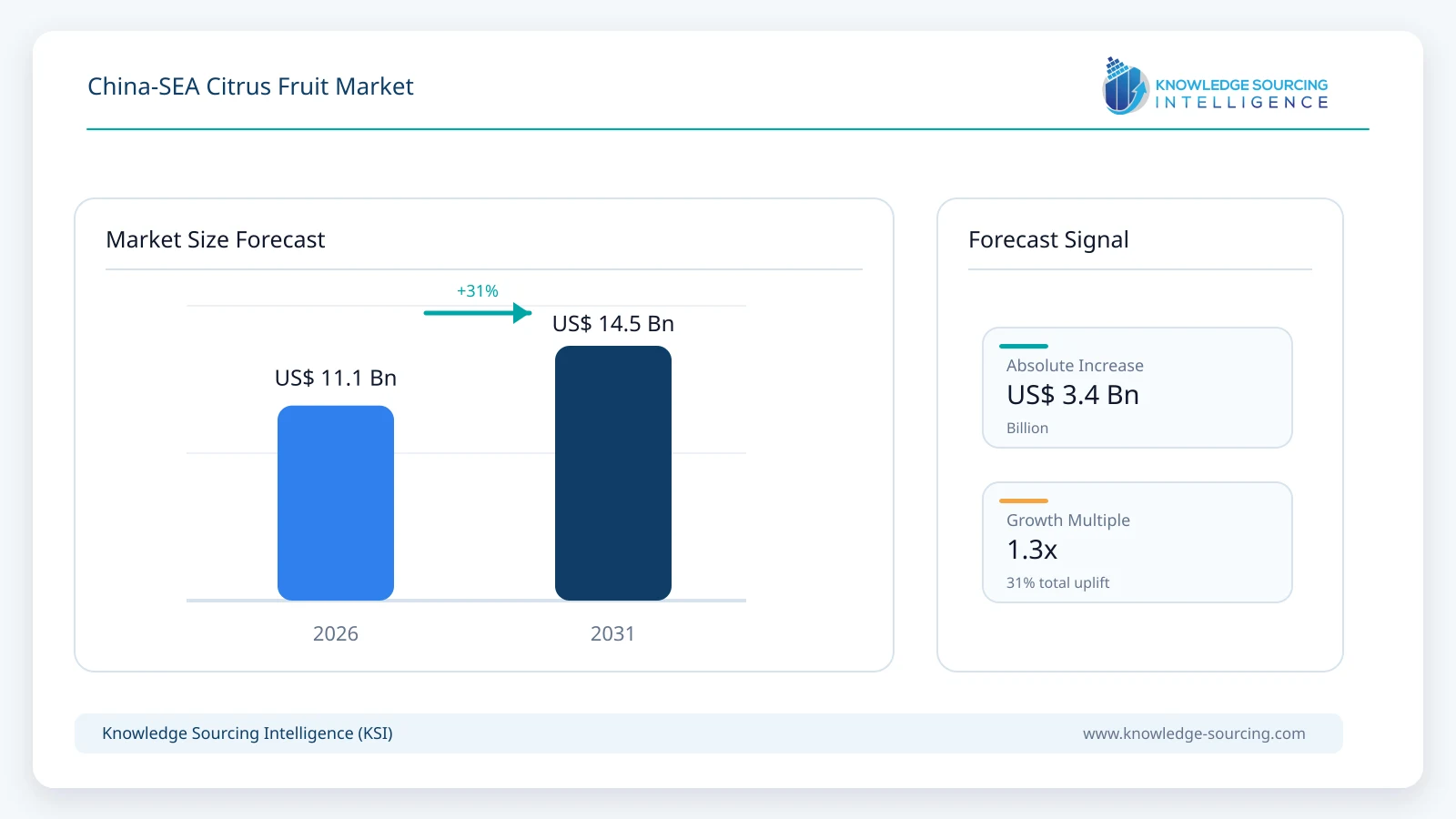
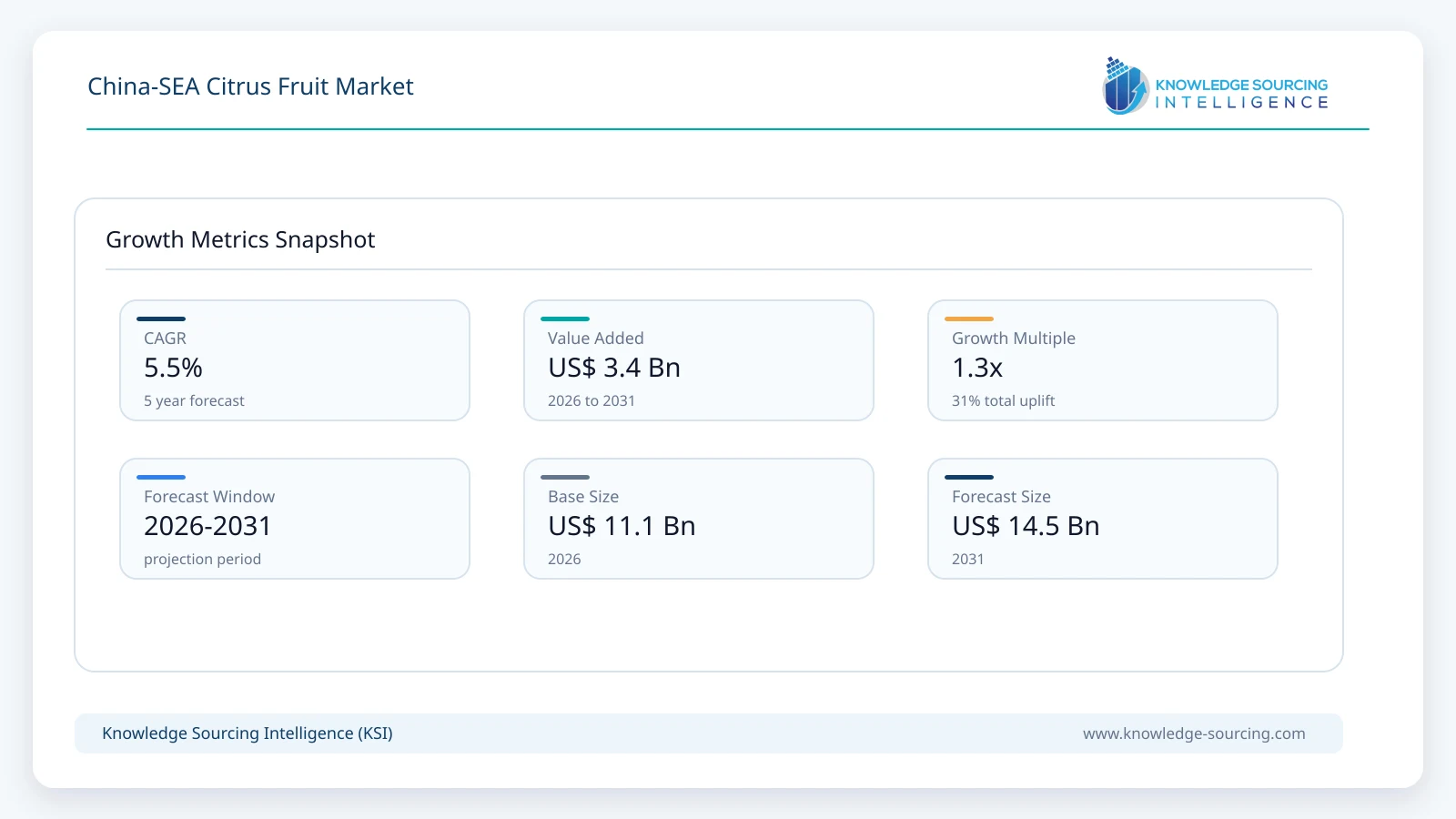
The China-SEA Citrus Fruit Market is projected to expand at a compound annual growth rate (CAGR) of 5.5%, rising from USD 11.1 billion in 2026 to USD 14.5 billion by 2031.
Highlights:
- 1Mandarins remain the largest fruit category by value, supported by China's 27.1 million metric ton MY2025/26 production base and more than 25 million metric tons of fresh domestic consumption.
- 2Fresh Consumption represents roughly three-quarters of regional market value in 2026, while Juice Processing and Processed Foods and Ingredients grow faster from smaller bases.
- 3Conventional production remains overwhelmingly dominant, while Organic citrus develops as a premium niche rather than the principal commercial category.
- 4China remains the largest geographic market, while Vietnam records one of the strongest forecast growth rates as formal export access and commercial orchard infrastructure improve.
- 5China's mandarin/tangerine exports are forecast to reach approximately 1.25 million metric tons in MY2025/26, with Vietnam, Indonesia, the Philippines, Thailand and Malaysia among important destinations.
- 6China's imports of pomelos/grapefruit from Laos increased 68.7% in MY2024/25, while Thai shipments increased 14.4%, demonstrating the growing importance of complementary harvest seasons and regional trade.
China remains the commercial centre of the regional market because of its production scale, large domestic fresh-fruit consumption base, extensive wholesale and retail infrastructure, and increasing ability to supply differentiated citrus varieties across longer seasonal windows. Southeast Asian markets add a different growth layer through expanding domestic consumption, improving export-oriented orchard systems and closer agricultural trade with China. The market consequently develops through a combination of volume growth, improvements in commercial fruit quality, formalization of cross-border supply and a gradual shift toward higher-value retail, foodservice and processing channels rather than through production expansion alone.
China's citrus industry provides the strongest physical anchor for the estimate. China's Statistical Yearbook indicates total citrus production of approximately 67.91 million metric tons in 2024, while USDA's MY2025/26 outlook estimates 27.1 million metric tons of mandarins and tangerines, 7.68 million metric tons of oranges and 5.35 million metric tons of pomelos and grapefruit. Fresh consumption remains particularly important: USDA expects approximately 25.26 million metric tons of Chinese mandarins and tangerines, 7.29 million metric tons of oranges and more than 5 million metric tons of pomelos and grapefruit to move through fresh channels during MY2025/26. These volumes support the continued dominance of Fresh Consumption within the market while also demonstrating that the commercial structure cannot be inferred from orange production alone.
The value mix is gradually changing as buyers place greater importance on sweetness, variety, appearance, traceability, packaging and reliable supply. USDA reports that improvements in cultivar structure, standardized orchard management and post-harvest handling have increased the competitiveness of China's Gannan navel oranges, while growers in Hubei, Hunan and other production areas have expanded late-season and differentiated orange varieties. Similar differentiation is visible in pomelos, where premium orchard and retail prices vary substantially according to variety and quality. The result is a market in which commercial value can increase faster than tonnage in selected varieties as premium retail and branded fruit channels become more important.
Cross-border market access is another increasingly important source of growth. China formally permitted imports of qualifying Vietnamese fresh pomelos and limes from April 27, 2026, following the conclusion of a bilateral phytosanitary protocol. Approved orchards and packing facilities must be registered, exporters must implement specified pest-control procedures, and consignments require inspection, traceability and phytosanitary certification. The change adds a formal new trade route between a major Southeast Asian citrus producer and the region's largest consumer market, while simultaneously raising the importance of professional orchard management, packing and compliance infrastructure.
Market Growth Drivers and Trends
China's Production Scale Continues to Anchor Regional Supply and Consumption
China's citrus industry gives the regional market a level of scale that is difficult for individual Southeast Asian countries to replicate. Large orchard areas, established wholesale markets and diversified growing regions allow China to maintain substantial output across mandarins, oranges, pomelos and other citrus categories. USDA expects Chinese mandarin and tangerine production to reach 27.1 million metric tons in MY2025/26, with output increasing modestly in Guangxi, Yunnan and other producing regions following favourable weather. Orange production is forecast at 7.68 million metric tons, while pomelo and grapefruit production reaches approximately 5.35 million metric tons.
The size of this production base supports investment throughout the value chain. Large volumes justify specialized packing, fruit grading, cold storage, wholesale markets and branded distribution, while differentiated growing regions allow retailers to extend citrus selling seasons. Improvements in quality are becoming particularly important because overall production growth is moderate. Greater commercial value therefore increasingly comes from better varieties, post-harvest performance and access to higher-value channels rather than simply increasing planted area.
Formal China-ASEAN Market Access Is Expanding Cross-Border Trade
Regional citrus trade is increasingly influenced by phytosanitary agreements and recognized growing-area and packing-house systems. The April 2026 China-Vietnam protocol for pomelos and limes provides one of the clearest examples. Vietnam has approximately 106,000 hectares of pomelo cultivation, but access to China depends on registered orchards, approved packing facilities, integrated pest management, traceability, and shipment-level certification.
The commercial impact extends beyond Vietnamese pomelos. Once export infrastructure is built around orchard codes, inspection, packaging and traceability, growers and exporters are better positioned to supply other regulated international markets. Vietnam's first fresh pomelo shipment to Australia in April 2026 similarly demonstrated its ability to meet stringent biosecurity and quality requirements.
Regional trade is also benefiting from complementary harvest periods. USDA reports that Laos became China's largest pomelo/grapefruit supplier in MY2024/25, with shipments increasing 68.7% to more than 45,000 metric tons, while Thailand supplied almost 24,000 metric tons. Seasonal differences allow imported fruit to fill gaps in China's domestic production cycle and improve year-round retail availability.
Organized Retail Is Increasing the Value of Quality and Traceability
Modern fruit retailers increasingly purchase according to defined product specifications rather than accepting mixed commercial grades. Size, soluble solids, appearance, pesticide residues, packing, temperature, and supplier reliability can determine access to major retail networks. Pagoda's July 2026 procurement specifications for Sanhong pomelos required defined fruit weights, minimum soluble-solids levels, limits on defects and rot, pesticide-residue and heavy-metal testing, grading equipment, and temperature-controlled storage capability. Refrigerated transportation was recommended, and suppliers were required to demonstrate established relationships with fresh-produce retailers.
These requirements illustrate how modern retail changes the economics of citrus production. Growers able to meet standardized specifications can access higher-value and geographically broader distribution, while suppliers without sorting, testing and cold-chain capabilities remain more exposed to local wholesale pricing. Joy Wing Mau's current operating model also reflects this shift, with sourcing across more than 40 countries and regions and an integrated focus on supply-chain services and omnichannel distribution.
Varietal Differentiation and Premium Fruit Are Increasing Value per Kilogram
The market is moving beyond broad categories such as "orange" or "pomelo" toward more differentiated products based on origin, sweetness, colour and season. USDA notes expansion of late-season and higher-Brix oranges in several Chinese regions and improved competitiveness of Gannan navel oranges following better cultivar structure and orchard management. Premium domestic oranges can command substantially higher retail prices than ordinary wholesale fruit, demonstrating that quality segmentation can materially change market value without requiring equivalent growth in production.
Premium pomelo varieties show a similar pattern. USDA reports a wide range in orchard and wholesale pricing for Chinese pomelos, with high-quality fruit from Guangxi and branded red-flesh products achieving substantial premiums. Retailers such as Pagoda reinforce this differentiation by specifying fruit size, soluble-solids content, appearance and defect thresholds at procurement.
International premium brands are also expanding in the region. SanLucar increased its presence across Hong Kong, Malaysia and Central China during late 2025 and in February 2026 signed a three-year partnership with Dingdong, one of China's largest online fresh-food retail operators.
Processing Is Providing an Additional Outlet for Citrus Supply
Fresh consumption remains the centre of the market, but processing provides an increasingly useful balancing mechanism. USDA expects China's use of domestic oranges for juice to remain elevated in MY2025/26 following shortages of Brazilian frozen orange juice concentrate. Approximately 400,000 metric tons of Chinese oranges are forecast to move into processing during the marketing year, compared with around 230,000 metric tons in USDA's earlier 2024/25 official estimate.
Processing also extends beyond conventional orange juice. Pomelo and grapefruit-derived ingredients are gaining use in beverage outlets and food processing, while citrus peel, oils, extracts and flavour ingredients allow processors to capture value from fruit that may not achieve premium fresh-market specifications.
This creates a more resilient commercial structure. Fresh markets can continue to command the highest value for premium grades, while juice and ingredient processing provide alternative outlets when appearance, size or seasonal oversupply reduce fresh-market realization.
Market Restraints
Weather Variability Can Change Both Yield and Commercial Quality
Citrus is exposed to weather conditions throughout flowering, fruit development and harvest. Excess rainfall, drought, extreme temperatures, and storms can affect fruit size, sweetness, disease pressure, and harvest timing even when total orchard area remains unchanged. USDA's MY2025/26 China outlook illustrates these regional differences: favourable conditions supported production in several southern areas, while Sichuan and Chongqing encountered less favourable weather for oranges.
The commercial impact can therefore be greater than the change in production tonnage because premium retail requires consistent colour, appearance and soluble-solids content. Weather that reduces quality can shift fruit from premium fresh channels into lower-value wholesale or processing outlets.
Pest and Disease Management Raises Orchard Costs
Fresh citrus trade exposes importing countries to fruit flies and other quarantine pests, requiring extensive orchard monitoring and treatment. China's new protocol for Vietnamese pomelos and limes identifies specific quarantine organisms, requires registered orchards and packing houses, and mandates fruit inspection before export. Where specified pests are detected, consignments can be rejected, and relevant orchards or packing facilities can be suspended from the export programme.
These requirements raise production costs but cannot be avoided by exporters seeking formal access to major markets. Integrated pest management, fruit bagging, orchard monitoring and traceability consequently become part of the commercial cost structure rather than optional agricultural practices.
Post-Harvest Losses Continue to Reduce Marketable Output
Citrus can remain saleable for longer than many soft fruits, but bruising, fungal disease, dehydration and poor temperature management still reduce commercial recovery. The challenge is particularly important when fruit travels over long distances from orchards to packing houses, border crossings, wholesale markets and urban retail locations.
Better storage technologies can materially improve economics. Yichang reported in July 2026 that citrus-specific storage environment control reduced loss rates for stored summer navel oranges to around 0.2%, while weight loss after 60 days was only 1%. This allowed off-season sales and contributed to average wholesale price increases of 15–20%.
The performance gap between sophisticated and poorly managed post-harvest systems therefore remains an important market restraint for smaller growers and exporters.
Export Compliance Can Exclude Fragmented Small Producers
Formal export programmes require consistent documentation, approved production areas, registered packing facilities and repeatable quality controls. These requirements favour commercial farms, cooperatives and exporters with sufficient scale to maintain specialized staff and infrastructure.
Vietnam's China-access protocol requires both orchard and packing-house registration and formal pest-management procedures, while Pagoda's domestic Chinese procurement process requires suppliers to possess grading equipment, dedicated quality-control personnel and controlled storage.
Small growers therefore often need to participate through cooperatives, contracted packing houses or larger exporters rather than accessing high-value customers independently. Fragmented production can slow adoption of traceability and standardized grading, particularly in parts of Southeast Asia.
Seasonal Supply Creates Price Volatility
Large citrus harvests are concentrated within defined production windows, creating periods when volumes arrive faster than fresh demand can absorb them. USDA expects average orchard prices for Chinese mandarins to remain slightly below the previous year in MY2025/26 because of increased supply, while some ordinary varieties experienced considerably lower prices despite premium grades maintaining much stronger retail realization.
Price volatility affects growers, distributors and processors differently. Growers face weaker farmgate realization during oversupply, while distributors can face higher costs when weather or logistics tighten availability. Cold storage, multiple sourcing regions and processing capacity reduce these fluctuations but cannot eliminate them entirely.
China-SEA Citrus Fruit Market Segmentation
By Fruit Type
Mandarins represent the largest commercial fruit category, with an estimated market value of approximately USD 4.6 billion in 2026. China's production of mandarins and tangerines alone is forecast at 27.1 million metric tons in MY2025/26, with approximately 25.26 million metric tons consumed fresh and 1.25 million metric tons exported. Easy-peel varieties, seasonal gifting and broad household consumption support the category, while exports to Vietnam, Indonesia, the Philippines, Thailand and Malaysia strengthen its regional role.
Oranges account for approximately one-quarter of regional market value in 2026. China's MY2025/26 production is forecast at 7.68 million metric tons, with 7.29 million metric tons consumed fresh and 400,000 metric tons entering processing. The segment grows more moderately than the overall market because it already has a mature production and consumption base, although improved cultivars, premium navel varieties and domestic juice processing continue to support value growth.
Lemons and Limes are projected to record a CAGR of approximately 8% through 2031, materially above the overall market rate. Demand is supported by foodservice, beverages, household cooking, and expanding trade. The 2026 opening of China to qualifying Vietnamese limes provides an additional regional growth channel and gives Vietnamese producers access to a substantially larger consumer market.
Pomelos remain one of the most strategically important regional specialty categories. China produces more than 5 million metric tons of pomelos and grapefruit combined, while Vietnam has around 106,000 hectares under pomelo cultivation and Thailand remains an established cross-border supplier. Premium varieties and complementary production seasons support continued growth without requiring pomelos to approach mandarin or orange scale.
Grapefruits represent a smaller market than pomelos within the China-SEA scope, but demand remains supported by fresh retail and beverage-related applications. Other citrus varieties collectively provide localized demand and varietal diversification across the region.
By Nature
Conventional citrus accounts for approximately 95% of market value in 2026 and remains dominant because mainstream fresh retail, wholesale markets, processors and regional trade require production volumes that organic orchards currently cannot supply economically at comparable prices. Commercial improvements are therefore focused primarily on better conventional orchard management, reduced residue risk, traceability and quality assurance rather than wholesale conversion to organic production.
Organic citrus is forecast to grow at a double-digit CAGR from a small base through 2031. Premium supermarkets, specialist retailers and affluent urban consumers provide opportunities, but certification expenses, lower supply availability and price premiums prevent the category from challenging conventional citrus in overall regional volume during the forecast period.
By Application
Fresh Consumption represents an estimated USD 8.3 billion of market value in 2026, making it the largest application by a considerable margin. China's USDA data support the structure: more than 25 million metric tons of mandarins/tangerines, 7.29 million metric tons of oranges and approximately 5 million metric tons of pomelo/grapefruit are expected to be consumed fresh during MY2025/26. Premium retail, gifting, traditional markets and online grocery all reinforce the category.
Juice Processing is projected to grow at approximately 7.5% annually through 2031, supported by domestic processing investment and the need for additional outlets for lower fresh-market grades. China's increased use of domestic oranges for juice provides a current example of this trend.
Processed Foods and Ingredients account for a mid-single-digit share of regional value but grow faster than the overall market as beverage companies, ingredient manufacturers and food processors expand the use of citrus extracts, flavours, oils and peel-derived products.
Foodservice/HoReCa remains smaller than household fresh consumption but benefits from restaurant, hotel, café and beverage demand, particularly for lemons, limes and premium fresh garnishes. Other applications remain limited and do not materially alter the overall market structure.
Geographical Outlook
China accounts for approximately 69% of China-SEA citrus fruit market value in 2026 and remains the dominant geography through 2031. Its scale reflects a combination of large production, high fresh domestic consumption, modern retail, processing and increasingly diversified varietal supply. The country's share moderates gradually as Southeast Asian markets grow faster, but absolute Chinese market value continues to increase throughout the forecast period.
Vietnam is projected to record a CAGR of approximately 10–11% through 2031, making it one of the fastest-growing markets within the defined geography. Expansion is supported by domestic consumption, commercial citrus cultivation and wider formal access to China and other export markets. The 2026 pomelo and lime protocol is particularly important because it links market growth directly to registered orchards, packing houses and phytosanitary compliance rather than informal cross-border trade.
Thailand remains one of the more important regional suppliers, particularly for pomelos and specialty citrus. Its position benefits from established agricultural export infrastructure and access to China; Chinese imports of Thai pomelos/grapefruit increased 14.4% in MY2024/25.
Indonesia combines a large domestic consumer base with local production and imported fruit, while Malaysia similarly balances domestic specialty production with imported premium citrus. The Philippines remains exposed to weather-related production variability but benefits from rising urban fresh-fruit and foodservice demand. Singapore is entirely dependent on imported supply and represents a small-volume but comparatively high-value retail market with sophisticated cold-chain and premium grocery channels. Other Southeast Asian markets remain smaller individually but benefit from increasing intra-regional sourcing.
Recent Developments
July 2026: Yichang reported that export orders for its summer navel oranges had increased by approximately 20% year-on-year. Production from approximately 3,120 hectares was expected to exceed 95,000 metric tons, while local storage technologies reduced post-harvest loss and enabled off-season price premiums.
April 2026: China formally opened its market to qualifying Vietnamese fresh pomelos and limes following implementation of new phytosanitary requirements. Registered orchards and packing facilities, traceability, pest control and shipment certification are required.
April 2026: Vietnam also shipped its first fresh pomelos to Australia. Although outside the China-SEA trade corridor, the development demonstrates improving Vietnamese capability to meet high-level export biosecurity, packing and traceability requirements and therefore strengthens the country's wider citrus-export infrastructure.
February 2026: SanLucar strengthened its China operations through a three-year partnership with online fresh-food retailer Dingdong, broadening the role of premium imported and branded fruit within China's digital grocery market.
Competitive Environment
The China-SEA citrus market remains fragmented because production is distributed across large numbers of orchards and producer groups, but concentration increases further down the value chain. Large distributors and retailers gain competitive advantage through sourcing relationships, cold-chain infrastructure, quality control, import capability and access to supermarket and digital channels. Joy Wing Mau represents this integrated model, sourcing across more than 40 countries and regions while providing supply-chain services and omnichannel distribution to the Chinese market
Pagoda operates closer to the final consumer and influences upstream suppliers through explicit procurement specifications covering fruit quality, residue testing, packaging and storage. Dole and Fresh Del Monte contribute international sourcing and fresh-produce distribution capabilities, while Sunkist remains relevant to branded citrus and grower-based marketing. Louis Dreyfus Company participates more strongly in citrus processing and juice value chains, giving it a different position from purely fresh-fruit distributors. China Hainan State Farms represents large-scale domestic agricultural production and remains relevant to China's commercial fruit supply.
Competition through 2031 is expected to depend less on orchard scale alone and more on the ability to provide year-round, specification-compliant supply. Companies that combine production relationships with grading, cold chain, import/export certification, retail access and data-based supply-chain management are positioned to capture a larger proportion of market value than growers operating only through local wholesale channels.
Analyst View
The China-SEA citrus market is forecast to increase, but the underlying opportunity is not simply greater production. China already operates at very large citrus volumes, and several Southeast Asian markets possess substantial domestic orchard bases. The more important value shift is toward fruit that can consistently meet the requirements of organized retail, international trade and branded premium channels.
Mandarins remain the largest commercial category, Fresh Consumption continues to dominate demand and China retains the majority of regional value. Growth nevertheless becomes progressively more diversified. Lemons and limes benefit from foodservice and new market access, processing absorbs additional domestic fruit, Vietnam strengthens its export position, and premium retail places greater value on variety, sweetness, traceability and post-harvest quality.
The forecast therefore favours integrated supply chains rather than production growth in isolation. Orchard operators that improve quality can capture better pricing, but the largest value pools increasingly extend beyond cultivation into grading, packing, cold storage, cross-border compliance and distribution. The companies best positioned through 2031 are those that can connect reliable orchard supply with the technical and logistical requirements of modern regional buyers.
China-SEA Citrus Fruit Market Scope:
| Report Metric | Details |
|---|---|
| Total Market Size in 2026 | USD 11.10 billion |
| Total Market Size in 2031 | USD 14.50 billion |
| Forecast Unit | Billion |
| Growth Rate | 5.5% |
| Study Period | 2021 to 2031 |
| Historical Data | 2021 to 2024 |
| Base Year | 2025 |
| Forecast Period | 2026 – 2031 |
| Segmentation | Fruit Type, Nature, Application, Geography |
| Companies |
|
Market Segmentation
By Fruit Type
Oranges
Mandarins
Lemons and Limes
Grapefruits
Pomelos
Others
By Nature
Conventional
Organic
By Application
Fresh Consumption
Juice Processing
Processed Foods and Ingredients
Foodservice / HoReCa
Others
By Geography
China
Thailand
Vietnam
Indonesia
Malaysia
Philippines
Singapore
Others
Table of Contents
1. EXECUTIVE SUMMARY
1.1. Market Snapshot
1.2. Key Findings and Insights
2. MARKET INTRODUCTION
2.1. Market Definition
2.2. Scope of the Study
2.3. Market Segmentation
3. MARKET SIZE AND FORECAST
4. MARKET DYNAMICS
4.1. Market Drivers
4.2. Market Restraints
4.3. Market Opportunities
4.4. Porter's Five Forces Analysis
4.5. Industry Value Chain Analysis
5. BUSINESS LANDSCAPE
5.1. Policies and Regulations
5.2. Trade Analysis
5.2.1. China Export and Import Analysis
5.2.2. Southeast Asia Trade Overview
5.3. Pricing Analysis
5.4. Consumption Trends
5.5. Supply Chain and Logistics
6. TECHNOLOGY AND POST-HARVEST INNOVATION OUTLOOK
7. CHINA AND SOUTH-EAST ASIA CITRUS FRUIT MARKET BY FRUIT TYPE
7.1. Introduction
7.2. Oranges
7.3. Mandarins
7.4. Lemons and Limes
7.5. Grapefruits
7.6. Pomelos
7.7. Others
8. CHINA AND SOUTH-EAST ASIA CITRUS FRUIT MARKET BY NATURE
8.1. Introduction
8.2. Conventional
8.3. Organic
9. CHINA AND SOUTH-EAST ASIA CITRUS FRUIT MARKET BY APPLICATION
9.1. Introduction
9.2. Fresh Consumption
9.3. Juice Processing
9.4. Processed Foods and Ingredients
9.5. Foodservice / HoReCa
9.6. Others
10. CHINA AND SOUTH-EAST ASIA CITRUS FRUIT MARKET BY GEOGRAPHY
10.1. Introduction
10.2. China
10.2.1. Mainland China
10.2.2. Hong Kong
10.2.3. Production Hubs
10.2.4. Consumption Trends
10.2.5. Domestic vs. Import Dynamics
10.3. Thailand
10.4. Vietnam
10.5. Indonesia
10.6. Malaysia
10.7. Philippines
10.8. Singapore
10.9. Others
11. COMPETITIVE ENVIRONMENT AND ANALYSIS
11.1. Market Share Analysis
11.2. Mergers, Acquisitions, Agreements and Collaborations
11.3. Strategic Developments
11.4. Competitive Benchmarking
12. COMPANY PROFILES
12.1. Joy Wing Mau Group
12.2. Dole plc
12.3. Fresh Del Monte Produce Inc.
12.4. Sunkist Growers, Inc.
12.5. Pagoda (Shenzhen Pagoda Industrial Group)
12.6. Louis Dreyfus Company Holdings B.V.
12.7. China Hainan State Farms
13. APPENDIX
13.1. Currency
13.2. Assumptions
13.3. Base and Forecast Years Timeline
13.4. Key Benefits for Stakeholders
13.5. Research Methodology
Navigate
Trusted by the world's leading organizations











