
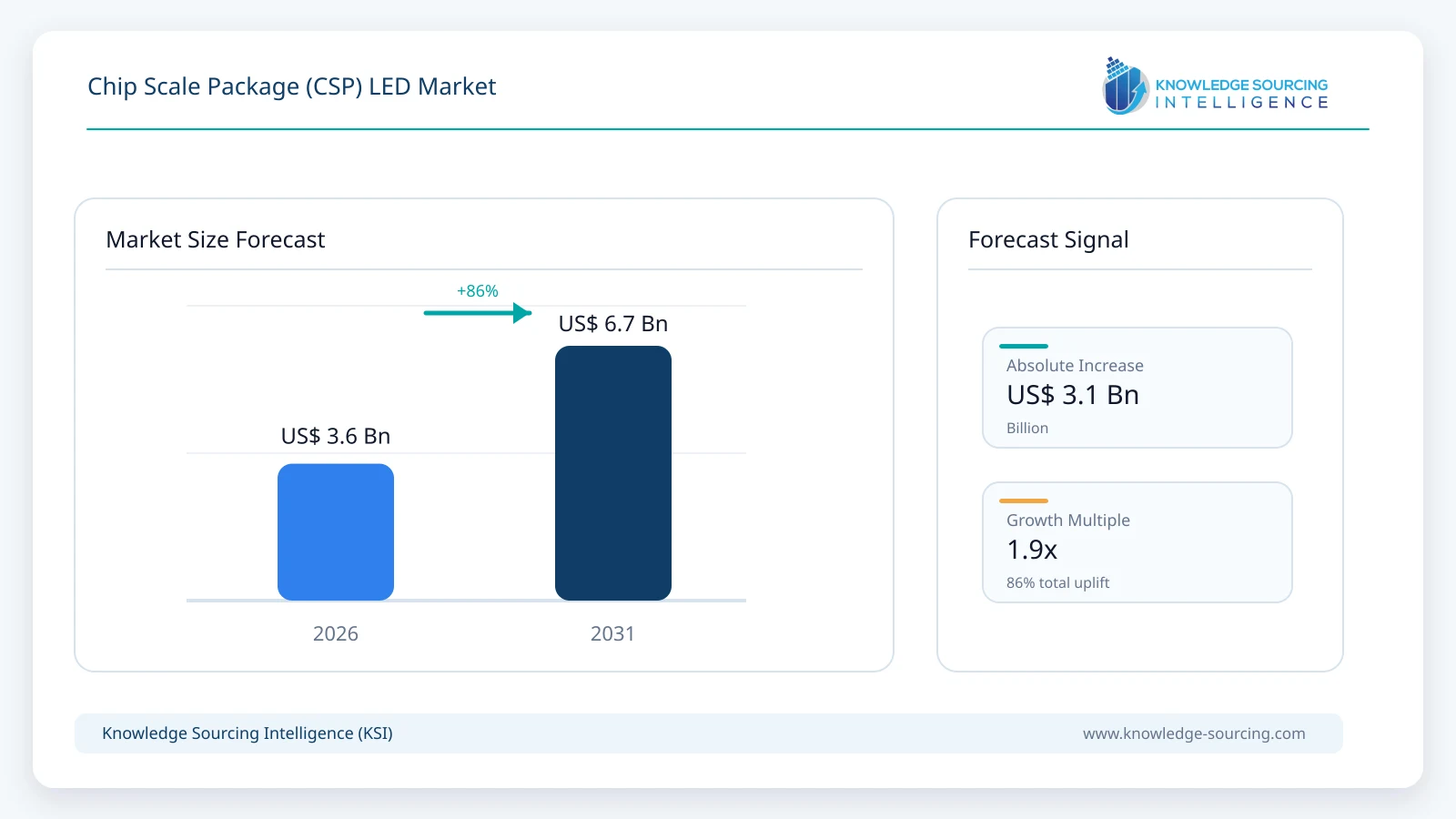
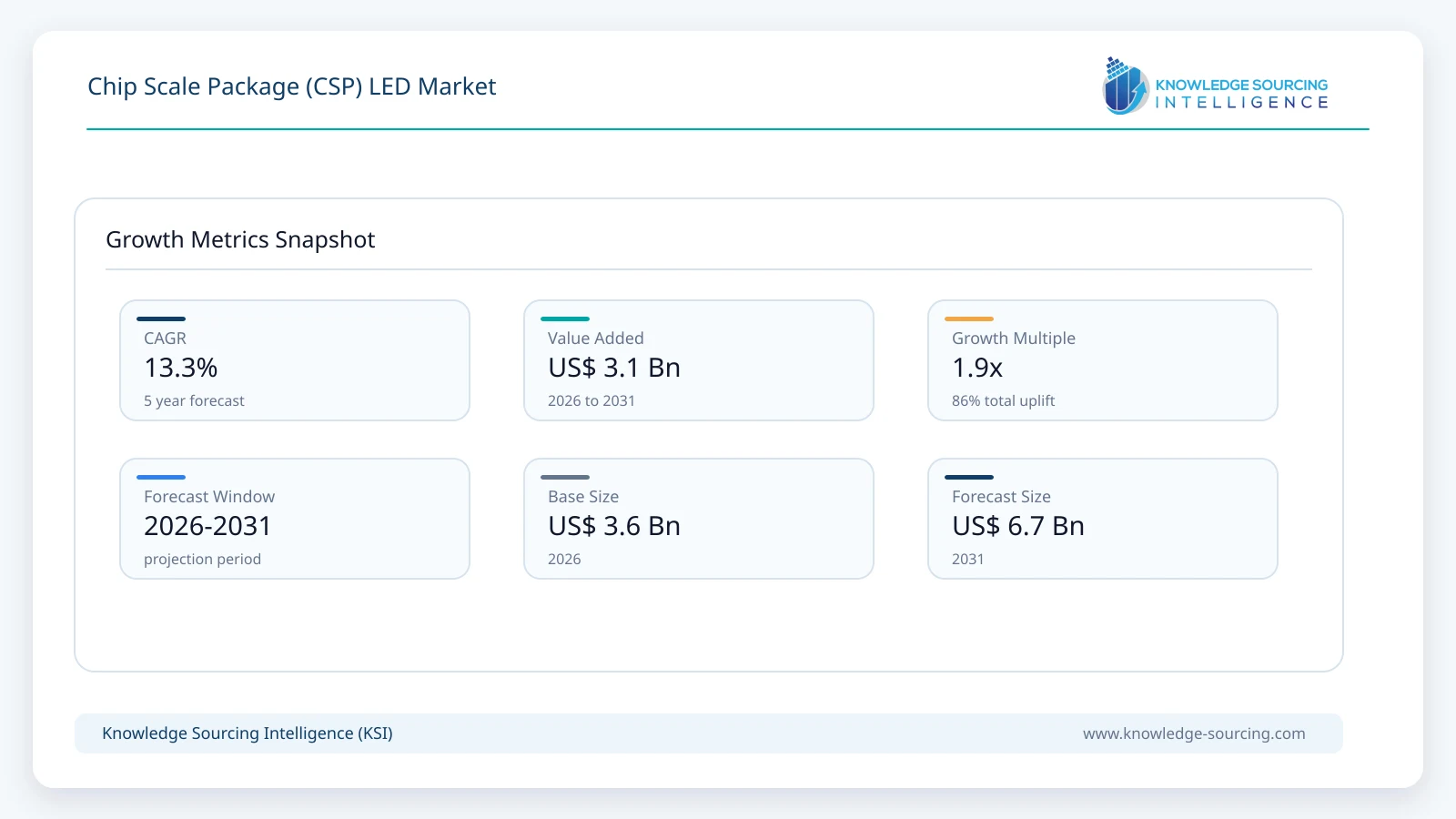
The Chip Scale Package (CSP) LED Market is forecast to grow at a CAGR of 13.3%, reaching USD 6.70 billion in 2031 from USD 3.60 billion in 2026.
Highlights:
- 1Compact, package-free LED architectures are expanding adoption across automotive, display, and specialty lighting applications.
- 2Automotive lighting specifications increasingly favor CSP LEDs with improved thermal management and higher optical density.
- 3Display manufacturers continue to seek smaller LED footprints for thinner, higher-brightness backlight units.
- 4Supply chains remain concentrated in East Asia, where wafer fabrication, packaging, and phosphor technologies are well established.
- 5Product differentiation increasingly depends on thermal performance, reliability qualification, and application-specific optical characteristics.
Market Overview
Unlike conventional packaged LEDs, CSP LEDs eliminate several packaging layers by mounting the semiconductor die directly onto the substrate, reducing package dimensions and lowering thermal resistance. These characteristics have made CSP devices increasingly attractive for automotive lighting, display backlighting, mobile flash modules, specialty lighting, and compact general illumination systems.
Purchasing decisions increasingly depend on lifetime reliability rather than component price alone. Automotive manufacturers require compliance with stringent quality standards, stable long-term supply, and consistent optical performance across operating temperatures. Display manufacturers prioritize miniaturization, uniform brightness, and integration flexibility, while lighting manufacturers evaluate thermal efficiency, efficacy, and ease of assembly. These differing procurement priorities have encouraged suppliers to expand product portfolios instead of competing solely on price.
Commercial value within the market is distributed across semiconductor wafer manufacturing, phosphor technology, chip processing, packaging innovation, optical design, and application-specific module integration. Companies with proprietary epitaxial processes, phosphor technologies, and advanced thermal designs generally retain stronger pricing power than suppliers competing primarily through manufacturing scale. Continuous improvements in chip architecture also allow manufacturers to target applications requiring higher brightness without proportionally increasing energy consumption. Official product announcements from several suppliers indicate continued investment in higher-efficiency devices, automotive-qualified products, and specialized UV and visible-light applications.
Key Market Indicators
Indicator | Latest Evidence | Commercial Meaning |
Automotive qualification | AEC-Q qualified CSP LED portfolios | Expands supplier eligibility for automotive programs. |
Automotive manufacturing standard | IATF 16949 compliance | Supports procurement by global vehicle manufacturers. |
Manufacturing focus | Mercury-free LED production initiatives (2025-2026) | Reflects continued investment in LED manufacturing efficiency and sustainability. |
CSP application expansion | Automotive, displays, specialty lighting, UV applications | Diversifies revenue opportunities beyond general illumination. |
Product development trend | Higher thermal efficiency and smaller package footprints | Supports higher-performance lighting systems with reduced space requirements. |
Market Drivers
Increasing adoption of adaptive automotive lighting systems.
Automotive manufacturers continue to integrate matrix headlights, adaptive driving beams, daytime running lights, and interior ambient lighting that require compact, thermally efficient light sources. CSP LEDs support these requirements by providing higher light density within limited installation space while improving heat transfer to vehicle lighting assemblies. Nichia's automotive product portfolio highlights CSP-based designs intended for direct heat-sink mounting and compliance with automotive quality standards, illustrating how suppliers are aligning product development with vehicle manufacturers' reliability and packaging requirements. As electric vehicles introduce additional energy-efficiency targets, demand for high-output, lower-power lighting components is expected to remain favorable.
Display manufacturers continue reducing backlight dimensions while improving brightness.
Although OLED displays have expanded into premium consumer electronics, liquid crystal displays remain widely used across televisions, industrial equipment, automotive displays, notebooks, and monitors. Higher display brightness, thinner assemblies, and improved energy efficiency have increased demand for compact LED backlighting solutions. Official corporate information from Nichia notes continuing development of LEDs supporting higher-performance LCD backlight systems as display quality requirements evolve. CSP LEDs enable tighter LED spacing and improved optical uniformity, making them suitable for increasingly compact backlight architectures used across multiple display categories.
Expansion of specialty lighting applications supports product diversification.
Growth opportunities increasingly extend beyond conventional illumination. UV curing, horticulture lighting, medical devices, industrial inspection, and disinfection applications require wavelength-specific performance rather than maximum luminous output. Manufacturers have therefore expanded research into higher-efficiency ultraviolet CSP technologies. Nichia's commercial launch of higher-efficiency deep ultraviolet LEDs demonstrates continuing investment in applications requiring specialized optical performance instead of conventional white-light illumination. This diversification reduces dependence on mature general lighting markets while creating opportunities for higher-value product categories supported by technical differentiation rather than commodity pricing.
Market Restraints and Challenges
Thermal management becomes increasingly difficult as optical output rises.
Higher luminous density is one of the principal advantages of CSP LEDs, but it also increases heat concentration within a much smaller footprint. If thermal energy is not dissipated efficiently, junction temperatures rise, reducing luminous efficacy, accelerating lumen depreciation, and shortening operating life. Automotive and industrial customers therefore require carefully engineered substrates, thermal interface materials, and heat sinks rather than treating the LED as a standalone component. Product documentation and technical guidance from multiple suppliers, including ams OSRAM, Lumileds, and Nichia, emphasize thermal design as a critical factor affecting product reliability, indicating that heat management remains an industry-wide engineering challenge rather than a company-specific issue.
Qualification requirements lengthen product development and procurement cycles.
Automotive CSP LEDs must satisfy demanding quality and reliability standards before they are incorporated into production vehicles. Compliance with AEC-Q qualification requirements, functional safety expectations, and customer-specific validation procedures often extends design and approval timelines. Vehicle manufacturers also expect consistent optical characteristics throughout a platform's production life, making supplier changes both technically complex and commercially costly. These extended qualification processes increase development costs and delay revenue realization, particularly for smaller suppliers with limited engineering resources or testing capacity. While established manufacturers possess stronger application support capabilities, qualification timelines remain an inherent characteristic of the automotive LED value chain.
Manufacturing complexity and concentrated supply chains increase operational risk.
CSP LEDs eliminate conventional packaging stages but demand high precision during wafer processing, phosphor deposition, chip singulation, and assembly. Yield losses during fabrication can materially affect production costs because even minor defects influence optical consistency and reliability. At the same time, much of the industry's epitaxial wafer production, chip fabrication, and advanced packaging capability remains concentrated across East Asia. Geopolitical tensions, trade restrictions, logistics disruptions, or shortages of specialty materials therefore have the potential to interrupt production schedules or increase procurement costs. Several global manufacturers have responded by strengthening regional manufacturing footprints, qualifying additional suppliers, and improving inventory resilience rather than relying on a single production location.
Major Segment Analysis
Automotive Lighting
Automotive lighting represents one of the most commercially important application segments because vehicle manufacturers increasingly require compact light sources capable of delivering high optical output, precise beam control, and consistent long-term reliability. Exterior lighting systems, including adaptive headlights, daytime running lights, signal lamps, and rear combination lamps, place greater emphasis on thermal efficiency and packaging flexibility than conventional lighting products. CSP LEDs satisfy these requirements by reducing package dimensions while enabling efficient heat transfer and higher luminance.
Procurement decisions in this segment extend well beyond component pricing. Vehicle manufacturers evaluate qualification history, optical consistency, lifetime performance, functional reliability, and long-term supply assurance before approving suppliers. Consequently, established manufacturers such as Nichia Corporation, ams OSRAM AG, Lumileds Holding B.V., Stanley Electric Co., Ltd., and Seoul Semiconductor Co., Ltd. compete through engineering capability, automotive-grade product portfolios, and application support rather than price alone. Although general lighting continues to generate substantial shipment volumes, automotive programs generally involve longer product lifecycles, higher qualification barriers, and stricter performance specifications, making the segment strategically important for technology development and supplier profitability.
Regional Analysis
Region | Main Demand Signal | Principal Constraint |
North America | Automotive production, specialty lighting, industrial applications | Dependence on imported LED components |
Europe | Automotive lighting regulations and premium vehicle manufacturing | High qualification and sustainability requirements |
Asia Pacific | Semiconductor manufacturing ecosystem and electronics production | Supply chain concentration and pricing pressure |
Middle East and Africa | Infrastructure development and commercial lighting projects | Limited domestic semiconductor manufacturing |
North America continues to generate demand through automotive manufacturing, industrial equipment, consumer electronics, and professional lighting applications. The United States remains the region's largest customer base for advanced automotive lighting technologies, supported by vehicle production, research activity, and demand for higher-performance electronic systems. However, much of the region's CSP LED supply continues to depend on imports from Asian semiconductor manufacturers, making procurement costs and lead times sensitive to trade policy and global logistics conditions.
European demand is shaped by premium automotive manufacturing, energy-efficiency regulations, and advanced industrial lighting requirements. Germany, France, and the United Kingdom remain important markets because vehicle manufacturers increasingly integrate adaptive lighting technologies into passenger and commercial vehicles. Environmental regulations and product quality expectations also encourage procurement of higher-efficiency lighting components that meet stringent reliability and lifecycle standards.
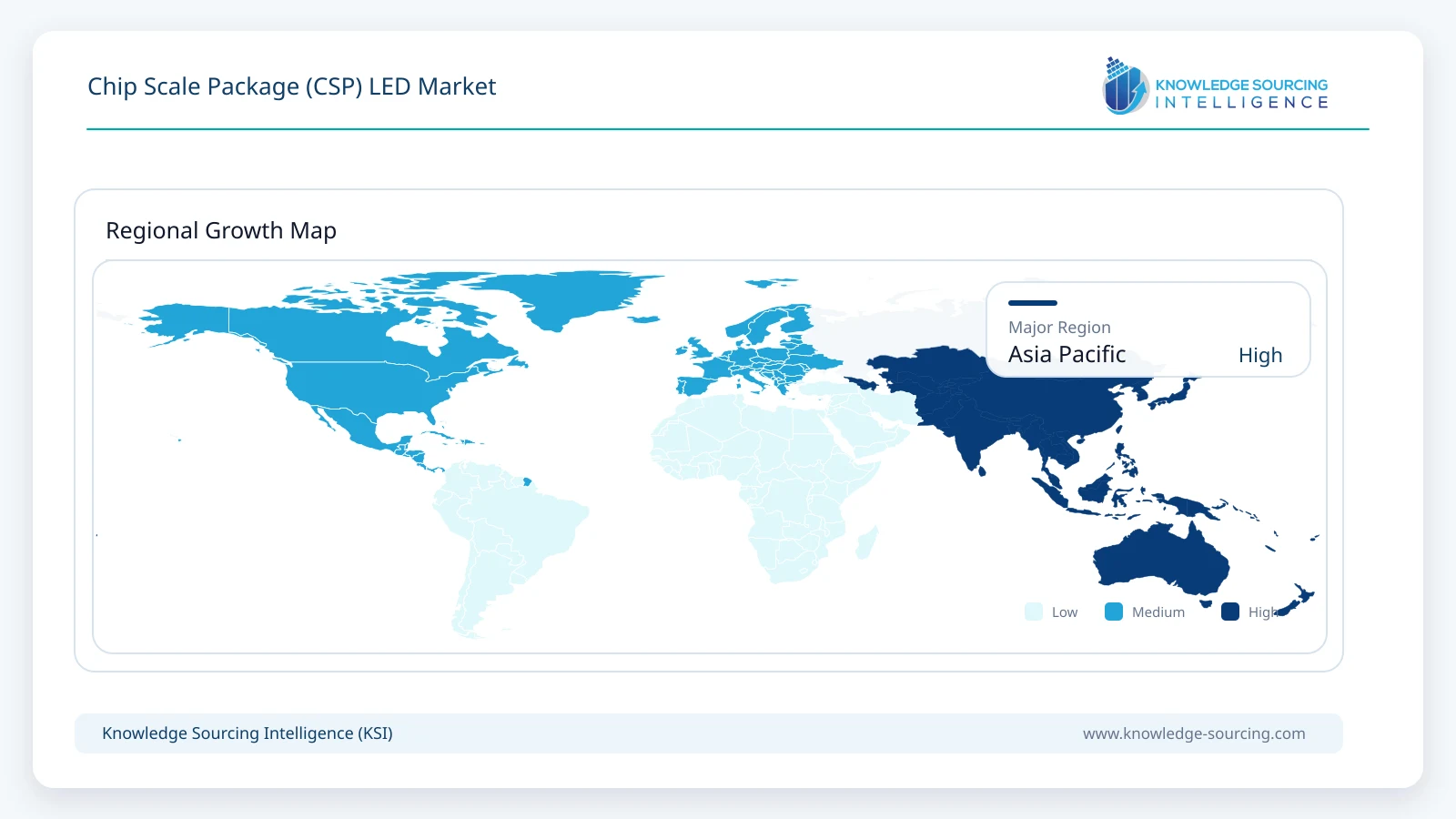
Asia Pacific forms the industry's manufacturing center, combining semiconductor fabrication, LED chip production, packaging capability, and downstream electronics assembly within an integrated supply chain. China, Japan, South Korea, and Taiwan host many of the industry's largest production facilities, while India continues to expand electronics manufacturing under government-supported industrial development programs. The concentration of manufacturing capability enables economies of scale but also exposes global supply chains to regional disruptions, trade restrictions, and fluctuations in raw material availability.
The Middle East and Africa account for a smaller share of global demand but continue to present opportunities through commercial construction, smart-city projects, transportation infrastructure, and energy-efficient lighting installations. Gulf countries are investing in modern infrastructure and intelligent urban development, supporting demand for higher-performance lighting systems. Nevertheless, the region remains largely dependent on imported semiconductor components, limiting the development of an integrated local CSP LED manufacturing ecosystem.
Competitive Landscape
Competition in the Chip Scale Package (CSP) LED market is technology-driven rather than volume-driven alone. Manufacturers compete by improving luminous efficacy, thermal performance, wavelength consistency, optical uniformity, and long-term reliability while meeting increasingly stringent customer qualification requirements. Automotive, display, and specialty lighting customers generally maintain rigorous supplier approval processes, creating relatively high switching costs once components are designed into commercial products.
Nichia Corporation, Lumileds Holding B.V., Samsung Electronics Co., Ltd., LG Innotek Co., Ltd., Seoul Semiconductor Co., Ltd., ams OSRAM AG, Cree LED, Everlight Electronics Co., Ltd., Stanley Electric Co., Ltd., and Toyoda Gosei Co., Ltd. continue to invest in product development, automotive-qualified portfolios, manufacturing efficiency, and application-specific optical technologies. Competitive differentiation increasingly depends on wafer technology, phosphor formulations, intellectual property, manufacturing yield, and customer engineering support rather than pricing alone. Several suppliers are also expanding regional manufacturing capabilities, strengthening supply-chain resilience, and introducing CSP LEDs optimized for automotive, ultraviolet, horticulture, and display applications to address changing customer requirements.
Recent Developments
December 2025 – Lumileds introduced the LUXEON Versat 2016 LED family for advanced automotive lighting. Built on compact packaging technology, the products deliver higher optical performance, improved thermal management, and design flexibility for next-generation vehicle headlamp and signaling applications.
October 2025 – Lumileds launched the LUXEON Altilon SMD-A, described as its thinnest single-chip addressable package for automotive forward lighting. The compact architecture supports space-constrained lighting designs while delivering high brightness and efficiency, reflecting continued advances in CSP-style LED packaging.
October 2025 – ams OSRAM and Nichia signed a comprehensive patent cross-license agreement covering thousands of innovations in LED and laser technologies. The agreement was expanded to include advanced LED packages and modules, strengthening collaboration across high-performance CSP LED and automotive lighting ecosystems.
August 2025 – San’an Optoelectronics and Inari Amertron entered a definitive agreement to acquire 100% of Lumileds Holding B.V. The proposed acquisition aimed to strengthen San’an’s global LED technology portfolio, manufacturing capabilities, intellectual property access, and position in premium LED packaging markets.
Regulatory and Policy Environment
Government energy-efficiency policies continue to support adoption of LED technologies across commercial, residential, and industrial lighting markets. Minimum energy-performance standards introduced in numerous jurisdictions have accelerated replacement of less efficient lighting technologies with solid-state lighting solutions. While these regulations generally apply to finished lighting products rather than CSP LEDs specifically, they indirectly strengthen long-term demand for high-efficiency LED components.
Automotive lighting products must comply with regional vehicle safety regulations and customer-specific qualification standards before entering production programs. International quality systems such as IATF 16949 and component qualification requirements under AEC-Q remain essential for suppliers targeting global automotive manufacturers. Environmental regulations, including restrictions on hazardous substances and waste electrical equipment, also influence material selection, manufacturing processes, and product lifecycle management. Compliance with these requirements has become a prerequisite for participation in international supply chains rather than a source of competitive differentiation.
Outlook and Strategic Implications
Demand during the 2026-2031 forecast period is expected to remain concentrated in applications where compact dimensions, high optical density, and efficient thermal management provide measurable performance advantages over conventional packaged LEDs. Automotive lighting, display backlighting, ultraviolet devices, horticulture lighting, and specialty industrial applications are likely to account for much of the industry's product development activity as customers continue seeking higher efficiency and improved system integration.
Future competition will depend less on manufacturing scale alone and more on engineering capability, product qualification, and application-specific performance. Suppliers able to improve manufacturing yield while maintaining consistent optical characteristics and long operating life are expected to strengthen their positions in higher-value applications. Continued investment in wafer technology, phosphor materials, thermal management, and automated manufacturing should help reduce production costs without compromising reliability.
Strategic priorities across the value chain are expected to include:
Diversifying manufacturing locations to improve supply-chain resilience.
Expanding automotive-qualified CSP LED portfolios for next-generation vehicle lighting.
Increasing research into ultraviolet and specialty wavelength products.
Improving manufacturing yields through process automation and wafer-level optimization.
Strengthening partnerships with automotive OEMs, display manufacturers, and lighting system integrators.
Although pricing pressure is likely to remain intense in mature lighting applications, suppliers with differentiated technologies, broad intellectual property portfolios, and strong customer support capabilities are expected to capture greater value in technically demanding applications where qualification requirements, reliability, and optical performance outweigh initial component cost.
Chip Scale Package CSP LED Market Scope:
| Report Metric | Details |
|---|---|
| Total Market Size in 2026 | USD 3.60 billion |
| Total Market Size in 2031 | USD 6.70 billion |
| Forecast Unit | USD Billion |
| Growth Rate | 13.3% |
| Study Period | 2021 to 2031 |
| Historical Data | 2021 to 2024 |
| Base Year | 2025 |
| Forecast Period | 2026 – 2031 |
| Segmentation | Power Range, End-User, Application, Geography |
| Companies |
|
Market Segmentation
By Power Range
Low Power
Medium Power
High Power
By End-User
Residential
Commercial
Industrial
Automotive
Consumer Electronics
General Lighting
By Application
Backlight Unit (Displays)
Flash/Flashlight
Automotive Lighting
General Lighting
Horticulture Lighting
UV Lighting
Specialty Lighting
Others
By Geography
North America
United States
Canada
Mexico
South America
Brazil
Argentina
Others
Europe
Germany
France
United Kingdom
Spain
Others
Middle East and Africa
Saudi Arabia
UAE
Israel
Others
Asia Pacific
China
Japan
India
South Korea
Indonesia
Taiwan
Others
Table of Contents
1. INTRODUCTION
1.1. Market Overview
1.2. Market Definition
1.3. Scope of the Study
1.4. Market Segmentation
1.5. Currency
1.6. Assumptions
1.7. Base and Forecast Years Timeline
1.8. Key benefits to the stakeholder
2. RESEARCH METHODOLOGY
2.1. Research Design
2.2. Research Process
3. EXECUTIVE SUMMARY
3.1. Key Findings
3.2. Analyst View
4. MARKET DYNAMICS
4.1. Market Drivers
4.2. Market Restraints
4.3. Porter’s Five Forces Analysis
4.3.1. Bargaining Power of Suppliers
4.3.2. Bargaining Power of Buyers
4.3.3. Threat of New Entrants
4.3.4. Threat of Substitutes
4.3.5. Competitive Rivalry in the Industry
4.4. Industry Value Chain Analysis
4.5. Analyst View
5. CHIP SCALE PACKAGE (CSP) LED MARKET BY POWER RANGE
5.1. Introduction
5.2. Low Power
5.2.1. Market opportunities and trends
5.2.2. Growth prospects
5.2.3. Geographic lucrativeness
5.3. Medium Power
5.3.1. Market opportunities and trends
5.3.2. Growth prospects
5.3.3. Geographic lucrativeness
5.4. High Power
5.4.1. Market opportunities and trends
5.4.2. Growth prospects
5.4.3. Geographic lucrativeness
6. CHIP SCALE PACKAGE (CSP) LED MARKET BY END-USER
6.1. Introduction
6.2. Residential
6.2.1. Market opportunities and trends
6.2.2. Growth prospects
6.2.3. Geographic lucrativeness
6.3. Commercial
6.3.1. Market opportunities and trends
6.3.2. Growth prospects
6.3.3. Geographic lucrativeness
6.4. Industrial
6.4.1. Market opportunities and trends
6.4.2. Growth prospects
6.4.3. Geographic lucrativeness
6.5. Automotive
6.5.1. Market opportunities and trends
6.5.2. Growth prospects
6.5.3. Geographic lucrativeness
6.6. Consumer Electronics
6.6.1. Market opportunities and trends
6.6.2. Growth prospects
6.6.3. Geographic lucrativeness
6.7. General Lighting
6.7.1. Market opportunities and trends
6.7.2. Growth prospects
6.7.3. Geographic lucrativeness
7. CHIP SCALE PACKAGE (CSP) LED MARKET BY APPLICATION
7.1. Introduction
7.2. Backlight Unit (Displays)
7.2.1. Market opportunities and trends
7.2.2. Growth prospects
7.2.3. Geographic lucrativeness
7.3. Flash/Flashlight
7.3.1. Market opportunities and trends
7.3.2. Growth prospects
7.3.3. Geographic lucrativeness
7.4. Automotive Lighting
7.4.1. Market opportunities and trends
7.4.2. Growth prospects
7.4.3. Geographic lucrativeness
7.5. General Lighting
7.5.1. Market opportunities and trends
7.5.2. Growth prospects
7.5.3. Geographic lucrativeness
7.6. Horticulture Lighting
7.6.1. Market opportunities and trends
7.6.2. Growth prospects
7.6.3. Geographic lucrativeness
7.7. UV Lighting
7.7.1. Market opportunities and trends
7.7.2. Growth prospects
7.7.3. Geographic lucrativeness
7.8. Specialty Lighting
7.8.1. Market opportunities and trends
7.8.2. Growth prospects
7.8.3. Geographic lucrativeness
7.9. Others
7.9.1. Market opportunities and trends
7.9.2. Growth prospects
7.9.3. Geographic lucrativeness
8. CHIP SCALE PACKAGE (CSP) LED MARKET BY GEOGRAPHY
8.1. Introduction
8.2. North America
8.2.1. By Power Range
8.2.2. By End-user
8.2.3. By Application
8.2.4. By Country
8.2.4.1. United States
8.2.4.1.1. Market Trends and Opportunities
8.2.4.1.2. Growth Prospects
8.2.4.2. Canada
8.2.4.2.1. Market Trends and Opportunities
8.2.4.2.2. Growth Prospects
8.2.4.3. Mexico
8.2.4.3.1. Market Trends and Opportunities
8.2.4.3.2. Growth Prospects
8.3. South America
8.3.1. By Power Range
8.3.2. By End-user
8.3.3. By Application
8.3.4. By Country
8.3.4.1. Brazil
8.3.4.1.1. Market Trends and Opportunities
8.3.4.1.2. Growth Prospects
8.3.4.2. Argentina
8.3.4.2.1. Market Trends and Opportunities
8.3.4.2.2. Growth Prospects
8.3.4.3. Others
8.3.4.3.1. Market Trends and Opportunities
8.3.4.3.2. Growth Prospects
8.4. Europe
8.4.1. By Power Range
8.4.2. By End-user
8.4.3. By Application
8.4.4. By Country
8.4.4.1. Germany
8.4.4.1.1. Market Trends and Opportunities
8.4.4.1.2. Growth Prospects
8.4.4.2. France
8.4.4.2.1. Market Trends and Opportunities
8.4.4.2.2. Growth Prospects
8.4.4.3. United Kingdom
8.4.4.3.1. Market Trends and Opportunities
8.4.4.3.2. Growth Prospects
8.4.4.4. Spain
8.4.4.4.1. Market Trends and Opportunities
8.4.4.4.2. Growth Prospects
8.4.4.5. Others
8.4.4.5.1. Market Trends and Opportunities
8.4.4.5.2. Growth Prospects
8.5. Middle East and Africa
8.5.1. By Power Range
8.5.2. By End-user
8.5.3. By Application
8.5.4. By Country
8.5.4.1. Saudi Arabia
8.5.4.1.1. Market Trends and Opportunities
8.5.4.1.2. Growth Prospects
8.5.4.2. UAE
8.5.4.2.1. Market Trends and Opportunities
8.5.4.2.2. Growth Prospects
8.5.4.3. Israel
8.5.4.3.1. Market Trends and Opportunities
8.5.4.3.2. Growth Prospects
8.5.4.4. Others
8.5.4.4.1. Market Trends and Opportunities
8.5.4.4.2. Growth Prospects
8.6. Asia Pacific
8.6.1. By Power Range
8.6.2. By End-user
8.6.3. By Application
8.6.4. By Country
8.6.4.1. China
8.6.4.1.1. Market Trends and Opportunities
8.6.4.1.2. Growth Prospects
8.6.4.2. Japan
8.6.4.2.1. Market Trends and Opportunities
8.6.4.2.2. Growth Prospects
8.6.4.3. India
8.6.4.3.1. Market Trends and Opportunities
8.6.4.3.2. Growth Prospects
8.6.4.4. South Korea
8.6.4.4.1. Market Trends and Opportunities
8.6.4.4.2. Growth Prospects
8.6.4.5. Indonesia
8.6.4.5.1. Market Trends and Opportunities
8.6.4.5.2. Growth Prospects
8.6.4.6. Taiwan
8.6.4.6.1. Market Trends and Opportunities
8.6.4.6.2. Growth Prospects
8.6.4.7. Others
8.6.4.7.1. Market Trends and Opportunities
8.6.4.7.2. Growth Prospects
9. COMPETITIVE ENVIRONMENT AND ANALYSIS
9.1. Major Players and Strategy Analysis
9.2. Market Share Analysis
9.3. Mergers, Acquisition, Agreements, and Collaborations
9.4. Competitive Dashboard
10. COMPANY PROFILES
10.1. Nichia Corporation
10.2. Lumileds Holding B.V.
10.3. Samsung Electronics Co., Ltd.
10.4. LG Innotek Co., Ltd.
10.5. Seoul Semiconductor Co., Ltd.
10.6. ams OSRAM AG
10.7. Cree LED
10.8. Everlight Electronics Co., Ltd.
10.9. Stanley Electric Co., Ltd.
10.10. Toyoda Gosei Co., Ltd.
LIST OF FIGURES
LIST OF TABLES
Navigate
Trusted by the world's leading organizations











