
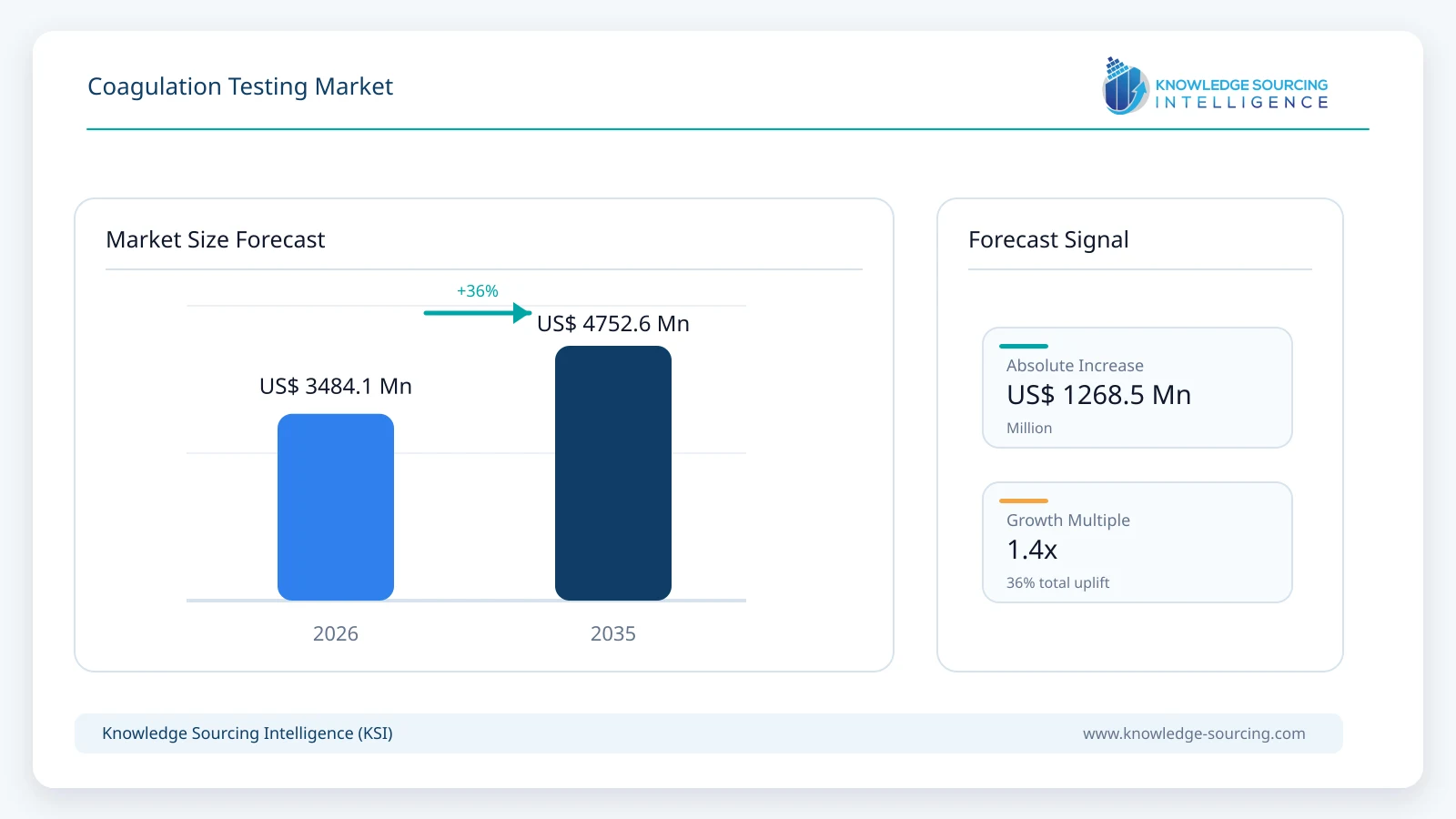
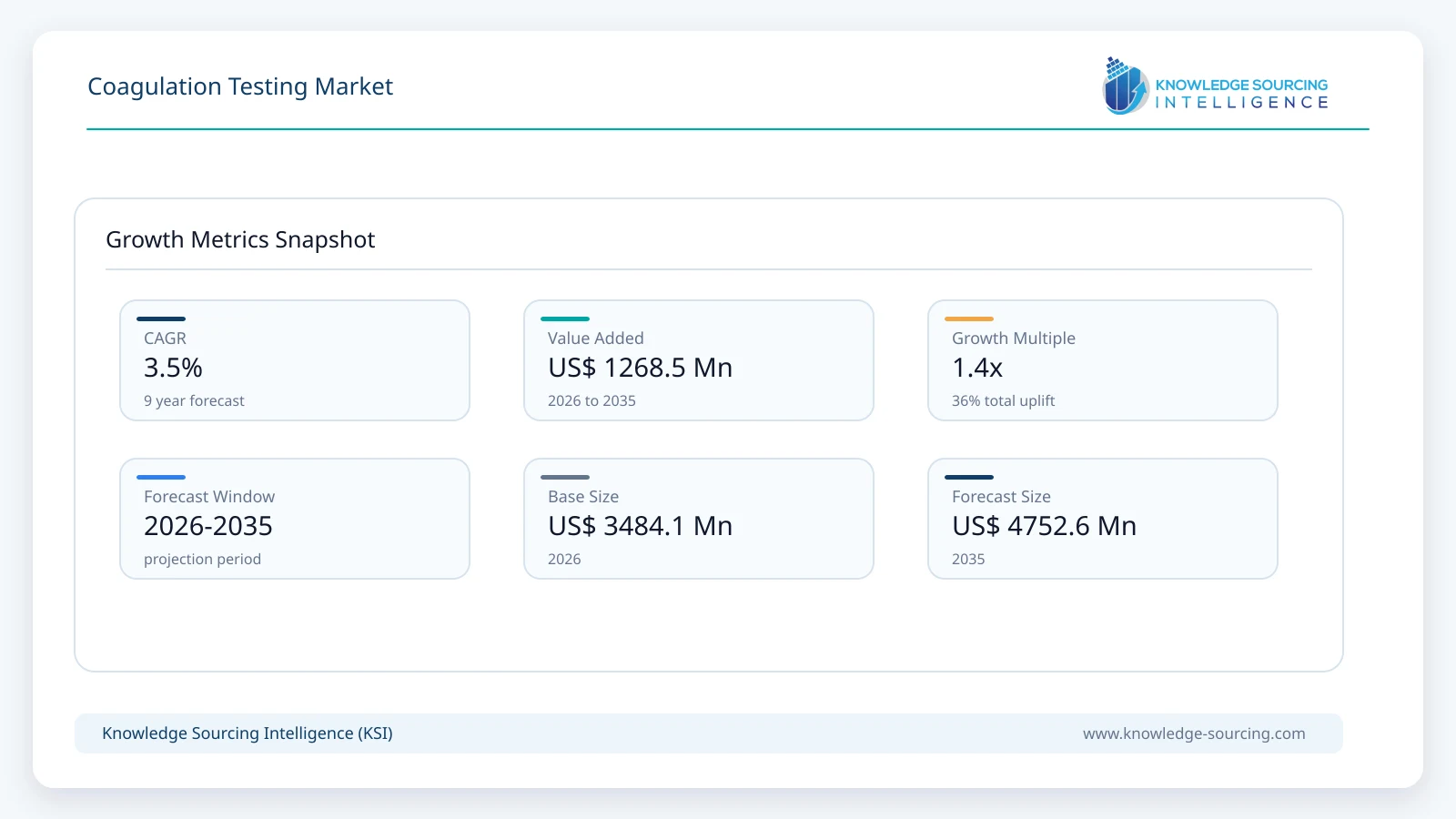
The Coagulation Testing Market is expected to grow at a CAGR of 3.5% from a market value of USD 3,484.06 million in 2026 to USD 4,752.58 million in 2035.
Highlights:
- 1Growing anticoagulant utilization is increasing demand for standardized coagulation testing because clinicians require reliable laboratory evidence to optimize treatment decisions.
- 2Laboratory automation is improving testing efficiency because healthcare providers are reducing manual workflow variability while expanding testing capacity.
- 3Rising surgical procedure volumes are strengthening demand for pre-operative coagulation assessment because perioperative bleeding risks require accurate patient evaluation.
- 4Development of advanced hemostatic therapies is increasing specialized assay adoption because clinical trials require detailed biomarker monitoring throughout treatment evaluation.
Coagulation testing enables clinicians to evaluate hemostatic function by measuring clot formation, platelet activity, coagulation factor performance, and fibrinolytic pathways. These diagnostic capabilities support disease detection, anticoagulant therapy monitoring, and pre-surgical assessments, making coagulation testing an essential component of modern healthcare delivery.
Demand is increasing because cardiovascular diseases, cancer-associated thrombosis, liver disorders, inherited coagulation abnormalities, and aging populations continue expanding the number of patients requiring laboratory evaluation. Clinical pathways increasingly rely on rapid laboratory confirmation before therapeutic intervention, which increases dependence on automated analyzers capable of delivering standardized and reproducible results. Healthcare institutions are investing in laboratory modernization to improve turnaround times without compromising analytical quality.
Regulatory oversight significantly influences market development because diagnostic manufacturers must demonstrate analytical performance, manufacturing consistency, software reliability, and clinical validity before commercialization. Regulatory expectations continue expanding to include cybersecurity, digital interoperability, post-market monitoring, and quality-management compliance. These requirements increase development complexity while strengthening long-term confidence in diagnostic performance across healthcare systems.
Market Dynamics
Market Drivers
Expanding Anticoagulant Utilization Is Increasing Dependence on Laboratory Monitoring: Anticoagulant therapy remains a primary treatment strategy for numerous cardiovascular and thrombotic disorders. Patient populations receiving anticoagulants are increasing because clinical guidelines continue recommending earlier intervention across multiple disease indications. Drug-response variability creates ongoing monitoring requirements that laboratories must address through accurate coagulation assessment. Diagnostic manufacturers are expanding automated assay portfolios to improve reproducibility across healthcare settings.
Laboratory Automation Is Reshaping Diagnostic Workflow Efficiency: Clinical laboratories prioritize operational efficiency because testing volumes continue increasing despite workforce shortages. Manual processing limits throughput while introducing variability that affects reporting consistency. Healthcare providers are investing in fully automated coagulation analyzers that reduce hands-on processing and improve quality assurance. Manufacturers are integrating artificial intelligence-supported workflow management and digital connectivity into analyzer platforms.
Rising Burden of Bleeding and Thrombotic Disorders Supports Advanced Diagnostics: Hemophilia, thrombophilia, liver disease, sepsis, trauma, and cancer-associated coagulation disorders require continuous laboratory assessment throughout diagnosis and treatment. Clinical complexity is increasing because patients frequently present with multiple comorbidities affecting coagulation pathways. Conventional testing alone provides limited clinical insight in these situations.
Precision Therapeutics Are Expanding Biomarker Requirements: Novel hemostatic therapies require increasingly sophisticated laboratory support throughout clinical development and post-marketing evaluation. Drug developers are incorporating specialized coagulation biomarkers into trial protocols because treatment response varies across genetically diverse patient populations. Diagnostic manufacturers are collaborating with pharmaceutical sponsors to validate companion laboratory approaches supporting therapeutic development.
Market Restraints
High capital investment for automated coagulation analyzers limits technology adoption among smaller healthcare facilities despite growing diagnostic demand.
Variability in laboratory standardization across healthcare systems reduces inter-laboratory result consistency and complicates clinical interpretation.
Stringent regulatory validation requirements increase product development timelines and commercialization costs for manufacturers introducing new diagnostic platforms.
Market Opportunities
Companion Diagnostics Are Expanding Clinical Development Strategies: Drug developers increasingly require validated laboratory biomarkers because targeted therapies demand precise patient selection and treatment monitoring. Companion diagnostic development is creating new commercial partnerships between pharmaceutical companies and diagnostic manufacturers. These collaborations expand assay utilization throughout clinical development while supporting regulatory submissions.
Digital Laboratory Ecosystems Are Improving Clinical Decision Support: Healthcare providers increasingly connect laboratory analyzers with hospital information systems because clinicians require immediate access to diagnostic results. Digital integration reduces reporting delays while improving traceability across laboratory operations. Manufacturers are expanding software functionality to support predictive analytics and workflow optimization. Connected diagnostics consequently become an important competitive differentiator.
Emerging Healthcare Infrastructure Is Increasing Testing Capacity: Healthcare investment continues expanding across developing economies because governments prioritize diagnostic accessibility. Laboratory infrastructure is improving through modernization programs that emphasize automation and standardized testing practices. Diagnostic companies are strengthening regional manufacturing, distribution, and technical support capabilities to address growing demand.
Specialized Hemostasis Testing Is Broadening Clinical Applications: Complex disease management increasingly requires detailed evaluation of coagulation pathways rather than basic screening alone. Clinicians are adopting advanced factor assays and specialized fibrinogen evaluation for precision treatment planning. Manufacturers are expanding comprehensive assay menus that support rare disease diagnosis, oncology, and transplant medicine. This evolution increases the long-term value of high-complexity coagulation platforms.
Disease & Epidemiology Analysis
Coagulation testing remains integral to the diagnosis and management of disorders affecting the hemostatic system because abnormalities in clot formation or dissolution directly influence morbidity and mortality. Demand is increasing as healthcare systems are identifying a larger number of patients with inherited bleeding disorders, acquired coagulopathies, cardiovascular diseases requiring anticoagulation, liver dysfunction, trauma-associated bleeding, and malignancy-related thrombosis. This expanding clinical burden increases dependence on laboratory diagnostics that provide rapid and reproducible assessment of coagulation status. Healthcare providers are incorporating broader testing panels into routine clinical pathways to improve treatment selection and reduce adverse outcomes. Coagulation diagnostics continue supporting decision-making across emergency medicine, hematology, oncology, cardiology, and critical care.
Cardiovascular disease remains one of the largest contributors to coagulation testing demand because long-term anticoagulant therapy requires laboratory evaluation before and during treatment in selected clinical scenarios. The number of patients receiving anticoagulant medications is increasing as clinical guidelines continue emphasizing thrombosis prevention in atrial fibrillation, venous thromboembolism, prosthetic heart valves, and high-risk surgical populations. Drug interactions, renal impairment, and patient-specific risk factors create variability in therapeutic response that laboratories must evaluate accurately. Manufacturers are expanding assay menus capable of supporting individualized anticoagulation management.
Treatment Guidelines Landscape
Organization | Disease Area | Guideline Focus | Impact on Coagulation Testing |
International Society on Thrombosis and Haemostasis (ISTH) | Venous thromboembolism, bleeding disorders | Standardized coagulation assessment and laboratory quality | Supports harmonized laboratory interpretation across healthcare systems |
World Federation of Hemophilia (WFH) | Hemophilia | Diagnosis, factor replacement monitoring, inhibitor testing | Expands utilization of factor assays and specialized coagulation diagnostics |
American Society of Hematology (ASH) | Thrombotic and bleeding disorders | Evidence-based anticoagulation management | Encourages appropriate laboratory monitoring in selected patient groups |
Clinical and Laboratory Standards Institute (CLSI) | Clinical laboratory practice | Analytical quality and laboratory standardization | Improves reproducibility and quality assurance for coagulation testing |
Market Segmentation
By Test Type
Complete Blood Count (CBC) supports initial evaluation of platelet abnormalities that influence coagulation status and bleeding risk. Demand is increasing because physicians frequently use CBC as the first laboratory investigation before ordering specialized coagulation assays. Platelet abnormalities provide an important clinical context that guides additional diagnostic evaluation. Healthcare facilities are integrating automated hematology and coagulation workflows to improve laboratory efficiency and reduce reporting delays. CBC remains an essential gateway test supporting broader coagulation assessment across multiple disease areas.
By Application
Monitoring anticoagulant therapy represents one of the most important clinical applications because therapeutic effectiveness depends on maintaining an appropriate balance between thrombosis prevention and bleeding risk. Patient populations receiving anticoagulant treatment are increasing as cardiovascular disease prevalence continues rising worldwide. Drug interactions, renal impairment, and complex clinical conditions require individualized laboratory assessment. Diagnostic manufacturers are developing standardized assays that improve monitoring accuracy across healthcare settings. Reliable coagulation testing remains fundamental to safe anticoagulant management.
By End User
Hospitals account for the largest utilization of coagulation testing because emergency departments, operating rooms, intensive care units, oncology centers, and cardiovascular services require immediate laboratory support. Patient complexity is increasing as tertiary hospitals manage larger volumes of critically ill individuals with multiple comorbidities. Rapid turnaround times remain essential for treatment decisions involving surgery, trauma, and anticoagulation management. Healthcare institutions are investing in fully automated analyzers that improve testing efficiency while supporting continuous laboratory operations. Hospitals remain the primary demand center for advanced coagulation diagnostics.
Regional Analysis
North America Market Analysis
North America represents the most technologically advanced market for coagulation testing because the region combines high diagnostic utilization with well-established laboratory infrastructure and widespread adoption of automated testing systems. Demand is increasing as cardiovascular disease, cancer, obesity, and an aging population continue expanding the number of patients requiring coagulation assessment. Clinical complexity increases dependence on standardized laboratory testing because physicians require rapid diagnostic evidence before initiating anticoagulant therapy or performing invasive procedures. Additionally, healthcare providers are modernizing laboratory operations through digital connectivity, artificial intelligence-supported workflow management, and integrated automation platforms that improve turnaround time while maintaining analytical accuracy.
Europe Market Analysis
Europe maintains a mature coagulation testing market because harmonized clinical guidelines and extensive public healthcare systems support routine laboratory evaluation across hospitals and specialized diagnostic laboratories. Demand is increasing as the prevalence of atrial fibrillation, venous thromboembolism, inherited bleeding disorders, and complex surgical procedures continues to expand across the region. National healthcare systems prioritize standardized diagnostic pathways because consistent laboratory quality directly influences treatment outcomes and healthcare efficiency. Diagnostic manufacturers are introducing higher-throughput analyzers and expanded assay portfolios that address increasing laboratory workloads while reducing operational variability.
Asia Pacific Market Analysis
Asia Pacific continues to represent the fastest-evolving regional market because healthcare infrastructure investment, expanding diagnostic accessibility, and rising chronic disease prevalence are increasing laboratory testing demand. Large patient populations create substantial diagnostic volumes that require scalable laboratory automation capable of supporting both urban tertiary hospitals and expanding regional healthcare networks. Governments are strengthening healthcare investment because earlier disease detection reduces long-term treatment costs and improves patient outcomes. Healthcare providers are installing automated coagulation analyzers to address workforce shortages while improving testing consistency across rapidly expanding laboratory networks.
Rest of the World
Healthcare systems across Latin America, the Middle East, and Africa continue strengthening diagnostic capacity because governments increasingly recognize laboratory medicine as an essential component of universal healthcare initiatives. Demand is increasing as cardiovascular disease, diabetes, cancer, trauma, and infectious diseases contribute to more complex coagulation abnormalities requiring laboratory assessment. Resource limitations continue affecting access to advanced diagnostic technologies, particularly in lower-income healthcare systems where centralized laboratory infrastructure remains under development. International healthcare organizations and public-private partnerships are supporting laboratory modernization through workforce training, quality assurance programs, and equipment procurement initiatives that improve diagnostic accessibility.
Regulatory Landscape
The regulatory environment for coagulation testing continues evolving because diagnostic technologies are becoming increasingly automated, software-driven, and interconnected with hospital information systems. Manufacturers must demonstrate analytical accuracy, clinical validity, manufacturing quality, cybersecurity resilience, and software reliability before commercialization. These requirements increase development timelines but improve confidence in diagnostic performance across healthcare settings. Regulatory agencies are also strengthening post-market surveillance expectations, encouraging continuous monitoring of product performance throughout the commercial lifecycle.
In the United States, the U.S. Food and Drug Administration (FDA) regulates coagulation testing systems under the medical device framework, while clinical laboratory operations remain subject to the Clinical Laboratory Improvement Amendments (CLIA) administered by the Centers for Medicare & Medicaid Services (CMS). Within Europe, implementation of the European Union In Vitro Diagnostic Regulation (IVDR 2017/746) is increasing clinical evidence requirements, traceability obligations, and post-market performance monitoring for in vitro diagnostics. Similar regulatory modernization efforts are occurring across Japan, China, South Korea, and other Asia-Pacific markets as governments strengthen quality standards for diagnostic products.
Pipeline Analysis
Innovation within the coagulation testing market increasingly aligns with advances in precision medicine because emerging therapeutics require more sophisticated laboratory support than conventional clotting assays alone. Diagnostic developers are expanding assay portfolios capable of evaluating coagulation factors, thrombin generation, fibrinolysis, platelet function, and novel biomarkers that improve disease characterization. Pharmaceutical sponsors are integrating these biomarkers into clinical development programs to improve patient selection and monitor therapeutic response more accurately. This convergence between therapeutics and diagnostics is increasing the strategic value of advanced coagulation testing.
Several late-stage therapeutic programs continue influencing future testing requirements. Fitusiran (developed by Sanofi) employs RNA interference technology to reduce antithrombin production, thereby restoring thrombin generation in patients with hemophilia A or B. Mim8 (developed by Novo Nordisk) is progressing through Phase III clinical development as a bispecific antibody that mimics activated factor VIII function to improve coagulation in hemophilia A. Marstacimab (developed by Pfizer) targets tissue factor pathway inhibitor (TFPI), enhancing thrombin generation while reducing bleeding episodes in hemophilia patients.
Reimbursement Landscape
Reimbursement policies continue influencing the adoption of coagulation testing because healthcare providers balance diagnostic value against laboratory operating costs. Public and private payers generally reimburse clinically indicated coagulation tests that support disease diagnosis, anticoagulant management, emergency medicine, and pre-operative assessment. Coverage increasingly emphasizes evidence-based utilization because healthcare systems seek to improve patient outcomes while controlling unnecessary testing. Laboratories are expanding standardized testing algorithms that align with established clinical guidelines and payer requirements.
Advanced coagulation assays and specialized factor testing frequently receive reimbursement when supported by documented clinical necessity, particularly for inherited bleeding disorders, thrombophilia evaluation, and complex anticoagulation management. Healthcare providers are adopting value-based care models that reward accurate diagnosis and early intervention because these approaches reduce hospitalization, surgical complications, and long-term treatment costs.
Competitive Landscape
Abbott Laboratories
Abbott Laboratories remains strategically distinct because it combines a broad in vitro diagnostics portfolio with advanced laboratory informatics and automation capabilities. The company focuses on integrating diagnostic instruments into connected laboratory ecosystems that improve workflow efficiency and data management.
F. Hoffmann-La Roche Ltd
F. Hoffmann-La Roche Ltd differentiates itself through its integrated diagnostics strategy that combines laboratory automation, molecular diagnostics, and digital healthcare solutions. The company emphasizes complete laboratory workflow optimization rather than individual analyzer performance, allowing healthcare providers to streamline operations across multiple testing disciplines.
Sysmex Corporation
Sysmex Corporation maintains a strong competitive position through its specialization in hematology and hemostasis diagnostics, supported by continuous analyzer innovation. The company prioritizes automation, analytical precision, and laboratory workflow optimization to address increasing testing volumes and workforce shortages.
Siemens AG
Siemens AG, through Siemens Healthineers, leverages its diversified healthcare technology portfolio to deliver integrated diagnostic solutions for hospitals and reference laboratories. The company combines laboratory diagnostics with digital healthcare infrastructure, enabling healthcare providers to manage diagnostic information more efficiently across enterprise-wide clinical networks.
Werfen Life Group
Werfen Life Group is strategically recognized for its exclusive focus on specialized diagnostics, particularly hemostasis, acute care, and autoimmune disease testing. This specialization enables the company to develop highly targeted coagulation solutions addressing complex clinical applications beyond routine screening.
Stago Group
Stago Group differentiates itself through its exclusive dedication to hemostasis diagnostics and comprehensive coagulation testing solutions. The company develops analyzers, reagents, and specialized assays designed specifically for bleeding and thrombotic disorders, allowing it to maintain deep technical expertise within this therapeutic area.
Terumo Corporation
Terumo Corporation leverages extensive expertise in cardiovascular care, transfusion medicine, and medical technologies to support coagulation-related clinical applications. The company develops products that integrate with hospital-based blood management and procedural workflows, strengthening its presence within perioperative and critical care settings.
Key Developments
December 2025: Sysmex Corporation launched its new Automated Blood Coagulation Analyzer CN™-700 in Japan, a compact model in the CN-Series hemostasis field. The CN-700 inherits the analytical technology and operability of the higher-end models CN-6000/CN-3000 while achieving a more compact design. With this addition to the CN-Series, Sysmex contributes to the automation and improved efficiency of a wide range of medical facilities, including those in emerging markets.
July 2025: Siemens Healthineers launched the CN-3000 and CN-6000 Hemostasis Systems, compact and flexible hemostasis analyzers for mid- and high-volume coagulation testing. These systems feature the smallest footprint available in the hemostasis market with a throughput of 450 PT tests per hour, intelligent software, and flexible connectivity options.
Strategic Insights and Future Market Outlook
The coagulation testing market is entering a phase where diagnostic value increasingly depends on clinical integration rather than individual assay performance. Healthcare providers are expecting laboratory systems to deliver rapid, standardized, and interoperable results that support precision treatment decisions across hematology, cardiovascular medicine, oncology, and critical care. This transition is encouraging manufacturers to combine analyzer automation with digital workflow management, artificial intelligence-assisted quality control, and enterprise-wide connectivity. Companies capable of integrating these capabilities into comprehensive diagnostic ecosystems are likely to strengthen long-term competitive positioning.
Therapeutic innovation is also reshaping future diagnostic requirements because gene therapies, RNA-based medicines, bispecific antibodies, and novel anticoagulants require increasingly sophisticated laboratory monitoring throughout development and clinical practice. Diagnostic manufacturers are collaborating more closely with pharmaceutical sponsors to validate biomarkers supporting patient selection, efficacy assessment, and long-term safety monitoring. These partnerships expand the strategic importance of coagulation testing beyond routine laboratory services while reinforcing its role within personalized medicine.
Coagulation testing will remain a critical component of evidence-based healthcare because accurate assessment of hemostatic function supports disease diagnosis, therapeutic monitoring, surgical safety, and pharmaceutical innovation. Continued advances in automation, precision diagnostics, and digital laboratory infrastructure are strengthening the market's strategic importance across global healthcare systems while creating sustainable opportunities for manufacturers that combine scientific innovation with regulatory excellence and clinical reliability.
Coagulation Testing Market Scope:
| Report Metric | Details |
|---|---|
| Total Market Size in 2026 | USD 3,484.06 million |
| Total Market Size in 2035 | USD 4,752.58 million |
| Forecast Unit | USD Million |
| Growth Rate | 3.5% |
| Study Period | 2021 to 2035 |
| Historical Data | 2021 to 2024 |
| Base Year | 2025 |
| Forecast Period | 2026 – 2035 |
| Segmentation | Product, Test Type, End User, Geography |
| Companies |
|
Market Segmentation
Product
Test Type
End User
Geography
- North America
- South America
- Europe
- Middle East and Africa
- Asia Pacific
Table of Contents
1. EXECUTIVE SUMMARY
1.1 Market Snapshot
1.2 Key Findings
1.3 Analyst Insights
1.4 Strategic Recommendations
2. RESEARCH METHODOLOGY
2.1 Research Design
2.2 Data Collection Methodology
2.3 Market Size Estimation
2.4 Forecasting Model
2.5 Assumptions & Limitations
3. GLOBAL COAGULATION TESTING MARKET OVERVIEW, SIZE & FORECAST
3.1 Market Definition & Scope
3.2 Overview of Hemostasis and Coagulation Testing
3.3 Industry Evolution
3.4 Key Market Trends
3.5 Historical Market Size Analysis (2021–2025)
3.6 Market Forecast (2026–2035)
3.7 Disease Burden and Clinical Need for Coagulation Testing
3.8 Testing Volume Analysis
3.9 Patient Population Analysis
3.10 Clinical Application Overview
3.11 Laboratory Workflow and Testing Pathway
4. MARKET DYNAMICS
4.1 Market Drivers
4.2 Market Restraints
4.3 Market Opportunities
4.4 Market Challenges
5. INDUSTRY LANDSCAPE
5.1 Industry Value Chain Analysis
5.2 Pricing Analysis
5.3 Reimbursement Landscape
6. INNOVATION LANDSCAPE
6.1 Emerging Technologies in Coagulation Diagnostics
6.2 Product Innovation
6.3 Pipeline Analysis
6.4 Technology Roadmap
6.5 Automation and Digital Laboratory Integration
6.6 Artificial Intelligence and Data Analytics Integration
7. REGULATORY LANDSCAPE
7.1 Regulatory Framework
7.2 Approval Pathways
7.3 Compliance Requirements
8. GLOBAL COAGULATION TESTING MARKET LANDSCAPE ANALYSIS
8.1 Analysis by Product Type
8.2 Analysis by Test Type
8.3 Analysis by Operating Mode
8.4 Analysis by Application
8.5 Analysis by End User
9. GLOBAL COAGULATION TESTING MARKET SEGMENT ANALYSIS (2021–2035)
9.1 By Product
9.1.1 Instruments
9.1.2 Reagents
9.1.3 Consumables & Accessories
9.2 By Test Type
9.2.1 Complete Blood Count (CBC)
9.2.2 Factor V Assay
9.2.3 Fibrinogen Level
9.2.4 Platelet Count
9.2.5 Others
9.3 By Operating Mode
9.3.1 Automatic Coagulation Analyzers
9.3.2 Semi-Automatic Coagulation Analyzers
9.4 By Application
9.4.1 Disease Detection
9.4.2 Monitoring Anticoagulant Therapy
9.4.3 Pre-Surgical Assessments
9.4.4 Others
9.5 By End User
9.5.1 Hospitals
9.5.2 Clinical Laboratories
9.5.3 Others
10. GLOBAL COAGULATION TESTING MARKET GEOGRAPHICAL ANALYSIS (2021–2035)
10.1 North America
10.2 Europe
10.3 Asia-Pacific
10.4 South America
10.5 Middle East & Africa
11. GLOBAL COAGULATION TESTING MARKET COUNTRY ANALYSIS (2021–2035)
11.1 United States
11.2 Canada
11.3 Germany
11.4 United Kingdom
11.5 France
11.6 Italy
11.7 Spain
11.8 Japan
11.9 China
11.10 India
11.11 South Korea
11.12 Australia
11.13 Brazil
11.14 Mexico
11.15 Saudi Arabia
11.16 South Africa
12. COMPETITIVE LANDSCAPE
12.1 Market Share Analysis
12.2 Strategic Developments
12.3 Mergers & Acquisitions, Partnerships & Collaborations
12.4 Product Launches
13. COMPANY PROFILES
13.1 Abbott Laboratories
13.1.1 Company Overview
13.1.2 Financials
13.1.3 Product Portfolio
13.1.4 Recent Developments
13.2 F. Hoffmann-La Roche Ltd
13.3 Sysmex Corporation
13.4 Medtronic plc
13.5 Siemens AG
13.6 Werfen Life Group
13.7 Stago Group
13.8 Haemonetics Corporation
13.9 Terumo Corporation
13.10 HORIBA, Ltd.
14. GLOBAL COAGULATION TESTING MARKET COMMERCIAL FORECAST ANALYSIS
14.1 Coagulation Analyzers
14.2 Routine Coagulation Assays
14.3 D-Dimer Testing
14.4 Viscoelastic Testing Systems
14.5 Platelet Function Testing Systems
14.6 Point-of-Care Coagulation Testing Systems
14.7 Specialized Coagulation Assays
15. INVESTMENT & FUNDING ANALYSIS
15.1 Venture Capital Trends
15.2 Government Funding
15.3 R&D Investments
16. FUTURE OUTLOOK
16.1 Key Growth Opportunities
16.2 Future Industry Trends
Navigate
Trusted by the world's leading organizations











