
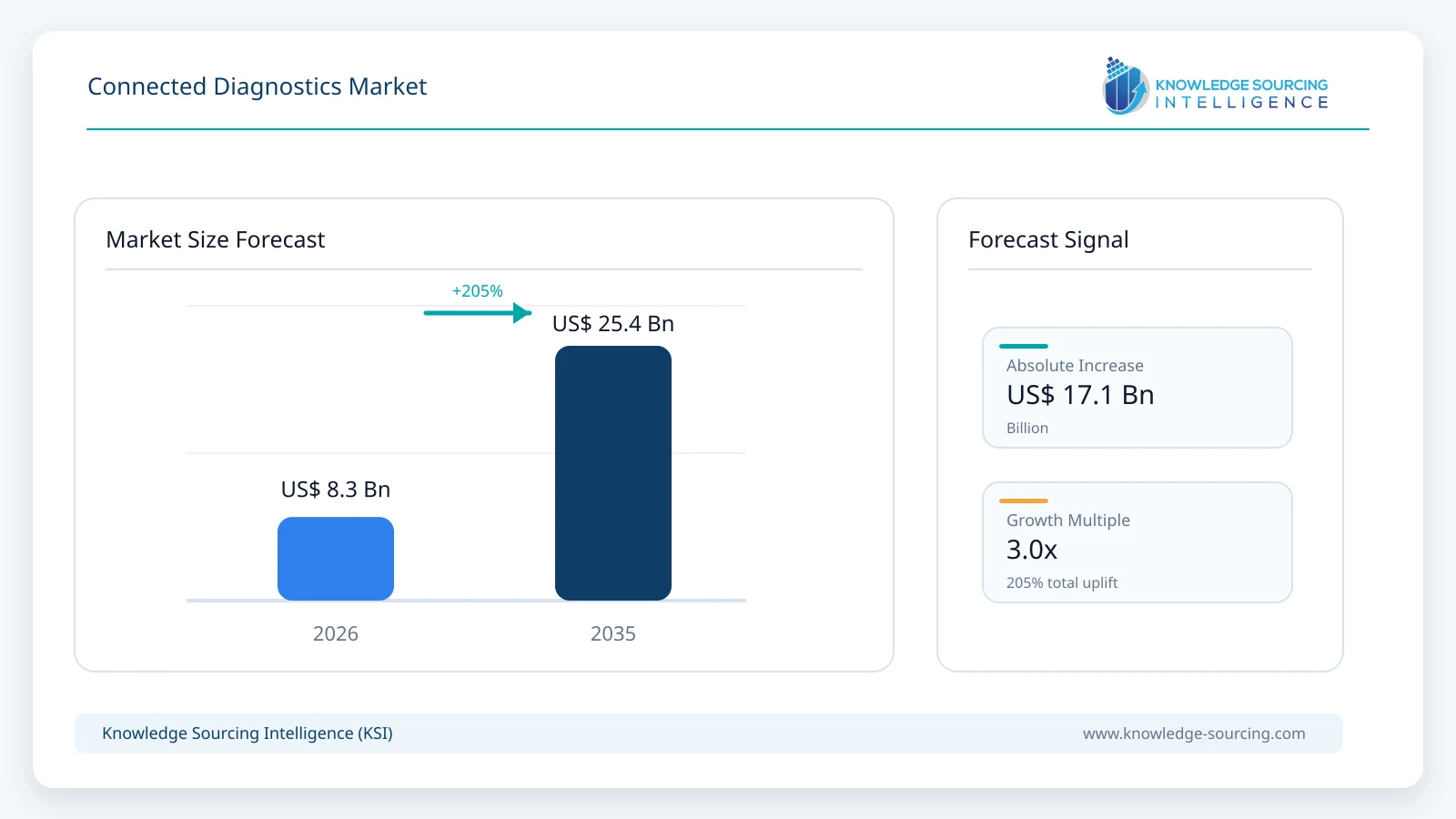
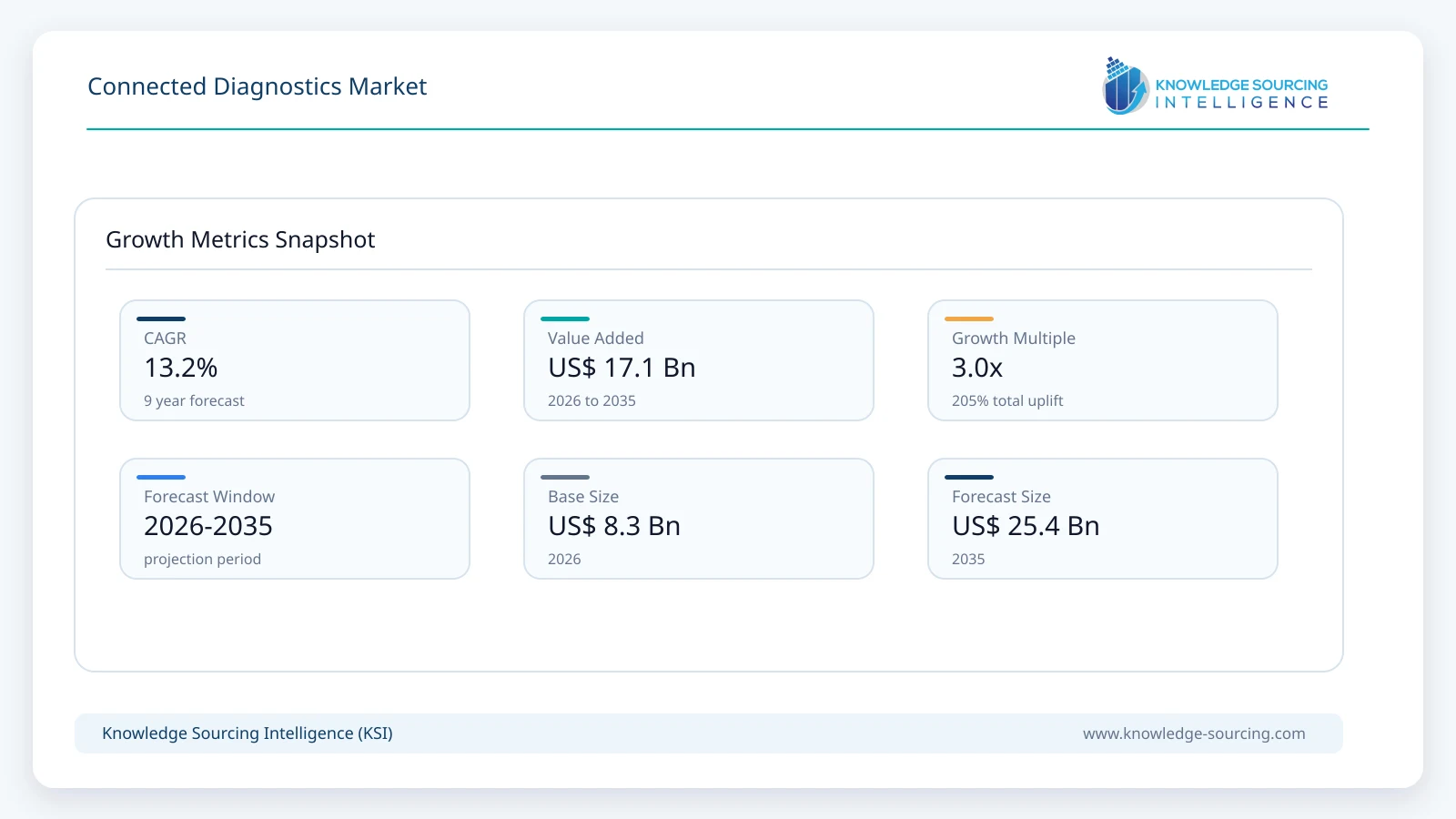
The Connected Diagnostics Market is forecast to increase at a CAGR of 13.2%, reaching USD 25.39 billion in 2035 from USD 8.33 billion in 2026.
Highlights:
- 1Growing adoption of decentralized healthcare is increasing demand for cloud-connected diagnostic platforms because healthcare providers require faster clinical decision-making beyond centralized laboratories.
- 2Expansion of electronic health record integration is strengthening demand for interoperable diagnostic systems because clinicians increasingly rely on unified patient information during treatment planning.
- 3Regulatory emphasis on cybersecurity and software lifecycle management is accelerating investment in secure connected diagnostic ecosystems because digital healthcare infrastructure requires continuous compliance.
- 4Artificial intelligence integration is improving diagnostic workflow efficiency because automated interpretation and clinical decision support reduce operational burden on healthcare professionals.
Connected diagnostics enables secure acquisition, transmission, storage, interpretation, and integration of diagnostic information across healthcare networks. The market encompasses connected laboratory analyzers, digital point-of-care testing systems, wearable diagnostic devices, cloud-based diagnostic software, and communication technologies that facilitate clinical decision support. Demand primarily originates from healthcare providers seeking faster clinical workflows, improved patient monitoring, and centralized management of distributed diagnostic assets.
Healthcare delivery increasingly depends on decentralized testing because hospitals, outpatient clinics, pharmacies, and home healthcare providers require diagnostic information closer to patients. Diagnostic manufacturers are expanding cloud-enabled product portfolios that support remote device monitoring, predictive maintenance, software updates, and centralized quality management. These developments reduce operational complexity while improving laboratory efficiency and device utilization.
Government digital health initiatives increasingly support connected healthcare infrastructure through electronic health record adoption, interoperability standards, cybersecurity regulations, and digital transformation funding. These regulatory developments encourage healthcare organizations to modernize diagnostic infrastructure while ensuring secure exchange of clinical information across healthcare networks. The resulting ecosystem strengthens disease surveillance, chronic disease management, telemedicine integration, and value-based healthcare delivery.
Connected diagnostics also supports pharmaceutical research, clinical trials, companion diagnostics, and real-world evidence generation because continuous diagnostic data improves patient stratification and treatment monitoring. This strategic importance continues expanding as precision medicine programs require integrated diagnostic information from multiple clinical environments throughout the patient care pathway.
Market Dynamics
Market Drivers
Expansion of Digital Healthcare Infrastructure: Healthcare delivery increasingly depends on interoperable digital infrastructure that supports rapid information exchange across hospitals, laboratories, outpatient facilities, and home care settings. Governments and healthcare providers are investing in electronic health records, health information exchanges, and secure clinical networks that require connected diagnostic solutions. Diagnostic manufacturers are integrating cloud connectivity and software services into laboratory instruments because healthcare organizations prioritize centralized management, remote maintenance, and real-time clinical visibility. This transition strengthens long-term demand for connected diagnostic ecosystems.
Rising Demand for Decentralized and Point-of-Care Testing: Healthcare providers increasingly perform diagnostic testing outside centralized laboratories because faster clinical decisions improve treatment efficiency and patient outcomes. Connected point-of-care platforms are enabling immediate transmission of test results into clinical information systems, reducing delays associated with manual reporting. Healthcare organizations continue expanding decentralized diagnostic programs because workforce shortages and growing patient volumes require efficient resource utilization. These operational requirements sustain investment in connected diagnostic platforms.
Increasing Burden of Chronic Disease Monitoring: Chronic diseases require continuous diagnostic assessment throughout disease progression rather than isolated laboratory evaluations. Healthcare providers are expanding remote monitoring programs because diabetes, cardiovascular disease, respiratory disorders, and oncology patients require longitudinal clinical data. Wearable diagnostic technologies and connected monitoring platforms are generating continuous physiological information that supports earlier intervention and personalized disease management. This clinical shift reinforces sustained demand for integrated diagnostic ecosystems.
Growing Importance of Laboratory Automation: Clinical laboratories prioritize workflow efficiency because testing volumes continue increasing while skilled laboratory workforce availability remains constrained. Connected diagnostic instruments support centralized monitoring, predictive maintenance, remote troubleshooting, and automated quality management across laboratory networks. Manufacturers are incorporating digital service platforms into diagnostic portfolios because laboratories increasingly evaluate total operational efficiency alongside analytical performance. This operational evolution strengthens demand for fully connected laboratory environments.
Market Restraints
High implementation costs associated with digital infrastructure integration, cybersecurity investment, and legacy system modernization limit adoption among resource-constrained healthcare organizations.
Regulatory requirements governing software validation, cybersecurity, interoperability, and patient data privacy increase development complexity and extend commercialization timelines.
Interoperability challenges between proprietary diagnostic platforms and heterogeneous hospital information systems continue restricting seamless clinical data exchange.
Market Opportunities
Expansion of Artificial Intelligence-Assisted Diagnostics: Artificial intelligence increasingly complements connected diagnostics because healthcare providers seek automated clinical interpretation alongside rapid data transmission. Manufacturers are integrating AI-enabled decision support into connected diagnostic platforms to improve workflow efficiency, prioritize abnormal findings, and support clinical decision-making. These developments create opportunities for software-centric business models while expanding recurring digital service revenues.
Growth of Remote Patient Monitoring Ecosystems: Healthcare systems increasingly manage chronic diseases beyond hospital settings because home-based care reduces healthcare utilization while supporting continuous patient engagement. Connected wearable diagnostics are enabling real-time physiological monitoring integrated with telemedicine platforms and electronic health records. Healthcare providers continue adopting these models because longitudinal patient information improves treatment optimization and early intervention strategies.
Increasing Adoption of Companion Diagnostics: Precision medicine requires integrated diagnostic information that guides therapeutic selection throughout disease management. Pharmaceutical companies are expanding biomarker-driven drug development while diagnostic manufacturers are developing connected platforms capable of securely transmitting molecular diagnostic information across clinical networks. This collaborative ecosystem strengthens opportunities for connected diagnostics within oncology, rare diseases, and personalized medicine programs.
Development of National Digital Health Platforms: Governments increasingly implement national digital health programs that prioritize interoperability, electronic medical records, and secure health information exchange. Diagnostic manufacturers are aligning product development with standardized connectivity frameworks because healthcare organizations require scalable digital infrastructure across public health systems. These national initiatives continue creating long-term procurement opportunities for connected diagnostic technologies.
Disease & Epidemiology Analysis
Connected diagnostics increasingly supports disease management where continuous clinical information influences therapeutic decisions rather than isolated diagnostic events. Infectious diseases remain a major application because rapid transmission of laboratory results strengthens outbreak surveillance, antimicrobial stewardship, and coordinated public health responses. Healthcare systems continue integrating connected molecular diagnostics into surveillance programs because real-time reporting improves epidemiological monitoring and accelerates containment strategies.
Chronic diseases account for a growing proportion of connected diagnostic utilization because diabetes, cardiovascular disease, respiratory disorders, and oncology require repeated biomarker assessment throughout treatment. Healthcare providers are expanding remote monitoring pathways that combine wearable diagnostics, connected point-of-care devices, and laboratory testing to maintain longitudinal patient records. These integrated care models improve disease progression assessment while supporting personalized therapeutic interventions across diverse clinical settings.
Treatment Guidelines Landscape
Organization | Guideline/Framework | Relevance to Connected Diagnostics | Market Impact |
World Health Organization (WHO) | Digital Health Guidelines and Global Strategy on Digital Health | Promotes integration of digital technologies into healthcare delivery and encourages interoperable health information systems. | Supports adoption of connected diagnostic platforms within national healthcare systems. |
U.S. Food and Drug Administration (FDA) | Software as a Medical Device (SaMD), Cybersecurity Guidance for Medical Devices, Digital Health policies | Defines expectations for software validation, cybersecurity, lifecycle management, and connected medical devices. | Encourages manufacturers to invest in secure cloud-enabled diagnostic ecosystems while increasing regulatory compliance requirements. |
European Commission / Medical Device Regulation (MDR) & In Vitro Diagnostic Regulation (IVDR) | MDR (EU 2017/745) and IVDR (EU 2017/746) | Establishes performance, safety, cybersecurity, software validation, and post-market surveillance requirements for connected diagnostic devices. | Increases development rigor while strengthening confidence in connected diagnostic technologies. |
Market Segmentation
By Product Type
Connected point-of-care devices enable diagnostic testing closer to patients while maintaining integration with hospital information systems and laboratory networks. Healthcare providers are expanding adoption because rapid clinical decisions reduce treatment delays and improve operational efficiency in emergency departments, outpatient clinics, pharmacies, and community healthcare settings. Device manufacturers are incorporating wireless connectivity, cloud synchronization, and automated quality management to support distributed testing environments. This evolution positions connected POC diagnostics as a critical component of decentralized healthcare delivery.
By Connectivity Technology
Cellular connectivity enables diagnostic devices to transmit clinical information independently of local network infrastructure, making it suitable for ambulatory care, remote monitoring, emergency response, and rural healthcare delivery. Healthcare organizations are increasing deployment because reliable real-time communication supports continuous patient management beyond hospitals. Technology providers continue integrating secure cellular communication, remote software management, and cloud analytics into diagnostic platforms. These capabilities strengthen scalability while supporting national telehealth and digital health initiatives.
By Application
Connected diagnostics plays a central role in infectious disease management because rapid reporting enables timely treatment decisions and public health surveillance. Healthcare systems are integrating molecular diagnostics, connected laboratory analyzers, and point-of-care testing platforms into disease monitoring networks to improve outbreak detection and epidemiological reporting. Diagnostic manufacturers continue strengthening interoperability with laboratory information systems and national surveillance databases. These developments enhance coordinated responses to emerging infectious disease threats while improving laboratory efficiency.
Regional Analysis
North America Market Analysis
North America represents the most mature connected diagnostics ecosystem because healthcare providers maintain high digital infrastructure adoption, advanced laboratory automation, and widespread implementation of electronic health records. Healthcare organizations are expanding investments in interoperable diagnostic platforms as value-based healthcare models increasingly reward coordinated patient management and longitudinal clinical data integration. This transition creates sustained demand for connected laboratory systems, wearable diagnostics, and cloud-enabled diagnostic software capable of supporting real-time clinical decision-making. The regulatory environment supports digital innovation while maintaining stringent safety expectations for software-enabled medical devices. Manufacturers are investing heavily in cybersecurity, artificial intelligence, interoperability standards, and remote device management because compliance requirements continue evolving alongside digital healthcare adoption.
European Market Analysis
European demand is driven by healthcare digitalization, interoperability initiatives, and regulatory harmonization under the Medical Device Regulation and In Vitro Diagnostic Regulation. Healthcare providers increasingly modernize laboratory infrastructure because integrated clinical information supports more efficient healthcare delivery across publicly funded systems. Diagnostic manufacturers are expanding cloud-enabled laboratory informatics, connected molecular diagnostics, and enterprise imaging platforms to align with evolving digital health priorities. National governments continue investing in electronic health records, health information exchange platforms, and secure healthcare infrastructure while emphasizing patient privacy and cybersecurity. These regulatory priorities encourage manufacturers to develop standardized connected diagnostic solutions capable of supporting cross-border interoperability and long-term lifecycle management. Healthcare organizations increasingly evaluate digital maturity alongside analytical performance during procurement decisions.
Asia Pacific Market Analysis
Asia Pacific demonstrates the fastest structural expansion in connected diagnostics because healthcare capacity, digital infrastructure, and chronic disease management programs continue evolving simultaneously. Governments are investing in national digital health architectures that integrate electronic medical records, telemedicine platforms, laboratory information systems, and connected medical devices. Healthcare providers are adopting cloud-enabled diagnostic platforms because growing patient volumes require faster clinical workflows and improved coordination across hospitals, community clinics, and remote healthcare facilities. This transition increases demand for scalable connected diagnostic ecosystems capable of supporting both urban tertiary hospitals and decentralized healthcare delivery. Rapid urbanization, population aging, and the increasing prevalence of diabetes, cardiovascular disease, respiratory disorders, and cancer continue expanding diagnostic testing volumes. Healthcare organizations are deploying connected point-of-care devices and wearable diagnostics because continuous patient monitoring reduces dependence on repeated hospital visits while improving disease management.
Rest of the World
Healthcare modernization remains the primary demand catalyst across Latin America, the Middle East, and Africa because governments continue strengthening diagnostic capacity while expanding access to digital healthcare services. Healthcare providers increasingly recognize that connected diagnostics improves operational efficiency, disease surveillance, and continuity of care across geographically dispersed populations. Diagnostic manufacturers are introducing cloud-enabled solutions because centralized monitoring supports healthcare delivery where specialist resources remain limited. This operational requirement strengthens adoption beyond traditional laboratory environments. Public health agencies continue expanding infectious disease surveillance programs that depend on timely diagnostic reporting and integrated health information systems. Connected molecular diagnostics and portable diagnostic platforms are supporting national disease monitoring initiatives because real-time reporting improves epidemiological response and healthcare resource allocation.
Regulatory Landscape
Connected diagnostics operates within an increasingly software-focused regulatory environment where cybersecurity, interoperability, data integrity, and lifecycle management receive the same regulatory attention as analytical performance. Regulatory authorities require manufacturers to demonstrate that connected diagnostic systems maintain clinical accuracy while protecting patient information throughout device operation. This regulatory evolution encourages companies to integrate secure software development, continuous monitoring, and post-market cybersecurity management into product development strategies rather than treating connectivity as an auxiliary feature.
The U.S. Food and Drug Administration continues refining guidance for Software as a Medical Device (SaMD), cybersecurity risk management, artificial intelligence-enabled medical devices, and connected healthcare technologies. These regulatory expectations encourage manufacturers to establish comprehensive software validation, vulnerability management, and post-market surveillance processes before commercialization. Connected diagnostic developers increasingly incorporate secure cloud infrastructure, encrypted communication protocols, and automated software update capabilities because regulatory compliance extends throughout the product lifecycle.
European regulatory oversight under the Medical Device Regulation (MDR) and In Vitro Diagnostic Regulation (IVDR) continues strengthening evidence requirements for connected diagnostic platforms. Manufacturers are expanding investments in clinical performance evaluation, usability engineering, interoperability validation, and quality management because digital functionality increasingly influences regulatory review. International harmonization initiatives through organizations such as the International Medical Device Regulators Forum (IMDRF) further support globally aligned regulatory approaches, allowing multinational manufacturers to streamline development while maintaining regional compliance.
Pipeline Analysis
Connected diagnostics development pipelines increasingly combine hardware innovation with digital software capabilities rather than focusing exclusively on analytical instrumentation. Manufacturers are expanding cloud-connected laboratory analyzers, molecular diagnostic platforms, wearable biosensors, and artificial intelligence-enabled clinical software because healthcare providers require integrated diagnostic ecosystems instead of isolated testing devices. Development strategies increasingly emphasize interoperability with electronic health records, laboratory information systems, and remote patient monitoring platforms, reflecting broader healthcare digitalization trends.
Major diagnostic companies continue strengthening digital ecosystems through software upgrades, cloud services, enterprise informatics platforms, and connected workflow management rather than introducing standalone diagnostic instruments alone. Roche continues expanding the navify digital health portfolio that integrates laboratory data with clinical decision support. Siemens Healthineers continues advancing digital enterprise solutions supporting laboratory diagnostics and imaging connectivity. Abbott continues expanding connected diabetes management and cardiovascular monitoring platforms that combine diagnostic data with remote patient management. Philips, GE HealthCare, and QIAGEN continue enhancing enterprise informatics, cloud connectivity, and remote diagnostic capabilities across their respective product portfolios.
Reimbursement Landscape
Reimbursement for connected diagnostics increasingly depends on demonstrated clinical value rather than device connectivity alone. Healthcare payers evaluate whether connected diagnostic platforms improve patient outcomes, reduce avoidable hospital utilization, accelerate diagnosis, or enhance chronic disease management before expanding reimbursement pathways. Manufacturers are generating real-world clinical evidence because value-based healthcare models increasingly reward technologies that demonstrate measurable improvements in healthcare efficiency and patient management.
Remote patient monitoring reimbursement policies, digital health reimbursement programs, and value-based care initiatives continue supporting adoption of connected diagnostic technologies across several healthcare systems. Healthcare providers are incorporating connected diagnostic services into integrated care pathways because continuous clinical monitoring supports earlier intervention while reducing long-term treatment costs. As reimbursement frameworks increasingly recognize digital healthcare services alongside conventional diagnostics, connected diagnostic ecosystems are becoming more economically sustainable for both providers and manufacturers.
Competitive Landscape
Abbott Laboratories
Abbott Laboratories differentiates itself through the combination of diagnostics, medical devices, cardiovascular monitoring, diabetes management, and digital health technologies within a unified healthcare ecosystem. The company continues expanding connectivity across its diagnostic instruments and remote patient monitoring platforms because healthcare providers increasingly require continuous clinical visibility rather than episodic diagnostic testing.
Roche Diagnostics
Roche Diagnostics maintains strategic leadership through its integration of molecular diagnostics, laboratory automation, digital pathology, companion diagnostics, and enterprise informatics. The company continues strengthening the navify® digital ecosystem because healthcare providers increasingly demand interoperable clinical workflows that integrate laboratory results, imaging, pathology, and treatment planning.
Siemens Healthineers
Siemens Healthineers differentiates itself through enterprise-wide healthcare digitalization that combines laboratory diagnostics, imaging, artificial intelligence, and digital workflow management. The company continues integrating connected diagnostics with enterprise imaging and hospital information systems because healthcare providers increasingly seek comprehensive operational visibility across clinical departments.
GE HealthCare
GE HealthCare leverages its extensive imaging portfolio and digital healthcare expertise to develop connected diagnostic ecosystems centered on enterprise imaging, artificial intelligence, and cloud-based clinical workflows. The company continues strengthening interoperability because healthcare organizations increasingly integrate imaging diagnostics with laboratory information and electronic medical records.
Koninklijke Philips N.V.
Koninklijke Philips N.V. differentiates itself by integrating connected diagnostics with patient monitoring, clinical informatics, telehealth, and enterprise-wide digital healthcare platforms. The company continues expanding cloud-enabled healthcare solutions because providers increasingly require continuous patient data across acute, ambulatory, and home care settings.
Danaher Corporation
Danaher Corporation maintains a strong competitive position through its life sciences and diagnostics portfolio, supported by subsidiaries including Beckman Coulter Diagnostics and Cepheid. The company continues integrating digital workflow management with laboratory automation because healthcare providers increasingly require standardized, high-throughput diagnostic operations across centralized and decentralized laboratory environments.
Key Developments
October 2025: BD introduced the BD Incada Connected Care Platform and the next-generation Pyxis Pro Automated Medication Dispensing Solution. The AI-enabled, cloud-based platform unifies device data across healthcare settings to improve connectivity, workflow visibility, and analytics.
June 2025: Amazon India unveiled Amazon Diagnostics, an at-home diagnostics service that lets customers book lab tests, schedule sample collection, and access digital reports through the Amazon app. The service launched with Orange Health Labs in six cities across 450+ pin codes.
Strategic Insights and Future Market Outlook
Connected diagnostics is evolving from an equipment-oriented market into an integrated healthcare information ecosystem where software, interoperability, and clinical intelligence increasingly determine purchasing decisions. Healthcare providers continue modernizing digital infrastructure because fragmented diagnostic information limits coordinated care, delays therapeutic intervention, and increases operational complexity. Manufacturers are responding by integrating cloud computing, artificial intelligence, cybersecurity, and enterprise informatics into diagnostic portfolios, transforming connected diagnostics into a recurring digital service model alongside conventional hardware sales.
Future competition will increasingly depend on ecosystem scalability rather than individual product performance. Diagnostic companies are expanding strategic collaborations with healthcare providers, pharmaceutical organizations, cloud technology companies, and health information platform developers because integrated care models require seamless exchange of clinical information across diverse healthcare environments.
Regulatory expectations surrounding cybersecurity, software lifecycle management, interoperability, and artificial intelligence validation will continue shaping innovation priorities across the industry. Manufacturers that successfully combine regulatory compliance with scalable digital ecosystems are likely to strengthen long-term competitive positioning because healthcare organizations increasingly evaluate technology partners based on their ability to support enterprise-wide digital transformation rather than isolated diagnostic performance.
Connected diagnostics represents a structural transformation in healthcare delivery where diagnostic information increasingly functions as a continuously accessible clinical asset instead of a standalone laboratory result. As healthcare systems continue integrating digital infrastructure, cloud connectivity, and data-driven clinical decision support, demand for secure, interoperable, and software-enabled diagnostic ecosystems is expected to remain resilient across hospitals, laboratories, outpatient facilities, and home healthcare environments.
Connected Diagnostics Market Scope:
| Report Metric | Details |
|---|---|
| Total Market Size in 2026 | USD 8.33 billion |
| Total Market Size in 2035 | USD 25.39 billion |
| Forecast Unit | USD Billion |
| Growth Rate | 13.2% |
| Study Period | 2021 to 2035 |
| Historical Data | 2021 to 2024 |
| Base Year | 2025 |
| Forecast Period | 2026 – 2035 |
| Segmentation | Product Type, Technology, Connectivity Technology, Application, End User, Geography |
| Companies |
|
Market Segmentation
Product Type
Technology
Connectivity Technology, Application, End User
Geography
- North America
- South America
- Europe
- Middle East and Africa
- Asia Pacific
Table of Contents
1. EXECUTIVE SUMMARY
1.1 Market Snapshot
1.2 Key Findings
1.3 Analyst Insights
1.4 Strategic Recommendations
2. RESEARCH METHODOLOGY
2.1 Research Design
2.2 Data Collection Methodology
2.3 Market Size Estimation
2.4 Forecasting Model
2.5 Assumptions & Limitations
3. CONNECTED DIAGNOSTICS MARKET OVERVIEW, SIZE & FORECAST
3.1 Market Definition & Scope
3.2 Industry Overview
3.3 Industry Evolution
3.4 Key Market Trends
3.5 Historical Market Size Analysis (2021–2025)
3.6 Market Forecast (2026–2035)
3.7 Connected Diagnostics Ecosystem
3.8 Connected Diagnostic Testing Workflow
3.9 Healthcare Digital Infrastructure & Connectivity Landscape
3.10 Adoption of Cloud-Based Diagnostic Platforms
3.11 Interoperability Standards and Data Exchange
3.12 Remote Diagnostic Care Pathway Analysis
4. MARKET DYNAMICS
4.1 Market Drivers
4.2 Market Restraints
4.3 Market Opportunities
4.4 Market Challenges
5. INDUSTRY LANDSCAPE
5.1 Industry Value Chain Analysis
5.2 Pricing Analysis
5.3 Reimbursement Landscape
6. INNOVATION LANDSCAPE
6.1 Emerging Technologies
6.2 Connected Diagnostic Device Innovation
6.3 AI-Enabled Diagnostic Decision Support
6.4 Digital Health Integration
6.5 Cloud and Edge Computing Integration
6.6 Internet of Medical Things (IoMT) Integration
6.7 Cybersecurity and Data Protection Technologies
6.8 Clinical Trial Analysis
6.9 Pipeline Analysis
6.10 Technology Roadmap
7. REGULATORY LANDSCAPE
7.1 Regulatory Framework
7.2 Approval Pathways
7.3 Compliance Requirements
8. CONNECTED DIAGNOSTICS MARKET LANDSCAPE ANALYSIS
8.1 Analysis by Technology Platform
8.2 Analysis by Connectivity Technology
8.3 Analysis by Diagnostic Modality
8.4 Analysis by Deployment Model
8.5 Analysis by Clinical Application
8.6 Analysis by End-user Environment
9. CONNECTED DIAGNOSTICS MARKET SEGMENT ANALYSIS (2021–2035)
9.1 By Product Type
9.1.1 Connected Diagnostic Instruments
9.1.2 Connected Point-of-Care (POC) Devices
9.1.3 Wearable Diagnostic Devices
9.1.4 Diagnostic Software Platforms
9.1.5 Others
9.2 By Technology
9.2.1 Cloud-Based Diagnostics
9.2.2 Edge Computing Diagnostics
9.2.3 Artificial Intelligence & Machine Learning
9.2.4 Others
9.3 By Connectivity Technology
9.3.1 Wi-Fi
9.3.2 Bluetooth
9.3.3 Cellular (4G/5G)
9.3.4 Near Field Communication (NFC)
9.3.5 Other Connectivity Technologies
9.4 By Application
9.4.1 Infectious Diseases
9.4.2 Diabetes Management
9.4.3 Cardiovascular Diseases
9.4.4 Oncology
9.4.5 Respiratory Diseases
9.4.6 Women's Health
9.4.7 Other Clinical Applications
9.5 By End User
9.5.1 Hospitals
9.5.2 Diagnostic Laboratories
9.5.3 Physician Offices & Clinics
9.5.4 Home Healthcare Settings
9.5.5 Others
10. CONNECTED DIAGNOSTICS MARKET GEOGRAPHICAL ANALYSIS (2021–2035)
10.1 North America
10.2 Europe
10.3 Asia-Pacific
10.4 South America
10.5 Middle East & Africa
11. CONNECTED DIAGNOSTICS MARKET COUNTRY ANALYSIS (2021–2035)
11.1 United States
11.2 Canada
11.3 Germany
11.4 United Kingdom
11.5 France
11.6 Italy
11.7 Spain
11.8 Japan
11.9 China
11.10 India
11.11 South Korea
11.12 Australia
11.13 Brazil
11.14 Mexico
11.15 Saudi Arabia
11.16 United Arab Emirates
12. COMPETITIVE LANDSCAPE
12.1 Market Share Analysis
12.2 Strategic Developments
12.3 Mergers & Acquisitions, Partnerships & Collaborations
12.4 Product Launches
13. COMPANY PROFILES
13.1 Abbott Laboratories
13.1.1 Company Overview
13.1.2 Financials
13.1.3 Product Portfolio
13.1.4 Recent Developments
13.2 Roche Diagnostics
13.3 Siemens Healthineers
13.4 GE HealthCare
13.5 Koninklijke Philips N.V.
13.6 Danaher Corporation
13.7 Becton, Dickinson and Company (BD)
13.8 bioMérieux
13.9 QIAGEN N.V.
13.10 Agilent Technologies Inc.
14. CONNECTED DIAGNOSTICS MARKET COMMERCIAL FORECAST ANALYSIS
14.1 Connected Point-of-Care Diagnostics
14.2 Connected Molecular Diagnostics
14.3 Connected Immunodiagnostics
14.4 Connected Glucose Monitoring Diagnostics
14.5 Connected Cardiac Diagnostics
14.6 Connected Wearable Diagnostics
14.7 AI-Enabled Diagnostic Software Platforms
14.8 Remote Diagnostic Monitoring Solutions
15. INVESTMENT & FUNDING ANALYSIS
15.1 Venture Capital Trends
15.2 Government Funding
15.3 R&D Investments
16. FUTURE OUTLOOK
16.1 Key Growth Opportunities
16.2 Future Industry Trends
Navigate
Trusted by the world's leading organizations











