
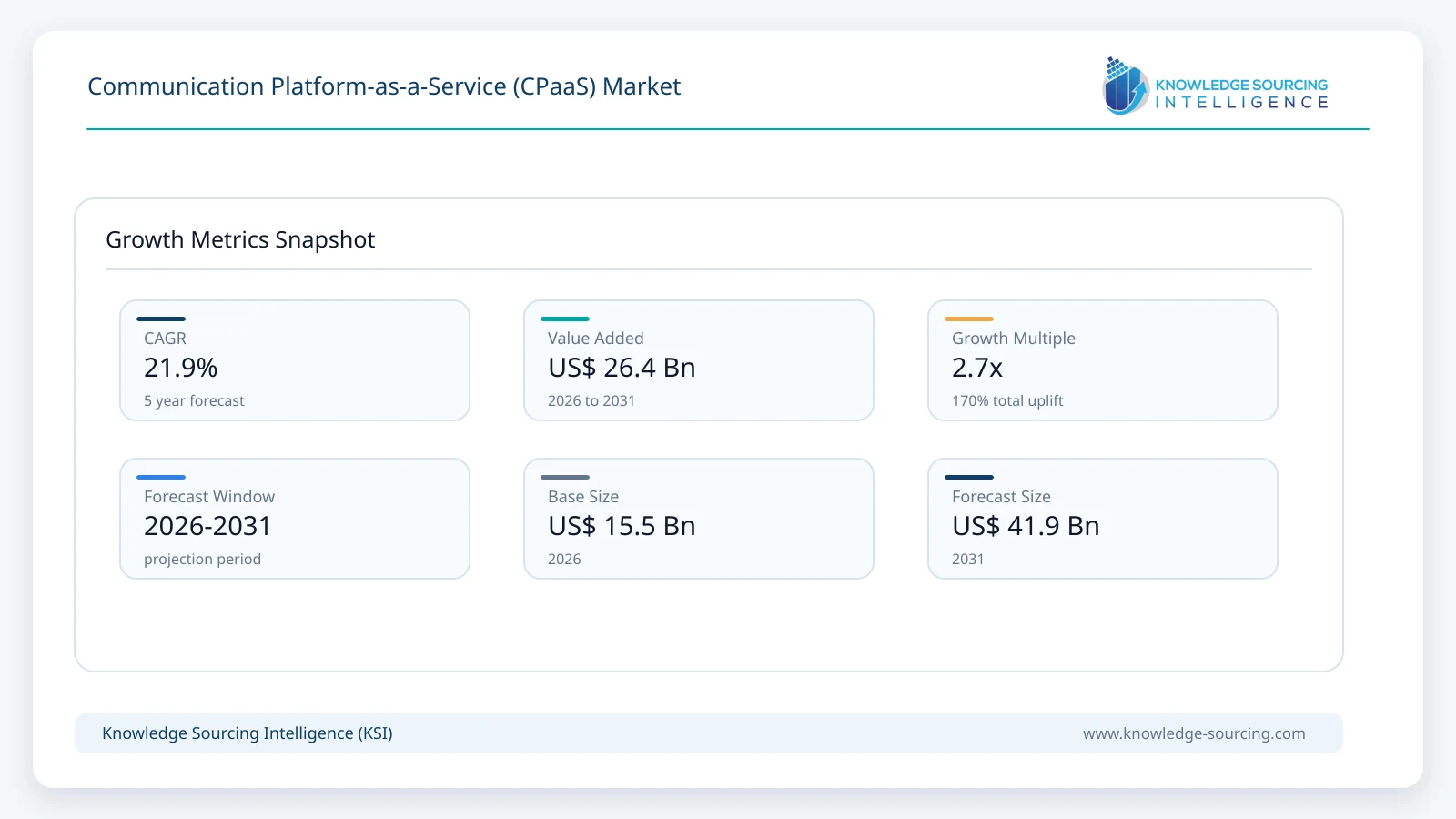
The Communication Platform-as-a-Service (CPaaS) Market is forecast to grow at a CAGR of 21.95%, reaching USD 41.88 billion in 2031 from USD 15.53 billion in 2026.
Highlights:
- 1Rising enterprise demand for omnichannel customer engagement continues to expand CPaaS deployment across customer service, marketing, and authentication applications.
- 2Messaging remains the leading application due to widespread adoption of SMS, rich messaging, one-time passwords (OTPs), and customer notifications.
- 3Asia Pacific presents substantial expansion opportunities as mobile-first businesses and digital payment ecosystems accelerate enterprise communication requirements.
- 4AI-enabled conversational interfaces, intelligent routing, and communication analytics are becoming important purchasing considerations for enterprise customers.
- 5Data privacy regulations, telecommunications compliance requirements, and digital identity standards increasingly influence vendor selection and platform architecture.
- 6Competition is shifting toward integrated communication ecosystems supported by global carrier relationships, developer tools, and industry-specific solutions.
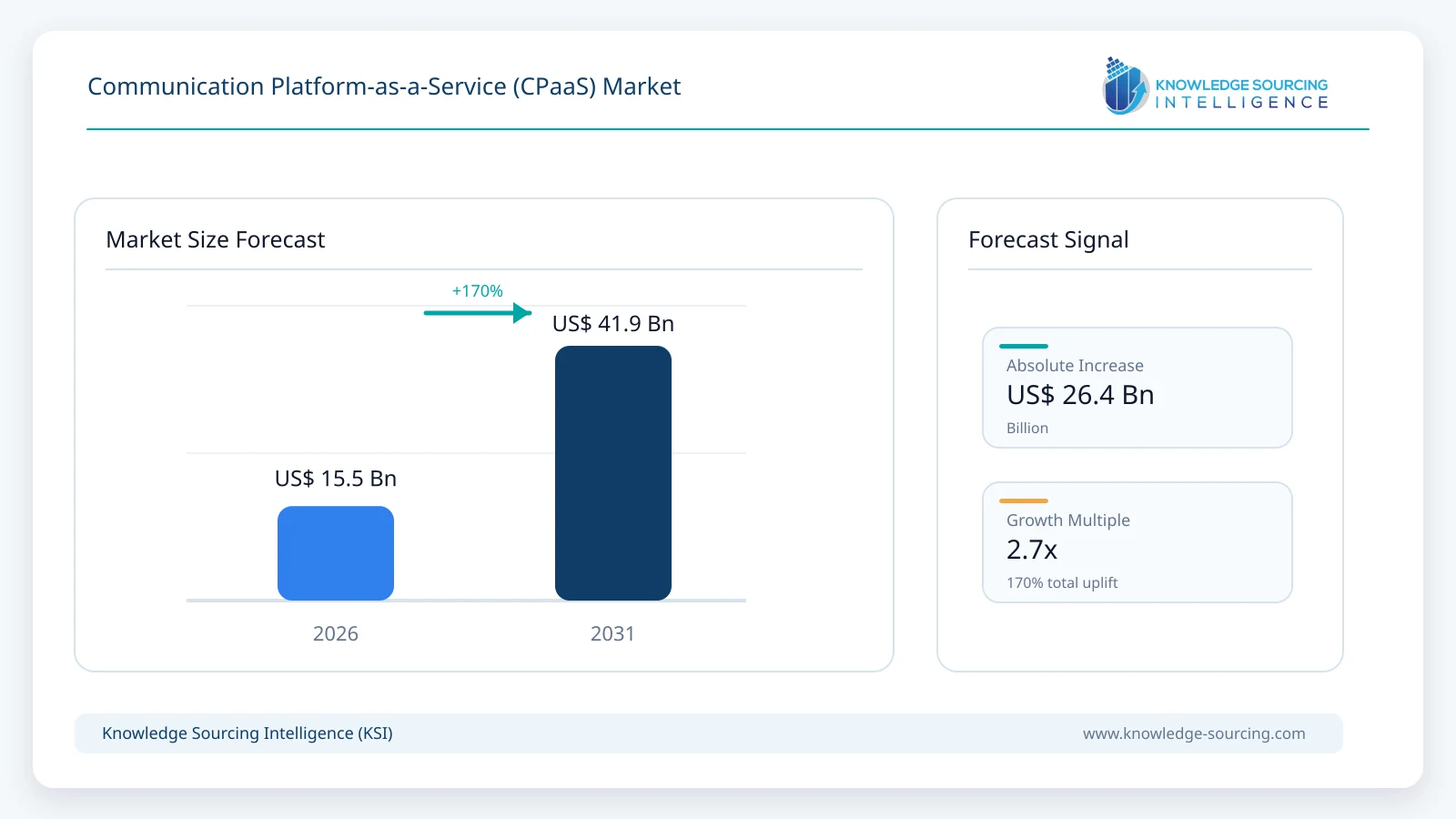
Communication Platform-as-a-Service (CPaaS) refers to cloud-based application programming interface (API) platforms that enable enterprises to embed real-time communication capabilities such as messaging, voice, video, email, authentication, and customer notifications directly into business applications without building underlying telecommunications infrastructure. CPaaS has become an essential component of enterprise communication architecture as organizations seek scalable customer engagement channels across mobile applications, websites, contact centers, and connected devices.
Demand is being driven by organizations seeking to improve customer response times, automate interactions, and support digital communication across multiple channels. Businesses increasingly expect communications to be integrated into operational workflows rather than relying on standalone communication tools. This has expanded CPaaS adoption beyond technology companies to sectors including banking, healthcare, retail, logistics, manufacturing, and public services.
Enterprise buyers prioritize reliability, global message delivery, API flexibility, compliance capabilities, analytics, and integration with customer relationship management (CRM), enterprise resource planning (ERP), and contact center platforms. Procurement decisions increasingly consider geographic coverage, carrier partnerships, pricing transparency, service-level agreements, and security certifications alongside communication quality.
The industry structure consists of global CPaaS platform providers, telecommunications operators, cloud infrastructure companies, systems integrators, and software developers. Vendors compete through programmable APIs, omnichannel communication capabilities, geographic connectivity, developer ecosystems, and value-added services such as conversational AI, authentication, fraud prevention, and customer engagement analytics. Revenue generation increasingly comes from usage-based pricing models that scale with message volumes, API calls, and communication sessions, allowing customers to align communication expenses with business activity.
The growing adoption of cloud-native applications, mobile commerce, remote customer service, and digital identity verification continues to expand the commercial relevance of CPaaS platforms. Organizations increasingly view programmable communications as operational infrastructure rather than discretionary software investment, supporting sustained enterprise deployment across industries.
Market Drivers
Growing customer expectations for immediate digital engagement remain one of the strongest demand catalysts. Consumers increasingly expect order confirmations, appointment reminders, payment alerts, delivery updates, and customer support through familiar digital channels. Enterprises therefore require programmable communication platforms capable of handling large communication volumes while maintaining delivery quality. CPaaS providers continue expanding API portfolios, communication channels, and automation capabilities to address these enterprise requirements, creating recurring revenue opportunities through transaction-based pricing.
The expansion of cloud-native enterprise software is strengthening CPaaS adoption across industries. Organizations modernizing business applications increasingly prefer modular cloud services instead of building proprietary communication infrastructure. CPaaS APIs simplify software development while reducing deployment time and ongoing infrastructure maintenance. Software vendors also integrate communication capabilities directly into enterprise applications, expanding CPaaS consumption through embedded business software.
Digital identity verification and fraud prevention requirements are creating additional commercial opportunities. Financial institutions, e-commerce companies, healthcare organizations, and government agencies rely heavily on secure authentication methods including one-time passwords, verification messages, and multi-factor authentication. Increasing cyber threats have elevated investment in trusted communication channels capable of supporting secure customer verification while meeting regulatory compliance obligations.
International business expansion has increased demand for globally connected communication platforms. Enterprises operating across multiple countries require consistent messaging quality, local regulatory compliance, multilingual capabilities, and carrier connectivity. CPaaS vendors continue investing in direct carrier partnerships, regional data infrastructure, and localized communication services to strengthen international enterprise adoption.
Market Restraints and Challenges
Regulatory complexity remains a major operational challenge. Telecommunications regulations, data residency requirements, consent management rules, and privacy legislation vary considerably across jurisdictions. Enterprises operating internationally must ensure communication practices comply with regional regulations, increasing implementation complexity and compliance costs. Vendors continue expanding compliance tools, regional hosting options, and regulatory advisory services to reduce customer risk.
Pricing pressure resulting from commoditized messaging services affects profitability. Basic messaging APIs often face intense price competition, particularly in mature markets where multiple providers offer comparable delivery capabilities. Vendors increasingly differentiate through premium services including AI-enabled customer engagement, advanced analytics, fraud detection, workflow automation, and omnichannel communication orchestration to improve margins.
Communication fraud and spam continue affecting enterprise confidence. Artificial traffic generation, SMS fraud, spoofing, phishing attacks, and fraudulent authentication requests increase operational costs while reducing customer trust. Platform providers invest heavily in traffic monitoring, identity verification technologies, machine learning-based fraud detection, and carrier collaboration to protect communication integrity.
Dependence on telecommunications networks introduces operational risks outside direct vendor control. Carrier outages, regional network disruptions, message filtering, and cross-border delivery restrictions can affect service quality. Enterprises therefore increasingly evaluate provider redundancy, geographic network diversity, and service-level commitments during procurement processes.
Major Segment Analysis
Messaging represents the most commercially significant application segment within the CPaaS market because it supports high-volume customer interactions across industries while delivering measurable operational efficiency. SMS, rich messaging, authentication messages, promotional campaigns, transactional notifications, and customer support communications generate consistent enterprise demand throughout the customer lifecycle.
Buyer priorities extend beyond message delivery to include delivery assurance, geographic reach, regulatory compliance, campaign analytics, API simplicity, and integration with enterprise software platforms. Organizations increasingly require communication orchestration that combines SMS with messaging applications, email, push notifications, and conversational channels according to customer preferences and regional communication habits.
Competition within messaging platforms increasingly focuses on communication quality rather than simply message pricing. Providers differentiate through direct carrier connectivity, intelligent routing, fraud prevention, delivery optimization, AI-assisted customer interactions, and omnichannel engagement capabilities. Vendors capable of supporting enterprise-scale messaging while maintaining compliance across multiple jurisdictions are positioned to secure long-term customer relationships.
The commercial importance of messaging also reflects its recurring transaction volumes, making it an important contributor to platform revenue. Growth in digital banking, healthcare scheduling, e-commerce fulfillment, and identity verification continues supporting sustained enterprise messaging demand.
Regional Analysis
North America represents a mature CPaaS market supported by widespread cloud adoption, advanced enterprise software deployment, established telecommunications infrastructure, and high demand for programmable customer engagement solutions. Financial services, healthcare, technology companies, and digital commerce organizations continue expanding communication automation investments. Buyers emphasize regulatory compliance, cybersecurity, integration capabilities, and communication reliability.
Europe maintains strong enterprise demand supported by digital business modernization and extensive adoption of cloud communication platforms. Privacy regulations encourage investment in secure communication infrastructure and compliant customer engagement solutions. Enterprises increasingly evaluate vendors based on data governance capabilities, regional hosting options, and interoperability with existing enterprise applications.
Asia Pacific demonstrates strong commercial momentum due to expanding digital commerce, mobile-first consumers, financial technology growth, and accelerating enterprise cloud adoption. Businesses increasingly deploy CPaaS platforms to support customer acquisition, digital payments, logistics, healthcare communication, and government digital services. Regional diversity, however, requires localized communication strategies and regulatory adaptation.
Middle East & Africa continues expanding through government digital initiatives, financial sector modernization, telecommunications investment, and rising smartphone adoption. Communication platforms increasingly support public services, banking, retail, and healthcare applications. Infrastructure disparities across countries remain a constraint, although investment in cloud services continues improving market accessibility.
South America presents growing opportunities as enterprises expand digital customer engagement and cloud software adoption. Banking, retail, logistics, and telecommunications sectors increasingly utilize programmable communications to improve customer service and operational efficiency. Economic volatility and varying regulatory frameworks may influence enterprise investment timing, but long-term communication digitization remains favorable.
Competitive Landscape
The CPaaS market combines established telecommunications providers with cloud communication specialists competing across enterprise software ecosystems. Competition increasingly centers on API quality, global connectivity, developer experience, communication reliability, compliance capabilities, and value-added communication intelligence rather than basic messaging services alone.
Providers including Bandwidth Inc., Alcatel-Lucent Enterprise, Infobip Ltd., Twilio Inc., Vonage (Ericsson), MessageBird B.V., Plivo Inc., Sinch AB, Tata Communications Limited, and 8x8, Inc. continue expanding platform capabilities through strategic partnerships, carrier relationships, AI integration, geographic infrastructure investments, and enterprise software interoperability. Vendors also pursue acquisitions and technology partnerships to broaden omnichannel communication portfolios while strengthening regional market presence and industry-specific capabilities.
Recent Developments
February 2026: Sinch AB introduced expanded AI-powered conversational messaging capabilities supporting enterprise customer engagement across multiple communication channels. The enhancement strengthens automation opportunities while improving customer interaction efficiency.
October 2025: Twilio Inc. expanded customer engagement capabilities through additional artificial intelligence functionality within its communications platform. The development supports enterprise demand for automated customer communication workflows and personalized engagement.
September 2025: Vonage, an Ericsson company, announced enhancements to its network APIs and programmable communication portfolio supporting enterprise developers. The initiative strengthens interoperability between telecommunications networks and cloud-based business applications.
Regulatory and Policy Environment
The CPaaS industry operates within a regulatory framework that combines telecommunications legislation, privacy requirements, cybersecurity standards, and consumer communication regulations. Compliance obligations vary across jurisdictions but generally include customer consent management, lawful communication practices, data protection, record retention, and secure processing of personal information.
Privacy regulations such as the European Union's General Data Protection Regulation (GDPR) influence platform architecture by requiring secure handling of personal communication data and transparent consent management. Telecommunications authorities in numerous countries also regulate messaging practices, caller identification, spam prevention, and communication authentication to reduce fraudulent activity.
Industry standards relating to cloud security, identity management, encryption, and API security increasingly influence enterprise procurement decisions. Government initiatives supporting digital public services, cloud adoption, and cybersecurity investment also contribute indirectly to enterprise demand for secure communication platforms capable of meeting public-sector and regulated industry requirements.
Outlook and Strategic Implications
Over the forecast period, enterprise investment is expected to prioritize communication platforms capable of integrating messaging, voice, video, authentication, customer engagement, and artificial intelligence within unified programmable environments. Procurement decisions will increasingly emphasize interoperability with enterprise software, regulatory compliance, geographic scalability, and communication analytics rather than standalone communication features.
Technology investment is likely to accelerate in conversational AI, intelligent communication routing, fraud prevention, rich messaging, and programmable customer engagement workflows. Vendors capable of combining global telecommunications connectivity with cloud-native software capabilities will strengthen their competitive positioning as enterprise communication requirements become more integrated across operational functions.
Competitive differentiation will increasingly depend on ecosystem partnerships, developer support, regional compliance expertise, and vertical-specific communication solutions. Organizations purchasing CPaaS platforms are expected to evaluate long-term platform flexibility alongside total cost of ownership, making continuous product innovation and reliable service delivery central to sustained commercial success. While regulatory complexity, cybersecurity risks, and pricing pressure will remain important considerations, the expanding role of embedded enterprise communications supports favorable long-term demand fundamentals for the Communication Platform-as-a-Service market.
Communication Platform-as-a-Service (CPaaS) Market Scope
| Report Metric | Details |
|---|---|
| Total Market Size in 2026 | USD 15.53 billion |
| Total Market Size in 2031 | USD 41.88 billion |
| Forecast Unit | Billion |
| Growth Rate | 21.95% |
| Study Period | 2021 to 2031 |
| Historical Data | 2021 to 2024 |
| Base Year | 2025 |
| Forecast Period | 2026 – 2031 |
| Segmentation | Offerings, Enterprise Size, Application, End-User, Geography |
| Companies |
|
Market Segmentation
By Offerings
By Enterprise Size
By Application
By End-user
By Geography
Table of Contents
1. EXECUTIVE SUMMARY
2. MARKET SNAPSHOT
2.1. Market Overview
2.2. Market Definition
2.3. Scope of the Study
2.4. Market Segmentation
3. BUSINESS LANDSCAPE
3.1. Market Drivers
3.2. Market Restraints
3.3. Market Opportunities
3.4. Porter’s Five Forces Analysis
3.5. Industry Value Chain Analysis
3.6. Policies and Regulations
3.7. Strategic Recommendations
4. TECHNOLOGICAL OUTLOOK
5. COMMUNICATION PLATFORM AS A SERVICE (CPAAS) MARKET BY OFFERINGS
5.1. Introduction
5.2. Solutions
5.3. Services
6. COMMUNICATION PLATFORM AS A SERVICE (CPAAS) MARKET BY ENTERPRISE SIZE
6.1. Introduction
6.2. Small and Medium Enterprises (SMEs)
6.3. Large Enterprises
7. COMMUNICATION PLATFORM AS A SERVICE (CPAAS) MARKET BY APPLICATION
7.1. Introduction
7.2. Messaging
7.3. Voice
7.4. Video
7.5. Email
7.6. Others
8. COMMUNICATION PLATFORM AS A SERVICE (CPAAS) MARKET BY END-USER
8.1. Introduction
8.2. BFSI
8.3. Healthcare
8.4. Retail and E-commerce
8.5. IT and Telecommunications
8.6. Manufacturing
8.7. Others
9. COMMUNICATION PLATFORM AS A SERVICE (CPAAS) MARKET BY GEOGRAPHY
9.1. Introduction
9.2. North America
9.2.1. United States
9.2.2. Canada
9.2.3. Mexico
9.3. South America
9.3.1. Brazil
9.3.2. Argentina
9.3.3. Others
9.4. Europe
9.4.1. Germany
9.4.2. France
9.4.3. United Kingdom
9.4.4. Spain
9.4.5. Others
9.5. Middle East and Africa
9.5.1. Saudi Arabia
9.5.2. United Arab Emirates
9.5.3. Israel
9.5.4. Others
9.6. Asia Pacific
9.6.1. China
9.6.2. India
9.6.3. Japan
9.6.4. South Korea
9.6.5. Indonesia
9.6.6. Others
10. COMPETITIVE ENVIRONMENT AND ANALYSIS
10.1. Major Players and Strategy Analysis
10.2. Market Share Analysis
10.3. Mergers, Acquisitions, Agreements, and Collaborations
10.4. Competitive Dashboard
11. COMPANY PROFILES
11.1. Bandwidth Inc.
11.2. Alcatel-Lucent Enterprise
11.3. Infobip Ltd.
11.4. Twilio Inc.
11.5. Vonage (Ericsson)
11.6. MessageBird B.V.
11.7. Plivo Inc.
11.8. Sinch AB
11.9. Tata Communications Limited
11.10. 8x8, Inc.
12. APPENDIX
12.1. Currency
12.2. Assumptions
12.3. Base and Forecast Years Timeline
12.4. Key Benefits for Stakeholders
12.5. Research Methodology
12.6. Abbreviations
LIST OF FIGURES
LIST OF TABLES
Navigate
Trusted by the world's leading organizations











