
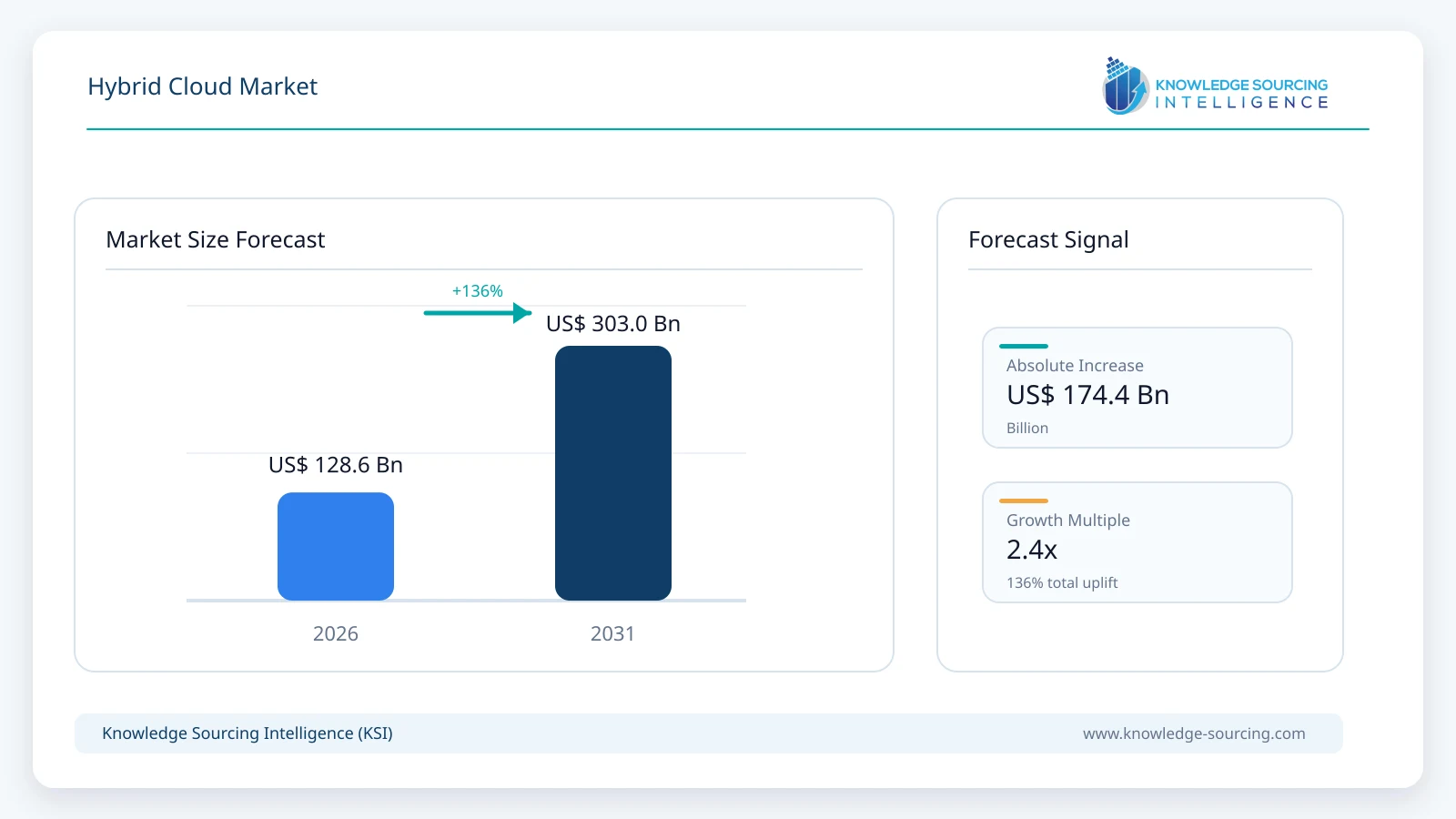
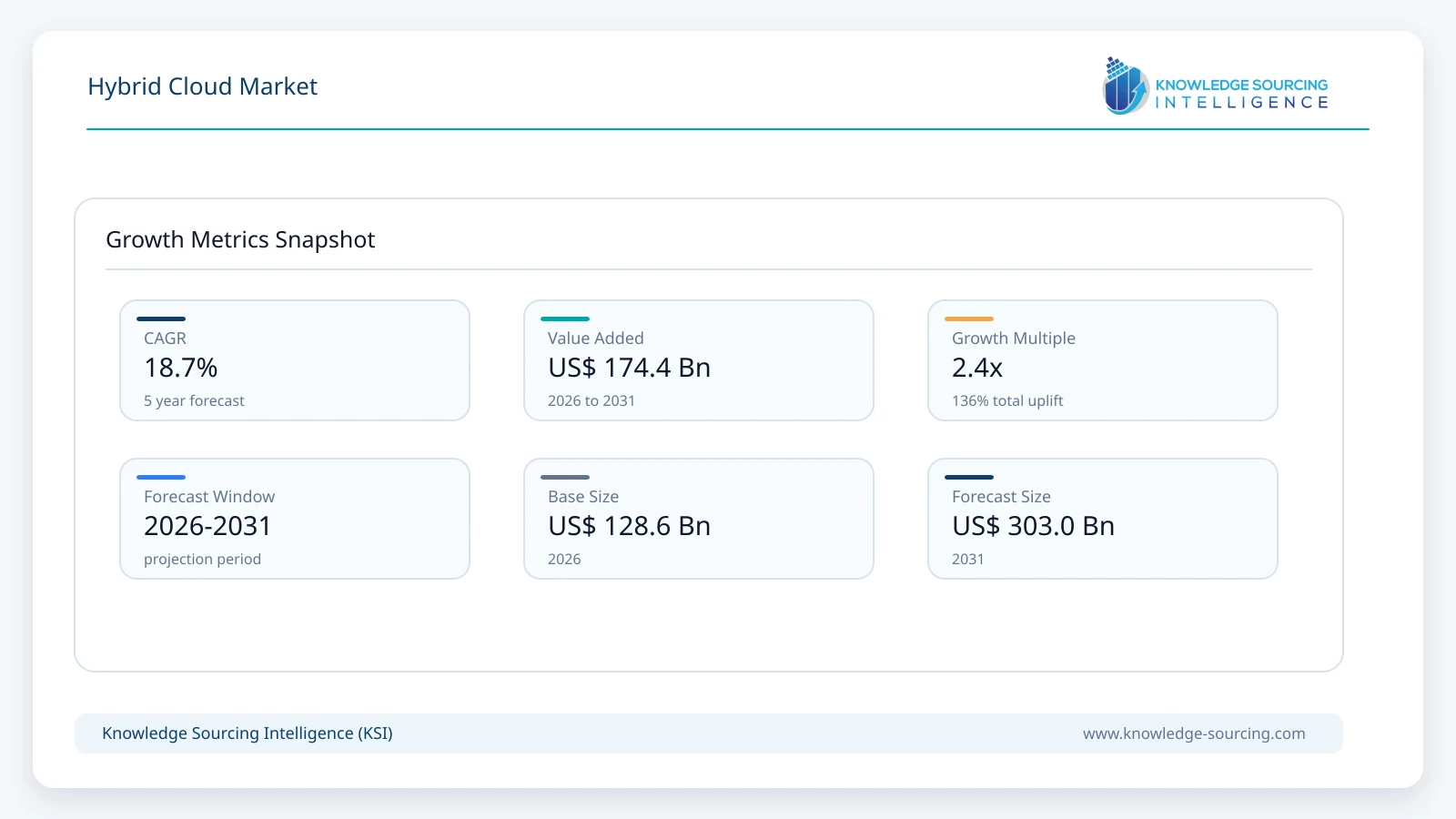
The Hybrid Cloud Market is forecast to grow at a CAGR of 18.7%, reaching USD 303.0 billion in 2031 from USD 128.6 billion in 2026.
Highlights:
- 1Rising enterprise demand for application modernization and AI deployment continues to strengthen hybrid cloud adoption.
- 2Infrastructure as a Service (IaaS) remains commercially important because it supports migration of enterprise workloads with greater operational flexibility.
- 3North America represents the largest demand center due to mature enterprise IT spending and hyperscale cloud investment.
- 4Kubernetes-based orchestration, automation, and AI-enabled infrastructure management are becoming standard purchasing requirements.
- 5Data protection, cybersecurity, and sovereignty regulations continue to influence hybrid deployment strategies across regulated industries.
- 6Competition increasingly centers on ecosystem partnerships, multicloud interoperability, and integrated management platforms.
The hybrid cloud market comprises software platforms, infrastructure services, consulting, migration, orchestration, and managed services that enable organizations to operate applications and data across private infrastructure, public cloud environments, and edge computing resources through a unified operating model. Rather than replacing on-premises systems, hybrid cloud architectures allow enterprises to determine where workloads should reside based on performance, security, compliance, latency, and cost considerations. This flexibility has made hybrid cloud an important technology strategy for organizations managing both modern cloud-native applications and legacy enterprise systems.
Commercial demand is being shaped by enterprise requirements for operational resilience, data sovereignty, AI deployment, disaster recovery, and application modernization. Large organizations increasingly maintain mixed computing environments because critical workloads often remain on private infrastructure while customer-facing applications, analytics, and development platforms operate in public clouds. Consequently, procurement decisions are shifting from standalone cloud infrastructure purchases toward integrated platforms capable of managing distributed workloads through centralized governance.
Buyer priorities have also evolved. Organizations now evaluate hybrid cloud platforms based on interoperability, cybersecurity capabilities, workload portability, automation, observability, compliance reporting, and compatibility with container technologies such as Kubernetes. Total cost of ownership remains a major procurement factor, particularly as enterprises seek to optimize cloud spending while avoiding excessive dependence on a single provider.
The industry structure combines hyperscale cloud providers, enterprise infrastructure vendors, networking companies, managed service providers, and consulting organizations. Revenue is generated through cloud subscriptions, infrastructure software, orchestration platforms, managed services, migration projects, and long-term support contracts. AI infrastructure deployment, industry-specific cloud platforms, and multicloud connectivity are expected to remain important revenue contributors during the forecast period.
Market Drivers
Enterprise application modernization
Many organizations continue to operate mission-critical applications that cannot be migrated entirely to public cloud infrastructure because of operational dependencies, regulatory obligations, or latency requirements. Hybrid cloud provides an intermediate operating model that allows businesses to modernize applications gradually while maintaining business continuity.
Enterprise buyers typically prioritize migration projects that minimize operational disruption and preserve existing technology investments. Suppliers therefore compete through migration tools, workload portability, application refactoring services, and centralized management platforms. This approach expands consulting opportunities while creating recurring software and infrastructure revenues.
Expansion of enterprise AI workloads
Artificial intelligence implementation requires scalable computing resources, high-performance storage, and secure access to enterprise data. Many organizations prefer hybrid architectures because proprietary datasets frequently remain within private environments while AI model development utilizes public cloud computing capacity.
Technology suppliers are responding by integrating AI orchestration, GPU resource management, and automated workload placement into hybrid cloud platforms. This strengthens customer retention while increasing demand for infrastructure software and managed services.
Data sovereignty and regulatory compliance
Financial institutions, healthcare providers, government agencies, and critical infrastructure operators face strict requirements governing data storage, processing, and access controls. Hybrid cloud enables organizations to separate regulated information from less sensitive workloads without sacrificing operational flexibility.
This purchasing behavior encourages investment in policy-based workload management, encryption, identity management, and compliance monitoring solutions. Vendors capable of demonstrating regulatory alignment gain stronger positioning in highly regulated industries.
Business continuity and operational resilience
Organizations increasingly recognize operational resilience as a strategic technology objective. Hybrid cloud environments improve disaster recovery capabilities by distributing applications across multiple infrastructure locations while supporting automated failover and backup strategies.
Buyers therefore evaluate providers according to recovery performance, infrastructure redundancy, service availability, and integrated cybersecurity capabilities. Long-term managed service contracts frequently emerge from these procurement priorities.
Market Restraints and Challenges
Integration complexity
Hybrid environments combine legacy infrastructure, multiple cloud providers, networking systems, and enterprise applications developed across different technology generations. Integrating these assets requires specialized expertise and substantial implementation effort.
Organizations without experienced IT teams often experience longer deployment schedules and higher consulting expenditures. Vendors increasingly address this challenge through automation software, standardized deployment frameworks, and professional implementation services.
Cloud cost management
Although hybrid cloud improves deployment flexibility, uncontrolled workload allocation can increase infrastructure spending. Variable consumption pricing, duplicated resources, and inefficient application placement frequently reduce anticipated financial benefits.
Enterprise procurement teams increasingly demand detailed cost visibility, workload optimization tools, and automated resource governance before expanding hybrid deployments.
Cybersecurity risks
Distributed infrastructure expands the number of potential attack surfaces. Identity management, configuration consistency, API security, and workload visibility become more difficult across multiple computing environments.
Organizations therefore allocate greater investment toward zero-trust security, centralized monitoring, encryption, privileged access management, and continuous compliance verification. Security capabilities increasingly influence supplier selection.
Skills shortages
Successful hybrid cloud implementation requires expertise spanning networking, cybersecurity, cloud architecture, automation, containers, and enterprise applications. Qualified professionals remain in limited supply across many regions.
This shortage increases dependence on managed service providers and consulting organizations while extending implementation timelines for internal IT departments.
Major Segment Analysis
Infrastructure as a Service (IaaS)
Infrastructure as a Service represents one of the most commercially significant segments because it provides the computing, networking, and storage foundation required for hybrid cloud deployment. Organizations frequently adopt IaaS during data center modernization initiatives, application migration programs, disaster recovery implementation, and AI infrastructure expansion.
Enterprise buyers typically require flexible computing capacity without abandoning existing private infrastructure investments. Consequently, hybrid IaaS solutions allow workloads to move between on-premises environments and public cloud resources according to utilization, compliance requirements, and operational priorities.
Competition within this segment extends beyond infrastructure pricing. Suppliers differentiate through automation, integrated security, multicloud management, networking performance, workload portability, developer services, and ecosystem compatibility. Strong relationships with enterprise software vendors, system integrators, and channel partners also influence purchasing decisions.
Recurring subscription revenues, infrastructure consumption, and long-term managed services make IaaS an important contributor to supplier profitability while supporting broader enterprise modernization programs.
Regional Analysis
North America remains the largest regional market because enterprises continue investing in AI infrastructure, cloud modernization, cybersecurity, and data center upgrades. Large financial institutions, healthcare organizations, technology companies, and government agencies generate sustained demand. Mature cloud ecosystems and substantial hyperscale investment support continued adoption.
Europe emphasizes regulatory compliance, digital sovereignty, and cybersecurity. Regulations concerning personal data protection encourage hybrid deployment models that maintain sensitive information within approved jurisdictions while utilizing public cloud resources for scalable computing. Manufacturing, banking, and public administration remain important customer groups.
Asia Pacific demonstrates strong investment activity driven by expanding digital economies, manufacturing modernization, telecommunications infrastructure, and enterprise cloud adoption. Countries including Japan, China, India, South Korea, and Southeast Asian economies continue expanding cloud infrastructure while organizations modernize legacy enterprise systems.
Middle East and Africa is experiencing increasing hybrid cloud adoption through government digital initiatives, smart city investments, financial sector modernization, and expanding regional data center capacity. Procurement decisions remain influenced by cybersecurity requirements and national digital development programs.
South America continues to adopt hybrid cloud gradually as organizations modernize enterprise infrastructure while balancing investment constraints. Banking, retail, telecommunications, and public sector organizations remain among the principal adopters, although economic volatility influences technology spending decisions.
Competitive Landscape
The hybrid cloud market remains highly competitive, with technology providers competing across infrastructure software, cloud platforms, networking, storage, consulting, and managed services. The competitive environment includes Microsoft Corporation, Oracle Corporation, Google LLC (Alphabet Inc.), IBM Corporation, Hewlett Packard Enterprise, Cisco Systems, Inc., Amazon Web Services, Inc., Cloud Software Group, Inc., Accenture plc, NetApp, Inc., Dell Technologies Inc., and Broadcom Inc.
Competition increasingly depends on platform interoperability rather than isolated infrastructure offerings. Vendors strengthen market positioning through multicloud integration, AI-enabled management capabilities, enterprise security, container orchestration, automation, and industry-specific solutions. Strategic alliances among cloud providers, infrastructure vendors, and consulting organizations continue expanding deployment options for enterprise customers while reducing migration complexity. Geographic expansion through regional cloud infrastructure and local implementation partners also remains an important competitive strategy.
Recent Developments
May 2026: IBM and Oracle expanded their strategic partnership to introduce additional AI and hybrid cloud capabilities, including broader Red Hat integration with Oracle Cloud Infrastructure. The collaboration strengthens enterprise deployment flexibility across hybrid environments.
April 2026: Oracle announced expanded multicloud networking with Amazon Web Services, enabling private, high-speed connectivity between Oracle Cloud Infrastructure and AWS. The initiative supports enterprises operating distributed hybrid and multicloud workloads.
May 2025: IBM announced an expanded collaboration with Oracle to integrate IBM watsonx capabilities with Oracle Cloud Infrastructure, supporting enterprise AI deployment across hybrid cloud environments. The partnership broadens joint enterprise solution offerings.
Regulatory and Policy Environment
The regulatory environment increasingly influences enterprise hybrid cloud procurement. Data protection legislation, including regional privacy regulations and industry-specific compliance frameworks, requires organizations to implement secure data governance, encryption, identity management, and audit capabilities.
Financial institutions, healthcare providers, and government organizations frequently operate under additional cybersecurity, operational resilience, and records management requirements that influence workload placement decisions. International standards such as ISO/IEC 27001, ISO/IEC 27701, SOC reporting frameworks, and cloud security guidance published by national cybersecurity agencies also influence supplier selection and procurement specifications.
Government investment in sovereign cloud infrastructure, national cybersecurity strategies, and digital public services further supports hybrid cloud adoption by encouraging secure domestic computing capabilities while maintaining interoperability with global cloud platforms.
Outlook and Strategic Implications
Hybrid cloud will remain a central enterprise infrastructure strategy as organizations balance operational flexibility with regulatory compliance, cybersecurity, and AI implementation requirements. Investment priorities are expected to focus on automation, AI-ready infrastructure, container platforms, workload orchestration, observability, and cloud cost optimization rather than simple infrastructure expansion.
Enterprise procurement will increasingly favor suppliers capable of delivering unified management across private infrastructure, public cloud services, and edge computing environments. Buyers will also seek stronger interoperability to reduce vendor dependence while improving operational resilience.
Competitive differentiation is likely to depend on integrated software ecosystems, AI-enabled operations, cybersecurity capabilities, and industry-specific deployment expertise. Partnerships between cloud providers, infrastructure vendors, and consulting organizations are expected to become more important as customers demand comprehensive implementation support.
Despite continued challenges related to integration complexity, cybersecurity, and skilled workforce availability, sustained enterprise investment in AI, regulatory compliance, and application modernization is expected to support long-term demand for hybrid cloud technologies across multiple industries.
Hybrid Cloud Market Scope
| Report Metric | Details |
|---|---|
| Total Market Size in 2026 | USD 128.6 billion |
| Total Market Size in 2031 | USD 303.0 billion |
| Forecast Unit | Billion |
| Growth Rate | 18.7% |
| Study Period | 2021 to 2031 |
| Historical Data | 2021 to 2024 |
| Base Year | 2025 |
| Forecast Period | 2026 – 2031 |
| Segmentation | Component, Service Model, Enterprise Size, Industry Vertical, Geography |
| Companies |
|
Market Segmentation
By Component
By Service Model
By Enterprise Size
By Industry Vertical
By Geography
Table of Contents
1. EXECUTIVE SUMMARY
2. MARKET SNAPSHOT
2.1. Market Overview
2.2. Market Definition
2.3. Scope of the Study
2.4. Market Segmentation
3. BUSINESS LANDSCAPE
3.1. Market Drivers
3.2. Market Restraints
3.3. Market Opportunities
3.4. Porter’s Five Forces Analysis
3.5. Industry Value Chain Analysis
3.6. Policies and Regulations
3.7. Strategic Recommendations
4. TECHNOLOGICAL OUTLOOK
5. HYBRID CLOUD MARKET BY COMPONENT
5.1. Introduction
5.2. Solutions
5.3. Services
6. HYBRID CLOUD MARKET BY SERVICE MODEL
6.1. Introduction
6.2. Software as a Service (SaaS)
6.3. Infrastructure as a Service (IaaS)
6.4. Platform as a Service (PaaS)
7. HYBRID CLOUD MARKET BY ENTERPRISE SIZE
7.1. Introduction
7.2. Small and Medium-sized Enterprises (SMEs)
7.3. Large Enterprises
8. HYBRID CLOUD MARKET BY INDUSTRY VERTICAL
8.1. Introduction
8.2. BFSI
8.3. Healthcare
8.4. Retail and E-commerce
8.5. IT and Telecommunications
8.6. Manufacturing
8.7. Government and Public Sector
8.8. Media and Entertainment
8.9. Others
9. HYBRID CLOUD MARKET BY GEOGRAPHY
9.1. Introduction
9.2. North America
9.2.1. United States
9.2.2. Canada
9.2.3. Mexico
9.3. South America
9.3.1. Brazil
9.3.2. Argentina
9.3.3. Others
9.4. Europe
9.4.1. United Kingdom
9.4.2. Germany
9.4.3. France
9.4.4. Spain
9.4.5. Others
9.5. Middle East & Africa
9.5.1. Saudi Arabia
9.5.2. United Arab Emirates
9.5.3. Israel
9.5.4. Others
9.6. Asia Pacific
9.6.1. Japan
9.6.2. China
9.6.3. India
9.6.4. South Korea
9.6.5. Indonesia
9.6.6. Taiwan
9.6.7. Others
10. COMPETITIVE ENVIRONMENT AND ANALYSIS
10.1. Major Players and Strategy Analysis
10.2. Market Share Analysis
10.3. Mergers, Acquisitions, Agreements, and Collaborations
10.4. Competitive Dashboard
11. COMPANY PROFILES
11.1. Microsoft Corporation
11.2. Oracle Corporation
11.3. Google LLC (Alphabet Inc.)
11.4. IBM Corporation
11.5. Hewlett Packard Enterprise
11.6. Cisco Systems, Inc.
11.7. Amazon Web Services, Inc.
11.8. Cloud Software Group, Inc.
11.9. Accenture plc
11.10. NetApp, Inc.
11.11. Dell Technologies Inc.
11.12. Broadcom Inc.
12. APPENDIX
12.1. Currency
12.2. Assumptions
12.3. Base and Forecast Years Timeline
12.4. Key Benefits for Stakeholders
12.5. Research Methodology
12.6. Abbreviations
LIST OF FIGURES
LIST OF TABLES
Navigate
Trusted by the world's leading organizations











