
The Content Intelligence Market is forecast to grow at a CAGR of 24.60%, reaching USD 9.82 billion in 2031 from USD 3.27 billion in 2026.
Highlights:
- 1Growing enterprise demand for AI-assisted knowledge discovery is accelerating investment in content intelligence platforms.
- 2Cloud deployment remains a preferred implementation model because it supports scalability, continuous feature updates, and lower infrastructure requirements.
- 3Large enterprises represent the largest purchasing segment due to complex information governance and compliance requirements.
- 4Integration of generative AI with enterprise content repositories is expanding platform functionality beyond traditional document management.
- 5Data privacy regulations and records management requirements continue to influence procurement criteria and deployment strategies.
- 6Competition increasingly centers on platform interoperability, governance capabilities, and industry-specific workflows instead of basic content analytics.
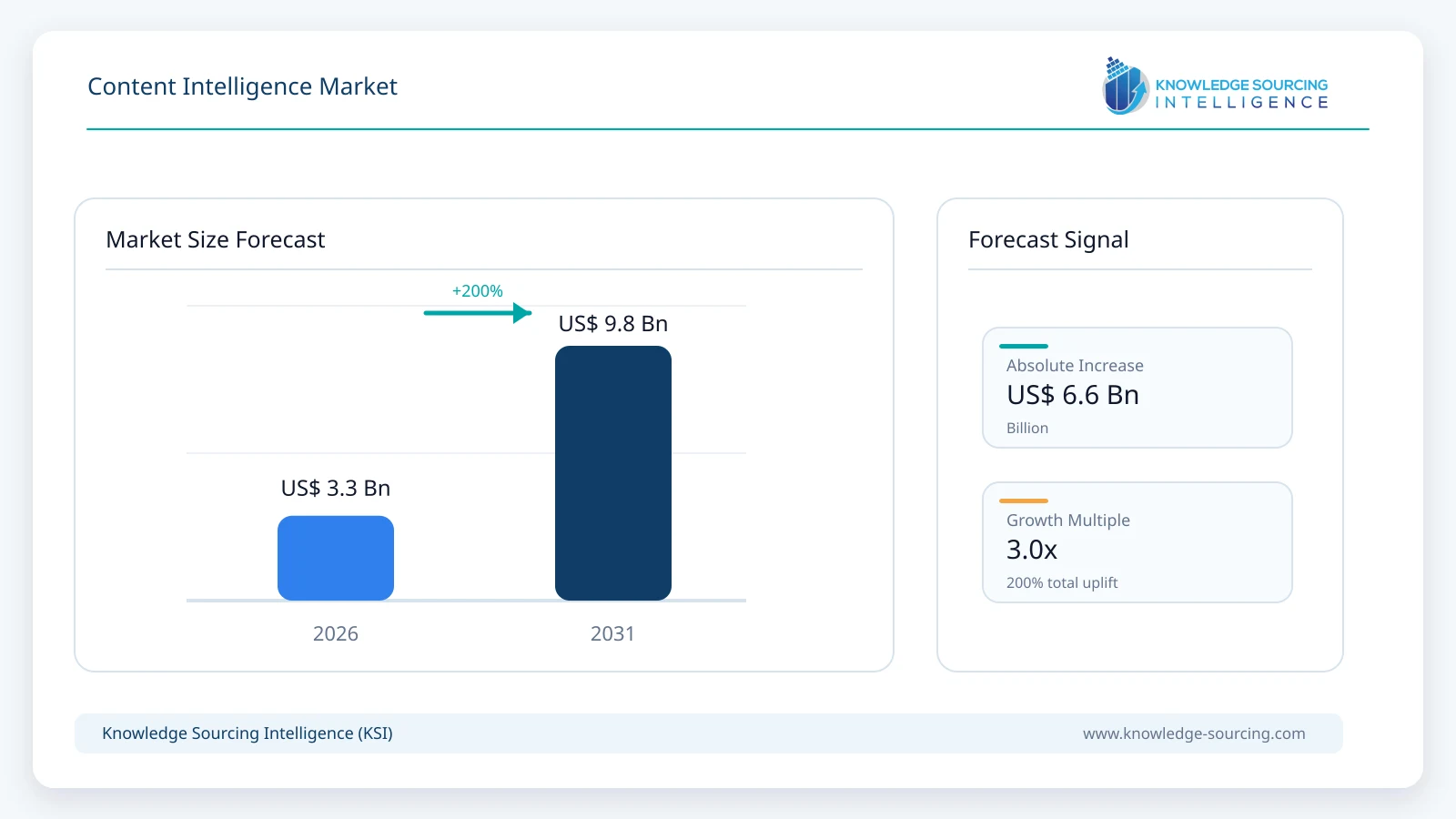
The Content Intelligence Market comprises software platforms and associated services that analyze, classify, enrich, govern, and optimize enterprise content using artificial intelligence, natural language processing (NLP), machine learning, computer vision, and metadata management technologies. These platforms enable organizations to extract business value from structured and unstructured information, including documents, emails, digital assets, videos, knowledge repositories, customer interactions, and web content. Content intelligence solutions support content discovery, automated tagging, semantic search, workflow automation, compliance monitoring, personalized content delivery, and enterprise knowledge management.
Demand for content intelligence is being shaped by the exponential increase in enterprise-generated data and the need to convert fragmented information into operational insights. Organizations across banking, healthcare, retail, government, education, media, and telecommunications are managing expanding repositories of digital content while facing stricter governance obligations and higher expectations for information accessibility. Buyers increasingly prioritize platforms capable of improving search accuracy, reducing manual document handling, and supporting enterprise-wide collaboration without disrupting existing information management systems.
Enterprise procurement decisions increasingly emphasize integration capabilities rather than standalone functionality. Organizations seek solutions that connect with content management platforms, customer relationship management systems, collaboration software, cloud storage environments, and enterprise resource planning applications. Vendors able to provide open APIs, configurable workflows, multilingual analytics, and scalable cloud deployment gain stronger commercial positioning because implementation complexity remains a major purchasing consideration.
The market structure includes enterprise software vendors, information management specialists, digital asset management providers, and cloud platform companies. Competition extends beyond analytics capabilities to implementation expertise, security controls, industry-specific content models, and lifecycle management. Service offerings such as consulting, migration, governance assessment, and managed support play a critical role in customer acquisition, particularly among organizations modernizing legacy document management infrastructure.
Another defining characteristic of the market is the growing convergence between content intelligence and generative AI. Enterprises increasingly expect platforms to summarize documents, identify business risks, generate metadata, recommend content, and automate knowledge extraction while maintaining governance and auditability. This trend has shifted buyer attention toward vendors capable of combining advanced language models with enterprise-grade security, permission management, and regulatory compliance.
Commercial adoption also reflects changing workforce practices. Hybrid work environments require employees to access accurate organizational knowledge regardless of location. Consequently, organizations are investing in content intelligence to reduce duplicated work, improve decision quality, shorten information retrieval times, and strengthen institutional knowledge retention. These operational improvements increasingly justify investment through measurable productivity gains rather than technology modernization alone.
Market Drivers
Growth in Enterprise Unstructured Data
Organizations generate vast quantities of documents, multimedia files, contracts, customer communications, and operational records that often remain inaccessible because of inconsistent classification. Content intelligence platforms address this issue by automating metadata generation, semantic indexing, and contextual search. Buyers prioritize these capabilities to improve employee productivity, accelerate business decisions, and reduce duplicate content creation. Software providers continue expanding AI-assisted classification models to improve information retrieval across increasingly complex enterprise repositories.
Rising Compliance and Information Governance Requirements
Industries handling regulated information require stronger oversight of document retention, audit trails, and content accessibility. Financial institutions, healthcare organizations, and government agencies increasingly invest in content intelligence solutions to automate policy enforcement and identify sensitive information across distributed repositories. Vendors respond by embedding governance frameworks, permission controls, and automated compliance reporting, enabling customers to reduce administrative costs while strengthening regulatory readiness.
Expansion of AI-Enabled Enterprise Knowledge Management
Organizations increasingly recognize institutional knowledge as a strategic business asset. Employee turnover, distributed workforces, and expanding digital operations have increased demand for centralized knowledge platforms capable of extracting insights from enterprise content. Buyers seek intelligent search, contextual recommendations, automated summarization, and multilingual capabilities that improve collaboration across departments. This has encouraged software developers to integrate advanced language models into enterprise content management ecosystems.
Demand for Personalized Digital Experiences
Media companies, retailers, educational institutions, and customer service organizations increasingly use content intelligence to understand audience engagement and optimize digital content delivery. Intelligent content recommendations, behavioral analytics, and automated tagging improve personalization while reducing manual editorial workloads. Organizations purchasing these platforms increasingly evaluate measurable improvements in customer engagement, conversion rates, and operational efficiency.
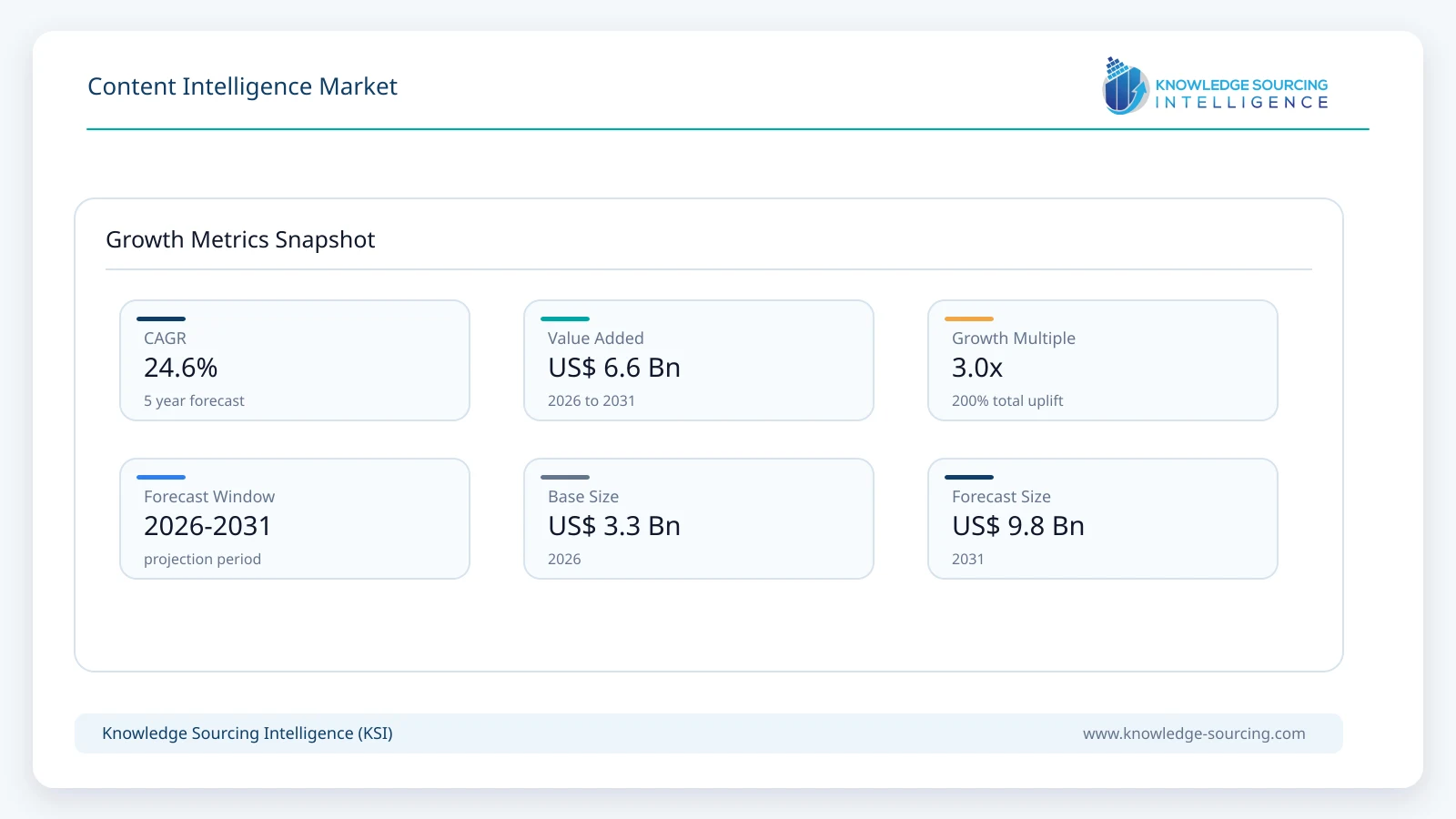
Market Restraints and Challenges
Complex Integration with Legacy Enterprise Systems
Many organizations continue operating multiple legacy content repositories developed over several decades. Integrating content intelligence platforms with these fragmented systems requires extensive migration planning, data cleansing, and workflow redesign. Large implementation projects often increase deployment timelines and consulting costs, particularly in regulated industries where historical records cannot be disrupted.
Data Quality and Metadata Inconsistencies
Artificial intelligence models depend on accurate metadata and well-structured information. Inconsistent document labeling, duplicated files, outdated taxonomies, and incomplete records reduce model accuracy and search performance. Organizations frequently invest in governance initiatives before realizing the full value of content intelligence deployments, increasing total project costs.
Privacy, Security, and Intellectual Property Concerns
Enterprise buyers remain cautious about deploying AI-powered content analytics involving confidential business documents, customer information, and proprietary intellectual property. Cloud deployments require rigorous encryption, access management, and data residency controls. Vendors must demonstrate transparent AI governance and secure processing environments to satisfy procurement requirements.
Skills Availability and Organizational Readiness
Successful implementation requires expertise spanning information architecture, AI governance, taxonomy management, workflow design, and change management. Organizations lacking experienced information management teams often face slower adoption, lower utilization rates, and extended implementation cycles despite investing in advanced software platforms.
Major Segment Analysis
Cloud Deployment Leads Commercial Adoption
Cloud deployment represents the most commercially significant segment because it provides scalability, continuous software updates, simplified administration, and lower infrastructure investment compared with traditional on-premise implementations. Organizations adopting cloud-first IT strategies increasingly prefer subscription-based deployment models that align technology spending with operational budgets while supporting geographically distributed workforces.
Large enterprises often begin cloud adoption by migrating selected content repositories before expanding enterprise-wide deployments. Small and medium enterprises particularly value cloud-based content intelligence because it reduces implementation complexity while providing access to advanced AI capabilities that would otherwise require substantial internal infrastructure investment.
Competitive differentiation within this segment increasingly depends on hybrid deployment flexibility, integration with public cloud ecosystems, security certifications, and AI model customization. Vendors offering seamless interoperability with productivity platforms, enterprise collaboration software, and business applications strengthen customer retention while expanding recurring subscription revenues.
Regional Analysis
North America
North America remains a mature market supported by high enterprise software spending, established cloud infrastructure, and widespread adoption of AI-enabled business applications. Demand originates from financial services, healthcare, media, technology, and public sector organizations seeking advanced information governance and knowledge management capabilities. Procurement decisions increasingly prioritize cybersecurity, compliance, and interoperability with enterprise cloud ecosystems.
Europe
European demand is strongly influenced by privacy regulations, records management requirements, and multilingual business operations. Organizations invest in content intelligence to improve regulatory compliance while supporting efficient information sharing across geographically dispersed operations. Manufacturing, financial services, and government agencies remain important buyers due to extensive documentation requirements.
Asia Pacific
Asia Pacific represents an expanding opportunity driven by enterprise digitization, cloud adoption, and growing investments in AI infrastructure. Rapid growth in digital commerce, telecommunications, financial technology, and public digital services has increased demand for scalable content management solutions. Cost sensitivity remains important, encouraging vendors to introduce modular deployment models and localized language capabilities.
Middle East & Africa
Government modernization initiatives, expanding digital public services, and enterprise technology investment support market development across the Middle East and Africa. Organizations increasingly seek secure information management platforms supporting document digitization, workflow automation, and compliance. Budget constraints and implementation expertise remain limiting factors in several emerging economies.
South America
South American adoption is progressing gradually as organizations modernize enterprise information systems and expand cloud-based software investment. Financial institutions, telecommunications providers, and retail organizations increasingly evaluate content intelligence to improve operational efficiency and customer engagement. Economic uncertainty and varying digital maturity continue to influence purchasing cycles across the region.
Competitive Landscape
The Content Intelligence Market exhibits moderate competitive concentration, combining diversified enterprise software providers with specialized information management companies. Competition increasingly revolves around AI model quality, semantic search performance, enterprise integration capabilities, governance functionality, and deployment flexibility rather than document management alone.
Suppliers compete by expanding cloud-native architectures, incorporating generative AI capabilities, strengthening metadata automation, and improving interoperability with enterprise productivity platforms. Strategic partnerships with cloud infrastructure providers, system integrators, and enterprise application vendors continue expanding market reach and implementation capacity.
Industry participants also differentiate through vertical-specific content models supporting regulated industries such as healthcare, financial services, and government. Investment priorities increasingly include multilingual AI, automated compliance monitoring, intelligent workflow orchestration, and enhanced cybersecurity capabilities. Competitive positioning is further influenced by global implementation networks, customer support services, and recurring subscription business models.
Major companies operating in the market include Adobe, OpenText Corporation, M-Files Corporation, Hyland, Aprimo, Veritone Inc., Quark Software Inc., Emplifi, Scoop.it, and Microsoft Corporation.
Recent Developments
June 2026: Optimizely unveiled AI-powered 1:1 personalization at scale, enabling marketers to automatically generate, govern, and continuously optimize individualized microsites for target buyers through its enterprise AI agent platform.
May 2026: Optimizely reported significant expansion of its AI Agent Orchestration Platform, announcing nearly 1,700 enterprise customers had created more than 4,000 AI agents supporting automated content operations, optimization, and marketing workflows.
May 2026: Microsoft expanded enterprise AI capabilities across Microsoft 365 by introducing additional governance and content management features supporting secure organizational knowledge retrieval. The development strengthens enterprise adoption of AI-assisted content intelligence.
April 2026: Adobe launched Brand Intelligence within Adobe GenStudio, providing AI-accessible contextual brand intelligence alongside new AI agents and content marketing capabilities to improve enterprise content creation, governance, personalization, and content supply chain orchestration.
Regulatory and Policy Environment
The regulatory environment increasingly shapes enterprise investment decisions because content intelligence platforms process large volumes of business-sensitive and personal information. Privacy legislation, electronic records requirements, cybersecurity regulations, and sector-specific governance standards require organizations to implement secure information management practices throughout the content lifecycle.
Data protection regulations emphasize lawful processing, transparency, retention management, and secure access controls, encouraging organizations to deploy platforms capable of enforcing governance policies automatically. Public sector procurement increasingly incorporates cybersecurity certification, auditability, and digital records management requirements into software evaluation criteria.
Government initiatives supporting cloud adoption, artificial intelligence development, and digital public services also encourage broader deployment of intelligent content management technologies. Vendors therefore continue strengthening compliance reporting, encryption capabilities, identity management integration, and AI governance frameworks to meet evolving regulatory expectations.
Outlook and Strategic Implications
Enterprise demand for content intelligence will increasingly be influenced by operational efficiency rather than document storage alone. Organizations are expected to prioritize platforms capable of converting enterprise information into actionable business knowledge while maintaining governance, security, and regulatory compliance. Procurement strategies will increasingly evaluate measurable productivity improvements alongside implementation costs and long-term scalability.
Investment is likely to concentrate on generative AI integration, multilingual knowledge discovery, intelligent workflow automation, and enterprise-wide semantic search. Buyers will increasingly favor vendors offering flexible cloud deployment, configurable governance policies, and open integration frameworks that simplify modernization of existing information ecosystems.
Competitive conditions are expected to reward suppliers capable of combining advanced AI functionality with enterprise-grade security and industry-specific implementation expertise. At the same time, vendors must address customer concerns regarding data privacy, AI transparency, model accuracy, and interoperability. Organizations that successfully balance automation with governance are expected to strengthen customer retention and expand recurring subscription revenue over the forecast period.
Content Intelligence Market Scope
| Report Metric | Details |
|---|---|
| Total Market Size in 2026 | USD 3.27 billion |
| Total Market Size in 2031 | USD 9.82 billion |
| Forecast Unit | Billion |
| Growth Rate | 24.60% |
| Study Period | 2021 to 2031 |
| Historical Data | 2021 to 2024 |
| Base Year | 2025 |
| Forecast Period | 2026 – 2031 |
| Segmentation | Component, Deployment, Enterprise Size, End-User, Geography |
| Companies |
|
Market Segmentation
By Component
By Deployment
By Enterprise Size
By End-user
By Geography
Table of Contents
1. EXECUTIVE SUMMARY
2. MARKET SNAPSHOT
2.1. Market Overview
2.2. Market Definition
2.3. Scope of the Study
2.4. Market Segmentation
3. BUSINESS LANDSCAPE
3.1. Market Drivers
3.2. Market Restraints
3.3. Market Opportunities
3.4. Porter’s Five Forces Analysis
3.5. Industry Value Chain Analysis
3.6. Policies and Regulations
3.7. Strategic Recommendations
4. TECHNOLOGICAL OUTLOOK
5. CONTENT INTELLIGENCE MARKET BY COMPONENT
5.1. Introduction
5.2. Solutions
5.3. Services
6. CONTENT INTELLIGENCE MARKET BY DEPLOYMENT
6.1. Introduction
6.2. Cloud
6.3. On-Premise
6.4. Hybrid
7. CONTENT INTELLIGENCE MARKET BY ENTERPRISE SIZE
7.1. Introduction
7.2. Small and Medium Enterprises (SMEs)
7.3. Large Enterprises
8. CONTENT INTELLIGENCE MARKET BY END-USER
8.1. Introduction
8.2. Media & Entertainment
8.3. BFSI
8.4. Healthcare
8.5. Retail & E-commerce
8.6. IT & Telecom
8.7. Government
8.8. Education
8.9. Others
9. CONTENT INTELLIGENCE MARKET BY GEOGRAPHY
9.1. Introduction
9.2. North America
9.2.1. USA
9.2.2. Canada
9.2.3. Mexico
9.3. South America
9.3.1. Brazil
9.3.2. Argentina
9.3.3. Others
9.4. Europe
9.4.1. Germany
9.4.2. France
9.4.3. United Kingdom
9.4.4. Spain
9.4.5. Others
9.5. Middle East and Africa
9.5.1. Saudi Arabia
9.5.2. UAE
9.5.3. Others
9.6. Asia Pacific
9.6.1. China
9.6.2. India
9.6.3. Japan
9.6.4. South Korea
9.6.5. Indonesia
9.6.6. Thailand
9.6.7. Others
10. COMPETITIVE ENVIRONMENT AND ANALYSIS
10.1. Major Players and Strategy Analysis
10.2. Market Share Analysis
10.3. Mergers, Acquisitions, Agreements, and Collaborations
10.4. Competitive Dashboard
11. COMPANY PROFILES
11.1. Adobe
11.2. OpenText Corporation
11.3. M-Files Corporation
11.4. Hyland
11.5. Aprimo
11.6. Veritone Inc.
11.7. Quark Software Inc.
11.8. Emplifi
11.9. Scoop.it
11.10. Microsoft Corporation
12. APPENDIX
12.1. Currency
12.2. Assumptions
12.3. Base and Forecast Years Timeline
12.4. Key Benefits for Stakeholders
12.5. Research Methodology
12.6. Abbreviations
LIST OF FIGURES
LIST OF TABLES
Navigate
Trusted by the world's leading organizations











