
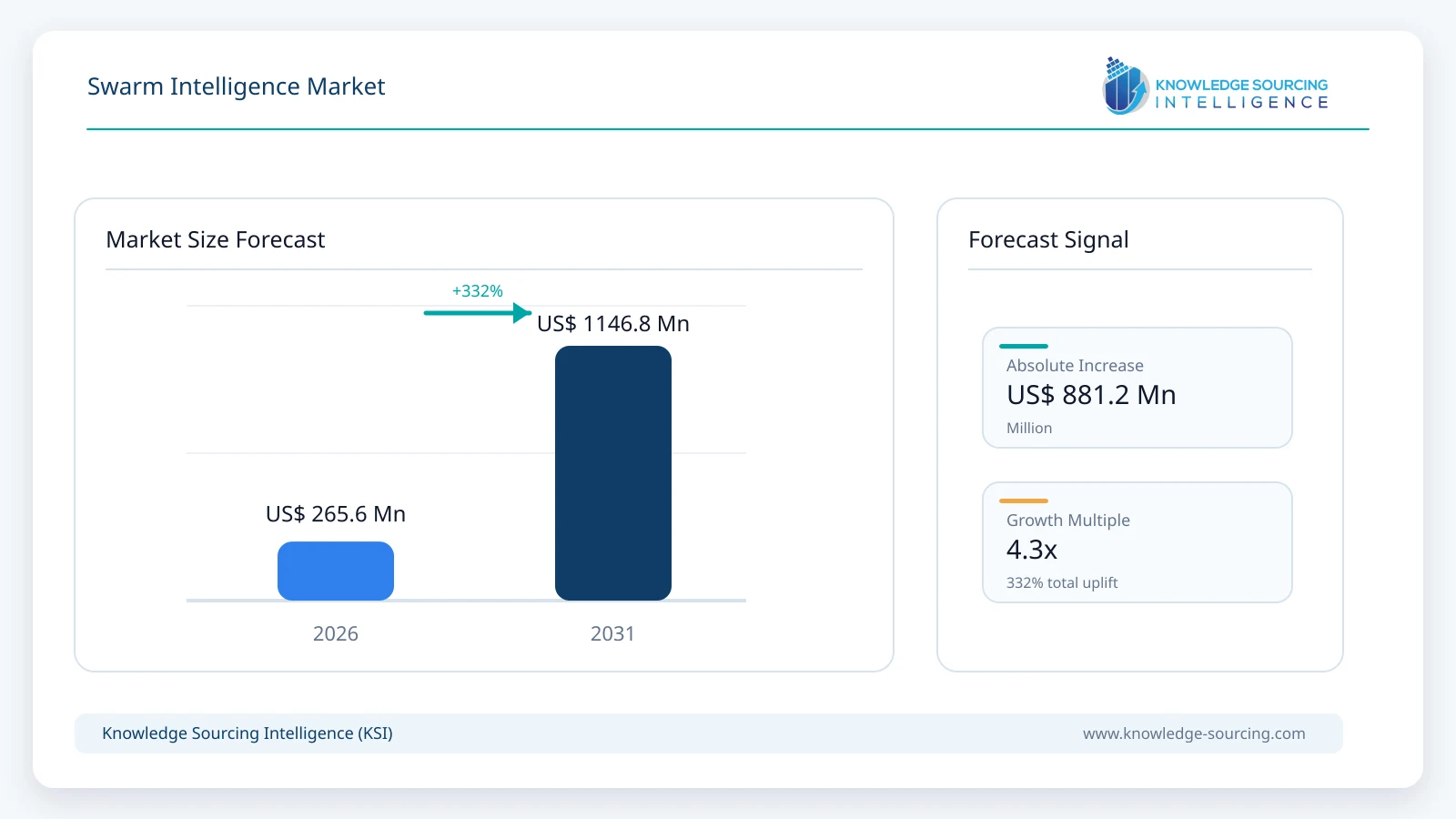
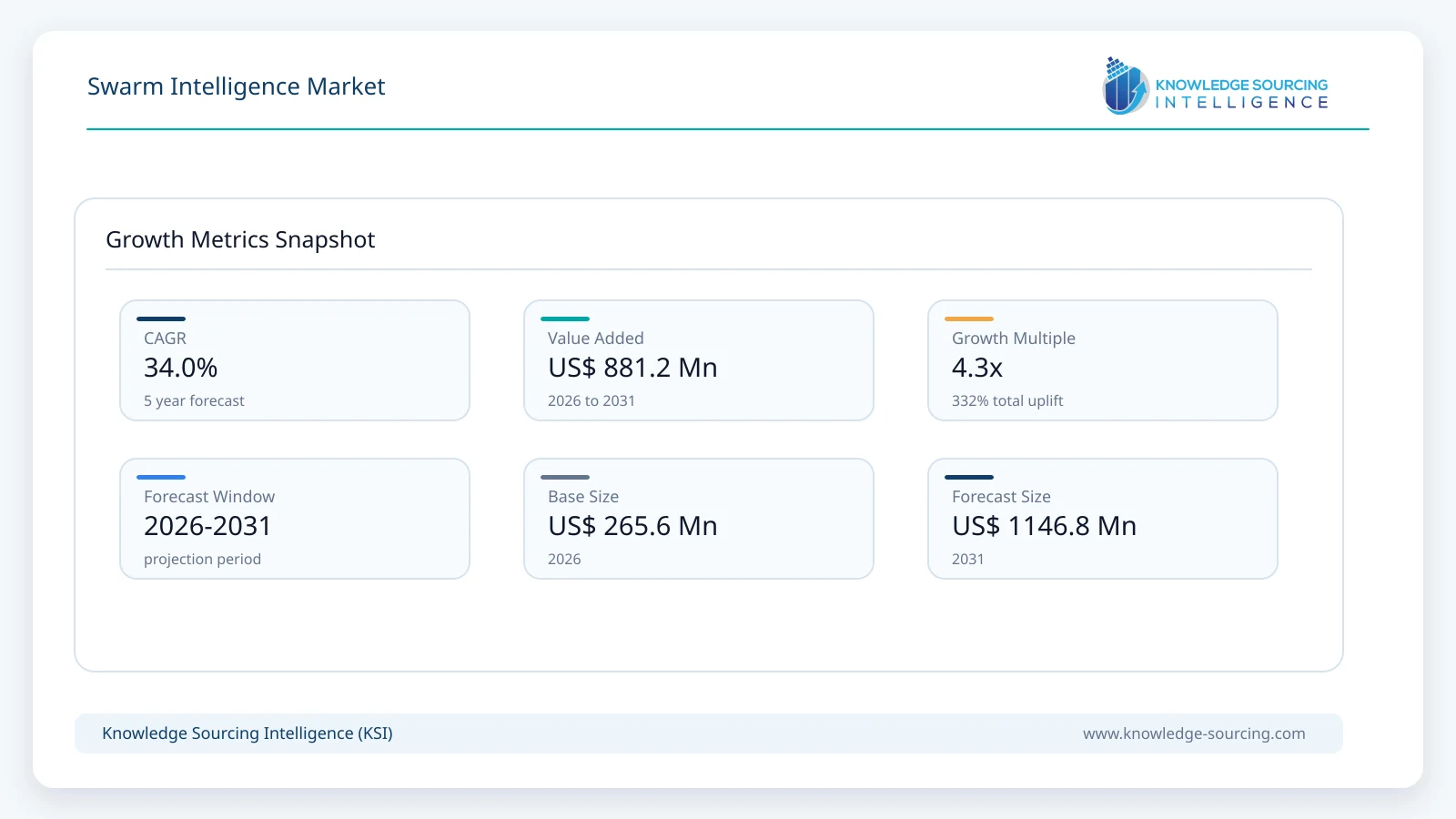
The Swarm Intelligence Market is forecast to grow at a CAGR of 33.98%, reaching USD 1,146.83 million in 2031 from USD 265.60 million in 2026.
Highlights:
- 1Transportation, logistics, and warehouse automation remain among the strongest commercial demand generators.
- 2Optimization and routing capabilities represent major purchasing priorities across industrial deployments.
- 3Asia Pacific is attracting considerable investment through manufacturing automation and robotics adoption.
- 4Multi-agent AI combined with edge computing is improving decentralized operational decision-making.
- 5Safety, cybersecurity, and autonomous system regulations increasingly influence procurement decisions.
- 6Competition is centered on software capability, integration expertise, simulation accuracy, and deployment scalability.
The swarm intelligence market comprises software platforms, algorithms, simulation tools, and autonomous control systems that enable multiple agents such as robots, drones, connected machines, software agents, or vehicles to coordinate decentralized decision-making using collective behavior principles. Unlike centralized control architectures, swarm intelligence distributes decision authority across multiple nodes, allowing systems to adapt to changing operating conditions with improved resilience and scalability. Commercial adoption spans industrial automation, logistics, defense, telecommunications, agriculture, healthcare, and energy infrastructure where large fleets of autonomous assets require continuous coordination.
Demand is being shaped by organizations seeking higher operational efficiency without proportionally increasing labor requirements. Distribution centers, manufacturers, utilities, and defense organizations are investing in autonomous systems capable of completing complex tasks collaboratively while minimizing downtime and communication bottlenecks. Buyers increasingly evaluate swarm intelligence solutions based on interoperability with existing automation infrastructure, cybersecurity, real-time processing capability, scalability, and ease of deployment rather than algorithmic sophistication alone.
Industry economics favor software-led value creation because swarm algorithms can often be integrated into existing robotic fleets, warehouse management systems, industrial control platforms, and autonomous vehicles without replacing physical assets. At the same time, implementation typically requires edge computing infrastructure, high-bandwidth communications, sensor integration, and continuous software validation. Consequently, suppliers compete not only on algorithm performance but also on integration services, simulation capabilities, lifecycle support, and compatibility with industrial communication standards.
Commercial procurement is shifting from experimental deployments toward production-scale implementations. Enterprises increasingly begin with pilot programs in warehouses, manufacturing plants, or inspection operations before expanding swarm-enabled coordination across multiple facilities. Public-sector procurement, particularly within aerospace, defense, and emergency response, continues to support technology development through research programs and operational demonstrations. As artificial intelligence, edge computing, and industrial connectivity mature together, swarm intelligence is becoming an enabling layer for distributed autonomous operations rather than a standalone technology category.
Market Drivers
Expansion of autonomous warehouse and logistics operations
E-commerce fulfillment, parcel delivery, and industrial distribution continue to increase demand for fleets of autonomous mobile robots capable of coordinating material movement efficiently. Conventional centralized fleet management becomes more complex as robot populations expand across larger facilities. Swarm intelligence distributes operational decisions across multiple agents, reducing congestion while improving throughput.
Warehouse operators increasingly seek solutions that maximize asset utilization without major infrastructure changes. Technology suppliers are therefore integrating swarm coordination into robotic fleet management platforms and warehouse software. Commercially, buyers prioritize measurable productivity improvements, shorter implementation timelines, and reduced operational interruptions.
Industrial automation requiring decentralized decision-making
Manufacturing facilities are deploying collaborative robots, automated guided vehicles, inspection systems, and connected production equipment across increasingly complex production environments. Coordinating numerous autonomous assets through centralized architectures can introduce communication delays and single points of failure.
Swarm intelligence enables localized decision-making while maintaining overall production objectives. Manufacturers adopting flexible production strategies view decentralized coordination as a practical method to improve equipment utilization, production continuity, and operational adaptability. Suppliers respond by developing software platforms compatible with existing industrial automation ecosystems instead of requiring complete infrastructure replacement.
Defense and security investments in autonomous systems
Military organizations are evaluating coordinated unmanned aerial vehicles, autonomous ground platforms, maritime systems, and surveillance assets capable of operating collaboratively in contested environments. Distributed autonomy offers operational resilience because missions can continue despite communication interruptions or individual platform failures.
Government-funded research programs and defense modernization initiatives continue to support investments in swarm-enabled technologies. Procurement decisions increasingly emphasize mission reliability, secure communications, electronic warfare resistance, and interoperability with existing command systems, creating opportunities for specialized software developers and autonomous platform providers.
Growth of precision agriculture and field robotics
Agricultural producers face persistent labor shortages alongside increasing pressure to improve productivity and optimize resource usage. Multiple autonomous field machines operating collaboratively can perform planting, spraying, monitoring, and harvesting with greater operational efficiency than individual autonomous units.
Farm equipment developers increasingly incorporate distributed intelligence into autonomous agricultural platforms to improve coverage efficiency while minimizing overlaps. Buyers evaluate these systems based on operational reliability, maintenance requirements, return on investment, and compatibility with precision farming technologies.
Market Restraints and Challenges
Integration complexity across heterogeneous systems
Industrial operators typically manage automation infrastructure sourced from multiple vendors over many years. Swarm intelligence platforms must communicate effectively with different robotic systems, sensors, industrial controllers, enterprise software, and communication protocols.
This integration complexity extends deployment timelines and raises implementation costs. Vendors increasingly mitigate these challenges through standardized interfaces, middleware platforms, digital twins, and professional integration services.
Cybersecurity risks associated with distributed autonomous networks
Distributed autonomous systems exchange continuous operational information across multiple connected devices. Compromised communication channels, unauthorized access, or manipulated decision logic may disrupt coordinated operations and create operational safety risks.
Critical infrastructure operators, manufacturers, and defense organizations therefore require strong cybersecurity capabilities before approving large-scale deployments. Suppliers increasingly invest in encrypted communications, secure software development practices, continuous monitoring, and compliance with recognized cybersecurity frameworks.
Limited availability of operational validation standards
Although artificial intelligence regulation continues to develop, standardized validation methodologies for large-scale swarm behavior remain comparatively immature. Organizations deploying collaborative autonomous systems often conduct extensive testing before operational approval.
Long validation cycles delay commercialization and increase implementation costs. Companies increasingly address this issue through advanced simulation environments, digital twins, scenario testing, and collaboration with regulatory organizations and industry associations.
High implementation costs for large-scale deployments
Software licensing represents only part of overall deployment expenditure. Organizations frequently invest in sensors, communication infrastructure, computing hardware, autonomous platforms, integration services, workforce training, and ongoing software maintenance.
Return on investment therefore depends on operational scale and measurable productivity improvements. Buyers often begin with narrowly defined pilot projects before approving enterprise-wide implementation.
Major Segment Analysis
Transportation and Logistics
Transportation and logistics represents one of the most commercially significant end-user segments because operational efficiency directly influences distribution costs, customer service performance, and warehouse productivity. Distribution centers increasingly manage hundreds of autonomous mobile robots, automated storage systems, and intelligent material handling assets simultaneously. Swarm intelligence enables these assets to coordinate movement dynamically, reducing congestion and improving resource utilization.
Procurement decisions increasingly prioritize software capable of integrating with warehouse management systems, transportation management platforms, industrial sensors, and existing robotic fleets. Buyers also evaluate scalability, cybersecurity, operational continuity, and maintenance requirements before selecting suppliers.
Competition within this segment extends beyond algorithm accuracy. Vendors differentiate themselves through simulation capabilities, implementation expertise, interoperability, fleet optimization, and post-deployment support. Revenue opportunities increasingly arise from recurring software subscriptions, lifecycle management services, analytics platforms, and system upgrades rather than hardware sales alone. As warehouse automation expands globally, transportation and logistics is expected to remain a primary commercial application for swarm intelligence solutions.
Regional Analysis
North America
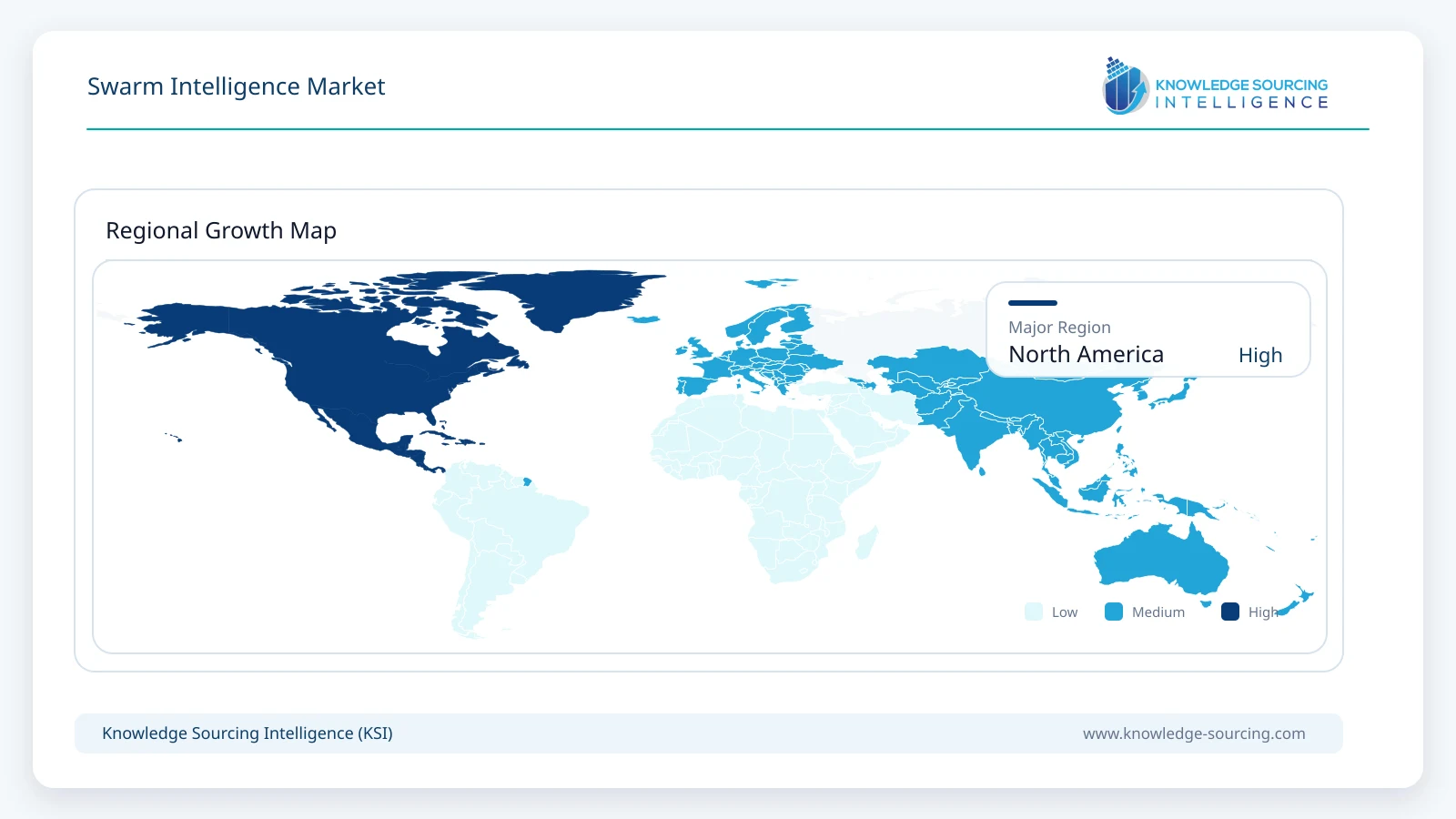
North America benefits from strong adoption across warehouse automation, defense modernization, industrial robotics, and artificial intelligence development. Technology companies, research institutions, and government agencies continue supporting autonomous systems through research funding and commercialization initiatives. Buyers generally emphasize cybersecurity, regulatory compliance, and software interoperability during procurement.
Europe
European demand is supported by advanced manufacturing, industrial automation, automotive production, and collaborative robotics. Sustainability objectives and labor productivity concerns encourage automation investments across logistics and manufacturing sectors. Regulatory attention toward artificial intelligence governance also influences procurement strategies by encouraging responsible deployment and operational transparency.
Asia Pacific
Asia Pacific represents an important growth region due to expanding manufacturing capacity, electronics production, warehouse automation, and government-supported robotics initiatives. China, Japan, South Korea, Taiwan, and India continue investing in industrial automation and intelligent manufacturing infrastructure. Competitive manufacturing environments encourage adoption of technologies capable of improving operational efficiency while addressing workforce availability challenges.
Middle East & Africa
Adoption remains concentrated within defense, energy infrastructure, smart city projects, mining, and industrial development initiatives. Gulf countries continue investing in advanced autonomous technologies as part of broader economic diversification programs. Market expansion remains influenced by technology transfer, infrastructure readiness, and specialized workforce availability.
Competitive Landscape
Competition is characterized by a combination of robotics manufacturers, industrial automation providers, autonomous platform developers, and specialized swarm intelligence software companies. Participants including UNANIMOUS A.I., Sentien Robotics, Agilox Services GmbH, SwarmFarm Robotics, Siemens AG, ABB Ltd., AeroVironment, Inc., and Archangel Imaging Ltd. compete through different technology specializations rather than identical product portfolios.
Suppliers increasingly differentiate themselves by combining artificial intelligence software with simulation platforms, industrial automation integration, autonomous fleet management, edge computing, and cloud-based analytics. Strategic partnerships with robotics manufacturers, logistics providers, industrial enterprises, and government organizations remain an important route to commercialization. Geographic expansion increasingly follows industrial automation investment, defense procurement, warehouse modernization, and precision agriculture adoption rather than purely consumer demand.
Recent Developments
June 2026: ANTS 2026 was held in Darmstadt, Germany, featuring peer-reviewed research on swarm intelligence, swarm robotics, distributed learning, autonomous multi-agent systems, and AI-enabled collective intelligence. This is a scientific conference rather than a company launch.
March 2026: ABB Ltd. expanded its AI-enabled robotic software capabilities through continued investment in autonomous industrial automation solutions, strengthening collaborative robot coordination for manufacturing applications. Commercial relevance: supports broader deployment of decentralized factory automation.
February 2026: The organizing committee of the 15th International Conference on Swarm Intelligence (ANTS 2026) announced the Call for Late Breaking Results & Fresh Perspectives for the June 2026 conference in Darmstadt, Germany, highlighting advances in swarm robotics, optimization, distributed AI, and human-swarm interaction.
Regulatory and Policy Environment
Swarm intelligence deployment is influenced by multiple regulatory frameworks rather than technology-specific legislation alone. Artificial intelligence governance initiatives in major economies increasingly require transparency, risk management, human oversight, and operational accountability for high-risk AI applications. Industrial operators must also comply with machinery safety regulations, functional safety standards, cybersecurity requirements, and data protection legislation.
Defense deployments operate under national procurement requirements and operational security standards, while autonomous drone applications remain subject to aviation authority regulations governing beyond-visual-line-of-sight operations and airspace integration. Critical infrastructure operators additionally face cybersecurity obligations designed to strengthen operational resilience across energy, transportation, and telecommunications networks.
Government funding programs supporting robotics, artificial intelligence, advanced manufacturing, and autonomous systems continue stimulating commercialization through research grants, pilot projects, and public-private collaboration. Compliance increasingly becomes a competitive differentiator because enterprise buyers seek suppliers capable of meeting regulatory expectations without delaying implementation.
Outlook and Strategic Implications
Commercial investment over the next five years is expected to prioritize scalable software platforms capable of coordinating large autonomous fleets across industrial environments. Buyers will increasingly favor solutions demonstrating measurable operational improvements, interoperability with existing automation infrastructure, strong cybersecurity, and flexible deployment architectures.
Procurement strategies are likely to shift toward integrated software ecosystems rather than standalone swarm algorithms. Vendors capable of combining simulation, digital twins, fleet orchestration, predictive analytics, and lifecycle support will strengthen competitive positioning. Manufacturing, logistics, defense, agriculture, and energy sectors are expected to remain the principal commercial adopters because distributed autonomous coordination directly addresses operational efficiency and workforce productivity objectives.
Competitive differentiation will increasingly depend on implementation expertise, regulatory readiness, software reliability, and ecosystem partnerships rather than algorithm performance alone. Companies capable of delivering validated, secure, and scalable swarm intelligence solutions across multiple industries will be best positioned to benefit as autonomous operations become a standard component of industrial digital infrastructure.
Swarm Intelligence Market Scope
| Report Metric | Details |
|---|---|
| Total Market Size in 2026 | USD 265.60 million |
| Total Market Size in 2031 | USD 1,146.83 million |
| Forecast Unit | Million |
| Growth Rate | 33.98% |
| Study Period | 2021 to 2031 |
| Historical Data | 2021 to 2024 |
| Base Year | 2025 |
| Forecast Period | 2026 – 2031 |
| Segmentation | End User, Capability, Geography |
| Companies |
|
Market Segmentation
By End User
- Transportation & Logistics
- Telecommunications
- Manufacturing
- Robotics
- Healthcare
- Aerospace & Defense
- Agriculture
- Energy & Utilities
- Others
By Capability
- Optimization
- Routing & Navigation
- Scheduling
- Resource Allocation
- Clustering
- Pattern Recognition
- Others
By Geography
- North America
- USA
- Canada
- Mexico
- South America
- Brazil
- Argentina
- Others
- Europe
- United Kingdom
- Germany
- France
- Others
- Middle East and Africa
- Saudi Arabia
- UAE
- South Africa
- Israel
- Others
- Asia Pacific
- China
- Japan
- India
- South Korea
- Taiwan
- Australia
- Others
Table of Contents
1. INTRODUCTION
1.1. Market Overview
1.2. Market Definition
1.3. Scope of the Study
1.4. Market Segmentation
1.5. Currency
1.6. Assumptions
1.7. Base and Forecast Years Timeline
1.8. Key Benefits for Stakeholders
2. RESEARCH METHODOLOGY
2.1. Research Design
2.2. Research Process
3. EXECUTIVE SUMMARY
3.1. Market Snapshot
3.2. Key Findings
3.3. Regional Insights
3.4. Competitive Overview
4. MARKET DYNAMICS
4.1. Market Drivers
4.2. Market Restraints
4.3. Market Opportunities
4.4. Market Challenges
4.5. Porter’s Five Forces Analysis
4.5.1. Bargaining Power of Suppliers
4.5.2. Bargaining Power of Buyers
4.5.3. Threat of New Entrants
4.5.4. Threat of Substitutes
4.5.5. Competitive Rivalry in the Industry
4.6. Industry Value Chain Analysis
4.7. Analyst View
5. SWARM INTELLIGENCE MARKET BY END USER
5.1. Introduction
5.2. Transportation & Logistics
5.3. Telecommunications
5.4. Manufacturing
5.5. Robotics
5.6. Healthcare
5.7. Aerospace & Defense
5.8. Agriculture
5.9. Energy & Utilities
5.10. Others
6. SWARM INTELLIGENCE MARKET BY CAPABILITY
6.1. Introduction
6.2. Optimization
6.3. Routing & Navigation
6.4. Scheduling
6.5. Resource Allocation
6.6. Clustering
6.7. Pattern Recognition
6.8. Others
7. SWARM INTELLIGENCE MARKET BY GEOGRAPHY
7.1. Introduction
7.2. North America
7.2.1. By End User
7.2.2. By Capability
7.2.3. By Country
7.2.3.1. USA
7.2.3.2. Canada
7.2.3.3. Mexico
7.3. South America
7.3.1. By End User
7.3.2. By Capability
7.3.3. By Country
7.3.3.1. Brazil
7.3.3.2. Argentina
7.3.3.3. Others
7.4. Europe
7.4.1. By End User
7.4.2. By Capability
7.4.3. By Country
7.4.3.1. United Kingdom
7.4.3.2. Germany
7.4.3.3. France
7.4.3.4. Others
7.5. Middle East and Africa
7.5.1. By End User
7.5.2. By Capability
7.5.3. By Country
7.5.3.1. Saudi Arabia
7.5.3.2. UAE
7.5.3.3. South Africa
7.5.3.4. Israel
7.5.3.5. Others
7.6. Asia Pacific
7.6.1. By End User
7.6.2. By Capability
7.6.3. By Country
7.6.3.1. China
7.6.3.2. Japan
7.6.3.3. India
7.6.3.4. South Korea
7.6.3.5. Taiwan
7.6.3.6. Australia
7.6.3.7. Others
8. COMPETITIVE ENVIRONMENT AND ANALYSIS
8.1. Major Players and Strategy Analysis
8.2. Market Share Analysis
8.3. Mergers, Acquisitions, Agreements, and Collaborations
8.4. Competitive Dashboard
9. COMPANY PROFILES
9.1. UNANIMOUS A.I.
9.2. Sentien Robotics
9.3. Agilox Services GmbH
9.4. SwarmFarm Robotics
9.5. Siemens AG
9.6. ABB Ltd.
9.7. AeroVironment, Inc.
9.8. Archangel Imaging Ltd.
Navigate
Trusted by the world's leading organizations











