
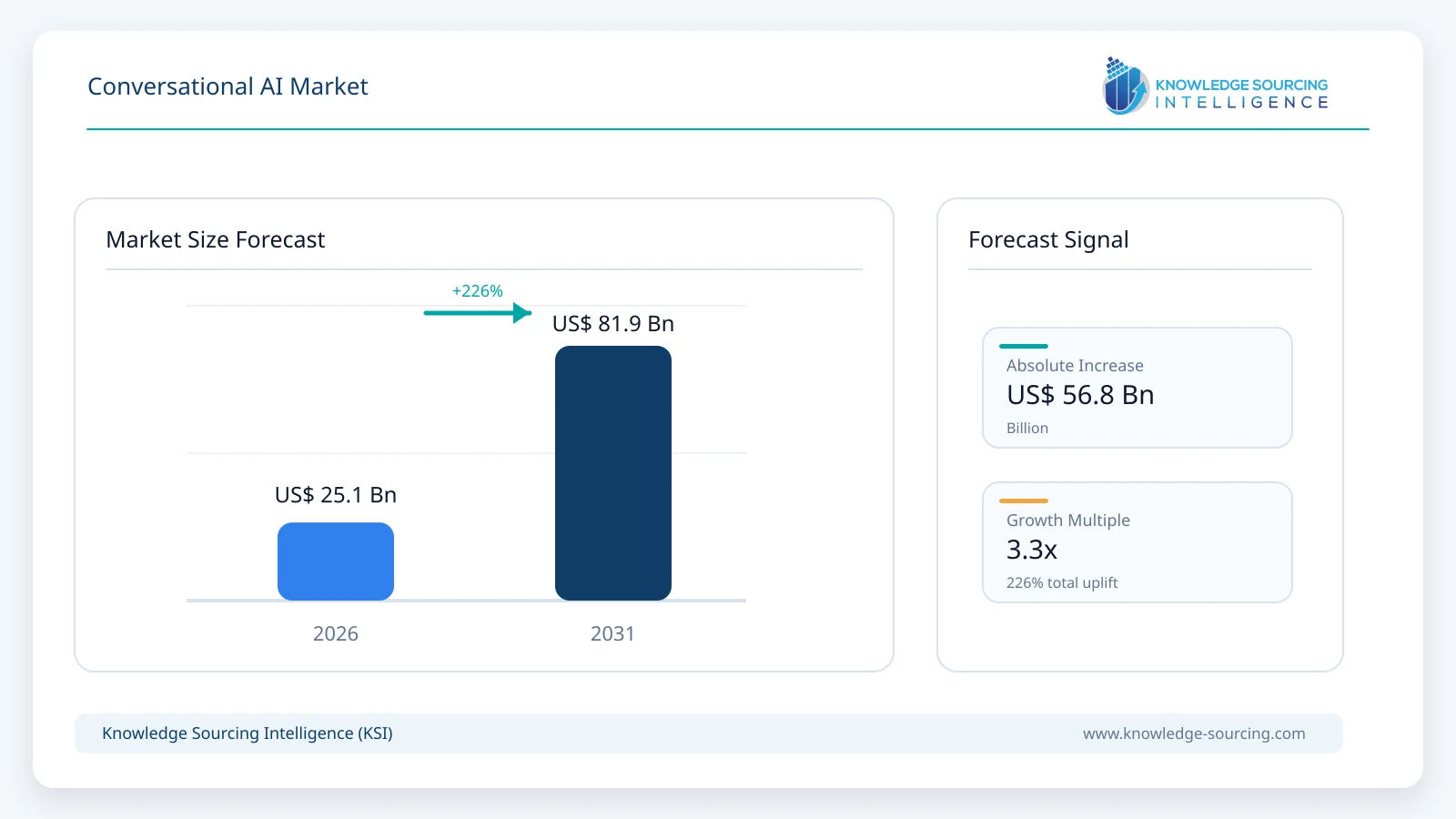
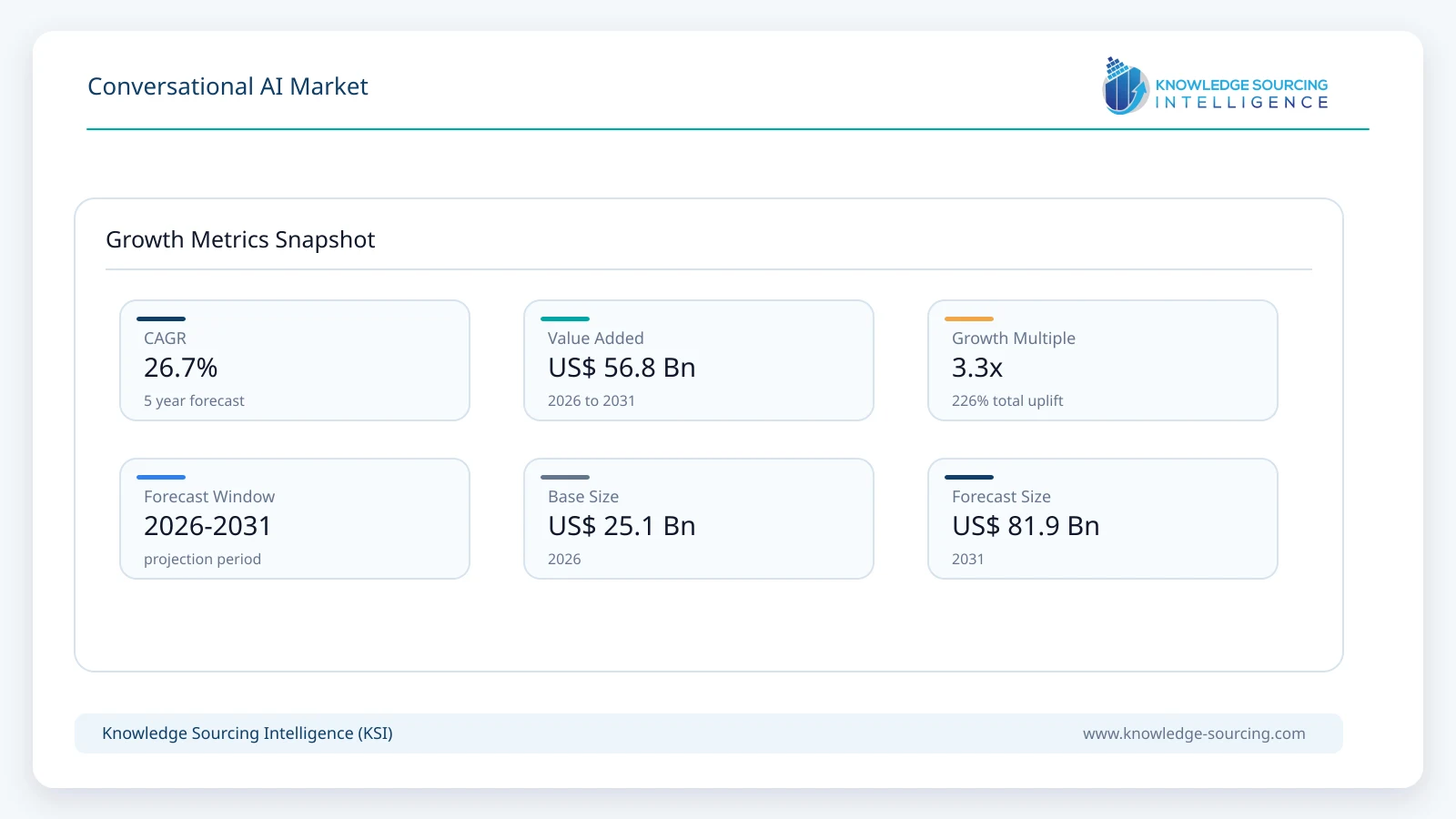
The Conversational AI market is forecast to grow at a CAGR of 26.7%, reaching USD 81.9 billion in 2031 from USD 25.1 billion in 2026.
Highlights:
- 1Enterprise demand is primarily driven by customer service automation and workforce productivity improvement.
- 2Cloud deployment remains the preferred implementation model because of scalability, continuous model updates, and lower infrastructure requirements.
- 3North America represents the largest commercial opportunity due to enterprise AI investment and mature cloud adoption.
- 4Large language models are expanding conversational AI applications beyond traditional customer support into enterprise knowledge management and workflow automation.
- 5Privacy regulations and emerging AI governance frameworks are influencing procurement decisions and deployment strategies.
- 6Competition increasingly centres on platform integration, enterprise security, proprietary AI models, and industry-specific capabilities.
The conversational AI market comprises software platforms, application programming interfaces (APIs), and related services that enable machines to understand, process, and respond to human language through text and voice interactions. These solutions integrate natural language processing (NLP), machine learning (ML), automatic speech recognition (ASR), generative AI, and large language models (LLMs) to automate customer support, employee assistance, sales engagement, and operational workflows. Demand spans enterprise software vendors, public-sector organizations, healthcare providers, retailers, financial institutions, telecommunications operators, and manufacturers seeking to improve service quality while reducing operating costs.
Commercial adoption has shifted beyond simple rule-based chatbots toward context-aware virtual assistants capable of handling complex, multi-step interactions. Enterprises now expect conversational AI platforms to integrate with customer relationship management (CRM) systems, enterprise resource planning (ERP) platforms, contact centers, workflow automation tools, and proprietary knowledge repositories. Procurement decisions increasingly emphasize response accuracy, multilingual capabilities, enterprise security, explainability, governance controls, and compatibility with existing technology infrastructure rather than standalone conversational functionality.
Enterprise spending reflects broader investment in automation and productivity initiatives. Organizations face rising customer service volumes, labour shortages in support functions, and growing expectations for continuous digital engagement. Buyers therefore evaluate conversational AI platforms based on measurable business outcomes, including reduced handling time, improved first-contact resolution, higher customer satisfaction, and lower service delivery costs. The emergence of generative AI has expanded enterprise use cases into knowledge management, employee productivity, document retrieval, internal technical support, and assisted decision-making, broadening the addressable market beyond customer-facing applications.
Industry economics favour software-centric business models supported by recurring subscription revenue, cloud infrastructure, implementation services, and ongoing model optimization. While software generates the largest share of revenue, professional services remain commercially important because organizations require data preparation, workflow integration, governance design, model tuning, employee training, and regulatory compliance support. Managed service providers are also expanding their role by monitoring conversational systems, maintaining model performance, and ensuring secure deployment across enterprise environments.
Technology adoption varies across industries according to regulatory obligations, customer interaction volumes, and digital maturity. Financial institutions prioritize secure authentication, fraud detection, and regulatory compliance. Healthcare organizations focus on appointment scheduling, patient engagement, and administrative automation while maintaining privacy standards. Retailers invest in conversational commerce and personalized recommendations, whereas telecommunications providers automate customer support and technical troubleshooting to reduce operational expenditure.
The competitive environment continues to evolve as cloud providers, enterprise software vendors, specialized conversational AI developers, and system integrators expand platform capabilities through proprietary foundation models, partner ecosystems, and industry-specific solutions. Buyers increasingly prefer vendors capable of delivering integrated AI platforms supported by governance, scalability, and enterprise-grade security rather than isolated chatbot applications.
Market Drivers
Expansion of enterprise customer engagement automation
Organizations across banking, retail, telecommunications, and travel sectors continue to automate high-volume customer interactions to improve service consistency and control operating expenses. Rising digital engagement has increased inquiry volumes across web, mobile, and messaging channels, making manual service delivery more expensive. Buyers seek conversational AI platforms capable of resolving routine requests while seamlessly transferring complex cases to human agents. Suppliers respond by expanding omnichannel capabilities, multilingual support, and integration with existing customer service platforms, strengthening recurring software revenue.
Adoption of generative AI for enterprise knowledge management
Generative AI has broadened conversational AI adoption from external customer engagement to internal enterprise operations. Employees increasingly use AI assistants to retrieve policies, summarize documents, generate reports, and support technical troubleshooting. Organizations therefore prioritize solutions capable of securely accessing proprietary enterprise data while maintaining governance controls. Vendors compete through retrieval-augmented generation, enterprise search integration, and configurable knowledge repositories, increasing commercial demand across large organizations.
Growth in cloud infrastructure investment
Cloud computing has reduced barriers to deploying advanced conversational AI by providing scalable computing resources, managed AI services, and rapid software updates. Enterprises increasingly prefer subscription-based cloud platforms over capital-intensive on-premises infrastructure, particularly for global customer support operations. Cloud deployment also enables continuous model improvement and simplified integration with enterprise applications, supporting long-term service contracts between technology providers and enterprise customers.
Regulatory focus on customer communication and accessibility
Government agencies and regulators increasingly encourage accessible digital public services and transparent customer communication. Public-sector organizations, healthcare providers, and financial institutions invest in conversational AI to improve citizen engagement while meeting accessibility requirements and maintaining service availability outside standard operating hours. Vendors respond by strengthening audit capabilities, language support, accessibility features, and governance frameworks that align with regulatory expectations.
Market Restraints and Challenges
Data privacy and regulatory compliance
Conversational AI systems frequently process sensitive personal, financial, and healthcare information. Compliance with privacy regulations requires organizations to implement strong encryption, access controls, data residency policies, and model governance procedures. These requirements increase implementation costs and extend procurement timelines, particularly in regulated industries. Suppliers mitigate these concerns through enterprise security certifications, private cloud deployment options, and enhanced governance capabilities.
Accuracy and hallucination risks
Generative AI models may occasionally produce inaccurate or unsupported responses, creating operational and legal risks. Organizations operating in regulated sectors remain cautious about deploying fully autonomous conversational systems without human oversight. Buyers increasingly require explainability, confidence scoring, content moderation, and approval workflows before expanding production deployments. Vendors continue investing in retrieval-based architectures and enterprise knowledge grounding to improve reliability.
Integration complexity
Many enterprises operate legacy business applications that were not originally designed for AI integration. Connecting conversational platforms with CRM, ERP, billing, identity management, and document management systems often requires extensive customization. Implementation complexity increases project costs and lengthens deployment schedules, making professional services an important component of overall market revenue.
Skills shortages
Successful deployment requires expertise in data engineering, AI governance, prompt engineering, cybersecurity, and enterprise architecture. Many organizations lack sufficient internal capabilities to manage conversational AI throughout its lifecycle. Consequently, enterprises increasingly rely on external consulting firms, managed service providers, and technology partners to accelerate implementation while reducing operational risk.
Major Segment Analysis
Cloud Deployment
Cloud deployment represents the most commercially significant segment because it aligns with enterprise purchasing preferences for scalable, subscription-based software delivery. Organizations increasingly seek rapid implementation, predictable operating costs, and continuous access to AI model improvements without maintaining dedicated infrastructure.
Large enterprises often deploy conversational AI across multiple geographic regions and business functions, requiring centralized management, flexible computing resources, and consistent security controls. Cloud platforms provide these capabilities while supporting integration with contact center software, productivity applications, analytics platforms, and enterprise databases. Buyers also benefit from faster deployment cycles compared with traditional on-premises implementations.
Competitive differentiation within this segment increasingly depends on AI model availability, enterprise security certifications, compliance capabilities, API ecosystems, and integration with broader cloud services. Providers capable of combining conversational AI with analytics, workflow automation, identity management, and data platforms strengthen customer retention through broader platform adoption. Consequently, cloud deployment continues to generate recurring subscription revenue while supporting expansion into additional enterprise use cases over time.
Regional Analysis
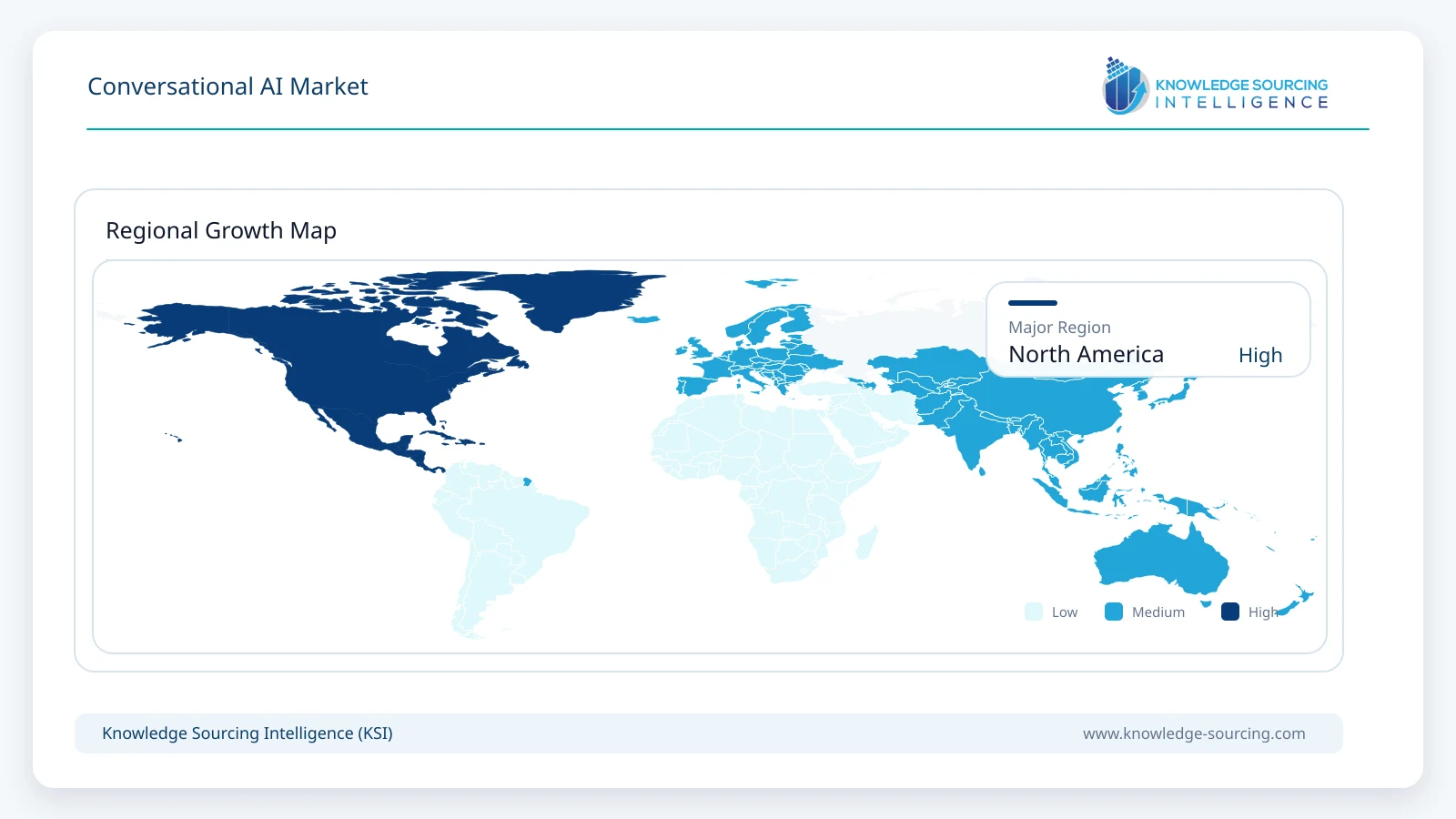
North America remains the largest regional market due to substantial enterprise software investment, mature cloud infrastructure, and widespread AI adoption across banking, healthcare, retail, and telecommunications. Organizations typically prioritize enterprise-scale deployments supported by strong cybersecurity, governance, and regulatory compliance. Technology partnerships between cloud providers and enterprise software vendors further strengthen regional competitiveness.
Europe emphasizes responsible AI deployment alongside digital innovation. Data protection regulations and emerging AI governance frameworks influence purchasing decisions, particularly in financial services, healthcare, and public administration. Enterprises increasingly seek transparent AI systems capable of supporting multilingual customer interactions while satisfying regulatory requirements across multiple jurisdictions.
Asia Pacific represents the fastest-expanding adoption environment owing to accelerating digital commerce, expanding cloud infrastructure, government-supported AI initiatives, and growing enterprise technology investment. Large consumer markets generate high customer interaction volumes, encouraging organizations to automate service operations through conversational platforms. Regional demand also benefits from multilingual AI development and expanding digital financial services.
Middle East & Africa continues to invest in digital government services, smart city initiatives, financial technology, and telecommunications modernization. National AI strategies encourage enterprise adoption, although implementation pace varies according to digital infrastructure maturity and workforce capabilities. Procurement frequently involves partnerships with global cloud providers and regional system integrators.
South America demonstrates growing enterprise interest in conversational AI for banking, retail, telecommunications, and customer support operations. Economic conditions influence technology spending, leading many organizations to favour cloud-based subscription models that reduce upfront investment. Localization, language capabilities, and implementation support remain important purchasing considerations throughout the region.
Competitive Landscape
The conversational AI market exhibits competition between diversified enterprise software companies, global cloud providers, and specialized conversational AI developers. Vendors compete through platform breadth, AI model performance, enterprise integration capabilities, security architecture, multilingual support, and industry-specific solutions.
Competitive positioning increasingly depends on combining conversational AI with broader enterprise software ecosystems that include productivity applications, cloud infrastructure, analytics, CRM, ERP, and workflow automation. Strategic partnerships with system integrators, cloud service providers, and consulting firms remain important for expanding implementation capacity and industry coverage.
Technology differentiation increasingly centres on proprietary large language models, retrieval-based knowledge integration, governance frameworks, responsible AI capabilities, and deployment flexibility across cloud and on-premises environments. Geographic expansion, localized language support, and industry-specific solution development remain important strategies among Microsoft Corporation, Alphabet Inc. (Google), Amazon Web Services, Inc., IBM Corporation, Oracle Corporation, Salesforce, Inc., SAP SE, Nuance Communications, Inc., and Kore.ai, Inc.
Recent Developments
June 2026: Salesforce expanded Agentforce capabilities with additional enterprise workflow automation and AI agent functionality for customer engagement. Commercial relevance: supported wider adoption of conversational AI across CRM-driven business operations.
June 2026: Apple introduced a completely redesigned AI-powered Siri at WWDC 2026, delivering a more conversational, context-aware digital assistant with enhanced natural-language understanding and deeper integration across the Apple ecosystem.
May 2026: Automation Anywhere launched pre-built AI solutions for enterprise IT and finance departments, integrating conversational AI agents with automation workflows to streamline business operations and improve enterprise productivity.
May 2026: Google unveiled the next generation of AI-powered Search at Google I/O 2026, introducing a conversational AI search experience with intelligent AI Search, agentic capabilities, and a redesigned AI-powered Search interface for natural-language interactions.
Regulatory and Policy Environment
The regulatory environment increasingly focuses on responsible AI development, data protection, cybersecurity, and transparency. Privacy regulations, including the European Union's General Data Protection Regulation (GDPR), require organizations to protect personal information processed through conversational platforms. Emerging AI governance frameworks, including the European Union AI Act, establish obligations relating to risk management, transparency, documentation, and human oversight for certain AI applications.
Governments also continue investing in national AI strategies, public-sector digital services, and cybersecurity initiatives that indirectly encourage conversational AI deployment. Procurement policies increasingly require explainability, security assessments, accessibility compliance, and responsible AI governance before enterprise implementation. Industry standards addressing information security, cloud operations, and software development further influence vendor selection and customer procurement processes.
Outlook and Strategic Implications
Over the next five years, enterprise investment will increasingly shift toward conversational AI platforms capable of supporting autonomous workflows, enterprise knowledge retrieval, multilingual engagement, and secure integration with business applications. Procurement priorities will extend beyond chatbot functionality to encompass governance, model lifecycle management, cybersecurity, interoperability, and measurable operational outcomes.
Technology suppliers are expected to strengthen investments in proprietary foundation models, retrieval-based architectures, enterprise data integration, and industry-specific AI assistants. Partnerships between cloud providers, enterprise software vendors, consulting firms, and managed service providers will remain commercially important because successful deployment increasingly depends on organizational change management as well as technology implementation.
Competition is likely to intensify around enterprise trust, regulatory compliance, implementation efficiency, and platform ecosystems rather than standalone conversational capabilities. Organizations able to demonstrate reliable performance, secure handling of sensitive information, transparent governance, and measurable productivity improvements will strengthen their competitive position. At the same time, evolving regulatory requirements, infrastructure costs, model reliability, and cybersecurity risks will remain important considerations influencing purchasing decisions and long-term investment strategies.
Conversational AI Market Scope
| Report Metric | Details |
|---|---|
| Total Market Size in 2026 | USD 25.1 billion |
| Total Market Size in 2031 | USD 81.9 billion |
| Forecast Unit | Billion |
| Growth Rate | 26.7% |
| Study Period | 2021 to 2031 |
| Historical Data | 2021 to 2024 |
| Base Year | 2025 |
| Forecast Period | 2026 – 2031 |
| Segmentation | Component, Deployment, Type, Technology, End-User, Geography |
| Companies |
|
Market Segmentation
By Component
- Solutions
- Managed Services
- Professional Services
- Training & Consulting
- System Integration & Implementation
- Support & Maintenance
By Deployment
- Cloud
- On-Premises
By Type
- Chatbots
- Intelligent Virtual Assistants (IVAs)
- Voice Assistants
By Technology
- Natural Language Processing (NLP)
- Machine Learning (ML) & Deep Learning
- Automatic Speech Recognition (ASR)
- Generative AI
- Large Language Models (LLMs)
By End-User
- BFSI
- Retail & E-commerce
- IT & Telecommunications
- Healthcare
- Media & Entertainment
- Automotive
- Manufacturing
- Government
- Travel & Tourism
- Food & Beverage
- Others
By Geography
- North America
- United States
- Canada
- Mexico
- South America
- Brazil
- Argentina
- Others
- Europe
- United Kingdom
- Germany
- France
- Spain
- Italy
- Others
- Middle East & Africa
- Saudi Arabia
- UAE
- South Africa
- Others
- Asia Pacific
- China
- Japan
- India
- South Korea
- Australia
- Indonesia
- Thailand
- Others
Table of Contents
1. INTRODUCTION
1.1. Market Overview
1.2. Market Definition
1.3. Scope of the Study
1.4. Market Segmentation
1.5. Currency
1.6. Assumptions
1.7. Base and Forecast Years Timeline
1.8. Key Benefits to the Stakeholder
2. RESEARCH METHODOLOGY
2.1. Research Design
2.2. Research Processes
3. EXECUTIVE SUMMARY
3.1. Key Findings
3.2. CXO Perspective
4. MARKET DYNAMICS
4.1. Market Drivers
4.2. Market Restraints
4.3. Porter's Five Forces Analysis
4.3.1. Bargaining Power of Suppliers
4.3.2. Bargaining Power of Buyers
4.3.3. Threat of New Entrants
4.3.4. Threat of Substitutes
4.3.5. Competitive Rivalry in the Industry
4.4. Industry Value Chain Analysis
4.5. Analyst View
5. CONVERSATIONAL AI MARKET BY COMPONENT
5.1. Introduction
5.2. Solutions
5.3. Managed Services
5.4. Professional Services
5.4.1. Training & Consulting
5.4.2. System Integration & Implementation
5.4.3. Support & Maintenance
6. CONVERSATIONAL AI MARKET BY DEPLOYMENT
6.1. Introduction
6.2. Cloud
6.3. On-Premises
7. CONVERSATIONAL AI MARKET BY TYPE
7.1. Introduction
7.2. Chatbots
7.3. Intelligent Virtual Assistants (IVAs)
7.4. Voice Assistants
8. CONVERSATIONAL AI MARKET BY TECHNOLOGY
8.1. Introduction
8.2. Natural Language Processing (NLP)
8.3. Machine Learning (ML) & Deep Learning
8.4. Automatic Speech Recognition (ASR)
8.5. Generative AI
8.6. Large Language Models (LLMs)
9. CONVERSATIONAL AI MARKET BY END-USER
9.1. Introduction
9.2. BFSI
9.3. Retail & E-commerce
9.4. IT & Telecommunications
9.5. Healthcare
9.6. Media & Entertainment
9.7. Automotive
9.8. Manufacturing
9.9. Government
9.10. Travel & Tourism
9.11. Food & Beverage
9.12. Others
10. CONVERSATIONAL AI MARKET BY GEOGRAPHY
10.1. Introduction
10.2. North America
10.2.1. By Component
10.2.2. By Deployment
10.2.3. By Type
10.2.4. By Technology
10.2.5. By End-User
10.2.6. By Country
10.2.6.1. United States
10.2.6.2. Canada
10.2.6.3. Mexico
10.3. South America
10.3.1. By Component
10.3.2. By Deployment
10.3.3. By Type
10.3.4. By Technology
10.3.5. By End-User
10.3.6. By Country
10.3.6.1. Brazil
10.3.6.2. Argentina
10.3.6.3. Others
10.4. Europe
10.4.1. By Component
10.4.2. By Deployment
10.4.3. By Type
10.4.4. By Technology
10.4.5. By End-User
10.4.6. By Country
10.4.6.1. United Kingdom
10.4.6.2. Germany
10.4.6.3. France
10.4.6.4. Spain
10.4.6.5. Italy
10.4.6.6. Others
10.5. Middle East & Africa
10.5.1. By Component
10.5.2. By Deployment
10.5.3. By Type
10.5.4. By Technology
10.5.5. By End-User
10.5.6. By Country
10.5.6.1. Saudi Arabia
10.5.6.2. UAE
10.5.6.3. South Africa
10.5.6.4. Others
10.6. Asia Pacific
10.6.1. By Component
10.6.2. By Deployment
10.6.3. By Type
10.6.4. By Technology
10.6.5. By End-User
10.6.6. By Country
10.6.6.1. China
10.6.6.2. Japan
10.6.6.3. India
10.6.6.4. South Korea
10.6.6.5. Australia
10.6.6.6. Indonesia
10.6.6.7. Thailand
10.6.6.8. Others
11. COMPETITIVE ENVIRONMENT AND ANALYSIS
11.1. Major Players and Strategy Analysis
11.2. Market Share Analysis
11.3. Mergers, Acquisitions, Agreements, and Collaborations
11.4. Competitive Dashboard
12. COMPANY PROFILES
12.1. Microsoft Corporation
12.2. Alphabet Inc. (Google)
12.3. Amazon Web Services, Inc.
12.4. IBM Corporation
12.5. Oracle Corporation
12.6. Salesforce, Inc.
12.7. SAP SE
12.8. Nuance Communications, Inc.
12.9. Kore.ai, Inc.
Navigate
Trusted by the world's leading organizations











