
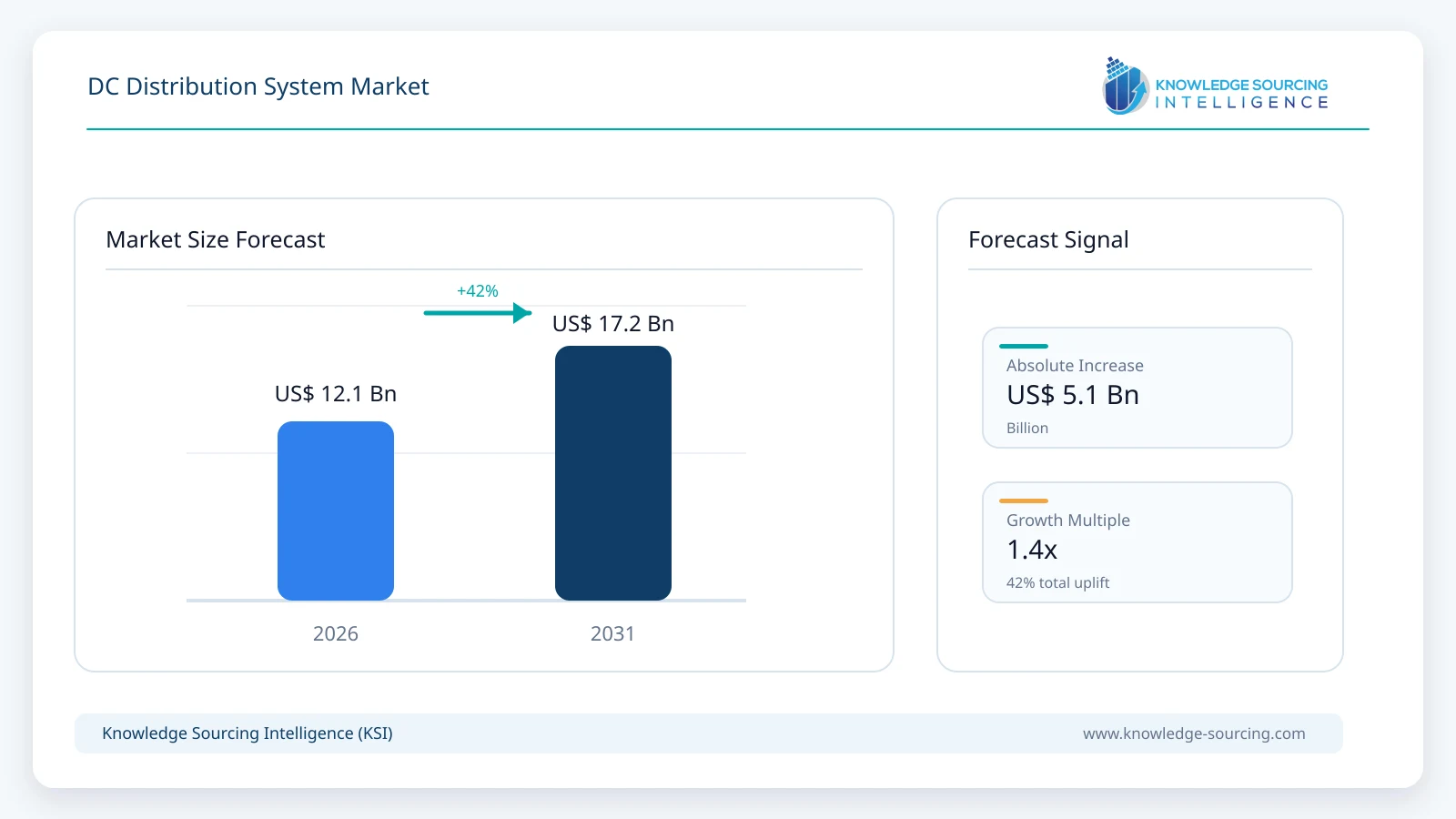
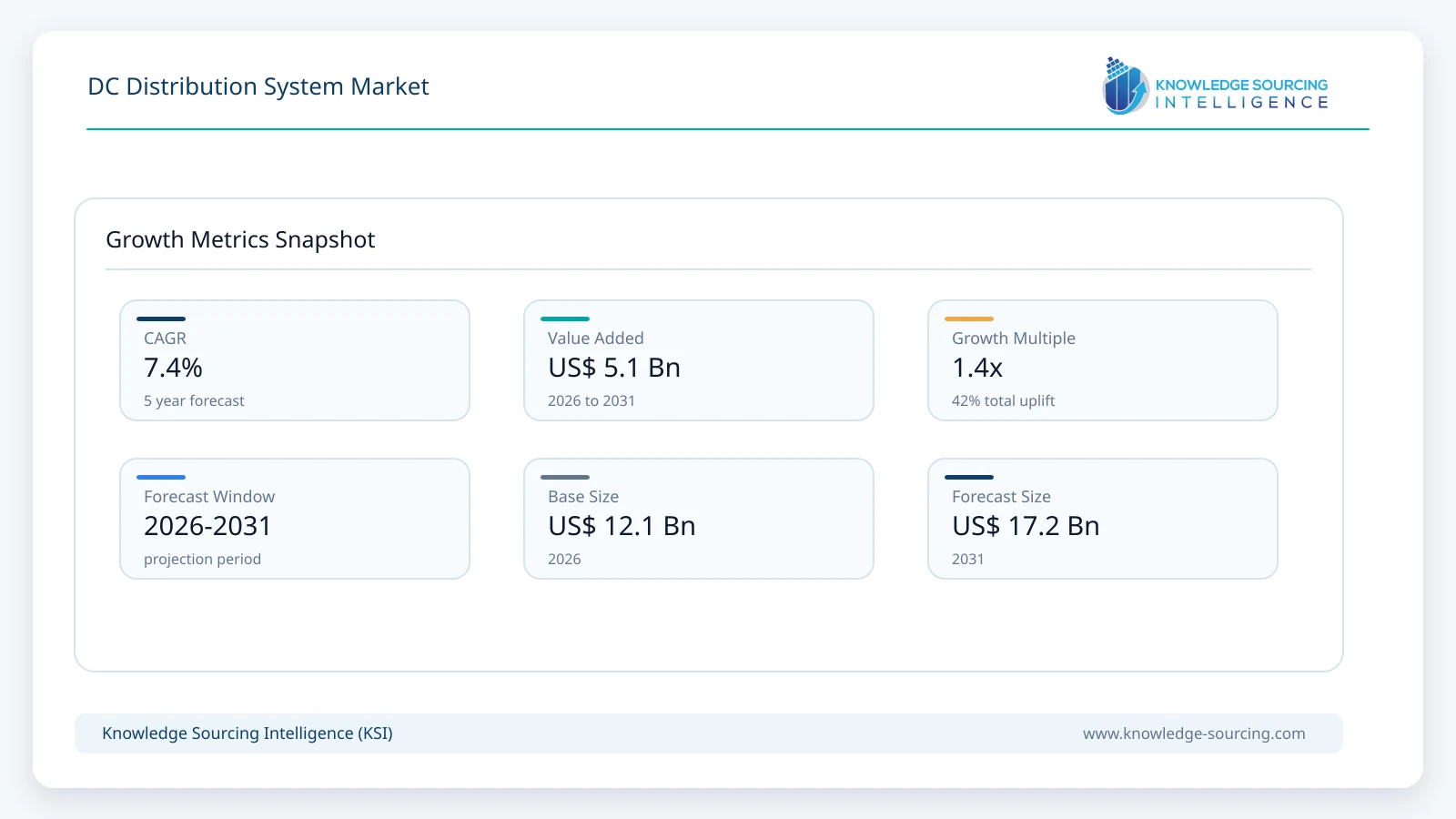
The DC Distribution System Market is projected to increase from USD 12.1 billion in 2026 to USD 17.2 billion by 2031, growing at a CAGR of 7.4%.
Highlights:
- 1Data Center and IT is projected to retain the highest end-use segment owing to rapidly growing power requirements of AI and high-density computing.
- 2DC Switchgear & Protection is another important segment because DC faults require specialized equipment to interrupt and monitor the fault.
- 3Power Conversion is a significant segment, since most useful DC systems combine AC grids with DC sources, storage, and loads.
- 4Asia Pacific is expected to continue being a major growth region driven by data-center construction, telecommunications infrastructure, renewable deployment, EV adoption, and electronics manufacturing.
A DC Distribution System is a type of electrical distribution architecture that provides direct current from a power source,conversion system to loads connected to the system. Photovoltaics (PV), batteries, fuel cells, rectifiers, DC generators, and AC/DC converters can provide this DC electricity depending on its architecture and the components required, such as switchgear, equipment, distribution units, protection devices, and monitoring, for distributed systems designed in accordance with the requirements of DC power special applications.
Further, it is continuously being looked at for deployment in uses that are readily generated or consumed as DC. The solar PV and batteries produce and store DC power, whereas servers, telecommunications equipment, LED lighting electronics, and many EV systems internally utilize DC. Hence, direct distribution of DC can minimize the number of AC/DC and DC/AC conversion stages, which in turn could enhance the system efficiency.
The market category includes multiple devices such as 2-wire and 3-wire DC architectures, localized DC switchgear and protection, power conversion equipment and/or power distribution units, as well as related components like protection/monitoring devices in the market. In terms of application, systems can be deployed in low-voltage DC architectures common in buildings and telecommunications or high-voltage DC systems associated with specific industrial applications or transmission.
The technology is crucial for data centers, where power passes through multiple conversion stages before getting to IT equipment. Power-infrastructure providers including Vertiv, Schneider Electric, Eaton, ABB, and Delta Electronics are creating systems for high-density computing as well as power distribution and UPS systems, DC power, and data-center electrical infrastructure.
DC also has relevance for renewable-energy microgrids and energy-storage systems. DC architecture works in interconnecting solar PV, batteries, EV chargers, and DC loads with fewer conversion stages is appealing for selected commercial, industrial, telecom, and remote power applications.
Market Dynamics
Market Drivers
Rise in data centers and AI computing: The rising use of AI infrastructure is promoting demand for electricity in data centers. According to IEA estimates, global data-center electricity consumption can exceed about 945TWh by 2030, which is more than double the levels in 2024. The growth in rack power density resulting from these servers is imposing more pressing requirements on the ability of UPS and distribution infrastructure to reliably deliver high-power levels to IT equipment. This requires high-capacity power distribution units, DC bus architectures, power conversion systems, monitoring equipment, and advanced protection technologies.
Expansion of renewable energy and utilitarian battery storage: Solar PV and battery products generate or retain electricity naturally with a DC electricity output. While solar-plus-storage systems are proliferating, using DC distribution architectures can offer an opportunity to connect generation, storage, and designated loads directly together in a manner that does not require extraneous conversion stages. According to the IEA, global renewable capacity additions are expected to remain strong in 2025. This expansion is broadening the addressable need for power conversion, DC protection, energy-management and distribution technologies.
Increase in EV charging systems: There is growing demand for high-power electrical distribution from EV charging. DC fast chargers condition grid electricity into a finely controlled DC output, the output that directly charges vehicle batteries, while charging hubs require ever more distribution capacity upstream. According to the IEA, more than 17 million electric cars were sold around the world in 2024, and sales exceeded 20 million units in 2025 and represented more than a quarter of all cars sold globally. As a result, this growing EV penetration is driving investment in charging infrastructure and related electrical distribution networks.
Growing demand for efficient energy systems: These conventional electrical architectures lead to a series of AC/DC and DC/AC conversions during generation, storage, distribution, and loads. By allowing electricity to stay in DC form for longer portions of the power chain, selected architectures can be simplified through direct use of DC distribution. This is most relevant for data centers, telecom networks, solar-plus-storage systems, microgrids, and certain types of buildings where power sources and loads are continually powered on DC.
Market Restraints & Opportunities
DC distribution systems can operate with different voltages and configurations depending on the application. The absence of a single global standard architecture may lead to higher engineering demands or interoperability issues between gear from suppliers.
In practice, interrupting DC currents is more difficult than with AC because a current does not pass through a zero-current point during each electrical cycle. This raises the technical requirements for DC circuit breakers, switchgear, arc suppression, coordination of protections, and fault detection.
This growth of AI computing is creating a window for DC power architectures within data centers with higher-voltage and more-efficient capabilities. Higher rack power densities are motivating both operators and equipment suppliers to re-examine traditional power-distribution architectures.
This will allow fewer conversion stages in DC microgrids, which can consist of solar PV, batteries, EV chargers, and some DC loads. There are opportunities for commercial buildings, industrial facilities, telecom sites, remote communities, and renewable-energy installations.
Key Developments
June 2026: nVent SCHROFF introduced the Smart DCDU, a smart –48 V DC power-distribution unit for telecom networks, edge data centers, and other mission-critical infrastructure. Housed in a slim 3U enclosure, it offers circuit-level, billing-grade monitoring, real-time alerts via TCP/IP remote management, dual power feeds, variable breaker configurations, and hot-swappable modules.
DC Distribution System Market Segmentation
The market is segmented by type, component, application, end user, and geography.
By Type
2-Wire DC System
2-Wire DC Systems are projected to continue dominating within the overall DC distribution system market because of the relative simplicity of the positive-and-negative conductor configuration and its suitability for a wide variety of low- and medium-voltage DC applications.
Its importance is especially acute for telecommunications, battery systems, solar PV, DC lighting and electronics, as well as small-scale DC distribution. Its comparatively simple topology decreases conductor needs and system architecture compared with other designs needing a neutral or midpoint conductor.
The architecture is also suitable for applications where loads function at a single DC voltage. This has resulted in demand for 2-wire configurations from telecommunications power systems, battery-backed systems and many DC electronic loads.
By Component
DC Switchgear & Protection
The DC Switchgear & Protection is anticipated to tabulate as a major segment owing to the fact that every architecture of DC distribution requires fault detection, isolation, switching and protection.
In DC systems, the current does not cross zero naturally as it does in AC systems; therefore, DC faults can establish steady-state arcs. As a result, with the increase in DC system voltage and power level, the need for DC circuit breakers, fuses, contactors, disconnectors, arc-fault detection, and protection coordination is also growing.
Additionally, the number of installations that require specialized DC protection is growing, including EV charging, data centers, renewable-energy systems, batteries, and DC microgrids.
By Application
Data Centers
Data centers are anticipated to maintain their dominance as the key application segment, owing to increased usage of electricity and rack-level power consumption with the significant emergence of cloud computing, AI, and digital services.
According to the IEA, data-center electricity consumption is expected to rise from about 480 TWh in 2024 to around 945 TWh by 2030, which is more than doubling. With the growing Power density, the use of more efficient UPS, power distribution, busway, PDU, and DC power architectures is fueling operators.
The increase in GPU and AI accelerators was most significant with high mix-density computing coupled to the power-delivery & thermal-management challenge. This is creating an opportunity for companies like Vertiv, Schneider Electric, Eaton, Delta, and ABB to begin offering more complete power-distribution and protection gear.
Regional Analysis
North America Market Analysis
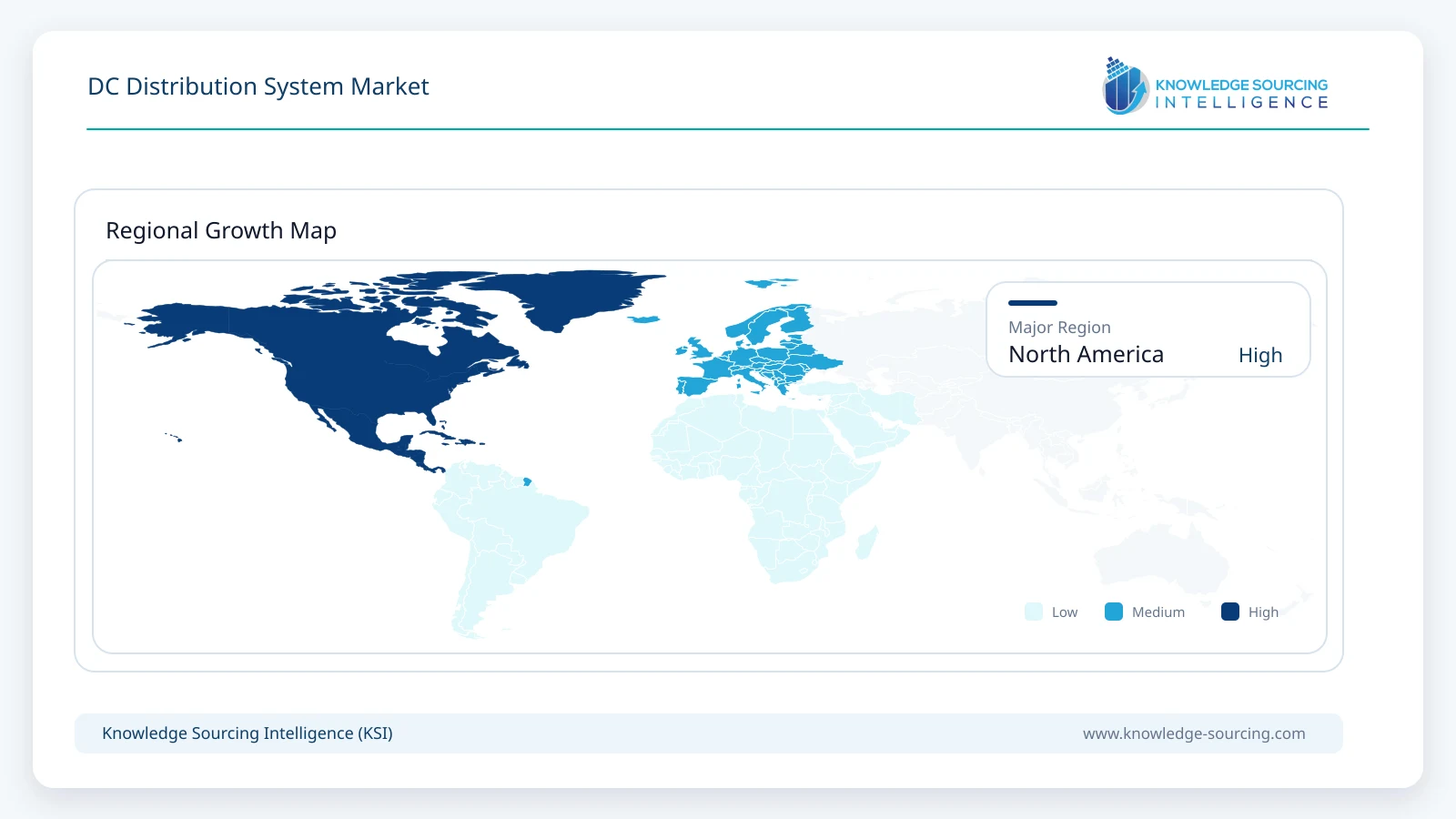
North America will continue being a large DC distribution market due to the rapid construction of data centers, expansion of AI infrastructure, adoption and development of EVs, and renewable-energy and grid modernization. In the U.S., where data-center electricity demand is growing faster than grid output, data-center consumption is projected by the IEA to constitute a large share of U.S. electricity-demand growth through 2030. This has resulted in an increased need for higher-density power distribution as well as uninterruptible power supply systems, power distribution units, DC conversion and monitoring.
South America Market Analysis
DC distribution opportunities, enabled through deployment of renewables, telecommunications infrastructure investment, EV adoption, and distributed energy systems, are being developed in South America. Brazil is the biggest regional opportunity, due to its size in terms of the electricity system and the rapidly growing solar generation capacity. Full DC-side Integration of PV panels, batteries, and power converters is needed to reduce costs for solar-plus-storage installations in the region.
Europe Market Analysis
Europe is an important market due to its transition to renewable energy, energy efficiency requirements, EV penetration, data center development, and an increasingly electrified environment. The growth of solar PV and battery storage is adding DC electricity to energy systems, whilst EV charging adds more loads on DC. As electricity costs and sustainability requirements grow in importance, data-center operators are also pursuing more efficient power architectures.
Middle East and Africa Market Analysis
Investment in data-center expansion, telecommunication expansion, renewable-energy projects, and electrification deployment of energy-storage solutions are supporting the growth of the Middle East & Africa market. Gulf countries are investing in hyperscale data centres and digital infrastructure as part of wider plans to diversify their economies. High solar resources make solar PV particularly relevant in the region and open up avenues for DC-side integration with batteries and power-conversion systems.
Asia Pacific Market Analysis
Asia Pacific is likely to remain one of the fastest-growing regional markets, benefiting from data-center expansions, telecommunications growth, EV adoption rate support, renewable generation growth, battery manufacturing, and electronics production. Large-scale renewable-energy and energy-storage capacity in China is already matched with rapid growth of data-center infrastructure. India has fast-expanding data centers, renewable generation, EV charging, and digital infrastructure.
List of Companies
Vertiv Group
Schneider Electric
ABB
Eaton Corporation
Delta Electronics
nVent
ZTE Corporation
EnerSys
AEG Power Solutions
Gorlan India
Vertiv Group
Vertiv has a solid position in DC distribution due to its ability to leverage its data-center power infrastructure portfolio consisting of UPS systems, power distribution, DC power systems, busway, rack power, monitoring, and thermal-management technologies.
Schneider Electric
The company offers UPS systems, switchgear, PDUs, busways, energy management, and DCIM solutions through its power-management and distribution technologies. Its EcoStruxure architecture integrates power equipment with monitoring and control systems, supporting high-density computing and digital infrastructure.
Eaton Corporation
Eaton provides electrical distribution, protection, power-quality, UPS and data-center power technologies. The company's solutions for electric infrastructure can combine all power conversion, protection, distribution, monitoring, and backup-power needs in mission-critical facilities.
Analyst View
The DC distribution system market is witnessing a growing need for DC-native equipment in applications such as data centers, renewables-storage systems, EV charging, telecommunications, and digital infrastructure. The most robust near-term demand center is data centers, while renewable integration and high-power EV charging increase the addressable market. DC Protection, power conversion, intelligent monitoring & modular distribution are witnessing growing demand as the system power level rises. It is becoming more important to distribute modular, well-protected power supplies capable of sustaining high peak loads.
DC Distribution System Market Scope:
| Report Metric | Details |
|---|---|
| Total Market Size in 2026 | USD 12.1 billion |
| Total Market Size in 2031 | 17.2 billion |
| Forecast Unit | USD Billion |
| Growth Rate | 7.4% |
| Study Period | 2021 to 2031 |
| Historical Data | 2021 to 2024 |
| Base Year | 2025 |
| Forecast Period | 2026 – 2031 |
| Segmentation | Type, Component, Application, End User, Geography |
| Companies |
|
Market Segmentation
By Type
2-Wire DC System
3-Wire DC System
By Component
DC Switchgear and Protection
Power Conversion
Power Distribution Units (PDUs)
Protection and Monitoring Devices
Others
By Application
Renewable Energy Integration
Data Centers
Electric Vehicle Charging
HVDC Transmission
Urban Power Systems
Others
By End User
Data Centers and IT
Telecommunications
Utilities and Grid Operators
Transportation and Mobility
Commercial and Institutional
Others
By Geography
North America
United States
Canada
Mexico
South America
Brazil
Argentina
Others
Europe
United Kingdom
Germany
France
Others
Middle East and Africa
Saudi Arabia
UAE
Others
Asia Pacific
China
Japan
India
South Korea
Others
Table of Contents
1. EXECUTIVE SUMMARY
2. MARKET SNAPSHOT
2.1. Market Overview
2.2. Market Definition
2.3. Scope of the Study
2.4. Market Segmentation
3. MARKET DYNAMICS
3.1. Market Drivers
3.2. Market Restraints
3.3. Market Opportunities
3.4. Porter’s Five Forces Analysis
3.5. Industry Value Chain Analysis
4. BUSINESS LANDSCAPE
4.1. Regulatory, Grid Codes & Electrical Distribution Standards Landscape
4.2. DC Distribution System Manufacturing & Component Ecosystem
4.3. Raw Material, Equipment & DC Distribution Supply Chain Analysis
4.4. Global Trade Statistics & Major Supplier/Buyer Analysis
4.5. Strategic Recommendations
5. TECHNOLOGICAL OUTLOOK
5.1. Advanced DC Distribution & Power Conversion Technologies
5.2. High-Efficiency DC-DC Converter & Power Electronics Technologies
5.3. Smart DC Distribution, Protection & Power Management Technologies
5.4. DC Microgrid, Energy Storage & Renewable Energy Integration Technologies
5.5. Digitalized, Intelligent & Condition-Monitored DC Distribution Infrastructure
6. DC DISTRIBUTION SYSTEM MARKET BY TYPE
6.1. Introduction
6.2. 2-Wire DC System
6.3. 3-Wire DC System
7. DC DISTRIBUTION SYSTEM MARKET BY COMPONENT
7.1. Introduction
7.2. DC Switchgear & Protection
7.3. Power Conversion
7.4. Power Distribution Units (PDUs)
7.5. Protection and Monitoring Devices
7.6. Others
8. DC DISTRIBUTION SYSTEM MARKET BY APPLICATION
8.1. Introduction
8.2. Renewable Energy Integration
8.3. Data Centers
8.4. Electric Vehicle Charging
8.5. HVDC Transmission
8.6. Urban Power Systems
8.7. Others
9. DC DISTRIBUTION SYSTEM MARKET BY END USER
9.1. Introduction
9.2. Data Centers and IT
9.3. Telecommunications
9.4. Utilities and Grid Operators
9.5. Transportation and Mobility
9.6. Commercial and Institutional
9.7. Others
10. DC DISTRIBUTION SYSTEM MARKET BY GEOGRAPHY
10.1. Introduction
10.2. North America
10.2.1. USA
10.2.2. Canada
10.2.3. Mexico
10.3. South America
10.3.1. Brazil
10.3.2. Argentina
10.3.3. Others
10.4. Europe
10.4.1. United Kingdom
10.4.2. Germany
10.4.3. France
10.4.4. Others
10.5. Middle East and Africa
10.5.1. Saudi Arabia
10.5.2. UAE
10.5.3. Others
10.6. Asia Pacific
10.6.1. China
10.6.2. Japan
10.6.3. India
10.6.4. South Korea
10.6.5. Others
11. COMPETITIVE ENVIRONMENT AND ANALYSIS
11.1. Major Players and Strategy Analysis
11.2. Market Share Analysis
11.3. Mergers, Acquisitions, Agreements, and Collaborations
11.4. Competitive Dashboard
12. COMPANY PROFILES
12.1. Vertiv Group
12.2. Schneider Electric
12.3. ABB
12.4. Eaton Corporation
12.5. Delta Electronics
12.6. nVent
12.7. ZTE Corporation
12.8. EnerSys
12.9. AEG Power Solutions
12.10. Gorlan India
13. APPENDIX
13.1. Currency
13.2. Assumptions
13.3. Base and Forecast Years Timeline
13.4. Key benefits for the stakeholders
13.5. Research Methodology
13.6. Abbreviations
Navigate
Trusted by the world's leading organizations











