
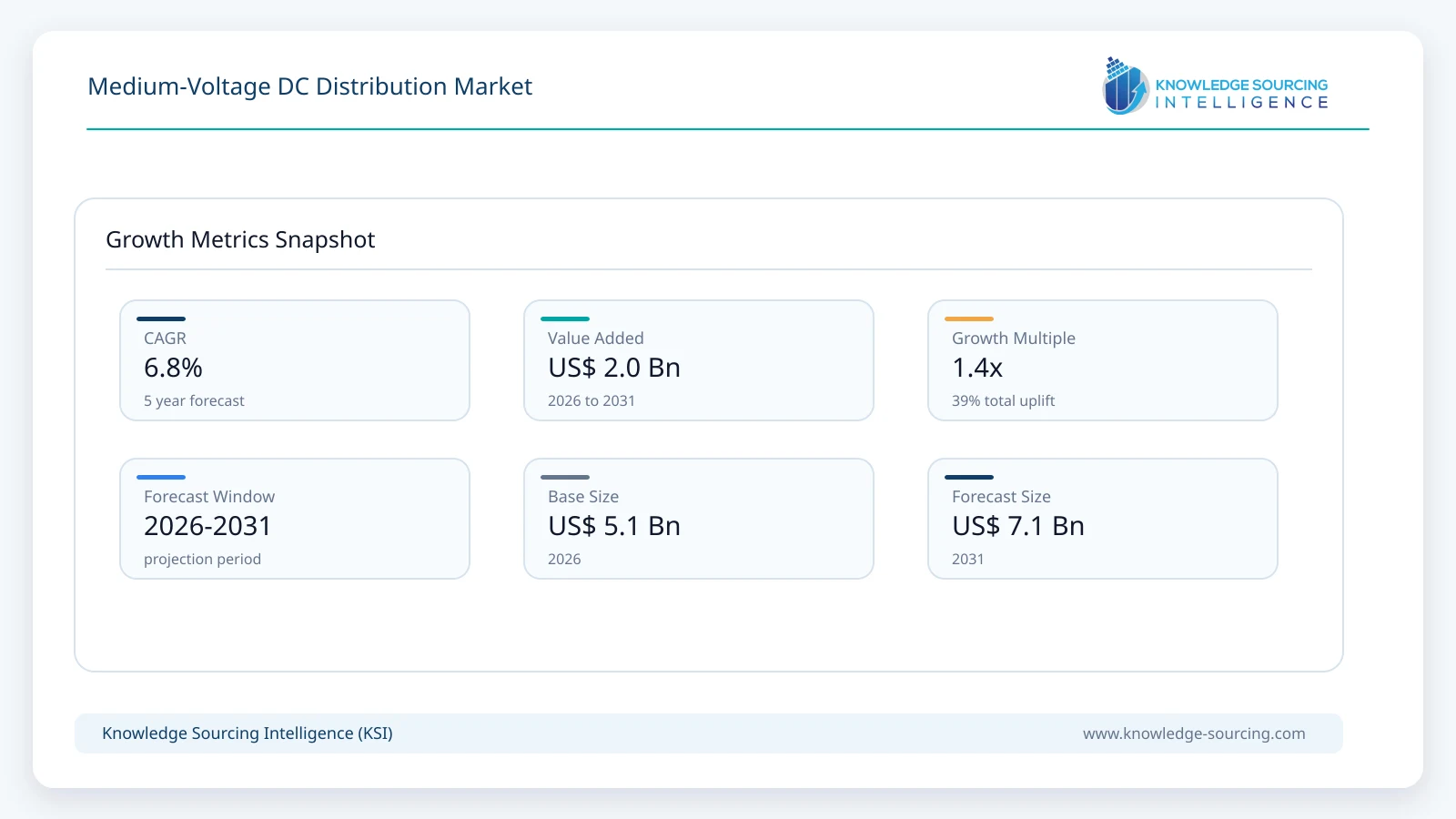
The Medium-Voltage DC Distribution Market is forecast to grow at a CAGR of 6.8%, reaching USD 7.12 billion in 2031 from USD 5.12 billion in 2026.
Highlights:
- 1Power converters take the leadPower Converters captured 35.0% of the Medium-Voltage DC Distribution Market in 2026, reaching USD 1.79 billion, as efficient power conversion becomes central to modern DC distribution networks.
- 2Data centers set the growth paceData Center Operators are projected to be the fastest-growing end-user segment, advancing at a 9.3% CAGR through 2031 amid increasing power requirements from high-density computing infrastructure.
- 3Dominant voltage rangeThe 1 kV–15 kV segment is expected to generate USD 4.84 billion by 2031, retaining its leading position with a 67.9% market share as medium-voltage DC architectures expand across large-scale applications.
- 4North America’s 2026 positionNorth America accounted for USD 1.54 billion in 2026, representing 30.0% of the global market, supported by investment in data centers, grid modernization, and advanced power distribution infrastructure.
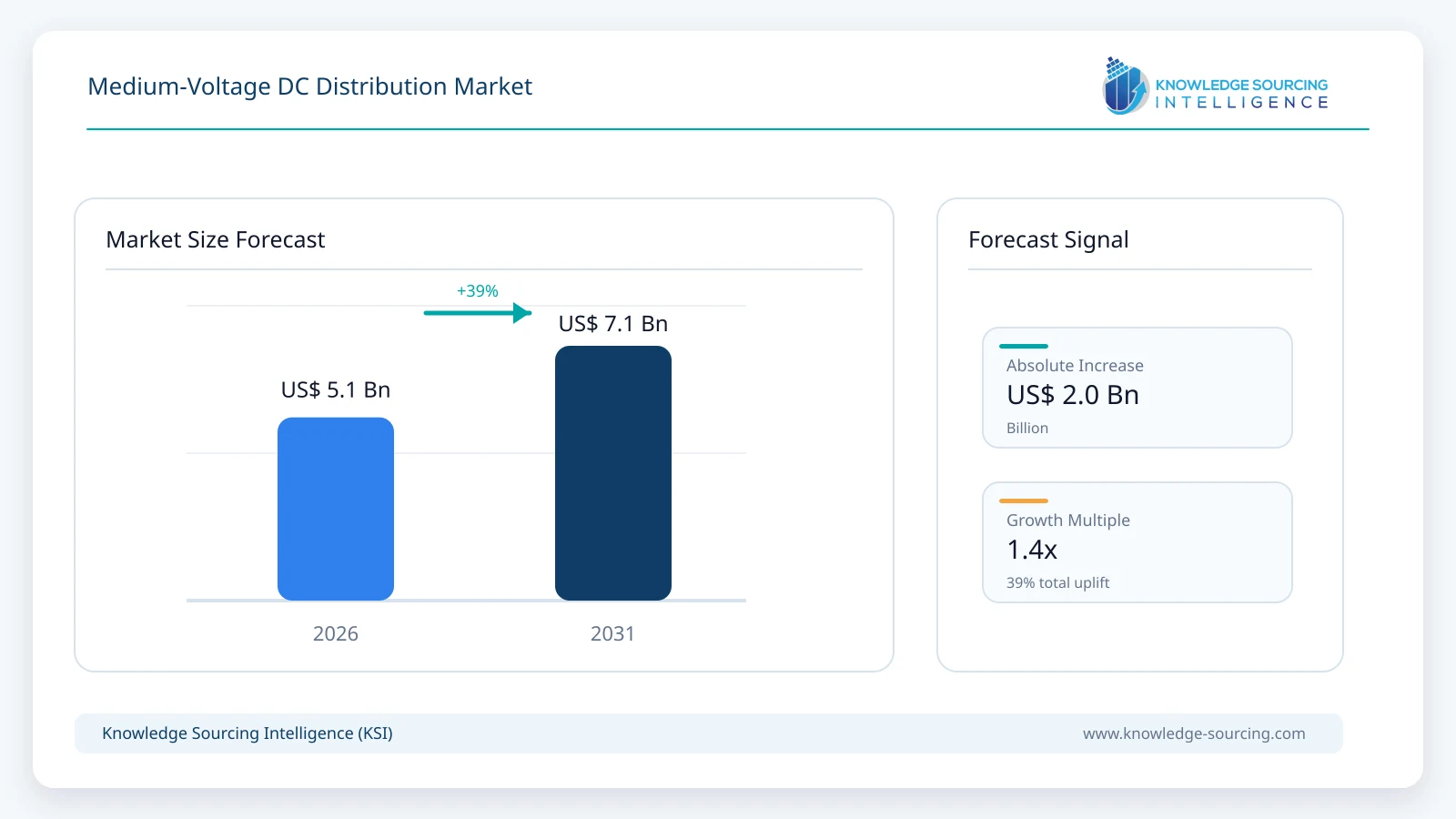
The forecast growth in the medium-voltage DC distribution market is driven by rising electrification, renewable energy deployment and battery storage, data center expansion, and the development of new DC-based industrial and transportation systems.
The market is experiencing a shift away from traditional AC-oriented distribution architectures and towards hybrid AC/DC and dedicated DC networks. Most acceptable electrical systems usually involve multiple power conversions when electricity passes between renewable generation, batteries, distribution networks, and electronic loads. The reduction of these conversion requirements can be achieved by using an MVDC distribution at the output, making the whole system more efficient.
The growth of PV solar systems and battery energy storage is making DC distribution a stronger technical case. Solar panels and batteries are naturally DC generators or stores, while much of modern load, including data center electronics, LED lighting, telecom equipment, EV charging infrastructure, and industrial drives, ultimately consumes DC power.
Hence, MVDC systems are capable of providing an intermediate common distribution layer between distributed generation, energy storage, and DC loads. Power converters still have an important role, since they can regulate voltage, control bidirectional power flows, and connect MVDC networks with conventional AC systems.
The market need is also developing for reliable DC protection. This is due to the absence of a current zero in DC faults, they are technically more difficult to interrupt compared with AC faults. This is driving demand for specialized DC breakers, solid-state switching technologies, fault-detection systems, and coordinated protection architectures.
Market Dynamics
Market Drivers
Increasing Deployment of Renewable Energy and Battery Storage: Solar PV and battery storage systems work using DC electricity by nature. Power electronic conversion between these resources and AC networks is a necessity in conventional AC distribution systems. This MVDC distribution can be viewed as an alternative architecture to enable renewable generation, batteries, and some of the special loads to coexist on a common DC distribution network. It also helps reduce the conversion stages and therefore improves energy efficiency.
Rapid Expansion of Data Centers: Data centers are one of the most appealing emerging applications for MVDC distribution. While electricity enters the facility as AC, it is ultimately DC power that modern computing equipment operates on. It has several conversion stages where some energy losses are encountered, and additional equipment is needed. The MVDC architectures can reduce conversion stages, as they deliver DC power closer to the IT equipment.
Electrification of Rail Networks and Transportation: Raising electricity needs from electric rail systems, ports, and airports to different transportation applications such as EV charging infrastructure. Most of these systems currently use DC power or need significant AC-to-DC conversion. For a transportation system, an MVDC network can be an efficient electrical architecture as it connects renewable generation, charging infrastructure, battery storage, and traction loads directly.
Increasing Industrial Electrification: Industrial plants are implementing variable-speed drives, robotics, automation systems, battery storage, solar PV, and power-electronics-based machinery. A large portion of industrial equipment usually depends on DC power or has an internal AC/DC conversion. An MVDC system is thus able to offer the possibility of consolidating electrical infrastructure and decreasing conversion losses. Industrial microgrids with DC architectures can also take advantage of direct integration between renewable generation and energy storage systems within the distribution network.
Market Restraints & Opportunities
The MVDC model is still relatively new and immature, which remains one of the major market restraints. AC has established the standards, protection technologies, equipment supply chains, engineering practices, and workforce expertise to use in profitable infrastructure builds, while MVDC infrastructure needs special equipment and new system-design approaches.
Interruption of DC faults is another problem. Natural zero-current passing can occur in AC circuit breakers, while DC systems rely on active interrupting mechanisms.
However, constraints are presented that offer manufacturers of solid-state circuit breakers, hybrid DC breakers, bidirectional converters, digital protection systems and modular MVDC distribution platforms opportunities to shine.
The increasing use of renewable energy, battery storage, data centre and DC transport systems is also creating a market for integrated AC/AD architectures which can optimise power flows from various electricity sources to destination loads.
Key Developments
April 2025: Researchers at Oak Ridge National Laboratory worked to create commercially viable circuit breakers compatible with medium-voltage DC grids. The prototype extinguished a 1,400 V current in under 50 microseconds, pushing the limit for mechanical switches, and is designed to endure scaling toward the target of 10 kV, with testing through up to 1,800 V.
January 2026: Fraunhofer ISE and partners from industry developed a medium-voltage system that is suitable for several megawatts for fast-charging stations of the future. They rely on a 1,500 V DC distribution network, low-loss silicon-carbide semiconductors, a centralized rectifier, and modular 175 kW DC converter units.
Market Segmentation
The market is segmented by component, voltage range, end user, and geography.
By Component: Power Converters
Power converters account for the largest component segment, representing a 35.9% share in 2031, with a segment value of USD 2.56 billion and a 7.4% CAGR during the forecast period. They are vital for controlling voltage and managing power flow from MVDC networks onward to AC grids, renewable generation, batteries, and electrical loads.
MVDC distribution requires AC/DC, DC/AC, and DC/DC conversion to maintain the required voltage stability and power quality through advanced converter systems. Bidirectional converters are particularly significant because they enable energy exchange between batteries, renewable generation, and distribution networks based on system demand.
Fuji Electric Power Semiconductors and Power Electronics develops power semiconductor and power electronics technologies that support efficient energy conversion and electrical equipment applications.
Hitachi Energy Power Electronics provides power electronics solutions across the network spectrum, including technologies designed to control and optimize electricity flows.
Power converters are becoming increasingly integrated with digital controllers and monitoring systems for dynamic voltage regulation, power-flow control, fault response, and renewable energy and storage integration.
By Voltage Range: 1 kV- 15 kV kV
The market in the voltage range of 1 kV–15 kV is anticipated to hold a major share of 70.0% in 2026, with a segment value of USD 3.58 billion, owing to its applicability across industrial campuses, commercial facilities, renewable energy installations, transportation applications, and localized distribution networks. This voltage range offers a practical balance between distribution capability, system efficiency, and infrastructure requirements compared with higher-voltage MVDC systems.
MVDC systems in this range can integrate solar PV, battery storage, motor drives, electric vehicle charging infrastructure, and DC loads within industrial facilities. Similar architectures can also support data centers by enabling efficient electricity distribution across campuses and between power conversion equipment and high-density loads.
The insulation, protection, and equipment requirements at 1 kV–15 kV are relatively moderate compared with higher-voltage systems, supporting cost-effective deployment and integration across emerging commercial and industrial applications. The segment is projected to grow at a 6.2% CAGR, reflecting increasing demand for efficient DC distribution and integration of distributed energy resources.
The 1 kV–15 kV segment is therefore expected to remain a key contributor to MVDC commercialization, serving localized industrial, commercial, renewable energy, data center, and transportation applications without the infrastructure complexity associated with higher voltage levels.
By End User: Data Center Operators
One of the fastest-growing end-user segments is data centers, accounting for a 25.0% share in 2026, equivalent to USD 1.28 billion, as rising computing density puts greater pressure on electrical efficiency. Conventional data centers receive AC power and take it through multiple conversion paths before distributing DC power to servers and other IT equipment. DC distribution works by reducing conversion stages in the computing load and improving energy efficiency associated with MVDC architectures.
The opportunity is reinforced by the rapid expansion of AI infrastructure, which requires significantly higher power density compared with conventional computing infrastructures. This is leading operators to assess electrical architectures that can improve energy efficiency while maintaining high availability. The data center segment is projected to increase its share to 28.0% by 2031, reflecting continued investment in high-density computing infrastructure.
Schneider Electric Data Center Solutions is a global provider of power distribution, cooling, energy management, and digital infrastructure solutions for data centers. Similarly, ABB Data Centers offers electrification and power-management technologies engineered for data center infrastructure.
Regional Analysis
North America Market Analysis
The North American MVDC distribution market is driven by distributed energy generation. The growth is represented by the rapid expansion of data centers, renewable energy deployment efforts, and industrial electrification and microgrid development. Substantial electricity demand growth in the United States is driven by AI data centers and hyperscale computing facilities. These facilities need reliable electric power infrastructure; to increase efficiency through various measures, they are considering more advanced power architectures.
South America Market Analysis
MVDC distribution is emerging in South America due to abundant renewable energy resources and rising electrification needs, expanding at a 6.8% CAGR. Brazil has mature electricity systems, growing solar and wind generation, and an industrial base, making it the largest regional market. Distributed solar PV adoption is increasing across commercial and industrial facilities, supporting DC-linked resources.
Europe Market Analysis
MVDC distribution is holding a considerable market share in Europe through strong investments in the balance of renewable generation, energy efficiency, smart grids, electrified transportation, and industrial decarbonization. The region's high renewable penetration is increasingly an opportunity in architecting ways to integrate solar PV, batteries, and other DC resources. Microgrids and energy management systems are being adopted for industrial facilities to reduce energy costs and increase resilience.
Middle East and Africa Market Analysis
The Middle East & Africa region witnesses MVDC distribution opportunities in the long term, associated with large-scale solar deployment, industrial development, data centre investment, and electrification programs. The Middle East has abundant solar resources, and this makes DC-based electricity architectures ideal for the region. Selected DC loads are directly integrated with solar PV and battery storage, which reduces conversion.
Asia Pacific Market Analysis
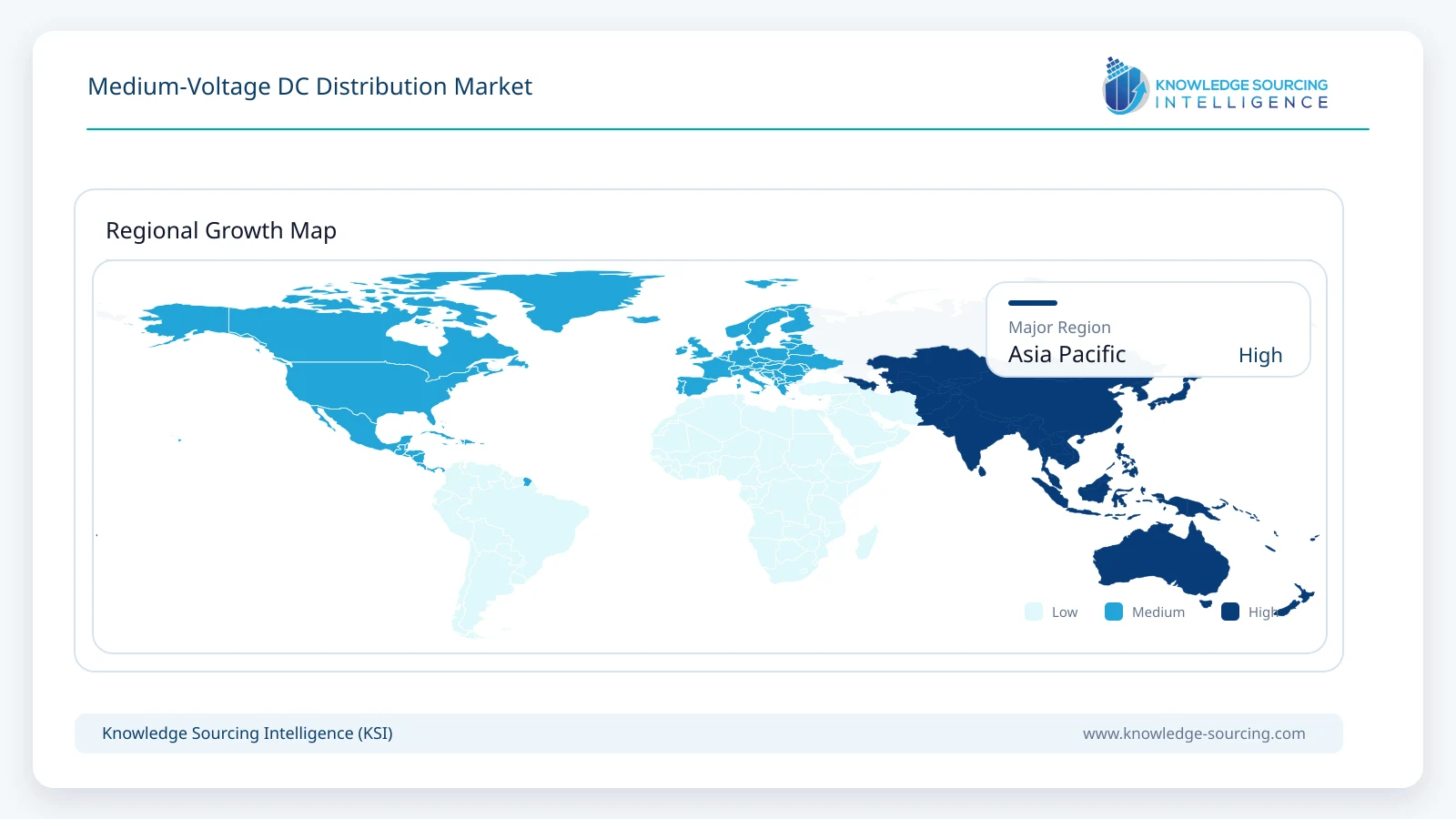
Asia-Pacific is anticipated to achieve the highest growth at a broader level, driven by fast-paced industrialization, renewable energy expansion, data center development, electric mobility, and grid modernization. The region is projected to account for a 37.0% share by 2031, with the segment value reaching USD 2.63 billion at an 8.0% CAGR. China is investing heavily in renewable generation, battery storage, power electronics, and smart-grid infrastructure. In addition, India’s large manufacturing base provides a broad application environment for DC distribution technologies.
List of Companies
Fuji Electric Co., Ltd.
Siemens AG
Hitachi Ltd.
Mitsubishi Electric
GE Vernova
ABB
Schneider Electric
Eaton Corporation
Rockwell Automation
Adani Group
Fuji Electric Co., Ltd.
The company provides power electronics, power semiconductors, energy management, and electrical equipment technologies. Its capabilities in power electronics are relevant for MVDC distribution, as converters and semiconductor devices are essential building blocks of DC power management. The company's power semiconductor technologies enable efficient switching and conversion in industrial & energy applications.
Siemens AG
Siemens offers medium-voltage distribution equipment, automation and digital grid, protection systems, and power electronics. Portfolios assist in promoting smart electrical networks in which monitoring, automation, and protection are progressively combined with physical distribution equipment.
Hitachi Ltd.
Hitachi Energy provides power electronics, grid integration, transformers – high-voltage equipment & digital. The power electronics portfolio includes technologies to control the flow of electrical power and support grid stability, so the company is well-positioned for new-build MVDC distribution architectures.
Analyst View
The Medium-Voltage DC Distribution market is migrating from a niche technology to an emerging distribution architecture fueled by the coupling of renewable generation, battery storage, data center and industrial electrification, and electric transportation. Power converters will continue to be an integral part as they represent MVDC connecting to traditional AC infrastructure, while the 1 kV–15 kV range will probably see early adoption in regional industry, commercial, renewable, and transportation applications. Data center operators are one of the significant new end users as AI-driven power density is increasing the value of high-efficiency DC architectures.
Medium-Voltage DC Distribution Market Scope:
| Report Metric | Details |
|---|---|
| Total Market Size in 2026 | USD 5.12 billion |
| Total Market Size in 2031 | USD 7.12 billion |
| Forecast Unit | Billion |
| Growth Rate | 6.8% |
| Study Period | 2021 to 2031 |
| Historical Data | 2021 to 2024 |
| Base Year | 2025 |
| Forecast Period | 2026 – 2031 |
| Segmentation | Component, Voltage Range, End User, Geography |
| Companies |
|
Market Segmentation
By Component
Power Converters
DC Cables & DC Busbars
DC Switchgear & Circuit Breakers
Protection & Control Systems
Monitoring & Communication Systems
Others
By Voltage Range
1 kV–15 kV
15 kV–35 kV
By End User
Electric Utilities
Data Center Operators
Industrial & Manufacturing Companies
Renewable Energy Developers
Transportation & Rail Operators
Others
By Geography
North America
USA
Canada
Mexico
South America
Brazil
Argentina
Others
Europe
United Kingdom
Germany
France
Others
Middle East and Africa
Saudi Arabia
UAE
Others
Asia Pacific
China
Japan
India
South Korea
Others
Table of Contents
1. EXECUTIVE SUMMARY
2. MARKET SNAPSHOT
2.1. Market Overview
2.2. Market Definition
2.3. Scope of the Study
2.4. Market Segmentation
3. MARKET DYNAMIC
3.1. Market Drivers
3.2. Market Restraints
3.3. Market Opportunities
3.4. Porter’s Five Forces Analysis
3.5. Industry Value Chain Analysis
4. BUSINESS LANDSCAPE
4.1. Regulatory & Technical Standards Landscape
4.2. MVDC Demonstration, Deployment & Commercialization Landscape
4.3. Renewable Energy, Energy Storage & Distributed Energy Integration Landscape
4.4. MVDC Equipment Supply & Procurement Landscape
4.5. Strategic Recommendations
5. TECHNOLOGICAL OUTLOOK
5.1. MVDC Power Conversion & Voltage Transformation Technologies
5.2. MVDC Cables, Busbars, Switchgear & Protection Technologies
5.3. MVDC Network Topologies, Control & Energy Management Technologies
5.4. Digital Monitoring, Grid Automation & Intelligent MVDC Technologies
6. MEDIUM-VOLTAGE DC DISTRIBUTION MARKET BY COMPONENT
6.1. Introduction
6.2. Power Converters
6.3. DC Cables & DC Busbars
6.4. DC Switchgear & Circuit Breakers
6.5. Protection & Control Systems
6.6. Monitoring & Communication Systems
6.7. Others
7. MEDIUM-VOLTAGE DC DISTRIBUTION MARKET BY VOLTAGE RANGE
7.1. Introduction
7.2. 1 kV–15 kV
7.3 15 kV–35 kV
8. MEDIUM-VOLTAGE DC DISTRIBUTION MARKET BY END USER
8.1. Introduction
8.2. Electric Utilities
8.3. Data Center Operators
8.4. Industrial & Manufacturing Companies
8.5. Renewable Energy Developers
8.6. Transportation & Rail Operators
8.7. Others
9. MEDIUM-VOLTAGE DC DISTRIBUTION MARKET BY GEOGRAPHY
9.1. Introduction
9.2. North Americas
9.2.1. USA
9.2.2. Canada
9.2.3. Mexico
9.3. South America
9.3.1. Brazil
9.3.2. Argentina
9.3.3. Others
9.4. Europe
9.4.1. United Kingdom
9.4.2. Germany
9.4.3. France
9.4.4. Others
9.5. Middle East and Africa
9.5.1. Saudi Arabia
9.5.2. UAE
9.5.3. Others
9.6. Asia Pacific
9.6.1. China
9.6.2. Japan
9.6.3. India
9.6.4. South Korea
9.6.5. Others
10. COMPETITIVE ENVIRONMENT AND ANALYSIS
10.1. Major Players and Strategy Analysis
10.2. Market Share Analysis
10.3. Mergers, Acquisitions, Agreements, and Collaborations
10.4. Competitive Dashboard
11. COMPANY PROFILES
11.1. Fuji Electric Co., Ltd.
11.2. Siemens AG
11.3. Hitachi Ltd.
11.4. Mitsubishi Group
11.5. GE Vernova
11.6. ABB
11.7. Schneider Electric SE
11.8. Eaton Corporation
11.9. Rockwell Automation
11.10. Adani Group
12. APPENDIX
12.1. Currency
12.2. Assumptions
12.3. Base and Forecast Years Timeline
12.4. Key benefits for the stakeholders
12.5. Research Methodology
12.6. Abbreviations
Navigate
Trusted by the world's leading organizations











