
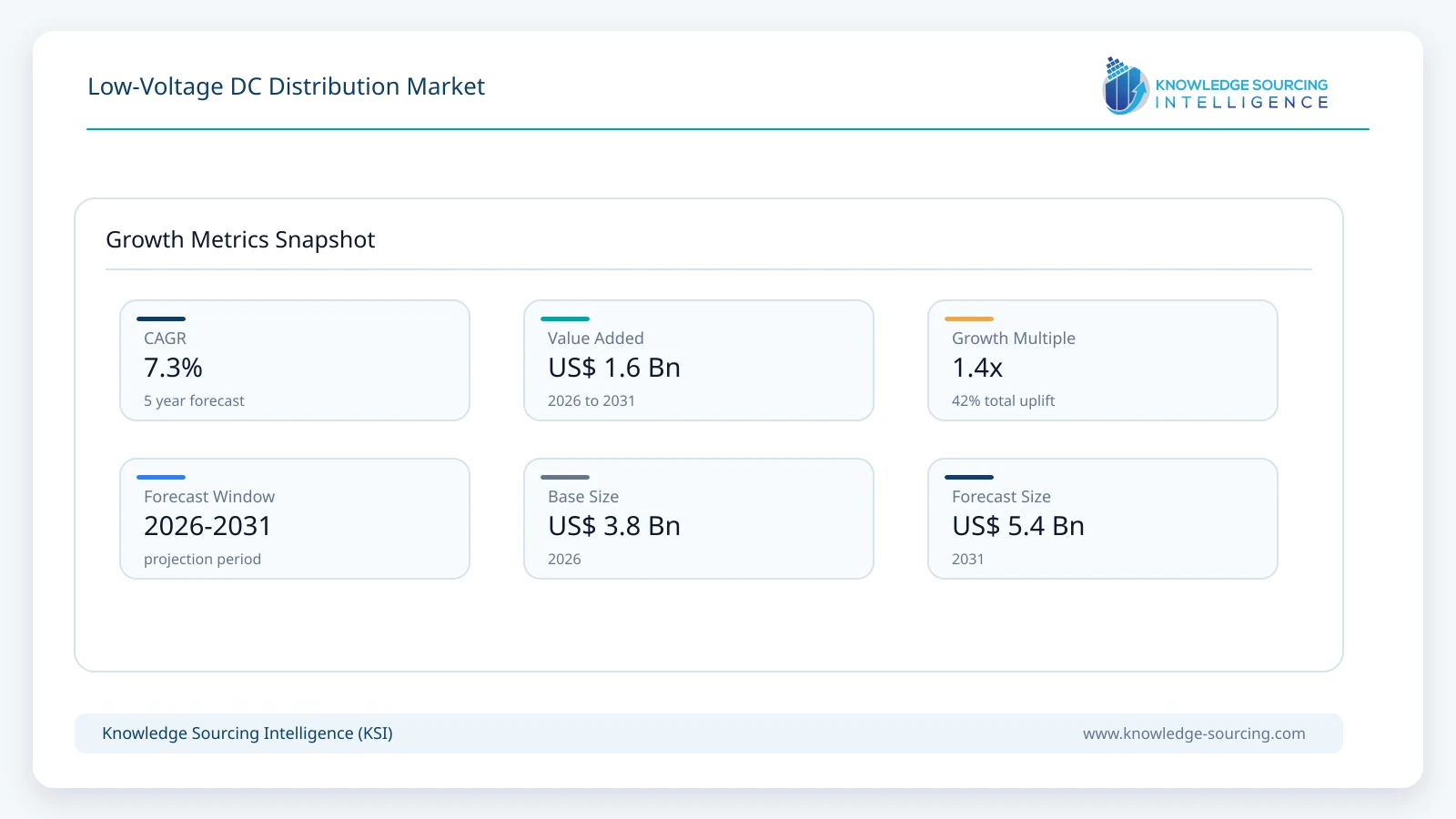
The Low-Voltage DC Distribution Market is forecast to grow at a CAGR of 7.3%, reaching USD 5.40 billion in 2031 from USD 3.80 billion in 2026.
Highlights:
- 1Power converters set the paceThe Power Converters segment commands 35.0% of the market in 2026, reaching USD 1.33 billion, and is forecast to climb to USD 1.95 billion by 2031.
- 2120V–1500V DC takes the leadWith a 70.0% market share in 2026, the 120V to 1500V DC range represents the largest voltage segment, valued at USD 2.66 billion and projected to reach USD 3.89 billion by 2031.
- 3Data centers emerge as the growth engineThe segment is expected to advance at a 9.7% CAGR through 2031, fueled by rising requirements for reliable, efficient, and scalable power distribution infrastructure.
- 4North America strengthens its market footprintThe region accounts for 30.0% of the 2026 market, equivalent to USD 1.14 billion, with its value expected to rise to USD 1.57 billion by 2031.
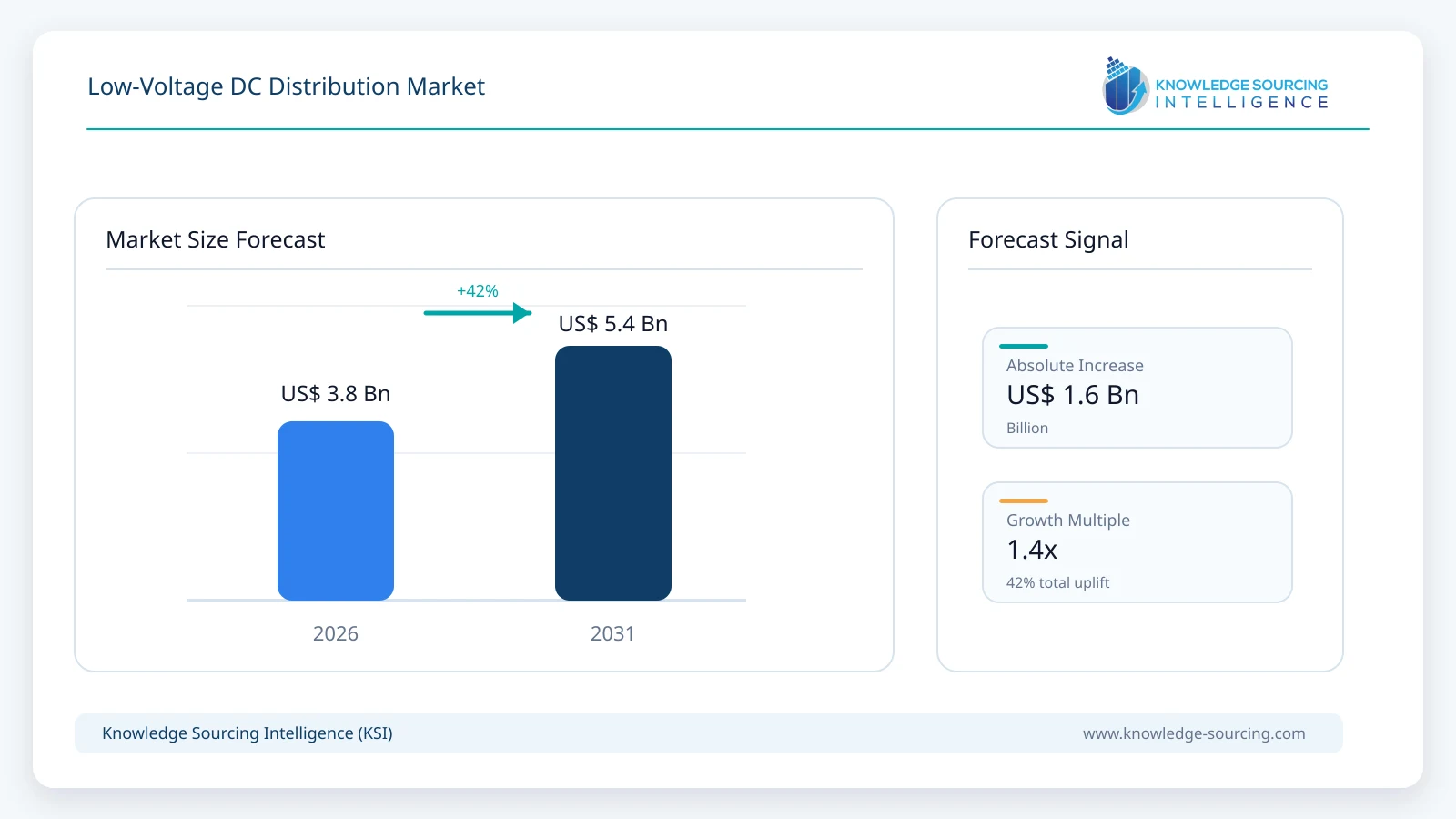
The market is expected to grow with the momentum of increasing electrification, renewable energy deployment and energy-efficiency requirements, data center expansion, and an increased penetration of DC-native electrical equipment.
The conventional forms of electrical distribution architectures are changing from centralized systems to localized Direct Current (DC) networks that would directly interconnect sources and loads that use DC electricity. For devices like solar panels, batteries, LED lights, computers, telecom systems, and EV charging equipment, regular AC systems often need multiple stages of running AC/DC followed by DC/AC.
In addition, this can minimize the number of conversion stages and could reduce electrical losses, providing better efficiency in the whole system. This obviously applies to buildings and facilities with very high DC loads.
The market is evolving with distributed energy resources. Solar PV panels produce clean, DC electricity, and batteries store electricity in the form of DC. The abundant availability of DC sources works to promote an LVDC architecture that can solely connect these resources with the DC loads and eliminate unnecessary AC-DC conversion.
Data centers are considered a major catalyst. Rising power density in servers, coupled with the booming application of AI workloads, is driving operators to look deeply into electrical architectures that would allow more power-efficient conversion and minimized losses through conversion time at the load level. Those types of opportunities are now beginning to emerge in telecom facilities, commercial buildings, manufacturing plants, and microgrids.
Market Dynamics
Market Drivers
Rise of DC-Native Electrical Loads: The growing usage of electronics and DC-based equipment is developing a structural driver for LVDC distribution. DC power is the ultimate source of never-ending supply for operating computers, telecom systems, LED lighting, sensors, consumer electronics, batteries, and other industrial electronic systems. In the case of conventional AC distribution, these loads require converting their input AC electrical energy into DC, leading to multiple stages of conversion and an increase in cost. Additionally, the adoption of LVDC distribution, which can provide DC power directly to specific loads, improving electrical architecture efficiency.
Rise in Solar PV and Battery Energy Storage: Solar PV generates DC electricity, and battery systems store DC electricity. Typical AC architectures require conversion equipment to couple these resources with the electrical system of a building or facility. The common distribution architecture connecting solar PV, batteries and DC loads is an LVDC network. This allows for less conversion and more effective utilization of onsite renewable electricity.
Expansion of Data Storage Facilities and Artificial Intelligence Infrastructure: LVDC distribution is emerging as one of the significant applications for data centers. IT equipment demands DC electricity, but traditional facilities typically get AC power and then convert it through a number of conversion steps. The high electricity requirements of AI workloads are boosting both server power density and the total amount of electricity needed. This is leading to stronger operator incentives for improved power utilization efficiency and conversion loss reduction. This could make it easier for net-zero IT sites to provide power delivery to servers and networking equipment while allowing for more direct integration with batteries and renewable generation.
Increase in Smart and Energy-Efficient Infrastructures: The incorporation of LED lighting, sensors, building automation systems, telecommunications equipment, access-control systems, and distributed energy resources into commercial and smart buildings is on the rise. Most of these systems are powered by DC electricity. Thus, a coordinated LVDC architecture can be used to serve multiple such loads over a common DC network instead of operating separate AC-to-DC conversion equipment for each. The smart building evolution is hence increasing the potential for LVDC systems by merging power distribution with digital controls and energy management.
Market Restraints & Opportunities
The prevalence of AC distribution still represents the biggest barrier for LVDC commercialisation. AC electrical standards, equipment, installation methods, protective measures, and workforce competency are already well established internationally.
Further, LVDC projects tend to have unique engineering and equipment requirements, which increase the initial cost of implementation. The scarcity of standardized LVDC technology and installation practices, in addition to customer hesitation to replace traditional AC infrastructure, can also inhibit the proliferation of LVDC.
However, these challenges are presenting openings for manufacturers working on smart DC circuit breakers, solid-state switches, modular busbars, next-generation and vast converters, and consolidated LVDC solutions.
The major opportunities are expected in new-build facilities. LVDC architectures can be incorporated in the initial design of data centers, smart buildings, industrial campuses, EV charging depots, and renewable-powered microgrids without the retrofitting cost associated with years of AC infrastructure.
Key Developments
January 2026: The CREST project at Loughborough University investigated DC microgrids at low voltage as an efficient infrastructure for distributed renewable energy integration. By contrast with AC systems, DC microgrids can provide easier control, higher reliability, and higher efficiency.
February 2025: Nexans participated in the Horizon Europe-funded Shift2DC project. The project encourages DC systems for medium- and low-voltage applications, has a budget of around €11 million, and runs until May 2027.
Market Segmentation
The market is segmented by component, voltage range, end use, and geography.
By Component: Power Converters
The power converters segment is expected to remain the dominant component segment of the LVDC distribution market, accounting for a 36.1% share by 2031 and registering a CAGR of 8.0% during the forecast period. This growth is driven by their critical role as an interface between DC networks and conventional AC electricity infrastructure.
Converters provide AC/DC, DC/DC, and DC/AC conversion, along with voltage regulation and fault current control between solar PV systems, batteries, AC grids, and DC loads. Bidirectional converters are particularly important for microgrids and energy storage systems, as they enable electricity to flow efficiently in both directions.
Fuji Electric Power Electronics provides power semiconductor and power electronics technologies for energy conversion and electrical control applications. Similarly, Mitsubishi Electric Power Semiconductors offers a broad range of power semiconductors used in power conversion systems, supporting efficient switching and energy management.
As batteries, solar PV systems, EV chargers, and DC loads continue to expand, demand is increasing for advanced converters capable of managing variable power flows while maintaining stable DC voltage. These capabilities are supporting the continued expansion of power converters within LVDC distribution systems.
By Voltage Range: 120V- 1500V DC
The 120V to 1500V DC segment is expected to lead the overall market, expanding at a CAGR of 7.9%, driven by its broad application across commercial & industrial facilities, renewable energy systems, EV charging infrastructure, and energy storage applications.
Higher voltage levels above 120V can support greater power transmission while enabling a more compact distribution architecture. The segment has strong relevance across solar PV installations, battery energy storage systems, EV charging systems, larger industrial facilities, and DC microgrids.
The 120V–1500V range also offers greater flexibility for facility-scale power systems compared with very-low-voltage DC networks, which are generally more suitable for telecommunications, controls, sensors, and smaller electronic loads.
This voltage range is applicable across commercial buildings, industrial plants, EV charging depots, and renewable energy installations requiring higher-voltage DC architectures. Such systems can transfer equivalent power at lower current levels, potentially reducing conductor requirements and supporting more efficient distribution designs.
By End Use: Data Centers
The data center segment is the fastest-growing and one of the most commercially attractive end-user segments, accounting for a 25.0% share in 2026, with a segment value of USD 0.95 billion. Cloud expansion, AI, machine learning, and high-performance computing are increasing energy consumption and rack power density.
Conventional data centers receive AC electricity from power sources and convert it into low-voltage DC to operate servers, storage systems, networking equipment, and other IT loads. The need to reduce conversion stages and improve power efficiency through LVDC architectures is expected to strengthen market opportunities.
The growing deployment of onsite batteries and renewable energy systems further supports this opportunity, as both technologies can be efficiently integrated through DC electrical architectures, reducing conversion losses and improving overall power management.
Schneider Electric provides integrated power, cooling, energy management, and digital infrastructure solutions for data centers. Likewise, ABB develops electrification and power management technologies designed to support critical data center infrastructure.
The emergence of high-density AI computing is expected to accelerate demand for advanced power distribution solutions capable of delivering electricity efficiently and reliably. The segment is projected to increase its market share to 27.9% by 2031, reflecting the rising power requirements of AI-driven and high-performance computing infrastructure.
Regional Analysis
North America Market Analysis
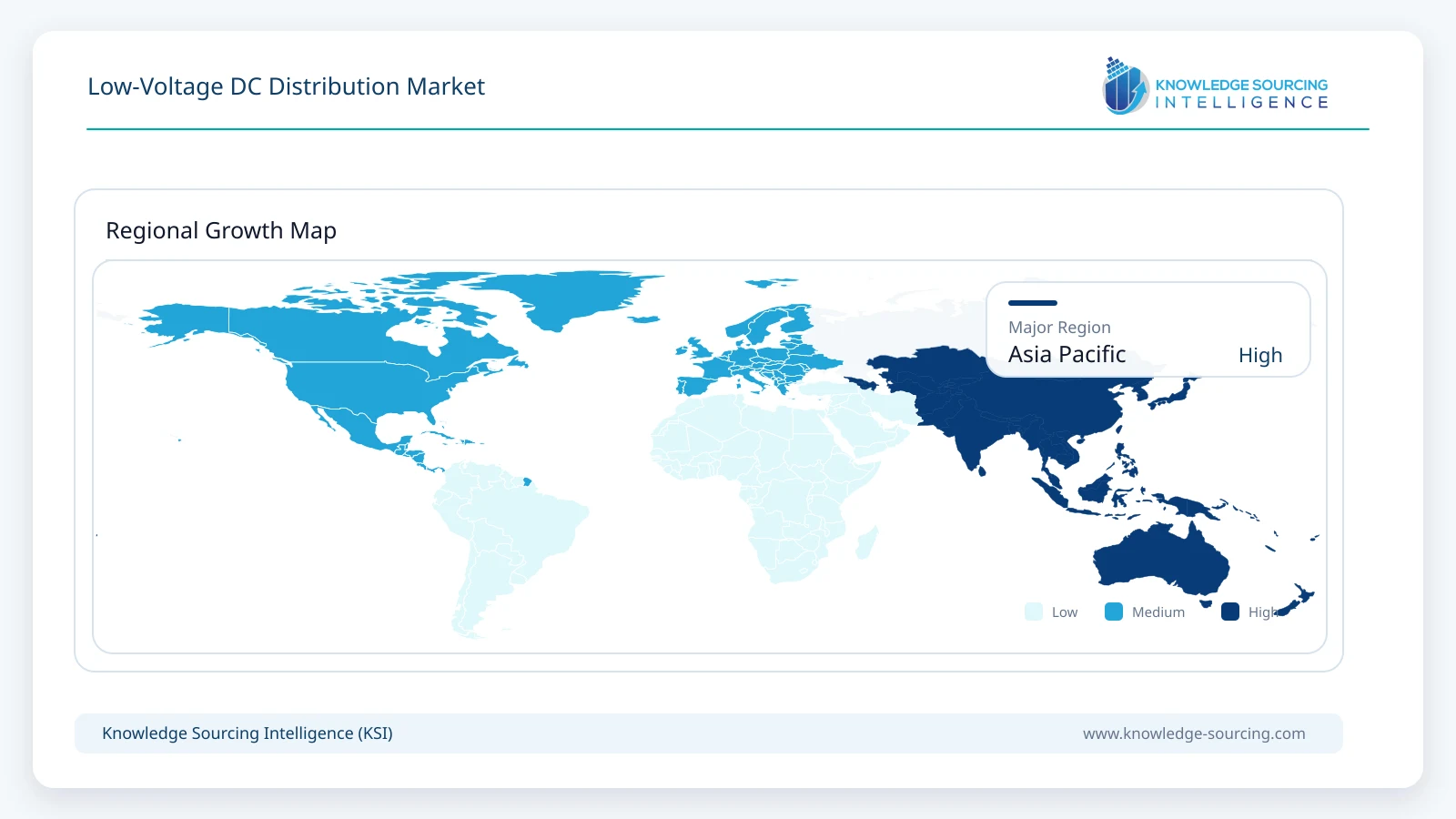
North America region is expected to be a major LVDC distribution market during the forecast period due to significant data center investment, smart-building buildout, renewable energy deployment, and industrial electrification. Cloud Computing and AI-driven data centers are rising in the USA, which is leading to growing electricity demand and is pushing operators to investigate highly efficient power distribution architecture.
South America Market Analysis
LVDC distribution in South America is an emerging market, valued at USD 0.15 billion in 2026 and accounting for a 4.0% share, supported by renewable energy expansion, electrification, industrial development, and distributed energy projects. Brazil represents the largest potential market in the region, driven by its established electricity infrastructure, growing solar PV deployment, commercial development, and expanding industrial base.
Europe Market Analysis
Europe is one of the technologically advanced LVDC markets owing to the strong focus on energy efficiency, renewable energy, smart buildings, electrification, and digital infrastructure across various countries. Developments of large data centers and smart commercial facilities in Germany, France, the United Kingdom, and Nordic countries are also promoting market expansion. The rising electricity needs from digital infrastructure have added to the demand for power distribution solutions.
Middle East and Africa Market Analysis
The LVDC distribution opportunities in the Middle East & Africa region can be leveraged due to investments driven by accelerating solar deployments, Smart-City development, ongoing data centre investments, and industrial infrastructure investments. The major investments of the UAE and Saudi Arabia in renewable energy, the digital economy, smart cities, and high-efficiency buildings is also providing opportunity.
Asia Pacific Market Analysis
Asia Pacific LVDC distribution market is forecasted to remain one of the largest and fastest-growing regional markets, supported by rapid urbanization, manufacturing expansion, renewable energy deployment, and data center development. By 2031, the region is projected to account for a 37.0% share, with a segment value of USD 2.0 billion, expanding at a CAGR of 8.5%. China is heavily investing in solar PV, battery storage, electric vehicles, data centers, and industrial automation. Likewise, India represents a significant opportunity, supported by rising electricity demand, renewable energy deployment, data center expansion, and accelerating electrification across commercial and industrial applications.
List of Companies
Schneider Electric SE
Siemens AG
ABB
Mitsubishi Electric Corporation
Eaton Corporation
Legrand Group
Hitachi Energy (Hitachi Ltd.)
Fuji Electric Co., Ltd.
LS Group
Toshiba Energy Systems (Toshiba Corporation)
Schneider Electric SE
Schneider Electric is a global specialist in low-voltage electrical distribution, circuit protection, power management, automation, and digital energy technologies. The company offers circuit breakers, switchgear, busbar systems, controllers, power management systems, and the EcoStruxure digital platform.
Siemens AG
Siemens offers low-voltage distribution, switching, protection, automation, and digital monitoring, as well as energy-management solutions. Its electrical infrastructure portfolio serves commercial buildings, industrial facilities, data centers, and infrastructure projects for digital control and energy efficiency.
ABB
ABB offers products and services in the fields of electrification, low-voltage products, power conversion, automation, energy management and digital electrical technologies. ABB is well-positioned due to its scale of power converters, circuit breakers, distribution equipment, and digital systems across the board between emerging LVDC and hybrid AC/DC applications.
Analyst View
The low-voltage DC Distribution market is transitioning from niche deployments to broad-based adoption with support from the perfect storm of solar PV, battery storage, data centers, smart buildings, and EV charging. Power converters will continue to be the most strategically important component because they set voltage regulation and define diverse DC-AC system interfaces, while 120V–1500V DC holds a large share of commercial, industrial, renewable, and EV applications. Data centers are the strongest end user, with AI workloads increasing power density and more focus on lowering conversion losses. Technological advancements in DC circuit breakers, intelligent switchgear, modular busbars, bidirectional converters, and digital energy management will be crucial for overcoming the long-standing bias towards AC distribution and speeding up commercial LVDC deployment over the forecast period.
Low-Voltage DC Distribution Market Scope:
| Report Metric | Details |
|---|---|
| Total Market Size in 2026 | USD 3.80 billion |
| Total Market Size in 2031 | USD 5.40 billion |
| Forecast Unit | Billion |
| Growth Rate | 7.3% |
| Study Period | 2021 to 2031 |
| Historical Data | 2021 to 2024 |
| Base Year | 2025 |
| Forecast Period | 2026 – 2031 |
| Segmentation | Component, Voltage Range, End Use, Geography |
| Companies |
|
Market Segmentation
By Component
Power Converters
Circuit Breakers and Busbar
Controllers and Rectifiers
Switchgear
Others
By Voltage Range
Below 120V DC
120V to 1500V DC
By End Use
Data Centers
Commercial and Smart Buildings
Industrial Facilities
Renewable Energy Systems
Electric Vehicle (EV) Charging Infrastructure
Residential Microgrids
Others
By Geography
North America
USA
Canada
Mexico
South America
Brazil
Argentina
Others
Europe
United Kingdom
Germany
France
Others
Middle East and Africa
Saudi Arabia
UAE
Others
Asia Pacific
China
Japan
India
South Korea
Others
Table of Contents
1. EXECUTIVE SUMMARY
2. MARKET SNAPSHOT
2.1. Market Overview
2.2. Market Definition
2.3. Scope of the Study
2.4. Market Segmentation
3. MARKET DYNAMIC
3.1. Market Drivers
3.2. Market Restraints
3.3. Market Opportunities
3.4. Porter’s Five Forces Analysis
3.5. Industry Value Chain Analysis
4. BUSINESS LANDSCAPE
4.1. Regulatory & Technical Standards Landscape
4.2. LVDC Demonstration, Deployment & Commercialization Landscape
4.3. Building Electrification, Distributed Energy & DC Load Integration Landscape
4.4. LVDC Equipment Supply & Procurement Landscape
4.5. Strategic Recommendations
5. TECHNOLOGICAL OUTLOOK
5.1. LVDC Power Conversion & Voltage Regulation Technologies
5.2. LVDC Cables, Busbars, Switchgear & Protection Technologies
5.3. LVDC Distribution Architectures, Control & Energy Management Technologies
5.4. Digital Monitoring, Automation & Smart Energy Management Technologies
6. LOW-VOLTAGE DC DISTRIBUTION MARKET BY COMPONENT
6.1. Introduction
6.2. Power Converters
6.3. Circuit Breakers and Busbar
6.4. Controllers and Rectifiers
6.5. Switchgear
6.6. Others
7. LOW-VOLTAGE DC DISTRIBUTION MARKET BY VOLTAGE RANGE
7.1. Introduction
7.2. Below 120V DC
7.3. 120V to 1500V DC
8. LOW-VOLTAGE DC DISTRIBUTION MARKET BY END USE
8.1. Introduction
8.2. Data Centers
8.3. Commercial and Smart Buildings
8.4. Industrial Facilities
8.5. Renewable Energy Systems
8.6. Electric Vehicle (EV) Charging Infrastructure
8.7. Residential Microgrids
8.8. Others
9. LOW-VOLTAGE DC DISTRIBUTION MARKET BY GEOGRAPHY
9.1. Introduction
9.2. North Americas
9.2.1. USA
9.2.2. Canada
9.2.3. Mexico
9.3. South America
9.3.1. Brazil
9.3.2. Argentina
9.3.3. Others
9.4. Europe
9.4.1. United Kingdom
9.4.2. Germany
9.4.3. France
9.4.4. Others
9.5. Middle East and Africa
9.5.1. Saudi Arabia
9.5.2. UAE
9.5.3. Others
9.6. Asia Pacific
9.6.1. China
9.6.2. Japan
9.6.3. India
9.6.4. South Korea
9.6.5. Others
10. COMPETITIVE ENVIRONMENT AND ANALYSIS
10.1. Major Players and Strategy Analysis
10.2. Market Share Analysis
10.3. Mergers, Acquisitions, Agreements, and Collaborations
10.4. Competitive Dashboard
11. COMPANY PROFILES
11.1. Schneider Electric SE
11.2. Siemens AG
11.3. ABB Group
11.4. Mitsubishi Electric Corporation
11.5. Eaton Corporation
11.6. Legrand Group
11.7. Hitachi Energy (Hitachi Ltd.)
11.8. Fuji Electric Co., Ltd.
11.9. LS Group
11.10. Toshiba Energy Systems (Toshiba Corporation)
12. APPENDIX
12.1. Currency
12.2. Assumptions
12.3. Base and Forecast Years Timeline
12.4. Key benefits for the stakeholders
12.5. Research Methodology
12.6. Abbreviations
Navigate
Trusted by the world's leading organizations











