
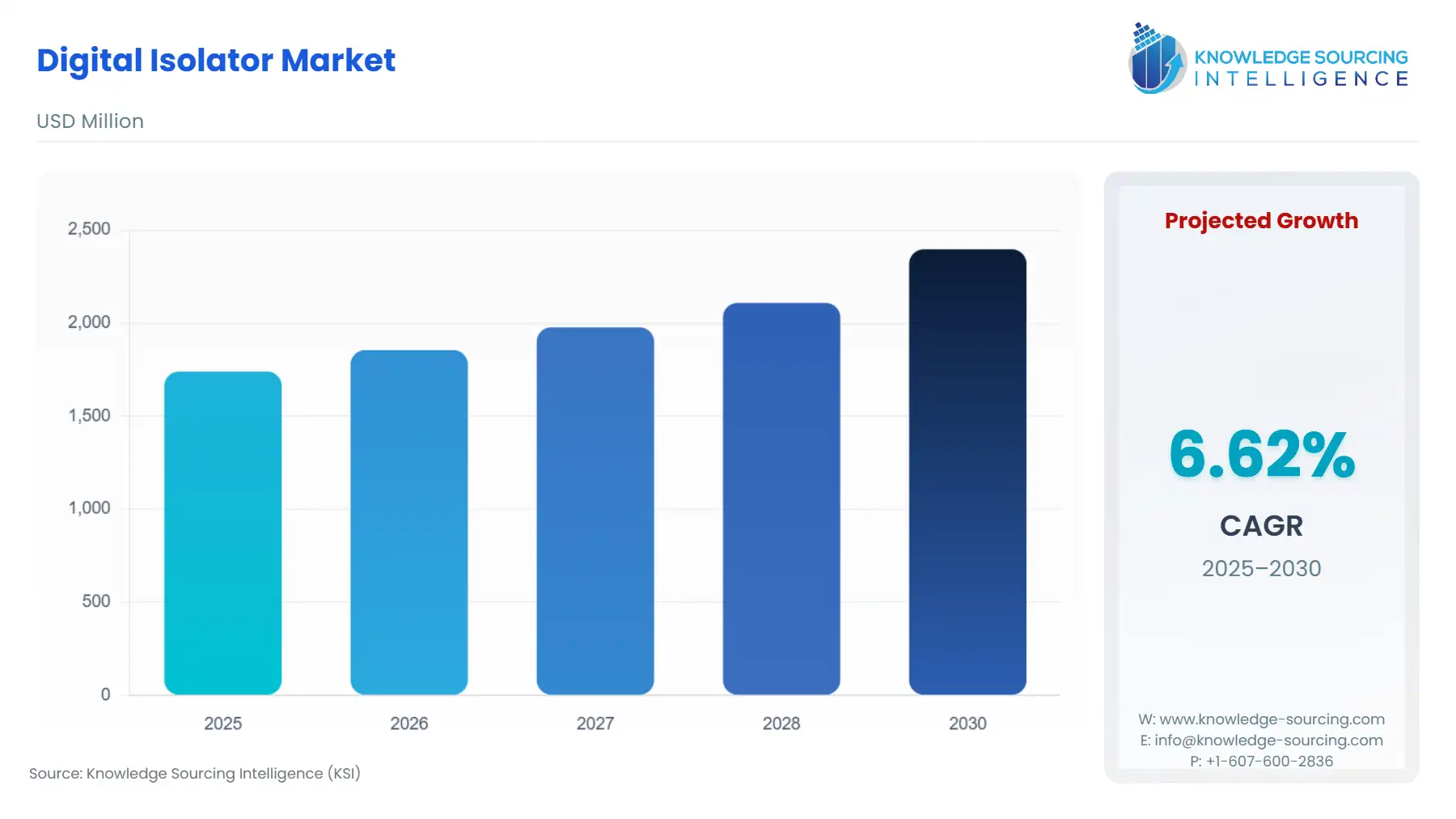
The Digital Isolator Market, with a 6.62% CAGR, is anticipated to reach USD 2.397 billion by 2030 from USD 1.740 billion in 2025.
Highlights:
- 1The mandated shift toward high-voltage system architectures in electric vehicles (EVs) and renewable energy systems directly increases demand for reinforced, multi-channel digital isolators that ensure user safety and signal integrity.
- 2Industrial automation and the proliferation of Industry 4.0 standards in manufacturing propel the demand for high-speed, robust digital isolators, specifically for real-time control, motor drives, and Programmable Logic Controllers (PLCs).
- 3Capacitive coupling technology maintains its market leadership, driven by its inherent advantages in high-speed data transmission, which is critical for modern telecommunications infrastructure and advanced automotive applications.
- 4The market is characterized by intense technological competition among major semiconductor companies, focusing on integrating isolated power supply capabilities onto a single chip to reduce system complexity and component footprint for Original Equipment Manufacturers (OEMs).
Digital Isolator Market Key Highlights
The digital isolator market, a critical segment within the broader power and mixed-signal semiconductor landscape, provides galvanic isolation, enabling the safe and reliable exchange of digital signals between circuits operating at vastly different power potentials. These components are essential for protecting human operators and sensitive low-voltage electronics from high-voltage hazards, while also eliminating ground loops that corrupt signal quality. The contemporary market trajectory is fundamentally shaped by the confluence of high-growth sectors—namely, electric mobility, industrial digitalization, and high-density power conversion—all of which require performance levels that traditional optocouplers cannot consistently deliver.
Digital Isolator Market Overview
& Scope
Report Metric
Details
Total Market Size in 2026
USD 1.740 billion
Total Market Size in 2031
USD 2.397 billion
Growth Rate
6.62%
Study Period
2021 to 2031
Historical Data
2021 to 2024
Base Year
2025
Forecast Period
2026 – 2031
Segmentation
Type, Material, Application, Geography
Companies
The Digital Isolator Market is segmented by:
- Type: The market is segmented into Capacitive Coupling, Magnetic Coupling, Giant Magnetoresistive, and Others. Capacitive coupling technology maintains its market leadership, driven by its inherent advantages in high-speed data transmission, which is critical for modern telecommunications infrastructure and advanced automotive applications. The technology is valued for its high Common-Mode Transient Immunity (CMTI) and robust performance in noisy electrical environments, making it suitable for high-frequency switching applications in power electronics and industrial drives.
- Material: The market segment consists of Polyimide-Based and Silicone-Dioxide (SiO2). Silicon Dioxide (SiO2) is a key insulation material used in capacitive digital isolators, providing high dielectric strength and long-term reliability. Its excellent thermal stability and integration compatibility with standard CMOS processes make it a preferred choice for high-volume manufacturing of robust isolation components required in automotive and industrial applications.
- Application: The market is segmented as Gate Drivers, DC/DC Converters, Analog-to-Digital Converters (ADC), and Others. Gate Drivers represent a critical application segment, fundamentally coupled with the rapid adoption of power switching devices. The need for digital isolators in gate drivers is escalating as Silicon Carbide (SiC) and Gallium Nitride (GaN) devices become standard in high-efficiency systems like EV traction inverters and solar power inverters, demanding isolators with superior Common-Mode Transient Immunity (CMTI) of 100 kV/µs or higher.
- End-User: Geographically, the market is expanding at varying rates depending on the location.
________________________________________________________________
Top Trends Shaping the Digital Isolator Market
Adoption of Advanced Isolation Technologies
More manufacturers are developing capacitive and magnetic coupling technologies in an effort to achieve higher data rates, improved noise immunity, and better power efficiency. These advancements in technology are thus a means of availing to the industrial market the increased demand for high-performance isolation and compliance with regulatory requirements, and contribute to reducing system complexity and component footprint throughout the supply chain.
Focus on Integrated Power and Signal Isolation
Increased demand for compact system designs and enhanced general performance goals of various companies are pushing the companies into adopting integrated solutions that combine signal isolation with isolated power supply on a single chip. This trend thus has implications of reduced system cost, improved reliability and increased attractiveness of the market to the automotive and industrial sectors concerned with space constraints.
________________________________________________________________
Digital Isolator Market Growth Drivers vs. Challenges
Drivers:
- Rising Industrial Demand Across Key Sectors: The digital isolator market is dominated by increasing demand from automotive, industrial automation, and renewable energy industries. The global transition to electrification dictates an acute demand for high-performance isolation in Electric Vehicles (EVs) for battery management systems, on-board chargers, and traction inverters. Concurrently, Industry 4.0 and automated factory floors drive the need for digital isolators in industrial motor drives and communication interfaces, where they ensure noise immunity and prevent ground potential differences from corrupting real-time control signals.
- Technological Advancements in Isolation Processes: Manufacturers are recognising the merits of using capacitive coupling and magnetic coupling techniques and are increasingly developing such methods for use in high-speed data transmission. The application of new techniques will increase data rates, improve noise immunity and end up with higher reliability digital isolators. These advancements in turn allow the new isolation solutions to manufacture various products for gate drivers, for power conversion, for data acquisition systems, etc. New techniques will also enable the companies producing digital isolators to comply with modern safety and environmental regulations and enable their operations to remain competitive.
Challenges:
- High Implementation Costs: The high initial Bill of Materials (BOM) cost associated with digital isolators, particularly those incorporating specialized insulation materials, can temper adoption rates in cost-sensitive consumer electronics applications.
________________________________________________________________
Digital Isolator Market Regional Analysis
- Chinese Market Analysis (Asia-Pacific): China is the single most dominant geographic segment, driven by its massive electronics manufacturing ecosystem and aggressive government-backed initiatives in new energy vehicles (NEVs) and renewable power generation. The sheer volume of production in industrial control systems, consumer electronics, and EV components ensures a colossal demand for all classes of digital isolators. Local factors, including the rapid scaling of Gigafactories for battery production and the world's largest roll-out of high-power charging infrastructure, fuel a demand for high-channel-count digital isolators for BMS and high-CMTI isolators for power modules, making China a critical center for both consumption and localized R&D/manufacturing.
________________________________________________________________
Digital Isolator Market Segmentation:
- By Type
- Capacitive Coupling
- Magnetic Coupling
- Giant Magnetoresistive
- Others
- By Material
- Polyimide-Based
- Silicone-Dioxide (SiO2)
- By Application
- Gate Drivers
- DC/DC Converters
- Analog-to-Digital Converters (ADC)
- Others
- By End-User
- Healthcare
- IT & Telecommunication
- Energy & Power
- Automotive
- Manufacturing
- Others
- By Geography
- Americas
- USA
- Europe, the Middle East, and Africa
- Germany
- France
- Netherlands
- Others
- Asia Pacific
- China
- India
- Japan
- South Korea
- Others
- Americas
Market Segmentation
By Type
By Material
By Application
By End-user
By Geography
Table of Contents
1. EXECUTIVE SUMMARY
2. MARKET SNAPSHOT
2.1. Market Overview
2.2. Market Definition
2.3. Scope of the Study
2.4. Market Segmentation
3. BUSINESS LANDSCAPE
3.1. Market Drivers
3.2. Market Restraints
3.3. Market Opportunities
3.4. Porter's Five Forces Analysis
3.5. Industry Value Chain Analysis
3.6. Policies and Regulations
3.7. Strategic Recommendations
4. TECHNOLOGICAL OUTLOOK
5. DIGITAL ISOLATORS MARKET BY TYPE
5.1. Introduction
5.2. Capacitive Coupling
5.3. Magnetic Coupling
5.4. Giant Magnetoresistive
5.5. Others
6. DIGITAL ISOLATORS MARKET BY MATERIAL
6.1. Introduction
6.2. Polyimide-Based
6.3. Silicone-Dioxide (SiO2)
7. DIGITAL ISOLATORS MARKET BY APPLICATION
7.1. Introduction
7.2. Gate Drivers
7.3. DC/DC Converters
7.4. Analog-to-Digital Converters (ADC)
7.5. Others
8. DIGITAL ISOLATORS MARKET BY END-USER
8.1. Introduction
8.2. Healthcare
8.3. IT & Telecommunication
8.4. Energy & Power
8.5. Automotive
8.6. Manufacturing
8.7. Others
9. DIGITAL ISOLATORS MARKET BY GEOGRAPHY
9.1. Introduction
9.2. Americas
9.2.1. USA
9.3. Europe Middle East and Africa
9.3.1. Germany
9.3.2. France
9.3.3. Netherlands
9.3.4. Others
9.4. Asia Pacific
9.4.1. China
9.4.2. India
9.4.3. Japan
9.4.4. South Korea
9.4.5. Others
10. COMPETITIVE ENVIRONMENT AND ANALYSIS
10.1. Major Players and Strategy Analysis
10.2. Market Share Analysis
10.3. Mergers, Acquisitions, Agreements, and Collaborations
10.4. Competitive Dashboard
11. COMPANY PROFILES
11.1. Alteryx, Inc.
11.2. Texas Instruments Incorporated
11.3. Analog Devices, Inc.
11.4. Skyworks Solutions, Inc.
11.5. Vicor Corporation
11.6. Onsemi
11.7. STMicroelectronics N.V
11.8. Infineon Technologies AG
11.9. Murata Manufacturing Co., Ltd.
11.10. Monolithic Power Systems, Inc.
11.11. Renesas Electronics Corporation.
11.12. Mornsun Guangzhou Science & Technology Co., Ltd.
11.13. Silicon Laboratories Inc.
12. APPENDIX
12.1. Currency
12.2. Assumptions
12.3. Base and Forecast Years Timeline
12.4. Key benefits for the stakeholders
12.5. Research Methodology
12.6. Abbreviations
LIST OF FIGURES
LIST OF TABLES
Trusted by the world's leading organizations











