
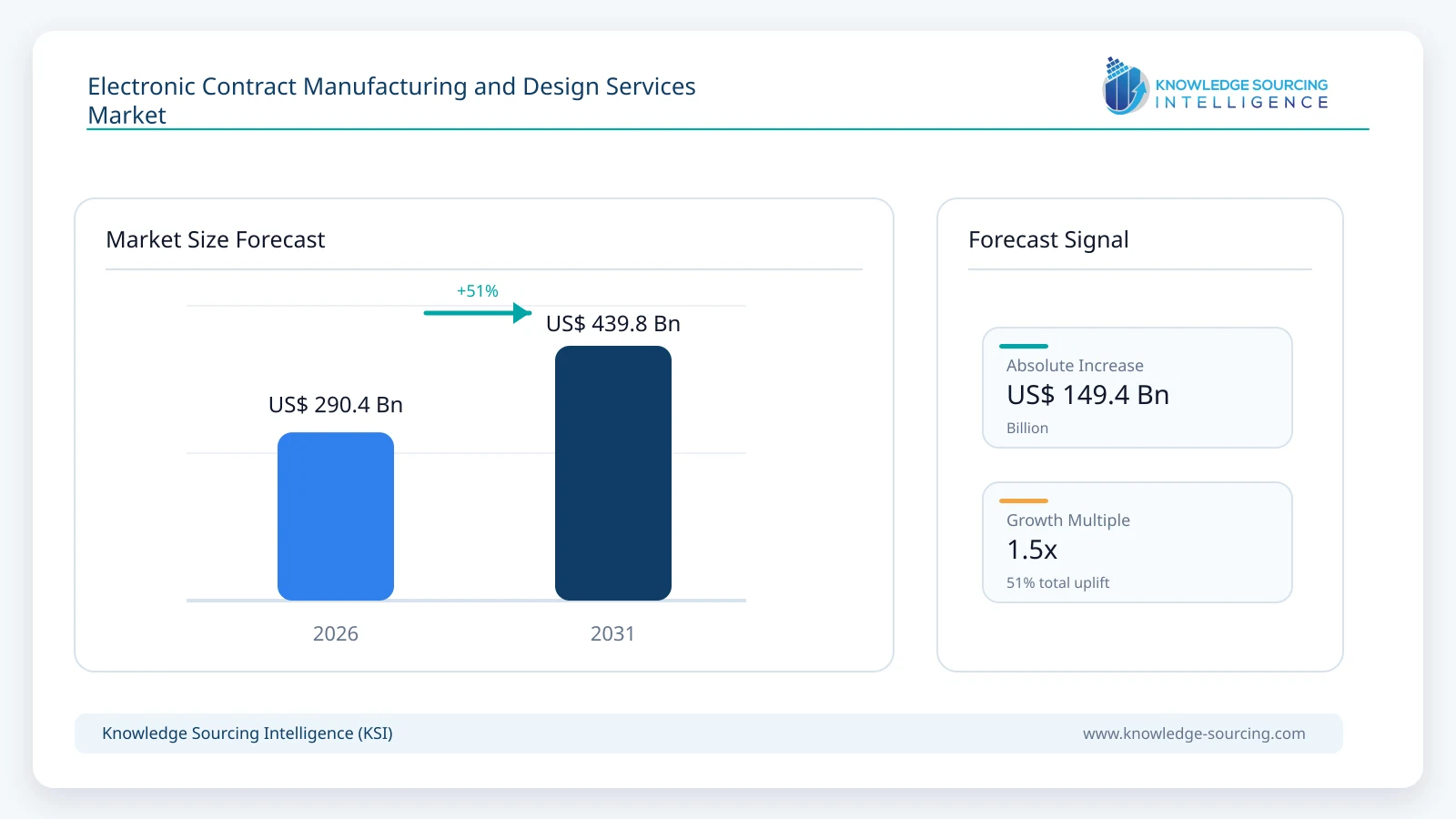
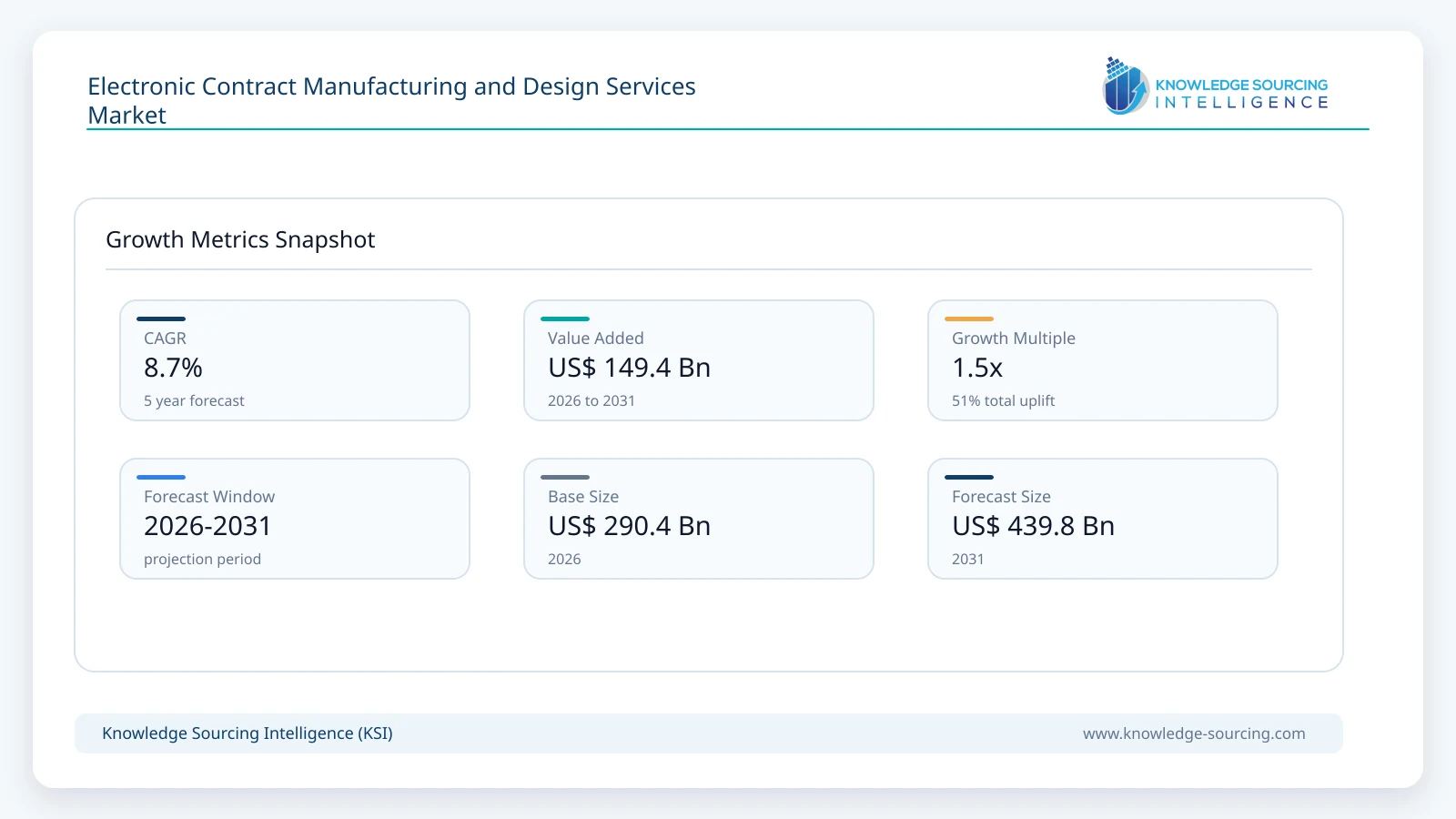
Electronic Contract Manufacturing and Design Services Market is forecast to grow at a CAGR of 8.7%, reaching USD 439.8 billion in 2031 from USD 290.4 billion in 2026.
Highlights:
- 1Electronics outsourcing continues shifting toward integrated design, manufacturing, testing, and lifecycle support services.
- 2OEMs increasingly prioritize supply-chain resilience, engineering capability, and manufacturing flexibility over production cost alone.
- 3Automotive electronics, industrial automation, medical devices, and data infrastructure are expanding high-value EMS demand.
- 4Regional manufacturing diversification is reshaping investment decisions, supplier qualification, and procurement strategies.
- 5Design-led manufacturing partnerships are increasing recurring customer relationships and longer product lifecycle support.
- 6Capacity expansion increasingly targets advanced PCB assembly, high-mix production, and regulated end-use industries.
Purchasing decisions have become increasingly dependent on engineering capability, manufacturing quality, regulatory compliance, component sourcing expertise, and geographic production flexibility rather than assembly cost alone. Customers in automotive electronics, healthcare, aerospace, industrial automation, telecommunications, and computing infrastructure require suppliers that manage complex product qualification, traceability, cybersecurity, and lifecycle support. As a result, established EMS providers are expanding engineering services alongside manufacturing capacity to deepen customer engagement and secure longer-term production programs.
Supply-chain resilience has become a defining commercial consideration following semiconductor shortages, logistics disruptions, geopolitical trade uncertainty, and evolving regional manufacturing policies. OEMs are increasingly adopting multi-region sourcing strategies and qualifying additional manufacturing partners to reduce dependence on single-country production networks. IPC notes that electronics manufacturers continue to monitor supply-chain conditions, labor availability, tariff developments, and customer demand through industry-wide business performance indicators and sentiment surveys.
Competition increasingly extends beyond manufacturing efficiency. Providers differentiate through new product introduction (NPI), design-for-manufacturing expertise, automated production, quality systems, component procurement capabilities, digital manufacturing platforms, and lifecycle services. These capabilities strengthen customer retention while allowing suppliers to participate earlier in product development, where engineering collaboration often influences future manufacturing awards.
Key Market Indicators
Indicator | Latest Evidence | Commercial Meaning |
IPC North American EMS Book-to-Bill Ratio | 1.41 (April 2025) | Orders continue to exceed shipments, indicating sustained production pipelines. |
European EMS PCBA Production | -14% in 2024 | European manufacturers remain cautious despite continued long-term outsourcing demand. |
European EMS Survey Participation | 427 companies (2025 survey) | Broad industry participation improves visibility into manufacturing conditions. |
IPC Statistical Programs | EMS, PCB, Business Performance programs | Companies increasingly benchmark demand, backlog, and operational performance using industry data. |
Global Electronics Industry Focus | Supply-chain resilience, workforce, tariffs, sustainability | Operational risk management remains a central purchasing consideration. |
Key indicator: North American EMS book-to-bill ratio reached 1.41 in April 2025.
Commercial meaning: Backlog levels remain supportive of production planning despite near-term shipment volatility.
Market Drivers
Expansion of outsourced product development alongside manufacturing. OEMs increasingly seek suppliers capable of participating before production begins, integrating product design, design-for-manufacturing, prototype development, testing, and production under a single commercial relationship. This approach shortens development timelines while reducing redesign costs during manufacturing transfer. Companies including Flex, Jabil, Plexus, Benchmark Electronics, and Sanmina continue expanding engineering capabilities because customers increasingly evaluate manufacturing partners on technical expertise rather than assembly capacity alone. This transition supports higher-value service revenue and strengthens long-term customer retention through earlier engagement in product lifecycles.
Automotive, industrial, and medical electronics require higher manufacturing complexity. Electronic content continues expanding across electric vehicles, industrial automation systems, medical equipment, telecommunications infrastructure, and aerospace platforms. These applications demand rigorous process validation, traceability, functional testing, and regulatory compliance, increasing reliance on experienced contract manufacturers. Rather than selecting suppliers solely on price, OEMs prioritize manufacturing quality, certification capability, component management, and production consistency. This raises demand for advanced PCB assembly, inspection technologies, clean-room manufacturing, and lifecycle quality management while supporting investments in automated production lines and engineering support services.
Regional supply-chain diversification is reshaping manufacturing investment. Trade uncertainty, geopolitical tensions, semiconductor shortages, and customer resilience strategies have encouraged manufacturers to diversify production beyond traditional manufacturing hubs. Electronics companies increasingly qualify facilities across Asia Pacific, North America, Europe, and selected emerging manufacturing locations to improve supply continuity and reduce logistics risk. IPC identifies tariffs, supply-chain resilience, labor availability, and manufacturing uncertainty among the industry's recurring commercial priorities, while government manufacturing incentives further encourage regional capacity expansion.
Higher automation and digital manufacturing improve production economics. Modern electronics manufacturing increasingly depends on automated optical inspection, robotics, machine connectivity, real-time production monitoring, and artificial intelligence-assisted quality inspection. These technologies improve yield, reduce manual defects, and enable manufacturers to manage increasingly complex assemblies with tighter tolerances. IPC's industry intelligence highlights growing interest in AI-enabled inspection and digital manufacturing tools as manufacturers respond to customer expectations for higher quality, traceability, and shorter production cycles. Continued investment in factory automation also helps address persistent skilled labor shortages while supporting consistent production across geographically distributed facilities.
Market Restraints and Challenges
Persistent component supply volatility increases production risk. Although semiconductor availability has improved compared with the peak shortages experienced during 2021–2023, contract manufacturers continue to manage uneven lead times across power semiconductors, analog devices, passive components, connectors, and specialized integrated circuits. Customer production schedules frequently depend on a relatively small number of qualified component suppliers, particularly in automotive, industrial, aerospace, and medical applications where substitute parts often require extensive validation. Annual reports from companies including Flex, Jabil, Sanmina, Celestica, and Benchmark Electronics continue to identify component availability, supplier concentration, and geopolitical disruption as operational risks that can affect production schedules, inventory costs, and customer deliveries. Manufacturers increasingly mitigate these risks through multi-source procurement, strategic inventory management, and closer collaboration with semiconductor suppliers, but supply uncertainty remains a structural operational challenge.
Regulated industries extend qualification and product introduction timelines. Electronics manufactured for healthcare, aerospace, defense, and automotive applications require extensive product validation before commercial production begins. Customers frequently mandate compliance with standards such as ISO 13485, AS9100, IATF 16949, IPC workmanship standards, and application-specific regulatory approvals. Qualification activities include process validation, reliability testing, traceability verification, documentation, and customer audits, all of which increase engineering costs and delay revenue generation. Smaller EMS providers often face greater financial pressure because engineering resources and certification expenses must be incurred before full production volumes are secured. Larger manufacturers compete partly through established quality systems and regulatory experience, creating higher barriers for new entrants seeking contracts in regulated sectors.
Customer pricing pressure limits margin expansion. Original equipment manufacturers continue to pursue cost reductions throughout the product lifecycle despite increasing labor expenses, higher compliance costs, automation investments, and ongoing supply-chain risk management. Many long-term manufacturing agreements include periodic pricing reviews, productivity targets, and customer-led cost optimization programs. Public filings from several listed EMS companies indicate that maintaining profitability depends on operational efficiency, manufacturing automation, procurement capability, and value-added engineering rather than price increases alone. Contract manufacturers therefore continue shifting toward higher-value engineering services, complex assembly, and lifecycle support to reduce dependence on low-margin, high-volume manufacturing contracts.
Trade policy changes complicate global manufacturing strategies. Export controls, tariffs, local-content requirements, sanctions, and evolving national industrial policies have increased complexity for globally distributed manufacturing operations. Production networks must remain flexible enough to accommodate changing trade regulations while maintaining customer delivery commitments. Companies have responded by expanding manufacturing capacity across multiple regions, qualifying additional suppliers, and redesigning supply chains to reduce geographic concentration. However, establishing duplicate production capability requires additional capital investment, engineering resources, workforce development, and customer qualification, making diversification a gradual and costly process rather than an immediate solution.
Major Segment Analysis
PCB Assembly (PCBA)
PCB Assembly (PCBA) represents one of the most commercially important services within the Electronic Contract Manufacturing and Design Services market because it connects engineering design with finished electronic products across nearly every end-use industry. Demand extends from consumer electronics and telecommunications equipment to automotive electronics, industrial control systems, medical devices, aerospace platforms, and cloud infrastructure. Customers increasingly require high-density interconnect (HDI) boards, miniaturized components, advanced packaging compatibility, and automated inspection capabilities, raising both technical requirements and manufacturing value.
Purchasing decisions increasingly emphasize manufacturing yield, traceability, process automation, component sourcing capability, and testing performance rather than assembly capacity alone. Automotive and medical customers typically require longer qualification cycles and stricter documentation than consumer electronics manufacturers, resulting in higher engineering intensity and stronger customer retention once production begins. Companies including Jabil, Flex, Sanmina, Celestica, Plexus, and Benchmark Electronics continue investing in advanced surface-mount technology (SMT), automated optical inspection, X-ray inspection, and digital manufacturing systems to improve quality, reduce defects, and support increasingly complex assemblies. The performance of the PCBA segment therefore influences production efficiency, customer satisfaction, and profitability across the broader ECMDS value chain.
Regional Analysis
Region | Main Demand Signal | Principal Constraint |
North America | Aerospace, defense, medical devices, cloud infrastructure, reshoring initiatives | High labor costs and skilled workforce shortages |
Europe | Automotive electronics, industrial automation, medical technology, sustainability regulations | Weak manufacturing output and elevated energy costs |
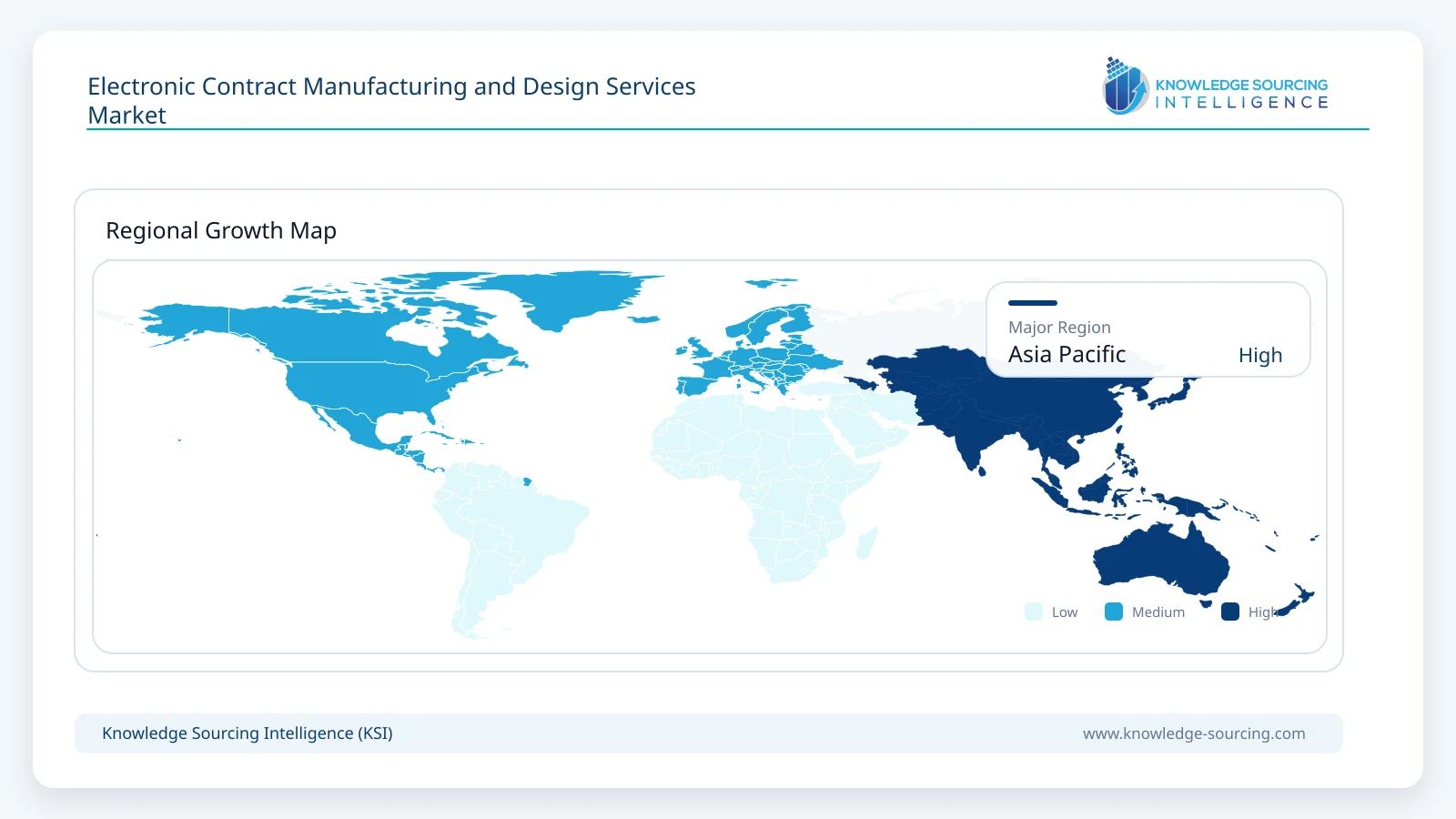
Asia Pacific | Consumer electronics production, semiconductor ecosystem, export-oriented manufacturing | Geopolitical trade risks and rising labor costs in selected markets |
Middle East and Africa | Electronics localization, industrial diversification, defense investment | Limited domestic component manufacturing ecosystem |
North America
Demand in North America remains concentrated in high-reliability industries where manufacturing quality, engineering support, cybersecurity, and regulatory compliance carry greater commercial weight than labor-cost advantages. The United States continues to expand domestic electronics manufacturing through semiconductor investment, defense modernization, and supply-chain resilience initiatives, while Mexico strengthens its position as an integrated manufacturing base serving North American OEMs through established electronics clusters and cross-border supply networks. Buyers increasingly seek regional production capacity to reduce transportation risk, improve responsiveness, and satisfy domestic sourcing requirements for selected programs.
Europe
Automotive electronics, industrial automation, medical technology, and aerospace manufacturing continue supporting outsourcing demand across Europe. Germany, France, and the United Kingdom remain important centers for high-value electronics production requiring advanced engineering capability and strict regulatory compliance. However, manufacturers continue to manage weaker industrial output, elevated operating costs, and cautious capital spending in several sectors. European EMS providers increasingly compete through specialized engineering services, high-mix low-volume manufacturing, and expertise in regulated applications rather than large-scale consumer electronics production.
Asia Pacific
Asia Pacific remains the world's largest electronics manufacturing ecosystem because of its extensive semiconductor supply chain, component production base, contract manufacturing capacity, and export infrastructure. China continues to account for substantial electronics production, while Japan and South Korea maintain strong positions in advanced components, semiconductor technologies, and precision manufacturing. India is attracting additional electronics manufacturing investment through production-linked incentive programs and expanding domestic assembly capacity. Regional suppliers are also increasing manufacturing diversification beyond China to strengthen supply-chain resilience and accommodate changing customer sourcing strategies.
Middle East and Africa
Manufacturing activity across the Middle East and Africa remains comparatively smaller but is expanding in selected industries supported by industrial diversification strategies, defense procurement, electronics assembly investment, and digital infrastructure development. Israel maintains strengths in defense electronics and advanced technology development, while Saudi Arabia continues encouraging domestic manufacturing under broader industrial development programs. The region remains dependent on imported electronic components and specialized manufacturing equipment, creating opportunities for contract manufacturers that support localized assembly, testing, and engineering services while working within evolving domestic industrial policies.
Competitive Landscape
The Electronic Contract Manufacturing and Design Services market is characterized by a combination of global manufacturing groups with diversified service portfolios and specialized providers serving regulated, high-reliability industries. Competition extends beyond manufacturing scale as OEMs increasingly evaluate suppliers on engineering capability, component sourcing, quality management, digital manufacturing, lifecycle support, and global production flexibility. Companies with integrated service offerings are better positioned to participate throughout the product lifecycle, from design and prototyping to volume manufacturing and aftermarket services.
Flex Ltd., Jabil Inc., Hon Hai Precision Industry Co., Ltd. (Foxconn), Sanmina Corporation, Celestica Inc., Plexus Corp., Benchmark Electronics, Compal Electronics Inc., Wistron Corporation, and Creation Technologies LP continue expanding manufacturing automation, engineering resources, regional production capacity, and supply-chain resilience. Several companies have strengthened operations through capacity investments, digital manufacturing initiatives, localized production, and acquisitions that broaden engineering or specialized manufacturing capabilities. As customers diversify sourcing across multiple regions, suppliers with established manufacturing networks, regulatory certifications, and long-term customer relationships are increasingly favored over companies competing primarily on production cost. High qualification requirements, extensive customer audits, quality certifications, and engineering expertise continue to create meaningful barriers for new entrants, particularly in healthcare, aerospace and defense, industrial electronics, and automotive applications.
Recent Developments
August 2026: Celestica completed a US$3.45 billion equity offering on August 7, with proceeds supporting working capital and capital expenditures as the company expands capabilities for AI and advanced data-center infrastructure.
July 2026: Jabil opened a 417,000-square-foot intelligent logistics hub in Penang on July 16, strengthening regional manufacturing supply-chain capabilities and increasing automation to support growing customer demand.
June 2026: Foxconn and Bull announced a strategic collaboration on June 1 to manufacture AI and cloud infrastructure across Europe, combining Bull’s engineering capabilities with Foxconn’s manufacturing and supply-chain network.
March 2026: Celestica and AMD announced a strategic collaboration on March 16 for AMD’s Helios rack-scale AI platform, with Celestica responsible for R&D, design and manufacturing of scale-up networking switches.
Regulatory and Policy Environment
Regulatory compliance remains a fundamental competitive requirement across the Electronic Contract Manufacturing and Design Services market because customers increasingly operate in highly regulated industries with stringent quality, safety, environmental, and cybersecurity obligations. International standards developed by IPC continue to define manufacturing quality, electronic assembly workmanship, reliability testing, and design practices that influence supplier qualification across global electronics supply chains. Compliance with IPC standards is frequently incorporated into customer procurement specifications, particularly for aerospace, defense, industrial, and medical electronics.
Medical device manufacturing requires compliance with quality management systems such as ISO 13485, while automotive electronics manufacturers typically require certification to IATF 16949. Aerospace and defense customers commonly specify AS9100 quality requirements together with extensive product traceability and documentation. These standards increase qualification costs but also strengthen customer confidence and reduce operational risk throughout the product lifecycle.
Government industrial policies are also influencing manufacturing location decisions. The U.S. CHIPS and Science Act, the European Chips Act, India's Production Linked Incentive (PLI) Scheme for electronics manufacturing, and similar national semiconductor and electronics manufacturing initiatives are encouraging regional production capacity, supply-chain diversification, and domestic component manufacturing. At the same time, export controls, sanctions, cybersecurity regulations, environmental compliance requirements, and conflict-mineral reporting obligations continue to shape supplier selection, sourcing strategies, and long-term manufacturing investment decisions.
Outlook and Strategic Implications
Demand for Electronic Contract Manufacturing and Design Services during the 2026–2031 forecast period is expected to be supported by increasing electronic content across transportation, healthcare, industrial automation, telecommunications, cloud computing, aerospace, and defense applications. OEMs are expected to continue outsourcing engineering-intensive activities alongside manufacturing as product complexity, shorter innovation cycles, and supply-chain risk increase the operational value of integrated service providers. Engineering capability, manufacturing flexibility, regulatory expertise, and secure component sourcing are therefore expected to become more influential than labor-cost advantages alone when selecting manufacturing partners.
Growing investment in artificial intelligence infrastructure, electric vehicles, industrial automation, edge computing, and connected medical technologies is likely to increase demand for advanced PCB assembly, high-density electronics manufacturing, sophisticated testing, and lifecycle support services. Manufacturers capable of combining design engineering with automated production, digital quality management, and global supply-chain coordination are expected to strengthen long-term customer relationships while improving operational efficiency.
Strategic implications
OEMs: Supplier selection is expected to place greater emphasis on engineering capability, regional manufacturing flexibility, cybersecurity, and long-term supply assurance.
Contract manufacturers: Continued investment in automation, engineering services, digital manufacturing, and geographically diversified production networks will remain important for maintaining competitiveness and supporting higher-margin business.
Component suppliers: Closer collaboration with EMS providers is expected to improve supply continuity, reduce lead-time variability, and support increasingly complex electronic assemblies.
Investors and policymakers: Regional manufacturing incentives, semiconductor capacity expansion, workforce development, and resilient supply chains are expected to remain central factors influencing long-term industry investment and production decisions.
As the market continues to evolve, competitive differentiation will increasingly depend on technical capability, operational resilience, manufacturing quality, and the ability to deliver integrated product lifecycle services rather than high-volume assembly alone. Companies capable of supporting customers from initial product development through aftermarket services are expected to secure stronger recurring business and higher-value manufacturing programs over the forecast period.
Electronic Contract Manufacturing and Design Services Market Scope:
| Report Metric | Details |
|---|---|
| Total Market Size in 2026 | USD 290.4 billion |
| Total Market Size in 2031 | USD 439.8 billion |
| Forecast Unit | Billion |
| Growth Rate | 8.7% |
| Study Period | 2021 to 2031 |
| Historical Data | 2021 to 2024 |
| Base Year | 2025 |
| Forecast Period | 2026 – 2031 |
| Segmentation | Service, End User, Geography |
| Companies |
|
Market Segmentation
By Service
Design and Engineering
PCB Assembly (PCBA)
Electronic Manufacturing
Testing and Inspection
Supply Chain and Logistics
Aftermarket Services / Repair Services
By End User
Consumer Electronics
Automotive
Industrial Electronics
Healthcare and Medical Devices
Aerospace and Defense
Telecom and Networking
Computing and Data Centers
Others
By Geography
North America
USA
Canada
Mexico
South America
Brazil
Argentina
Others
Europe
Germany
France
United Kingdom
Spain
Others
Middle East and Africa
Saudi Arabia
Israel
Others
Asia Pacific
China
Japan
South Korea
India
Others
Table of Contents
1. INTRODUCTION
1.1. MARKET OVERVIEW
1.2. MARKET DEFINITION
1.3. SCOPE OF THE STUDY
1.4. CURRENCY
1.5. ASSUMPTIONS
1.6. BASE AND FORECAST YEARS TIMELINE
2. RESEARCH METHODOLOGY
2.1. RESEARCH DESIGN
2.2. SECONDARY SOURCES
3. EXECUTIVE SUMMARY
4. MARKET DYNAMICS
4.1. MARKET SEGMENTATION
4.2. MARKET DRIVERS
4.3. MARKET RESTRAINTS
4.4. MARKET OPPORTUNITIES
4.5. PORTER’S FIVE FORCE ANALYSIS
4.5.1. BARGAINING POWER OF SUPPLIERS
4.5.2. BARGAINING POWER OF BUYERS
4.5.3. THREAT OF NEW ENTRANTS
4.5.4. THREAT OF SUBSTITUTES
4.5.5. COMPETITIVE RIVALRY IN THE INDUSTRY
4.6. LIFE CYCLE ANALYSIS - REGIONAL SNAPSHOT
4.7. MARKET ATTRACTIVENESS
5. ELECTRONIC CONTRACT MANUFACTURING AND DESIGN SERVICES MARKET BY SERVICE
5.1. DESIGN AND ENGINEERING
5.2. PCB ASSEMBLY (PCBA)
5.3. ELECTRONIC MANUFACTURING
5.4. TESTING AND INSPECTION
5.5. SUPPLY CHAIN AND LOGISTICS
5.6. AFTERMARKET SERVICES / REPAIR SERVICES
6. ELECTRONIC CONTRACT MANUFACTURING AND DESIGN SERVICES MARKET BY END USER
6.1. CONSUMER ELECTRONICS
6.2. AUTOMOTIVE
6.3. INDUSTRIAL ELECTRONICS
6.4. HEALTHCARE AND MEDICAL DEVICES
6.5. AEROSPACE AND DEFENSE
6.6. TELECOM AND NETWORKING
6.7. COMPUTING AND DATA CENTERS
6.8. OTHERS
7. ELECTRONIC CONTRACT MANUFACTURING AND DESIGN SERVICES MARKET BY GEOGRAPHY
7.1. NORTH AMERICA
7.1.1. USA
7.1.2. CANADA
7.1.3. MEXICO
7.2. SOUTH AMERICA
7.2.1. BRAZIL
7.2.2. ARGENTINA
7.2.3. OTHERS
7.3. EUROPE
7.3.1. GERMANY
7.3.2. FRANCE
7.3.3. UNITED KINGDOM
7.3.4. SPAIN
7.3.5. OTHERS
7.4. MIDDLE EAST AND AFRICA
7.4.1. SAUDI ARABIA
7.4.2. ISRAEL
7.4.3. OTHERS
7.5. ASIA PACIFIC
7.5.1. CHINA
7.5.2. JAPAN
7.5.3. SOUTH KOREA
7.5.4. INDIA
7.5.5. OTHERS
8. COMPETITIVE INTELLIGENCE
8.1. COMPETITIVE BENCHMARKING AND ANALYSIS
8.2. RECENT INVESTMENT AND DEALS
8.3. STRATEGIES OF KEY PLAYERS
9. COMPANY PROFILES
9.1. BENCHMARK ELECTRONICS
9.2. FLEX LTD.
9.3. PLEXUS CORP
9.4. JABIL INC.
9.5. CELESTICA INC.
9.6. COMPAL ELECTRONICS INC.
9.7. CREATION TECHNOLOGIES LP
9.8. HON HAI PRECISION INDUSTRY CO. LTD.
9.9. SANMINA CORPORATION
9.10. WISTRON CORPORATION
Navigate
Trusted by the world's leading organizations











