
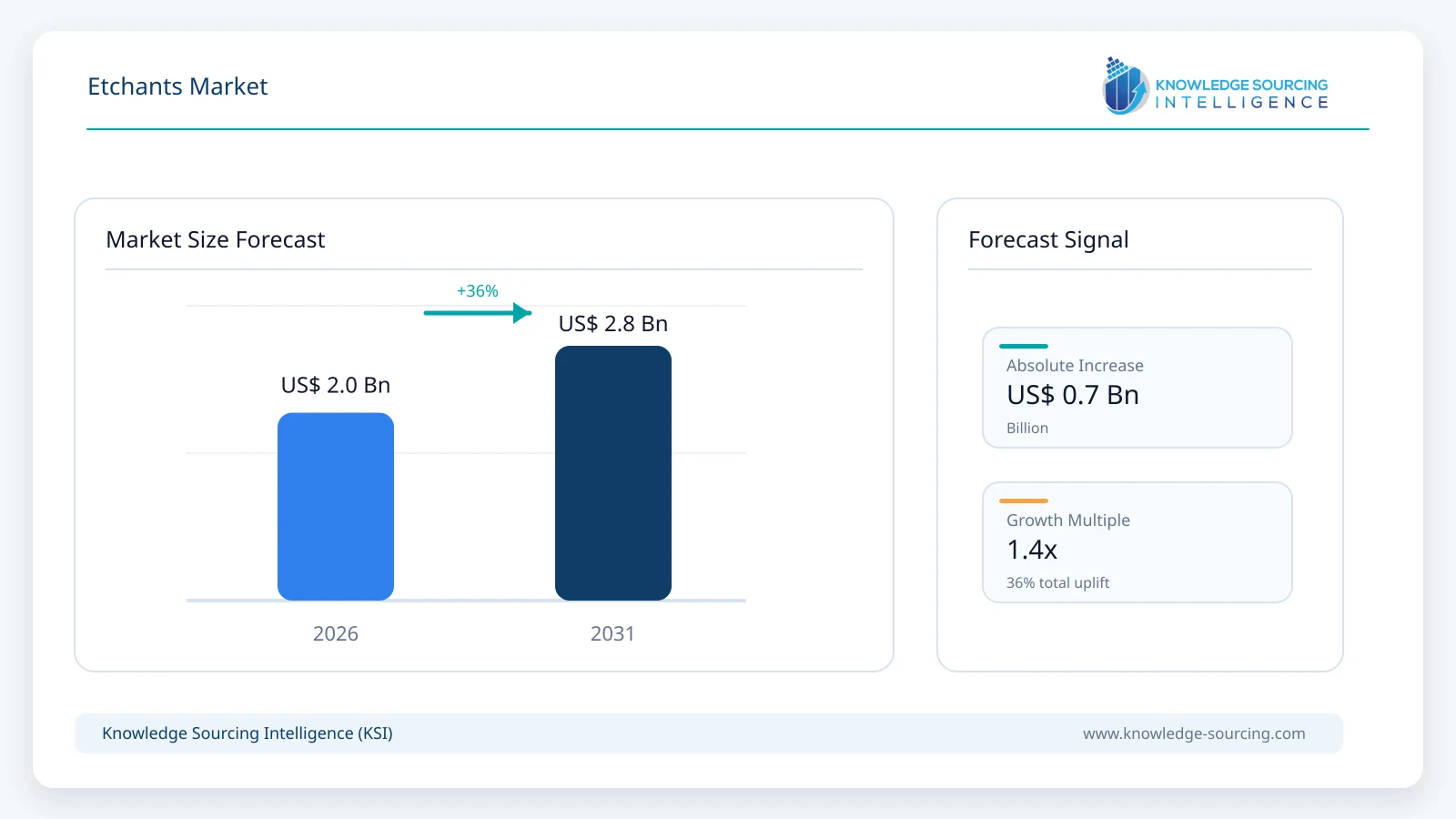
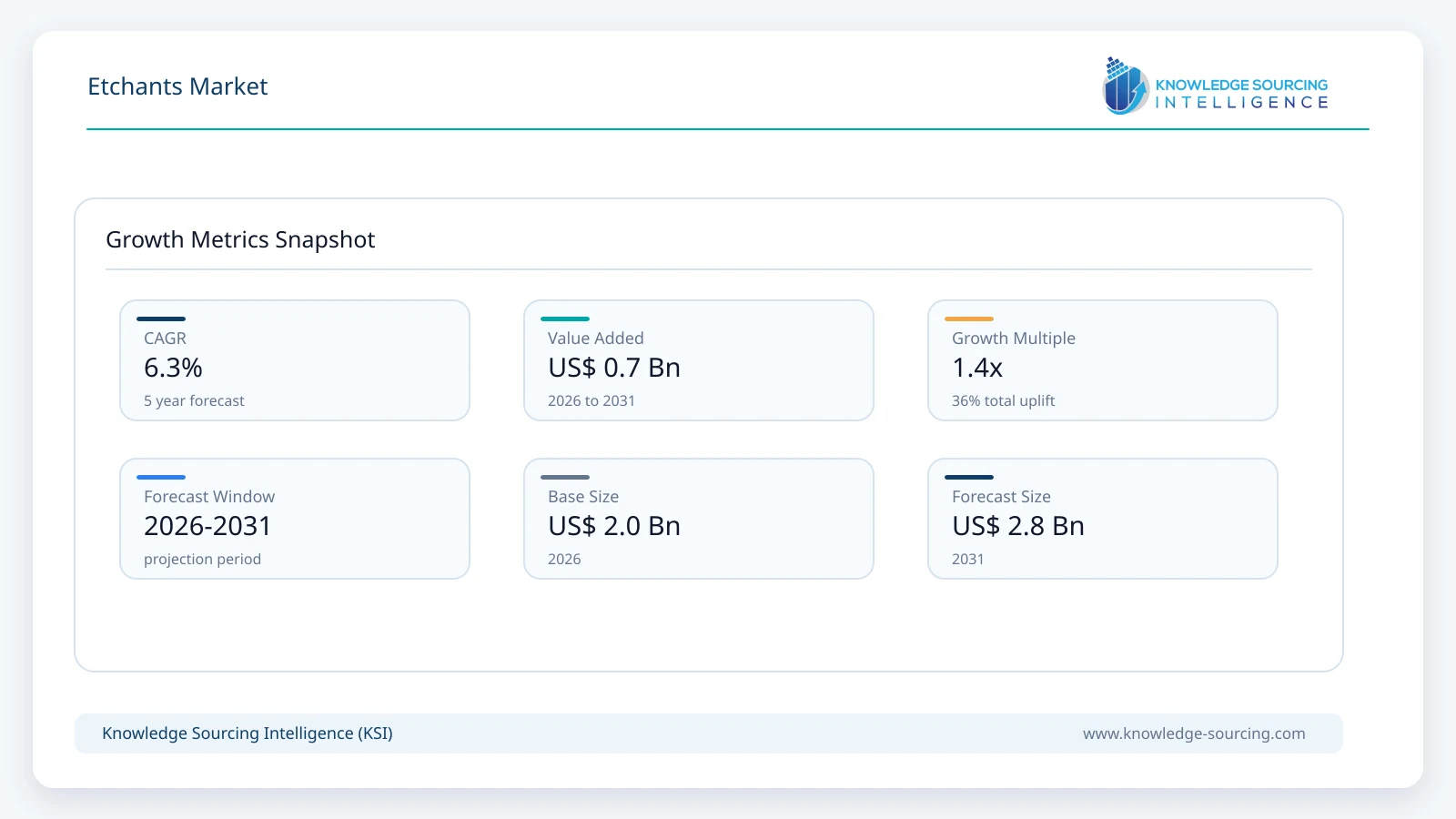
The Etchants Market is forecast to grow at a CAGR of 6.28%, reaching USD 2.78 billion in 2031 from USD 2.05 billion in 2026.
Highlights:
- 1Market growthThe Etchants Market is forecast to rise from USD 2.05 billion in 2026 to USD 2.78 billion by 2031, representing a 6.28% CAGR.
- 2Application mixSemiconductor manufacturing is expected to represent the largest application category, supported by wafer fabrication, advanced packaging, memory, logic, and power-device production.
- 3Method mixWet etching remains commercially important because of its broad chemical coverage, while dry etching gains value where anisotropic profiles and tight feature control are required.
- 4Regional concentrationAsia-Pacific is expected to account for approximately half of global etchant demand, reflecting its concentration of semiconductor, display, PCB, and electronics manufacturing.
- 5High-purity demandSemiconductor-grade formulations command greater process importance than general industrial etchants because contamination and selectivity can directly affect wafer yield.
- 6Environmental pressurePFAS-related regulatory work in Europe is increasing the need to assess chemical alternatives, emissions controls, and process-specific exemptions in semiconductor manufacturing.
The etchants market covers chemical formulations and process materials used to selectively remove material from semiconductor wafers, printed circuit boards, glass, metals, MEMS structures, and other engineered surfaces. Demand is closely linked to the number and complexity of manufacturing steps rather than to chemical consumption alone. Semiconductor fabrication is particularly important because tighter feature dimensions require controlled etch rates, high chemical purity, selectivity, and repeatable process performance.
The commercial value of an etchant increasingly depends on process control, contamination limits, material compatibility, supply reliability, and customer qualification. Semiconductor manufacturers may qualify several chemicals during development, but production switching can require process requalification because even small changes in chemistry can affect yield and device performance. This creates a higher entry barrier for suppliers serving advanced fabrication facilities than for suppliers serving less demanding industrial applications.
Semiconductor capacity expansion is providing the clearest demand channel. TSMC reported more than 17 million 12-inch-equivalent wafers of annual manufacturing capacity across its managed facilities in 2025 and continued investment in 2 nm and advanced packaging capacity. Its 2025 wafer shipments reached 15.0 million 12-inch-equivalent wafers, up from 12.9 million in 2024. Higher wafer output and more process-intensive device architectures increase the number of cleaning and etching steps required during fabrication.
The demand profile is also shifting toward higher-purity and application-specific formulations. BASF's SELECTIPUR portfolio, for example, includes high-purity chemicals and customized wet-etching solutions for silicon dioxide, silicon, polysilicon, silicon nitride, titanium nitride, aluminum, copper, nickel, titanium, and multilayer structures. This illustrates why semiconductor customers evaluate etchants as process-critical materials rather than interchangeable bulk chemicals.
What are the current trends in the Etchants Market?
Three trends are particularly relevant to purchasing and supplier strategy. First, advanced semiconductor structures are increasing the need for tighter etch control. Second, chemical purity and contamination control are becoming more important as wafer geometries shrink. Third, environmental regulation is increasing pressure on suppliers and chipmakers to evaluate alternative chemistries, treatment systems, and process routes.
Lam Research's February 2025 introduction of Akara illustrates the technology direction on the dry-etch side. The company stated that its new conductor-etch platform uses proprietary plasma-control technology to create atomic-scale features for 3D chip structures. Although Lam supplies etch equipment rather than etchant chemicals, its product development indicates the process requirements that chemical suppliers must support as device structures become more complex.
Key Market Indicators
Indicator | Latest Evidence | Commercial Meaning |
|---|---|---|
TSMC annual wafer shipments | 15.0 million 12-inch-equivalent wafers, 2025 | Higher wafer throughput supports recurring demand for semiconductor process chemicals. |
TSMC manufacturing capacity | More than 17 million 12-inch-equivalent wafers annually, 2025 | Expanding capacity broadens the addressable base for qualified chemical suppliers. |
TSMC advanced-technology revenue mix | 74% from 7 nm and beyond, 2025 | Advanced nodes require tighter process control and specialized chemical formulations. |
TSMC process technologies | 305 distinct technologies, 2025 | Process diversity increases demand for application-specific chemical recipes and qualification support. |
EU PFAS restriction consultation | More than 5,600 scientific and technical comments evaluated by August 2025 | Regulatory scrutiny is increasing the need for chemical substitution and risk-management planning. |
Japan semiconductor supply policy | 100 billion yen FY2025 allocation for Rapidus support | Government-backed semiconductor capacity development creates additional demand for process-material supply chains. |
Market Drivers
Expansion of advanced semiconductor capacity. TSMC's 2025 manufacturing expansion included additional investment in the United States, construction of a third Arizona facility, continued 2 nm development in Taiwan, and a second Kumamoto fab in Japan. The company also continued work on its Dresden facility for automotive and industrial applications. Each new fabrication site requires qualified process-chemical supply, logistics, contamination control, and local technical support.
Higher etch complexity in 3D and advanced-node devices. Shrinking dimensions and three-dimensional structures place tighter limits on etch rate, selectivity, profile control, and surface damage. Lam Research's Akara platform was introduced specifically to address conductor etch requirements in complex 3D structures. For chemical suppliers, this shifts competition away from simple volume supply toward formulation control, technical service, and close coordination with process engineers.
Growth of high-purity process chemicals. Semiconductor manufacturers require chemicals with controlled impurity levels because metallic and particulate contamination can affect device yield. BASF's semiconductor portfolio includes high-purity materials used for cleaning, etching, photolithography, deposition, and CMP, while its SELECTIPUR etching portfolio covers both non-metal and metal etch applications. The wider product range reflects the need for chemistry matched to specific process layers.
Regionalization of semiconductor supply chains. Government programs in the United States, Japan, Europe, Taiwan, South Korea, and other semiconductor-producing economies are encouraging new fabrication and materials capacity. Japan's METI, for example, has established support mechanisms for stable semiconductor production and selected Rapidus for FY2025 support, including a 100 billion yen allocation. Localization increases the value of suppliers that can maintain consistent chemical quality close to fabrication clusters.
Market Restraints and Challenges
Strict handling and waste-treatment requirements. Etchants can be corrosive, toxic, reactive, or difficult to treat after use. Semiconductor facilities therefore require controlled storage, dosing, exhaust systems, wastewater treatment, worker protection, and chemical monitoring. These requirements raise the total cost of supplying and using process chemicals, particularly where local environmental rules require additional treatment or reporting.
PFAS regulatory uncertainty. The European Chemicals Agency's PFAS restriction process covers electronics and semiconductor applications. In August 2025, ECHA published an updated restriction proposal after evaluating more than 5,600 scientific and technical comments. By March 2026, ECHA's Risk Assessment Committee had adopted its PFAS opinion, while the broader regulatory process continued. Suppliers serving European semiconductor customers therefore face a need to map chemical composition, alternatives, exemptions, and emissions controls.
Long customer qualification cycles. Semiconductor customers cannot freely replace a qualified etchant when the chemical is embedded in a production recipe. A replacement may require laboratory testing, wafer trials, defect analysis, reliability checks, and production qualification. This slows new-supplier entry but also creates recurring business for suppliers that establish qualified formulations and maintain consistent batch quality.
Dependence on semiconductor investment cycles. Etchant demand follows fabrication activity, utilization, technology migration, and capacity expansion. A delay in a new fab, lower utilization, or a correction in memory or logic demand can reduce chemical consumption before suppliers can adjust production capacity. Chemical manufacturers therefore need flexible production and inventory planning around geographically concentrated semiconductor customers.
Major Segment Analysis
Semiconductor Manufacturing
Semiconductor manufacturing represents the most commercially important application for etchants because chemical consumption is embedded across wafer fabrication and advanced packaging processes. Etchants are used to remove selected films and metals while preserving adjacent layers, making selectivity and process stability central to customer purchasing decisions. The application also supports higher-value formulations because customers place greater weight on purity, consistency, traceability, and technical support than on chemical price alone.
TSMC's 2025 operating data illustrates the scale of the underlying process-material requirement. The company manufactured 12,682 products for 534 customers using 305 process technologies, while 7 nm and more advanced technologies generated 74% of wafer revenue. Such process diversity requires multiple chemical recipes and controlled specifications rather than a single standardized etchant.
Purchasing criteria in this segment extend beyond chemical performance. Semiconductor manufacturers evaluate contamination, lot-to-lot consistency, delivery reliability, packaging, technical documentation, regulatory status, and the supplier's ability to maintain quality during capacity expansion. BASF's portfolio of customized wet-etching solutions demonstrates the degree of formulation specialization required for different material layers and semiconductor process steps.
Regional Analysis
Asia-Pacific
Asia-Pacific has the strongest structural demand base because Taiwan, South Korea, Japan, China, Singapore, and India host substantial portions of semiconductor, PCB, display, and electronics production. Taiwan remains especially important for leading-edge logic manufacturing. TSMC reported more than 17 million 12-inch-equivalent wafers of annual capacity across its global network in 2025, with a large portion of its manufacturing infrastructure located in Taiwan.
Japan combines semiconductor production with a deep specialty-chemical supply base. METI's semiconductor policy also supports domestic production capability and supply-chain resilience. The government's support for Rapidus, together with continued investment by international manufacturers in Japan, creates opportunities for high-purity chemical suppliers able to meet local qualification and delivery requirements.
North America
North American demand is being supported by new semiconductor fabrication and advanced packaging investment, particularly in the United States. TSMC's Arizona expansion includes a second fab scheduled for high-volume manufacturing in the second half of 2027 and construction of a third facility that began in 2025. The company also announced plans for additional U.S. fabs, advanced packaging facilities, and an R&D center.
The regional opportunity is therefore linked to domestic production of process materials as well as fab construction. Suppliers with established qualification capabilities, high-purity production, reliable logistics, and technical service can benefit as customers seek shorter supply chains and greater resilience.
Europe
European demand is closely connected with automotive, industrial, power semiconductor, and specialty-device manufacturing. TSMC is developing a specialty technology facility in Dresden, while the European regulatory environment is placing greater attention on chemical composition and PFAS exposure. Japan and the European Union also identified safe and sustainable semiconductor chemical alternatives, including PFAS-related research, as an area for cooperation in 2025.
South America, Middle East and Africa
These regions represent smaller demand pools than the principal semiconductor and electronics manufacturing centers, with consumption more closely tied to PCB production, industrial processing, metal treatment, glass, and downstream electronics assembly. Local demand can therefore be more sensitive to imported chemical availability, logistics costs, industrial investment, and distributor networks. Suppliers typically compete through product availability, technical support, compliance documentation, and dependable regional distribution.
Competitive Landscape
The competitive structure of the etchants market is shaped by a combination of chemical manufacturing scale and process-specific technical capability. FUJIFILM Corporation, Merck KGaA, STELLA CHEMIFA CORPORATION, Kanto Chemical Co., Inc., Daikin Industries, Ltd., Solvay SA, BASF SE, Soulbrain Co., Ltd., Avantor, Inc., and Honeywell International Inc. participate across specialty chemicals, electronic materials, high-purity chemicals, or related process-material categories. Their competitive positions differ according to chemistry portfolio, geographic production, semiconductor qualification, and customer support.
FUJIFILM's participation in SEMICON India 2025 included semiconductor materials and high-purity chemicals used in cleaning and etching processes. BASF supplies high-purity chemicals and customized etching solutions, while Honeywell's former Advanced Materials business was separated into Solstice Advanced Materials in October 2025. The separation matters to market structure because Solstice became an independent specialty-materials company with semiconductor materials among its stated business areas.
Supplier differentiation increasingly rests on qualification depth and supply security rather than on chemical availability alone. Semiconductor customers need consistent material performance across long production cycles, and new fabs require suppliers to establish local logistics, quality controls, and technical support before full production ramps. This favors suppliers with global manufacturing networks and strong process-development capabilities, while regional specialists can compete where they offer faster qualification support or chemistry tailored to specific fabrication processes.
Recent Developments
May 2026: STELLA CHEMIFA confirmed completion of a highly selective etching solution for semiconductor manufacturing, offering higher selectivity than conventional products; the company said user sample evaluations were underway.
April 2026: Air Liquide reported continued investment in semiconductor materials, including its Taiwan advanced-materials facility for deposition and etching applications and a €200 million Hiroshima investment supporting next-generation semiconductor production.
March 2026: Tokyo Ohka Kogyo (TOK) acquired approximately 90,794 square meters of land in Koriyama, Japan, expanding its production-base options for future semiconductor-related business and high-purity chemical manufacturing.
March 2026: Air Liquide inaugurated its first large-scale Advanced Materials plant in Taichung, Taiwan, producing advanced deposition and etching materials for next-generation semiconductor manufacturing and strengthening regional supply.
Regulatory and Policy Environment
Chemical regulation is becoming a direct commercial consideration for etchant suppliers because product formulation, worker exposure, transport, wastewater treatment, and disposal can affect both operating cost and customer qualification. In Europe, the PFAS restriction process has progressed through scientific and socio-economic evaluation, with electronics and semiconductor uses receiving specific assessment. The European Commission will ultimately decide on the restriction after the ECHA process and consultation with Member States.
The semiconductor industry also faces pressure to reduce PFAS releases from manufacturing processes. A European Commission Joint Research Centre technical document notes that PFAS emissions to water are an issue associated with semiconductor manufacturing and reports data from semiconductor facilities in the United States and Europe. The issue increases the importance of wastewater controls, chemical substitution assessment, and process-level monitoring for suppliers and fab operators.
Japan's semiconductor policy provides a different form of regulatory influence by supporting domestic production capacity. METI's 2025 measures were designed to encourage stable semiconductor production and larger public and private investment, while the ministry subsequently selected Rapidus for government support. Such programs can indirectly strengthen local demand for process chemicals by accelerating fabrication investment and building domestic supply chains.
What are business analysts watching in the Etchants Market?
How will advanced semiconductor nodes affect etchant demand?
Advanced nodes are likely to increase the value of specialized etchants even when chemical volumes do not rise at the same rate as wafer output. Smaller features and three-dimensional structures require tighter selectivity, profile control, purity, and process repeatability. Suppliers that can support customer-specific recipes and rapid process qualification should have stronger opportunities in advanced logic, memory, and packaging applications.
Why are semiconductor customers concerned about chemical supply security?
A qualified chemical cannot always be replaced quickly because changes can affect yield, contamination, and process performance. New fabrication sites also require suppliers to establish local delivery, quality testing, storage, and technical support. As semiconductor manufacturing expands across the United States, Japan, and Europe, customers are likely to place greater weight on regional supply continuity alongside chemical performance and price.
How will PFAS regulation affect the Etchants Market?
PFAS regulation will increase formulation review, documentation, testing, and alternative-chemistry development where fluorinated substances are involved. The effect will vary by chemical and process because semiconductor manufacturing contains applications with different technical requirements. Suppliers that can document composition, control emissions, qualify alternatives, and work with customers during process changes should be better positioned as European restrictions develop.
What will buyers prioritize when selecting etchant suppliers?
Semiconductor buyers will prioritize purity, etch selectivity, batch consistency, contamination control, supply reliability, technical support, regulatory documentation, and total process cost. Price remains relevant, but it is less likely to outweigh yield or qualification risk in advanced fabrication. PCB and industrial buyers may place greater emphasis on throughput, chemical consumption, waste treatment, availability, and unit cost.
Outlook and Strategic Implications
The Etchants Market is expected to expand at a measured pace through 2031, with semiconductor manufacturing remaining the central source of higher-value demand. The supplied forecast indicates growth from USD 2.05 billion in 2026 to USD 2.78 billion in 2031 at a 6.28% CAGR. The underlying demand base will depend on wafer starts, fab utilization, advanced-node migration, packaging investment, and chemical qualification.
For suppliers, capacity planning should follow semiconductor manufacturing clusters rather than global demand alone. Local technical support and dependable logistics will become more important as fabs expand into new regions. Product development will also need to address tighter process specifications while reducing regulatory exposure and wastewater-management costs.
Buyers: Supplier qualification should consider chemical purity, dual sourcing, regulatory status, delivery continuity, and technical response capability.
Suppliers: Investment should favor high-purity formulations, application-specific chemistry, local production or distribution, and alternative formulations where regulation creates substitution risk.
Investors: Capacity expansion should be assessed alongside customer qualification depth, semiconductor exposure, regional manufacturing footprint, and the supplier's ability to protect margins.
Technology providers: Etch chemistry and equipment development will remain closely linked as advanced 3D structures require coordinated control of chemistry, plasma conditions, and surface response.
Policymakers: Semiconductor incentives can strengthen domestic chemical supply chains, but chemical regulation should account for the technical qualification time required to replace process-critical materials.
The commercial outlook therefore depends less on broad chemical consumption and more on the increasing process intensity of electronics manufacturing. Suppliers that combine high-purity production, customer qualification capability, regulatory readiness, and regional supply security are positioned to capture a greater share of the value created by semiconductor capacity expansion.
Market Segmentation
BY TYPE
Acid Etchants
Alkaline Etchants
Oxidizing Etchants
Specialty/Proprietary Etchants
Others
BY METHOD
Wet Etching
Dry Etching
BY APPLICATION
Semiconductor Manufacturing
Printed Circuit Boards (PCBs)
MEMS and Sensors
Display and Glass
Metal Etching and Surface Treatment
Others
BY GEOGRAPHY
North America
United States
Canada
Mexico
South America
Brazil
Argentina
Others
Europe
United Kingdom
Germany
France
Italy
Netherlands
Others
Middle East and Africa
Saudi Arabia
United Arab Emirates
Israel
Others
Asia-Pacific
China
Japan
India
South Korea
Taiwan
Singapore
Others
Geographical Segmentation
- Asia Pacific
Table of Contents
1. EXECUTIVE SUMMARY
2. MARKET SNAPSHOT
2.1. Market Overview
2.2. Market Definition
2.3. Scope of the Study
2.4. Market Segmentation
3. BUSINESS LANDSCAPE
3.1. Market Drivers
3.2. Market Restraints
3.3. Market Opportunities
3.4. Porter’s Five Forces Analysis
3.5. Industry Value Chain Analysis
3.6. Policies and Regulations
3.7. Strategic Recommendations
4. TECHNOLOGICAL OUTLOOK
5. ETCHANTS MARKET BY TYPE
5.1. Introduction
5.2. Acid Etchants
5.3. Alkaline Etchants
5.4. Oxidizing Etchants
5.5. Specialty/Proprietary Etchants
5.6. Others
6. ETCHANTS MARKET BY METHOD
6.1. Introduction
6.2. Wet Etching
6.3. Dry Etching
7. ETCHANTS MARKET BY APPLICATION
7.1. Introduction
7.2. Semiconductor Manufacturing
7.3. Printed Circuit Boards (PCBs)
7.4. MEMS and Sensors
7.5. Display and Glass
7.6. Metal Etching and Surface Treatment
7.7. Others
8. ETCHANTS MARKET BY GEOGRAPHY
8.1. Introduction
8.2. North America
8.2.1. By Type
8.2.2. By Method
8.2.3. By Application
8.2.4. By Country
8.2.4.1. United States
8.2.4.2. Canada
8.2.4.3. Mexico
8.3. South America
8.3.1. By Type
8.3.2. By Method
8.3.3. By Application
8.3.4. By Country
8.3.4.1. Brazil
8.3.4.2. Argentina
8.3.4.3. Others
8.4. Europe
8.4.1. By Type
8.4.2. By Method
8.4.3. By Application
8.4.4. By Country
8.4.4.1. United Kingdom
8.4.4.2. Germany
8.4.4.3. France
8.4.4.4. Italy
8.4.4.5. Netherlands
8.4.4.6. Others
8.5. Middle East and Africa
8.5.1. By Type
8.5.2. By Method
8.5.3. By Application
8.5.4. By Country
8.5.4.1. Saudi Arabia
8.5.4.2. United Arab Emirates
8.5.4.3. Israel
8.5.4.4. Others
8.6. Asia-Pacific
8.6.1. By Type
8.6.2. By Method
8.6.3. By Application
8.6.4. By Country
8.6.4.1. China
8.6.4.2. Japan
8.6.4.3. India
8.6.4.4. South Korea
8.6.4.5. Taiwan
8.6.4.6. Singapore
8.6.4.7. Others
9. COMPETITIVE ENVIRONMENT AND ANALYSIS
9.1. Major Players and Strategy Analysis
9.2. Market Share Analysis
9.3. Mergers, Acquisitions, Agreements, and Collaborations
9.4. Competitive Dashboard
10. COMPANY PROFILES
10.1. FUJIFILM Corporation
10.2. Merck KGaA
10.3. STELLA CHEMIFA CORPORATION
10.4. Kanto Chemical Co., Inc.
10.5. Daikin Industries, Ltd.
10.6. Solvay SA
10.7. BASF SE
10.8. Soulbrain Co., Ltd.
10.9. Avantor, Inc.
10.10. Honeywell International Inc.
11. APPENDIX
11.1. Currency
11.2. Assumptions
11.3. Base and Forecast Years Timeline
11.4. Key Benefits for the Stakeholders
11.5. Research Methodology
11.6. Abbreviations
LIST OF TABLES
LIST OF FIGURES





Frequently asked questions
What is the projected growth and market size for the global Etchants Market between 2026 and 2031?
The Etchants Market is forecast to grow at a Compound Annual Growth Rate (CAGR) of 6.28% from 2026 to 2031. This growth is expected to increase the market value from USD 2.05 billion in 2026 to USD 2.78 billion by 2031, reflecting the strategic expansion of this critical industry.
Which application segment is expected to represent the largest demand in the Etchants Market, and what drives this growth?
Semiconductor manufacturing is expected to represent the largest application category for etchants. This demand is primarily supported by advancements in wafer fabrication, advanced packaging, and the production of memory, logic, and power devices, where tighter feature dimensions require controlled etch rates and high chemical purity.
What are the key etching methods analyzed in the report, and what are their primary applications?
The report highlights both wet and dry etching methods. Wet etching remains commercially important due to its broad chemical coverage, while dry etching gains value in applications requiring anisotropic profiles and tight feature control. The choice of method often depends on the specific material removal requirements and desired precision.
Which region is forecasted to account for the largest share of global etchant demand?
Asia-Pacific is expected to account for approximately half of global etchant demand during the forecast period. This regional concentration is largely attributed to its significant presence of semiconductor, display, PCB, and other electronics manufacturing facilities.
What strategic insights are provided regarding the demand for high-purity etchants and environmental regulations?
The report emphasizes that semiconductor-grade formulations command greater process importance due to their direct impact on wafer yield, necessitating high purity and selectivity. Furthermore, PFAS-related regulatory work in Europe is increasing the need for assessing chemical alternatives, emissions controls, and process-specific exemptions in semiconductor manufacturing, influencing future market dynamics.
What are the main entry barriers for suppliers serving advanced fabrication facilities in the Etchants Market?
Suppliers face high entry barriers for serving advanced fabrication facilities due to stringent requirements. Production switching can require extensive process requalification, as even minor changes in chemistry can significantly affect yield and device performance. The commercial value increasingly depends on process control, contamination limits, material compatibility, and customer qualification, making market entry challenging.
Cite this report
Knowledge Sourcing Intelligence. (Sep 2026). Etchants Market - Strategic Insights and Forecasts (2026-2031). https://www.knowledge-sourcing.com/report/etchants-market