
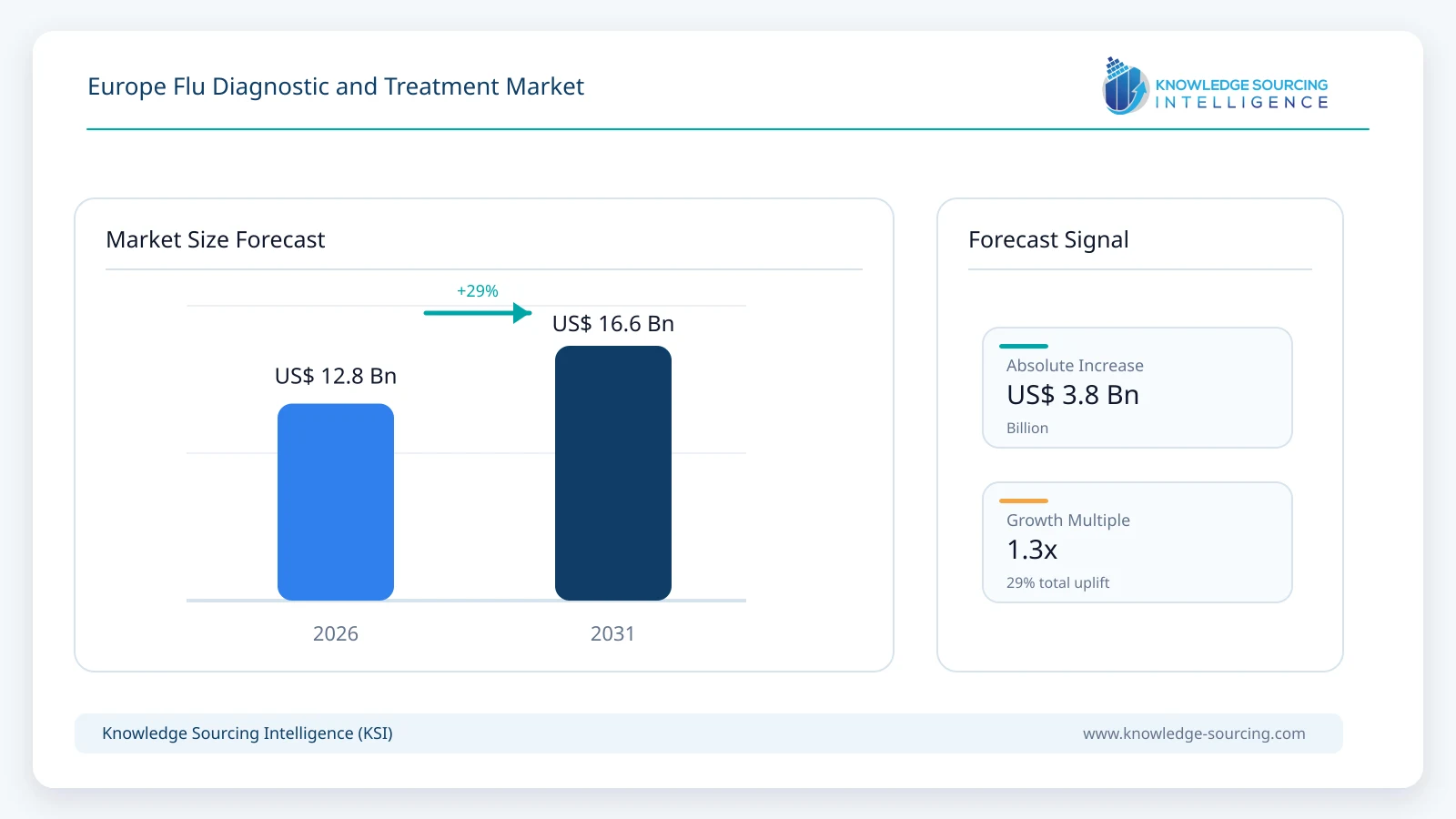
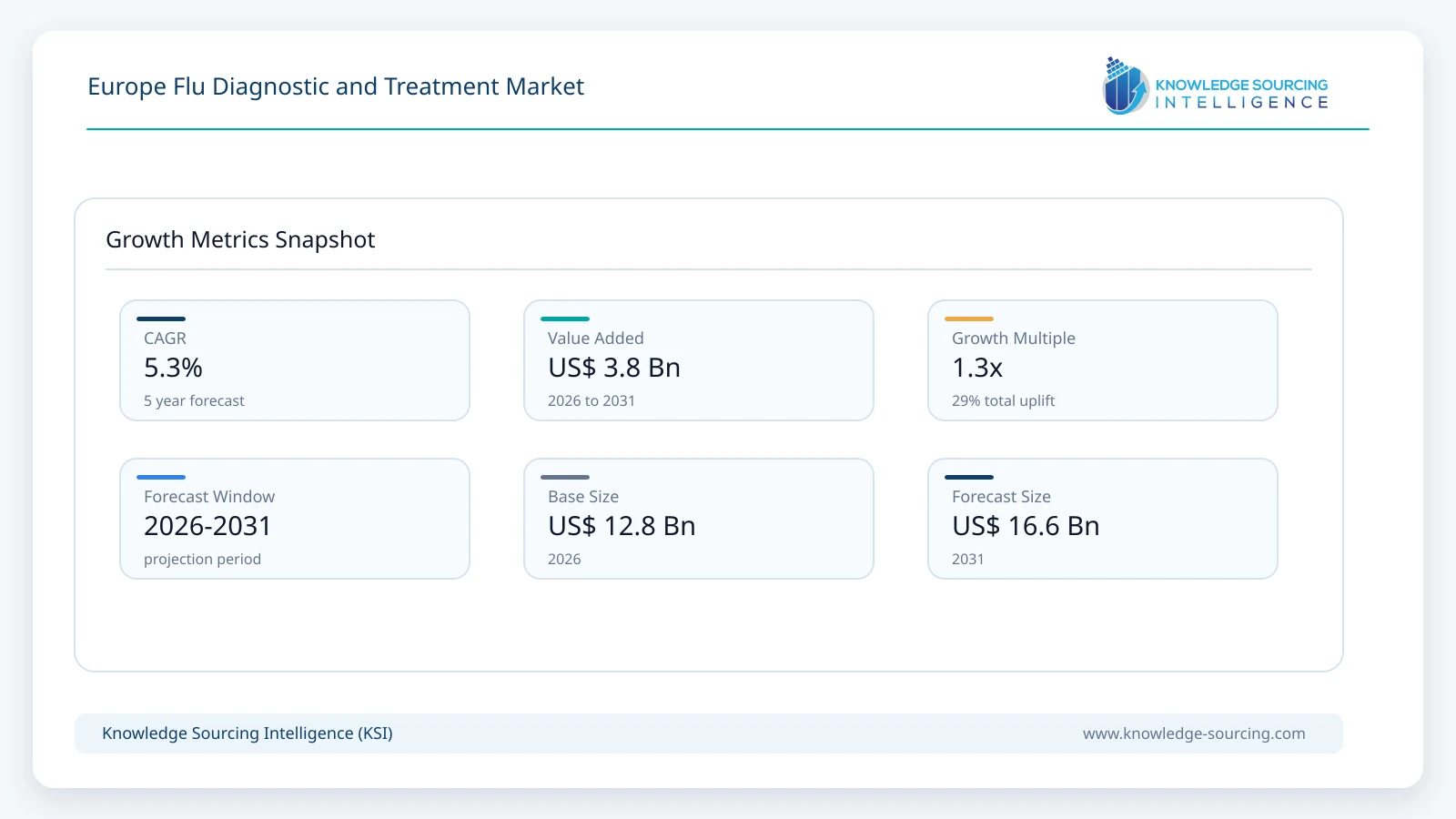
The European flu diagnostic and treatment market is estimated at USD 12.85 billion in 2026 and is forecast to reach approximately USD 16.62 billion in 2031, representing a CAGR of 5.3% over the forecast period.
Highlights:
- 1Seasonal influenza creates recurring demand for diagnostics, antivirals, surveillance, and hospital testing capacity.
- 2Molecular and multiplex testing is gaining importance where rapid treatment decisions affect patient management.
- 3Older adults remain a priority population because vaccination coverage remains below European policy targets.
- 4National procurement systems create different purchasing conditions across Western, Northern, and Central Europe.
- 5IVDR compliance is increasing regulatory work and market-entry costs for diagnostic manufacturers.
- 6Competitive positioning increasingly depends on turnaround time, multiplex capability, workflow fit, and supply reliability.
Key Highlights
Market Overview
ECDC collects weekly epidemiological and virological data from EU/EEA countries, including sentinel surveillance and hospitalised-case surveillance, creating a sustained requirement for laboratory testing and disease monitoring.
The purchasing environment is split between public health systems, hospitals, laboratories, physician practices, and decentralised care providers. Buyers increasingly assess diagnostic products on turnaround time, analytical performance, multiplex capability, workflow burden, instrument compatibility, and total testing cost. Abbott's ID NOW Influenza A & B 2, Roche's cobas liat respiratory assays, BD's respiratory panel, and bioMérieux's BIOFIRE panels illustrate the shift toward rapid molecular and multiplex testing.
Therapeutic demand remains linked to seasonal case volumes and clinical risk. EMA authorises influenza antivirals including neuraminidase inhibitors and baloxavir, while national treatment guidance influences prescribing and stock requirements.
Commercial value is distributed across assay consumables, instruments, laboratory workflows, rapid tests, antiviral medicines, and supporting services. Diagnostics suppliers can capture recurring seasonal revenue through reagent demand, while platform suppliers seek installed-base retention through broader respiratory menus. Treatment demand is more sensitive to clinical guidance, timing of diagnosis, reimbursement, and seasonal severity.
Key Market Indicators
Indicator | Latest Evidence | Commercial Meaning |
Influenza positivity in WHO European Region | 17%, mid-November 2025 | Seasonal activity creates an early testing and treatment demand signal. |
Older-adult influenza vaccination coverage | 47% median, 2024/25 | Coverage remains below the 75% European policy target, leaving a large prevention gap. |
Older-adult vaccination range | 5% to 76%, 2024/25 | National differences create uneven vaccine demand and seasonal disease exposure. |
Spain influenza burden | >33,000 hospitalisations, 2024/25 | Hospital activity supports demand for rapid diagnosis and antiviral decision support. |
UK influenza viruses genetically characterised | 1,740, through week 8 of 2026 | Surveillance requires sustained molecular testing and laboratory capacity. |
EU/EEA vaccination recommendations | All 30 countries recommended vaccination for older adults, 2024/25 | Public policy provides a broad recurring framework for prevention and related testing. |
WHO/Europe reported 17% influenza test positivity in primary care across the Region by mid-November 2025, while ECDC reported median older-adult vaccination coverage of 47% for 2024/25. Spain recorded more than 33,000 influenza hospitalisations during the 2024/25 season, according to Instituto de Salud Carlos III. UKHSA genetically characterised 1,740 seasonal influenza viruses between week 40 of 2025 and week 8 of 2026.
Market Drivers
Recurring seasonal respiratory testing demand.
ECDC's surveillance system covers epidemiological, virological, and hospitalised-case information across Europe, while national systems in Germany, France, Italy, Spain, and the United Kingdom maintain seasonal monitoring programmes. Seasonal concentration creates repeated demand for reagents, rapid tests, laboratory panels, and respiratory testing capacity. Hospitals and laboratories also need enough capacity to manage sharp changes in sample volumes without maintaining equivalent throughput throughout the year.
Low vaccination coverage leaves preventable demand in high-risk groups.
ECDC reported median influenza vaccination coverage of only 47% among older adults in the 2024/25 season, with country-level coverage ranging from 5% to 76%. Only Denmark, Ireland, Portugal, and Sweden approached the 75% EU Council target. The resulting prevention gap sustains exposure among older and clinically vulnerable populations, which can increase demand for diagnosis and antiviral treatment when seasonal transmission rises. Manufacturers and health systems therefore face two linked markets: prevention through vaccination and clinical management after infection.
Rapid differentiation of respiratory pathogens is changing test selection.
Influenza symptoms overlap with COVID-19 and RSV, increasing the clinical value of tests that identify several pathogens from one specimen. BD's respiratory panel differentiates SARS-CoV-2, influenza A, influenza B, and RSV, while Roche's cobas liat platform provides rapid multiplex RT-PCR testing. Hospitals, emergency departments, clinics, and laboratories can use these systems to shorten diagnostic pathways and reduce sequential testing. Suppliers that combine speed with broad respiratory menus can compete for higher-value workflows rather than isolated influenza tests.
Point-of-care molecular testing is widening the addressable setting.
Abbott's ID NOW Influenza A & B 2 provides molecular influenza results within 13 minutes or less, while QuidelOrtho's LEX VELO system was designed to deliver multiplex molecular results for influenza A, influenza B, and COVID-19 in approximately six to ten minutes. These systems target settings where central laboratory turnaround is too slow for same-visit decisions. Growth in decentralised testing can shift some spending from central laboratories toward instruments, cartridges, and recurring point-of-care consumables.
Surveillance and preparedness are increasing demand for broader respiratory testing capacity.
WHO/Europe and ECDC publish joint weekly respiratory surveillance through ERVISS, while the European Commission continues to support preparedness for vaccines, treatments, diagnostics, and other medical countermeasures. The European Commission has also pursued pre-commercial procurement for next-generation influenza vaccines. These programmes support laboratory capability, pathogen monitoring, and supplier readiness, although public-health preparedness spending does not translate directly into routine commercial testing volumes.
Market Restraints and Challenges
IVDR compliance is raising the regulatory burden for influenza diagnostics.
Regulation (EU) 2017/746 has changed conformity assessment, evidence, quality-system, and post-market requirements for in vitro diagnostics. Transitional provisions extend certain legacy devices through risk-based deadlines, but manufacturers must meet specific conditions and work with notified bodies. Smaller suppliers can face disproportionate costs because regulatory work, clinical evidence, quality systems, and technical documentation must be maintained even when seasonal test volumes remain concentrated in a few months.
Seasonal utilisation creates capacity and inventory risk.
Flu testing volumes rise sharply during winter transmission and fall during warmer months. Manufacturers and laboratories therefore need to balance reagent inventories, production capacity, staffing, and instrument utilisation across highly uneven demand periods. QuidelOrtho's 2025 results illustrate this sensitivity: its respiratory revenue declined as COVID-19 testing fell, while flu revenue increased 3% during the year. Suppliers with broader respiratory portfolios can spread fixed platform costs across influenza, RSV, and SARS-CoV-2 testing.
Price pressure can limit the value captured from routine influenza testing.
Public healthcare systems frequently purchase diagnostic products through tenders that assess price alongside performance, workflow, service, and supply conditions. Routine influenza testing can therefore face lower reimbursement or procurement prices than specialised molecular diagnostics. The commercial challenge is greater for standalone assays because buyers can compare alternative antigen, molecular, and multiplex products within the same clinical pathway.
Laboratory workflow constraints limit adoption of high-complexity testing.
Multiplex molecular panels can improve pathogen identification, but laboratories still consider instrument capacity, sample preparation, staffing, quality control, and per-test cost. bioMérieux's BIOFIRE respiratory panels and Hologic's Panther Fusion assays illustrate the value of automated workflows, but the economic case depends on whether faster diagnosis offsets reagent and platform costs. Smaller laboratories may therefore favour simpler rapid tests when patient volume does not justify broader molecular infrastructure.
Uneven national reimbursement and vaccination policy complicate regional scaling.
European influenza prevention and treatment policies are not uniform. ECDC reports differences in vaccination age thresholds and coverage across EU/EEA countries, while WHO/Europe notes that high-risk-group coverage varies widely across the Region. Suppliers must therefore adapt pricing, distribution, clinical positioning, and market access strategies to national healthcare structures rather than treating Europe as one procurement market.
Major Segment Analysis
Diagnostics
Diagnostics represent a commercially important offering because treatment decisions depend on distinguishing influenza from other respiratory infections, particularly among hospitalised and high-risk patients. Molecular tests and NAATs gain value when clinical teams require higher sensitivity or need to differentiate several respiratory pathogens from one specimen. Roche, BD, bioMérieux, Hologic, Abbott, and DiaSorin all maintain respiratory diagnostic solutions that combine influenza detection with other viral targets.
Purchasing criteria differ by setting. Hospitals and reference laboratories can justify higher-throughput molecular systems, whereas clinics and physician offices place greater weight on turnaround time, ease of use, instrument size, and per-test economics. Multiplex panels also compete by reducing sequential testing and improving clinical differentiation, but higher consumable costs can restrict routine use where reimbursement is limited. The segment's commercial direction will depend on whether rapid molecular workflows can move beyond acute hospital use into decentralised European care.
Regional Analysis
Influenza surveillance across Europe shows that demand conditions differ materially between national health systems, even though all markets face recurring seasonal transmission. ECDC collects epidemiological and virological data from EU/EEA countries through national surveillance systems, while national agencies determine testing pathways, vaccination programmes, reimbursement, and procurement. The country mix covered in this report therefore requires a national rather than broad regional comparison.
Country | Main Demand Signal | Commercial Consideration |
Germany | Large healthcare system, established influenza surveillance, and hospital-based testing | Demand favours reliable molecular workflows, laboratory automation, and rapid clinical testing |
France | Integrated respiratory surveillance and extensive public healthcare provision | National procurement and laboratory networks influence product access and pricing |
United Kingdom | Mature laboratory and primary-care surveillance infrastructure | NHS procurement, clinical pathways, and point-of-care economics shape adoption |
Spain | High seasonal hospital burden and established respiratory surveillance | Hospital testing and rapid diagnosis remain important during severe seasons |
Italy | National RespiVirNet surveillance across community and hospital settings | Decentralised healthcare structures create differences in regional purchasing |
Norway | Strong public-health infrastructure and high-risk-group vaccination focus | Smaller volumes favour suppliers with efficient distribution and established support |
Sweden | High older-adult vaccination coverage and mature surveillance | Prevention reduces avoidable severe disease, while testing remains important for clinical differentiation |
Netherlands | Integrated national respiratory surveillance and established laboratory capacity | Centralised healthcare structures support standardised testing procurement |
Switzerland | Mature healthcare infrastructure with distinct national market-access conditions | Suppliers must address country-specific regulatory and reimbursement requirements |
Belgium | Established laboratory and hospital networks within a fragmented institutional structure | Procurement and healthcare responsibilities can vary across administrative levels |
Denmark | High older-adult vaccination coverage and coordinated public-health infrastructure | Strong prevention can reduce severe disease while supporting continued surveillance demand |
Poland | Expanding healthcare capacity and lower vaccination uptake than Nordic markets | Testing access, public budgets, and infrastructure investment affect adoption |
Germany combines established sentinel surveillance with hospital and laboratory testing, creating demand across primary care, hospitals, and reference laboratories. Its 2024/25 influenza season included circulation of influenza A(H1N1)pdm09, influenza A(H3N2), and influenza B/Victoria, reinforcing the need for continued virological monitoring and differentiated diagnosis. France has similarly integrated influenza, COVID-19, and RSV surveillance, supporting demand for respiratory assays that can distinguish multiple pathogens within the same clinical episode.
The United Kingdom maintains laboratory, primary-care, hospital, and mortality surveillance through UKHSA. Influenza activity had returned to baseline levels by July 2026 after the 2025/26 season, but the established surveillance network continues to generate recurring testing requirements. Spain's commercial case is supported by hospital demand, with more than 33,000 influenza hospitalisations recorded during the 2024/25 season. Italy's RespiVirNet system provides another broad surveillance channel covering community and hospital settings.
Nordic markets show a different balance between prevention and treatment demand. ECDC reported older-adult influenza vaccination coverage of 76% in Denmark and 68% in Sweden during 2024/25, among the highest reported levels in the EU/EEA. Norway also operates a mature public-health system, while the Netherlands, Switzerland, and Belgium provide established laboratory markets with country-specific procurement structures. Poland presents a different commercial profile, where lower vaccination uptake and differences in healthcare resources can leave greater room for improvements in prevention, diagnostic access, and laboratory capacity.
Across these countries, suppliers will need to adapt channel strategy, pricing, regulatory execution, and clinical positioning to national healthcare structures. The commercial opportunity is therefore not determined solely by influenza incidence. It also depends on vaccination coverage, hospital utilisation, laboratory capacity, reimbursement, public procurement, and the extent to which healthcare providers adopt rapid molecular and multiplex testing.
Competitive Landscape
The competitive structure is technology-led and procurement-driven, with established diagnostic manufacturers competing across rapid antigen, molecular, multiplex, automation, and laboratory workflow categories. Abbott and QuidelOrtho have strong point-of-care positioning, while Roche, BD, bioMérieux, Hologic, Thermo Fisher Scientific, DiaSorin, Fujirebio, and Sekisui Diagnostics provide molecular or laboratory-oriented solutions. Their differentiation increasingly depends on turnaround time, test menus, automation, installed platforms, and compatibility with existing laboratory systems.
Roche's respiratory portfolio combines automated PCR with multiplex testing, while bioMérieux uses the BIOFIRE platform to consolidate multiple respiratory targets. Hologic focuses on automated molecular workflows, and DiaSorin continues to expand respiratory testing around LIAISON platforms. Competition is therefore shifting toward platform economics rather than individual influenza assays. Supplier concentration in instruments can also raise switching costs because laboratories must consider validated workflows, staff training, software interfaces, and recurring consumable contracts before changing platforms.
Recent Developments
May 2026: DiaSorin's investor presentation identified LIAISON NES as launched in 2026 and positioned the system around simplified point-of-care molecular testing. The platform expands DiaSorin's ability to address faster respiratory testing workflows outside conventional high-throughput laboratory environments.
April 2026: QuidelOrtho completed its approximately $100 million acquisition of LEX Diagnostics. The LEX VELO platform adds rapid multiplex molecular testing for influenza A, influenza B, and COVID-19, strengthening QuidelOrtho's decentralised molecular strategy.
January 2026: MSD completed its approximately $9.2-billion acquisition of Cidara Therapeutics, gaining MK-1406 (formerly CD388), an investigational long-acting antiviral designed for broad influenza prevention.
April 2025: SEKISUI Diagnostics launched the Metrix COVID/Flu Test on its molecular platform for point-of-care and home-test markets. The assay differentiates SARS-CoV-2, influenza A, and influenza B and provides results in 20 minutes.
Regulatory and Policy Environment
EU influenza diagnostics operate under the In Vitro Diagnostic Medical Devices Regulation, which has materially changed evidence, conformity assessment, quality management, and post-market requirements. The European Commission's extended IVDR transition periods depend on device risk class and manufacturer compliance with specified conditions. Class C devices can receive transition to December 2028 under the applicable framework, while Class B and Class A sterile devices can extend to December 2029.
EUDAMED also became more relevant to market access in 2026. The European Commission stated that four modules covering actor registration, UDI/device registration, notified bodies and certificates, and market surveillance became mandatory from 28 May 2026 after the applicable transition period. Diagnostic suppliers must therefore manage regulatory compliance alongside national tender requirements and clinical evidence expectations.
Influenza treatment is governed through medicines regulation and national prescribing systems. EMA lists baloxavir as an authorised antiviral for treatment and prevention in eligible adults and children, while neuraminidase inhibitors remain important components of influenza treatment. WHO and ECDC vaccination policies also influence the underlying disease burden. The 75% vaccination target for older adults remains unmet in most European countries, leaving substantial scope for prevention programmes to affect seasonal diagnostic and treatment demand.
Outlook and Strategic Implications
Europe's flu diagnostic and treatment market will remain closely tied to seasonal epidemiology, vaccination coverage, hospital pressure, and the ability of healthcare systems to identify respiratory pathogens quickly. Molecular and multiplex testing should receive continued attention because clinicians increasingly need to distinguish influenza from COVID-19, RSV, and other respiratory infections within the same clinical episode. Platform suppliers can strengthen recurring revenue by expanding respiratory menus while improving workflow speed and reducing hands-on steps.
The 2026-2031 period will also place greater weight on regulatory readiness and procurement economics. IVDR compliance can increase development and maintenance costs, while national tender structures can restrict price flexibility. Suppliers therefore need evidence packages that address analytical performance, clinical utility, workflow impact, total cost, supply continuity, and regulatory status rather than relying on technical sensitivity claims alone.
For manufacturers, the strongest commercial positions are likely to come from platforms that combine influenza detection with broader respiratory testing and fit established laboratory or point-of-care workflows. For healthcare buyers, purchasing decisions will increasingly balance test accuracy, turnaround time, utilisation, consumable cost, service support, and regulatory continuity. Public agencies and policymakers will remain important demand shapers through surveillance, vaccination programmes, preparedness procurement, and reimbursement policy. The market's performance through 2031 will depend less on influenza incidence alone than on how European health systems convert seasonal disease pressure into funded testing, treatment, and preparedness activity.
Europe Flu Diagnostic and Treatment Market Scope:
| Report Metric | Details |
|---|---|
| Total Market Size in 2026 | USD 12.85 billion |
| Total Market Size in 2031 | USD 16.62 billion |
| Growth Rate | 5.3% |
| Study Period | 2021 to 2031 |
| Historical Data | 2021 to 2024 |
| Base Year | 2025 |
| Forecast Period | 2026 – 2031 |
| Segmentation | Type of Flu, Offering, Age Group, End-User, Country |
| Companies |
|
Market Segmentation
BY TYPE OF FLU
Influenza A
Influenza B
Influenza C
Others
BY OFFERING
Diagnostics
Rapid Influenza Diagnostic Tests (RIDTs)
Molecular Tests / NAATs
Digital Immunoassays
Multiplex Respiratory Panels
Others
Therapeutics
Neuraminidase Inhibitors
Cap-Dependent Endonuclease Inhibitors
Others
BY AGE GROUP
0–14 Years
15–64 Years
?65 Years
BY END-USER
Hospitals
Diagnostic Centers and Reference Laboratories
Clinics and Physician Offices
Others
BY COUNTRY
Germany
France
United Kingdom
Spain
Italy
Norway
Sweden
Netherlands
Switzerland
Belgium
Denmark
Poland
Others
Table of Contents
1. INTRODUCTION
1.1. Market Overview
1.2. COVID-19 Impact
1.3. Market Definition
1.4. Market Segmentation
2. RESEARCH METHODOLOGY
2.1. Research Data
2.2. Assumptions
3. EXECUTIVE SUMMARY
3.1. Research Highlights
4. MARKET DYNAMICS
4.1. Market Drivers
4.2. Market Restraints
4.3. Market Opportunities
4.4. Porters Five Forces Analysis
4.4.1. Bargaining Power of Suppliers
4.4.2. Bargaining Power of Buyers
4.4.3. Threat of New Entrants
4.4.4. Threat of Substitutes
4.4.5. Competitive Rivalry in the Industry
4.5. Industry Value Chain Analysis
5. EUROPE FLU DIAGNOSTIC AND TREATMENT MARKET ANALYSIS, BY TYPE OF FLU
5.1. Introduction
5.2. Influenza A
5.3. Influenza B
5.4. Influenza C
5.5. Others
6. EUROPE FLU DIAGNOSTIC AND TREATMENT MARKET ANALYSIS, BY OFFERING
6.1. Introduction
6.2. Diagnostics
6.2.1. Rapid Influenza Diagnostic Tests (RIDTs)
6.2.2. Molecular Tests / NAATs
6.2.3. Digital Immunoassays
6.2.4. Multiplex Respiratory Panels
6.2.5. Others
6.3. Therapeutics
6.3.1. Neuraminidase Inhibitors
6.3.2. Cap-Dependent Endonuclease Inhibitors
6.3.3. Others
7. EUROPE FLU DIAGNOSTIC AND TREATMENT MARKET ANALYSIS, BY AGE GROUP
7.1. Introduction
7.2. 0-14 Years
7.3. 15-64 Years
7.4. >=65 Years
8. EUROPE FLU DIAGNOSTIC AND TREATMENT MARKET ANALYSIS, BY END-USER
8.1. Introduction
8.2. Hospitals
8.3. Diagnostic Centers and Reference Laboratories
8.4. Clinics and Physician Offices
8.5. Others
9. EUROPE FLU DIAGNOSTIC AND TREATMENT MARKET ANALYSIS, BY COUNTRY
9.1. Introduction
9.2. Germany
9.3. France
9.4. United Kingdom
9.5. Spain
9.6. Italy
9.7. Norway
9.8. Sweden
9.9. Netherlands
9.10. Switzerland
9.11. Belgium
9.12. Denmark
9.13. Poland
9.14. Others
10. COMPETITIVE ENVIRONMENT AND ANALYSIS
10.1. Major Players and Strategy Analysis
10.2. Emerging Players and Market Lucrativeness
10.3. Mergers, Acquisitions, Agreements, and Collaborations
10.4. Vendor Competitiveness Matrix
11. COMPANY PROFILES
11.1. Abbott
11.2. QuidelOrtho Corporation
11.3. F. Hoffmann-La Roche Ltd
11.4. BD
11.5. Thermo Fisher Scientific Inc.
11.6. bioMérieux SA
11.7. DiaSorin S.p.A.
11.8. Hologic, Inc.
11.9. Sekisui Diagnostics
11.10. Fujirebio
List of Figures
List of Tables
Navigate
Trusted by the world's leading organizations











