
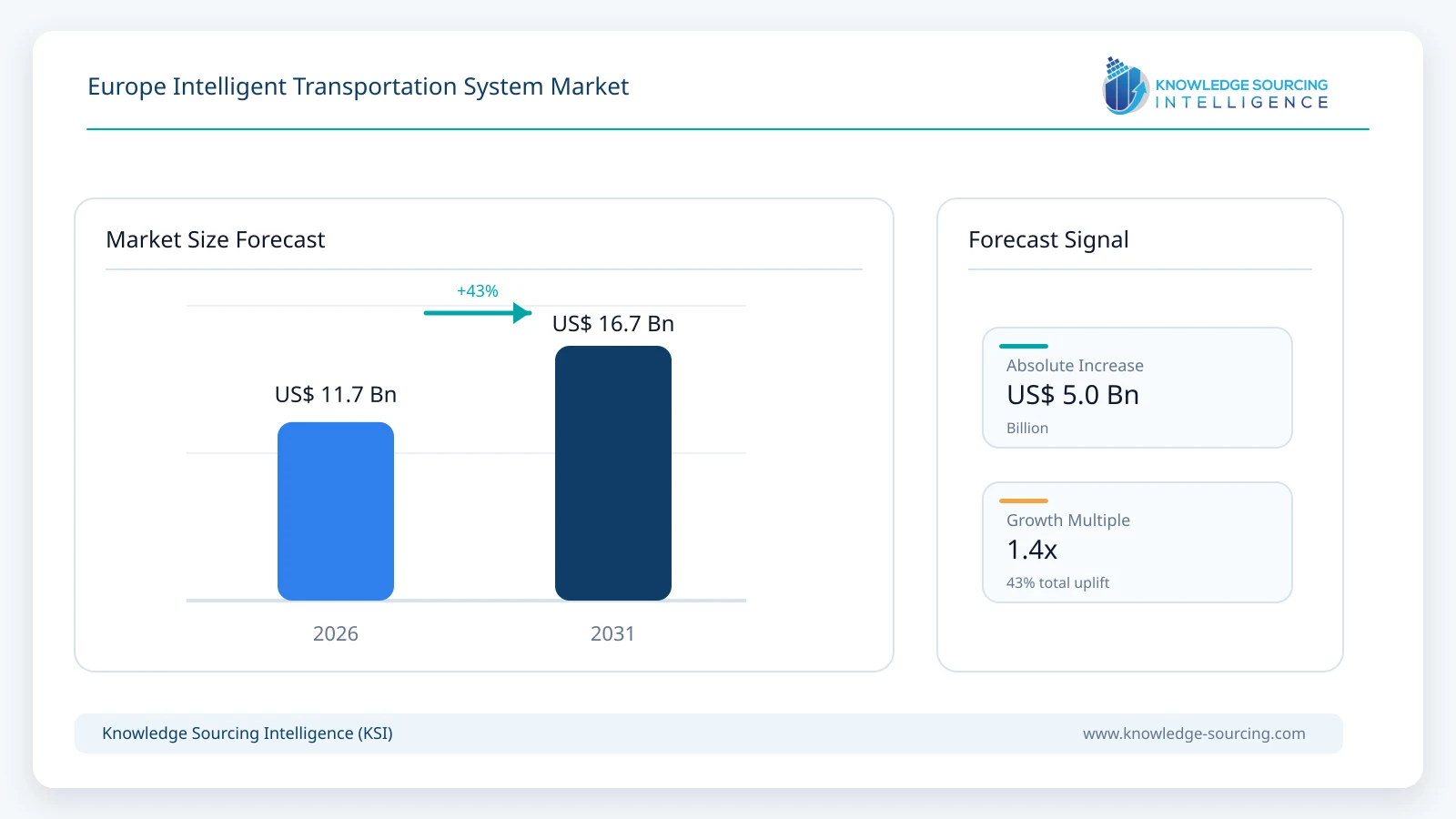
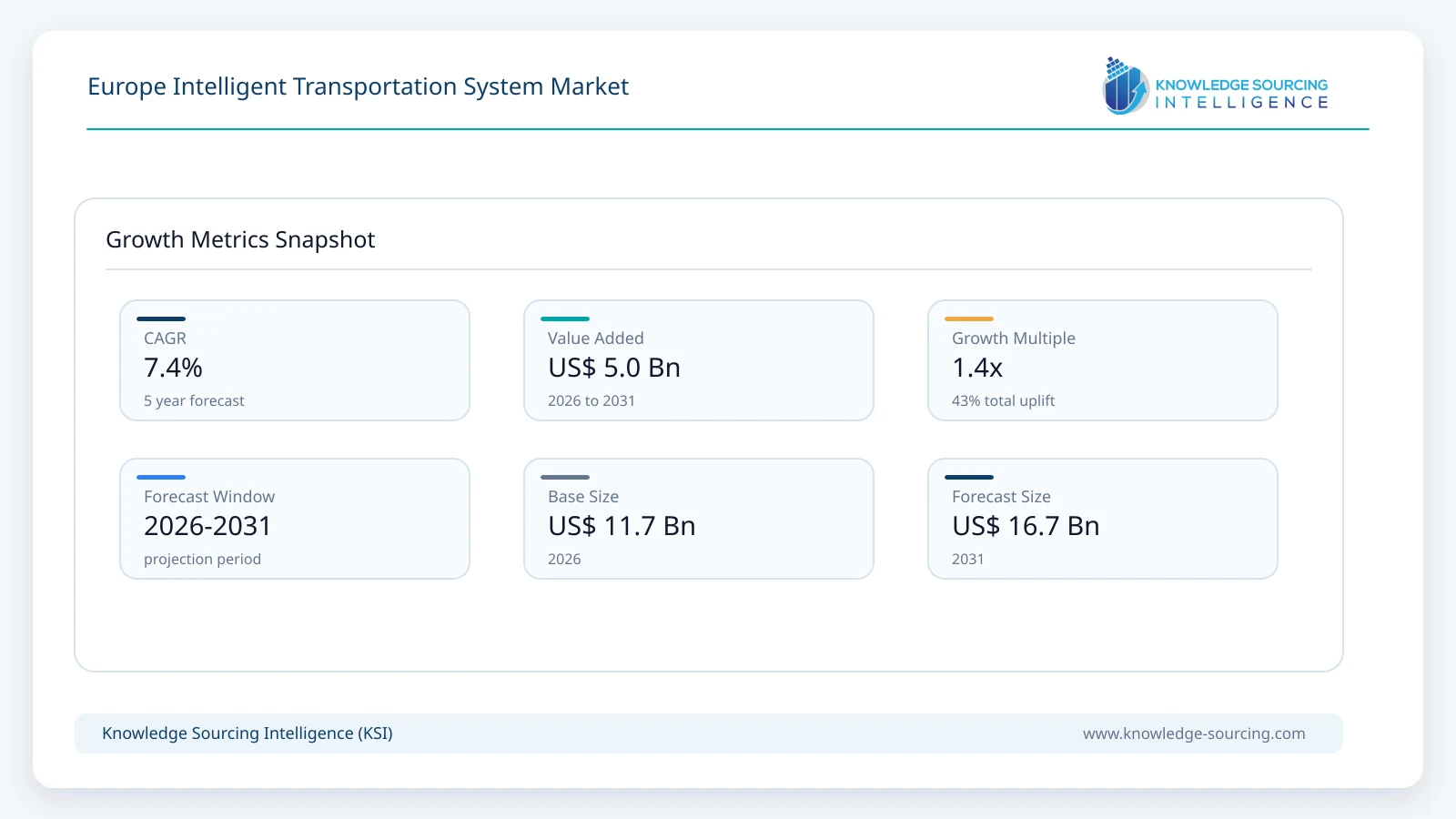
Europe Intelligent Transportation System Market is forecast to grow at a CAGR of 7.4%, reaching USD 16.7 billion in 2031 from USD 11.7 billion in 2026.
Highlights:
- 1Deployment priorities are shifting from standalone traffic systems to connected, interoperable mobility platforms.
- 2EU transport policy is accelerating investment in C-ITS, digital road infrastructure, and real-time mobility data.
- 3Public authorities increasingly procure integrated traffic management, tolling, safety, and multimodal information solutions.
- 4Interoperability, cybersecurity, and data governance have become decisive supplier selection criteria.
- 5Growth opportunities are strongest where roadside infrastructure, connected vehicles, and cloud-based traffic analytics converge.
Demand is primarily generated by national road authorities, municipalities, motorway concessionaires, public transport agencies, and logistics operators seeking measurable improvements in traffic efficiency, road safety, congestion management, and environmental performance. Purchasing decisions increasingly extend beyond hardware specifications. Buyers evaluate long-term software support, cybersecurity capabilities, cloud integration, lifecycle maintenance, regulatory compliance, and compatibility with existing transport infrastructure before awarding contracts.
Commercial activity also reflects broader changes in European mobility policy. Connected and automated driving initiatives require continuous exchange of high-quality road, traffic, and safety data between infrastructure and vehicles. At the same time, urban congestion charging, smart parking, multimodal journey planning, and low-emission transport policies are increasing demand for intelligent traffic management platforms capable of processing real-time information from multiple transport modes. These developments are expanding supplier opportunities beyond equipment sales toward recurring software, maintenance, analytics, and managed service revenues.
Competition increasingly depends on system integration capability rather than individual products. Suppliers with expertise in traffic control, communications infrastructure, cloud software, roadside equipment, and lifecycle services are better positioned to participate in large public infrastructure projects. Interoperability across national borders and compliance with European technical specifications have become important differentiators as transport authorities seek scalable platforms that remain compatible with future connected mobility initiatives.
Key Market Indicators
Indicator | Latest Evidence | Commercial Meaning |
Revised EU ITS Directive | Directive (EU) 2023/2661 | Expands deployment requirements for interoperable digital transport services. |
Member State implementation reporting | 2025 national reports; Commission review published 2026 | Demonstrates continued monitoring of ITS deployment and implementation progress across Europe. |
ITS Working Programme | 2024-2028 | Supports coordinated implementation of connected mobility, digital road data, and C-ITS services. |
EU-wide Real-Time Traffic Information | Delegated Regulation in force | Encourages standardized traffic information services and interoperable data sharing. |
Multimodal Travel Information | Updated delegated rules effective 2024 | Supports integrated passenger information and digital mobility platforms across Member States. |
Market Drivers
Expansion of connected mobility through European transport policy.
The revised ITS Directive broadens the regulatory framework for connected and automated mobility by requiring wider availability of digital road, traffic, and travel information across the European transport network. Public authorities increasingly invest in roadside communication infrastructure, digital mapping, traffic data platforms, and vehicle-to-infrastructure communication to support Cooperative Intelligent Transport Systems (C-ITS). These investments extend procurement beyond conventional traffic control equipment toward integrated software platforms capable of supporting future mobility services. Suppliers are expanding interoperability, cybersecurity, and cloud capabilities to meet these evolving technical requirements.
Road network operators are prioritizing real-time traffic management.
Congestion, incident response, and network optimization continue to influence investment decisions among motorway operators and municipal traffic authorities. Advanced Traffic Management Systems increasingly combine roadside sensors, connected cameras, variable message signs, weather monitoring, artificial intelligence, and predictive traffic analytics within centralized traffic control centers. Procurement increasingly emphasizes continuous operational visibility rather than isolated equipment replacement. This approach creates demand for long-term software licensing, maintenance contracts, system integration, and data management services while encouraging suppliers to strengthen lifecycle support capabilities.
Growing deployment of Cooperative Intelligent Transport Systems (C-ITS).
Vehicle connectivity has become an operational requirement rather than an experimental technology. European policy initiatives encourage communication between vehicles, roadside infrastructure, and traffic management centers to improve collision prevention, emergency response, traffic coordination, and road safety. Deployment of standardized communication protocols allows transport authorities to integrate connected vehicle services into existing traffic infrastructure without replacing entire operating environments. Technology suppliers are responding through expanded roadside unit portfolios, digital communication platforms, and software architectures designed to accommodate future autonomous mobility applications.
Public transport digitalization is expanding procurement opportunities.
Urban mobility agencies increasingly require integrated passenger information systems, fleet monitoring, priority signaling, and multimodal journey planning platforms that combine buses, rail, cycling, and shared mobility services. Passenger expectations for accurate real-time information continue to increase, while transport operators seek operational efficiency and improved service reliability. These requirements encourage investment in Advanced Public Transportation Systems that integrate scheduling, dispatching, vehicle tracking, passenger communication, and operational analytics. Suppliers capable of combining software, communications infrastructure, and long-term service support are well positioned for recurring public sector contracts.
Market Restraints and Challenges
Fragmented legacy infrastructure complicates system integration.
European transport networks contain equipment installed over several decades using different communication standards, software platforms, and proprietary technologies. Integrating these legacy assets into modern ITS architectures frequently requires customized interfaces, extended testing, and phased implementation. Transport authorities often prioritize compatibility with existing infrastructure to reduce replacement costs, increasing project complexity for system integrators. Suppliers therefore invest heavily in middleware, interoperability solutions, and migration services rather than relying solely on new hardware deployment.
Lengthy public procurement and regulatory approval cycles.
Most large ITS deployments depend on government procurement procedures that require extensive technical evaluation, compliance verification, and competitive tendering. Multi-year procurement timelines delay revenue realization and increase project management costs for suppliers. Cross-border projects frequently involve multiple public agencies with different operational priorities and procurement processes, extending implementation schedules further. These characteristics favor suppliers with strong financial capacity, established reference projects, and dedicated regulatory compliance resources.
Cybersecurity and data governance requirements continue to increase implementation costs.
Connected transport infrastructure exchanges operational data among vehicles, roadside equipment, traffic management centers, and cloud platforms. As digital connectivity expands, transport authorities require stronger cybersecurity controls, secure communications, identity management, software certification, and continuous vulnerability monitoring. Compliance with European cybersecurity and data protection requirements raises development costs while increasing lifecycle support obligations. Vendors increasingly differentiate themselves through secure software architectures, regular security updates, and dedicated managed cybersecurity services rather than hardware performance alone.
Maintaining interoperability across multiple jurisdictions remains technically demanding.
Europe's ITS environment spans numerous national transport authorities, infrastructure operators, communication providers, and technology suppliers. Although European legislation promotes harmonized deployment, practical implementation continues to involve differences in infrastructure maturity, procurement priorities, operational practices, and digital readiness across Member States. Suppliers must therefore design flexible platforms capable of adapting to national requirements while remaining compliant with common European specifications. Maintaining this balance increases engineering effort, certification requirements, and long-term support commitments.
Major Segment Analysis
Cooperative Intelligent Transport Systems (C-ITS)
Cooperative Intelligent Transport Systems (C-ITS) represent one of the most commercially important technology segments because they enable direct communication between vehicles, roadside infrastructure, traffic management centers, and other road users. Unlike conventional traffic management systems that primarily monitor network conditions, C-ITS supports proactive safety and traffic optimization by exchanging real-time information on hazards, congestion, weather conditions, roadworks, and signal timing. The European Commission's C-ITS framework and the revised ITS Directive continue to encourage deployment through harmonized technical specifications, making this segment central to Europe's long-term connected mobility strategy.
Demand is led by national highway authorities, urban transport agencies, motorway concessionaires, and municipalities investing in roadside communication units and digital traffic infrastructure compatible with connected vehicles. Buyers increasingly prioritize interoperability, cybersecurity, scalability, and compliance with European communication standards over standalone hardware performance. Suppliers including Yunex Traffic, SWARCO AG, Siemens AG, Kapsch TrafficCom, and Q-Free ASA increasingly compete through integrated software platforms, roadside communication technologies, lifecycle services, and cloud-enabled traffic management capabilities. Commercial success within this segment depends on supporting future vehicle connectivity while remaining compatible with existing transport infrastructure, allowing authorities to modernize networks without replacing entire traffic management systems.
Regional Analysis
Country | Main Demand Signal | Principal Constraint |
United Kingdom | Smart motorway programmes, urban traffic management, connected mobility initiatives | Legacy infrastructure integration and public procurement complexity |
Germany | Connected vehicle ecosystem, motorway digitalization, automotive industry support | Interoperability across federal and regional transport authorities |
France | Smart city projects, tolling modernization, multimodal mobility services | Complex urban transport integration and cybersecurity requirements |
Italy | Highway management modernization, congestion monitoring, electronic tolling | Regional infrastructure disparities and financing constraints |
Spain | Urban mobility programmes, intelligent public transport, traffic monitoring | Budget prioritization across autonomous communities |
Netherlands | Digital mobility services, cooperative mobility pilots, multimodal transport integration | Limited expansion opportunities due to mature transport infrastructure |
United Kingdom
The United Kingdom remains an important ITS market due to continued investment in motorway management, congestion reduction, and connected mobility infrastructure. National Highways continues to expand digital traffic management capabilities using roadside sensors, variable message signs, traffic monitoring systems, and real-time incident management platforms. Local authorities are also investing in adaptive traffic signal control, bus priority systems, and smart mobility applications to improve urban traffic efficiency. Procurement increasingly favors suppliers capable of integrating existing infrastructure with cloud-based traffic analytics, predictive traffic management, and connected vehicle technologies.
Germany
Germany's ITS market benefits from its extensive motorway network, advanced automotive industry, and federal commitment to connected and automated mobility. Digitalization of transport infrastructure supports deployment of Advanced Traffic Management Systems, Cooperative ITS services, and intelligent freight management solutions across national transport corridors. Demand is also supported by vehicle manufacturers participating in connected mobility initiatives requiring reliable vehicle-to-infrastructure communication. However, implementation often requires coordination between federal, state, and municipal authorities, increasing project complexity and extending procurement timelines.
France
France continues to strengthen ITS deployment through investments in intelligent motorway operations, electronic toll collection, public transport information systems, and urban traffic optimization. Metropolitan regions increasingly deploy integrated traffic management platforms that combine traffic monitoring, parking guidance, multimodal passenger information, and emergency response coordination. Public procurement places considerable emphasis on cybersecurity, long-term maintenance, and compliance with European interoperability requirements, encouraging suppliers to provide integrated lifecycle support rather than standalone equipment.
Italy
Italy's transport authorities continue to modernize motorway operations and urban mobility infrastructure to improve road safety, traffic efficiency, and network resilience. Electronic toll collection, tunnel monitoring, incident management, and intelligent traffic control remain important procurement areas, particularly across heavily travelled motorway corridors. Regional differences in infrastructure maturity and funding priorities can influence deployment speed, encouraging suppliers to deliver scalable systems that can be implemented in phases while remaining compatible with existing traffic infrastructure.
Spain
Spain's ITS investment is supported by smart city initiatives, urban mobility planning, and modernization of national transport infrastructure. Municipal authorities increasingly deploy adaptive traffic signal systems, intelligent public transport management, and integrated mobility platforms that support multimodal travel information and congestion management. Large metropolitan areas continue to prioritize operational efficiency, while national road operators invest in traffic monitoring and incident detection technologies to improve highway safety and network reliability.
Netherlands
The Netherlands maintains one of Europe's most digitally connected transport networks, supporting extensive deployment of intelligent traffic management, multimodal journey planning, and connected mobility services. Public authorities prioritize efficient use of existing infrastructure through predictive traffic management, real-time traveler information, and cooperative vehicle communication. Because much of the transport network already incorporates advanced ITS technologies, procurement increasingly focuses on software upgrades, cybersecurity improvements, cloud integration, and data-driven mobility management rather than large-scale hardware expansion.
Competitive Landscape
The European Intelligent Transportation System market is characterized by established infrastructure technology providers competing through integrated platforms, long-term public sector relationships, software capability, and lifecycle service delivery rather than equipment supply alone. Large public infrastructure contracts generally favor suppliers with proven implementation experience, regulatory compliance expertise, and the ability to integrate legacy transport infrastructure with modern digital platforms.
Yunex Traffic, SWARCO AG, Siemens AG, Kapsch TrafficCom, Indra Sistemas S.A., Thales Group, TomTom N.V., and Q-Free ASA compete across traffic management, tolling, connected mobility, public transport information, traffic analytics, and digital mapping solutions. Competition increasingly centers on cloud-enabled traffic operations, cybersecurity, artificial intelligence, roadside communication systems, and interoperability with European C-ITS standards. Companies are also expanding software capabilities, managed services, predictive maintenance, and data analytics to strengthen recurring revenue while responding to transport authorities seeking long-term operational support instead of one-time infrastructure deployments.
Recent Developments
August 2026: Kapsch TrafficCom began implementing smart parking integration in Santa Cruz de Tenerife, connecting occupancy data from 24 parking areas to the city’s traffic management system and nine variable message panels.
August 2026: Cofiroute selected TomTom Traffic to strengthen real-time motorway operations across its French network, using Route Monitoring for traffic conditions, incident management, and driver information through variable message signs.
July 2026: Yunex Traffic completed deployment of its AI-enabled Yutraffic awareAI video analytics solution at a complex Coventry intersection, providing near-real-time detection and signal control to improve road safety.
April 2026: The European Commission published its third implementation report on the EU Intelligent Transport Systems Directive, outlining progress on digital transport data, connected mobility, standards, and future ITS deployment priorities.
Regulatory and Policy Environment
European ITS deployment is increasingly shaped by harmonized legislation intended to improve interoperability, safety, and digital mobility across Member States. The revised Directive (EU) 2023/2661 broadens the scope of the original ITS Directive by expanding requirements for digital transport services, real-time traffic information, multimodal travel information, and connected mobility applications. Complementary delegated regulations establish common specifications for traffic data exchange and information services, reducing fragmentation across national transport networks.
The 2024-2028 ITS Working Programme further supports coordinated implementation of Cooperative Intelligent Transport Systems, digital road infrastructure, and connected vehicle services. At the national level, procurement increasingly incorporates cybersecurity, data protection, system resilience, and interoperability requirements alongside traditional technical performance criteria. Compliance with these regulatory frameworks has become an important competitive factor, particularly for suppliers participating in large public infrastructure projects and cross-border transport initiatives.
Outlook and Strategic Implications
European ITS investment is expected to remain focused on connected mobility, digital infrastructure, and integrated traffic management throughout the 2026-2031 forecast period. Procurement priorities are gradually shifting from isolated traffic control systems toward software-driven platforms capable of combining traffic operations, connected vehicle communication, predictive analytics, public transport management, and real-time traveler information within unified digital environments. This transition supports higher demand for lifecycle services, cloud software, cybersecurity, and long-term operational support.
Key strategic implications include:
Transport authorities: Greater emphasis on interoperable, scalable platforms that remain compatible with future connected mobility initiatives.
Technology suppliers: Continued investment in cloud platforms, cybersecurity, artificial intelligence, and roadside communication technologies will strengthen competitive positioning.
System integrators: Growing opportunities to modernize legacy infrastructure through phased implementation and software integration rather than complete asset replacement.
Infrastructure investors: Long-term returns are increasingly linked to digital transport assets capable of supporting connected mobility, intelligent traffic operations, and data-driven transport management.
Europe Intelligent Transportation System Market Scope:
| Report Metric | Details |
|---|---|
| Total Market Size in 2026 | USD 11.7 billion |
| Total Market Size in 2031 | USD 16.7 billion |
| Forecast Unit | Billion |
| Growth Rate | 7.4% |
| Study Period | 2021 to 2031 |
| Historical Data | 2021 to 2024 |
| Base Year | 2025 |
| Forecast Period | 2026 – 2031 |
| Segmentation | Type, Application, Geography |
| Companies |
|
Market Segmentation
By Type
ATMS (Advanced Traffic Management System)
ATIS (Advanced Traffic Information System)
APTS (Advanced Public Transportation System)
ATPS (Advanced Transportation Pricing System)
Cooperative Intelligent Transport Systems (C-ITS)
By Application
Collision Avoidance System
Traffic Monitoring
Parking Availability
Traffic Signal Control System
Fleet Management and Asset Monitoring
Road User Charging / Electronic Toll Collection
Smart Mobility Management
Emergency Vehicle Notification
Incident Management
Connected Vehicle Services
Public Transport Passenger Information
Others
By Geography
U.K.
Germany
France
Italy
Spain
Netherlands
Others
Table of Contents
1. Introduction
2. Research Methodology
3. Executive Summary
4. Market Dynamics
4.1. Market Overview and Segmentations
4.2. Drivers
4.3. Restraints
4.4. Opportunities
4.5. Porter's Five Forces
4.6. Supplier Outlook
4.7. Industry Outlook
4.8. Industry Value Chain Analysis
4.9. Scenario Analysis
5. Europe Intelligent Transportation System Market Forecast By Type
5.1. ATMS (Advanced Traffic Management System)
5.2. ATIS (Advanced Traffic Information System)
5.3. APTS (Advanced Public Transportation System)
5.4. ATPS (Advanced Transportation Pricing System)
5.5. Cooperative Intelligent Transport Systems (C-ITS)
6. Europe Intelligent Transportation System Market Forecast By Application
6.1. Collision Avoidance System
6.2. Traffic Monitoring
6.3. Parking Availability
6.4. Traffic Signal Control System
6.5. Fleet Management and Asset Monitoring
6.6. Road User Charging / Electronic Toll Collection
6.7. Smart Mobility Management
6.8. Emergency Vehicle Notification
6.9. Incident Management
6.10. Connected Vehicle Services
6.11. Public Transport Passenger Information
6.12. Others
7. Europe Intelligent Transportation System Market Forecast By Geography
7.1. U.K.
7.2. Germany
7.3. France
7.4. Italy
7.5. Spain
7.6. Netherlands
7.7. Others
8. Competitive Intelligence
8.1. Market Share of Key Players
8.2. Investment Analysis
8.3. Recent Deals
8.4. Strategies of Key Players
9. Company Profiles
9.1. Yunex Traffic (formerly Siemens Intelligent Traffic Systems)
9.2. SWARCO AG
9.3. Indra Sistemas S.A.
9.4. Thales Group
9.5. Siemens AG
9.6. Kapsch Traffic Com
9.7. TomTom N.V.
9.8. Q-Free ASA
Navigate
Trusted by the world's leading organizations











