
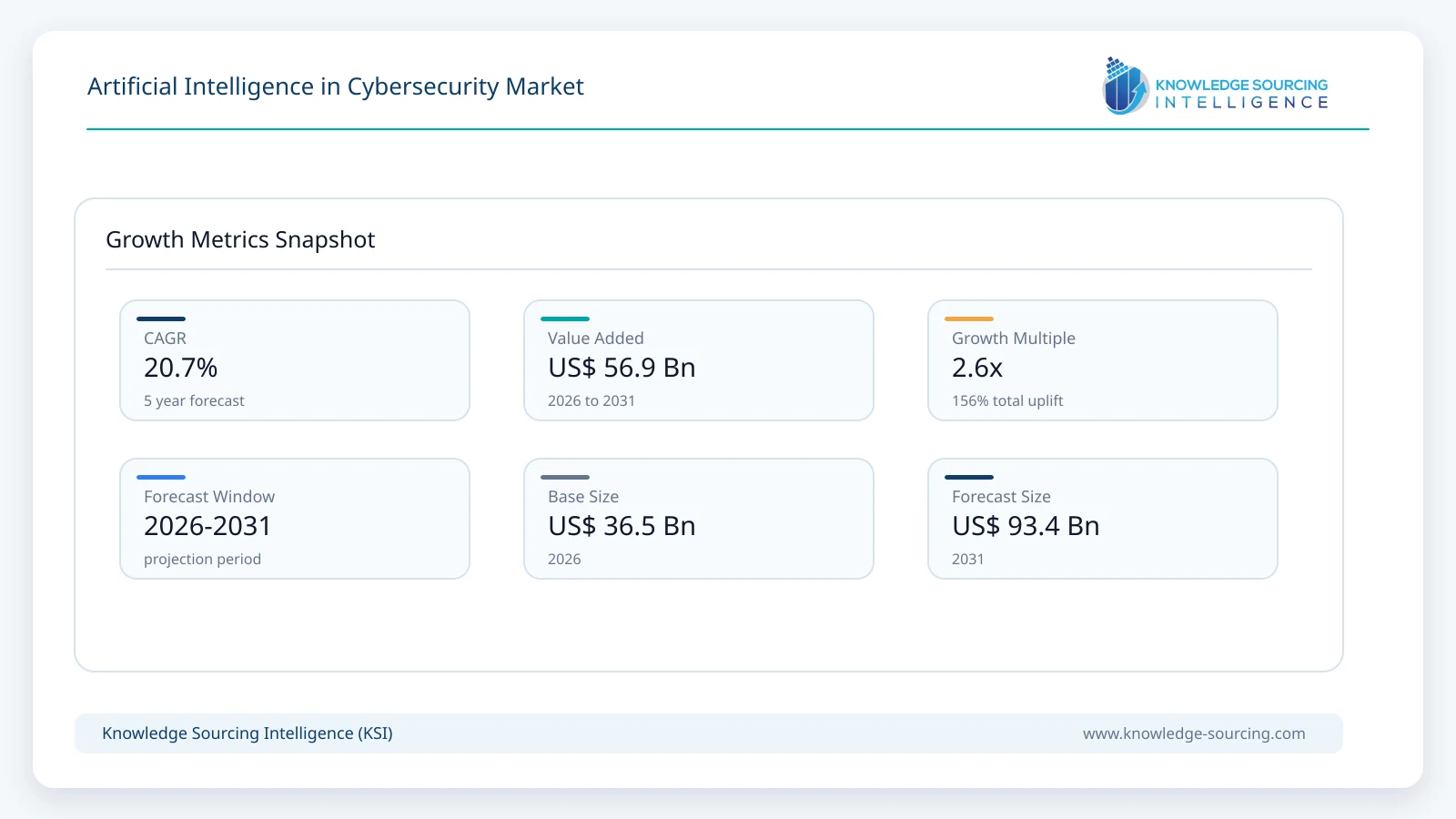
The Artificial Intelligence in Cybersecurity Market is forecast to grow at a CAGR of 15.0%, reaching USD 100.6 billion in 2031 from USD 50.1 billion in 2026.
Highlights:
- 1Network security and endpoint security & management continue to be the biggest application segments, and cloud security will see the highest growth rate, as businesses rush to cloudify more of their infrastructure.
- 2The top vendors are battling for dominance in the Agentic AI-native SOC platform that provides autonomous investigation, detection and response instead of alert-only monitoring.
- 3The EU AI Act high-risk system obligations, which come into effect from August 2026, are driving the design of cybersecurity vendors targeted at EU-regulated critical sectors to implement risk management, logging, and human oversight.
- 4Behavioral biometrics and continuous authentication are growing in popularity as AI-powered identity verification solutions to combat ever more sophisticated AI-driven social engineering and deepfake-enabled fraud.
AI in Cybersecurity is the adoption of machine learning, deep learning, natural language processing, and now, more agentic AI, to detect anomalies, analyze vast amounts of security telemetry, automate threat response, and constantly validate identity through behavioral biometrics. The technology is being introduced in network security, endpoint security and management, cloud security, identity and access management (IAM), application security and security operations center (SOC) modernization, with network security and endpoint security dominating revenue share, and cloud security anticipated to grow the most as companies keep moving workloads to the cloud.
One of the most important factors that will shape the future of this market in the near future is the regulatory landscape. At the same time, the EU's July 2026 Action Plan on Cybersecurity and Artificial Intelligence pledges the European Commission and ENISA to create a secure testing environment for essential sectors and to enhance third-party testing for sophisticated AI systems. The NIST AI Risk Management Framework is the most prominent voluntary framework in the U.S. and in May 2026, NIST's Cybersecurity and Privacy Program published an updated annual report (SP 800-238) for FY2025 that includes additional guidance specifically on automated threat detection, AI risk management and secure system design, and several U.S. states have enacted AI-specific risk management requirements for high-risk systems that explicitly reference the NIST framework.
Market Dynamics
Market Drivers
As the volume and sophistication of ransomware, phishing, and artificial intelligence-powered cybercrime continues to increase, enterprises and governments are turning to AI-powered attack detection and response solutions that can respond at machine speed, with the FBI reporting more than 2,100 ransomware attacks against U.S. critical infrastructure in 2025 alone.
New regulatory compliance requirements, such as the EU AI Act's high-risk system cybersecurity requirements (which go into effect in August 2026), the NIST AI Risk Management Framework and the state-level AI laws in the United States are pushing organizations to invest in AI security solutions that reinforce risk management, auditability, and human oversight by design.
As enterprise workloads move to the cloud and hybrid environments, and more devices are connected, the attack surface is growing, and so is the need for AI-powered cloud security, identity protection, and security analytics platforms.
Market Restraints & Opportunities
Skilled cybersecurity workforce shortage, the high implementation and integration costs of AI-native security platforms, and potential adversarial manipulation of AI detection models (including AI-powered attacks targeting AI defenses) are major challenges to AI adoption, especially for SMBs.
However, continued enterprise investment in security automation, the market's evolution of autonomous SOC operations with agentic AI platforms, and increasing regulatory requirements for AI risk management open the door to significant long-term potential, with cloud security, identity protection, and critical-infrastructure markets like energy, healthcare and financial services leading the way.
Key Developments
August 2026: Fortress Information Security and Industrial Defender Join Forces to Ready Critical Infrastructure for AI-Speed Vulnerability Discovery.
May 2026: Google Cloud introduced a comprehensive AI-powered cybersecurity solution, Google AI Threat Defense, an always-on autonomous security platform.
Market Segmentation
By Offering: Software Platforms
Software platforms hold the largest offering share, encompassing AI-enabled detection and analytics engines, SIEM, XDR, and agentic SOC automation tools that form the core of modern AI-driven security stacks.
Microsoft integrates AI-powered threat detection, identity protection, and SOC automation across its Defender and Sentinel security product lines, serving as one of the leading platforms in enterprise AI cybersecurity deployment.
With a machine learning-based threat detection and automated response capabilities, Palo Alto Networks offers AI-native security platforms to cover network, cloud, and endpoint protection.
CrowdStrike has cloud-native, behavioral analytics and threat intelligence-based AI-powered endpoint detection and response (EDR) and extended detection and response (XDR) solutions.
By Security Type: Network Security
Network security is the largest security related business segment, with enterprises continuing to invest in network-based intrusion detection, traffic analysis and anomaly detection using AI.
Cisco uses AI to analyze network traffic for anomalies and detect threats throughout its security portfolio, enabling protection for large-scale enterprise and service-provider networks.
By End-User Vertical: BFSI
Within the banking and financial services and insurance industry, AI has emerged as a key enabler for cybersecurity, thanks to high-value fraud-detection applications, real-time transaction monitoring and regulation requirements.
The retail & e-commerce market is projected to see the highest vertical CAGR in the forecast period, as AI-driven fraud prevention and fake account detection are driving growth in this market.
Regional Analysis
North America Market Analysis
North America is the biggest market share holder, as the digital economy is well developed, the region is prone to high-profile cyber incidents, a concentration of top AI cybersecurity vendors, and high levels of investment in the sector is provided by the US government, through NIST.
Europe Market Analysis
Regulatory compliance is becoming a key driver in Europe's marketplace, with the EU AI Act's high-risk system cybersecurity requirements and the EU Action Plan on Cybersecurity and AI that was released in July 2026 catalysing investment in compliant AI security platforms for both enterprises and public sector organizations.
Asia-Pacific Market Analysis
Asia-Pacific will see the most growth fueled by growing digital economies, volume of attacks and government investments in cybersecurity capabilities in China, India, Japan and South Korea.
Middle East and Africa Market Analysis
There's been a surge in investment in AI-powered cybersecurity in the Middle East and Africa, particularly in the UAE and Saudi Arabia, within larger smart city and critical infrastructure protection projects.
South America Market Analysis
In South America, the market for AI cybersecurity adoption continues to be a developing area, with increased investments in fraud detection and threat monitoring platforms in the enterprise and financial services sectors, as well as in Brazil.
List of Companies
Microsoft
Palo Alto Networks
Amazon Web Services
CrowdStrike
Cisco
Deep Instinct
Nozomi Networks
Acalvio Technologies
Cylance Inc.
Darktrace
Competitive Landscape
Microsoft
As AI grows increasingly integral to cybersecurity, Microsoft has implemented AI features in its Defender, Sentinel, and Security Copilot product lines, emerging as one of the top enterprise AI cybersecurity vendors globally.
Palo Alto Networks
Palo Alto Networks provides AI-powered cybersecurity platforms for network security, cloud security, and security operations, with AI for threat detection and automated incident response for hybrid enterprise environments.
CrowdStrike
CrowdStrike's AI-powered endpoint and extended detection and response (XDR) capabilities rely on behavioral analytics and threat intelligence to detect and neutralize advanced threats on endpoint systems in real time, while being cloud-based
Analyst View
The AI in cybersecurity market is transitioning from AI-assisted detection toward AI-native, agentic security operations, where platforms increasingly investigate and respond to threats autonomously rather than simply surfacing alerts for human analysts. Regulatory frameworks, particularly the EU AI Act's August 2026 high-risk obligations and NIST's expanding AI security research agenda, are becoming a direct driver of product design and enterprise procurement decisions, not merely a compliance afterthought. Vendors that combine agentic automation, regulatory-aligned governance features, and cross-domain visibility (network, cloud, endpoint, identity) are best positioned to lead the next phase of market growth.
Artificial Intelligence in Cybersecurity Market Scope
| Report Metric | Details |
|---|---|
| Total Market Size in 2026 | USD 50.1 billion |
| Total Market Size in 2031 | USD 100.6 billion |
| Forecast Unit | Billion |
| Growth Rate | 15.0% |
| Study Period | 2021 to 2031 |
| Historical Data | 2021 to 2024 |
| Base Year | 2025 |
| Forecast Period | 2026 – 2031 |
| Segmentation | Offering, Security Type, Deployment, End-User Vertical, Geography |
| Companies |
|
Table of Contents
1. EXECUTIVE SUMMARY
2. MARKET SNAPSHOT
2.1. Market Overview
2.2. Market Definition
2.3. Scope of the Study
2.4. Market Segmentation
3. BUSINESS LANDSCAPE
3.1. Market Drivers
3.2. Market Restraints
3.3. Market Opportunities
3.4. Porter's Five Forces Analysis
3.5. Industry Value Chain Analysis
3.7. Strategic Recommendations
4. TECHNOLOGICAL OUTLOOK
4.1. Agentic AI & Autonomous SOC Platforms
4.2. Behavioral Biometrics & Continuous Authentication
4.3. AI-Generated Threats & Adversarial AI Defense
4.4. Large Language Models in Threat Intelligence
5. AI IN CYBERSECURITY MARKET BY OFFERING
5.1. Introduction
5.2. Software Platforms
5.3. Services (Managed Security Services, Professional Services)
5.4. Hardware
6. AI IN CYBERSECURITY MARKET BY SECURITY TYPE
6.1. Introduction
6.2. Network Security
6.3. Endpoint Security & Management
6.4. Cloud Security
6.5. Identity & Access Management
6.6. Application Security
6.7. Others
7. AI IN CYBERSECURITY MARKET BY DEPLOYMENT
7.1. Introduction
7.2. Cloud-Based
7.3. On-Premise
8. AI IN CYBERSECURITY MARKET BY END-USER VERTICAL
8.1. Introduction
8.2. BFSI
8.3. IT & Telecom
8.4. Retail & E-Commerce
8.5. Healthcare
8.6. Government & Defense
8.7. Energy & Utilities
8.8. Others
9. AI IN CYBERSECURITY MARKET BY GEOGRAPHY
9.1. Introduction
9.2. North America
9.2.1. USA
9.2.2. Canada
9.2.3. Mexico
9.3. Europe
9.3.1. Germany
9.3.2. France
9.3.3. United Kingdom
9.3.4. Others
9.4. Asia Pacific
9.4.1. China
9.4.2. India
9.4.3. Japan
9.4.4. South Korea
9.4.5. Others
9.5. Middle East and Africa
9.5.1. UAE
9.5.2. Saudi Arabia
9.5.3. Others
9.6. South America
9.6.1. Brazil
9.6.2. Others
10. COMPETITIVE ENVIRONMENT AND ANALYSIS
10.1. Major Players and Strategy Analysis
10.2. Market Share Analysis
10.3. Mergers, Acquisitions, Agreements, and Collaborations
10.4. Competitive Dashboard
11. COMPANY PROFILES
11.1. Microsoft
11.2. Palo Alto Networks
11.3. Amazon Web Services
11.4. CrowdStrike
11.5. Cisco
11.6. Deep Instinct
11.7. Nozomi Networks
11.8. Acalvio Technologies
11.9. Cylance Inc.
11.10. Darktrace
12. APPENDIX
12.1. Currency
12.2. Assumptions
12.3. Base and Forecast Years Timeline
12.4. Key Benefits for the Stakeholders
12.5. Research Methodology
12.6. Abbreviations
Navigate
Trusted by the world's leading organizations











