Report Overview
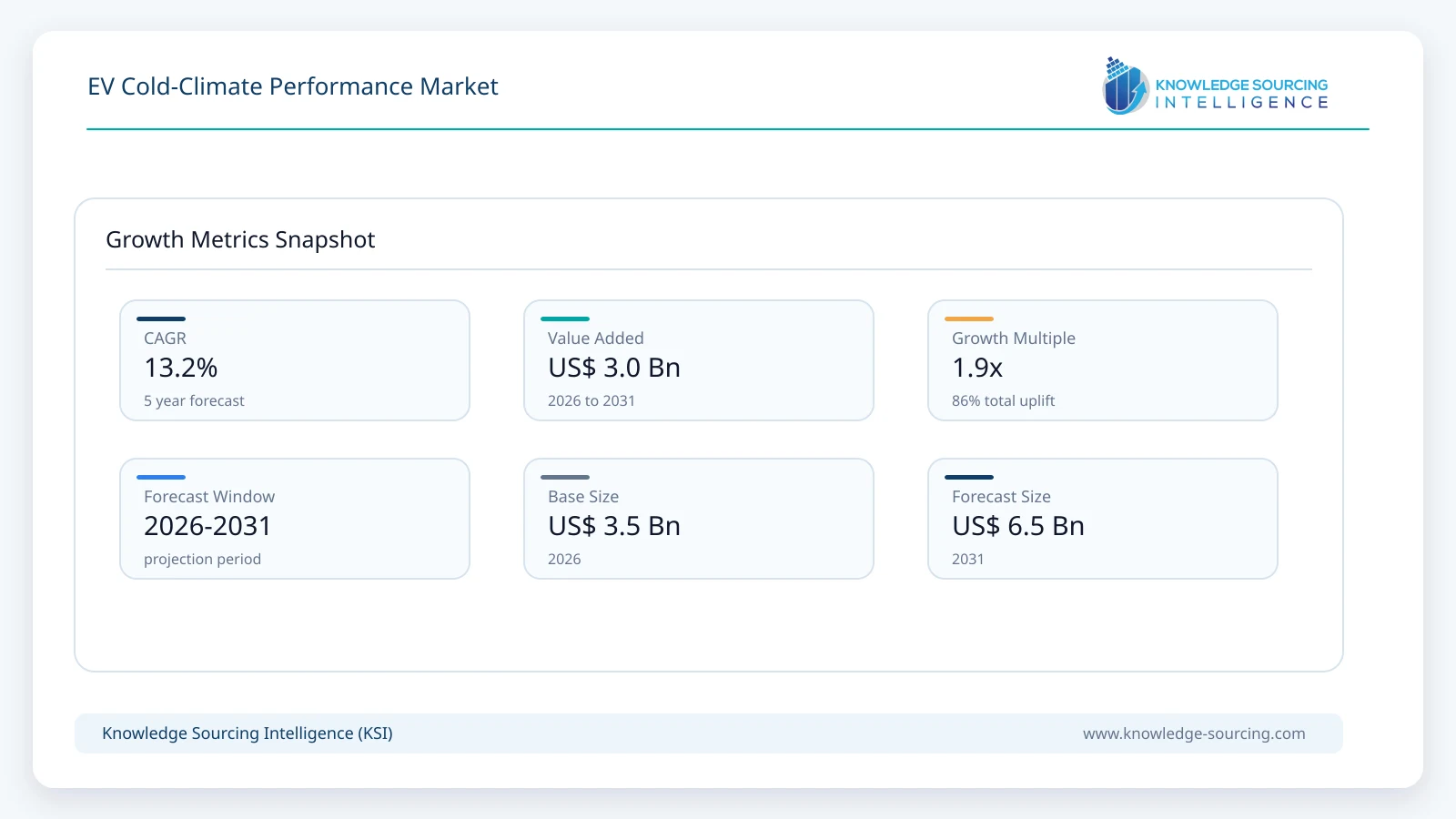
The EV Cold-Climate Performance market is forecast to grow at a CAGR of 13.2%, reaching USD 6.47 billion in 2031 from USD 3.48 billion in 2026.
Highlights:
- 1Increased EV penetration in Cold climates:Newer EV penetration in North America, Northern Europe and high-altitude Asia Pacific has led to pressure on innovative cold-weather performance products.
- 2Thermal Efficiency:OEMs are looking to heat pumps, superior insulation and built-in thermal loops as a way of minimizing the loss of winter range and increasing the comfort in their cabins.
- 3Software-Driven Energy Optimization:AI-based energy control and predictive pre-conditioning systems are now being adopted to find a balance between comfort and range in cold weather.
- 4Charging Reliability in Winter Conditions:EV charging systems are becoming cold climate optimized to keep consumer confidence and speed up the adoption of EVs.
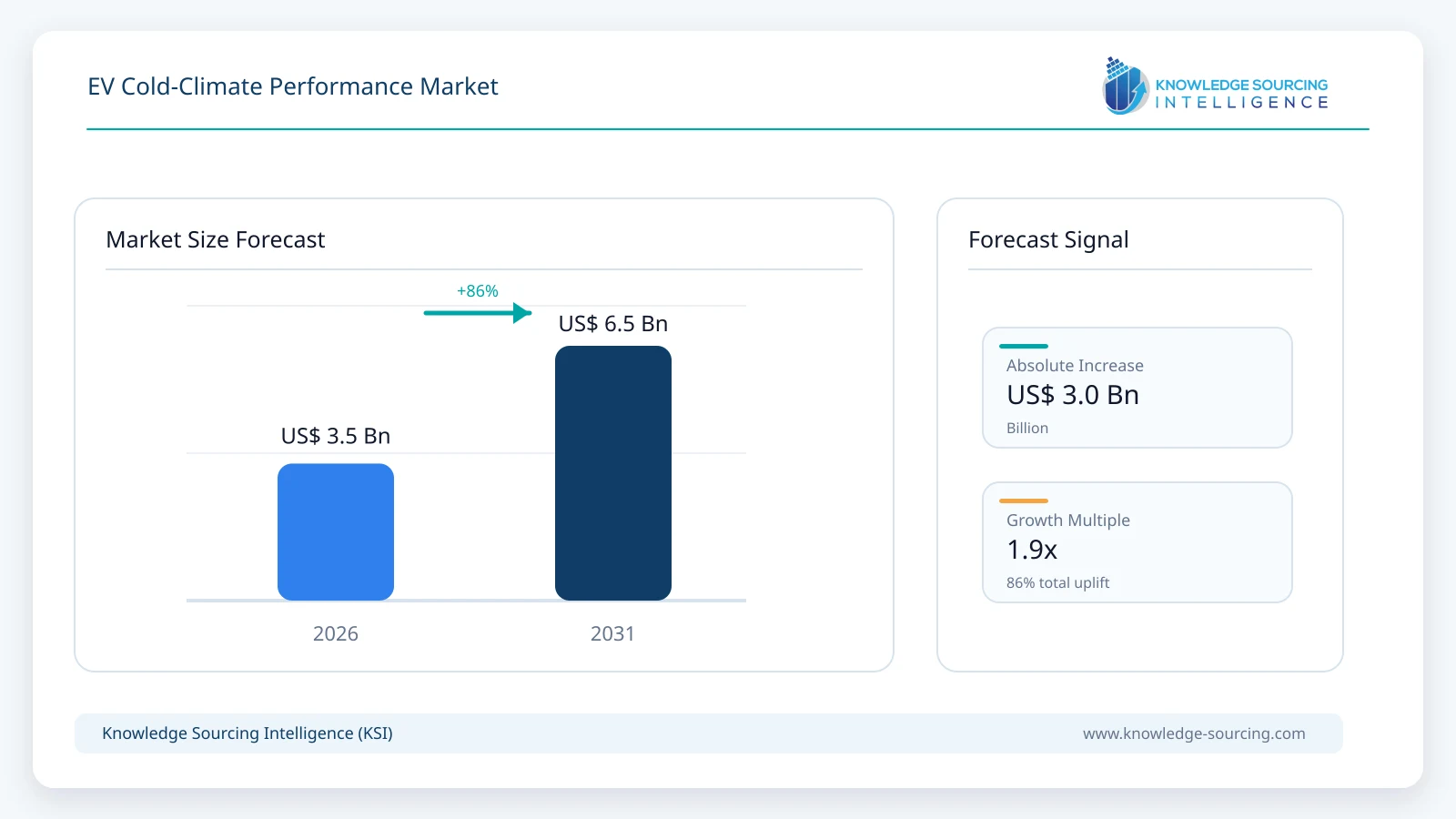
The EV cold-climate performance market is rapidly becoming influenced by the necessity to help mitigate performance losses in terms of temperature that have a direct effect on vehicle range, charging time, safety, and user experience. The cold weather has an impact on the electrochemistry of the lithium-ion battery, it consumes more energy to heat the device and its charging efficiency, especially when it comes to fast charging. These issues have compounded with EVs no longer being in early adopters and transitioning into mass markets in geographies characterized by colder climates.
OEMs are in turn reacting by incorporating multi-layered thermal frameworks which at the same time control battery packs, cabin heating, power electronics and electric motors. There is also the transition to software-defined thermal management in the market, where predictive and cloud connectivity and AI-based optimization of energy adaptation dynamically changes the behaviors of vehicles depending on the circumstances. In this regard, there are no more custom-made cold-climate performance solutions as mere add-ons but a basis when designing an EV platform.
Market Dynamics
Market Drivers
Expansion of EV Adoption into Cold-Climate Regions: Government incentives, emission regulations, and sustainability targets are accelerating EV adoption in regions with harsh winters. As EVs replace internal combustion vehicles in these markets, maintaining consistent winter performance has become a critical requirement, driving investment in thermal and energy management technologies.
Growing Consumer Expectations for Winter Reliability: Modern EV buyers expect minimal range loss, rapid cabin heating, and reliable charging even in sub-zero conditions. Poor cold-weather performance directly affects customer satisfaction and brand perception, compelling OEMs to prioritize cold-climate optimization.
Advancements in Battery and Thermal Technologies: Continuous innovation in battery thermal management systems, heat pumps, and insulation materials has made it technically feasible to significantly improve cold-weather performance without excessive energy penalties.
Regulatory Push for EV Adoption: Governments in colder regions are enforcing stricter emission targets and EV mandates, indirectly compelling OEMs to address cold-weather performance limitations to ensure widespread adoption.
Market Restraints and Opportunities
High Cost of Advanced Thermal Systems: Sophisticated battery heating, heat pump integration, and multi-loop thermal architectures increase vehicle cost and complexity. This remains a challenge for mass-market EVs, particularly in price-sensitive regions.
Opportunity for Software-Led Optimization: The growing use of AI-based thermal optimization software presents a major opportunity to improve cold-climate performance without proportional increases in hardware costs. Software-driven efficiency gains are expected to play a key role in cost reduction and scalability.
Key Developments
April 2026: CATL unveiled its third-generation Shenxing battery, featuring self-heating technology that supports ultra-fast charging at temperatures as low as -30°C, significantly improving EV usability and charging performance in severe winter conditions.
April 2026: BYD introduced its Flash Charging technology in Europe, promoting enhanced cold-weather charging performance through its “Cold Add 3” capability, aimed at reducing winter charging delays and improving EV operation in low temperatures.
Market Segmentation
The market is segmented by vehicle type, component, battery chemistry, technology, end user, and geography.
By Vehicle: Battery Electric Vehicles (BEV)
BEVs represent the largest and most technologically demanding segment of the EV cold-climate performance market. The share of battery electric vehicles (BEVs) among total new registrations in Europe averaged 23% in November 2025, up from 20% in October. The Nissan-BYD pool again led in BEV sales shares in November with 35%, followed by the BMW (31%), Mercedes-Volvo-Polestar-Smart (29%), and Kia (27%) pools. Just below the European average were the Tesla and Volkswagen pools at 22%, followed by SAIC and the Hyundai and Renault pools (each at 19%). Cold temperatures significantly reduce battery capacity, increase internal resistance, and elevate energy consumption due to heating requirements. As a result, BEVs rely heavily on advanced battery thermal management, heat pumps, and intelligent pre-conditioning systems.
OEMs are increasingly integrating liquid-based thermal systems and software-controlled energy management to minimize winter range loss. As BEV adoption accelerates in cold regions, this segment will remain the primary driver of market growth.
By Component: Battery Thermal Management Systems
Battery thermal management systems constitute the most critical component segment, enabling optimal battery operation, charging, and longevity in cold climates. Advanced liquid-based systems and intelligent heating strategies dominate this segment.
By Battery Chemistry: Lithium-ion
Lithium-ion batteries dominate the market but require sophisticated thermal management to mitigate cold-temperature performance losses. According to a NITI Aayog–Green Growth Equity Fund report, India’s cumulative lithium-ion battery stock is projected to reach 600 GWh by 2030, generating 128 GWh of recyclable battery volume. Strengthening material recovery systems, local recycling infrastructure, and battery innovation will help India reduce reliance on imports, enhance supply chain resilience, and support sustainable growth in its EV ecosystem.
By Technology: Heat Pump-based Systems
Technology segmentation engraves the process of improving the performance of EV in cold conditions. The heating technology that is increasingly taking over the market is the use of heat pumps because it is more efficient in cold climates. As an example, Tetra Pak in November 2025 will expand its Factory Sustainable Solutions offering with a new Tetra Pak Integrated Heat Pump system to pasteurizers, which claims food and beverage (F and B) producers can reduce energy consumption and minimise costs.
Regional Analysis
North America Market Analysis
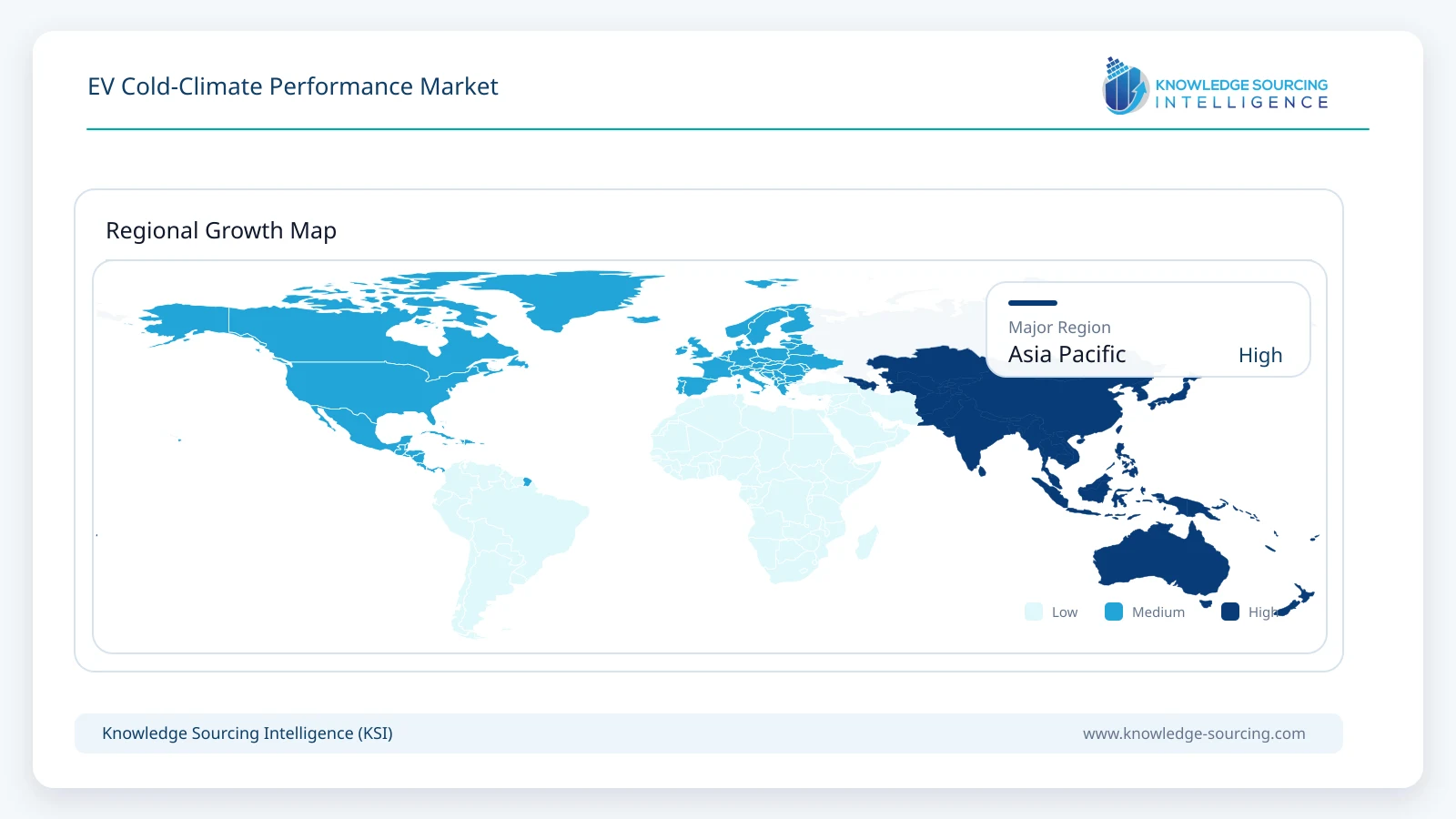
The United States and Canada in general, are likely to dominate the EV Cold-Climate Performance market with a lot of EVs use in the cold and sub-zero areas of North America. Severe winter weather in most of the areas affects EV range, changeover, and battery life considerably, making OEMs focus on advanced battery thermal controls, cabin heating, and pre-conditioning technologies. The contention of major EV makers and technology-oriented automobile producers has boosted the implementation of software-controlled energy optimization and combined thermal platforms. Besides this, government subsidies to the use of EVs in colder states and provinces are indirectly encouraging manufacturers to address winter performance so that consumers will accept them, and they do not break the regulations.
South America Market Analysis
The South American EV cold climate performance market environment is relatively small but slowly developing with the demand majorly based on the higher altitude and temperate areas in Brazil, Chile, and Argentina. Although the extreme cold conditions are not as common as in North America or Europe, the change in temperature in mountain areas and latitudes towards the South presents the EV batteries and charging systems with a difficulty in performance. The gradual introduction of international EV platforms modified to suit the regional climatic conditions facilitates market growth, and OEMs add simple thermal protection and power management systems to the vehicles to guarantee that they can operate in cold weather conditions without adding an excessive amount to vehicle prices.
Europe Market Analysis
Europe is one of the key markets with regard to the EV Cold-Climate Performance market because EV penetration in colder countries like the United Kingdom, Germany, France, and the Nordic nations is high. OEMs are spending vast sums of money on sophisticated thermal management systems to support their efforts to satisfy high consumer demands of winter reliability, stringent emission rules, and ambitious electrification agenda. The major movers of heat pumps, integrated thermal loop and AI-based energy optimization software are European manufacturers and Tier-1 suppliers to reduce winter range loss. The emphasis of the region on high-end EVs and long-range functionality enhances the need of high-efficiency performance in cold climate even more.
Middle East and Africa Market Analysis
The Middle East and Africa region is a niche, but an aggressive market of EV cold-climate performance technologies. Although the general climate of most countries is hot, there are selective needs caused by thermal management due to geographical areas of mountains and harsher winter conditions, as well as due to the use of imported EV. In the United Arab Emirates, EV usage is also motivated by smart mobility programs and sustainability, and OEMs are interested in the reliability of their performance at a broad temperature range instead of the optimization of extreme cold. Certainly, in South Africa and North African areas, the seasonal fall in temperatures is favouring the incorporation of simple battery protection and pre-conditioning mechanisms.
Asia Pacific Market Analysis
Asia Pacific EV Cold-Climate Performance market is one with a high growth potential, due to the variation in climatic conditions and high rate of EV adoption. The batteries used in the cold winters in countries like China, Japan and South Korea in northern areas have great demand as there is high need of battery heating, efficient cabin heating and optimization of cold weather charging. The non-Chinese emerging markets and developing economies had still only a minor portion of the world battery demand, almost 5 per cent in 2024. However, in 2022, they have increased their share twice, which is supported by their continuous growth in Southeast Asia, India and Brazil.
The region has a reputation of rapid development cycles and cost-conscious development by domestic OEMs, which has resulted in wide-spread use of software based energy management and scaled thermal development. Government policies towards EV adoption alongside carbon neutrality objectives are also making the adoption of cold-climate performance technologies on passenger and commercial EV platforms faster.
List of Companies
Robert Bosch GmbH
Continental AG
Gentherm Inc.
DENSO Corporation
Dana Incorporated
MAHLE GmbH
Valeo
Modine Manufacturing Company
Hanon Systems
VOSS Automotive GmbH
Infineon Technologies AG
Robert Bosch GmbH
Robert Bosch GmbH is considered to be one of the most powerful market competitors in the EV cold-climate performance and it relies on its strong knowledge in the automotive electronics, thermal systems and software integration. Bosch provides complex battery thermal management systems, heat pump and software to optimize energy, which reduces the loss of range and inefficiencies in charging in low temperatures. The strength of the company is in its system-level strategy, which implies that battery, cabin, power electronics, and the area of thermal management of the drive are incorporated into an integrated architecture. Bosch has international networks of OEMs, a well-established presence in Europe and North America, which makes the company a key catalyst to the EV implementation in cold climates.
Continental AG
The Continental AG has been at the forefront of ensuring that EV cold-climate performance is optimized by offering a wide range of thermal management and energy efficiency systems. The company concentrates on smart heat pump systems, high-efficiency HVAC modules, and novel thermal control software that helps the firm to save on winter. The fact that Continental focuses on software-defined vehicle architectures enables the thermal systems of the company to dynamically adjust to external temperatures and driving conditions. Its robust presence in the European high-end OEMs and its growing presence in the mass-market EV platforms support its leadership in cold-weather optimization technologies.
DENSO Corporation
DENSO Corporation is a large international manufacturer of EV thermal management systems and is especially famous for its efficient heat pumps and compact climate control systems. The company is concerned with enhancing the energy efficiency of cold weather through the maximization of heat recovery of power electronics and motors. The strength of DENSO is that it has both hardware innovation and control algorithms that allow it to provide consistent performance in winter conditions of the EV. It has a high presence in Asia Pacific, North America, and Europe, which facilitates the use of cold-climate optimized EV technologies.
EV Cold-Climate Performance Market Scope
| Report Metric | Details |
|---|---|
| Total Market Size in 2026 | USD 3.48 billion |
| Total Market Size in 2031 | USD 6.47 billion |
| Forecast Unit | Billion |
| Growth Rate | 13.2% |
| Study Period | 2021 to 2031 |
| Historical Data | 2021 to 2024 |
| Base Year | 2025 |
| Forecast Period | 2026 – 2031 |
| Segmentation | Vehicle Type, Component, Battery Chemistry, Geography |
| Geographical Segmentation | North America, South America, Europe, Middle East and Africa, Asia Pacific |
| Companies |
|
Market Segmentation
By Vehicle Type
By Component
By Battery Chemistry
By Technology
By End-user
By Geography
Table of Contents
1. EXECUTIVE SUMMARY
2. MARKET SNAPSHOT
2.1. Market Overview
2.2. Market Definition
2.3. Scope of the Study
2.4. Market Segmentation
3. BUSINESS LANDSCAPE
3.1. Market Drivers
3.2. Market Restraints
3.3. Market Opportunities
3.4. Porter’s Five Forces Analysis
3.5. Industry Value Chain Analysis
3.6. Policies and Regulations
3.7. Strategic Recommendations
4. TECHNOLOGICAL OUTLOOK
5. EV COLD-CLIMATE PERFORMANCE MARKET BY VEHICLE TYPE
5.1. Introduction
5.2. Battery Electric Vehicles (BEVs)
5.3. Plug-in Hybrid Electric Vehicles (PHEVs)
5.4. Hybrid Electric Vehicles (HEVs)
6. EV COLD-CLIMATE PERFORMANCE MARKET BY COMPONENT
6.1. Introduction
6.2. Battery thermal management systems
6.3. Cabin heating systems
6.4. Power electronics and motor thermal management
6.5. Charging systems
6.6. Software and energy management systems
7. EV COLD-CLIMATE PERFORMANCE MARKET BY BATTERY CHEMISTRY
7.1. Introduction
7.2. Lithium-ioN
7.3. Lithium Iron Phosphate (LFP)
7.4. Solid-state
7.5. Others
8. EV COLD-CLIMATE PERFORMANCE MARKET BY TECHNOLOGY
8.1. Introduction
8.2. Heat pump-based systems
8.3. Advanced insulation materials
8.4. Pre-conditioning technologies
8.5. AI-based thermal optimization software
9. EV COLD-CLIMATE PERFORMANCE MARKET BY END-USER
9.1. Introduction
9.2. Individual consumers
9.3. Fleet operators
9.4. Government and public transport authorities
10. EV COLD-CLIMATE PERFORMANCE MARKET BY GEOGRAPHY
10.1. Introduction
10.2. North America
10.2.1. USA
10.2.2. Canada
10.2.3. Mexico
10.3. South America
10.3.1. Brazil
10.3.2. Argentina
10.3.3. Others
10.4. Europe
10.4.1. United Kingdom
10.4.2. Germany
10.4.3. France
10.4.4. Spain
10.4.5. Others
10.5. Middle East and Africa
10.5.1. Saudi Arabia
10.5.2. UAE
10.5.3. Others
10.6. Asia Pacific
10.6.1. China
10.6.2. India
10.6.3. Japan
10.6.4. South Korea
10.6.5. Indonesia
10.6.6. Thailand
10.6.7. Others
11. COMPETITIVE ENVIRONMENT AND ANALYSIS
11.1. Major Players and Strategy Analysis
11.2. Market Share Analysis
11.3. Mergers, Acquisitions, Agreements, and Collaborations
11.4. Competitive Dashboard
12. COMPANY PROFILES
12.1. Robert Bosch GmbH
12.2. Continental AG
12.3. Gentherm Inc.
12.4. DENSO Corporation
12.5. Dana Incorporated
12.6. MAHLE GmbH
12.7. Valeo
12.8. Modine Manufacturing Company
12.9. Hanon Systems
12.10. VOSS Automotive GmbH
12.11. Infineon Technologies AG
13. APPENDIX
13.1. Currency
13.2. Assumptions
13.3. Base and Forecast Years Timeline
13.4. Key benefits for the stakeholders
13.5. Research Methodology
13.6. Abbreviations
Navigate
Trusted by the world's leading organizations











