
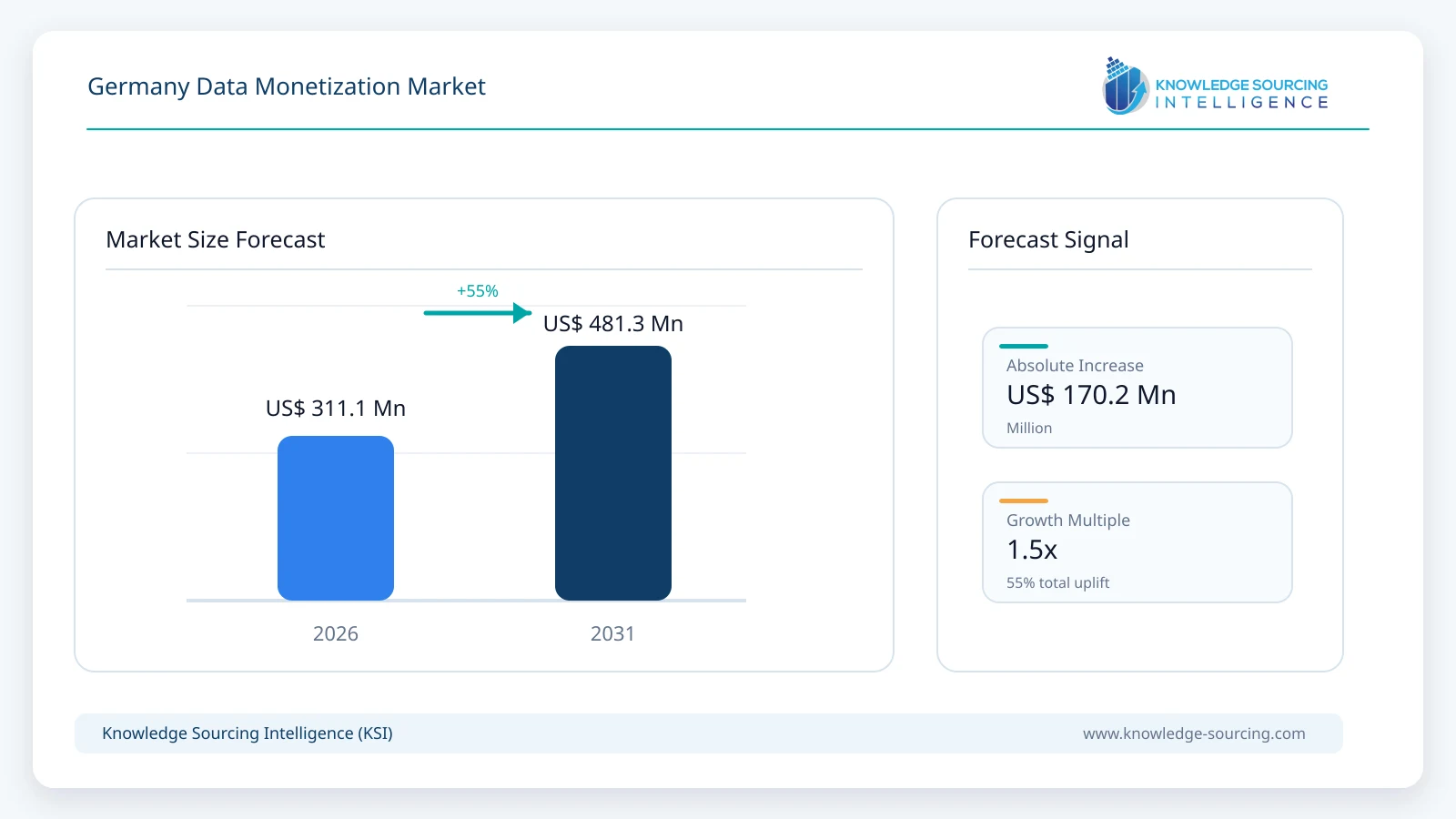
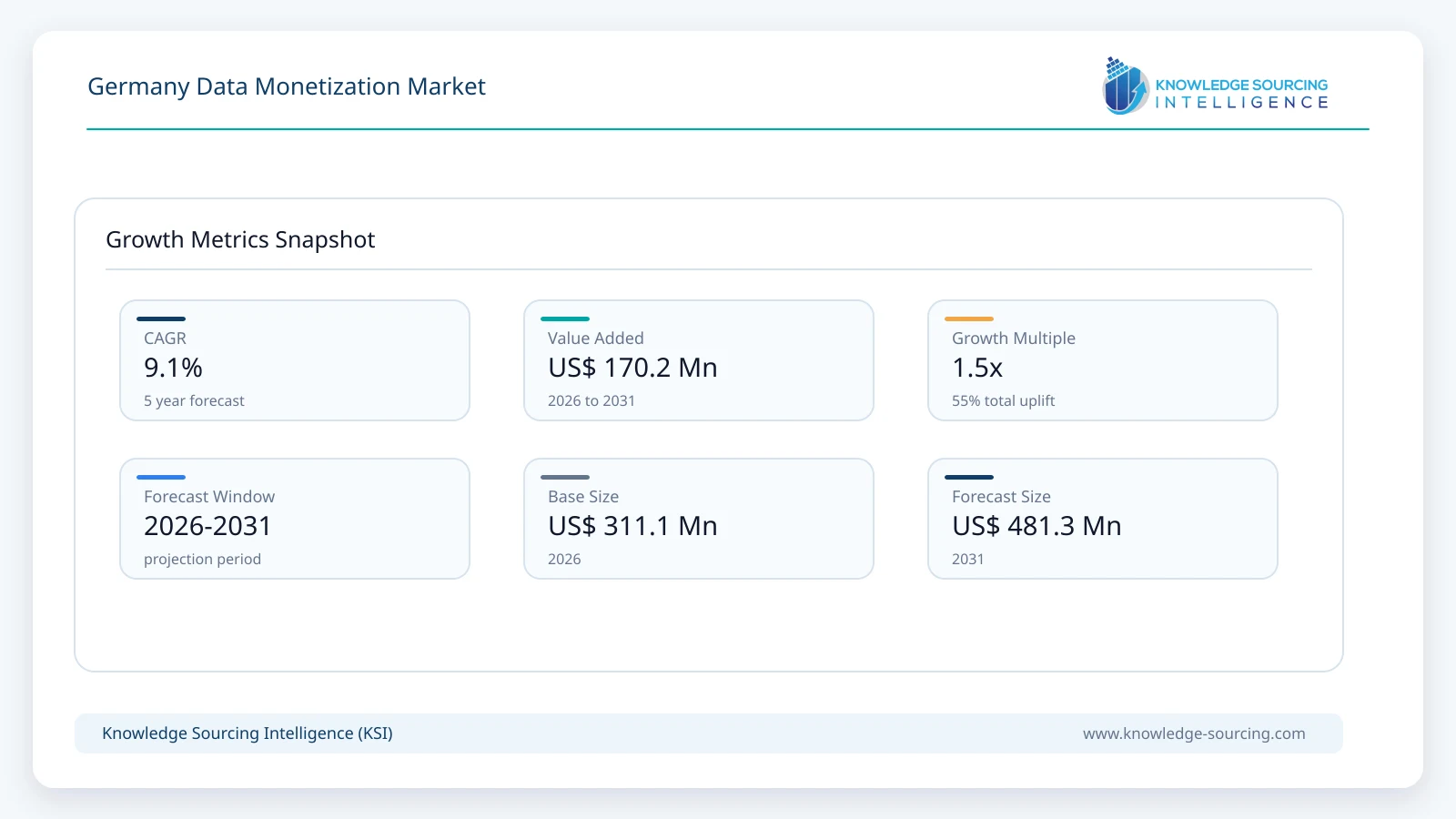
Germany data monetization market is anticipated to grow at a CAGR of 9.1%, increasing to USD 481.3 million in 2031 from USD 311.1 million in 2026.
Highlights:
- 1Enterprise demand is shifting from data collection toward revenue generation through analytics, AI, and data-sharing ecosystems.
- 2Germany's manufacturing, automotive, BFSI, and healthcare sectors remain the primary commercial adopters of data monetization platforms.
- 3The EU Data Act and Data Governance Act are reshaping enterprise data access, portability, and commercial data-sharing models.
- 4Cloud-native data platforms are expanding as organizations modernize legacy architectures and integrate AI-driven analytics.
- 5Compliance, cybersecurity, data sovereignty, and interoperability continue to influence vendor selection and deployment strategies.
Demand is shaped by Germany's highly digitalized industrial base, where manufacturers, automotive companies, financial institutions, retailers, healthcare organizations, telecommunications providers, and public agencies continue expanding investments in cloud infrastructure and enterprise data platforms. Industrial Internet of Things (IIoT) deployments, connected manufacturing systems, digital banking services, predictive maintenance, and customer personalization initiatives are increasing the commercial value of enterprise data. Organizations are simultaneously seeking stronger governance capabilities as regulatory obligations surrounding data privacy, cybersecurity, and cross-border data transfers become more stringent.
The commercial structure of the market combines software providers, cloud platform vendors, consulting firms, systems integrators, cybersecurity specialists, and managed service providers. Revenue is generated through software licensing, subscription platforms, implementation services, data governance consulting, AI integration, and ongoing managed analytics services. Purchasing decisions increasingly emphasize regulatory compliance, interoperability with existing enterprise systems, deployment flexibility, scalability, and total lifecycle cost rather than software functionality alone.
Germany's policy environment is also influencing market development. The European Union's Data Act establishes new rules governing access to connected-device data, while the Data Governance Act promotes trusted mechanisms for voluntary data sharing across public and private organizations. Germany has designated the Bundesnetzagentur as the national authority responsible for implementing key provisions of the Data Act, creating greater legal certainty for businesses seeking to commercialize industrial and enterprise data while maintaining compliance with European data protection requirements.
Key Market Indicators
Indicator | Latest Evidence | Commercial Meaning |
EU Data Act implementation in Germany | Bundesnetzagentur designated as competent authority (2026) | Establishes clearer rules governing access to and commercial use of enterprise and connected-device data. |
German AI adoption | AI adoption among enterprises continues to increase according to Destatis surveys | Expands demand for governed, high-quality datasets required for enterprise AI deployment. |
Cloud adoption | Growing enterprise cloud migration reported by major cloud providers and enterprise software vendors | Increases demand for cloud-native data monetization platforms and managed services. |
Manufacturing contribution | Manufacturing remains one of Germany's largest economic sectors (Destatis) | Industrial operational data represents an important commercial source for monetization initiatives. |
SAP Business Data Cloud expansion | SAP and AWS expanded zero-copy enterprise data sharing capabilities (2026) | Improves enterprise access to governed data for analytics and AI without unnecessary data duplication. |
Key indicator: Germany has implemented institutional arrangements supporting the EU Data Act through the Bundesnetzagentur in 2026.
Commercial meaning: Greater regulatory clarity is expected to encourage enterprise investment in compliant data-sharing and monetization initiatives.
Market Drivers
Industrial digitalization is increasing the commercial value of enterprise data
Germany's manufacturing sector continues generating large volumes of operational information through connected production systems, industrial automation, robotics, quality monitoring, and predictive maintenance applications. Industrial enterprises increasingly seek platforms capable of transforming production data into commercial assets that improve operational efficiency, reduce downtime, support aftermarket services, and create subscription-based business models. SAP, Microsoft, AWS, IBM, and Oracle continue expanding industrial cloud capabilities and AI-enabled analytics platforms to support these requirements. Rather than investing solely in data storage, manufacturers increasingly prioritize governed data environments that enable secure sharing across suppliers, customers, and internal business units. Destatis data showing the continued economic importance of manufacturing reinforces sustained enterprise investment in industrial data infrastructure.
European data legislation is encouraging structured enterprise data sharing
Regulatory developments are changing how organizations evaluate data assets. The EU Data Act introduces standardized rules governing access to connected-product data, while the Data Governance Act establishes frameworks supporting trusted data-sharing arrangements across sectors. These measures reduce legal uncertainty surrounding data ownership, portability, and access rights, encouraging organizations to develop structured monetization strategies rather than isolated internal analytics initiatives. Germany's designation of the Bundesnetzagentur as the national supervisory authority provides businesses with clearer regulatory oversight as they establish commercial data-sharing arrangements. Consulting firms, systems integrators, and software providers are responding by expanding governance, metadata management, compliance automation, and secure collaboration capabilities that align with evolving European legislation.
Enterprise AI deployment is increasing demand for governed, high-quality datasets
Generative AI, predictive analytics, and intelligent automation depend on reliable enterprise data rather than algorithm performance alone. Organizations increasingly recognize that fragmented datasets, inconsistent governance, and poor metadata quality reduce AI effectiveness and increase operational risk. This has shifted procurement priorities toward integrated data platforms capable of combining governance, cataloging, security, lineage tracking, master data management, and AI-ready analytics. Company announcements from SAP, Microsoft, IBM, Snowflake, and AWS increasingly emphasize trusted enterprise data environments that support AI deployment while maintaining compliance with European privacy requirements. The commercial value of data monetization therefore extends beyond direct revenue generation into enabling higher-value AI applications across multiple industries.
Cloud-native enterprise architectures are expanding platform-based monetization models
German enterprises continue modernizing legacy information technology environments by adopting hybrid and cloud-native architectures that improve scalability, collaboration, and data accessibility. Cloud deployment enables organizations to integrate structured and unstructured information from multiple business systems while supporting subscription-based analytics, API-enabled services, and external data marketplaces. Enterprise buyers increasingly evaluate vendors according to interoperability, security certifications, integration with existing enterprise resource planning platforms, and support for multi-cloud environments. Major providers including AWS, Microsoft, Oracle, SAP, and Google continue investing in platform capabilities that simplify enterprise data sharing while reducing infrastructure complexity. These developments support recurring software and managed service revenue across the broader data monetization ecosystem.
Market Restraints and Challenges
Data sovereignty and regulatory compliance increase implementation complexity
Commercializing enterprise data requires organizations to balance revenue generation with strict obligations under the General Data Protection Regulation (GDPR), the EU Data Act, sector-specific compliance requirements, and cybersecurity regulations. Companies operating across multiple jurisdictions frequently encounter differing contractual obligations regarding data ownership, consent management, retention periods, and cross-border transfers. Meeting these requirements increases implementation costs and extends deployment timelines, particularly for highly regulated sectors such as financial services, healthcare, and government. Software providers continue expanding governance automation, encryption, identity management, and audit capabilities, yet compliance remains a decisive purchasing criterion rather than a secondary technical feature.
Legacy enterprise infrastructure limits scalable data integration
Many German organizations continue operating complex combinations of legacy enterprise resource planning systems, manufacturing execution systems, customer databases, and proprietary industrial equipment that were not designed for modern data-sharing architectures. Integrating these heterogeneous environments often requires extensive middleware, data transformation, application modernization, and governance standardization before monetization initiatives can generate commercial returns. Large enterprises generally possess greater financial resources to modernize infrastructure, while many SMEs face longer implementation periods and tighter investment constraints. Systems integrators therefore remain essential participants within the value chain because technical integration frequently determines project success more than software selection alone.
Cybersecurity risks and buyer concerns restrict external data commercialization
As organizations increasingly exchange operational and customer information across partners, suppliers, and digital ecosystems, cybersecurity becomes directly linked to commercial value. Data breaches, ransomware attacks, unauthorized access, and intellectual property theft create financial, legal, and reputational risks that discourage organizations from sharing commercially valuable datasets. Vendors continue strengthening zero-trust security architectures, confidential computing, encryption, continuous monitoring, and identity-based access controls to reduce these risks. Even so, buyers often require extensive security validation, contractual safeguards, and compliance assessments before approving enterprise-wide data monetization projects, extending procurement cycles and increasing implementation costs.
Major Segment Analysis
Cloud Deployment Model
Cloud deployment represents the most commercially important segment of Germany's data monetization market because organizations increasingly require scalable environments capable of integrating enterprise applications, AI workloads, and distributed data sources. Unlike traditional on-premises deployments, cloud platforms allow businesses to process structured and unstructured data across multiple business units while supporting near real-time analytics, secure collaboration, and API-based data sharing. Demand is particularly evident among large enterprises operating across manufacturing, banking, telecommunications, and retail, where data volumes and application complexity continue to increase.
Purchasing decisions extend beyond infrastructure cost. Buyers evaluate compliance with GDPR and the EU Data Act, data residency options, interoperability with enterprise resource planning and customer relationship management systems, cybersecurity controls, and support for hybrid architectures. SAP, AWS, Microsoft, Google Cloud, Oracle, IBM, and Snowflake continue expanding cloud-native analytics, governance, and AI capabilities, while consulting firms and system integrators differentiate through implementation expertise, migration services, and industry-specific deployment models. On-premises deployments remain relevant for organizations with stringent security or regulatory requirements, but cloud platforms are receiving a larger share of new enterprise data modernization initiatives.
Competitive Landscape
Competition within Germany's data monetization market is technology-led and service-intensive, combining global cloud providers, enterprise software vendors, consulting organizations, and specialized analytics companies. SAP, Microsoft, AWS, Google, IBM, Oracle, Snowflake, SAS Institute, Accenture, Infosys, and Thales compete through platform breadth, AI integration, cybersecurity capabilities, regulatory compliance, and implementation expertise rather than software functionality alone.
Large enterprises increasingly prefer vendors capable of delivering integrated solutions that combine governance, analytics, AI, cloud infrastructure, cybersecurity, and managed services. This preference has strengthened partnerships among hyperscale cloud providers, enterprise software companies, and consulting firms responsible for large-scale digital transformation projects. Vendors are also expanding sovereign cloud offerings, industry-specific data platforms, and zero-copy data-sharing capabilities to address European compliance expectations. High implementation complexity, long customer relationships, integration costs, and migration effort create moderate switching costs, while established ecosystems surrounding enterprise resource planning, cloud infrastructure, and AI services continue strengthening customer retention.
Recent Developments
July 2026 – SAP acquires Prior Labs: SAP announced its acquisition of Prior Labs to strengthen tabular foundation models for structured enterprise data, enhancing AI-driven analytics, governance, and monetization opportunities across business applications and data platforms.
June 2026 – Schwarz Digits expands sovereign data ecosystem: Schwarz Digits expanded its partner ecosystem and launched a startup program around STACKIT, accelerating sovereign cloud, AI, and data-sharing capabilities that help German enterprises securely monetize business data and digital services.
March 2026 – Schwarz Digits and Charité establish health-data venture: Schwarz Digits and Charité formed Schwarz Charité Health Data GmbH, creating a secure healthcare data platform enabling privacy-preserving medical data sharing, analytics, and commercialization for research and precision medicine.
May 2025 – Schwarz Digits expands STACKIT into a German hyperscaler: Schwarz Digits launched new STACKIT capabilities, including RISE with SAP hosting, Aleph Alpha's PhariaAI integration, and sovereign cloud services, enabling secure enterprise data management and monetization across Germany.
Regulatory and Policy Environment
Germany's regulatory environment is increasingly aligned with European initiatives designed to improve data accessibility while maintaining high standards for privacy, cybersecurity, and consumer protection. The General Data Protection Regulation remains the primary framework governing personal data processing, while the EU Data Act establishes rules for access to and use of connected-product data. The Data Governance Act complements these provisions by promoting trusted data-sharing mechanisms across public and private organizations.
The Bundesnetzagentur has been designated as Germany's competent authority for supervising implementation of key provisions of the Data Act, providing organizations with greater regulatory clarity regarding data portability, access rights, contractual fairness, and dispute resolution. Companies operating data monetization platforms must also consider sector-specific cybersecurity obligations, industry standards, intellectual property protection, and contractual controls governing commercial data exchange. Compliance increasingly influences procurement decisions because enterprise customers seek vendors capable of combining governance, security, and interoperability within integrated platform architectures rather than addressing these requirements through separate point solutions.
Outlook and Strategic Implications
Enterprise demand during the 2026–2031 period is expected to shift from isolated analytics projects toward organization-wide commercialization of governed data assets. AI adoption, cloud modernization, connected industrial systems, and expanding digital ecosystems will increase the strategic value of enterprise information, while European legislation will encourage more structured data-sharing models with stronger governance requirements. Vendors capable of combining analytics, AI, security, compliance, and integration within unified platforms are likely to strengthen their competitive positioning.
Key strategic implications include:
Enterprise buyers: Procurement decisions will increasingly prioritize interoperability, regulatory compliance, cybersecurity, AI readiness, and lifecycle service capability over standalone analytics functionality.
Technology providers: Investment in sovereign cloud services, metadata management, AI governance, and secure cross-organizational data sharing is expected to remain a competitive priority.
System integrators and consulting firms: Demand for migration, governance implementation, application integration, and regulatory advisory services is likely to expand as organizations modernize legacy environments.
Policymakers and regulators: Consistent implementation of European data legislation will remain important for encouraging trusted commercial data exchange while maintaining privacy, cybersecurity, and competition safeguards.
Commercial success will increasingly depend on an organization's ability to transform governed enterprise data into measurable operational, financial, and customer value while maintaining compliance with Germany's evolving regulatory framework.
Germany Data Monetization Market Scope:
| Report Metric | Details |
|---|---|
| Total Market Size in 2026 | USD 311.1 million |
| Total Market Size in 2031 | USD 481.3 million |
| Forecast Unit | Million |
| Growth Rate | 9.1% |
| Study Period | 2021 to 2031 |
| Historical Data | 2021 to 2024 |
| Base Year | 2025 |
| Forecast Period | 2026 – 2031 |
| Segmentation | Offering, Deployment Model, Enterprise Size, End-User Industry |
| Companies |
|
Market Segmentation
By Offering
Solution
Services
By Deployment Model
On-Premises
Cloud
By Enterprise Size
SMEs
Large Enterprises
By End-User Industry
BFSI
Retail and E-commerce
Manufacturing
Telecommunications and IT
Healthcare and Life Sciences
Government and Public Sector
Media and Entertainment
Automotive
Energy and Utilities
Others
Table of Contents
1. INTRODUCTION
1.1. Market Overview
1.3. Market Definition
1.4. Market Segmentation
2. RESEARCH METHODOLOGY
2.1. Research Data
2.2. Assumptions
3. EXECUTIVE SUMMARY
3.1. Research Highlights
4. MARKET DYNAMICS
4.1. Market Drivers
4.2. Market Restraints
4.3. Porter's Five Forces Analysis
4.3.1. Bargaining Power of Suppliers
4.3.2. Bargaining Power of Buyers
4.3.3. Threat of Substitutes
4.3.4. The Threat of New Entrants
4.3.5. Competitive Rivalry in Industry
4.4. Industry Value Chain Analysis
5. GERMANY DATA MONETIZATION MARKET BY OFFERING
5.1. Introduction
5.2. Solution
5.3. Services
6. GERMANY DATA MONETIZATION MARKET BY DEPLOYMENT MODEL
6.1. Introduction
6.2. On-Premises
6.3. Cloud
7. GERMANY DATA MONETIZATION MARKET BY ENTERPRISE SIZE
7.1. Introduction
7.2. SMEs
7.3. Large Enterprises
8. GERMANY DATA MONETIZATION MARKET BY END-USER INDUSTRY
8.1. Introduction
8.2. BFSI
8.3. Retail and E-commerce
8.4. Manufacturing
8.5. Telecommunications and IT
8.6. Healthcare and Life Sciences
8.7. Government and Public Sector
8.8. Media and Entertainment
8.9. Automotive
8.10. Energy and Utilities
8.11. Others
9. COMPETITIVE ENVIRONMENT AND ANALYSIS
9.1. Major Players and Strategic Analysis
9.2. Emerging Players and Market Lucrative
9.3. Mergers, Acquisitions, Agreements, and Collaboration
9.4. Vendor Competitive Matrix
10. COMPANY PROFILES
10.1. Accenture
10.2. SAP
10.3. Google
10.4. Infosys
10.5. Thales Group
10.6. AWS
10.7. Microsoft
10.8. IBM
10.9. Oracle
10.10. SAS Institute
10.11. Snowflake
Navigate
Trusted by the world's leading organizations











