
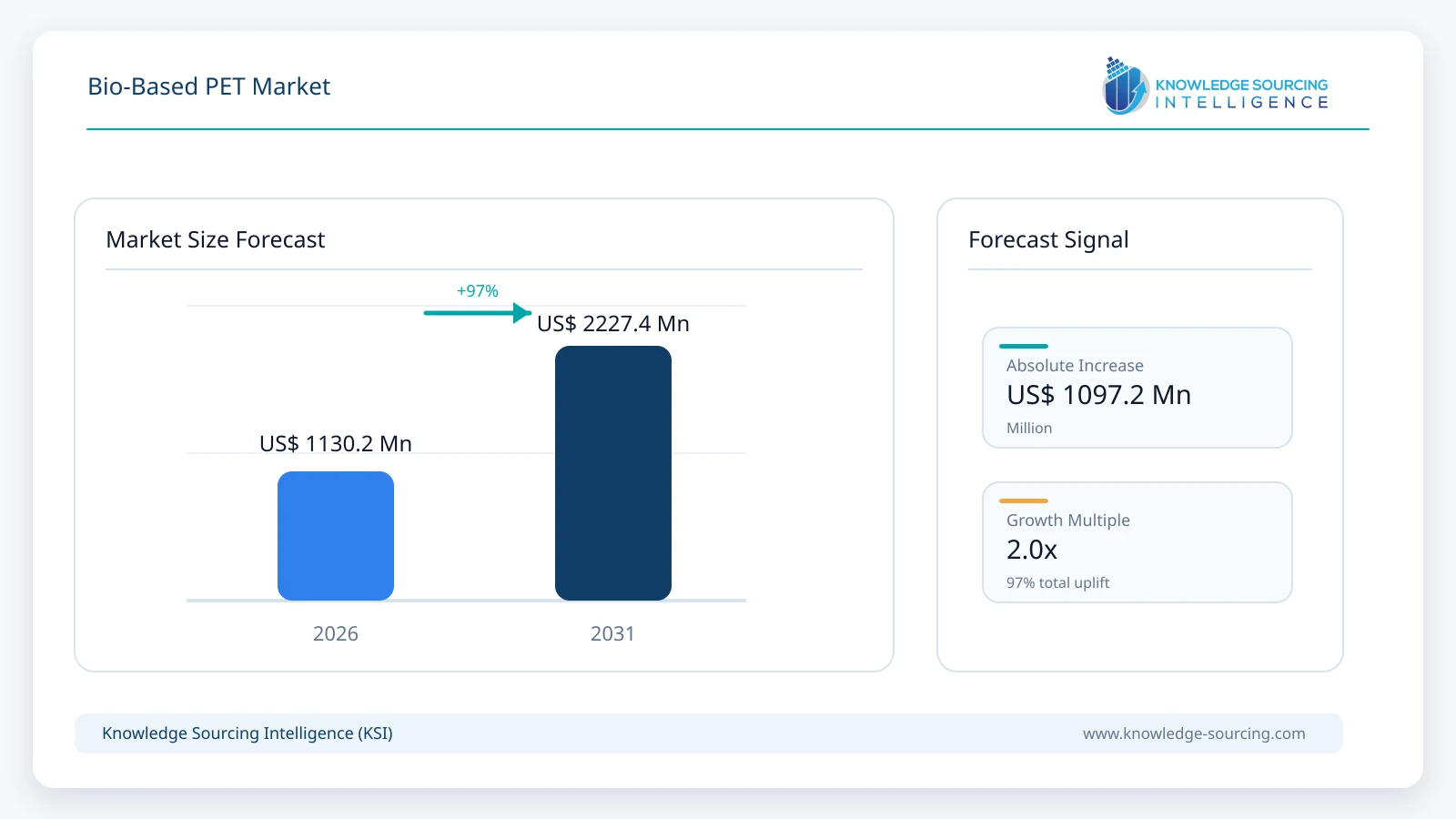
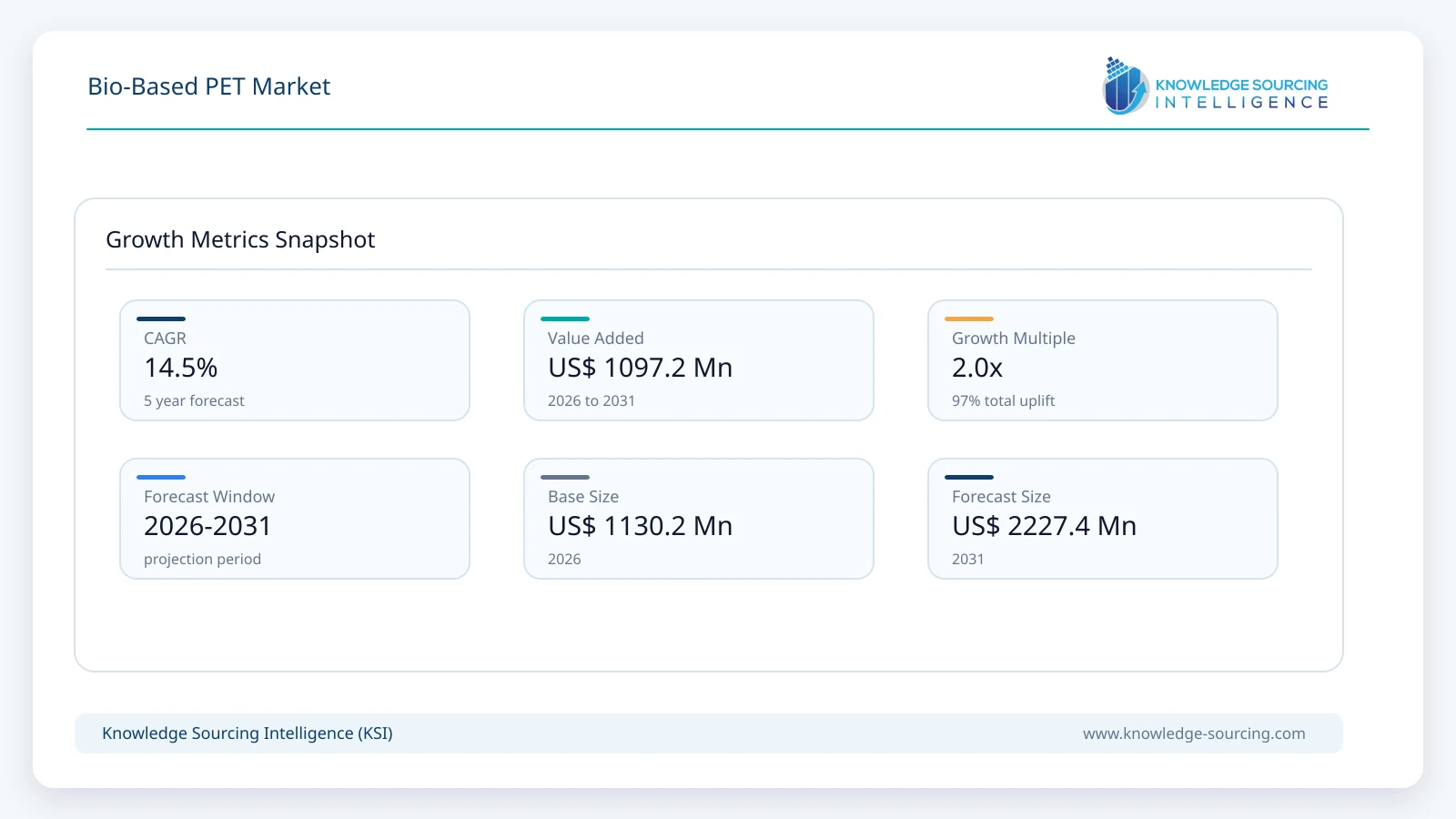
The Bio-Based PET Market is forecast to grow at a CAGR of 14.53%, reaching USD 2,227.43 million in 2031 from USD 1,130.22 million in 2026.
Highlights:
- 1Corporate sustainability commitments and circular economy targets continue driving demand for bio-based PET packaging.
- 2Bottlesrepresent the leading application segment because beverage manufacturers require recyclable packaging compatible with existing PET infrastructure.
- 3Europe remains an important market due to supportive packaging regulations and ambitious resource efficiency policies.
- 4Investment in renewable feedstock technologies is improving commercial scalability of bio-based PET production.
- 5Packaging regulations promoting recyclability and reduced carbon emissions are influencing procurement decisions across consumer goods industries.
- 6Competition focuses on renewable feedstock technology, production scale, lifecycle emissions, and supply chain integration.
The bio-based PET market comprises the production and commercialization of polyethylene terephthalate manufactured partially or fully from renewable biological feedstocks instead of conventional fossil-based raw materials. Bio-based PET is chemically identical to conventional PET, allowing manufacturers to use existing processing equipment, recycling systems, and packaging infrastructure while reducing dependence on petroleum-derived inputs. The material is primarily used in beverage bottles, food packaging, films, sheets, synthetic fibers, and selected engineering applications where recyclability, transparency, strength, and lightweight characteristics are important purchasing criteria.
Demand is primarily driven by packaging companies, beverage manufacturers, consumer goods producers, textile manufacturers, and brand owners seeking lower-carbon packaging solutions without compromising product performance or food-contact safety. Procurement decisions increasingly consider renewable feedstock availability, recycled content compatibility, life-cycle greenhouse gas emissions, supply reliability, regulatory compliance, and compatibility with established PET recycling streams. Buyers also evaluate whether bio-based PET can be incorporated into existing manufacturing operations without requiring significant capital investment.
Growing sustainability commitments from multinational consumer goods companies continue supporting commercialization of bio-based PET. Many global beverage producers have established targets for increasing renewable and recycled material content in packaging while reducing lifecycle carbon emissions. Since bio-based PET retains the same mechanical and chemical properties as conventional PET, manufacturers can introduce renewable content while maintaining existing bottle designs and production processes.
Government policies supporting circular economy initiatives also contribute to market demand. The European Commission continues promoting sustainable packaging through the Circular Economy Action Plan and packaging legislation encouraging higher recycled content, resource efficiency, and reduced dependence on virgin fossil-based plastics. These policy initiatives encourage packaging manufacturers to evaluate renewable polymer alternatives alongside mechanical recycling.
Feedstock innovation remains an important commercial factor. Companies are investing in bio-based monoethylene glycol (Bio-MEG), renewable paraxylene technologies, and biomass conversion processes that increase renewable content while maintaining product performance. According to the International Energy Agency (IEA), sustainable feedstocks and circular material systems will become increasingly important for reducing emissions from the petrochemical sector as demand for plastics continues to expand globally.
Market Drivers
Corporate Sustainability and Packaging Commitments
Global consumer goods and beverage companies continue setting measurable targets for renewable materials, recyclable packaging, and carbon emission reductions. Bio-based PET enables companies to reduce reliance on fossil-derived feedstocks while maintaining packaging performance and compatibility with existing recycling systems.
Brand owners increasingly evaluate suppliers based on lifecycle environmental performance, traceability of renewable feedstocks, and long-term supply reliability. Material suppliers capable of supporting these sustainability objectives strengthen their commercial relationships with multinational packaging customers.
Expansion of Circular Economy Policies
Governments across Europe and other regions are implementing policies encouraging recyclable packaging, reduced plastic waste, and greater resource efficiency. These initiatives encourage manufacturers to diversify raw material sourcing by incorporating renewable feedstocks alongside recycled polymers.
According to the Organisation for Economic Co-operation and Development (OECD), improving plastics circularity requires increased use of recycled and renewable materials together with stronger waste management systems and sustainable product design. Official source: https://www.oecd.org/environment/plastic-pollution/
The regulatory environment therefore supports investment in bio-based PET as part of broader packaging sustainability strategies.
Technological Progress in Renewable Feedstocks
Commercial development of bio-based monoethylene glycol and renewable aromatic feedstocks is improving the economic feasibility of bio-based PET production. Advances in biomass conversion technologies, catalytic processes, and feedstock optimization are enabling manufacturers to increase renewable content while preserving product quality.
Technology providers continue investing in pilot facilities and commercial-scale manufacturing to improve production efficiency and reduce manufacturing costs, supporting broader market adoption over the forecast period.
Rising Demand for Low-Carbon Packaging
Retailers, food manufacturers, cosmetics companies, and beverage producers increasingly seek packaging materials with lower lifecycle greenhouse gas emissions. Procurement decisions now frequently include environmental performance alongside traditional purchasing factors such as cost, durability, transparency, and food-contact compliance.
Bio-based PET offers manufacturers an opportunity to reduce carbon intensity without requiring significant modifications to existing filling, labeling, transportation, or recycling systems, making adoption commercially attractive for high-volume packaging applications.
Market Restraints and Challenges
Higher Production Costs
Bio-based PET currently commands higher production costs than conventional petroleum-derived PET because renewable feedstocks remain available at smaller commercial scale and require additional processing. Price-sensitive packaging markets may therefore continue relying on conventional materials where sustainability objectives are less influential.
Manufacturers continue investing in production scale, feedstock diversification, and process optimization to improve long-term cost competitiveness.
Limited Renewable Feedstock Availability
Commercial production depends on reliable supplies of sustainable biomass-derived feedstocks. Competition for agricultural resources, seasonal variability, and feedstock logistics may influence production economics and limit rapid expansion in certain regions.
Companies increasingly evaluate non-food biomass, agricultural residues, and alternative renewable feedstocks to improve long-term supply security.
Infrastructure and Investment Requirements
Although bio-based PET is compatible with existing PET recycling infrastructure, expanding commercial production requires significant investment in renewable chemical manufacturing, feedstock processing, and supply chain development. Companies must carefully assess capital allocation, production economics, and long-term customer demand before investing in new manufacturing capacity.
Major Segment Analysis
Bottles
The bottles segment represents the largest commercial application for bio-based PET because beverage packaging accounts for a substantial proportion of global PET consumption. Carbonated soft drinks, bottled water, juices, edible oils, dairy beverages, and ready-to-drink products require packaging materials that provide high strength, transparency, barrier performance, and compatibility with high-speed filling operations.
Beverage manufacturers increasingly specify packaging materials capable of supporting corporate sustainability objectives while maintaining product quality and consumer acceptance. Bio-based PET satisfies these requirements because it delivers physical properties equivalent to conventional PET and can be processed using existing bottle manufacturing equipment, blow molding systems, and recycling infrastructure.
Competition within this segment focuses on renewable content, lifecycle carbon reduction, food-contact compliance, production consistency, and supply reliability. Material suppliers capable of scaling renewable feedstock production while maintaining competitive costs are expected to strengthen their position as global beverage companies continue expanding the use of sustainable packaging solutions. Continued regulatory support for circular packaging and corporate commitments to renewable materials are expected to sustain bottles as the leading application segment throughout the forecast period.
Regional Analysis
Asia Pacific
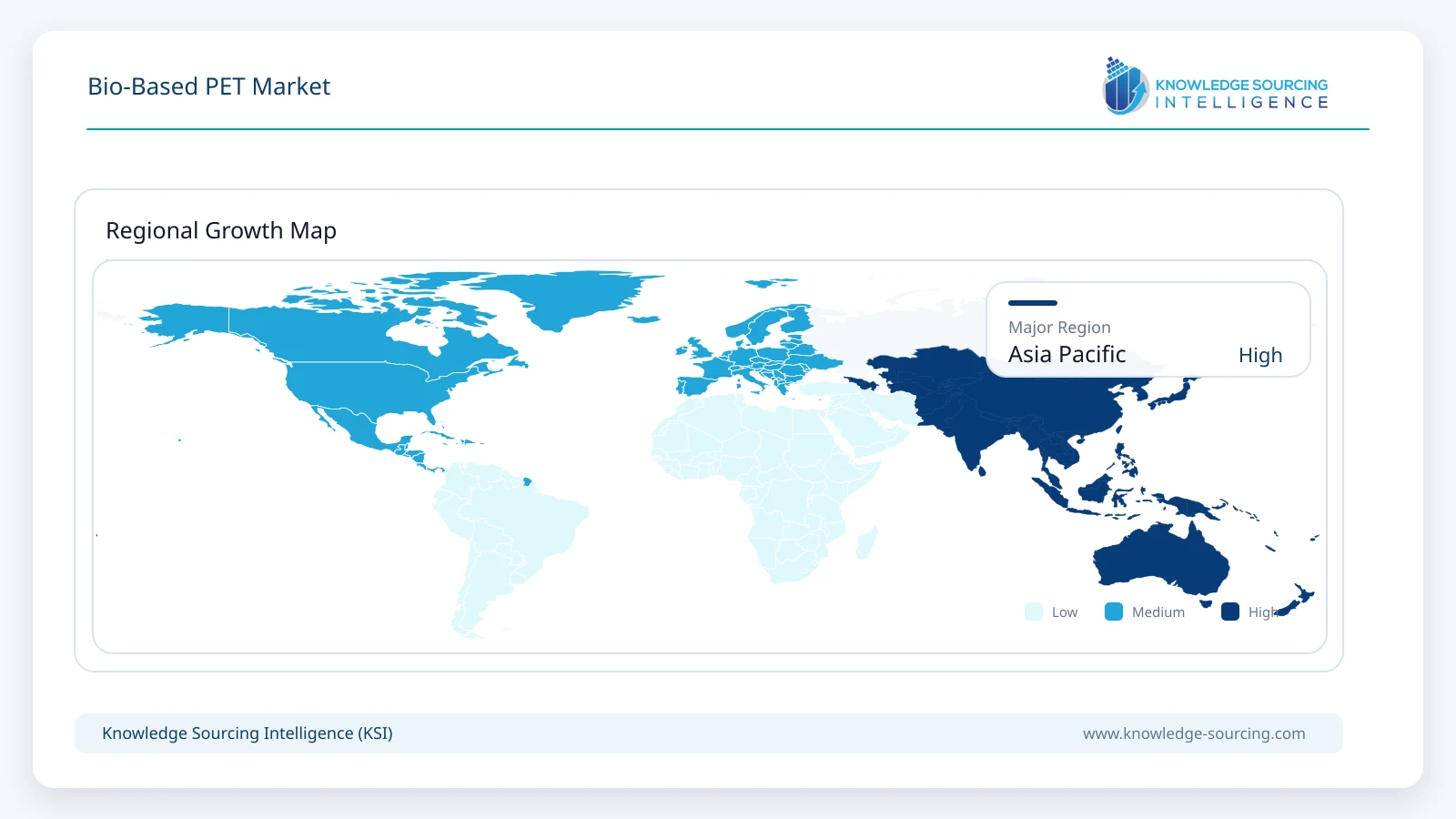
Asia Pacific is expected to remain the largest production and consumption region for bio-based PET during the forecast period because of its extensive packaging manufacturing base, expanding food and beverage industry, and well-established PET processing infrastructure. China, Japan, India, South Korea, Indonesia, and Thailand account for substantial demand from beverage packaging, consumer goods, and textile manufacturing. Regional converters are increasingly evaluating renewable polymers to meet sustainability commitments established by multinational brand owners operating production facilities across Asia. Investment in bio-based chemical production and recycling infrastructure is also improving the commercial viability of renewable PET value chains.
Europe
Europe represents one of the most policy-driven markets for bio-based PET. Regulations promoting recyclable packaging, circular material use, and reduced greenhouse gas emissions encourage packaging manufacturers to diversify feedstock sources. Consumer goods companies and retailers are incorporating sustainability requirements into procurement contracts, increasing demand for renewable polymers that remain compatible with existing recycling systems. Public and private investment in bio-based chemicals, renewable feedstocks, and advanced recycling technologies further supports commercial adoption across the region.
North America
North America benefits from advanced polymer manufacturing capabilities, strong beverage packaging demand, and active corporate sustainability programs. Brand owners, packaging converters, and resin manufacturers continue evaluating renewable PET solutions that can reduce lifecycle emissions while maintaining existing production efficiency. The United States remains the primary regional market because of its large packaged food and beverage industry, supported by investments in renewable chemical technologies and circular packaging initiatives.
Middle East & Africa and South America
South America presents opportunities through its agricultural resource base, which can support renewable feedstock production for bio-based chemicals. Brazil is particularly well positioned because of its established bioeconomy and large-scale bioethanol industry. In the Middle East and Africa, adoption remains at an earlier stage, although sustainability initiatives, packaging modernization, and investment diversification strategies are encouraging gradual evaluation of renewable polymers. Market expansion will depend on feedstock availability, investment in local processing capacity, and regulatory support for sustainable packaging materials.
Competitive Landscape
The bio-based PET market remains moderately concentrated, with competition based on renewable feedstock technology, production scale, polymer quality, lifecycle carbon performance, and long-term partnerships with global packaging companies. Suppliers compete by integrating renewable raw materials into existing PET manufacturing while maintaining compatibility with conventional recycling infrastructure and packaging equipment.
Companies including Toray Industries, Inc., Anellotech, Inc., The Coca-Cola Company, SCG Chemicals Co., Ltd., FKuR Kunststoff GmbH, Avantium N.V., Neste Oyj, Plastipak Holdings, Inc., Suntory Holdings Limited, and Indorama Ventures Public Company Limited continue investing in renewable feedstock technologies, collaborative product development, and commercial demonstration projects. Strategic partnerships across the value chain are becoming increasingly important because commercialization requires cooperation among feedstock suppliers, chemical producers, resin manufacturers, packaging converters, and consumer brands.
Competitive positioning depends on technological capability, access to renewable raw materials, manufacturing efficiency, intellectual property, regulatory compliance, and the ability to supply global consumer goods companies with consistent product quality and reliable volumes.
Recent Developments
January 2026: Indorama Ventures Public Company Limited announced additional investments focused on circular packaging solutions and sustainable polymer production within its global packaging portfolio. Commercial relevance: The investment strengthens production capacity for sustainable packaging materials while supporting customers pursuing renewable and circular packaging strategies.
May 2025: Neste Oyj expanded cooperation with packaging and polymer partners to increase the availability of renewable feedstocks for plastics manufacturing. Commercial relevance: Greater renewable feedstock availability supports production of lower-carbon plastics, including renewable PET value chains.
Regulatory and Policy Environment
Government policy continues to shape investment decisions across the bio-based PET market through regulations promoting circular material use, waste reduction, and lower greenhouse gas emissions.
The European Union Packaging and Packaging Waste Regulation (PPWR) establishes requirements intended to improve packaging recyclability, increase recycled content, and reduce packaging waste across member states. These measures encourage packaging manufacturers to evaluate renewable materials that remain compatible with established recycling systems.
In the United States, the U.S. Environmental Protection Agency (EPA) supports sustainable materials management through programs encouraging resource efficiency, waste reduction, and circular material use across manufacturing industries.
International sustainability standards, life-cycle assessment methodologies, food-contact regulations, and certification schemes governing renewable feedstocks continue influencing procurement decisions. Manufacturers supplying multinational consumer goods companies increasingly document renewable material content, greenhouse gas reductions, product traceability, and compliance with recognized environmental standards to satisfy customer purchasing requirements.
Outlook and Strategic Implications
The bio-based PET market is expected to advance steadily between 2026 and 2031 as sustainability objectives become more deeply integrated into packaging procurement strategies. Consumer goods companies will continue balancing environmental targets with cost competitiveness, product performance, and supply security when selecting packaging materials.
Investment priorities are expected to include expansion of renewable feedstock production, commercialization of bio-based aromatic technologies, manufacturing scale-up, and greater integration between biomass processing and polymer production. Companies capable of reducing production costs while maintaining material performance will improve their competitive position.
Procurement practices are likely to place greater emphasis on verified carbon reduction, renewable content certification, feedstock traceability, and compatibility with existing recycling infrastructure. Packaging converters will continue preferring materials that minimize operational changes while supporting customer sustainability commitments.
Potential risks include limited renewable feedstock availability, higher production costs compared with conventional PET, evolving regulatory requirements, and slower-than-expected commercialization of advanced renewable technologies. Nevertheless, expanding circular economy policies, increasing investment in renewable chemicals, and sustained commitments from global beverage and consumer goods companies are expected to create long-term commercial opportunities for suppliers operating across the bio-based PET value chain during the 2026 to 2031 forecast period.
Bio-Based PET Market Scope
| Report Metric | Details |
|---|---|
| Total Market Size in 2026 | USD 1,130.22 million |
| Total Market Size in 2031 | USD 2,227.43 million |
| Forecast Unit | Million |
| Growth Rate | 14.53% |
| Study Period | 2021 to 2031 |
| Historical Data | 2021 to 2024 |
| Base Year | 2025 |
| Forecast Period | 2026 – 2031 |
| Segmentation | Application, End-User, Geography |
| Companies |
|
Market Segmentation
By Application
By End-user
By Geography
Table of Contents
1. EXECUTIVE SUMMARY
2. MARKET SNAPSHOT
2.1. Market Overview
2.2. Market Definition
2.3. Scope of the Study
2.4. Market Segmentation
3. BUSINESS LANDSCAPE
3.1. Market Drivers
3.2. Market Restraints
3.3. Market Opportunities
3.4. Porter’s Five Forces Analysis
3.5. Industry Value Chain Analysis
3.6. Policies and Regulations
3.7. Strategic Recommendations
4. TECHNOLOGICAL OUTLOOK
5. BIO-BASED PET MARKET BY APPLICATION
5.1. Introduction
5.2. Bottles
5.3. Films & Sheets
5.4. Synthetic Fibers
5.5. Others
6. BIO-BASED PET MARKET BY END-USER
6.1. Introduction
6.2. Packaging
6.3. Automotive
6.4. Personal Care
6.5. Electronics
6.6. Others
7. BIO-BASED PET MARKET BY GEOGRAPHY
7.1. Introduction
7.2. North America
7.2.1. By Application
7.2.2. By End-User
7.2.3. By Country
7.2.3.1. USA
7.2.3.2. Canada
7.2.3.3. Mexico
7.3. South America
7.3.1. By Application
7.3.2. By End-User
7.3.3. By Country
7.3.3.1. Brazil
7.3.3.2. Argentina
7.3.3.3. Others
7.4. Europe
7.4.1. By Application
7.4.2. By End-User
7.4.3. By Country
7.4.3.1. United Kingdom
7.4.3.2. Germany
7.4.3.3. France
7.4.3.4. Spain
7.4.3.5. Others
7.5. Middle East and Africa
7.5.1. By Application
7.5.2. By End-User
7.5.3. By Country
7.5.3.1. Saudi Arabia
7.5.3.2. UAE
7.5.3.3. Israel
7.5.3.4. Others
7.6. Asia Pacific
7.6.1. By Application
7.6.2. By End-User
7.6.3. By Country
7.6.3.1. Japan
7.6.3.2. China
7.6.3.3. India
7.6.3.4. Australia
7.6.3.5. South Korea
7.6.3.6. Indonesia
7.6.3.7. Thailand
7.6.3.8. Taiwan
7.6.3.9. Others
8. COMPETITIVE ENVIRONMENT AND ANALYSIS
8.1. Major Players and Strategy Analysis
8.2. Market Share Analysis
8.3. Mergers, Acquisitions, Agreements, and Collaborations
8.4. Competitive Dashboard
9. COMPANY PROFILES
9.1. Toray Industries, Inc.
9.2. Anellotech, Inc.
9.3. The Coca-Cola Company
9.4. SCG Chemicals Co., Ltd.
9.5. FKuR Kunststoff GmbH
9.6. Avantium N.V.
9.7. Neste Oyj
9.8. Plastipak Holdings, Inc.
9.9. Suntory Holdings Limited
9.10. Indorama Ventures Public Company Limited
10. APPENDIX
10.1. Currency
10.2. Assumptions
10.3. Base and Forecast Years Timeline
10.4. Key Benefits for Stakeholders
10.5. Research Methodology
10.6. Abbreviations
Navigate
Trusted by the world's leading organizations











