
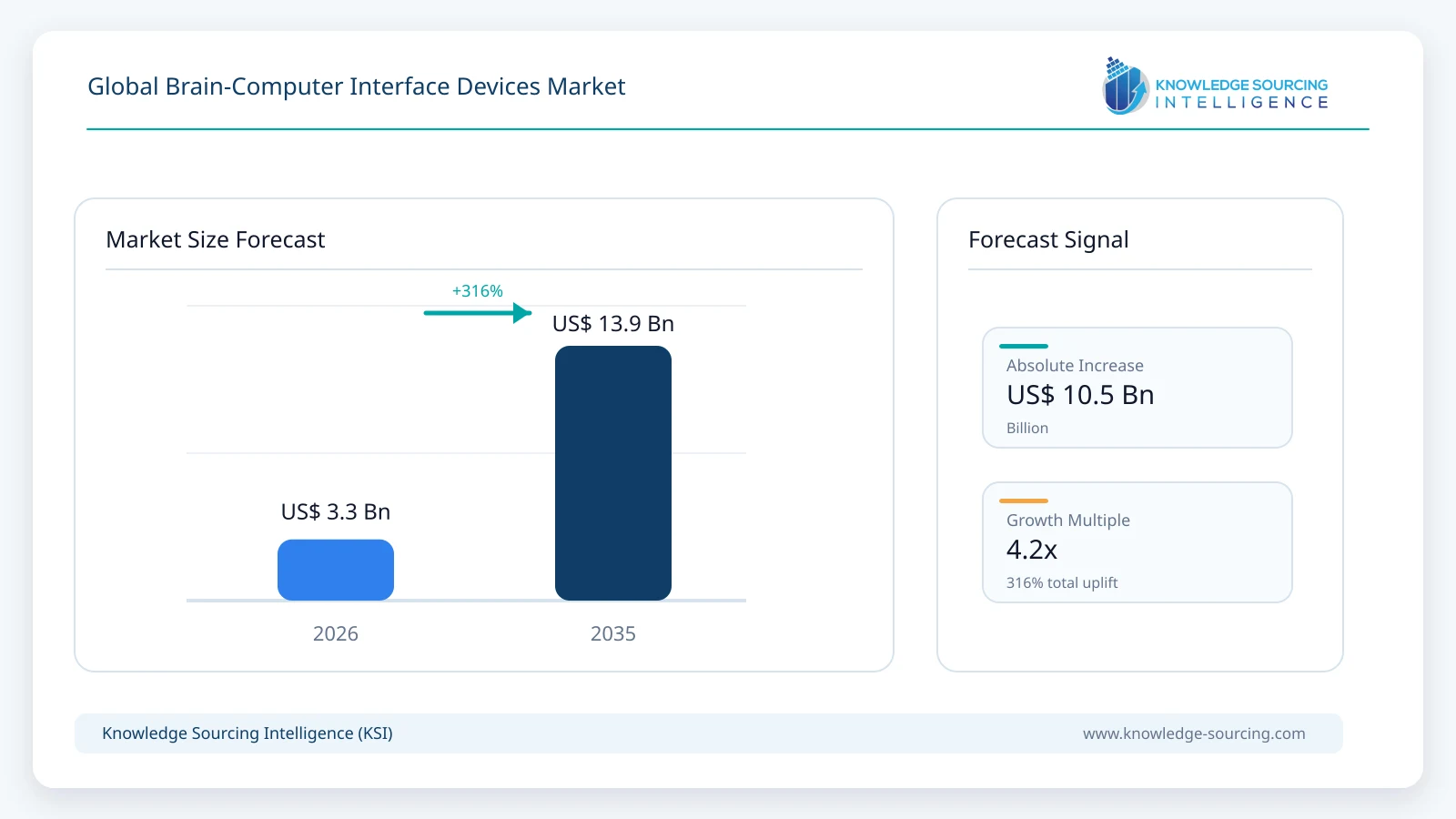
The Global Brain-Computer Interface Devices Market is projected to grow at a CAGR of 17.2% for the forecast period, increasing from USD 3.33 billion in 2026 to USD 13.86 billion by 2035.
Highlights:
- 1Rising paralysis prevalence is increasing demand for neural communication systems because conventional assistive technologies often depend on residual motor function.
- 2Regulatory acceleration programs are improving clinical development timelines because neurotechnology companies are receiving earlier engagement with regulatory authorities.
- 3AI integration is enhancing neural signal interpretation because decoding accuracy increasingly determines device usability and patient independence.
- 4Healthcare providers are expanding interest in neurorehabilitation platforms because stroke recovery outcomes frequently plateau under conventional rehabilitation pathways.
The market derives demand from growing incidences of paralysis, amyotrophic lateral sclerosis (ALS), spinal cord injury, stroke-related disability, Parkinson’s disease, and treatment-resistant neurological disorders. Neurological impairment limits communication and movement, which increases dependence on assistive technologies capable of restoring functional autonomy. BCI systems address this gap because they bypass damaged neural pathways and directly convert brain activity into executable commands.
Clinical dependency on neurotechnology is increasing because conventional rehabilitation outcomes often plateau after neurological injury. This limitation is encouraging hospitals and neurology centers to evaluate implantable and non-invasive BCI platforms capable of extending recovery windows beyond traditional therapeutic timelines. As a result, developers are prioritizing long-duration neural recording stability and adaptive stimulation capabilities.
Regulatory influence remains a major structural factor because implantable BCIs require extensive safety validation. The U.S. FDA Breakthrough Device Program increasingly supports BCI innovation through accelerated regulatory engagement, which is improving clinical development efficiency for emerging neurotechnology platforms. Companies obtaining breakthrough designation are gaining earlier regulatory feedback, which supports trial expansion and commercialization planning.
The strategic importance of the market extends beyond medical applications because neural interfaces are increasingly becoming foundational infrastructure for digital accessibility, assistive computing, and neuroadaptive communication systems.
Market Dynamics
Market Drivers
Expanding Neurological Disability Burden: Neurological disorders create long-term communication and mobility limitations that conventional therapeutic approaches often fail to reverse. Demand is increasing for BCI-enabled communication and control systems because ALS, spinal cord injury, and severe paralysis patients require alternative pathways for environmental interaction. Healthcare providers are increasingly evaluating neural interface technologies as assistive treatment extensions because disability-related healthcare expenditures continue rising. This shift strengthens investment in implantable systems that support independent digital engagement and functional autonomy.
Regulatory Advancement of Neurotechnology: Medical device regulation establishes commercialization pathways for implantable neural systems. Regulatory agencies are increasing engagement with BCI developers through breakthrough and investigational device programs because neurological disorders represent areas of significant unmet need. Developers are expanding clinical studies as regulatory feedback becomes more structured. This environment supports faster evidence generation and strengthens investor confidence in long-term commercialization opportunities.
AI-Enabled Neural Decoding Improvements: BCI performance depends on signal interpretation quality. Machine learning platforms are improving neural decoding precision because large-scale neural datasets increasingly support adaptive algorithm development. Companies are integrating AI frameworks into clinical systems as users demand faster and more reliable communication outputs. This evolution increases usability and expands applicability across neurological indications.
Expansion of Neurorehabilitation Applications: Traditional rehabilitation focuses on physical therapy and compensatory mechanisms. Research institutions are evaluating closed-loop stimulation and adaptive neural feedback systems because motor recovery often stagnates after stroke and spinal injury. Developers are expanding rehabilitation-focused BCI programs as evidence increasingly supports neuroplasticity-based recovery approaches. This trend broadens clinical demand beyond communication restoration alone.
Market Restraints
Long-term implant safety validation requirements extend commercialization timelines and increase clinical development costs.
Neural signal variability reduces decoding consistency, which limits performance standardization across patient populations.
Reimbursement frameworks remain underdeveloped for many BCI applications, which constrains large-scale healthcare adoption.
Market Opportunities
Home-Based Neurorehabilitation Expansion: Healthcare systems prioritize outpatient recovery models because neurological rehabilitation generates long-term resource burdens. Home-based neurotechnology platforms are emerging as viable alternatives because remote monitoring capabilities continue improving. Device developers are integrating cloud-enabled therapy management systems, which expand long-term patient engagement opportunities.
Communication Restoration in ALS Populations: ALS progressively reduces speech and motor function while cognitive capacity frequently remains preserved. Demand is increasing for neural communication platforms because patients require direct digital interaction pathways. Clinical developers are prioritizing speech restoration programs as communication loss becomes one of the most disabling aspects of disease progression.
Minimally Invasive Implant Development: Open-brain surgical procedures create adoption barriers among clinicians and patients. Endovascular and surface-based neural interfaces are gaining momentum because they reduce procedural complexity. Developers are investing in minimally invasive architectures as healthcare systems prioritize safety and scalability.
AI-Native Neurotechnology Ecosystems: Neural interface deployment increasingly generates large-scale brain activity datasets. Companies are developing AI-enabled neural foundation models because decoding performance improves through continuous learning frameworks. This transition supports future neuroadaptive applications across communication, rehabilitation, and assistive computing environments.
Disease & Epidemiology Analysis
Neurological disability remains the primary demand foundation for BCI devices because communication impairment and motor dysfunction frequently persist despite pharmacological intervention. ALS represents a high-priority indication since disease progression gradually eliminates voluntary movement while preserving cognitive function. This clinical profile increases demand for neural communication platforms capable of maintaining patient autonomy.
Stroke rehabilitation constitutes another major demand segment because motor recovery often reaches functional plateaus after conventional therapy. Rehabilitation centers are evaluating neural interface technologies because extended recovery windows may improve long-term functional outcomes. Emerging implantable stimulation systems are targeting chronic stroke populations where therapeutic alternatives remain limited.
Spinal cord injury continues to generate sustained interest in motor restoration technologies because interrupted neural pathways restrict voluntary movement despite preserved cortical intent. Parkinson’s disease and epilepsy also represent expanding opportunities because adaptive neural sensing and stimulation architectures increasingly support personalized neurological intervention models. This disease diversification broadens the clinical relevance of BCI platforms beyond paralysis-focused applications.
Treatment Guidelines Landscape
Indication | Current Treatment Approach | Limitation | Emerging Role of BCI |
ALS | Assistive communication devices | Dependence on residual movement | Direct neural communication |
Spinal Cord Injury | Rehabilitation and assistive mobility | Limited motor recovery | Neural-controlled mobility systems |
Stroke Rehabilitation | Physical and occupational therapy | Recovery plateau risk | Neuroplasticity-based restoration |
Parkinson’s Disease | Deep brain stimulation and medication | Symptom fluctuation | Adaptive neural modulation |
Market Segmentation
By Application
Communication and control represent a foundational BCI application because severe neurological impairment frequently eliminates conventional interaction pathways. Demand is increasing among ALS and paralysis populations because patients require independent access to digital environments despite motor limitations. Clinical developers are improving decoding accuracy as communication speed becomes a key adoption metric. This progression increases the practical value of neural interfaces within everyday healthcare settings.
Motor Function Restoration continues to attract investment because spinal cord injuries disrupt neural signal transmission rather than cognitive intent generation. Research programs are evaluating implantable interfaces that reconnect motor planning activity with external devices. Clinical interest remains strong because functional independence significantly influences long-term quality-of-life outcomes.
Neurorehabilitation is emerging as a major growth application because recovery limitations persist across stroke and neurological injury populations. Healthcare providers are exploring adaptive stimulation platforms as neuroplasticity-focused treatment strategies gain clinical support. This transition broadens the role of BCIs from assistive tools toward restorative intervention systems.
By Indication
ALS maintains strategic importance because communication loss progressively restricts patient independence. BCI developers are prioritizing neural communication systems as speech restoration demand continues to increase. Clinical programs increasingly target advanced-stage patients because unmet needs remain substantial.
Spinal Cord Injury generates demand for motor restoration technologies because cortical intent frequently remains intact despite pathway disruption. Researchers are expanding clinical investigations as neural decoding accuracy improves. This focus supports development of mobility, communication, and environmental control solutions.
Stroke Rehabilitation is becoming increasingly relevant because long-term disability burdens healthcare systems worldwide. Rehabilitation providers are investigating BCI-enabled recovery frameworks as conventional outcomes plateau. This trend strengthens demand for adaptive stimulation and neural feedback technologies designed to support motor relearning.
By End User
Hospitals represent a primary deployment environment because surgical implantation and neurological monitoring require specialized clinical infrastructure. Healthcare systems are expanding neurotechnology programs as clinical evidence continues to develop. This position maintains hospitals as central adoption hubs.
Specialty Neurology Centers increasingly participate in BCI implementation because complex neurological disorders require multidisciplinary management. Clinical teams are integrating advanced neurodiagnostic and neural interface capabilities as patient demand expands. This specialization supports broader technology acceptance.
Research Institutes and Academic Centers remain critical because evidence generation drives regulatory progression and reimbursement development. Academic networks are conducting clinical trials and translational research programs as neurotechnology innovation accelerates. This role sustains long-term market advancement.
Regional Analysis
North America Market Analysis
North America represents the most active BCI development region because regulatory pathways, venture capital investment, and neurological research infrastructure remain highly concentrated. Demand is increasing for implantable communication and motor restoration systems because academic medical centers continue expanding clinical neurotechnology programs. Regulatory agencies support innovation through breakthrough device frameworks, which encourage earlier-stage commercialization planning. Developers are increasing multicenter clinical studies as neurological disability management increasingly shifts toward functional restoration models. This environment strengthens the region’s leadership across clinical validation, investment activity, and commercialization readiness.
Europe Market Analysis
Europe maintains strategic relevance because neuroengineering research capabilities remain deeply integrated with university hospitals and neuroscience institutes. Demand is increasing for rehabilitation-focused neural technologies because aging demographics continue elevating neurological disease burdens. Research organizations are expanding translational programs as healthcare systems seek alternatives to long-term disability management. Regulatory harmonization supports clinical collaboration across multiple countries, which strengthens evidence generation. This structure positions Europe as a significant contributor to rehabilitation-oriented BCI development.
Asia Pacific Market Analysis
Asia Pacific is experiencing increasing neurotechnology activity because neurological disease prevalence continues rising alongside healthcare modernization initiatives. Research institutions are expanding neural interface programs as governments prioritize advanced medical technology development. China is accelerating clinical activity through supportive innovation policies, which increases competitive pressure within the global BCI landscape. Healthcare providers increasingly recognize the long-term economic burden of neurological disability, which supports interest in functional restoration technologies. This momentum strengthens regional participation across research, manufacturing, and clinical deployment.
Rest of the World
The Rest of the World market remains at an earlier development stage because specialized neurotechnology infrastructure remains concentrated within developed healthcare systems. Demand is gradually increasing as neurological disability management becomes a growing healthcare priority. Clinical adoption continues depending on regulatory modernization, specialist workforce availability, and reimbursement development. International collaborations are supporting technology transfer initiatives as developers seek broader clinical validation opportunities. This progression expands long-term market accessibility despite current deployment limitations.
Regulatory Landscape
The regulatory environment increasingly determines commercialization timelines because implantable BCI systems require extensive safety and efficacy validation. The U.S. Food and Drug Administration remains the most influential regulatory authority in the sector because multiple leading developers are pursuing breakthrough and investigational pathways. Breakthrough Device Designation is becoming strategically important because it enables structured regulatory interaction and expedited review processes for technologies addressing unmet clinical needs.
Clinical evidence requirements continue expanding because regulators increasingly focus on long-term neural recording stability, cybersecurity protection, device durability, and surgical safety. Developers are investing heavily in human clinical studies as regulators require real-world performance validation across diverse neurological populations. This emphasis strengthens the importance of multicenter trial networks.
Data governance requirements are also gaining importance because AI-enabled neural decoding systems increasingly rely on continuous brain activity collection. Regulatory frameworks are evolving toward addressing neurodata privacy, algorithm transparency, and patient autonomy concerns, which will shape future commercialization strategies.
Pipeline Analysis
The BCI pipeline increasingly focuses on communication restoration, motor recovery, adaptive stimulation, and neural decoding enhancement. Neuralink, Synchron, Paradromics, Precision Neuroscience, and other developers are expanding human clinical investigations because neurological disability remains inadequately addressed by existing interventions. Clinical pipelines increasingly emphasize scalable implantation methods and long-duration signal stability.
Synchron continues advancing the Stentrode platform through human studies focused on paralysis-related communication and device control. Positive COMMAND study outcomes support continued development because neural signals remained functional throughout extended evaluation periods.
Neuralink is expanding implantation programs while exploring communication, motor restoration, and vision restoration applications. Precision Neuroscience is progressing toward commercialization through regulatory clearances supporting cortical interface deployment. Paradromics is transitioning into clinical-stage development after completing early human implantation activity. These developments indicate a pipeline increasingly moving beyond feasibility toward scalable clinical utility.
Competitive Landscape
Neuralink
Neuralink remains strategically distinct because it combines high-channel-count neural implants with robotic surgical deployment systems. The company focuses on restoring communication, motor function, and sensory capability through fully implantable interfaces. Human implantation programs are expanding because Neuralink seeks large-scale neural data acquisition and clinical validation. Its integrated hardware-software architecture strengthens long-term commercialization potential.
Synchron
Synchron differentiates itself through an endovascular implantation strategy that avoids open-brain surgery. The Stentrode platform targets communication restoration and digital device control for paralysis patients. Clinical progress continues strengthening because minimally invasive procedures reduce surgical barriers. Strategic partnerships involving AI and consumer technology ecosystems support broader accessibility objectives.
Blackrock Neurotech
Blackrock Neurotech maintains strategic strength through long-standing neural recording expertise and established research collaborations. The company supports both clinical and academic neurotechnology applications. Its experience in neural data acquisition strengthens credibility within advanced neuroscience environments. This positioning supports continued participation in next-generation implantable interface development.
Paradromics
Paradromics focuses on high-bandwidth neural communication systems intended for severe motor impairment populations. Human implantation activity is advancing because the company seeks clinical validation of its Connexus platform. Its strategy emphasizes data-rich neural recording capabilities that support communication restoration and future AI-enhanced decoding frameworks.
Precision Neuroscience
Precision Neuroscience differentiates itself through ultra-thin cortical interface architectures designed to minimize tissue disruption. Regulatory progress continues supporting commercialization efforts because the company has achieved FDA clearance for a core system component. Hospital partnership expansion strengthens clinical deployment opportunities.
Cognixion
Cognixion focuses on communication-enabling neurotechnology solutions for individuals experiencing speech and motor limitations. The company integrates assistive communication platforms with neural sensing technologies. Its strategic emphasis on accessibility expands applicability across neurological disease populations requiring nontraditional interaction methods.
EMOTIV
EMOTIV maintains strategic relevance through non-invasive EEG-based neurotechnology solutions. The company supports healthcare, research, and cognitive monitoring applications. Its wearable approach reduces procedural barriers, which broadens adoption opportunities across clinical and consumer neurotechnology environments.
Key Developments
April 2026: Motif Neurotech, commercializing technology from Rice University research, received FDA approval for its first clinical trial of a therapeutic brain-computer interface for treatment-resistant depression, obtaining the investigational device exemption just four years after founding—a record timeline for a BCI company.
November 2025: INBRAIN Neuroelectronics announced a strategic collaboration with Microsoft to advance agentic AI for precision neurology and brain-computer interface therapeutics. It is leveraging Microsoft's Azure AI infrastructure, including time-series large language models, to enable INBRAIN's graphene-based neural platform to continuously learn and adapt to individual patient signals for closed-loop precision interventions in Parkinson's, epilepsy, and psychiatric disorders.
September 2025: UCLA engineers developed a wearable noninvasive brain-computer interface system using AI as a co-pilot to infer user intent and complete tasks like moving a robotic arm or computer cursor, achieving a new level of performance in noninvasive BCI systems that could help immobilized individuals with paralysis or neurological conditions handle and move objects more easily and precisely.
Strategic Insights and Future Market Outlook
The market is increasingly shifting toward clinically actionable neural interfaces because healthcare systems require measurable functional outcomes rather than experimental demonstrations. Communication restoration remains a leading commercialization pathway because severe neurological impairment creates immediate and identifiable unmet needs. Clinical evidence generation is accelerating because regulatory agencies and healthcare providers increasingly recognize the long-term socioeconomic burden of neurological disability.
AI integration is becoming a defining competitive variable because neural signal interpretation increasingly determines user experience and clinical effectiveness. Companies are investing in scalable neural decoding frameworks as long-term data accumulation expands algorithm training opportunities. This transition strengthens the strategic value of integrated hardware, software, and neuroinformatics ecosystems.
Future market leadership will depend on balancing clinical efficacy, procedural safety, reimbursement viability, and long-term neural stability. Developers capable of demonstrating durable functional improvement while reducing surgical complexity are likely to achieve stronger adoption across hospitals, rehabilitation centers, and specialty neurology networks.
The Global Brain-Computer Interface Devices Market is transitioning from research-driven innovation toward regulated clinical deployment. Neurological disability continues generating demand for communication restoration, motor recovery, and neurorehabilitation technologies, which is accelerating investment, regulatory engagement, and clinical validation across the neurotechnology ecosystem. As evidence expands and implantation approaches become safer, BCI systems increasingly position themselves as long-term therapeutic infrastructure rather than experimental neurological tools.
Global Brain-Computer Interface Devices Market Scope:
| Report Metric | Details |
|---|---|
| Total Market Size in 2026 | USD 3.33 billion |
| Total Market Size in 2035 | USD 13.86 billion |
| Forecast Unit | USD Billion |
| Growth Rate | 17.2% |
| Study Period | 2021 to 2035 |
| Historical Data | 2021 to 2024 |
| Base Year | 2025 |
| Forecast Period | 2026 – 2035 |
| Segmentation | Device Type, Application, Indication, Geography |
| Companies |
|
Market Segmentation
By Geography
Key Countries Analysis
Regulatory & Policy Landscape
Table of Contents
1. EXECUTIVE SUMMARY
1.1 Market Overview
1.2 Key Findings
1.3 Market Snapshot
1.4 Strategic Highlights
1.5 Key Growth Opportunities
1.6 Analyst Perspective
1.7 Executive Outlook
2. DISEASE & EPIDEMIOLOGY ANALYSIS
2.1 Introduction to Neurological Conditions Addressed by Brain-Computer Interface (BCI) Devices
2.2 Disease Burden and Clinical Need Assessment
2.3 Epidemiology of Major Target Indications
2.3.1 Spinal Cord Injury
2.3.2 Amyotrophic Lateral Sclerosis (ALS)
2.3.3 Stroke and Post-Stroke Disability
2.3.4 Traumatic Brain Injury (TBI)
2.3.5 Parkinson’s Disease
2.3.6 Epilepsy
2.3.7 Cerebral Palsy
2.3.8 Locked-In Syndrome
2.3.9 Neurodegenerative Disorders
2.4 Patient Population Analysis by Indication
2.5 Addressable Patient Pool Assessment
2.6 Unmet Clinical Needs and Treatment Gaps
2.7 Epidemiology Forecast Analysis
3. MARKET DYNAMICS
3.1 Market Definition and Scope
3.2 Market Evolution and Historical Overview
3.3 Market Drivers
3.3.1 Increasing Prevalence of Neurological Disorders
3.3.2 Advancements in Neurotechnology and AI Integration
3.3.3 Growing Demand for Assistive Communication Technologies
3.3.4 Expansion of Neurorehabilitation Applications
3.4 Market Restraints
3.4.1 High Device Development and Implementation Costs
3.4.2 Regulatory and Clinical Validation Challenges
3.4.3 Data Privacy and Ethical Concerns
3.5 Market Opportunities
3.5.1 Next-Generation Implantable BCIs
3.5.2 Wireless and Minimally Invasive Systems
3.5.3 Human-Machine Interface Expansion
3.5.4 Consumer and Wellness Applications
3.6 Market Challenges
3.7 Porter's Five Forces Analysis
3.8 PESTLE Analysis
3.9 Value Chain Analysis
4. COMMERCIAL & MARKET ACCESS
4.1 Commercialization Framework for BCI Devices
4.2 Market Access Pathways
4.3 Reimbursement Landscape
4.4 Healthcare Provider Adoption Trends
4.5 Pricing Analysis
4.6 Procurement and Purchasing Models
4.7 Stakeholder Analysis
4.8 Patient Access Considerations
4.9 Technology Adoption Barriers
5. INNOVATION & PIPELINE LANDSCAPE
5.1 Overview of BCI Innovation Ecosystem
5.2 Technology Development Trends
5.3 Pipeline Analysis by Development Stage
5.3.1 Early-Stage Research Programs
5.3.2 Phase I Clinical Programs
5.3.3 Phase II Clinical Programs
5.3.4 Phase III Clinical Programs
5.4 Pipeline Analysis by Device Type
5.4.1 Invasive BCI Devices
5.4.2 Partially Invasive BCI Devices
5.4.3 Non-Invasive BCI Devices
5.5 Pipeline Analysis by Modality
5.5.1 Electrocorticography (ECoG)
5.5.2 Intracortical Interfaces
5.5.3 Electroencephalography (EEG)
5.5.4 Functional Near-Infrared Spectroscopy (fNIRS)
5.5.5 Hybrid BCI Systems
5.6 Mechanism of Action Assessment
5.7 Patent Landscape Analysis
5.8 Research Collaborations and Strategic Partnerships
5.9 Emerging Technology Roadmap
6. TREATMENT LANDSCAPE
6.1 Current Standard of Care Across Major Indications
6.2 Role of BCI Devices in Clinical Management
6.3 Neurorehabilitation Technologies
6.4 Assistive Communication Technologies
6.5 Neuroprosthetics and Motor Restoration Solutions
6.6 Comparative Assessment of Treatment Modalities
6.7 Clinical Outcomes and Effectiveness Trends
6.8 Future Treatment Paradigm Evolution
7. GLOBAL BRAIN-COMPUTER INTERFACE DEVICES MARKET SIZE & FORECAST
7.1 Market Size Assessment (Historical)
7.2 Market Forecast Methodology
7.3 Global Market Revenue Forecast
7.4 Market Forecast by Device Type
7.5 Market Forecast by Application
7.6 Market Forecast by End User
7.7 Market Forecast by Geography
7.8 Scenario Analysis
7.9 Opportunity Assessment
8. GLOBAL BRAIN-COMPUTER INTERFACE DEVICES MARKET SEGMENTATION
8.1 By Device Type
8.1.1 Invasive Brain-Computer Interface Devices
8.1.2 Non-Invasive Brain-Computer Interface Devices
8.2 By Application
8.2.1 Communication and Control
8.2.2 Motor Function Restoration
8.2.3 Neurorehabilitation
8.2.4 Others
8.3 By Indication
8.3.1 Amyotrophic Lateral Sclerosis (ALS)
8.3.2 Spinal Cord Injury
8.3.3 Stroke Rehabilitation
8.3.4 Parkinson’s Disease
8.3.5 Epilepsy
8.3.6 Other Neurological Disorders
8.4 By End User
8.4.1 Hospitals
8.4.2 Specialty Neurology Centers
8.4.3 Rehabilitation Centers
8.4.4 Research Institutes and Academic Centers
8.4.5 Home Care Settings
9. GEOGRAPHICAL ANALYSIS
9.1 North America
9.1.1 Market Size and Forecast
9.1.2 Demand Drivers
9.1.3 Regional Regulatory Environment
9.1.4 Competitive Intensity
9.1.5 Technology Adoption Trends
9.2 Europe
9.2.1 Market Size and Forecast
9.2.2 Demand Drivers
9.2.3 Regional Regulatory Environment
9.2.4 Competitive Intensity
9.2.5 Technology Adoption Trends
9.3 Asia-Pacific
9.3.1 Market Size and Forecast
9.3.2 Demand Drivers
9.3.3 Regional Regulatory Environment
9.3.4 Competitive Intensity
9.3.5 Technology Adoption Trends
9.4 Latin America
9.4.1 Market Size and Forecast
9.4.2 Demand Drivers
9.4.3 Regional Regulatory Environment
9.4.4 Competitive Intensity
9.4.5 Technology Adoption Trends
9.5 Middle East & Africa
9.5.1 Market Size and Forecast
9.5.2 Demand Drivers
9.5.3 Regional Regulatory Environment
9.5.4 Competitive Intensity
9.5.5 Technology Adoption Trends
10. KEY COUNTRIES ANALYSIS
10.1 United States
10.1.1 Market Size
10.1.2 Epidemiology and Target Population
10.1.3 Regulatory Framework
10.1.4 Reimbursement Environment
10.1.5 Key Company and Product Presence
10.2 Canada
10.3 Germany
10.4 United Kingdom
10.5 France
10.6 Italy
10.7 Spain
10.8 China
10.9 Japan
10.10 India
10.11 South Korea
10.12 Australia
10.13 Brazil
10.14 Mexico
10.15 Saudi Arabia
10.16 South Africa
11. REGULATORY & POLICY LANDSCAPE
11.1 Global Regulatory Overview
11.2 United States Regulatory Framework (FDA)
11.2.1 Device Classification Pathways
11.2.2 Breakthrough Device Designation
11.2.3 Clinical Evidence Requirements
11.3 Europe Regulatory Framework (EU MDR)
11.3.1 CE Marking Requirements
11.3.2 Clinical Evaluation Standards
11.4 Japan Regulatory Framework (PMDA)
11.4.1 Approval Process
11.4.2 Post-Market Requirements
11.5 India Regulatory Framework (CDSCO)
11.5.1 Device Registration Requirements
11.5.2 Import and Manufacturing Regulations
11.6 China Regulatory Framework (NMPA)
11.6.1 Device Registration Pathways
11.6.2 Local Clinical Trial Requirements
11.7 Data Privacy and Cybersecurity Regulations
11.8 Ethical Considerations in BCI Deployment
11.9 Regulatory Trends and Future Outlook
12. COMPETITIVE LANDSCAPE
12.1 Market Structure Analysis
12.2 Competitive Benchmarking
12.3 Market Share Analysis
12.4 Product Portfolio Comparison
12.5 Technology Positioning Matrix
12.6 Strategic Developments
12.6.1 Collaborations and Partnerships
12.6.2 Mergers and Acquisitions
12.6.3 Funding and Investments
12.6.4 Clinical Milestones
12.7 SWOT Analysis
13. COMPANY PROFILES
13.1 Neuralink
13.1.1 Company Overview
13.1.2 Commercialized Products/Devices
13.1.3 Key Indications
13.1.4 Pipeline Programs and Clinical Development Stage
13.1.5 Strategic Developments
13.2 Synchron
13.2.1 Company Overview
13.2.2 Commercialized Products/Devices
13.2.3 Key Indications
13.2.4 Pipeline Programs and Clinical Development Stage
13.2.5 Strategic Developments
13.3 Blackrock Neurotech
13.3.1 Company Overview
13.3.2 Commercialized Products/Devices
13.3.3 Key Indications
13.3.4 Pipeline Programs and Clinical Development Stage
13.3.5 Strategic Developments
13.4 Paradromics
13.4.1 Company Overview
13.4.2 Commercialized Products/Devices
13.4.3 Key Indications
13.4.4 Pipeline Programs and Clinical Development Stage
13.4.5 Strategic Developments
13.5 Precision Neuroscience
13.5.1 Company Overview
13.5.2 Commercialized Products/Devices
13.5.3 Key Indications
13.5.4 Pipeline Programs and Clinical Development Stage
13.5.5 Strategic Developments
13.6 Cognixion
13.6.1 Company Overview
13.6.2 Commercialized Products/Devices
13.6.3 Key Indications
13.6.4 Pipeline Programs and Clinical Development Stage
13.6.5 Strategic Developments
13.7 EMOTIV
13.7.1 Company Overview
13.7.2 Commercialized Products/Devices
13.7.3 Key Indications
13.7.4 Pipeline Programs and Clinical Development Stage
13.7.5 Strategic Developments
13.8 NeuroSky
13.8.1 Company Overview
13.8.2 Commercialized Products/Devices
13.8.3 Key Indications
13.8.4 Pipeline Programs and Clinical Development Stage
13.8.5 Strategic Developments
13.9 g.tec medical engineering GmbH
13.9.1 Company Overview
13.9.2 Commercialized Products/Devices
13.9.3 Key Indications
13.9.4 Pipeline Programs and Clinical Development Stage
13.9.5 Strategic Developments
13.10 Kernel
13.10.1 Company Overview
13.10.2 Commercialized Products/Devices
13.10.3 Key Indications
13.10.4 Pipeline Programs and Clinical Development Stage
13.10.5 Strategic Developments
14. FUTURE OUTLOOK
14.1 Future Market Evolution
14.2 Technology Adoption Forecast
14.3 Emerging Clinical Applications
14.4 AI and Machine Learning Integration Outlook
14.5 Investment and Funding Trends
14.6 Competitive Outlook Through Forecast Period
14.7 Key Strategic Recommendations
14.8 Long-Term Industry Outlook
15. METHODOLOGY
15.1 Research Objectives
15.2 Market Definition and Scope
15.3 Secondary Research Methodology
15.4 Primary Research Methodology
15.5 Data Validation and Triangulation
15.6 Forecasting Methodology
15.7 Assumptions and Limitations
15.8 Abbreviations and Definitions
15.9 Sources and References
Navigate
Trusted by the world's leading organizations











