
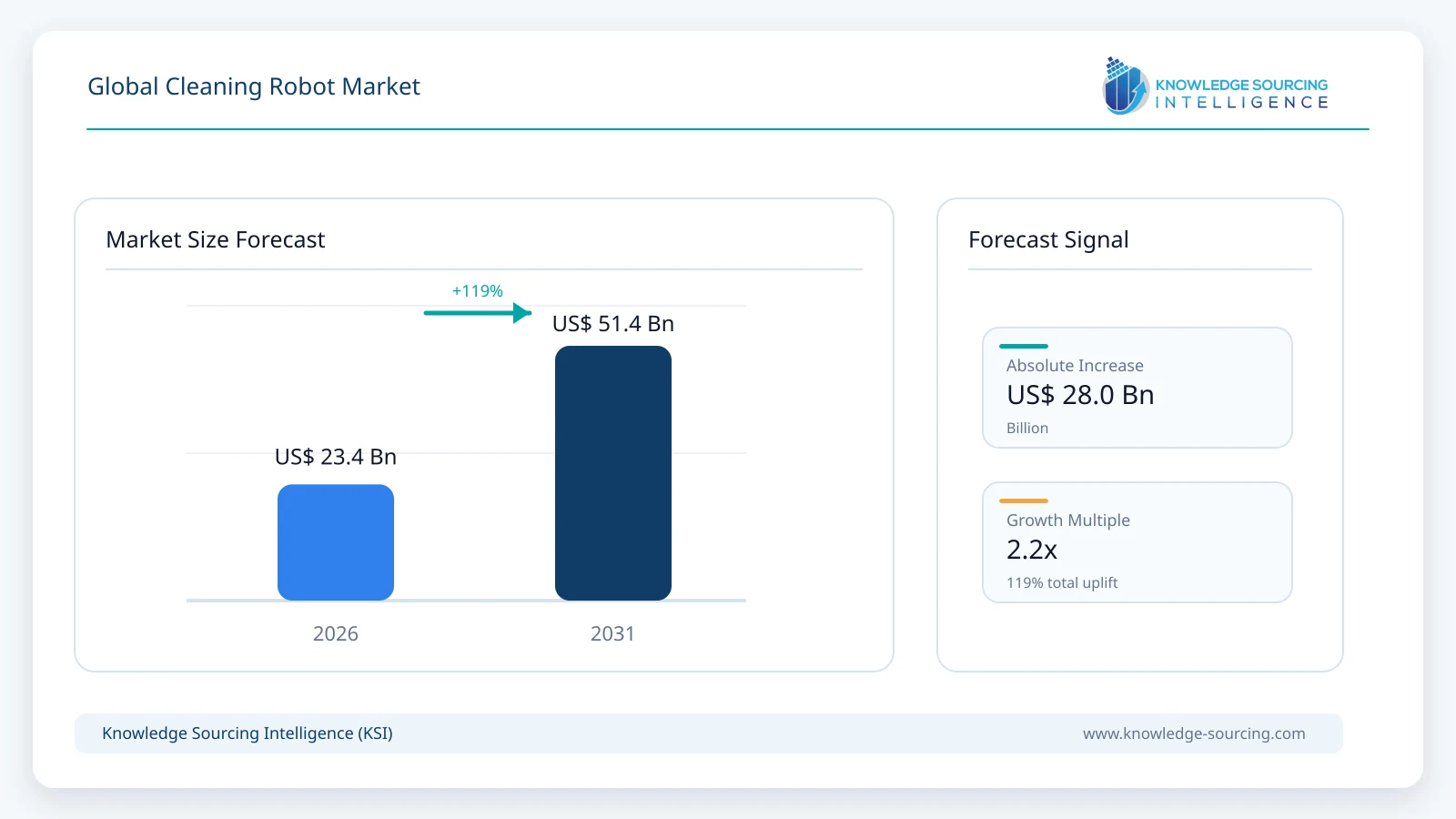
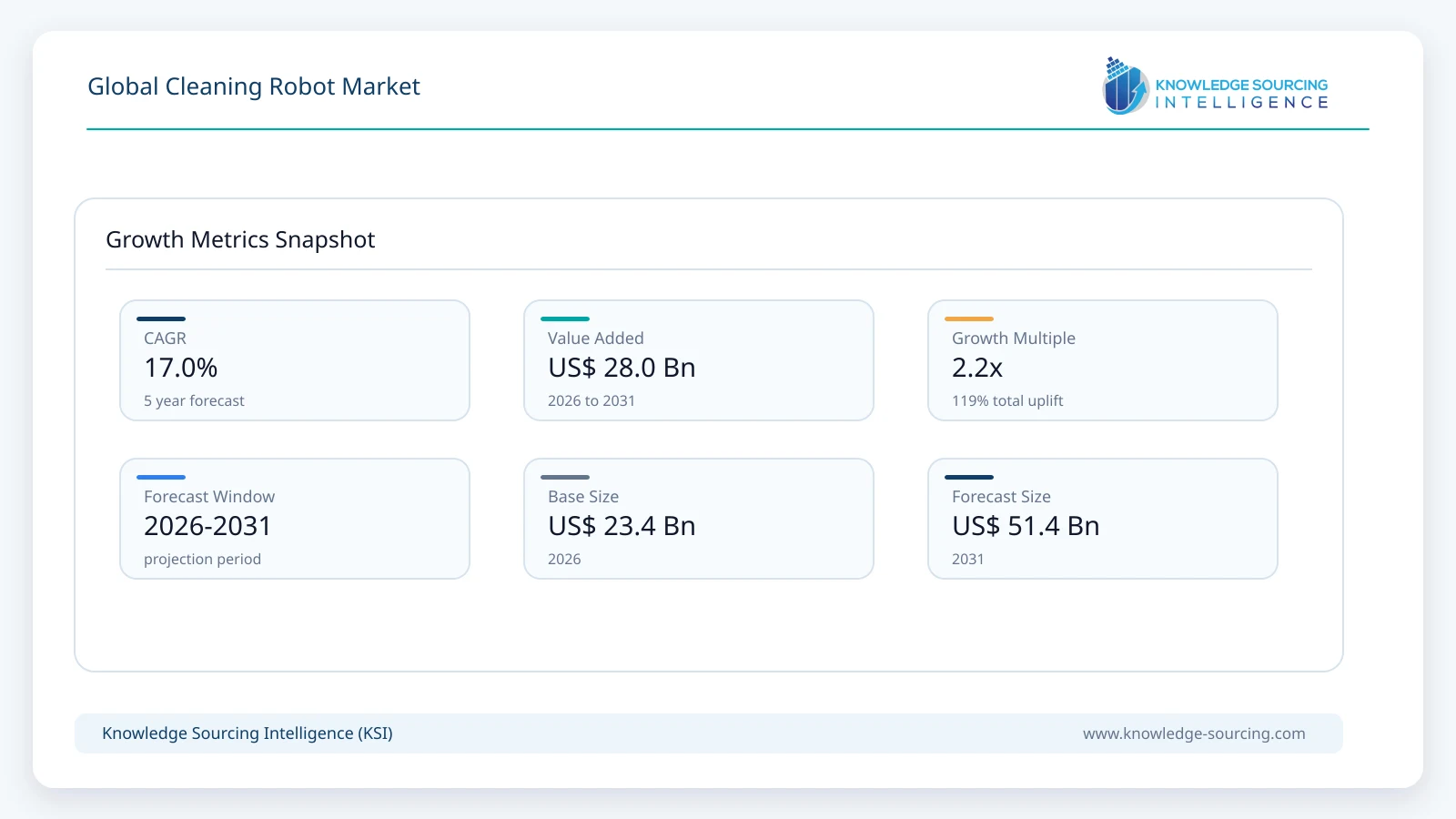
The Cleaning Robot Market is forecast to grow at a CAGR of 17.0%, reaching USD 51.42 billion in 2031 from USD 23.45 billion in 2026.
Highlights:
- 1Labor shortages and rising cleaning service costs are accelerating investment in autonomous cleaning systems.
- 2Floor cleaning robots represent the most commercially important product category because of broad adoption across residential and commercial facilities.
- 3Asia Pacific remains an important manufacturing and technology development hub while also representing one of the fastest-expanding demand centers.
- 4AI-enabled navigation, computer vision, and cloud fleet management are improving operational efficiency and expanding deployment scenarios.
- 5Hygiene regulations in healthcare, food processing, and public facilities continue to support automation investments.
- 6Competition increasingly depends on navigation accuracy, software capabilities, service networks, and ecosystem integration rather than hardware specifications alone.
The cleaning robot market comprises autonomous and semi-autonomous robotic systems designed to perform repetitive cleaning tasks across residential, commercial, industrial, and institutional environments. These systems integrate mobility platforms, sensors, navigation software, artificial intelligence (AI), computer vision, and connected services to automate floor cleaning, window cleaning, lawn mowing, pool cleaning, and specialized sanitation applications. Demand extends beyond household convenience, with enterprises adopting robotic cleaning solutions to improve labor productivity, maintain consistent hygiene standards, and optimize operational costs.
Demand conditions continue to strengthen as labor shortages affect cleaning service providers, facility management companies, hospitality operators, healthcare institutions, airports, educational campuses, logistics centers, and manufacturing facilities. Rising labor expenses, higher expectations for workplace cleanliness, and expanding building footprints have altered procurement priorities. Buyers increasingly evaluate cleaning robots based on cleaning performance, navigation accuracy, battery endurance, fleet management capabilities, total cost of ownership, and after-sales service rather than purchase price alone.
Commercial buyers typically conduct lifecycle cost analyses before deployment, comparing robotic cleaning systems against recurring labor expenses. Multi-site organizations increasingly prefer centralized fleet management platforms capable of monitoring machine utilization, predictive maintenance, software updates, and cleaning performance through cloud-based dashboards. Residential buyers, meanwhile, prioritize ease of use, intelligent mapping, obstacle avoidance, quiet operation, and compatibility with smart home ecosystems.
The industry structure reflects participation from established consumer electronics manufacturers, dedicated robotics companies, commercial cleaning equipment suppliers, and software-focused automation firms. Hardware remains the largest revenue contributor because of sensor modules, motors, batteries, navigation components, cameras, and mechanical assemblies. However, software subscriptions, fleet analytics, and maintenance services are becoming more meaningful revenue streams as connected robots require continuous updates and operational support throughout their service life.
Technology adoption is also shifting from isolated robotic devices toward connected cleaning ecosystems. Artificial intelligence enables better route optimization, object recognition, adaptive cleaning patterns, and remote diagnostics. Improvements in simultaneous localization and mapping (SLAM), LiDAR navigation, edge computing, and machine vision have expanded the range of environments where autonomous cleaning can operate reliably with limited human intervention.
Industrial and institutional users increasingly incorporate robotic cleaning into broader facility automation strategies. Airports, hospitals, retail complexes, warehouses, and public infrastructure operators seek standardized cleaning quality while addressing workforce shortages and compliance requirements related to hygiene and workplace safety. These long-term procurement trends support continued investment in autonomous cleaning technologies.
Market Drivers
Rising labor shortages and increasing facility operating costs
Cleaning remains a labor-intensive activity across commercial buildings, healthcare facilities, retail centers, airports, and industrial sites. Many employers face persistent recruitment and retention challenges for cleaning personnel while wage inflation continues to increase operating expenses. Robotic cleaning systems provide predictable operating costs and reduce dependence on manual labor for repetitive tasks.
Equipment suppliers have responded by expanding autonomous product portfolios capable of operating during off-hours with minimal supervision. Buyers increasingly evaluate return on investment through reduced labor requirements, higher cleaning consistency, and extended operating schedules.
Stronger hygiene and sanitation requirements
Healthcare providers, educational institutions, transportation hubs, and food-related industries maintain strict cleanliness standards to reduce contamination risks and improve public confidence. Automated cleaning systems support standardized cleaning schedules and digital documentation that assists facility managers in demonstrating operational compliance.
Manufacturers have introduced advanced mapping, cleaning verification, and reporting capabilities that improve accountability while supporting institutional procurement requirements.
Advances in artificial intelligence and navigation technologies
Continuous improvements in AI algorithms, computer vision, LiDAR, structured-light sensors, and edge computing have significantly enhanced robotic navigation and obstacle avoidance. Modern systems can identify dynamic obstacles, optimize cleaning paths, and operate efficiently in complex indoor environments.
Technology improvements reduce deployment barriers, shorten implementation periods, and improve buyer confidence, encouraging replacement of conventional equipment with autonomous alternatives.
Expansion of smart buildings and connected facility management
Commercial real estate owners increasingly integrate connected infrastructure into building management systems. Cleaning robots equipped with cloud connectivity generate operational data that supports maintenance planning, utilization tracking, and energy management.
Software integration enhances procurement value because facility operators can monitor multiple robotic assets across geographically distributed locations from centralized platforms.
Market Restraints and Challenges
High initial capital investment
Although robotic cleaning systems often reduce long-term operating expenses, upfront acquisition costs remain substantially higher than conventional cleaning equipment. Small businesses, independent cleaning contractors, and budget-constrained institutions may postpone investments despite favorable lifecycle economics.
Manufacturers address this challenge through leasing models, robotics-as-a-service (RaaS), financing options, and subscription-based commercial agreements that reduce capital expenditure.
Operational complexity in unstructured environments
Cleaning robots perform best within mapped and relatively organized environments. Constant furniture movement, crowded public spaces, irregular floor layouts, and temporary obstacles can reduce cleaning efficiency and require human intervention.
Suppliers continue improving AI-driven navigation, adaptive route planning, and sensor fusion to enhance operational reliability under changing conditions.
Maintenance and technical support requirements
Commercial buyers expect continuous equipment availability because cleaning schedules often operate overnight or during limited operational windows. Battery degradation, sensor calibration, software updates, and component replacement require responsive service networks.
Manufacturers increasingly invest in predictive maintenance software, remote diagnostics, and regional service centers to minimize equipment downtime.
Cybersecurity and data privacy considerations
Connected cleaning robots collect mapping information and operational data within commercial facilities. Organizations handling sensitive information must ensure secure data transmission, access controls, and compliance with organizational cybersecurity policies.
Software developers continue strengthening encryption, authentication protocols, and enterprise security features to address buyer concerns.
Major Segment Analysis
Floor Cleaning Robots
Floor cleaning robots represent the largest commercial opportunity because they address the broadest range of applications across residential, commercial, industrial, and institutional facilities. Large floor areas require frequent cleaning, making automation economically attractive where repetitive manual work creates significant operating costs.
Commercial buyers prioritize navigation accuracy, cleaning coverage, battery runtime, obstacle avoidance, fleet scalability, and integration with facility management software. Residential consumers focus on convenience, automated scheduling, intelligent mapping, pet hair removal, and compatibility with connected home platforms.
Competitive differentiation increasingly depends on software intelligence rather than mechanical performance alone. AI-powered route optimization, self-emptying systems, automated charging, predictive maintenance, and cloud analytics improve customer retention while creating recurring software and service revenues.
As organizations expand automation initiatives across facility operations, floor cleaning robots remain central to long-term procurement strategies because they provide measurable productivity improvements and relatively faster investment payback compared with other robotic cleaning applications.
Regional Analysis
North America demonstrates mature commercial adoption supported by labor shortages, higher wage levels, widespread smart building deployment, and strong investment in warehouse automation, healthcare infrastructure, and commercial real estate. Buyers emphasize lifecycle cost savings, cybersecurity, and software integration.
Europe benefits from workplace safety regulations, sustainability objectives, and high labor costs that improve automation economics. Healthcare facilities, transportation infrastructure, hospitality operators, and municipal organizations continue expanding robotic cleaning deployments while manufacturers focus on energy-efficient equipment and regulatory compliance.
Asia Pacific represents both a major production center and a rapidly expanding consumption market. China, Japan, South Korea, and Taiwan contribute substantially to robotics manufacturing, while India and Southeast Asia present increasing commercial demand as modern retail, healthcare infrastructure, airports, and industrial facilities expand. Growing middle-class purchasing power also supports residential adoption.
Middle East & Africa experiences demand from airports, hospitality developments, healthcare projects, commercial real estate, and smart city initiatives. High-profile infrastructure investments encourage adoption, although procurement cycles can be influenced by public-sector budgeting and imported equipment costs.
South America remains an emerging market where commercial adoption is strongest among large enterprises, shopping centers, airports, hospitals, and industrial operators seeking productivity improvements. Economic volatility and import costs may influence purchasing decisions, but expanding awareness of automation benefits supports gradual adoption.
Competitive Landscape
Competition combines consumer robotics manufacturers, commercial cleaning equipment specialists, and enterprise automation providers. Companies including iRobot Corporation, ECOVACS Robotics Co., Ltd., Roborock Technology Co., Ltd., Brain Corporation, ADLATUS Robotics GmbH, LG Electronics Inc., Samsung Electronics Co., Ltd., TASKI, Peppermint Robotics, Tennant Company, Kärcher, and Gaussian Robotics compete through technology differentiation, software capabilities, product reliability, distribution reach, and service quality.
Competitive positioning increasingly depends on autonomous navigation performance, AI-enabled obstacle recognition, cloud fleet management, predictive maintenance, and integration with enterprise facility management platforms. Strategic partnerships with distributors, facility management providers, and technology companies expand market access while strengthening after-sales support. Geographic expansion continues through localized service capabilities and regional manufacturing investments that improve supply chain resilience and customer responsiveness.
Recent Developments
March 2026: Kärcher expanded its autonomous cleaning portfolio with enhanced AI-based navigation and fleet management capabilities for commercial facilities. The development strengthens enterprise productivity and centralized facility operations.
March 2026: SharkNinja introduced the Shark PowerDetect™ UV Reveal™ robot vacuum and mop, the industry's first model combining UV stain detection with RGB vision technology to identify and automatically clean invisible household messes.
March 2026: iRobot launched the Roomba® Mini Robot Vacuum & Mop + AutoEmpty™ Dock across the UK and Europe, expanding its cleaning robot portfolio with its smallest Roomba model featuring combined vacuuming, mopping, and automatic dust-emptying capabilities.
January 2026: Dreame Technology launched its AI-powered whole-home smart ecosystem at CES 2026, showcasing the new X60 Ultra Series robot vacuum alongside advanced intelligent home-cleaning technologies designed to expand automated residential cleaning capabilities.
Regulatory and Policy Environment
Cleaning robots operate within multiple regulatory frameworks covering electrical safety, wireless communications, battery transportation, electromagnetic compatibility, machinery safety, cybersecurity, environmental compliance, and product recycling. Manufacturers supplying international markets must comply with regional certification requirements such as CE marking within Europe, FCC regulations in the United States, and country-specific safety certifications across Asia Pacific.
Government policies encouraging automation, digital manufacturing, smart buildings, and service robotics indirectly support market expansion. Workplace safety regulations and institutional hygiene standards also encourage investment in autonomous cleaning systems where consistent cleaning quality and operational documentation are important. Environmental regulations promoting energy efficiency and responsible battery recycling influence product design, component selection, and end-of-life management strategies.
Outlook and Strategic Implications
The cleaning robot market is expected to evolve toward highly connected, software-driven automation platforms rather than standalone cleaning devices. Procurement decisions will increasingly emphasize measurable operational outcomes, including cleaning consistency, equipment utilization, predictive maintenance, and workforce optimization.
Investment priorities are likely to concentrate on artificial intelligence, computer vision, battery efficiency, autonomous navigation, cloud analytics, and robotics-as-a-service business models that reduce customer capital expenditure. Enterprise buyers are expected to favor scalable platforms capable of supporting multiple robotic assets across distributed facilities through centralized management systems.
Competitive differentiation will increasingly depend on software ecosystems, service capabilities, cybersecurity, and interoperability with broader building management infrastructure. Manufacturers capable of combining reliable hardware, intelligent software, responsive service networks, and recurring digital services are likely to strengthen long-term customer relationships.
Potential risks include supply chain disruptions for electronic components, evolving cybersecurity requirements, pricing pressure from expanding competition, and slower adoption among cost-sensitive buyers. Nevertheless, sustained labor shortages, rising operational efficiency requirements, stricter hygiene expectations, and continued advances in autonomous navigation are expected to support long-term commercial opportunities across residential, commercial, industrial, and institutional markets.
Cleaning Robot Market Scope
| Report Metric | Details |
|---|---|
| Total Market Size in 2026 | USD 23.45 billion |
| Total Market Size in 2031 | USD 51.42 billion |
| Forecast Unit | Billion |
| Growth Rate | 17.0% |
| Study Period | 2021 to 2031 |
| Historical Data | 2021 to 2024 |
| Base Year | 2025 |
| Forecast Period | 2026 – 2031 |
| Segmentation | Component, Type, End-User, Geography |
| Companies |
|
Market Segmentation
By Component
By Type
By End-user
By Geography
Table of Contents
1. EXECUTIVE SUMMARY
2. MARKET SNAPSHOT
2.1. Market Overview
2.2. Market Definition
2.3. Scope of the Study
2.4. Market Segmentation
3. BUSINESS LANDSCAPE
3.1. Market Drivers
3.2. Market Restraints
3.3. Market Opportunities
3.4. Porter’s Five Forces Analysis
3.5. Industry Value Chain Analysis
3.6. Policies and Regulations
3.7. Strategic Recommendations
4. TECHNOLOGICAL OUTLOOK
5. CLEANING ROBOT MARKET BY COMPONENT
5.1. Introduction
5.2. Hardware
5.3. Software
5.4. Services
6. CLEANING ROBOT MARKET BY TYPE
6.1. Introduction
6.2. Floor Cleaning Robot
6.3. Window Cleaning Robot
6.4. Lawn Mowing Robot
6.5. Pool Cleaning Robot
6.6. Others
7. CLEANING ROBOT MARKET BY END-USER
7.1. Introduction
7.2. Residential
7.3. Commercial
7.4. Industrial
7.5. Institutional
8. CLEANING ROBOT MARKET BY GEOGRAPHY
8.1. Introduction
8.2. North America
8.2.1. United States
8.2.2. Canada
8.2.3. Mexico
8.3. South America
8.3.1. Brazil
8.3.2. Argentina
8.3.3. Others
8.4. Europe
8.4.1. United Kingdom
8.4.2. Germany
8.4.3. France
8.4.4. Italy
8.4.5. Spain
8.4.6. Others
8.5. Middle East and Africa
8.5.1. Saudi Arabia
8.5.2. United Arab Emirates
8.5.3. Others
8.6. Asia Pacific
8.6.1. China
8.6.2. Japan
8.6.3. India
8.6.4. South Korea
8.6.5. Taiwan
8.6.6. Thailand
8.6.7. Indonesia
8.6.8. Others
9. COMPETITIVE ENVIRONMENT AND ANALYSIS
9.1. Major Players and Strategy Analysis
9.2. Market Share Analysis
9.3. Mergers, Acquisitions, Agreements, and Collaborations
9.4. Competitive Dashboard
10. COMPANY PROFILES
10.1. iRobot Corporation
10.2. ECOVACS Robotics Co., Ltd.
10.3. Roborock Technology Co., Ltd.
10.4. Brain Corporation
10.5. ADLATUS Robotics GmbH
10.6. LG Electronics Inc.
10.7. Samsung Electronics Co., Ltd.
10.8. TASKI
10.9. Peppermint Robotics
10.10. Tennant Company
10.11. Kärcher
10.12. Gaussian Robotics
11. APPENDIX
11.1. Currency
11.2. Assumptions
11.3. Base and Forecast Years Timeline
11.4. Key Benefits for Stakeholders
11.5. Research Methodology
11.6. Abbreviations
Navigate
Trusted by the world's leading organizations











