
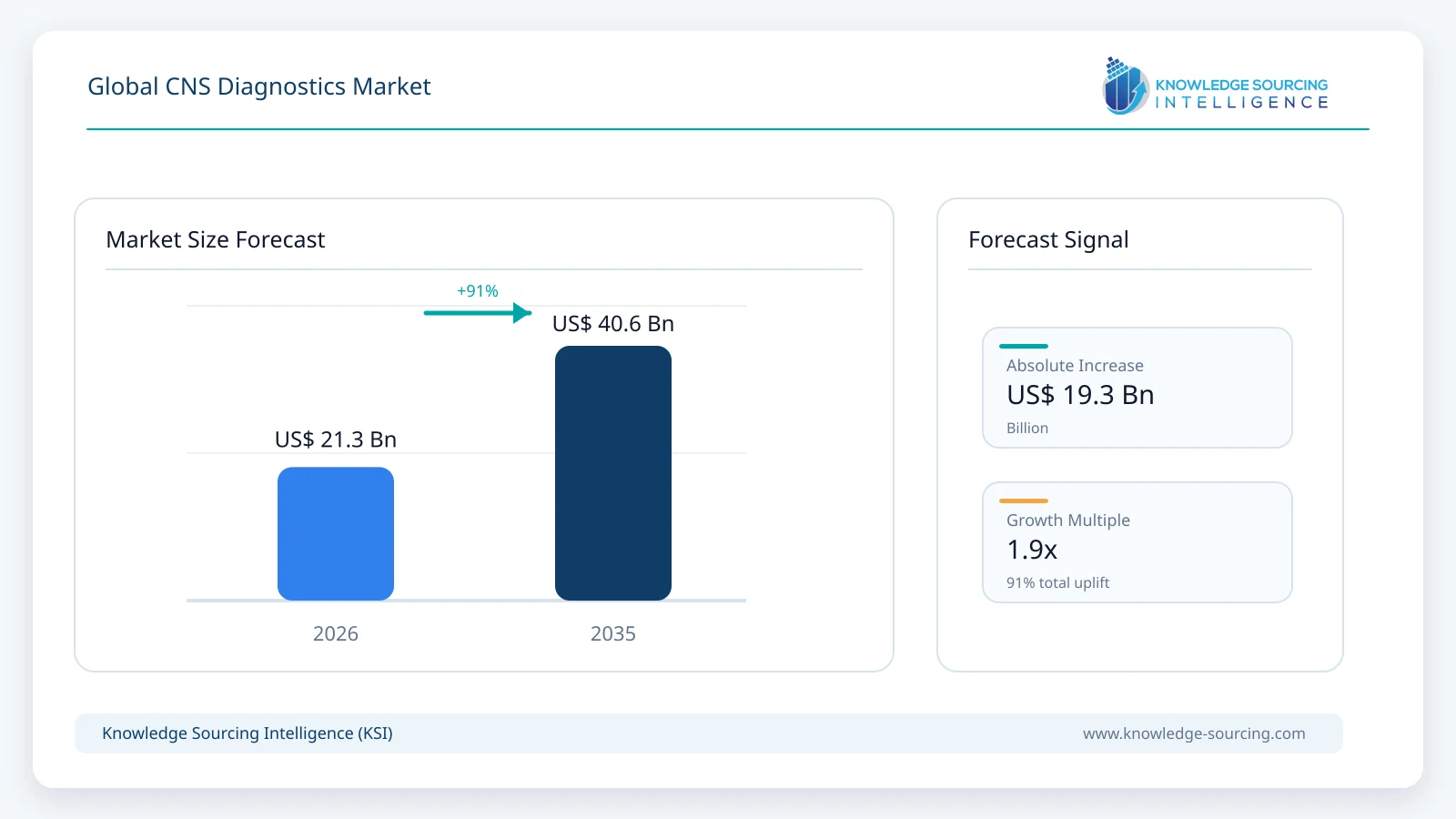
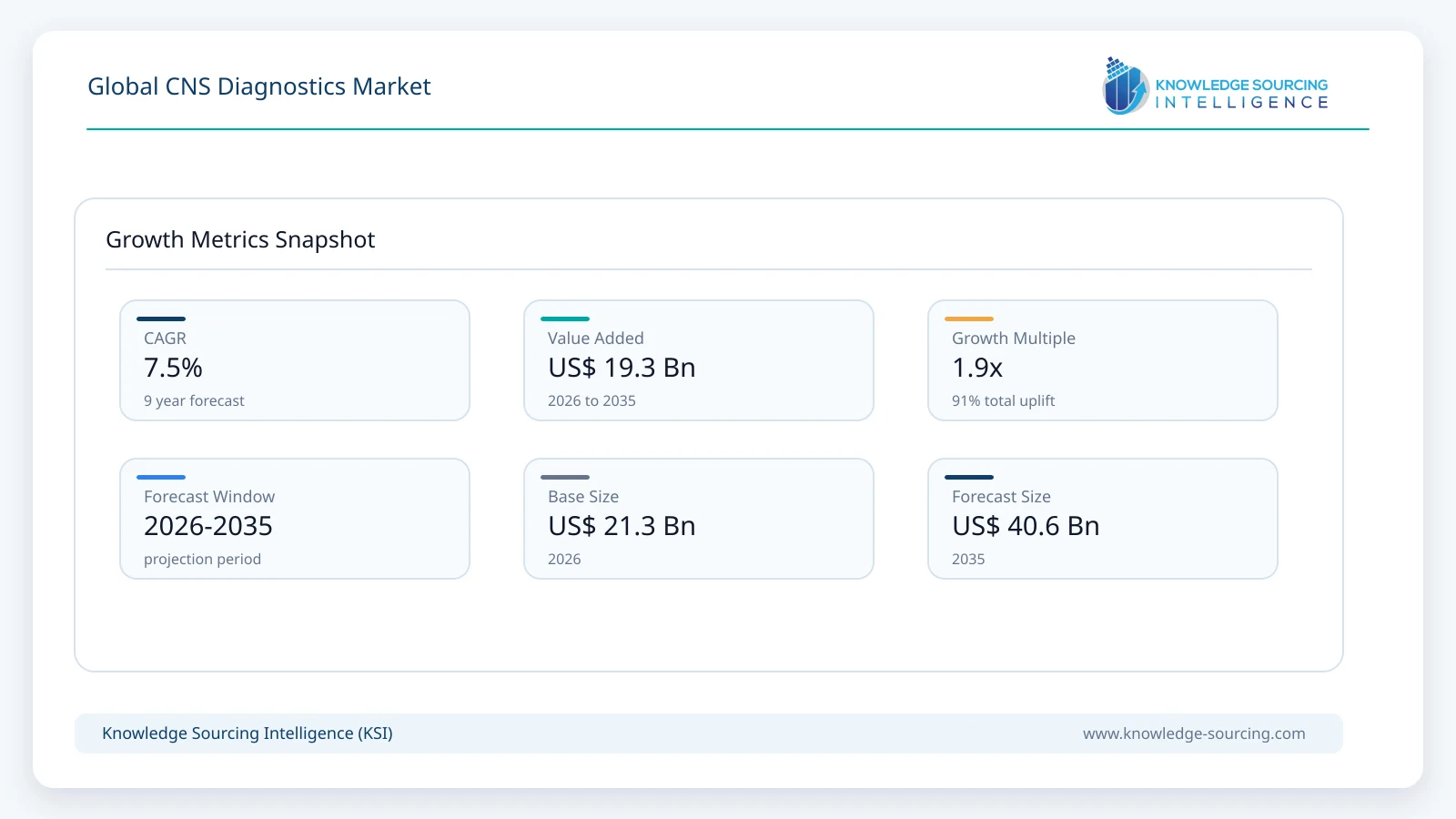
The Global CNS Diagnostics Market is projected to grow at a CAGR of 7.5% the forecast period, increasing from USD 21.26 billion in 2026 to USD 40.59 billion by 2035.
Highlights:
- 1Aging populations are increasing neurodegenerative disease burden, which is accelerating demand for early-stage CNS diagnostic technologies.
- 2Blood-based biomarker testing is expanding because healthcare systems require scalable neurological screening approaches.
- 3AI-assisted neuroimaging adoption is increasing since radiology workloads continue rising across neurology departments.
- 4Hospitals are strengthening neurological imaging infrastructure because CNS therapeutic monitoring increasingly depends on longitudinal diagnostics.
The CNS diagnostics market includes imaging systems, molecular diagnostics, biomarker assays, electrodiagnostic technologies, and genetic testing platforms used to identify and monitor neurological disorders. Diagnostic systems support disease detection across Alzheimer’s disease, Parkinson’s disease, multiple sclerosis, epilepsy, stroke, psychiatric disorders, and brain tumors. Demand is increasing because neurodegenerative and psychiatric disease prevalence continues to rise across aging and urbanized populations.
Healthcare providers are increasing utilization of MRI, PET, and molecular biomarker technologies because neurological diseases require earlier and more accurate differentiation between disease subtypes. Blood-based biomarker development is accelerating because lumbar puncture procedures and imaging-based diagnosis create accessibility and cost constraints. CNS diagnostics therefore increasingly depend on scalable, minimally invasive, and AI-supported technologies.
Regulatory oversight remains strategically important because neurological diagnostics influence therapeutic eligibility and long-term treatment planning. Diagnostic developers are strengthening clinical validation programs since biomarker reliability and algorithm transparency directly affect reimbursement acceptance. The market therefore increasingly prioritizes precision diagnostics capable of supporting both clinical decision-making and therapeutic monitoring.
Market Dynamics
Market Drivers
Rising Burden of Neurodegenerative Disorders: Neurodegenerative diseases remain a major healthcare burden because aging populations continue increasing Alzheimer’s disease and Parkinson’s disease prevalence globally. Healthcare systems are expanding neurological screening initiatives because delayed diagnosis increases institutional care dependency and long-term disability expenditure. Diagnostic manufacturers are strengthening biomarker development because early-stage disease detection improves therapeutic intervention opportunities. CNS diagnostics therefore increasingly support preventive neurological management strategies.
Expansion of AI-Integrated Neuroimaging: Neuroimaging remains central to CNS diagnosis because MRI and PET systems provide structural and functional neurological assessment. Healthcare providers are integrating AI-supported imaging interpretation because radiology workloads continue expanding faster than specialist availability. Diagnostic companies are strengthening machine learning integration since automated lesion detection improves workflow efficiency and diagnostic consistency. CNS imaging systems therefore increasingly combine hardware performance with software-enabled neurological analytics.
Growing Demand for Biomarker-Based Diagnostics: Biomarker-based diagnostics are reshaping neurological assessment because blood and cerebrospinal fluid markers improve disease differentiation and progression monitoring. Diagnostic laboratories are increasing investment in amyloid, tau, and neurofilament light chain testing because therapeutic selection increasingly depends on molecular confirmation. Pharmaceutical developers are collaborating with biomarker companies since CNS therapeutics require precise patient stratification. The market therefore increasingly prioritizes scalable molecular neurology platforms.
Expansion of Precision Neurology: Precision neurology is becoming clinically important because neurological disorders demonstrate substantial biological heterogeneity across patient populations. Clinicians are increasing genetic and molecular testing utilization because targeted therapies require disease subtype validation. Academic neurology centers are strengthening precision diagnostic programs since biomarker-guided intervention improves clinical trial enrollment quality. CNS diagnostics therefore increasingly support personalized neurological treatment frameworks.
Market Restraints
Advanced neuroimaging systems create high infrastructure costs because MRI and PET installations require specialized operational environments.
Biomarker standardization remains limited since neurological disease heterogeneity affects diagnostic reproducibility across laboratories.
Reimbursement variability restricts adoption because many healthcare systems continue limiting coverage for advanced CNS diagnostic testing.
Market Opportunities
Expansion of Blood-Based Alzheimer’s Testing: Blood-based neurological diagnostics are creating significant opportunities because minimally invasive testing improves population-scale screening feasibility. Diagnostic companies are advancing plasma amyloid and tau assays because lumbar puncture procedures limit routine neurological assessment accessibility. Healthcare providers are increasing interest in scalable biomarker screening since neurodegenerative disease prevalence continues rising. CNS diagnostics therefore increasingly support outpatient neurological monitoring expansion.
Growth of Portable Neurodiagnostic Devices: Portable neurodiagnostic technologies are gaining adoption because decentralized neurological care models continue expanding across outpatient and emergency settings. Healthcare systems are increasing investment in mobile EEG and compact imaging solutions because stroke and epilepsy management require rapid neurological assessment. Diagnostic manufacturers are strengthening point-of-care development since rural neurological access remains constrained. The market therefore increasingly favors flexible and scalable neurodiagnostic systems.
AI-Driven Predictive Neurology: Artificial intelligence is improving predictive neurological diagnostics because longitudinal imaging and biomarker datasets enable disease progression modeling. Diagnostic companies are integrating machine learning algorithms since neurological interpretation complexity continues increasing across healthcare systems. Research institutions are expanding AI-supported neurology collaborations because predictive analytics improve treatment planning accuracy. CNS diagnostics therefore increasingly depend on computational neuroscience capabilities.
Government Regulations
Region/Country | Regulatory Authority | Regulatory Focus |
United States | FDA | AI-enabled diagnostics, imaging system approvals, biomarker validation |
Europe | EMA / IVDR / MDR | Clinical evidence requirements, diagnostic performance validation |
Japan | PMDA | Neurological imaging oversight, digital diagnostic regulation |
China | NMPA | Domestic diagnostic innovation, AI medical device approvals |
India | CDSCO | Diagnostic device registration, imaging system compliance |
Market Segmentation
By Diagnostic Type
Neuroimaging remains a foundational diagnostic category because MRI and PET technologies provide structural and functional neurological assessment across multiple CNS disorders. Biomarker-based assays are gaining rapid adoption because minimally invasive neurological testing improves accessibility and disease monitoring scalability. Molecular diagnostics and genetic testing are expanding because neurological heterogeneity increasingly requires subtype-specific evaluation. Electrodiagnostic testing continues supporting epilepsy and neuromuscular disease assessment because electrical neurological activity remains clinically significant for disease differentiation. CNS diagnostic demand therefore increasingly combines imaging precision with molecular and biomarker-driven neurological analysis.
By Indication
Alzheimer’s disease continues driving substantial diagnostic demand because early-stage cognitive decline identification increasingly influences therapeutic eligibility. Stroke diagnostics remain strategically important since rapid neurological intervention directly affects long-term disability outcomes. Multiple sclerosis and Parkinson’s disease testing are expanding because chronic neurological monitoring requires repeated imaging and biomarker evaluation. Psychiatric disorder diagnostics are gradually integrating biological assessment tools because mental health management increasingly depends on measurable neurological indicators. CNS diagnostics therefore increasingly support longitudinal neurological disease management rather than isolated acute evaluation.
By End-User
Hospitals maintain dominant CNS diagnostic utilization because advanced neuroimaging infrastructure and emergency neurological assessment capabilities remain concentrated within tertiary care systems. Diagnostic laboratories are increasing biomarker and molecular testing capacity because outpatient neurological screening demand continues expanding. Neurology clinics are adopting integrated diagnostic platforms since chronic neurological disease monitoring requires faster clinical interpretation. Academic and research institutes remain strategically important because neurological biomarker validation and AI diagnostic development continue depending on translational neuroscience research. The CNS diagnostics market therefore increasingly operates through interconnected imaging, laboratory, and specialty-neurology ecosystems.
Regional Analysis
North America Market Analysis
North America maintains strong CNS diagnostic demand because advanced healthcare infrastructure supports widespread neuroimaging and biomarker testing adoption. Healthcare providers are increasing investment in precision neurology because Alzheimer’s disease prevalence and psychiatric disorder diagnosis rates continue rising across aging populations. Hospitals are integrating AI-supported imaging platforms because radiologist shortages and neurological imaging volumes are increasing simultaneously. Diagnostic companies are expanding biomarker commercialization since disease-modifying CNS therapies increasingly require molecular confirmation before treatment initiation.
The United States dominates regional diagnostic adoption because reimbursement systems support advanced neurological imaging and specialty laboratory testing. Academic neuroscience research remains highly active, which is accelerating biomarker validation and AI-supported neurological diagnostics development. Pharmaceutical collaborations with diagnostic manufacturers are increasing because companion diagnostics are becoming central to neurodegenerative therapy commercialization. The regional market therefore increasingly favors integrated imaging, molecular diagnostics, and digital neurology ecosystems.
Europe Market Analysis
Europe maintains significant CNS diagnostics demand because public healthcare systems continue prioritizing neurological disease burden reduction and early intervention. Regulatory frameworks are becoming more stringent since IVDR implementation increases clinical evidence requirements for diagnostic assays and AI-enabled platforms. Diagnostic manufacturers are strengthening biomarker validation programs because reimbursement agencies increasingly require demonstrated neurological outcome relevance.
Western European healthcare systems maintain strong MRI and PET utilization because neurodegenerative disease management depends heavily on longitudinal neurological imaging. Academic neurology collaborations are expanding because biomarker harmonization remains necessary for broader clinical adoption. Blood-based Alzheimer’s diagnostics are gaining traction since healthcare providers require scalable alternatives to invasive cerebrospinal fluid testing. The regional market therefore increasingly depends on standardized biomarker validation and integrated neurological care pathways.
Asia Pacific Market Analysis
Asia Pacific is experiencing rapid CNS diagnostics expansion because aging populations and urban neurological disease burden continue increasing across major healthcare economies. Governments are strengthening neurological infrastructure investment since untreated neurodegenerative disorders are increasing healthcare dependency and economic burden. Diagnostic companies are increasing regional manufacturing partnerships because healthcare systems require more affordable imaging and molecular testing access.
Japan remains strategically important because advanced aging demographics continue increasing neurodegenerative diagnostic demand. China is accelerating AI-enabled diagnostics adoption because healthcare modernization initiatives prioritize digital medical infrastructure. India is expanding neurological imaging access because urban tertiary hospitals continue strengthening specialty-care capabilities. The regional market therefore increasingly supports both scalable neuroimaging systems and lower-cost biomarker diagnostics.
Rest of the World
Latin America, the Middle East, and Africa continue expanding CNS diagnostic access because neurological disease awareness and healthcare investment are increasing gradually. Healthcare providers are prioritizing stroke and epilepsy diagnostics because emergency neurological intervention remains clinically significant in resource-constrained environments. Imaging accessibility remains uneven since MRI and PET infrastructure require substantial capital investment and specialized workforce availability.
Diagnostic laboratories are increasing biomarker testing partnerships because blood-based neurological assays improve accessibility compared with advanced imaging modalities. International diagnostics companies are expanding regional collaborations since neurological disease prevalence continues increasing across urban populations. Governments are strengthening digital health investment because remote neurological interpretation improves specialist accessibility. The broader regional market therefore increasingly depends on affordable molecular diagnostics and scalable neurological screening programs.
Regulatory Landscape
The CNS diagnostics regulatory environment is becoming more rigorous because neurological biomarkers and AI-enabled systems directly influence treatment selection and long-term disease management. Regulatory agencies are increasing scrutiny of algorithm transparency because machine learning systems require reproducible neurological interpretation across diverse patient populations. Diagnostic developers are strengthening clinical validation studies since biomarker inconsistency and imaging variability continue affecting approval pathways.
The U.S. FDA continues expanding oversight of AI-enabled medical devices because software-assisted diagnostics are increasingly integrated into neurological workflows. Europe’s IVDR framework is increasing evidence requirements because neurological diagnostic assays require stronger clinical validation and post-market surveillance. Japan’s PMDA is strengthening digital diagnostic oversight since aging populations continue increasing demand for precision neurology technologies. China’s NMPA is supporting domestic AI diagnostic innovation because healthcare digitization remains a national strategic priority.
Regulatory harmonization remains limited because biomarker thresholds and AI validation standards vary significantly across healthcare systems. Diagnostic manufacturers are increasing multinational clinical studies since global commercialization depends on region-specific compliance requirements. The CNS diagnostics market therefore increasingly prioritizes standardized biomarker validation, AI transparency, and longitudinal clinical evidence generation.
Pipeline Analysis
The CNS diagnostics pipeline is increasingly focusing on blood-based neurological biomarkers because minimally invasive testing improves scalability and patient compliance. Companies are advancing plasma amyloid and tau assays since Alzheimer’s disease diagnosis increasingly depends on early molecular detection. Neurofilament light chain testing is gaining development attention because neuronal injury monitoring supports multiple neurological disease applications. CNS diagnostics therefore increasingly depend on high-sensitivity biomarker platforms.
Artificial intelligence is reshaping diagnostic development because neurological imaging interpretation requires large-scale pattern recognition and longitudinal disease tracking. Diagnostic manufacturers are integrating machine learning into MRI and PET workflows since automated lesion analysis improves clinical efficiency. AI-supported stroke and neurodegenerative assessment tools are expanding because emergency neurological intervention increasingly depends on rapid imaging interpretation.
Genetic testing platforms are gaining pipeline importance because neurological disorders increasingly demonstrate subtype-specific molecular characteristics. Research institutions are expanding precision neurology collaborations since targeted CNS therapeutics require biomarker-confirmed patient populations. The diagnostic pipeline therefore increasingly aligns with personalized neurology and companion diagnostic integration.
Competitive Landscape
GE HealthCare
GE HealthCare remains strategically differentiated because the company combines advanced neuroimaging infrastructure with AI-supported neurological workflow integration. SIGNA MRI systems maintain strong neurology utilization because high-resolution brain imaging remains essential for stroke, tumor, and neurodegenerative assessment. The company is strengthening PET imaging capabilities since Alzheimer’s disease monitoring increasingly depends on molecular imaging precision. GE HealthCare therefore increasingly benefits from integrated imaging analytics and hospital-based neurology infrastructure expansion.
Siemens Healthineers
Siemens Healthineers maintains strong CNS diagnostic positioning because MRI and PET imaging remain foundational neurological assessment technologies globally. MAGNETOM and Biograph systems support advanced neurodegenerative imaging because healthcare providers require improved lesion characterization and longitudinal disease monitoring. The company is increasing AI-enabled imaging integration since radiology efficiency pressures continue rising across tertiary healthcare systems. Siemens Healthineers therefore increasingly focuses on precision imaging and digital neurology ecosystems.
Philips
Philips remains strategically important because the company combines neuroimaging systems with AI-enabled neurological software platforms. Ingenia MRI systems support advanced brain imaging since neurological disease monitoring increasingly depends on imaging consistency and workflow efficiency. Philips is strengthening digital neurology development because integrated software analytics improve radiology productivity and interpretation accuracy. The company therefore increasingly aligns imaging infrastructure with connected neurological care models.
F. Hoffmann-La Roche Ltd
Roche maintains strong biomarker positioning because Elecsys neurological assays support molecular confirmation of neurodegenerative disease progression. The company is expanding amyloid and cerebrospinal fluid biomarker development since disease-modifying Alzheimer’s therapies increasingly require validated patient stratification. Roche is strengthening companion diagnostic integration because CNS therapeutic eligibility now depends heavily on molecular neurological evidence. The company therefore increasingly benefits from combined diagnostics and pharmaceutical capabilities.
Quest Diagnostics
Quest Diagnostics remains strategically differentiated because the company combines large-scale laboratory infrastructure with expanding neurology testing capabilities. Alzheimer’s biomarker testing services are gaining relevance since outpatient neurological screening demand continues increasing. Genetic neurology panels support precision diagnostic expansion because inherited neurological disorders require subtype-specific molecular evaluation. Quest Diagnostics therefore increasingly benefits from scalable laboratory logistics and broad outpatient diagnostic access.
Bio-Rad Laboratories
Bio-Rad Laboratories maintains strategic CNS relevance because droplet digital PCR systems support highly sensitive neurological biomarker analysis. Molecular diagnostic demand is increasing since neurodegenerative disease assessment increasingly depends on precise biomarker quantification. The company is strengthening ddPCR platform development because neurological research institutions require advanced molecular analysis tools. Bio-Rad therefore increasingly aligns with precision biomarker and translational neuroscience demand.
Quanterix Corporation
Quanterix remains strongly positioned because Simoa technology enables ultra-sensitive neurological biomarker detection across neurodegenerative disorders. Blood-based neurofilament light chain testing is expanding because clinicians require scalable neuronal injury monitoring tools. The company is strengthening biomarker commercialization because minimally invasive neurological testing increasingly supports outpatient disease monitoring. Quanterix therefore increasingly benefits from precision biomarker scalability and neurodegenerative disease screening expansion.
Fujirebio
Fujirebio maintains strategic differentiation because Lumipulse biomarker assays support automated neurodegenerative disease assessment workflows. Alzheimer’s disease diagnostics demand is increasing since biomarker-confirmed patient identification increasingly influences therapeutic access. The company is advancing tau and amyloid testing because blood-based neurological diagnostics are improving scalability and accessibility. Fujirebio therefore increasingly focuses on automated biomarker integration and precision neurology expansion.
Key Developments
March 2026: Alamar Biosciences, Inc., a leader in precision proteomics dedicated to advancing the early detection of disease, announced the launch of the NULISAseq Neuro 220 Panel with multiplexed measurement of 220 biomarkers from a single sample while maintaining ultra-high sensitivity and high specificity.
April 2025: Belay Diagnostics, a CLIA/CAP accredited laboratory focused on the development and commercialization of molecular diagnostics targeting central nervous system (CNS) cancers, announced the results of the analytical validation and clinical sensitivity study of the Belay Summit™ assay for detection of DNA variants in cerebrospinal fluid (CSF) of primary and metastatic CNS cancers.
Strategic Insights and Future Market Outlook
The CNS diagnostics market is transitioning toward precision neurology because disease-modifying therapies increasingly require biomarker-confirmed patient selection. Diagnostic companies are strengthening AI integration since neurological imaging workloads continue expanding faster than specialist availability. Blood-based biomarkers are becoming commercially important because healthcare systems require scalable and less invasive neurological screening solutions.
Companion diagnostics are gaining strategic importance because pharmaceutical companies increasingly depend on validated molecular confirmation before therapeutic initiation. Neuroimaging platforms are integrating advanced analytics because longitudinal neurological monitoring requires more consistent and automated interpretation frameworks. Diagnostic developers are increasing partnerships with biotechnology and pharmaceutical firms since neurological treatment pathways increasingly depend on integrated diagnostic ecosystems.
Healthcare systems are likely increasing investment in early neurological intervention because aging populations continue elevating neurodegenerative disease burden and long-term disability costs. Companies capable of combining imaging precision, biomarker scalability, and AI-supported analytics are likely strengthening long-term competitive positioning because precision neurology continues reshaping global CNS care pathways.
The global CNS diagnostics market therefore continues evolving toward integrated biomarker-imaging ecosystems, AI-enabled neurological interpretation, and scalable precision neurology infrastructure as neurodegenerative and psychiatric disease burden expands globally.
Global CNS Diagnostics Market Scope:
| Report Metric | Details |
|---|---|
| Total Market Size in 2026 | USD 21.26 billion |
| Total Market Size in 2035 | USD 40.59 billion |
| Forecast Unit | USD Billion |
| Growth Rate | 7.5% |
| Study Period | 2021 to 2035 |
| Historical Data | 2021 to 2024 |
| Base Year | 2025 |
| Forecast Period | 2026 – 2035 |
| Segmentation | Diagnostic Type, Indication, End User, Geography |
| Companies |
|
Market Segmentation
By Geography
Key Countries Analysis
Regulatory & Policy Landscape
Table of Contents
1. EXECUTIVE SUMMARY
1.1 Market Snapshot
1.2 Key Findings
1.3 Strategic Insights
1.4 CNS Diagnostics Market Overview
1.5 Key Demand Drivers
1.6 Competitive Benchmarking
1.7 Technology Evolution Summary
1.8 Regional Market Highlights
1.9 Future Outlook
2. DISEASE & EPIDEMIOLOGY ANALYSIS
2.1 Overview of Central Nervous System Disorders
2.2 Epidemiology Burden of CNS Diseases
2.3 Epidemiology by Major CNS Indications
2.3.1 Alzheimer’s Disease
2.3.2 Parkinson’s Disease
2.3.3 Multiple Sclerosis
2.3.4 Epilepsy
2.3.5 Brain Tumors
2.3.6 Stroke and Cerebrovascular Disorders
2.3.7 Migraine Disorders
2.3.8 Schizophrenia
2.3.9 Major Depressive Disorder
2.3.10 Amyotrophic Lateral Sclerosis (ALS)
2.4 Prevalence Analysis
2.5 Incidence Analysis
2.6 Mortality and Disability Burden
2.7 Diagnosed Patient Population
2.8 Early Diagnosis Trends
2.9 Age-Based Epidemiology Analysis
2.10 Gender-Based Epidemiology Analysis
2.11 Genetic and Environmental Risk Factors
2.12 Disease Progression and Diagnostic Challenges
2.13 Epidemiology Forecast Analysis
3. MARKET DYNAMICS
3.1 Market Overview
3.2 Market Drivers
3.2.1 Rising Burden of Neurodegenerative Disorders
3.2.2 Growing Demand for Early CNS Diagnosis
3.2.3 Expansion of Advanced Neuroimaging Technologies
3.2.4 Increasing Biomarker-Based Diagnostics Adoption
3.2.5 Rising AI Integration in Neurological Diagnostics
3.3 Market Restraints
3.3.1 High Cost of Advanced Diagnostic Systems
3.3.2 Limited Access to Neurology Infrastructure
3.3.3 Diagnostic Complexity in Neurodegenerative Diseases
3.3.4 Reimbursement Limitations for Advanced CNS Testing
3.4 Market Opportunities
3.4.1 Development of Blood-Based Biomarkers
3.4.2 Expansion of Portable Neurodiagnostic Devices
3.4.3 AI-Assisted Imaging Interpretation
3.4.4 Growth in Precision Neurology
3.5 Market Challenges
3.5.1 False Positives and Diagnostic Variability
3.5.2 Regulatory Complexity for AI Diagnostics
3.5.3 Limited Standardization of Biomarker Testing
3.6 Porter’s Five Forces Analysis
3.7 PESTLE Analysis
3.8 Value Chain Analysis
3.9 Pricing Analysis
3.10 Reimbursement Analysis
3.11 Investment and Funding Trends
4. COMMERCIAL & MARKET ACCESS
4.1 Market Access Overview
4.2 Reimbursement Landscape
4.2.1 Public Reimbursement Systems
4.2.2 Private Insurance Coverage
4.2.3 Diagnostic Coding and Payment Policies
4.3 Commercialization Strategies
4.4 Hospital Procurement Trends
4.5 Laboratory Network Expansion
4.6 Distribution and Supply Chain Overview
4.7 Market Access Barriers
4.8 Stakeholder Analysis
4.9 Adoption Trends in Neurology Diagnostics
4.10 Health Technology Assessment (HTA) Trends
5. INNOVATION & PIPELINE LANDSCAPE
5.1 Innovation Overview
5.2 CNS Diagnostic Technology Trends
5.3 Pipeline Analysis by Development Stage
5.3.1 Commercialized Technologies
5.3.2 Late-Stage Diagnostic Pipelines
5.3.3 Early-Stage Diagnostic Innovations
5.4 Pipeline Analysis by Modality
5.4.1 Molecular Diagnostics
5.4.2 Neuroimaging Technologies
5.4.3 Genetic Testing Platforms
5.4.4 Biomarker Assays
5.4.5 AI-Based Diagnostic Software
5.5 Biomarker Innovation Landscape
5.5.1 Amyloid Biomarkers
5.5.2 Tau Biomarkers
5.5.3 Neurofilament Light Chain Biomarkers
5.5.4 Synuclein Biomarkers
5.6 AI and Machine Learning in CNS Diagnostics
5.7 Digital Neurology and Remote Monitoring
5.8 Clinical Trial Landscape for CNS Diagnostics
5.9 Collaborations, Partnerships, and M&A Activities
5.10 Emerging Diagnostic Technologies
6. TREATMENT LANDSCAPE
6.1 Role of Diagnostics in CNS Treatment Pathways
6.2 Companion Diagnostics in Neurology
6.3 Diagnostic-Guided Treatment Decision Making
6.4 Imaging in CNS Disease Management
6.4.1 MRI-Based Neurological Assessment
6.4.2 PET Imaging in Alzheimer’s Disease
6.4.3 CT Imaging in Stroke Diagnosis
6.5 Molecular and Genetic Testing Applications
6.6 Biomarker-Guided Therapy Monitoring
6.7 Point-of-Care Neurological Diagnostics
6.8 Personalized Neurology Approaches
6.9 Integration of Diagnostics with CNS Therapeutics
6.10 Future Trends in Precision Diagnostics
7. GLOBAL CNS DIAGNOSTICS MARKET SIZE & FORECAST
7.1 Global Market Size Overview
7.2 Historical Market Analysis
7.3 Forecast Market Analysis
7.4 Market Forecast by Diagnostic Type
7.5 Market Forecast by Indication
7.6 Market Forecast by End User
7.7 Market Forecast by Region
7.8 Market Attractiveness Analysis
7.9 Scenario Analysis
7.10 Forecast Assumptions and Methodology
8. GLOBAL CNS DIAGNOSTICS MARKET SEGMENTATION
8.1 By Diagnostic Type
8.1.1 Neuroimaging
8.1.2 Molecular Diagnostics
8.1.3 Genetic Testing
8.1.4 Biomarker-Based Assays
8.1.5 Electrodiagnostic Testing
8.2 By Indication
8.2.1 Alzheimer’s Disease
8.2.2 Parkinson’s Disease
8.2.3 Multiple Sclerosis
8.2.4 Epilepsy
8.2.5 Stroke
8.2.6 Brain Tumors
8.2.7 Psychiatric Disorders
8.3 By End User
8.3.1 Hospitals
8.3.2 Neurology Clinics
8.3.3 Diagnostic Laboratories
8.3.4 Academic and Research Institutes
8.4 By Technology
8.4.1 MRI
8.4.2 PET
8.4.3 CT
8.4.4 EEG
8.4.5 Next-Generation Sequencing
8.4.6 Immunoassays
9. GEOGRAPHICAL ANALYSIS
9.1 North America
9.1.1 Market Size and Forecast
9.1.2 Key Demand Drivers
9.1.3 Regional Regulatory Overview
9.1.4 Competitive Intensity
9.1.5 Innovation and Technology Trends
9.2 Europe
9.2.1 Market Size and Forecast
9.2.2 Key Demand Drivers
9.2.3 Regional Regulatory Overview
9.2.4 Competitive Intensity
9.2.5 Innovation and Technology Trends
9.3 Asia-Pacific
9.3.1 Market Size and Forecast
9.3.2 Key Demand Drivers
9.3.3 Regional Regulatory Overview
9.3.4 Competitive Intensity
9.3.5 Innovation and Technology Trends
9.4 Latin America
9.4.1 Market Size and Forecast
9.4.2 Key Demand Drivers
9.4.3 Regional Regulatory Overview
9.4.4 Competitive Intensity
9.4.5 Innovation and Technology Trends
9.5 Middle East & Africa
9.5.1 Market Size and Forecast
9.5.2 Key Demand Drivers
9.5.3 Regional Regulatory Overview
9.5.4 Competitive Intensity
9.5.5 Innovation and Technology Trends
10. KEY COUNTRIES ANALYSIS
10.1 United States
10.1.1 Market Size and Forecast
10.1.2 CNS Disease Epidemiology
10.1.3 FDA Regulatory Framework
10.1.4 Reimbursement Landscape
10.1.5 Key Companies and Diagnostic Products Presence
10.2 Canada
10.2.1 Market Size and Forecast
10.2.2 CNS Disease Epidemiology
10.2.3 Regulatory Framework
10.2.4 Reimbursement Landscape
10.2.5 Key Companies and Diagnostic Products Presence
10.3 Germany
10.3.1 Market Size and Forecast
10.3.2 CNS Disease Epidemiology
10.3.3 Regulatory Framework
10.3.4 Reimbursement Landscape
10.3.5 Key Companies and Diagnostic Products Presence
10.4 United Kingdom
10.4.1 Market Size and Forecast
10.4.2 CNS Disease Epidemiology
10.4.3 Regulatory Framework
10.4.4 Reimbursement Landscape
10.4.5 Key Companies and Diagnostic Products Presence
10.5 France
10.5.1 Market Size and Forecast
10.5.2 CNS Disease Epidemiology
10.5.3 Regulatory Framework
10.5.4 Reimbursement Landscape
10.5.5 Key Companies and Diagnostic Products Presence
10.6 Italy
10.6.1 Market Size and Forecast
10.6.2 CNS Disease Epidemiology
10.6.3 Regulatory Framework
10.6.4 Reimbursement Landscape
10.6.5 Key Companies and Diagnostic Products Presence
10.7 Spain
10.7.1 Market Size and Forecast
10.7.2 CNS Disease Epidemiology
10.7.3 Regulatory Framework
10.7.4 Reimbursement Landscape
10.7.5 Key Companies and Diagnostic Products Presence
10.8 China
10.8.1 Market Size and Forecast
10.8.2 CNS Disease Epidemiology
10.8.3 NMPA Regulatory Framework
10.8.4 Reimbursement Landscape
10.8.5 Key Companies and Diagnostic Products Presence
10.9 Japan
10.9.1 Market Size and Forecast
10.9.2 CNS Disease Epidemiology
10.9.3 PMDA Regulatory Framework
10.9.4 Reimbursement Landscape
10.9.5 Key Companies and Diagnostic Products Presence
10.10 India
10.10.1 Market Size and Forecast
10.10.2 CNS Disease Epidemiology
10.10.3 CDSCO Regulatory Framework
10.10.4 Reimbursement Landscape
10.10.5 Key Companies and Diagnostic Products Presence
10.11 South Korea
10.11.1 Market Size and Forecast
10.11.2 CNS Disease Epidemiology
10.11.3 Regulatory Framework
10.11.4 Reimbursement Landscape
10.11.5 Key Companies and Diagnostic Products Presence
10.12 Australia
10.12.1 Market Size and Forecast
10.12.2 CNS Disease Epidemiology
10.12.3 Regulatory Framework
10.12.4 Reimbursement Landscape
10.12.5 Key Companies and Diagnostic Products Presence
10.13 Brazil
10.13.1 Market Size and Forecast
10.13.2 CNS Disease Epidemiology
10.13.3 Regulatory Framework
10.13.4 Reimbursement Landscape
10.13.5 Key Companies and Diagnostic Products Presence
10.14 Mexico
10.14.1 Market Size and Forecast
10.14.2 CNS Disease Epidemiology
10.14.3 Regulatory Framework
10.14.4 Reimbursement Landscape
10.14.5 Key Companies and Diagnostic Products Presence
10.15 Saudi Arabia
10.15.1 Market Size and Forecast
10.15.2 CNS Disease Epidemiology
10.15.3 Regulatory Framework
10.15.4 Reimbursement Landscape
10.15.5 Key Companies and Diagnostic Products Presence
10.16 South Africa
10.16.1 Market Size and Forecast
10.16.2 CNS Disease Epidemiology
10.16.3 Regulatory Framework
10.16.4 Reimbursement Landscape
10.16.5 Key Companies and Diagnostic Products Presence
11. REGULATORY & POLICY LANDSCAPE
11.1 Regulatory Overview for CNS Diagnostics
11.2 United States FDA Framework
11.3 Europe IVDR and MDR Framework
11.4 Japan PMDA Framework
11.5 India CDSCO Framework
11.6 China NMPA Framework
11.7 AI and Software-as-Medical-Device Regulations
11.8 Clinical Validation Requirements
11.9 Diagnostic Reimbursement Policies
11.10 Data Privacy and Digital Health Regulations
11.11 Quality Standards and Compliance
11.12 Policy Impact Analysis
12. COMPETITIVE LANDSCAPE
12.1 Competitive Environment Overview
12.2 Market Share Analysis
12.3 Technology Benchmarking
12.4 Strategic Initiatives
12.4.1 Partnerships and Collaborations
12.4.2 Product Launches
12.4.3 Acquisitions and M&A Activities
12.4.4 Research and Development Investments
12.5 Innovation Positioning Matrix
12.6 SWOT Analysis
12.7 Strategic Recommendations
13. COMPANY PROFILES
13.1 GE HealthCare
13.1.1 Company Overview
13.1.2 CNS Diagnostics Portfolio
13.1.3 Approved Diagnostic Platforms
13.1.3.1 SIGNA MRI Systems – Neurological Imaging
13.1.3.2 PET Imaging Solutions – Alzheimer’s Disease Assessment
13.1.4 Pipeline and AI Innovations
13.1.5 Strategic Developments
13.2 Siemens Healthineers
13.2.1 Company Overview
13.2.2 CNS Diagnostics Portfolio
13.2.3 Approved Diagnostic Platforms
13.2.3.1 MAGNETOM MRI Systems – Neurological Imaging
13.2.3.2 Biograph PET/CT Systems – Neurodegenerative Diagnostics
13.2.4 Pipeline and AI Innovations
13.2.5 Strategic Developments
13.3 Philips
13.3.1 Company Overview
13.3.2 CNS Diagnostics Portfolio
13.3.3 Approved Diagnostic Platforms
13.3.3.1 Ingenia MRI Systems – Brain Imaging
13.3.3.2 AI-Enabled Neuroimaging Software
13.3.4 Pipeline and Digital Innovations
13.3.5 Strategic Developments
13.4 F. Hoffmann-La Roche Ltd
13.4.1 Company Overview
13.4.2 CNS Biomarker Portfolio
13.4.3 Approved Diagnostic Assays
13.4.3.1 Elecsys Amyloid Plasma Panel – Alzheimer’s Disease
13.4.3.2 Elecsys CSF Biomarker Assays – Neurodegenerative Disorders
13.4.4 Pipeline Biomarker Programs
13.4.5 Strategic Developments
13.5 Quest Diagnostics
13.5.1 Company Overview
13.5.2 Neurology Diagnostics Portfolio
13.5.3 Approved and Commercialized Testing Services
13.5.3.1 Alzheimer’s Biomarker Testing Services
13.5.3.2 Genetic Neurology Panels
13.5.4 Pipeline Diagnostic Expansion
13.5.5 Strategic Developments
13.6 Bio-Rad Laboratories
13.6.1 Company Overview
13.6.2 CNS Diagnostics Portfolio
13.6.3 Approved Diagnostic Platforms
13.6.3.1 Droplet Digital PCR Systems – Neurological Biomarker Analysis
13.6.3.2 QX600 ddPCR System – Molecular Diagnostics
13.6.4 Pipeline Development Programs
13.6.5 Strategic Developments
13.7 Quanterix Corporation
13.7.1 Company Overview
13.7.2 CNS Biomarker Portfolio
13.7.3 Commercialized Diagnostic Platforms
13.7.3.1 Simoa Technology – Neurodegenerative Biomarker Detection
13.7.3.2 Blood-Based NfL Testing Solutions
13.7.4 Pipeline Biomarker Programs
13.7.5 Strategic Developments
13.8 Fujirebio
13.8.1 Company Overview
13.8.2 CNS Diagnostics Portfolio
13.8.3 Approved Diagnostic Assays
13.8.3.1 Lumipulse G ?-Amyloid Ratio Assays – Alzheimer’s Disease
13.8.3.2 Tau Biomarker Assays – Neurodegenerative Disorders
13.8.4 Pipeline Programs
13.8.5 Strategic Developments
14. FUTURE OUTLOOK
14.1 Future Market Projections
14.2 Expansion of Blood-Based CNS Biomarkers
14.3 AI-Driven Neurology Diagnostics Outlook
14.4 Future of Precision Neurology
14.5 Integration of Diagnostics and Therapeutics
14.6 Future Regulatory Trends
14.7 Investment and Funding Outlook
14.8 Strategic Recommendations for Stakeholders
15. METHODOLOGY
15.1 Research Methodology Overview
15.2 Secondary Research Sources
15.3 Primary Research Methodology
15.4 Market Size Estimation Approach
15.5 Forecasting Methodology
15.6 Data Validation and Triangulation
15.7 Assumptions and Limitations
15.8 Abbreviations and Definitions
Navigate
Trusted by the world's leading organizations











