
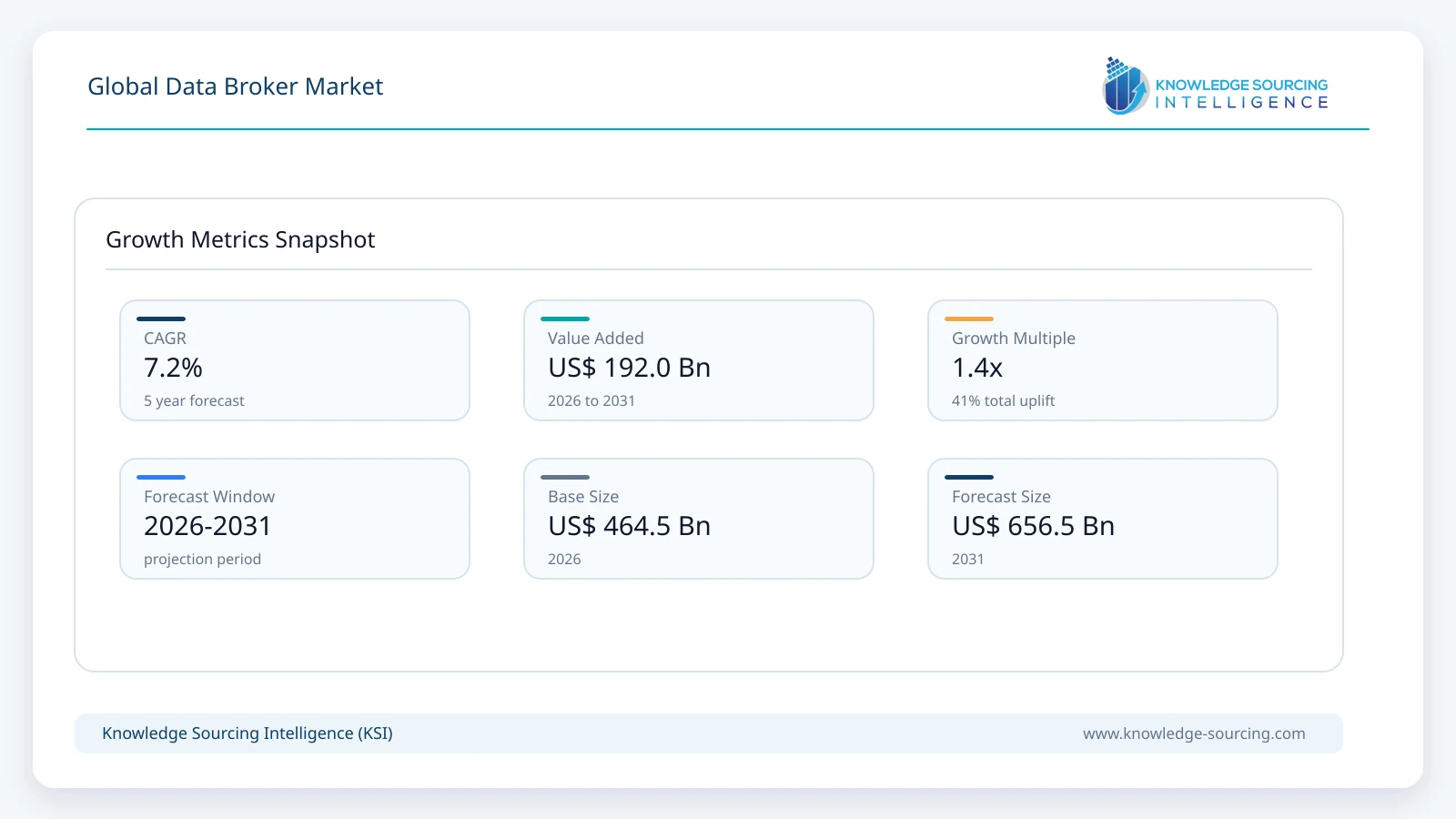
The global data broker market is set to reach USD 656.5 billion in 2031, growing at a CAGR of 7.2% from a valuation of USD 464.5 billion in 2026.
Highlights:
- 1Consumer data accounts for approximately 46% of the market in 2026, remaining the largest data category despite slower growth than business and health data.
- 2Marketing and audience intelligence represents about 43% of market value in 2026, but risk, identity and compliance applications gain relative importance through 2031.
- 3Identity, fraud and compliance applications are projected to grow at approximately 10.9% CAGR, reflecting rising digital identity risk and demand for verified third-party signals.
- 4BFSI accounts for approximately 31% of the market in 2026, supported by credit, underwriting, fraud, identity and financial-risk use cases.
- 5North America represents approximately 45% of the global market in 2026, reflecting the concentration of large commercial-data, credit-information and advertising-data companies.
- 6Asia Pacific is projected to grow at approximately 10.8% CAGR, supported by digital commerce, financial digitization and increasing use of external data in enterprise decisioning.
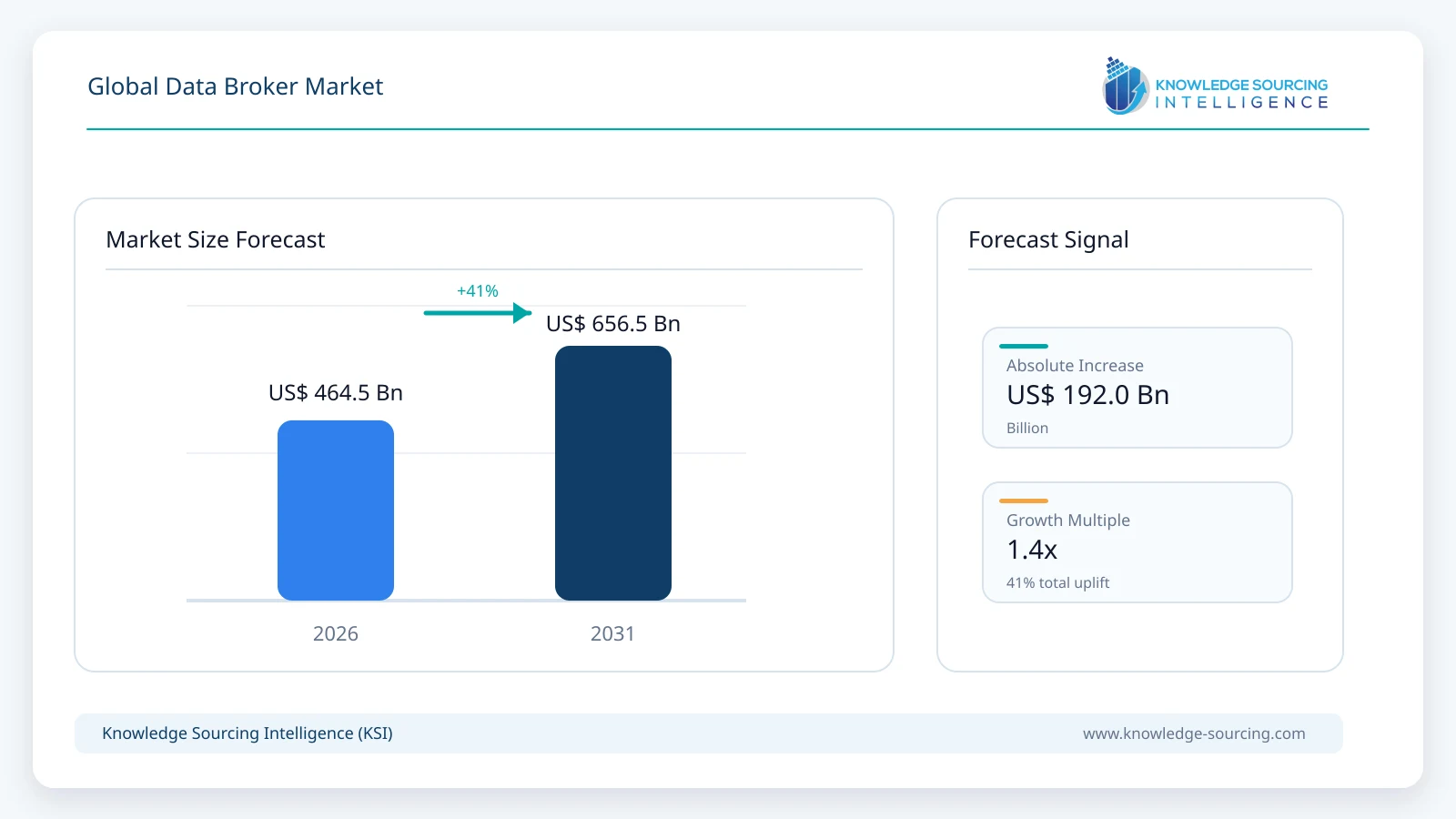
The market is moving beyond conventional lists and audience datasets toward persistent data enrichment, identity resolution, risk intelligence and AI-ready data services that are embedded directly into enterprise workflows.
This transition is changing what customers purchase from data brokers. Marketing and advertising remain major uses of third-party information, but financial institutions, retailers, healthcare organizations and digital platforms increasingly require verified identities, employment and income data, business relationships, fraud signals, alternative credit information and permissioned consumer attributes. Experian describes its data activities across credit, automotive, healthcare and marketing, while Equifax maintains large consumer, commercial and employment databases used in lending, identity verification and risk decisions. LexisNexis Risk Solutions similarly combines proprietary and public information with analytics across business services, insurance, healthcare and government markets.
Artificial intelligence is creating another layer of demand. Enterprise AI systems require reliable external context rather than simply larger volumes of unverified information. Dun & Bradstreet is integrating its Commercial Graph into AI tools and enterprise workflows, while LiveRamp has expanded its marketplace beyond conventional audience data to include datasets, AI models and agent-based applications. This increases the strategic value of structured, permissioned and continuously maintained data assets.
At the same time, privacy regulation is materially changing market economics. California’s Delete Request and Opt-Out Platform now allows consumers to direct deletion requests across registered brokers, and from August 2026 brokers must access the mechanism at least once every 45 days and process applicable requests. U.S. restrictions on transactions involving bulk sensitive data with countries of concern also directly cover data-brokerage transactions. These measures do not eliminate commercial demand for external data, but they increase the value of provenance, consent, governance and auditable data processing.
Market Growth Drivers and Trends
AI Systems Are Increasing Demand for Verified External Data
The rise of enterprise AI is creating a new distribution channel for commercial data rather than eliminating the need for data suppliers. AI agents used in finance, sales, risk and research need verified information on companies, consumers, ownership relationships, identities and transactions before they can automate decisions reliably. In June 2026, Dun & Bradstreet announced an integration that brings its Commercial Graph into ChatGPT and Codex, allowing financial professionals to access business identity, ownership, credit and risk information through AI-enabled workflows. The company states that its Commercial Graph is continuously validated and used as a context layer for understanding commercial entities and their relationships.
LiveRamp is pursuing a similar evolution in marketing data. Its January 2026 marketplace expansion allows customers to license data for AI training as well as third-party models and AI applications. The development indicates that established data marketplaces are moving from selling datasets for manual analytics toward supplying governed data directly to AI systems and agents.
Credit, Fraud and Identity Use Cases Are Increasing Data Value
Financial decisioning increasingly relies on datasets extending beyond conventional credit files. Equifax’s Work Number contained approximately 209 million active employment records at the end of 2025, alongside a much larger historical database, while its U.S. information-services business combines credit histories, payment records, identities and commercial information for lending and account-opening decisions.
Experian is also expanding the combination of identity, consumer, behavioral and alternative information used in fraud prevention and marketing. Its 2026 annual report identifies consumer identity, device graphs and audience information as important Marketing Services datasets and describes automotive and healthcare businesses built around proprietary industry data. These capabilities support KSI’s expectation that risk, identity and compliance applications will outgrow traditional list-based data brokerage.
Privacy-Safe Data Collaboration Is Replacing Unrestricted Data Movement
Companies increasingly need to extract value from third-party data without moving raw information freely between organizations. This is supporting data clean rooms, cloud-based enrichment and identity-resolution platforms where information can be matched or analyzed under controlled conditions. In June 2026, TransUnion expanded TruIQ Data Enrichment on Snowflake so customers can link and activate TransUnion credit data for prescreen marketing while keeping the workflow within the customer’s Snowflake environment.
LiveRamp’s platform is built around a related collaboration model, connecting advertisers, publishers, technology providers and data suppliers while emphasizing governed access. The commercial significance is that regulation does not necessarily reduce the need for third-party information; it shifts demand toward services that can demonstrate provenance, purpose limitation, security and controlled activation.
Retail Media and Audience Measurement Sustain Consumer-Data Demand
Marketing remains the largest application because retailers, brands and media owners continue to need audience enrichment, prospecting and measurement beyond their own first-party datasets. LiveRamp’s data marketplace and cross-media tools illustrate how third-party attributes are increasingly combined with brand-owned data rather than simply sold as static lists. Experian similarly describes subscriptions and usage-based access to identity graphs, audience segments and campaign-measurement tools as part of its marketing-services model.
The market is therefore moving away from anonymous bulk audience files toward identity-linked, privacy-aware and measurable data products. This helps explain why marketing remains large while its relative share moderates as risk, compliance and AI-oriented uses expand.
Business-Relationship Data Is Becoming Infrastructure for Enterprise Decisioning
Commercial information is gaining strategic value as enterprises automate supplier onboarding, credit assessment, know-your-business processes and account intelligence. Dun & Bradstreet is progressively making its commercial graph available through Microsoft, Snowflake, AI assistants and other enterprise environments, reflecting demand for verified company identities and relationship data inside operational systems rather than standalone databases.
This supports faster growth for business data than consumer data in the KSI model. AI-driven procurement, finance and risk systems require normalized business identities and verified connections across legal entities, suppliers and ownership structures, which increases the value of continuously maintained commercial datasets.
Market Restraints
Centralized Consumer Deletion Is Raising Compliance Costs
California’s Delete Act creates one of the clearest structural challenges for consumer-focused brokers. Beginning in August 2026, registered brokers are required to access the state’s DROP mechanism at least once every 45 days and process applicable deletion requests submitted through the centralized platform. This converts deletion management from an individual broker-by-broker consumer process into a recurring industry-wide operating requirement.
For brokers whose commercial value depends on persistent consumer profiles, deletion obligations can reduce dataset continuity and increase matching, suppression and compliance costs. The burden is particularly material for companies maintaining identifiers across multiple data sources and downstream customers.
Sensitive Location and Health Data Face Increasing Enforcement Risk
Sensitive datasets carry higher monetization potential but also substantially greater regulatory exposure. The U.S. Federal Trade Commission has pursued several actions against data brokers involving the sale of precise location information, including X-Mode/Outlogic, Mobilewalla and Gravy Analytics/Venntel. These cases specifically address information capable of identifying visits to sensitive locations such as healthcare facilities, places of worship and private homes.
The implication is not simply higher legal cost. Data suppliers increasingly need to evaluate collection consent, upstream provenance, sensitive-location filtering and downstream use, limiting the commercial flexibility of certain high-value datasets.
Cross-Border Data Brokerage Is Becoming More Restricted
The U.S. Department of Justice’s Data Security Program directly covers data-brokerage transactions involving bulk U.S. sensitive personal information or government-related data. The framework prohibits certain transactions with countries of concern and places conditions on transfers to other foreign parties to reduce onward-transfer risk.
Global data companies therefore face increasing complexity when operating centralized databases across jurisdictions. Restrictions on cross-border access can require segmentation of infrastructure, contractual controls, additional due diligence and jurisdiction-specific product configurations.
Data Provenance Is Becoming a Commercial Liability
A broker’s ability to use a dataset increasingly depends on whether it can demonstrate where that information originated and what rights attach to it. FTC enforcement concerning location information has focused not only on downstream use but also on whether suppliers obtained appropriate consumer consent.
This raises the cost of acquiring data from long supplier chains. Brokers must assess vendors, maintain consent records and ensure downstream restrictions are enforceable, particularly for sensitive consumer information. Data with unclear lineage therefore becomes less commercially useful even when technically available.
Legacy Advertising-Data Models Are Being Disrupted
The market is also experiencing strategic exits. Oracle formally ended all Oracle Advertising products, including its Data Management Platform, Data Append, Data Enrichment, Digital Audiences and cross-device services, on September 30, 2024.
Oracle’s exit does not indicate the disappearance of third-party data demand. Instead, it highlights the pressure on older standalone advertising-data architectures as clients migrate toward first-party data collaboration, cloud-based enrichment, retail media networks and privacy-controlled identity solutions. Suppliers unable to adapt their delivery model face consolidation or declining relevance.
Data Broker Market Segment Analysis
By Data Type
Consumer Data
Consumer data remains the largest category, representing approximately 46% of market value in 2026. The segment includes demographic, identity, behavioral, transaction, device, audience and other attributes used in marketing, fraud prevention, customer acquisition and decisioning. Its scale is supported by broad commercial demand, but regulation and identifier restrictions constrain growth relative to business and health information.
KSI expects consumer data to remain indispensable, but products increasingly need to be permissioned, attributable and usable in controlled environments. The economic advantage therefore shifts toward providers capable of combining broad coverage with identity resolution and compliance rather than firms selling undifferentiated audience files.
Business Data
Business data is projected to grow at approximately 8.5% CAGR through 2031. Commercial identity, corporate relationships, ownership, financial information, supplier intelligence and firmographic attributes are increasingly used by AI systems, credit teams, compliance functions and sales platforms. Dun & Bradstreet’s integration strategy provides direct evidence of this shift toward embedding business data into automated enterprise workflows.
Health Data
Health data represents a smaller but faster-growing category, with KSI projecting approximately 8.8% CAGR. The opportunity includes patient identity, provider information, claims-related data, healthcare eligibility and commercial healthcare intelligence, but privacy and regulatory requirements are substantially higher than for ordinary business information. Experian reports that its healthcare activities support hospitals, physician groups and insurers with identity verification, eligibility and claims-related information, illustrating the commercial value of structured healthcare datasets.
By Application
Marketing and audience intelligence remains the largest use case with approximately 43% share in 2026, although its relative contribution gradually declines. Retail media, prospecting, customer enrichment and campaign measurement continue to sustain demand, but privacy changes shift the market toward consent-aware and first-party-linked data collaboration.
Credit, risk and underwriting expands more rapidly as lenders, insurers and other businesses incorporate employment, income, commercial, identity and alternative data into decisioning. Identity, fraud and compliance is the fastest-growing major application in KSI’s model at approximately 10.9% CAGR, supported by the increasing cost of digital fraud and the need to validate both consumers and businesses across remote transactions.
By End User
BFSI remains the largest end-user category, representing approximately 31% of market value in 2026. Banks, lenders, insurers and fintech companies use third-party information for underwriting, customer acquisition, identity verification, fraud detection, portfolio management and regulatory compliance. The embedded nature of these data products creates recurring demand and supports premium pricing for accurate, current and auditable information.
Retail and e-commerce represents another important growth market as first-party transaction data is combined with external audiences, demographic enrichment and measurement datasets. Healthcare grows faster from a smaller base because patient identity, provider information and claims-related intelligence are becoming more integrated into digital healthcare workflows. Automotive and mobility demand is supported by vehicle ownership, history, credit, insurance and customer intelligence.
Geographical Outlook
North America remains the largest regional market with approximately 45% share in 2026. The region combines a large advertising and financial-services sector with major global data companies including Experian, Equifax, TransUnion, LiveRamp, Dun & Bradstreet, LexisNexis Risk Solutions and Acxiom. Regulation is becoming materially stricter, however, meaning future growth increasingly comes from compliant data enrichment, identity, risk and AI use cases rather than unrestricted consumer-data resale.
Europe remains a major market but operates under stronger privacy constraints around personal-data processing and cross-border use. Asia Pacific is projected to expand most rapidly, at approximately 10.8% CAGR, as digital commerce, financial digitization and enterprise AI adoption increase demand for external consumer and business information. The region’s opportunity is substantial, although national privacy and localization rules require country-specific data strategies.
Key Developments
June 2026: TransUnion expanded TruIQ Data Enrichment on Snowflake AI Data Cloud to support prescreen credit-marketing campaigns. Customers can access, link and activate TransUnion credit information inside Snowflake without moving the underlying data, demonstrating how brokerage and enrichment are shifting toward controlled cloud environments.
June 2026: Dun & Bradstreet announced a collaboration with OpenAI enabling customers to bring D&B Commercial Graph information into ChatGPT and Codex through Model Context Protocol connections. The integration makes verified business identity, ownership, relationship, credit and risk data accessible within AI-driven financial workflows.
May 2026: Publicis Groupe agreed to acquire LiveRamp in a transaction valuing the company at approximately USD 2.5 billion in equity value. LiveRamp connects brands, publishers, platforms and data partners through its data-collaboration network, and the transaction reflects the strategic value of identity, interoperable data infrastructure and AI-ready collaboration capabilities.
January 2026: LiveRamp expanded its Data Marketplace to include datasets for AI training, third-party AI models, applications and agents. The development widens the role of data marketplaces from advertising activation toward governed data access for broader AI applications.
Competitive Environment
The competitive landscape spans traditional credit bureaus, commercial-information providers, audience-data companies, identity platforms, risk-information businesses and specialized data marketplaces. Experian, Equifax and TransUnion combine large proprietary datasets with decisioning, marketing, identity and fraud capabilities. Dun & Bradstreet remains a major provider of commercial-entity information, while LexisNexis Risk Solutions has a strong position in risk, insurance, government and business-services analytics. LiveRamp and Acxiom are particularly relevant to identity, marketing and data collaboration.
Competition increasingly depends on data quality rather than data volume alone. Important differentiators include identity resolution, frequency of refresh, provenance, proprietary coverage, permissioned use, privacy controls, analytics, cloud interoperability and integration into customer workflows. AI creates an additional competitive layer because providers able to make verified datasets readily usable by models and agents can become embedded infrastructure rather than interchangeable information vendors.
Data Broker Market Scope:
| Report Metric | Details |
|---|---|
| Total Market Size in 2026 | USD 464.5 billion |
| Total Market Size in 2031 | USD 656.5 billion |
| Forecast Unit | Billion |
| Growth Rate | 7.2% |
| Study Period | 2021 to 2031 |
| Historical Data | 2021 to 2024 |
| Base Year | 2025 |
| Forecast Period | 2026 – 2031 |
| Segmentation | Data Type, Application, End-User, Geography |
| Companies |
|
Market Segmentation
By Data Type
Consumer Data
Business Data
Health Data
Others
By Application
Marketing & Audience Intelligence
Credit, Risk & Underwriting
Identity, Fraud & Compliance
Investigations & Public-Sector Intelligence
Others
By End User
BFSI
Retail & E-commerce
Media & Advertising
Healthcare & Life Sciences
Automotive & Mobility
Government & Public Sector
Others
By Geography
North America
South America
Europe
Middle East and Africa
Asia Pacific
Table of Contents
1. EXECUTIVE SUMMARY
2. MARKET SNAPSHOT
2.1. Market Overview
2.2. Market Definition
2.3. Scope of the Study
2.4. Market Segmentation
3. BUSINESS LANDSCAPE
3.1. Market Drivers
3.1.1. Integration of Verified Third-Party Data into Enterprise AI and Agent Workflows
3.1.2. Expansion of Identity, Fraud and Alternative-Data Decisioning
3.1.3. Shift Toward Privacy-Safe Data Collaboration and Cloud-Based Enrichment
3.1.4. Growth of Retail Media, Audience Enrichment and Cross-Media Measurement
3.1.5. Increasing Use of Commercial Relationship Data in Automated Enterprise Decisions
3.2. Market Restraints
3.2.1. Centralized Consumer Deletion Requirements for Registered Data Brokers
3.2.2. Enforcement Restrictions on Sensitive Location and Health Data
3.2.3. Cross-Border Restrictions on Bulk Sensitive Personal Data Transactions
3.2.4. Data Provenance, Consent and Supplier-Chain Liability
3.2.5. Disruption of Legacy Advertising-Data Brokerage Models
3.3. Market Opportunities
3.4. Porter’s Five Forces Analysis
3.5. Industry Value Chain Analysis
3.6. Policies and Regulations
3.7. Strategic Recommendations
4. TECHNOLOGICAL OUTLOOK
4.1. Data Clean Rooms and Privacy-Enhancing Technologies
4.2. Identity Resolution and Data Matching
4.3. AI-Ready Data Marketplaces
4.4. Alternative Data and Decision Intelligence
4.5. Agentic Data Access and Enterprise Integration
5. DATA BROKER MARKET BY DATA TYPE
5.1. Introduction
5.2. Consumer Data
5.3. Business Data
5.4. Health Data
5.5. Others
6. DATA BROKER MARKET BY APPLICATION
6.1. Introduction
6.2. Marketing & Audience Intelligence
6.3. Credit, Risk & Underwriting
6.4. Identity, Fraud & Compliance
6.5. Investigations & Public-Sector Intelligence
6.6. Others
7. DATA BROKER MARKET BY END USER
7.1. Introduction
7.2. BFSI
7.3. Retail & E-commerce
7.4. Media & Advertising
7.5. Healthcare & Life Sciences
7.6. Automotive & Mobility
7.7. Government & Public Sector
7.8. Others
8. DATA BROKER MARKET BY GEOGRAPHY
8.1. Introduction
8.2. North America
8.3. South America
8.4. Europe
8.5. Middle East and Africa
8.6. Asia Pacific
9. COMPETITIVE ENVIRONMENT AND ANALYSIS
9.1. Major Players and Strategy Analysis
9.2. Market Share Analysis
9.3. Mergers, Acquisitions, Agreements, and Collaborations
9.4. Competitive Dashboard
10. COMPANY PROFILES
10.1. Experian plc
10.2. Equifax Inc.
10.3. TransUnion
10.4. Dun & Bradstreet
10.5. LexisNexis Risk Solutions
10.6. LiveRamp
10.7. Acxiom
10.8. Epsilon
10.9. Verisk Analytics, Inc.
10.10. Cotality
10.11. ZoomInfo Technologies Inc.
10.12. Data Axle, Inc.
10.13. Precisely
10.14. Nielsen
10.15. Lotame
10.16. People Data Labs, Inc.
10.17. FullContact Inc.
10.18. Lusha Systems Inc.
10.19. Apollo.io
10.20. Foursquare
11. APPENDIX
11.1. Currency
11.2. Assumptions
11.3. Base and Forecast Years Timeline
11.4. Key Benefits for the Stakeholders
11.5. Research Methodology
11.6. Abbreviations
Navigate
Trusted by the world's leading organizations











