
The Global Digital Mental Health Platforms Market is projected to grow at a CAGR of 16.5% the forecast period, increasing from USD 20.3 billion in 2026 to USD 80.3 billion by 2035.
Highlights:
- 1Rising prevalence of anxiety, depression, stress-related disorders, and burnout is increasing demand for scalable digital mental health interventions.
- 2Persistent shortages of behavioral health professionals are driving adoption of teletherapy and telepsychiatry platforms.
- 3Employer investment in workforce wellbeing is expanding demand for integrated mental health solutions.
- 4Mobile-first healthcare engagement is increasing utilization of self-guided and clinician-supported digital platforms.
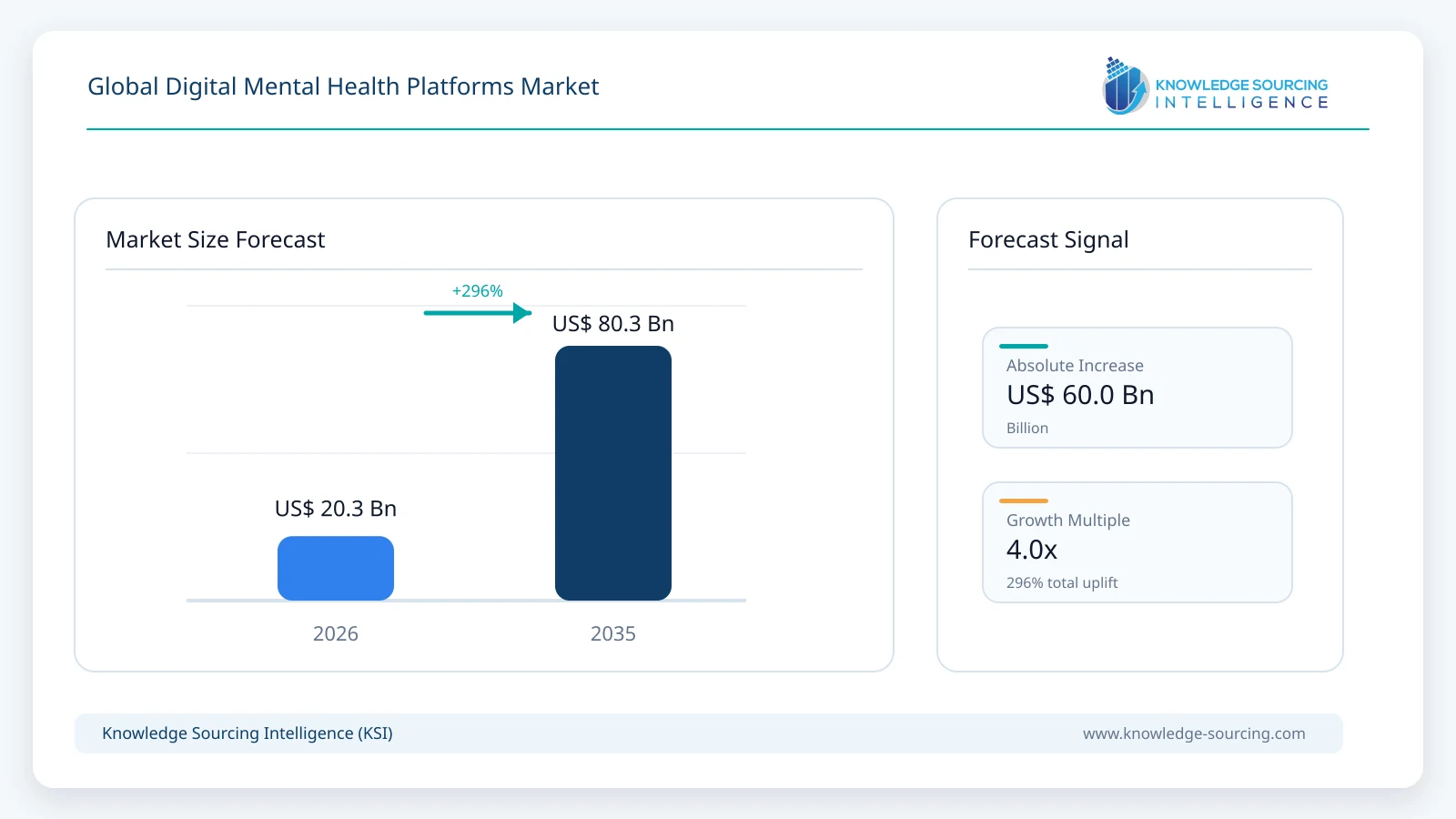
Mental health disorders represent one of the largest global healthcare burdens. Rising awareness increases help-seeking behavior while healthcare systems continue facing shortages of psychiatrists, psychologists, and licensed therapists. This imbalance creates demand for scalable delivery models that can expand access without proportional increases in workforce capacity.
Digital mental health platforms provide assessment tools, therapy delivery, symptom monitoring, behavioral coaching, meditation programs, and psychiatric consultation services. Adoption is increasing because consumers expect healthcare services to be available through mobile and digital channels. Healthcare providers are integrating virtual mental health solutions because continuity of care becomes easier when monitoring, communication, and intervention occur within a connected ecosystem.
Regulatory oversight increasingly influences platform development because data privacy, cybersecurity, clinical validation, and patient safety requirements affect market entry. Organizations are investing in evidence generation and outcome measurement because employers, providers, and payers require demonstrable clinical value before expanding adoption.
Market Dynamics
Market Drivers
Growing Global Mental Health Burden: Mental health disorders represent a significant contributor to disability and healthcare utilization. Demand is increasing because more individuals are seeking diagnosis and treatment services. Provider capacity remains constrained across many healthcare systems, which creates access bottlenecks. Digital platforms are expanding service availability through remote delivery models. The outcome is broader access to behavioral healthcare services.
Behavioral Health Workforce Shortages: Mental healthcare depends heavily on specialized clinical professionals. Demand is growing faster than workforce expansion in many countries. Limited provider availability increases wait times and treatment delays. Healthcare organizations are adopting virtual care pathways to extend clinician reach. The result is stronger demand for teletherapy and telepsychiatry platforms.
Employer Focus on Workforce Wellbeing: Employee wellbeing directly influences productivity and healthcare expenditure. Organizations are increasing investments in behavioral health programs because stress, anxiety, and burnout affect workforce performance. Traditional employee assistance programs often provide limited engagement. Employers are adopting digital mental health platforms that offer continuous access and measurable outcomes. The outcome is sustained enterprise demand.
Expansion of Digital Health Infrastructure: Healthcare delivery increasingly relies on digital channels. Consumer expectations are shifting toward convenient and accessible care experiences. Physical infrastructure limitations constrain service availability in many regions. Providers are implementing virtual behavioral health services to improve reach and efficiency. The result is stronger integration of digital mental health solutions.
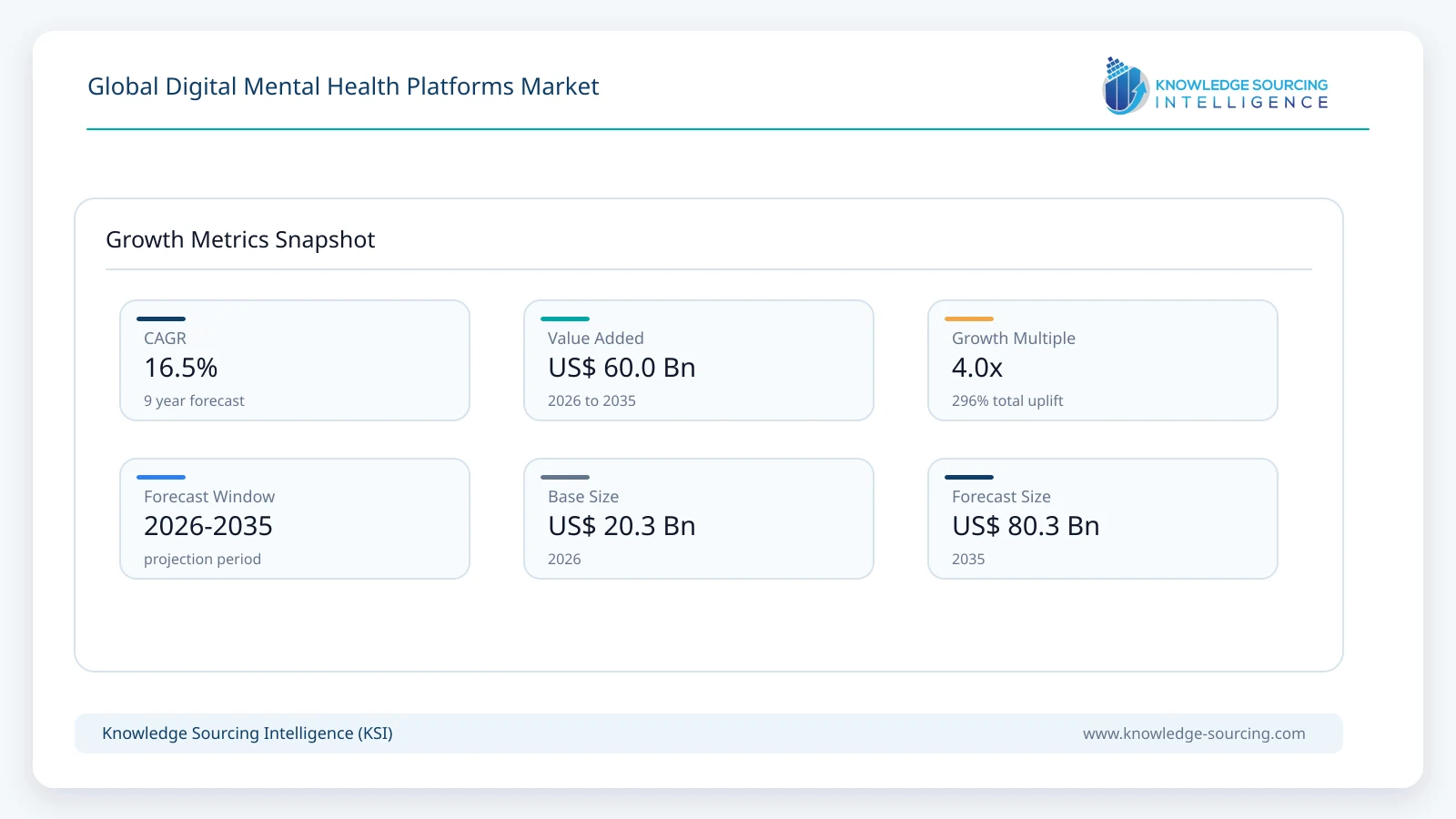
Market Restraints
Data privacy and cybersecurity concerns limit adoption among highly regulated healthcare organizations.
Clinical validation requirements increase development costs and extend commercialization timelines.
Reimbursement variability creates uncertainty regarding long-term revenue sustainability.
Market Opportunities
AI-Enabled Personalized Care: Mental health outcomes depend on individualized interventions. Demand is increasing for solutions that adapt to patient behavior and symptom patterns. Traditional care models provide limited continuous monitoring. Platform developers are integrating artificial intelligence to support personalization and engagement. The result is improved scalability and user retention.
Integration with Healthcare Ecosystems: Mental healthcare increasingly functions within broader care delivery frameworks. Providers require interoperability with electronic health records and care management systems. Fragmented workflows reduce operational efficiency. Vendors are developing integrated behavioral health platforms that support coordinated care. The outcome is stronger enterprise adoption.
Expansion in Emerging Markets: Mental healthcare access remains limited in many developing economies. Smartphone penetration continues increasing across underserved populations. Physical infrastructure expansion remains costly and time intensive. Digital platforms are enabling more rapid service deployment. The result is substantial long-term growth potential.
Government Regulations
Region | Regulatory Authority | Key Regulatory Focus |
United States | FDA | Software as Medical Device (SaMD), Digital Therapeutics, Telehealth |
European Union | MDR & National Authorities | Medical Device Regulation, Data Protection, Clinical Evaluation |
Japan | PMDA | Digital Health Approval Pathways |
India | CDSCO | Software-Based Medical Products and Telemedicine Guidelines |
China | NMPA | Digital Medical Device Registration and Data Governance |
Market Segmentation
By Platform Type
Platform type determines service intensity, clinical involvement, and care delivery structure. Demand is increasing for teletherapy and telepsychiatry solutions because provider shortages create access challenges. Digital therapeutics are gaining attention because healthcare stakeholders increasingly require measurable outcomes. Meditation and wellness applications continue attracting users seeking preventive mental health support. Integrated behavioral health platforms are expanding because organizations prefer consolidated care ecosystems. The outcome is growing convergence between wellness, clinical intervention, and care management functions.
By Application
Application-specific demand reflects varying mental health burdens across populations. Depression and anxiety management represent major adoption areas because prevalence remains high globally. Stress management solutions are attracting employer investment because workplace wellbeing increasingly affects productivity. Sleep disorder management continues expanding because sleep quality influences broader mental health outcomes. Substance use disorder and PTSD interventions are gaining relevance because healthcare systems are prioritizing long-term behavioral health support. The result is diversified demand across multiple therapeutic categories.
By Delivery Mode
Delivery mode influences accessibility, engagement, and operational scalability. Mobile-based platforms dominate user interaction because smartphones provide continuous access. Web-based services remain important for therapy sessions and provider workflows. Cloud-based infrastructure supports scalability, security, and interoperability requirements. Healthcare organizations are increasingly adopting cloud-enabled architectures because integrated care delivery depends on real-time data availability. The outcome is greater flexibility in service deployment and expansion.
Regional Analysis
North America
North America represents a mature digital mental health ecosystem because healthcare organizations, employers, and consumers demonstrate strong digital adoption. Demand is increasing as behavioral health challenges continue affecting workforce productivity and healthcare utilization. Provider shortages persist despite substantial healthcare spending, which increases reliance on telehealth-enabled care models. Organizations are expanding digital behavioral health programs because scalable intervention strategies support broader population management. The region maintains strong innovation activity and enterprise adoption.
Europe
European demand reflects increasing focus on mental health accessibility and preventive care. Healthcare systems emphasize equitable service delivery, which creates opportunities for digitally enabled interventions. Workforce constraints continue affecting behavioral health service availability. Providers are integrating virtual care pathways to improve access and efficiency. Regulatory oversight remains extensive, which supports patient safety and long-term market credibility.
Asia Pacific
Asia Pacific represents a rapidly evolving opportunity because smartphone penetration and digital healthcare adoption continue increasing. Mental health awareness is improving across major economies, which encourages greater treatment-seeking behavior. Physical healthcare infrastructure remains uneven across some regions. Digital platforms are expanding access through scalable delivery models. The result is increasing demand for mobile-first behavioral health services.
Rest of the World
Demand across Latin America, the Middle East, and Africa reflects increasing recognition of mental health as a public health priority. Healthcare infrastructure limitations constrain traditional service expansion. Mobile connectivity continues improving across many markets. Digital mental health providers are leveraging technology-enabled delivery to expand access. The outcome is gradual but sustained market development.
Regulatory Landscape
Digital mental health platforms operate within evolving regulatory frameworks that balance innovation with patient safety. Regulatory agencies increasingly recognize software-based healthcare solutions because healthcare delivery continues to become more technology-dependent. Clinical validation requirements influence product development because stakeholders require evidence of effectiveness before large-scale deployment.
Data privacy regulations significantly affect platform architecture. Healthcare organizations handle sensitive patient information, which requires compliance with regional privacy frameworks. Platform providers are strengthening cybersecurity investments because trust remains essential for long-term adoption. The resulting regulatory environment increasingly favors organizations with strong compliance capabilities.
Regulators continue refining guidance for digital therapeutics, artificial intelligence applications, and software-based interventions. Healthcare stakeholders require clarity regarding clinical claims, safety monitoring, and outcome measurement. Regulatory evolution therefore supports market maturity while encouraging responsible innovation.
Pipeline Analysis
The development pipeline increasingly focuses on clinically validated digital interventions for depression, anxiety, PTSD, substance use disorders, and related behavioral health conditions. Developers are combining behavioral science, artificial intelligence, and digital engagement technologies to improve treatment adherence and outcomes. Clinical validation efforts are expanding because payers and providers require evidence-based adoption decisions.
Artificial intelligence-driven mental health support tools are attracting investment because personalization improves engagement and intervention relevance. Traditional therapy models often depend on episodic interactions. Digital platforms are creating opportunities for continuous monitoring and adaptive support. The outcome is stronger alignment between technology capabilities and patient needs.
Pipeline activity also reflects increasing interest in digital therapeutics that function alongside conventional care pathways. Healthcare systems seek scalable interventions that complement clinician-led treatment. Developers are therefore focusing on solutions that integrate with existing healthcare infrastructures while generating measurable outcomes.
Competitive Landscape
Teladoc Health
Teladoc Health maintains strategic differentiation through its combination of virtual care infrastructure and behavioral health capabilities. Demand is increasing for integrated healthcare experiences because employers and healthcare organizations prefer consolidated vendor relationships. The company continues expanding virtual mental healthcare offerings through BetterHelp and enterprise-focused services. Its broad healthcare ecosystem strengthens cross-selling opportunities and supports large-scale deployment.
Talkspace
Talkspace differentiates itself through direct-to-consumer accessibility and institutional partnerships. Consumer demand increasingly favors flexible access to licensed therapists. Traditional therapy scheduling often creates barriers to engagement. The company continues expanding digital communication-based care models. Its positioning supports broad access across diverse user populations.
Headspace Health
Headspace Health combines mindfulness, coaching, therapy, and enterprise wellbeing services within a unified platform. Demand increasingly spans both preventive and clinical mental health interventions. Employers seek comprehensive wellbeing solutions that support workforce engagement. The organization continues integrating behavioral health services with wellness capabilities. Its approach supports broad user adoption.
Lyra Health
Lyra Health focuses on employer-sponsored mental healthcare. Workforce mental health increasingly influences organizational performance and healthcare costs. Employers require measurable outcomes and quality assurance. The company continues expanding provider networks and personalized care pathways. Its enterprise-centric strategy strengthens competitive positioning.
Spring Health
Spring Health differentiates itself through precision matching and data-driven care navigation. Mental healthcare outcomes depend on treatment appropriateness and engagement. Organizations increasingly seek solutions that improve efficiency and effectiveness. The company continues leveraging analytics to personalize care recommendations. Its technology-enabled model supports scalable intervention delivery.
Calm
Calm maintains strong consumer brand recognition in mental wellness and mindfulness. Demand increasingly includes preventive mental health support rather than solely clinical treatment. Consumers seek accessible tools that fit daily routines. The company continues expanding content and engagement capabilities. Its wellness orientation supports broad market reach.
Brightside Health
Brightside Health focuses on virtual mental healthcare with clinical support models. Demand continues increasing for integrated therapy and psychiatric services. Traditional care pathways often involve fragmented provider interactions. The company delivers coordinated virtual care experiences. Its clinical focus supports differentiation within behavioral healthcare delivery.
Amwell
Amwell leverages broader telehealth infrastructure to support behavioral health services. Healthcare organizations increasingly prefer integrated virtual care ecosystems. Standalone solutions can create workflow complexity. The company continues expanding behavioral health capabilities within enterprise healthcare environments. Its healthcare system relationships support market access.
Key Developments
April 2026: Healthcare Triangle, Inc., a leader in digital transformation solutions for healthcare and life sciences, announced the launch of ZoraNex, an AI-driven digital self-care therapy platform developed under its wholly owned subsidiary, QuantumNexis Inc.
March 2026: Sword Health, the world's leading AI Health company, announced the launch of its first-ever direct-to-consumer solution, Dawn. Ushering in a new era for mental health, Dawn tackles two of the system's most pressing problems: the 48-day wait for mental health appointments and the archaic, reactive nature of the traditional 45-minute therapy session.
Strategic Insights and Future Market Outlook
Digital mental health platforms increasingly occupy a central role in healthcare delivery because demand for behavioral health services continues exceeding available provider capacity. Healthcare systems require scalable intervention models while employers seek measurable workforce wellbeing outcomes. Technology-enabled care therefore becomes increasingly important for long-term service accessibility.
Artificial intelligence, digital therapeutics, and integrated care ecosystems are shaping future competitive dynamics. Buyers increasingly prioritize clinical evidence, interoperability, and measurable outcomes. Platform providers are responding by strengthening validation efforts and expanding partnerships across healthcare ecosystems. The resulting market structure increasingly favors organizations that combine technological innovation with clinical credibility.
The market continues evolving from wellness-oriented applications toward evidence-based healthcare solutions. Regulatory oversight, payer engagement, and healthcare integration support this transition. Organizations that successfully demonstrate effectiveness, security, and scalability are likely to strengthen their competitive position throughout the forecast period.
Mental healthcare demand continues expanding because awareness, diagnosis, and treatment-seeking behavior are increasing across global populations. Digital platforms provide a scalable response to workforce shortages, infrastructure limitations, and accessibility challenges. As healthcare systems continue integrating virtual behavioral health services, digital mental health platforms increasingly function as an essential component of modern healthcare delivery rather than a supplementary service category.
Digital Mental Health Platforms Market Scope:
| Report Metric | Details |
|---|---|
| Total Market Size in 2026 | USD 20.3 billion |
| Total Market Size in 2035 | USD 80.3 billion |
| Forecast Unit | USD Billion |
| Growth Rate | 16.5% |
| Study Period | 2021 to 2035 |
| Historical Data | 2021 to 2024 |
| Base Year | 2025 |
| Forecast Period | 2026 – 2035 |
| Segmentation | Platform Type, Application, Delivery Mode, End User |
| Companies |
|
Market Segmentation
By Geography
Key Countries Analysis
Regulatory & Policy Landscape
Table of Contents
1. EXECUTIVE SUMMARY
1.1 Market Overview
1.2 Key Findings
1.3 Market Snapshot
1.4 Executive Insights
1.5 Analyst Recommendations
1.6 Future Growth Opportunities
2. DISEASE & EPIDEMIOLOGY ANALYSIS
2.1 Overview of Mental Health Disorders
2.1.1 Depression
2.1.2 Anxiety Disorders
2.1.3 Bipolar Disorder
2.1.4 Post-Traumatic Stress Disorder (PTSD)
2.1.5 Obsessive-Compulsive Disorder (OCD)
2.1.6 Substance Use Disorders
2.1.7 Eating Disorders
2.1.8 Sleep Disorders
2.1.9 Schizophrenia and Psychotic Disorders
2.2 Global Mental Health Burden
2.3 Prevalence and Incidence Analysis
2.3.1 By Disorder Type
2.3.2 By Age Group
2.3.3 By Gender
2.3.4 By Socioeconomic Status
2.4 Treatment Gap Assessment
2.5 Digital Mental Health Adoption Trends
2.6 Healthcare Resource Utilization Analysis
2.7 Impact of Mental Health Disorders on Healthcare Systems
2.8 Unmet Needs and Access Challenges
3. MARKET DYNAMICS
3.1 Market Overview
3.2 Market Drivers
3.2.1 Rising Prevalence of Mental Health Disorders
3.2.2 Growing Demand for Remote Mental Healthcare Services
3.2.3 Expansion of Smartphone and Internet Penetration
3.2.4 Increasing Employer-Sponsored Mental Health Programs
3.2.5 Growing Acceptance of Digital Therapeutics and Telepsychiatry
3.3 Market Restraints
3.3.1 Data Privacy and Cybersecurity Concerns
3.3.2 Limited Reimbursement Coverage
3.3.3 Clinical Validation Challenges
3.3.4 Regulatory Complexity Across Regions
3.4 Market Opportunities
3.4.1 Artificial Intelligence-Based Mental Health Solutions
3.4.2 Personalized Digital Therapeutics
3.4.3 Integration with Wearables and Remote Monitoring
3.4.4 Expansion into Emerging Markets
3.5 Market Challenges
3.5.1 User Engagement and Retention Issues
3.5.2 Digital Literacy Barriers
3.5.3 Interoperability Challenges
3.6 Porter's Five Forces Analysis
3.7 PESTLE Analysis
3.8 Value Chain Analysis
3.9 Ecosystem Analysis
4. COMMERCIAL & MARKET ACCESS
4.1 Commercial Landscape Overview
4.2 Reimbursement Environment
4.2.1 Public Reimbursement Models
4.2.2 Private Insurance Coverage
4.2.3 Employer-Sponsored Programs
4.3 Pricing Models
4.3.1 Subscription-Based Platforms
4.3.2 Pay-Per-Session Models
4.3.3 Freemium Models
4.3.4 Enterprise Licensing Models
4.4 Market Access Challenges
4.5 Stakeholder Analysis
4.5.1 Patients
4.5.2 Providers
4.5.3 Payers
4.5.4 Employers
4.5.5 Government Agencies
4.6 Adoption and Procurement Trends
5. INNOVATION & PIPELINE LANDSCAPE
5.1 Innovation Overview
5.2 Emerging Technologies in Digital Mental Health
5.2.1 Artificial Intelligence and Machine Learning
5.2.2 Predictive Analytics
5.2.3 Conversational AI and Chatbots
5.2.4 Digital Biomarkers
5.2.5 Virtual Reality Therapies
5.2.6 Augmented Reality Interventions
5.3 Digital Therapeutics Pipeline Analysis
5.3.1 Early-Stage Development
5.3.2 Clinical Validation Stage
5.3.3 Late-Stage Development
5.4 Pipeline Analysis by Indication
5.4.1 Depression
5.4.2 Anxiety Disorders
5.4.3 PTSD
5.4.4 ADHD
5.4.5 Substance Use Disorders
5.4.6 Insomnia
5.5 Pipeline Analysis by Modality
5.5.1 Mobile Applications
5.5.2 Web-Based Platforms
5.5.3 Virtual Reality Solutions
5.5.4 AI-Powered Therapeutics
5.5.5 Hybrid Care Platforms
5.6 Patent Landscape Analysis
5.7 Strategic Collaborations and Partnerships
5.8 Funding and Investment Trends
6. TREATMENT LANDSCAPE
6.1 Current Mental Health Treatment Paradigm
6.2 Conventional Treatment Approaches
6.2.1 Pharmacotherapy
6.2.2 Psychotherapy
6.2.3 Cognitive Behavioral Therapy (CBT)
6.2.4 Group Therapy
6.2.5 Inpatient Treatment
6.3 Role of Digital Mental Health Platforms
6.4 Telepsychiatry and Teletherapy Services
6.5 Digital Therapeutics in Mental Healthcare
6.6 Self-Guided Mental Health Interventions
6.7 Provider-Assisted Digital Care Models
6.8 Comparative Assessment of Treatment Modalities
6.9 Treatment Adoption Trends
7. MARKET SIZE & FORECAST
7.1 Global Market Overview
7.2 Historical Market Size Analysis (2021–2025)
7.3 Market Forecast (2026–2033)
7.4 Market Forecast by Platform Type
7.5 Market Forecast by Application
7.6 Market Forecast by End User
7.7 Market Forecast by Delivery Mode
7.8 Market Forecast by Business Model
7.9 Market Attractiveness Analysis
8. MARKET SEGMENTATION
8.1 By Platform Type
8.1.1 Mental Health Applications
8.1.2 Teletherapy Platforms
8.1.3 Telepsychiatry Platforms
8.1.4 Digital Therapeutics Platforms
8.1.5 Meditation and Wellness Platforms
8.1.6 Integrated Behavioral Health Platforms
8.2 By Application
8.2.1 Depression Management
8.2.2 Anxiety Management
8.2.3 PTSD Management
8.2.4 Substance Use Disorder Management
8.2.5 Stress Management
8.2.6 Sleep Disorder Management
8.2.7 Eating Disorder Management
8.2.8 General Mental Wellness
8.3 By Delivery Mode
8.3.1 Mobile-Based Platforms
8.3.2 Web-Based Platforms
8.3.3 Cloud-Based Platforms
8.4 By End User
8.4.1 Patients and Consumers
8.4.2 Healthcare Providers
8.4.3 Employers
8.4.4 Payers
8.4.5 Educational Institutions
8.5 By Business Model
8.5.1 Subscription-Based
8.5.2 Pay-Per-Use
8.5.3 Enterprise Licensing
8.5.4 Hybrid Models
9. GEOGRAPHICAL ANALYSIS
9.1 North America
9.1.1 Market Size and Forecast
9.1.2 Key Demand Drivers
9.1.3 Regional Regulatory Overview
9.1.4 Competitive Intensity Analysis
9.2 Europe
9.2.1 Market Size and Forecast
9.2.2 Key Demand Drivers
9.2.3 Regional Regulatory Overview
9.2.4 Competitive Intensity Analysis
9.3 Asia-Pacific
9.3.1 Market Size and Forecast
9.3.2 Key Demand Drivers
9.3.3 Regional Regulatory Overview
9.3.4 Competitive Intensity Analysis
9.4 Latin America
9.4.1 Market Size and Forecast
9.4.2 Key Demand Drivers
9.4.3 Regional Regulatory Overview
9.4.4 Competitive Intensity Analysis
9.5 Middle East & Africa
9.5.1 Market Size and Forecast
9.5.2 Key Demand Drivers
9.5.3 Regional Regulatory Overview
9.5.4 Competitive Intensity Analysis
10. KEY COUNTRIES ANALYSIS
10.1 United States
10.1.1 Market Size Analysis
10.1.2 Mental Health Epidemiology
10.1.3 Regulatory Framework
10.1.4 Reimbursement Environment
10.1.5 Key Company Presence
10.2 Canada
10.3 Germany
10.4 United Kingdom
10.5 France
10.6 Italy
10.7 Spain
10.8 China
10.9 Japan
10.10 India
10.11 South Korea
10.12 Australia
10.13 Brazil
10.14 Mexico
10.15 Saudi Arabia
10.16 South Africa
11. REGULATORY & POLICY LANDSCAPE
11.1 Global Regulatory Overview
11.2 United States Regulatory Framework (FDA)
11.2.1 Software as a Medical Device (SaMD) Requirements
11.2.2 Digital Health Regulatory Guidance
11.3 Europe Regulatory Framework (MDR and Digital Health Regulations)
11.3.1 CE Marking Requirements
11.3.2 Digital Therapeutics Regulatory Considerations
11.4 Japan Regulatory Framework (PMDA)
11.5 India Regulatory Framework (CDSCO)
11.6 China Regulatory Framework (NMPA)
11.7 Data Privacy and Security Regulations
11.7.1 HIPAA Compliance
11.7.2 GDPR Compliance
11.7.3 Regional Data Protection Requirements
11.8 Reimbursement and Coverage Policies
11.9 Regulatory Trends and Future Outlook
12. COMPETITIVE LANDSCAPE
12.1 Market Share Analysis
12.2 Competitive Benchmarking
12.3 Strategic Positioning Analysis
12.4 Mergers and Acquisitions
12.5 Strategic Collaborations
12.6 Product Launches and Expansions
12.7 Funding and Investment Activities
12.8 Competitive Dashboard
13. COMPANY PROFILES
13.1 Teladoc Health
13.2 Talkspace
13.3 Headspace Health
13.4 Lyra Health
13.5 Spring Health
13.6 Calm
13.7 Brightside Health
13.8 Amwell
13.9 Koa Health
13.10 Woebot Health
14. FUTURE OUTLOOK
14.1 Future Market Projections
14.2 Emerging Business Models
14.3 AI-Driven Mental Healthcare Evolution
14.4 Digital Therapeutics Expansion Opportunities
14.5 Regulatory Evolution Impact
14.6 Investment Outlook
14.7 Key Growth Opportunities Through 2033
15. METHODOLOGY
15.1 Research Methodology Overview
15.2 Primary Research
15.3 Secondary Research
15.4 Market Size Estimation Approach
15.5 Forecasting Methodology
15.6 Data Triangulation
15.7 Assumptions and Limitations
15.8 Quality Control and Validation Framework
Navigate
Trusted by the world's leading organizations











