
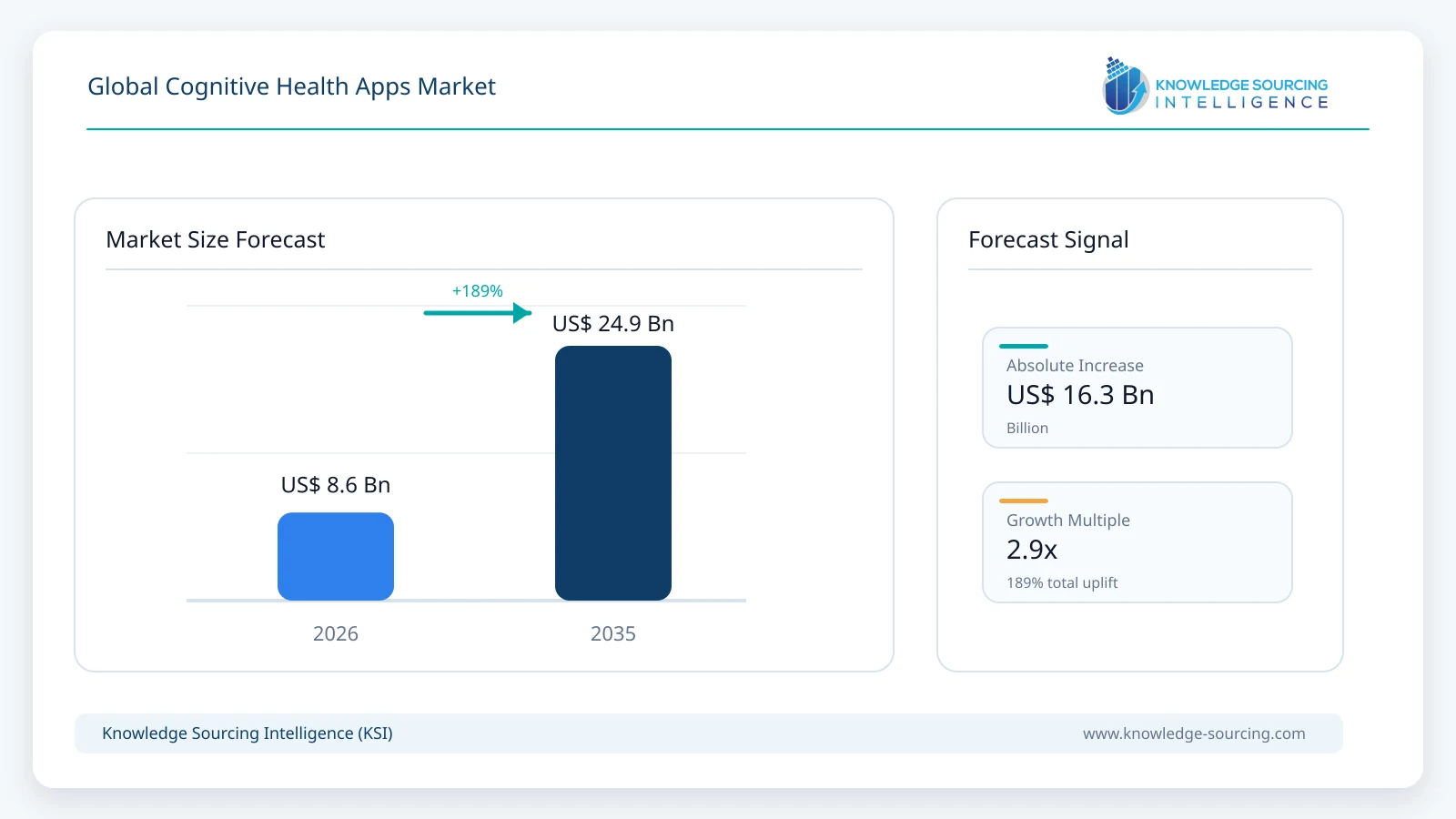
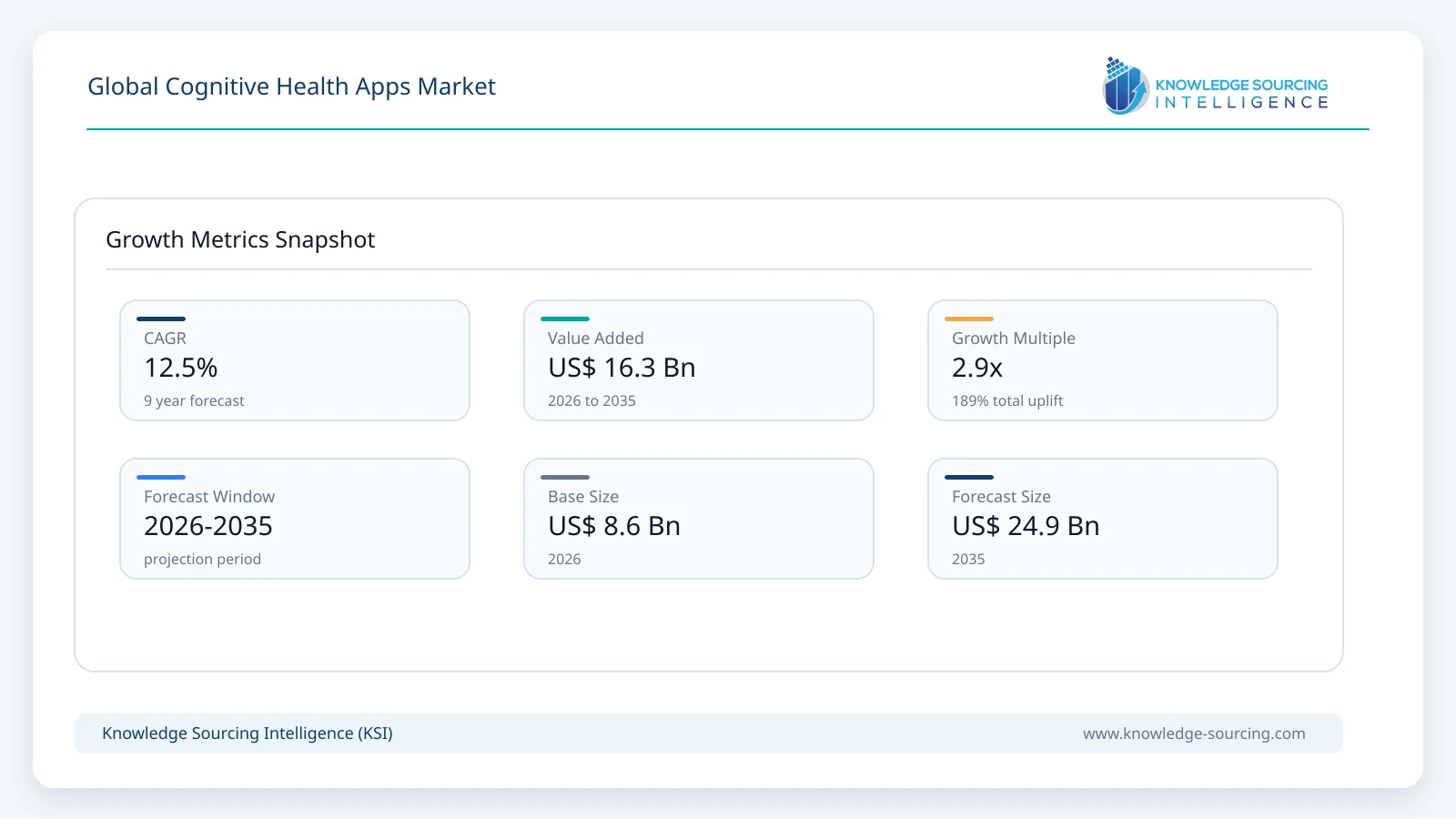
The Global Cognitive Health Apps Market is set to reach USD 24.85 billion in 2035, growing at a CAGR of 12.5% from USD 8.59 billion in 2026.
Highlights:
- 1Rising dementia prevalence is increasing demand for cognitive monitoring technologies.
- 2Healthcare providers are expanding digital cognitive assessment programs because early detection improves intervention opportunities.
- 3Artificial intelligence integration is enhancing cognitive analytics and risk prediction capabilities.
- 4Remote cognitive monitoring adoption is increasing because healthcare systems seek scalable neurological care solutions.
Cognitive health applications provide digital tools that assess, monitor, train, and support cognitive function across healthy individuals and patients with neurological conditions. Their importance continues to increase because aging populations and neurological disease prevalence are creating growing demand for scalable cognitive health solutions.
Healthcare organizations increasingly emphasize early cognitive detection because neurological disorders often progress silently before clinical diagnosis. Developers are advancing mobile-based assessment technologies because remote cognitive evaluation improves accessibility and patient engagement.
Clinical researchers are adopting digital cognitive platforms because continuous data collection enables more precise monitoring of cognitive trajectories. Healthcare providers increasingly utilize app-based cognitive tools because longitudinal assessment improves clinical decision-making.
Strategic importance continues expanding because digital cognitive health solutions support preventive care, remote monitoring, clinical research, and personalized intervention strategies across diverse healthcare settings.
Market Dynamics
Market Drivers
Growing Burden of Cognitive Disorders
Cognitive impairment continues to affect larger patient populations because demographic aging remains a global healthcare trend. Healthcare providers are adopting cognitive health applications because early identification of decline supports timely intervention. This trend strengthens market demand.
Increasing Focus on Early Detection
Healthcare systems emphasize early diagnosis because treatment effectiveness often improves when interventions occur before significant cognitive deterioration. Digital health developers are expanding assessment capabilities because accessible screening improves patient reach. This development accelerates adoption.
Expansion of Digital Health Infrastructure
Digital healthcare adoption continues growing because healthcare organizations seek efficient and scalable care delivery models. Providers are integrating cognitive applications into remote care programs because continuous monitoring enhances patient management. This factor supports market growth.
Advances in Artificial Intelligence and Digital Biomarkers
Artificial intelligence improves cognitive assessment accuracy because advanced algorithms identify subtle performance changes. Developers are incorporating digital biomarkers because objective measurement enhances clinical relevance. This trend supports technology advancement.
Market Restraints
Limited reimbursement coverage restricts adoption in some healthcare systems.
Clinical validation requirements remain significant for healthcare integration.
Data privacy and cybersecurity concerns create implementation challenges.
Market Opportunities
Expansion of Dementia Prevention Programs
Healthcare organizations increasingly prioritize dementia prevention because aging populations continue expanding globally. Developers are creating monitoring and intervention platforms because proactive cognitive management improves healthcare outcomes. This opportunity supports market growth.
Growth of Remote Cognitive Care
Remote healthcare delivery continues expanding because access to cognitive specialists remains uneven across regions. Companies are strengthening telehealth-enabled cognitive solutions because digital access improves continuity of care. This development creates significant opportunities.
Integration into Clinical Trials
Pharmaceutical and biotechnology companies increasingly require objective cognitive endpoints because neurological research demands precise patient monitoring. Digital health providers are expanding research-focused platforms because continuous assessment improves trial efficiency. This trend broadens market potential.
Development of Personalized Cognitive Interventions
Healthcare providers increasingly recognize individual variability in cognitive decline because neurological conditions progress differently among patients. Developers are implementing adaptive intervention programs because personalized approaches improve engagement and outcomes. This opportunity drives innovation.
Disease & Epidemiology Analysis
Cognitive impairment continues to represent a major healthcare challenge because aging populations increase the prevalence of dementia and neurodegenerative disorders. Healthcare systems increasingly focus on cognitive health because early intervention may delay disease progression and improve patient outcomes.
Alzheimer’s disease remains the largest contributor to cognitive decline because it accounts for a substantial proportion of dementia cases globally. Healthcare providers are implementing digital monitoring solutions because continuous cognitive assessment improves longitudinal disease management.
Mild cognitive impairment continues to attract clinical attention because it frequently precedes more severe neurological decline. Researchers are expanding digital assessment programs because early-stage detection improves opportunities for intervention and monitoring.
Parkinson’s disease, traumatic brain injury, and other neurological disorders continue to support demand because cognitive dysfunction often accompanies disease progression. Technology developers are advancing cognitive health applications because scalable monitoring solutions improve clinical oversight.
Treatment Guidelines Landscape
Clinical Area | Primary Objective | Impact on Cognitive Health Apps |
Alzheimer's Disease | Early detection and monitoring | Increases cognitive assessment adoption |
Mild Cognitive Impairment | Risk identification | Expands screening application utilization |
Cognitive Rehabilitation | Functional improvement | Supports rehabilitation app demand |
Neurological Disorders | Longitudinal monitoring | Increases remote tracking adoption |
Clinical Research | Objective cognitive endpoints | Strengthens digital assessment deployment |
Market Segmentation
By App Type
Cognitive assessment apps account for substantial demand because healthcare providers increasingly require scalable screening and monitoring solutions. Brain training applications continue expanding because consumers seek proactive cognitive wellness management. Memory enhancement apps maintain adoption because aging populations increasingly prioritize cognitive preservation. Cognitive rehabilitation applications are gaining clinical relevance because neurological recovery programs require personalized intervention tools. Dementia monitoring and cognitive fitness applications continue supporting market expansion because continuous cognitive engagement remains a healthcare priority.
By Platform
Android platforms maintain broad utilization because smartphone accessibility supports large-scale deployment across diverse populations. iOS applications continue attracting adoption because healthcare organizations frequently integrate digital health solutions within premium mobile ecosystems. Web-based platforms remain important because healthcare providers and research organizations require centralized cognitive assessment and data management capabilities. Cross-platform availability strengthens overall market accessibility and engagement.
By Application
Alzheimer’s disease and dementia management represent the largest application segment because cognitive decline monitoring remains essential for long-term care planning. Mild cognitive impairment monitoring continues expanding because healthcare providers emphasize early detection strategies. Cognitive rehabilitation applications support growing demand because neurological recovery increasingly incorporates digital interventions. Brain fitness and wellness programs attract consumer adoption because preventive cognitive health awareness continues rising. Clinical research and neurological disorder monitoring applications support increasing utilization because objective cognitive data remains highly valuable.
Regional Analysis
North America
North America leads the cognitive health apps market because advanced digital healthcare infrastructure supports widespread adoption of mobile health technologies. Healthcare providers increasingly deploy cognitive assessment applications because dementia prevalence and neurological disease awareness continue rising. Research organizations strengthen digital biomarker initiatives because cognitive monitoring remains a major focus within neurological research. Technology developers expand artificial intelligence integration because healthcare systems increasingly require scalable cognitive care solutions. These factors sustain regional leadership.
Europe
European healthcare systems continue strengthening digital cognitive health programs because aging demographics increase neurological disease burden. Healthcare providers increasingly implement cognitive monitoring technologies because early intervention remains a key healthcare objective. Research institutions expand cognitive assessment initiatives because evidence-based neurological care continues gaining importance. Digital health adoption supports broader utilization because healthcare systems increasingly integrate remote monitoring solutions. These developments contribute to continued market growth.
Asia Pacific
Asia Pacific demonstrates significant growth potential because population aging and healthcare modernization continue accelerating. Healthcare organizations increasingly adopt digital cognitive assessment technologies because dementia prevalence continues increasing. Governments strengthen neurological care initiatives because cognitive disorders create substantial healthcare and socioeconomic challenges. Technology providers expand regional operations because smartphone penetration supports large-scale digital health deployment. These factors generate considerable market opportunities.
Rest of the World
Latin America, the Middle East, and Africa continue expanding digital healthcare capabilities because neurological disease awareness is improving. Healthcare providers increasingly explore cognitive health applications because specialist neurological resources remain limited in many areas. Technology companies strengthen mobile health initiatives because digital platforms improve accessibility. These developments support gradual but sustained market expansion.
Regulatory Landscape
Regulatory authorities increasingly evaluate cognitive health applications because digital healthcare technologies are becoming more integrated into clinical practice. Agencies focus on clinical evidence, software performance, cybersecurity, and patient safety because cognitive assessments may influence healthcare decisions.
The U.S. Food and Drug Administration continues providing oversight for digital health technologies that support diagnosis, monitoring, and treatment functions.
European healthcare regulators increasingly emphasize evidence generation and data protection because digital cognitive platforms collect sensitive patient information. These requirements support responsible market expansion while maintaining patient trust and safety.
Pipeline Analysis
The cognitive health technology pipeline continues expanding because healthcare providers require scalable tools for assessment, monitoring, and intervention. Developers increasingly focus on digital biomarkers because objective cognitive measurements improve diagnostic precision.
Artificial intelligence-driven cognitive analytics remain a major innovation area because predictive modeling supports earlier identification of neurological decline. Companies are advancing adaptive assessment technologies because personalized monitoring improves clinical relevance and patient engagement.
Digital therapeutics targeting cognitive rehabilitation continue progressing because healthcare systems increasingly recognize the value of non-pharmacological interventions. Integration of remote monitoring, behavioral analytics, and machine learning capabilities is strengthening future commercialization opportunities across neurological care and cognitive wellness applications.
Reimbursement Landscape
Reimbursement frameworks continue evolving because healthcare systems increasingly recognize the value of digital cognitive assessment and monitoring technologies. Coverage remains strongest in research programs and selected clinical applications because evidence generation continues expanding.
Healthcare providers are demonstrating economic value because early cognitive detection may reduce long-term healthcare costs associated with advanced neurological disease. Digital health companies continue generating clinical validation data because broader reimbursement adoption depends on measurable healthcare outcomes.
Competitive Landscape
Cogstate Limited
Cogstate differentiates itself through scientifically validated cognitive assessment technologies widely utilized in clinical research and healthcare settings. The company strengthens its position because objective cognitive measurement remains critical for neurological monitoring and pharmaceutical development.
Altoida, Inc.
Altoida focuses on artificial intelligence-driven cognitive biomarkers supporting early neurological risk assessment. The company advances predictive analytics capabilities because healthcare providers increasingly prioritize early detection of cognitive decline.
Linus Health, Inc.
Linus Health specializes in digital cognitive assessment solutions designed for early dementia identification and neurological monitoring. The company strengthens clinical integration because healthcare systems increasingly require scalable screening tools.
BrainCheck, Inc.
BrainCheck provides digital cognitive testing platforms supporting healthcare providers across multiple care settings. The company expands assessment accessibility because rapid cognitive evaluation improves clinical workflow efficiency.
Neurotrack Technologies, Inc.
Neurotrack focuses on cognitive monitoring and brain health management solutions. The company strengthens longitudinal assessment capabilities because continuous cognitive tracking supports preventive healthcare strategies.
Cambridge Cognition Holdings plc
Cambridge Cognition maintains a strong position through cognitive assessment technologies supporting clinical trials and neurological research. The company expands scientific validation efforts because evidence-based healthcare adoption remains essential.
Akili Interactive Labs, Inc.
Akili Interactive Labs develops digital therapeutic technologies targeting cognitive function improvement. The company advances clinically validated intervention approaches because healthcare providers increasingly seek evidence-based digital treatments.
Posit Science Corporation
Posit Science specializes in brain training and cognitive enhancement technologies designed to support cognitive resilience. The company strengthens consumer and clinical engagement because preventive cognitive health awareness continues increasing.
Happify Health, Inc.
Happify Health combines behavioral health and digital wellness capabilities supporting cognitive and emotional well-being. The company expands digital intervention programs because holistic brain health management is gaining importance.
MindMaze SA
MindMaze leverages neuroscience, digital therapeutics, and neurotechnology expertise to support cognitive rehabilitation and neurological recovery. The company advances immersive therapeutic solutions because personalized neurological care remains a major healthcare objective.
Key Developments
January 2026: Linus Health expanded digital cognitive assessment initiatives supporting early dementia detection programs.
December 2025: Altoida advanced artificial intelligence-based cognitive biomarker technologies for neurological monitoring.
November 2025: BrainCheck strengthened digital cognitive testing capabilities supporting healthcare provider workflows.
October 2025: Cogstate expanded cognitive assessment applications supporting pharmaceutical research programs.
Strategic Insights and Future Market Outlook
Cognitive health applications are becoming increasingly important because healthcare systems seek scalable solutions for early detection, monitoring, and management of neurological conditions. Digital assessment technologies continue moving closer to routine clinical practice because traditional cognitive evaluations often lack frequency and accessibility.
Artificial intelligence, digital biomarkers, and predictive analytics are strengthening the clinical relevance of cognitive health applications because healthcare providers increasingly require objective and continuous cognitive measurements. Developers are expanding evidence-generation initiatives because reimbursement and healthcare integration depend on validated outcomes.
Healthcare organizations will continue adopting cognitive monitoring platforms because aging populations and dementia prevalence are increasing globally. Remote assessment capabilities are improving access to cognitive care because specialist neurological resources remain limited in many regions. These developments support broader deployment across healthcare systems.
The global cognitive health apps market will continue evolving toward clinically validated, data-driven, and personalized cognitive management ecosystems. Advances in artificial intelligence, digital therapeutics, remote monitoring, and cognitive biomarker technologies will drive sustained demand across dementia care, neurological monitoring, cognitive rehabilitation, preventive brain health, and clinical research throughout the forecast period.
Global Cognitive Health Apps Market Scope:
| Report Metric | Details |
|---|---|
| Total Market Size in 2026 | USD 8.59 billion |
| Total Market Size in 2035 | USD 24.85 billion |
| Forecast Unit | USD Billion |
| Growth Rate | 12.5% |
| Study Period | 2021 to 2035 |
| Historical Data | 2021 to 2024 |
| Base Year | 2025 |
| Forecast Period | 2026 – 2035 |
| Segmentation | App Type, Platform, Application, Geography |
| Companies |
|
Market Segmentation
By App Type
- Cognitive Assessment Apps
- Brain Training Apps
- Memory Enhancement Apps
- Cognitive Rehabilitation Apps
- Dementia Monitoring Apps
- Mental Wellness and Cognitive Fitness Apps
By Platform
- iOS
- Android
- Web-Based Applications
By Application
- Alzheimer's Disease and Dementia Management
- Mild Cognitive Impairment Monitoring
- Cognitive Rehabilitation
- Brain Fitness and Wellness
- Clinical Research and Trials
- Neurological Disorder Monitoring
By End User
- Individual Consumers
- Hospitals and Clinics
- Rehabilitation Centers
- Academic and Research Institutes
- Pharmaceutical and Biotechnology Companies
By Geographical Analysis
- North America
- Europe
- Asia-Pacific
- Latin America
- Middle East & Africa
Table of Contents
Executive Summary
1.1 Global Cognitive Health Apps Market Scope and Objectives
1.2 Key Market Insights and Strategic Highlights
1.3 Cognitive Health App Adoption Trends
1.4 Market Growth Outlook and Revenue Forecast
1.5 Strategic Conclusions
Global Cognitive Health Apps Market Overview
2.1 Definition and Scope of Global Cognitive Health Apps Market
2.2 Global Cognitive Health Apps Market Size Analysis 2021–2024
2.3 Global Cognitive Health Apps Market Size Forecast 2025–2035
2.4 Market Drivers
2.4.1 Rising Prevalence of Cognitive Disorders and Dementia
2.4.2 Growing Consumer Focus on Brain Health and Wellness
2.4.3 Increasing Smartphone and Digital Health Adoption
2.4.4 Expansion of Remote Cognitive Assessment Solutions
2.5 Market Restraints
2.5.1 Limited Clinical Validation of Certain Applications
2.5.2 Data Privacy and Security Concerns
2.5.3 Regulatory and Reimbursement Challenges
2.6 Market Opportunities
2.6.1 AI-Driven Cognitive Health Applications
2.6.2 Expansion of Digital Therapeutics for Cognitive Disorders
2.6.3 Growth in Aging Population and Preventive Healthcare
2.7 Global Cognitive Health Apps Market Segmentation
2.7.1 By App Type
2.7.1.1 Cognitive Assessment Apps
2.7.1.2 Brain Training Apps
2.7.1.3 Memory Enhancement Apps
2.7.1.4 Cognitive Rehabilitation Apps
2.7.1.5 Dementia Monitoring Apps
2.7.1.6 Mental Wellness and Cognitive Fitness Apps
2.7.2 By Platform
2.7.2.1 iOS
2.7.2.2 Android
2.7.2.3 Web-Based Applications
2.7.3 By Application
2.7.3.1 Alzheimer's Disease and Dementia Management
2.7.3.2 Mild Cognitive Impairment Monitoring
2.7.3.3 Cognitive Rehabilitation
2.7.3.4 Brain Fitness and Wellness
2.7.3.5 Clinical Research and Trials
2.7.3.6 Neurological Disorder Monitoring
2.7.4 By End User
2.7.4.1 Individual Consumers
2.7.4.2 Hospitals and Clinics
2.7.4.3 Rehabilitation Centers
2.7.4.4 Academic and Research Institutes
2.7.4.5 Pharmaceutical and Biotechnology Companies
Cognitive Disorders Epidemiology and Digital Health Demand Analysis
3.1 Global Burden of Cognitive Disorders
3.2 Alzheimer's Disease Epidemiology
3.3 Dementia Epidemiology
3.4 Mild Cognitive Impairment Prevalence Analysis
3.5 Aging Population and Cognitive Health Trends
3.6 Forecast of Cognitive Health App Users
Disease and Unmet Need Analysis
4.1 Need for Early Detection of Cognitive Decline
4.2 Challenges in Long-Term Cognitive Monitoring
4.3 Need for Accessible Cognitive Health Solutions
4.4 Limitations of Conventional Cognitive Assessment Methods
4.5 Unmet Need in Personalized Cognitive Care
Technology and Innovation Landscape
5.1 Evolution of Cognitive Health Applications
5.2 Artificial Intelligence and Predictive Analytics Integration
5.3 Digital Biomarker Development Trends
5.4 Gamification and User Engagement Technologies
5.5 Remote Monitoring and Telehealth Integration
5.6 Digital Therapeutics and Prescription App Development
5.7 Comparative Clinical Utility Analysis
Clinical and Commercial Intelligence
6.1 Clinical Guideline Positioning
6.2 Cognitive Health App Utilization Trends
6.3 Comparative Effectiveness Benchmarking
6.4 Pricing and Subscription Model Analysis
6.5 Market Share Analysis by App Type
6.6 Consumer Adoption Trends
6.7 Lifecycle Management Strategies
6.8 Regulatory and Compliance Analysis
Product Benchmarking
7.1 Cognitive Assessment App Benchmarking
7.2 Brain Training App Benchmarking
7.3 Cognitive Rehabilitation App Benchmarking
7.4 Dementia Monitoring App Benchmarking
7.5 AI-Powered Cognitive Health Platform Benchmarking
7.6 Competitive Differentiation Analysis
Market Forecast and Risk Analysis
8.1 Revenue Forecast Modeling
8.2 User Adoption Forecast
8.3 Subscription and Monetization Forecast
8.4 Pricing Sensitivity Analysis
8.5 Key Risk Factors
8.5.1 Regulatory Risks
8.5.2 Data Privacy and Security Risks
8.5.3 User Retention Risks
8.5.4 Clinical Validation Risks
8.6 Sensitivity and Scenario Analysis
Competitive Landscape
9.1 Market Share Analysis by Company
9.2 Competitive Positioning of Cognitive Health Apps
9.3 Innovation and Intellectual Property Analysis
9.4 Product Portfolio Analysis
9.5 Strategic Collaborations and Partnerships
9.6 Mergers, Acquisitions, and Investment Activity
Geographic Analysis
10.1 North America
10.2 Europe
10.3 Asia-Pacific
10.4 Latin America
10.5 Middle East and Africa
Key Countries Analysis
11.1 United States
11.2 Canada
11.3 Germany
11.4 United Kingdom
11.5 France
11.6 Italy
11.7 Spain
11.8 China
11.9 Japan
11.10 India
11.11 South Korea
11.12 Australia
11.13 Brazil
11.14 Mexico
11.15 Saudi Arabia
11.16 South Africa
Company Profiles
12.1 Cogstate Limited
12.1.1 Overview
12.1.2 Financials
12.1.3 Product Portfolio
12.1.4 Recent Developments
12.2 Altoida, Inc.
12.2.1 Overview
12.2.2 Financials
12.2.3 Product Portfolio
12.2.4 Recent Developments
12.3 Linus Health, Inc.
12.3.1 Overview
12.3.2 Financials
12.3.3 Product Portfolio
12.3.4 Recent Developments
12.4 BrainCheck, Inc.
12.4.1 Overview
12.4.2 Financials
12.4.3 Product Portfolio
12.4.4 Recent Developments
12.5 Neurotrack Technologies, Inc.
12.5.1 Overview
12.5.2 Financials
12.5.3 Product Portfolio
12.5.4 Recent Developments
12.6 Cambridge Cognition Holdings plc
12.6.1 Overview
12.6.2 Financials
12.6.3 Product Portfolio
12.6.4 Recent Developments
12.7 Akili Interactive Labs, Inc.
12.7.1 Overview
12.7.2 Financials
12.7.3 Product Portfolio
12.7.4 Recent Developments
12.8 Posit Science Corporation
12.8.1 Overview
12.8.2 Financials
12.8.3 Product Portfolio
12.8.4 Recent Developments
12.9 Happify Health, Inc.
12.9.1 Overview
12.9.2 Financials
12.9.3 Product Portfolio
12.9.4 Recent Developments
12.10 MindMaze SA
12.10.1 Overview
12.10.2 Financials
12.10.3 Product Portfolio
12.10.4 Recent Developments
Future Outlook and Strategic Insights
13.1 Expansion of AI-Powered Cognitive Health Solutions
13.2 Growth of Digital Therapeutics for Cognitive Disorders
13.3 Increasing Adoption of Remote Cognitive Monitoring Platforms
13.4 Opportunities in Preventive Brain Health and Healthy Aging
13.5 Strategic Recommendations
Methodology and Data Framework
14.1 Data Sources
14.2 Epidemiology and User Adoption Modeling Approach
14.3 Market Sizing and Forecasting Methodology
14.4 Competitive Benchmarking Framework
14.5 Assumptions and Limitations
Navigate
Trusted by the world's leading organizations











