
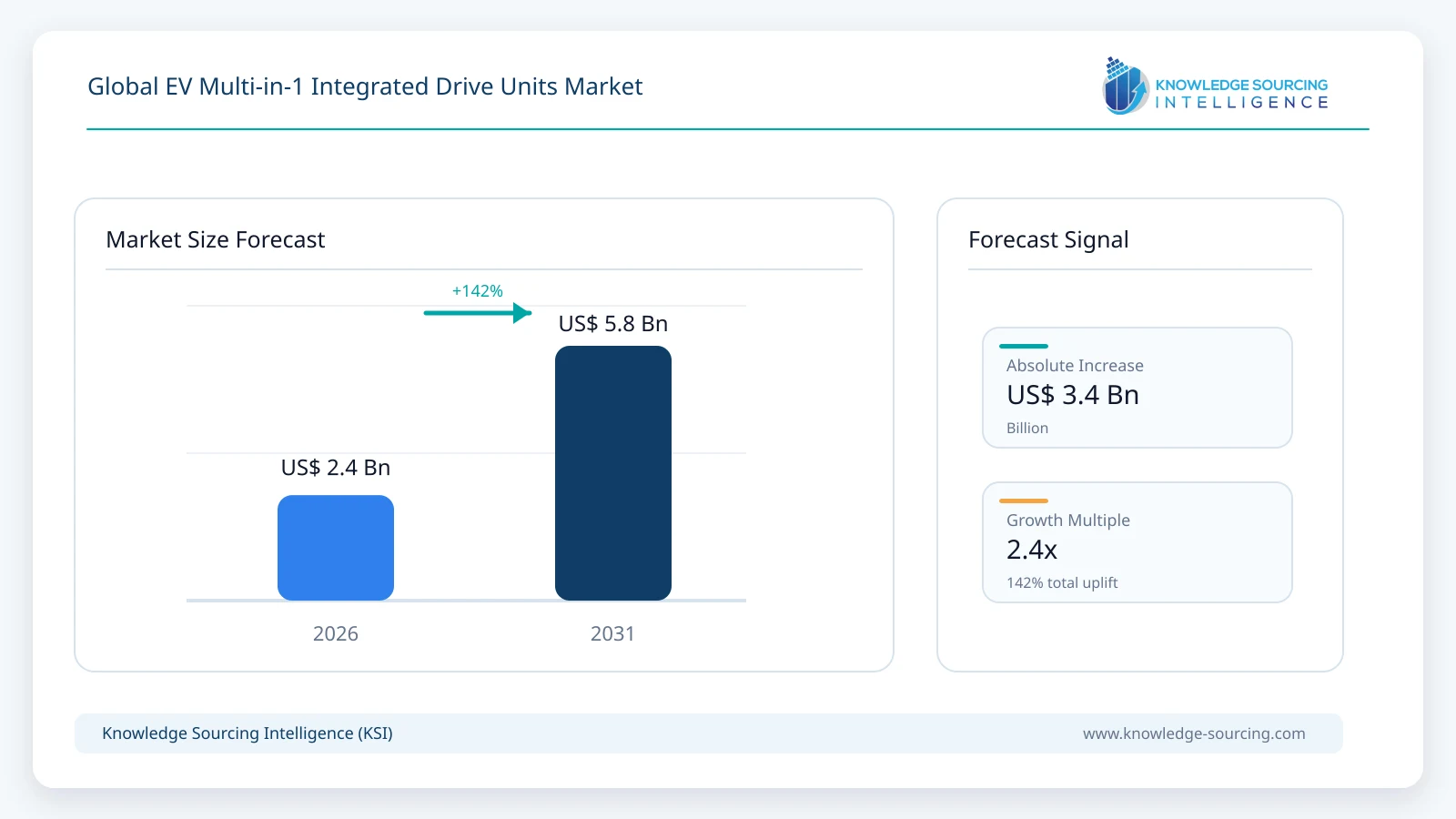
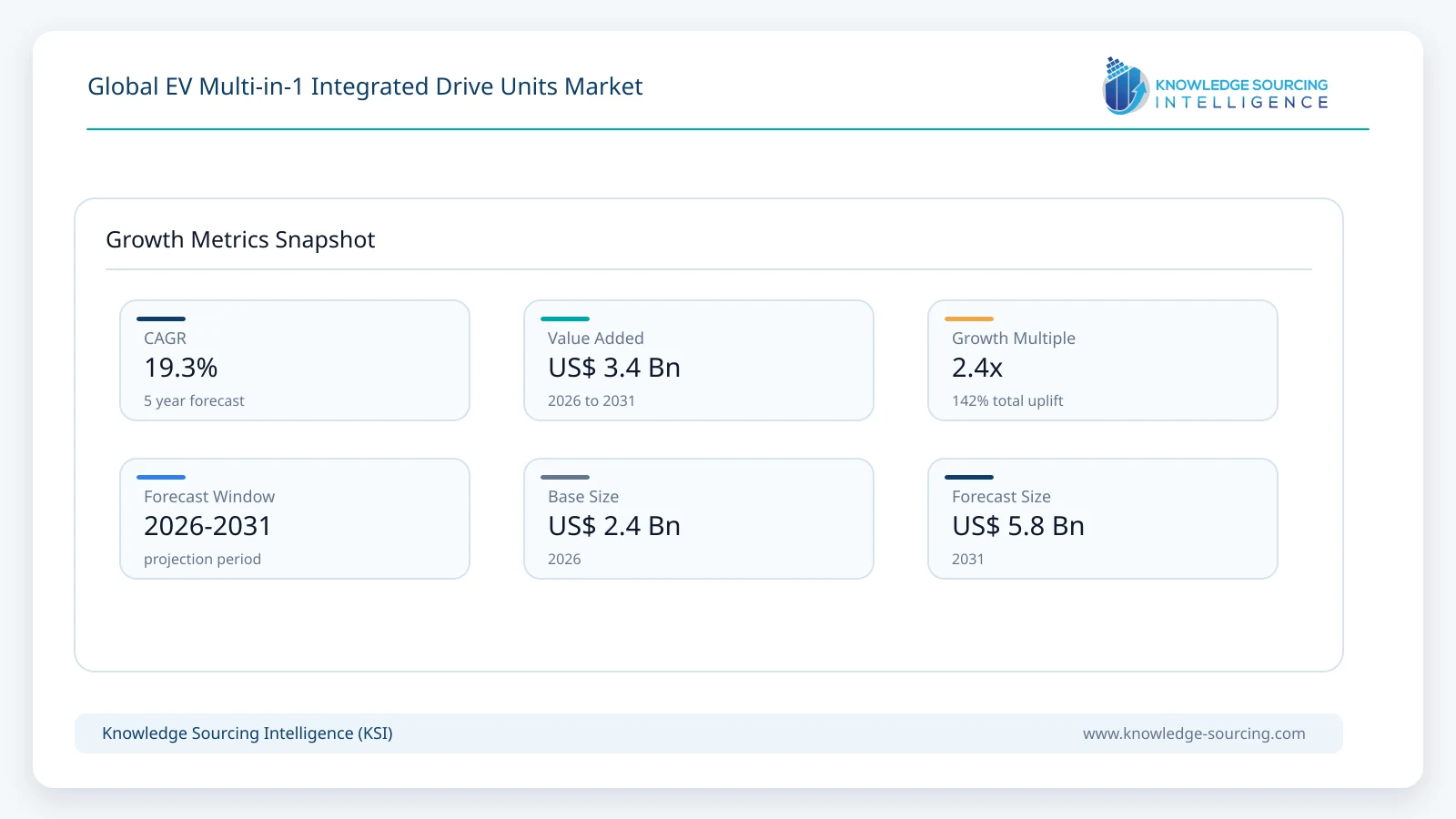
The global EV Multi-in-1 Integrated Drive Units Market is anticipated to grow from USD 2.40 billion in 2026 to USD 5.80 billion by 2031, at a CAGR of 19.3% across the forecast period.
Highlights:
- 1BYD's 8-in-1 powertrain combines eight propulsion, charging and control functions in one architecture.
- 2Geely's 11-in-1 electric drive is already deployed across high-volume new-energy vehicle platforms.
- 3Valeo's 5-in-1 module reached start of production in early 2026 after less than one year from concept to mass-production readiness.
- 4Leapmotor's 2026 A-platform uses a 7-in-1 oil-cooled electric drive for compact mainstream electric vehicles.
- 5Shared housings, controllers, cooling loops and semiconductor resources reduce bill-of-material and packaging complexity.
- 6800 V architectures and silicon carbide power electronics increase the value of tightly coordinated multi-function modules.
- 7China remains the principal commercialization center, but global Tier 1 suppliers are adapting multi-in-1 platforms for international OEMs.
Key Highlights:
Five-function and higher architectures are moving from Chinese premium platforms into broader mass-market EV programs.
Multi-in-1 electric drive architectures extend integration beyond the traditional traction motor, inverter and reduction gear. Additional functions can include the onboard charger (OBC), DC-DC converter, power distribution unit (PDU), battery management system (BMS), vehicle control unit (VCU), eFuse, charging boost circuitry and domain-control electronics. The architectural objective is not simply to place several devices in the same housing; higher-value designs share semiconductor resources, cooling circuits, control processors and physical interfaces across functions.
BYD's e-Platform 3.0 provides one of the clearest mass-production examples. Its 8-in-1 powertrain integrates the VCU, BMS, motor control unit, PDU, DC-DC controller, onboard charger, drive motor and transmission. BYD states that the architecture contributes to reduced overall size and weight while supporting high system efficiency. Geely has moved further toward 11-in-1 architectures, while InfiMotion offers 11-in-1 electric drive units and a 9-in-1 power-domain controller. These systems show that the category is no longer confined to engineering concepts.
The market covered here begins at five integrated functions and excludes conventional 3-in-1 e-axles. This boundary keeps the focus on deep integration of propulsion, charging and power-distribution functions rather than standard motor-inverter-reducer packaging.
Integration Architecture Comparison
Architecture | Typical Integrated Functions | Commercial Position | Main Engineering Challenge |
5-in-1 | Inverter, OBC, DC-DC, PDU, eFuse / gateway functions | Early mass-production power-electronics integration | Thermal isolation and shared control-resource validation |
6-in-1 / 7-in-1 | 3-in-1 e-drive plus OBC, DC-DC, PDU and selected control functions | Growing adoption in compact and mainstream EVs | Serviceability and packaging across several thermal zones |
8-in-1 | Drive motor, controller, reducer, OBC, DC-DC, PDU, VCU and BMS | Established at high volume on BYD platforms | System-level software and safety coordination |
9-in-1 / 11-in-1 | Expanded power-domain and propulsion integration with shared control and distribution functions | Commercialized by Chinese suppliers and OEMs | EMC, cooling, fault isolation and platform scalability |
X-in-1 | Configurable combination of propulsion, charging, power distribution and domain-control functions | Modular supplier approach for multiple OEM platforms | Balancing standardization against OEM-specific E/E architectures |
Market Dynamics
OEMs Are Reducing Hardware Count and High-Voltage Interconnections
Each separately packaged inverter, charger, converter and power distribution device requires its own housing, connectors, cooling connections, mounting points and validation. Combining functions reduces duplicate mechanical content and can shorten high-voltage cables and coolant paths. Valeo states that its 5-in-1 deep-integration module reduces weight by around 20% through hardware and control consolidation. For high-volume EV programs, these savings can translate directly into lower material and assembly costs.
Software and Control Integration Are Becoming as Important as Mechanical Integration
The next stage of integration involves shared control processors and coordinated software. Valeo's 5-in-1 platform uses a common system-on-chip architecture for several power-electronics functions, while BYD and Geely integrate vehicle- and battery-control functions inside broader electric-drive architectures. This reduces communication latency and hardware duplication but increases the validation burden because faults can affect several vehicle functions simultaneously.
China Is Accelerating Commercial Adoption
Chinese EV manufacturers have moved faster than most global OEMs in integrating multiple propulsion and power-electronics functions. BYD's 8-in-1 architecture is already used across e-Platform 3.0 vehicles, Geely uses 11-in-1 systems on high-volume products, Leapmotor has deployed 7-in-1 drives, and InfiMotion supplies multi-in-1 electric drive and power-domain platforms. China's shorter vehicle-development cycles and aggressive cost targets favor architectures that remove components and simplify final vehicle assembly.
Thermal Coupling and Repairability Can Offset Integration Benefits
Placing propulsion, charging and power-distribution functions into one compact module increases thermal interaction between semiconductors, motors and passive components. Cooling systems must handle different temperature limits and duty cycles inside a smaller package. Deep integration also creates repair challenges: failure of one sub-function can make a larger module unavailable unless suppliers design replaceable subassemblies. These factors can limit adoption in vehicles where low service cost is more important than maximum packaging efficiency.
Technological Outlook
Shared Semiconductor and Controller Architectures
Deeply integrated modules increasingly share microcontrollers, gate-driver resources, sensing hardware and communication interfaces. This approach can reduce printed circuit board count and semiconductor duplication, but requires functional-safety partitioning so that a fault in one power domain does not propagate across unrelated vehicle functions.
Integrated Charging and Voltage Boost
Adding the onboard charger and DC-DC converter to the propulsion module allows manufacturers to combine magnetic components, coolant circuits and high-voltage distribution. Some X-in-1 designs also reuse motor windings or inverter hardware for voltage-boost charging, reducing the number of dedicated high-power components needed elsewhere in the vehicle.
800 V and Silicon Carbide Platforms
Higher-voltage EVs benefit from silicon carbide power devices because lower switching losses and greater temperature capability support higher power density. Multi-in-1 modules can distribute these benefits across traction, charging and conversion functions, although the cost advantage depends on how much semiconductor and cooling hardware can genuinely be shared.
Domain-Control Fusion
The most advanced architectures are moving toward powertrain-domain control rather than simply mechanical packaging. Battery management, vehicle control and electric-drive control can be coordinated through fewer processors, enabling faster torque response, energy optimization and over-the-air software updates. This direction links multi-in-1 hardware to the broader software-defined vehicle architecture.
Global EV Multi-in-1 Integrated Drive Units Market Segment Analysis
By Integration Level
Five- and six-function modules are often centered on power electronics, combining the inverter, onboard charger, DC-DC converter and distribution or protection functions. Seven- and eight-function systems extend integration into the drive unit and vehicle control. Eleven-in-one and X-in-1 systems represent the most aggressive architectures, typically combining propulsion hardware with charging, power distribution and domain-control electronics.
By Functional Scope
Power-electronics-focused modules offer the lowest integration barrier because inverter, charger and DC-DC functions share semiconductor, magnetic and cooling technologies. Complete propulsion-domain modules add the motor and reducer, increasing mechanical complexity but also allowing more substantial vehicle-level packaging gains. Controller-rich architectures can further reduce wiring and external electronic control units.
By Voltage Architecture
400 V systems remain important in high-volume compact EVs because semiconductor and insulation costs are lower. 800 V architectures are increasingly used in vehicles prioritizing fast charging and high sustained power. Multi-in-1 integration is particularly attractive at 800 V because every removed high-voltage connector, cable and enclosure has meaningful cost, mass and packaging value.
By Vehicle Type
Passenger battery-electric vehicles are the primary commercialization base because their production scale can amortize the engineering cost of deeply integrated modules. Plug-in hybrids use integrated power electronics but can require different packaging around the engine and transmission. Commercial EVs offer high component value but often favor serviceable and modular systems over the highest possible integration.
By Supplier Model
Vertically integrated automakers such as BYD and Geely can optimize multi-in-1 systems around proprietary vehicle architectures. Tier 1 suppliers instead emphasize modularity so that a common platform can be adapted to multiple OEM electrical and mechanical interfaces. The two approaches create different competitive models: vehicle-level optimization versus broader customer scalability.
Market and Demand Indicators
Indicator | Latest Development | Market Impact |
Global EV sales | IEA expects approximately 23 million electric-car sales in 2026. | Expands the annual vehicle base for integrated propulsion and power-electronics modules. |
8-in-1 mass production | BYD's e-Platform 3.0 uses a mass-produced 8-in-1 electric powertrain across multiple vehicle models. | Demonstrates that deep integration is viable at multi-million-vehicle OEM scale. |
11-in-1 commercialization | Geely's EX2 and EX5 platforms use highly integrated 11-in-1 electric drive systems. | Shows integration beyond 8-in-1 moving into high-volume mainstream vehicles. |
7-in-1 mainstream deployment | Leapmotor launched its A10/B03X on March 26, 2026 with a 7-in-1 oil-cooled electric drive. | Extends multi-in-1 architecture into lower-cost compact EVs. |
Tier 1 industrialization | Valeo confirmed on April 22, 2026 that its 5-in-1 deep-integration module had reached SOP in early 2026. | Shows multi-in-1 adoption is expanding beyond vertically integrated automakers. |
Supplier portfolio depth | Huawei DriveONE offers both 3-in-1 and X-in-1 ePowertrains and had shipped more than 2.4 million powertrain systems by end-2025. | Indicates growing supplier scale for configurable integrated-drive architectures. |
Asia Pacific Market Analysis
Asia Pacific is the principal market for multi-in-1 EV drive units because China combines the world's largest electric-vehicle production base with the fastest commercialization of deeply integrated powertrain electronics. BYD has deployed its 8-in-1 system across multiple e-Platform 3.0 models, while Geely's 11-in-1 drive is used in vehicles including the EX2 and EX5. Leapmotor's 7-in-1 system, InfiMotion's 11-in-1 products and Huawei DriveONE's X-in-1 platforms broaden the regional supplier base beyond a small number of vertically integrated OEMs.
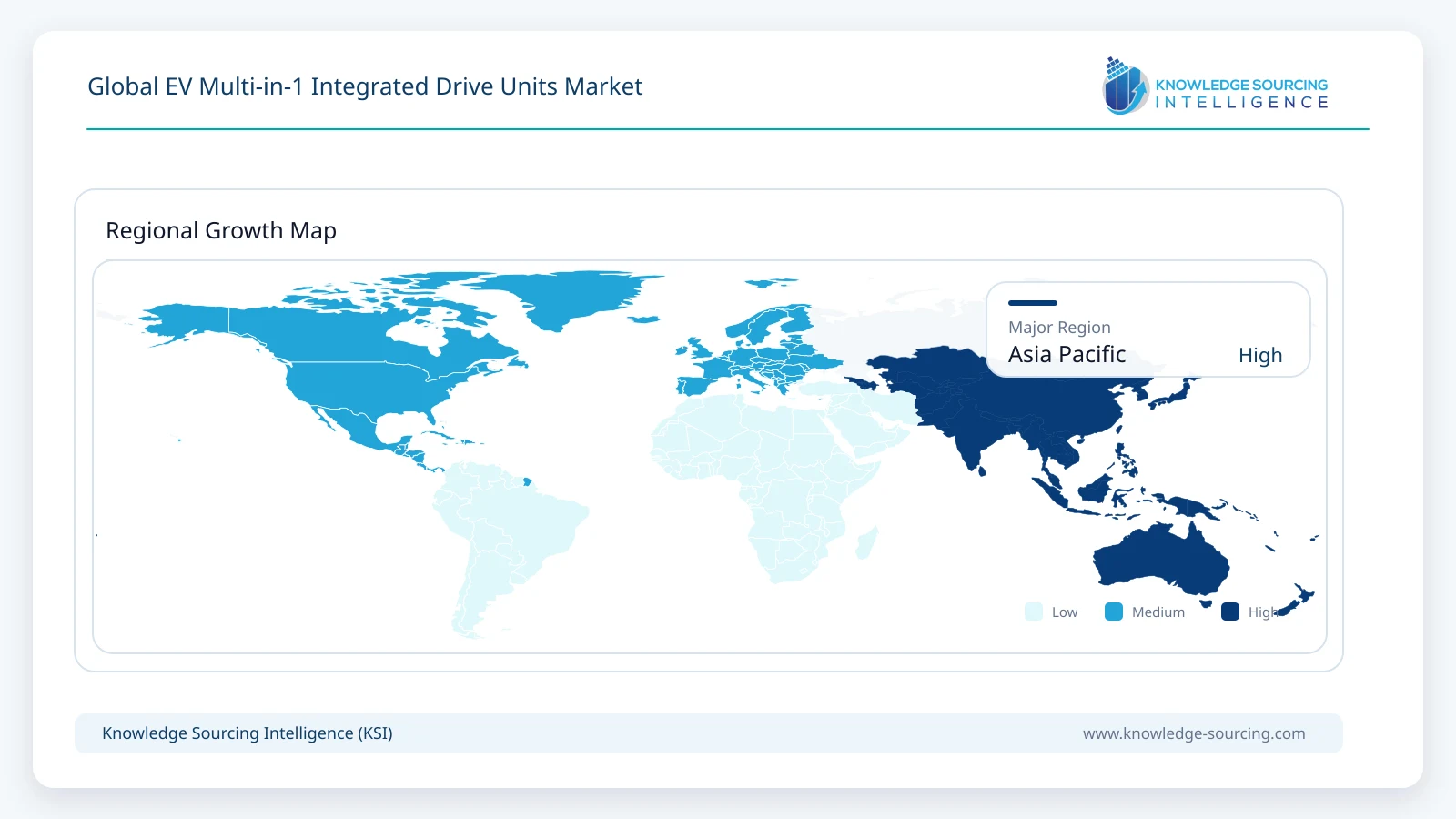
The region's advantage is not limited to vehicle volume. Chinese automakers operate short product cycles and aggressive cost-down programs that reward reduction in housings, harnesses, connectors and external controllers. Local silicon carbide, inverter, motor and charging-electronics supply chains also allow closer co-development. Japan and South Korea contribute semiconductor, motor and power-electronics expertise, although their OEMs have generally adopted deeper multi-function integration more gradually.
India is an emerging opportunity as EV localization expands, but the near-term market remains centered on simpler 3-in-1 e-axles and separately packaged charging electronics. As domestic passenger EV volumes rise, multi-in-1 architectures could become attractive for compact vehicles where packaging efficiency and bill-of-material reduction are especially valuable.
Competitive Landscape
Competition spans vertically integrated automakers, global Tier 1 suppliers and China-based electric-drive specialists. BYD and Geely develop deeply integrated systems around their own vehicle architectures. Huawei Digital Power and InfiMotion offer supplier platforms that can be adapted across multiple OEMs, while Valeo is commercializing deep-integration power electronics for external customers. Nidec has positioned X-in-1 as the next evolutionary stage beyond its conventional e-axle portfolio.
The central competitive issue is whether suppliers can deliver measurable vehicle-level cost and weight savings without increasing warranty and repair risk. Platform scalability, shared control electronics, electromagnetic compatibility, thermal design, functional safety and software integration are becoming as important as motor efficiency. Suppliers with both power-electronics and drivetrain expertise are best positioned to move from conventional 3-in-1 systems toward higher-value multi-function modules.
Recent Developments
April 2026: Valeo confirmed ahead of Auto China 2026 that its 5-in-1 Deep Integration power-electronics module had reached start of production in early 2026.
March 2026: Leapmotor debuted the A10, known globally as the B03X, using a 7-in-1 oil-cooled electric drive on its new A-platform.
March 2026: Geely highlighted the 11-in-1 electric drive in the EX2 after the model reached 465,775 sales during 2025.
January 2026: Geely reported 1.69 million new-energy vehicle sales in 2025 and set a 2026 NEV sales target of 2.22 million, expanding the addressable production base for its highly integrated drive architectures.
November 2025: Geely announced that the EX5, which uses its 11-in-1 electric drive system, had exceeded 210,000 global deliveries.
July 2025: Valeo announced that a major Chinese NEV manufacturer had selected its 5-in-1 module, with production scheduled for 2026.
Global EV Multi-in-1 Integrated Drive Units Market Scope:
| Report Metric | Details |
|---|---|
| Total Market Size in 2026 | USD 2.40 billion |
| Total Market Size in 2031 | USD 5.80 billion |
| Forecast Unit | USD Billion |
| Growth Rate | 19.3% |
| Study Period | 2021 to 2031 |
| Historical Data | 2021 to 2024 |
| Base Year | 2025 |
| Forecast Period | 2026 – 2031 |
| Segmentation | Integration Level, Functional Scope, Voltage Architecture, Vehicle Type, Supplier Model, Geography |
| Companies |
|
Market Segmentation
By Integration Level
5-in-1
6-in-1 and 7-in-1
8-in-1
9-in-1 to 11-in-1
X-in-1 / Higher Integration
By Functional Scope
Power Electronics Integration
Propulsion and Power Electronics Integration
Propulsion, Charging and Domain-Control Integration
By Voltage Architecture
Below 400 V
400-799 V
800 V and Above
By Vehicle Type
Passenger Battery Electric Vehicles
Plug-in Hybrid Electric Vehicles
Commercial Electric Vehicles
Other Electric Vehicles
By Supplier Model
Vertically Integrated OEM Systems
Tier 1 Modular Platforms
By Geography
North America
United States
Canada
Mexico
South America
Brazil
Argentina
Rest of South America
Europe
Germany
United Kingdom
France
Italy
Rest of Europe
Middle East and Africa
Saudi Arabia
United Arab Emirates
South Africa
Rest of Middle East and Africa
Asia Pacific
China
Japan
India
South Korea
Rest of Asia Pacific
Table of Contents
1. EXECUTIVE SUMMARY
2. MARKET SNAPSHOT
2.1. Market Overview
2.2. Market Segmentation
3. BUSINESS LANDSCAPE
3.1. Market Drivers
3.1.1. OEMs Are Reducing Hardware Count and High-Voltage Interconnections
3.1.2. Software and Control Integration Are Becoming as Important as Mechanical Integration
3.1.3. China Is Accelerating Commercial Adoption
3.2. Market Restraints
3.2.1. Thermal Coupling and Repairability Can Offset Integration Benefits
3.3. Market Opportunities
3.4. Porter's Five Forces Analysis
3.5. Industry Value Chain Analysis
3.6. Functional Safety and Electromagnetic Compatibility Requirements
4. TECHNOLOGICAL OUTLOOK
4.1. Shared Semiconductor and Controller Architectures
4.2. Integrated Charging and Voltage Boost
4.3. 800 V and Silicon Carbide Platforms
4.4. Domain-Control Fusion
5. GLOBAL EV MULTI-IN-1 INTEGRATED DRIVE UNITS MARKET BY INTEGRATION LEVEL
5.1. 5-in-1
5.2. 6-in-1 and 7-in-1
5.3. 8-in-1
5.4. 9-in-1 to 11-in-1
5.5. X-in-1 / Higher Integration
6. GLOBAL EV MULTI-IN-1 INTEGRATED DRIVE UNITS MARKET BY FUNCTIONAL SCOPE
6.1. Power Electronics Integration
6.2. Propulsion and Power Electronics Integration
6.3. Propulsion, Charging and Domain-Control Integration
7. GLOBAL EV MULTI-IN-1 INTEGRATED DRIVE UNITS MARKET BY VOLTAGE ARCHITECTURE
7.1. Below 400 V
7.2. 400-799 V
7.3. 800 V and Above
8. GLOBAL EV MULTI-IN-1 INTEGRATED DRIVE UNITS MARKET BY VEHICLE TYPE
8.1. Passenger Battery Electric Vehicles
8.2. Plug-in Hybrid Electric Vehicles
8.3. Commercial Electric Vehicles
8.4. Other Electric Vehicles
9. GLOBAL EV MULTI-IN-1 INTEGRATED DRIVE UNITS MARKET BY SUPPLIER MODEL
9.1. Vertically Integrated OEM Systems
9.2. Tier 1 Modular Platforms
10. GLOBAL EV MULTI-IN-1 INTEGRATED DRIVE UNITS MARKET BY GEOGRAPHY
10.1. North America
10.1.1. United States
10.1.2. Canada
10.1.3. Mexico
10.2. South America
10.2.1. Brazil
10.2.2. Argentina
10.2.3. Rest of South America
10.3. Europe
10.3.1. Germany
10.3.2. United Kingdom
10.3.3. France
10.3.4. Italy
10.3.5. Rest of Europe
10.4. Middle East and Africa
10.4.1. Saudi Arabia
10.4.2. United Arab Emirates
10.4.3. South Africa
10.4.4. Rest of Middle East and Africa
10.5. Asia Pacific
10.5.1. China
10.5.2. Japan
10.5.3. India
10.5.4. South Korea
10.5.5. Rest of Asia Pacific
11. COMPETITIVE ENVIRONMENT AND ANALYSIS
11.1. Major Players and Strategy Analysis
11.2. Market Share Analysis
11.3. Product Development, Platform Awards and Partnerships
11.4. Competitive Dashboard
12. COMPANY PROFILES
12.1. BYD Company Limited
12.2. Geely Automobile Holdings Limited
12.3. Huawei Digital Power Technologies Co., Ltd.
12.4. Valeo SE
12.5. Nidec Corporation
12.6. InfiMotion Technology
12.7. Leapmotor
12.8. ZF Friedrichshafen AG
12.9. Robert Bosch GmbH
12.10. BorgWarner Inc.
12.11. Schaeffler AG
12.12. Magna International Inc.
12.13. Hitachi Astemo, Ltd.
12.14. DENSO Corporation
12.15. AISIN Corporation
12.16. Hyundai Mobis Co., Ltd.
12.17. LG Magna e-Powertrain Co., Ltd.
12.18. Jing-Jin Electric Technologies Co., Ltd.
13. RECENT DEVELOPMENTS
14. APPENDIX
14.1. Currency
14.2. Assumptions
14.3. Base and Forecast Years Timeline
14.4. Abbreviations
Navigate
Trusted by the world's leading organizations











