
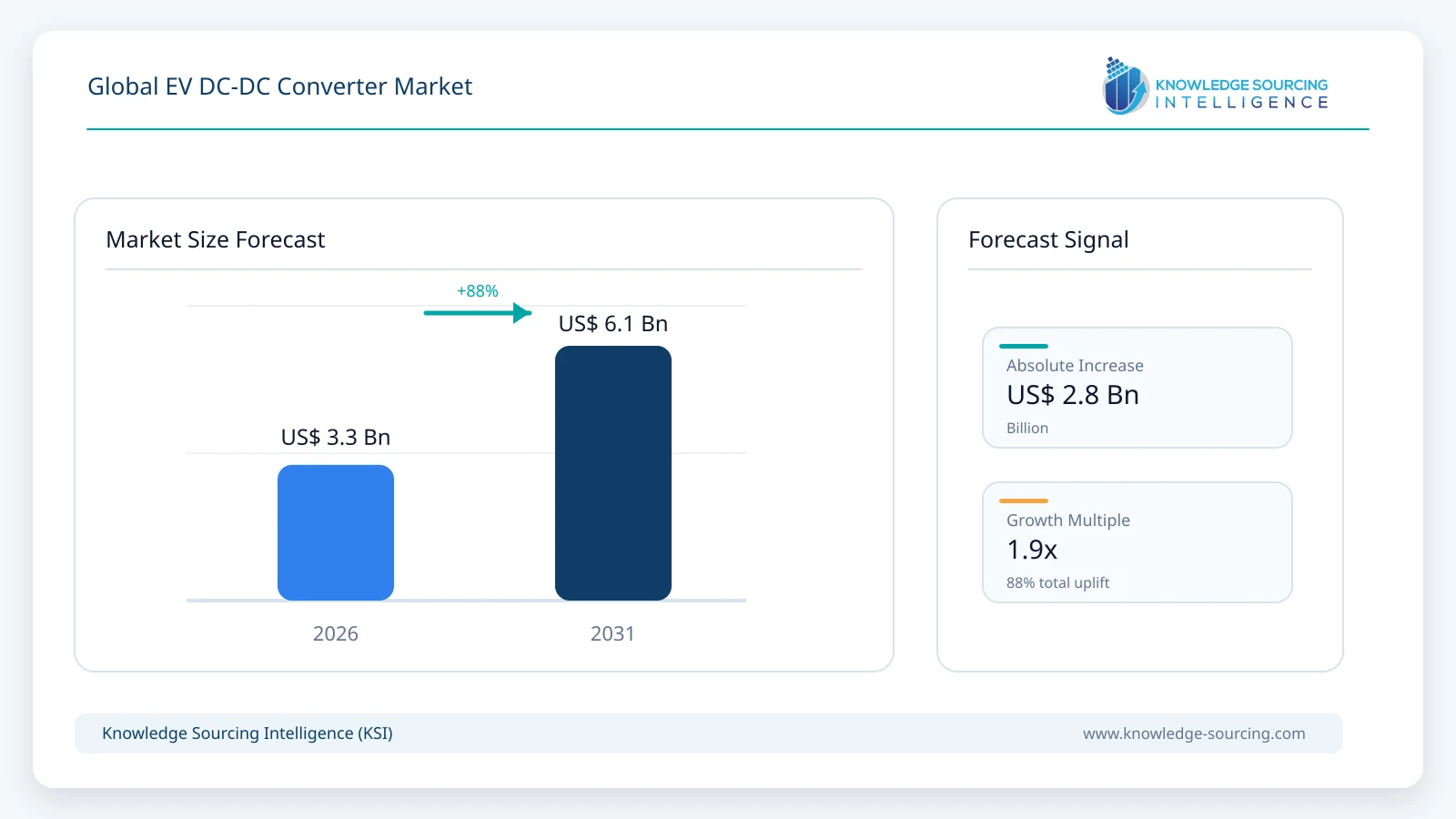
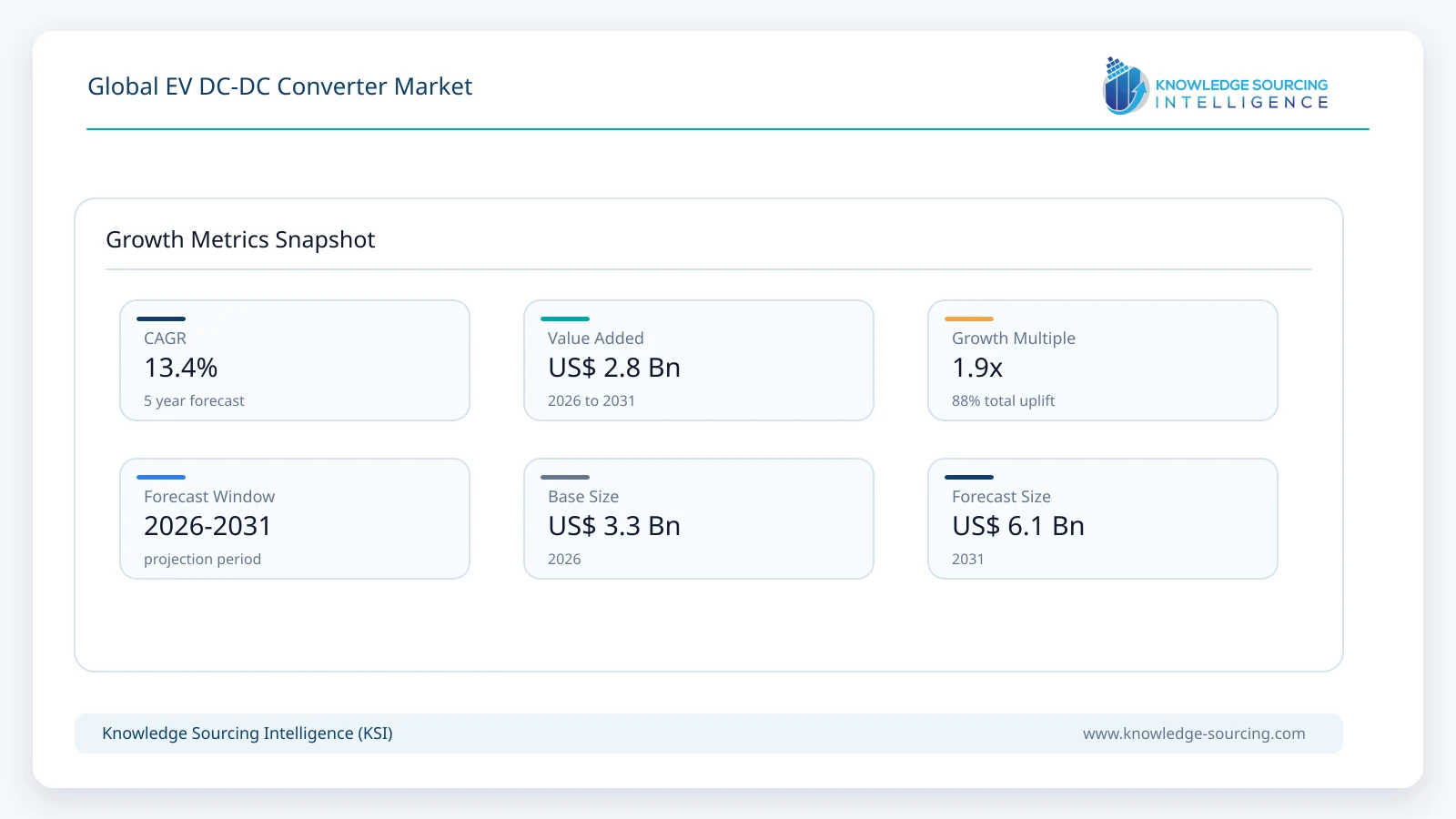
The Global EV DC-DC Converter Market is growing at a CAGR of approximately 13.4%, from USD 3.25 billion in 2026 to USD 6.10 billion by 2031.
Highlights:
- 1Global electric-car sales are expected to reach approximately 23 million units in 2026, expanding the installed base for onboard DC-DC conversion.
- 2800 V traction architectures increase demand for compact converters capable of efficiently supplying 12 V and 48 V vehicle networks.
- 3Bidirectional conversion is gaining relevance as EVs integrate smarter auxiliary-battery management and higher-power low-voltage loads.
- 4Onboard charger and DC-DC integration is increasing as OEMs reduce enclosure count, cabling, weight and cooling interfaces.
- 5Silicon carbide enables higher switching frequencies and power density in integrated charger-converter platforms.
- 648 V auxiliary architectures expand converter power requirements as electric pumps, active suspension, thermal systems and computing loads increase.
- 7Asia Pacific remains the largest manufacturing region because China leads global electric-vehicle production and power-electronics supply.
Market Overview
The DC-DC converter is one of the essential power-electronics components in an electric vehicle because the traction battery operates at a much higher voltage than most auxiliary systems. Bosch's current generation 3evo converter, for example, transforms 250-475 V input to a 10.5-15.5 V output and supplies up to 3.6 kW in forward operation. Valeo offers 400 V and 800 V converter variants with output power up to 4 kW and more than 95% efficiency. These specifications illustrate the central design requirement: converting high-voltage battery energy efficiently while maintaining electrical isolation and stable low-voltage supply.
Vehicle architecture is becoming more demanding. Premium and fast-charging EVs are adopting 800 V traction systems, while the low-voltage side is gradually expanding from traditional 12 V networks toward mixed 12 V/48 V architectures. Higher auxiliary loads from electric thermal systems, advanced driver-assistance computing, chassis actuators and comfort functions increase DC-DC output requirements. Vicor's BCM6135 illustrates the direction of travel with bidirectional 800 V-to-48 V conversion aimed at next-generation automotive architectures.
Technology and Architecture Comparison
Architecture | Typical Voltage Path | Automotive Role | Commercial Direction |
HV-to-12 V Isolated Converter | 400/800 V to 12 V | Supplies conventional auxiliary electrical network | Mature core architecture with higher power density and lower cost per kW |
HV-to-48 V Converter | 400/800 V to 48 V | Supports higher-power auxiliary and zonal electrical loads | Growing with software-defined vehicles and electrified chassis/thermal systems |
Bidirectional HV-LV Converter | 12/48 V <-> 400/800 V | Supports reverse power transfer, pre-charge and smarter auxiliary-battery management | Increasing as OEMs simplify contactors and energy-management architectures |
OBC + DC-DC Integrated Module | Grid AC / HV battery / LV network | Combines charging and low-voltage conversion in one enclosure | Reduces weight, cooling interfaces, connectors and cabling |
Multi-in-1 Power Electronics | Multiple HV/LV functions | Combines converter with OBC, PDU, inverter or eFuse | Strongest in cost- and packaging-sensitive high-volume EV platforms |
Market Dynamics
Electric Vehicle Scale Expands the Converter Unit Base
The International Energy Agency expects global electric-car sales to reach approximately 23 million in 2026, representing 28% of total car sales. Every battery-electric and plug-in hybrid vehicle requires a mechanism to supply its low-voltage electrical network from the traction battery, making electrified-vehicle production the primary unit-volume driver for DC-DC converters. Electric commercial vehicles add further value because they typically require higher continuous auxiliary power for compressors, steering, pumps, telematics and body systems.
800 V Architectures Increase Power-Density and Isolation Requirements
The shift from 400 V toward 800 V traction batteries changes semiconductor, transformer, isolation and thermal design requirements. Infineon positions its 800 V CoolMOS portfolio for high-voltage automotive DC-DC converters and notes that higher system voltage is increasingly relevant to premium and fast-charging EVs. Converter suppliers therefore need platforms that can support multiple input-voltage ranges without materially increasing package size or cooling demand.
48 V Auxiliary Networks Create a New Value Layer
Traditional 12 V networks remain widespread, but higher electrical loads are increasing interest in 48 V distribution. A 48 V network can supply high-power auxiliaries with lower current than 12 V, reducing conductor size and electrical losses. This creates demand for high-voltage-to-48 V conversion and, in some architectures, additional 48 V-to-12 V conversion. The commercial opportunity is strongest in premium passenger EVs, commercial vehicles and software-defined platforms with high computing and actuator loads.
Integration Reduces Standalone Converter Content per Vehicle
The principal structural restraint is integration. Bosch combines the onboard charger and DC-DC converter in a single charger-converter, while Valeo's 5-in-1 power-electronics platform integrates the inverter, onboard charger, DC-DC converter, power distribution unit and eFuse. Integration does not eliminate DC-DC functionality, but it can reduce standalone housings, connectors and cooling hardware. Suppliers therefore compete increasingly on functional value and power density rather than on standalone converter unit volume alone.
Segment Analysis
By Converter Direction
Unidirectional step-down converters remain the established architecture for supplying 12 V and 48 V loads from the traction battery. Bidirectional systems are gaining strategic relevance where OEMs want reverse power transfer, simplified auxiliary-battery charging or additional energy-management flexibility. The adoption rate depends on whether the vehicle architecture can justify the additional control and switching complexity.
By Input Voltage
400 V-class converters remain the largest installed base, reflecting the current global vehicle fleet. 800 V-compatible platforms are gaining importance as premium and fast-charging vehicle architectures expand. Suppliers increasingly design common converter platforms capable of operating across a wide input-voltage range, reducing the need for separate products for each traction-voltage architecture.
By Low-Voltage Output
12 V output remains essential because most vehicle electronics and legacy subsystems continue to operate at traditional automotive voltage. 48 V output is becoming more important for high-power auxiliaries, active chassis systems, thermal management and compute-intensive software-defined vehicles. Mixed 12 V/48 V architectures can therefore increase the total power-conversion content even if individual converter packaging becomes more integrated.
By Integration Level
Standalone converters continue to serve platforms that prioritize modular sourcing or have established electrical architectures. Integrated OBC-DC/DC units reduce enclosure count and cabling, while multi-in-1 power-electronics modules extend integration to the inverter, power distribution and protection functions. The market is moving toward integration fastest in high-volume passenger EVs, while commercial vehicles continue to value modularity and serviceability.
By Vehicle Type
Passenger battery-electric vehicles represent the largest addressable unit base. Plug-in hybrid vehicles also require high-voltage-to-low-voltage conversion but operate with different power and packaging constraints. Commercial EVs are a smaller volume segment with higher auxiliary loads and potentially higher converter power ratings, while electric two- and three-wheelers use lower-value converter architectures.
Market and Demand Indicators
Indicator | Latest Development | Market Impact |
Global EV demand | IEA expects approximately 23 million electric-car sales in 2026. | Expands the annual installation base for onboard DC-DC conversion. |
Production-proven standalone architecture | Bosch generation 3evo provides up to 3.6 kW forward conversion and reverse power transfer. | Shows continued demand for compact standalone converters alongside integrated systems. |
800 V / 48 V architecture | Vicor highlighted an 800 V-to-48 V bidirectional converter for next-generation EVs in February 2026. | Supports higher-power auxiliary networks and software-defined vehicle loads. |
Deep integration | Valeo's 5-in-1 power-electronics module entered production readiness for 2026. | Shows converter functionality moving into integrated multi-function modules. |
Aftermarket emergence | Valeo launched 48 V DC-DC converters into the independent aftermarket. | Indicates the installed electrified-vehicle fleet is beginning to create replacement demand. |
Asia Pacific Market Analysis
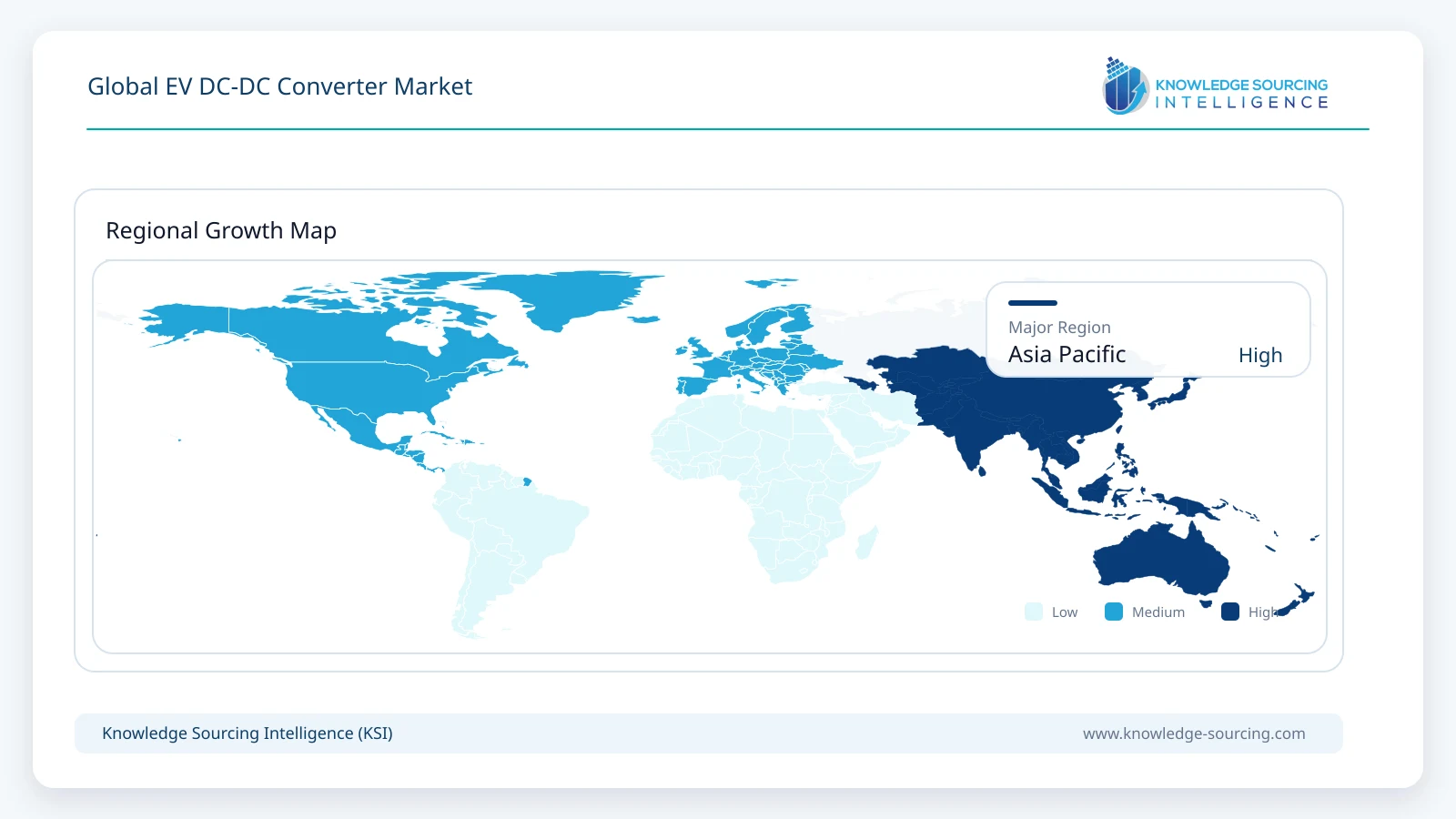
Asia Pacific is the largest EV DC-DC converter market because it combines the world's largest electric-vehicle production base with a dense automotive electronics and power-semiconductor supply chain. China is the principal volume market and supports both domestic converter suppliers and global companies producing locally for Chinese original equipment manufacturers. MAHLE, Valeo and other international suppliers have expanded local electrification manufacturing in China and India, while DENSO, Toyota Industries, Delta Electronics and Asian semiconductor companies contribute established power-electronics capability.
The regional architecture mix is also evolving quickly. Chinese vehicle manufacturers have adopted 800 V platforms, deep power-electronics integration and 48 V auxiliary systems at a faster pace than many legacy markets. Valeo's 5-in-1 module was selected by a leading Chinese new-energy vehicle manufacturer with production planned from 2026, illustrating the region's role in accelerating integrated power electronics. Japan and South Korea remain important for hybrid and EV converter expertise, while India is expanding local production as domestic EV platforms scale.
Competitive Landscape
Competition includes global Tier 1 power-electronics suppliers, automotive electrical-system specialists and semiconductor-enabled converter specialists. Robert Bosch, Valeo, DENSO, MAHLE, Delta Electronics, Hyundai Mobis, Toyota Industries, Schaeffler, FORVIA HELLA and LG Innotek compete in vehicle power conversion or integrated power electronics. Vicor and EGTRONICS contribute high-density converter technologies, while Infineon, onsemi, STMicroelectronics and other semiconductor suppliers influence system performance through silicon carbide and advanced silicon devices.
Competitive advantage depends on efficiency, power density, voltage range, bidirectional capability, thermal performance and integration flexibility. Suppliers also need automotive qualification, local production and software control capability. As OEMs consolidate electronics into fewer housings, the winning converter technology may increasingly be sold as part of an integrated charger-converter or multi-function power electronics unit rather than as a visible standalone component.
Recent Developments
February 4, 2026: Vicor announced that its BCM6135 bidirectional 800 V-to-48 V DC-DC bus converter had received the 2025 World Electronics Achievement Award Product of the Year in the Power Management/Voltage Converter category.
April 24, 2026: Valeo reported at Auto China 2026 that its 5-in-1 Deep Integration power-electronics module, combining the inverter, onboard charger, DC-DC converter, power distribution unit and eFuse, had reached start of production in early 2026.
July 15, 2025: Valeo announced that a leading Chinese new-energy vehicle manufacturer had selected its 5-in-1 Deep Integration power-electronics module, with production scheduled to begin in 2026.
April 10, 2025: MAHLE announced a EUR 200 million order to supply 800 V-to-12 V DC-DC converters for future battery-electric vehicles of an international automaker in China, with series production planned from mid-2028.
November 20, 2025: Vicor announced that its BCM6135 bidirectional DC-DC converter had received Gasgoo's Best Technology Practice Application Award 2025 for automotive electrification applications.
EV DC-DC Converter Market Scope
| Report Metric | Details |
|---|---|
| Total Market Size in 2026 | USD 3.25 billion |
| Total Market Size in 2031 | USD 6.10 billion |
| Forecast Unit | Billion |
| Growth Rate | 13.4% |
| Study Period | 2021 to 2031 |
| Historical Data | 2021 to 2024 |
| Base Year | 2025 |
| Forecast Period | 2026 – 2031 |
| Segmentation | Converter Direction, Input Voltage, Output Voltage, Integration Level, Vehicle Type, Geography |
| Companies |
|
Market Segmentation
By Converter Direction
Unidirectional
Bidirectional
By Input Voltage
Below 400 V
400 V Class
800 V and Above
By Output Voltage
12 V
24 V
48 V and Above
By Integration Level
Standalone DC-DC Converter
OBC + DC-DC Integrated Unit
Multi-in-1 Power Electronics
By Vehicle Type
Passenger Battery Electric Vehicles
Plug-in Hybrid Electric Vehicles
Commercial Electric Vehicles
Electric Two-Wheelers and Three-Wheelers
Other Electric Vehicles
By Geography
North America
United States
Canada
Mexico
South America
Brazil
Argentina
Rest of South America
Europe
Germany
United Kingdom
France
Italy
Rest of Europe
Middle East and Africa
Saudi Arabia
United Arab Emirates
South Africa
Rest of Middle East and Africa
Asia Pacific
China
Japan
India
South Korea
Rest of Asia Pacific
Table of Contents
1. EXECUTIVE SUMMARY
2. MARKET SNAPSHOT
2.1. Market Overview
2.2. Market Segmentation
3. BUSINESS LANDSCAPE
3.1. Market Drivers
3.1.1. Electric Vehicle Scale Expands the Converter Unit Base
3.1.2. 800 V Architectures Increase Power-Density and Isolation Requirements
3.1.3. 48 V Auxiliary Networks Create a New Value Layer
3.2. Market Restraints
3.2.1. Integration Reduces Standalone Converter Content per Vehicle
3.3. Market Opportunities
3.4. Porter's Five Forces Analysis
3.5. Industry Value Chain Analysis
3.6. Automotive Safety and Power-Electronics Requirements
4. TECHNOLOGICAL OUTLOOK
4.1. Silicon Carbide and High-Frequency Switching
4.2. Bidirectional Power Conversion
4.3. Integrated Charger-Converter Platforms
4.4. 800 V-to-48 V High-Power Conversion
5. GLOBAL EV DC-DC CONVERTER MARKET BY CONVERTER DIRECTION
5.1. Unidirectional
5.2. Bidirectional
6. GLOBAL EV DC-DC CONVERTER MARKET BY INPUT VOLTAGE
6.1. Below 400 V
6.2. 400 V Class
6.3. 800 V and Above
7. GLOBAL EV DC-DC CONVERTER MARKET BY OUTPUT VOLTAGE
7.1. 12 V
7.2. 24 V
7.3. 48 V and Above
8. GLOBAL EV DC-DC CONVERTER MARKET BY INTEGRATION LEVEL
8.1. Standalone DC-DC Converter
8.2. OBC + DC-DC Integrated Unit
8.3. Multi-in-1 Power Electronics
9. GLOBAL EV DC-DC CONVERTER MARKET BY VEHICLE TYPE
9.1. Passenger Battery Electric Vehicles
9.2. Plug-in Hybrid Electric Vehicles
9.3. Commercial Electric Vehicles
9.4. Electric Two-Wheelers and Three-Wheelers
9.5. Other Electric Vehicles
10. GLOBAL EV DC-DC CONVERTER MARKET BY GEOGRAPHY
10.1. North America
10.1.1. United States
10.1.2. Canada
10.1.3. Mexico
10.2. South America
10.2.1. Brazil
10.2.2. Argentina
10.2.3. Rest of South America
10.3. Europe
10.3.1. Germany
10.3.2. United Kingdom
10.3.3. France
10.3.4. Italy
10.3.5. Rest of Europe
10.4. Middle East and Africa
10.4.1. Saudi Arabia
10.4.2. United Arab Emirates
10.4.3. South Africa
10.4.4. Rest of Middle East and Africa
10.5. Asia Pacific
10.5.1. China
10.5.2. Japan
10.5.3. India
10.5.4. South Korea
10.5.5. Rest of Asia Pacific
11. COMPETITIVE ENVIRONMENT AND ANALYSIS
11.1. Major Players and Strategy Analysis
11.2. Market Share Analysis
11.3. Product Development, Platform Awards and Integration Strategies
11.4. Competitive Dashboard
12. COMPANY PROFILES
12.1. Robert Bosch GmbH
12.2. Valeo SE
12.3. DENSO Corporation
12.4. MAHLE GmbH
12.5. Delta Electronics, Inc.
12.6. Hyundai Mobis Co., Ltd.
12.7. Toyota Industries Corporation
12.8. Schaeffler AG
12.9. FORVIA HELLA GmbH & Co. KGaA
12.10. LG Innotek Co., Ltd.
12.11. Vicor Corporation
12.12. EGTRONICS Co., Ltd.
12.13. BorgWarner Inc.
12.14. Continental AG
12.15. Panasonic Automotive Systems Co., Ltd.
12.16. Hitachi Astemo, Ltd.
12.17. Infineon Technologies AG
12.18. onsemi
13. RECENT DEVELOPMENTS
14. APPENDIX
14.1. Currency
14.2. Assumptions
14.3. Base and Forecast Years Timeline
14.4. Abbreviations
Navigate
Trusted by the world's leading organizations











