
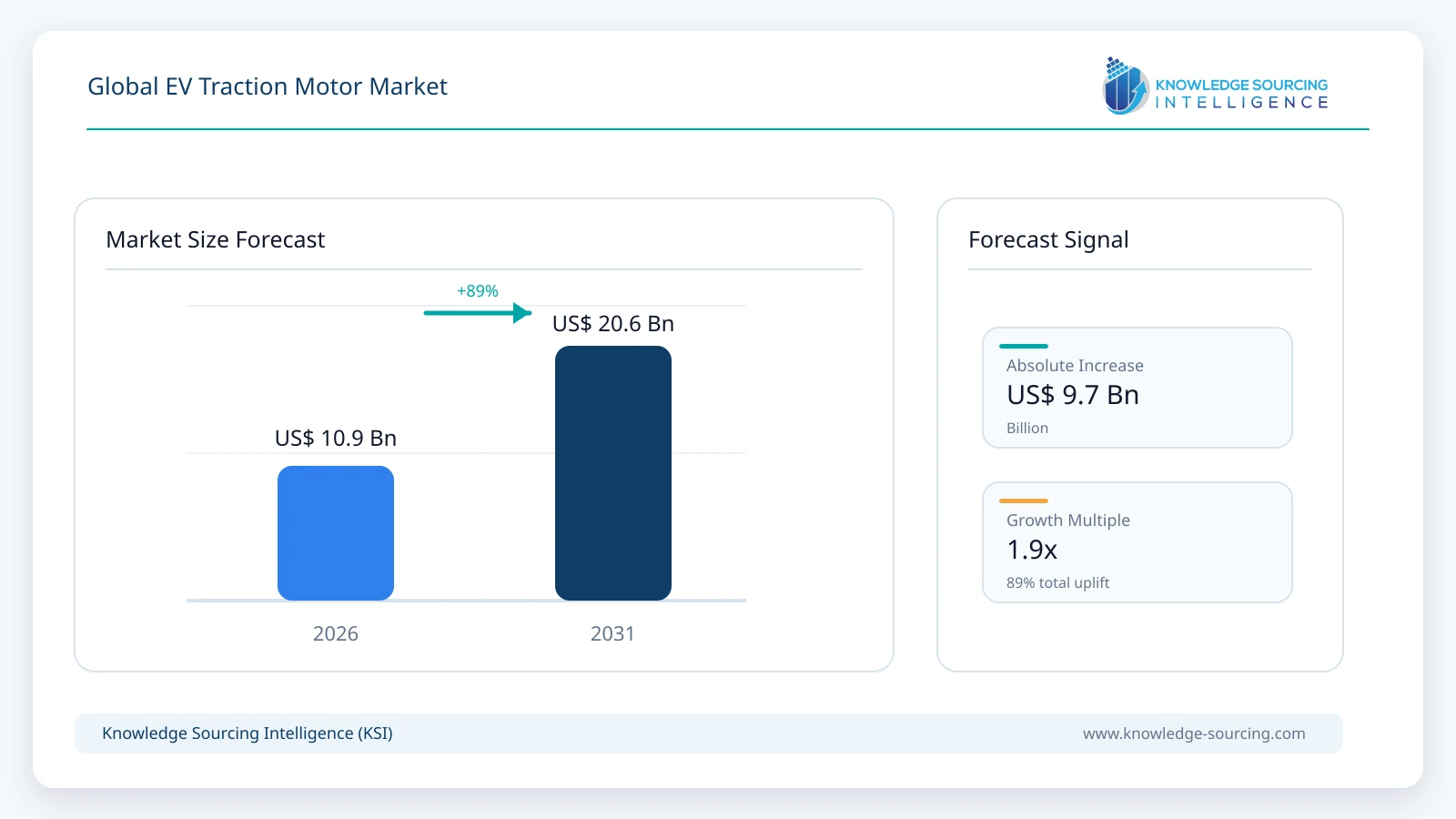
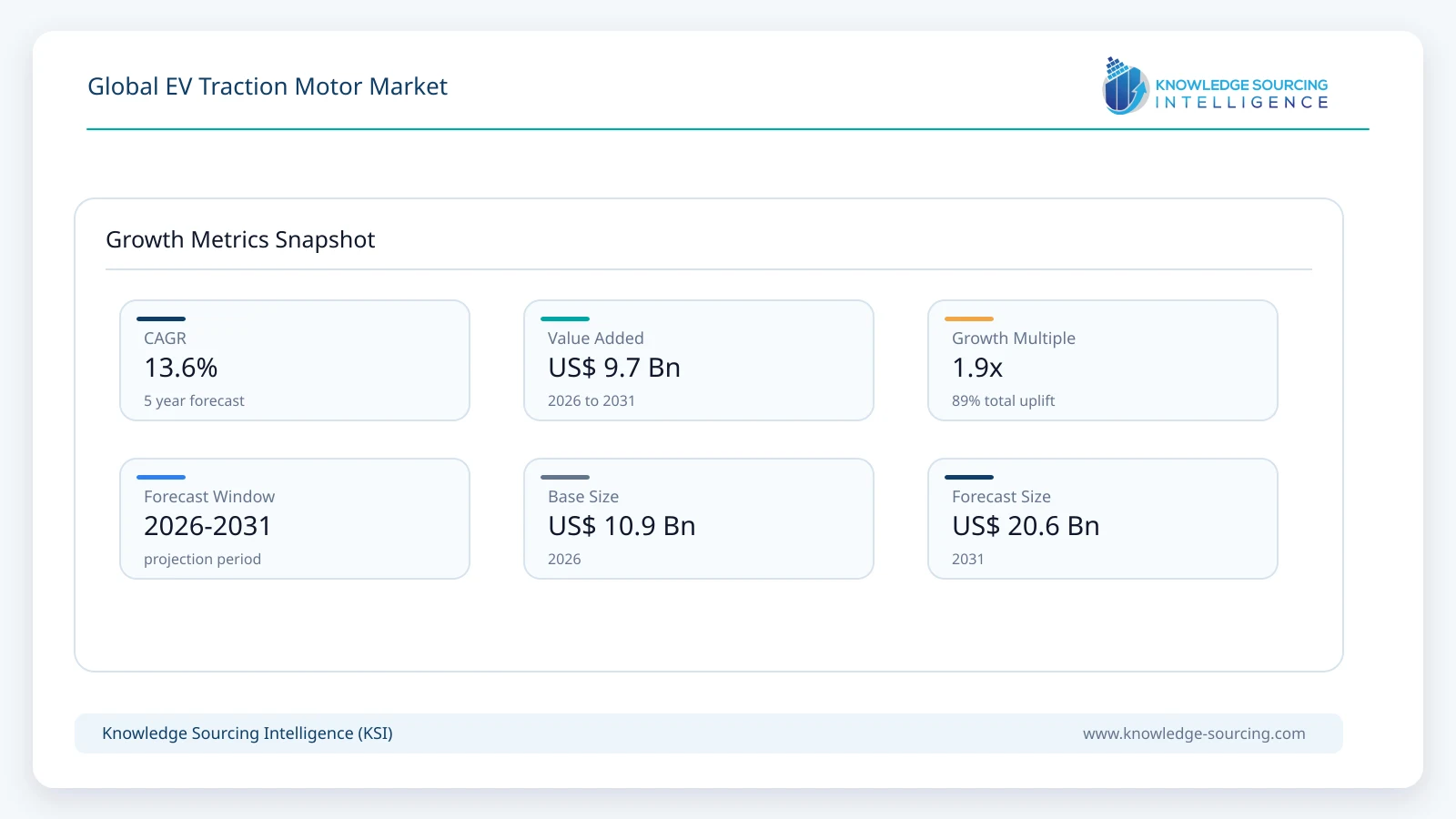
Global EV traction motor revenue is expected to grow from USD 10.9 billion in 2026 to USD 20.6 billion by 2031, at a CAGR of 13.6% during the forecast period.
Highlights:
- 1Global electric-car sales are expected to reach approximately 23 million units in 2026, expanding the annual propulsion-motor demand base.
- 2Permanent magnet synchronous motors remain central to high-efficiency passenger EVs, while rare-earth exposure is accelerating alternative rotor architectures.
- 3Asynchronous and externally excited synchronous motors are gaining strategic relevance where manufacturers prioritize material flexibility and supply-chain resilience.
- 4Hairpin and advanced winding technologies support higher slot fill, compact packaging and scalable high-volume motor production.
- 5Direct oil cooling and improved stator thermal management are enabling higher continuous power from smaller motor packages.
- 6Dual-motor and all-wheel-drive EV configurations increase motor content per vehicle beyond the one-motor baseline.
- 7Commercial EV traction motors carry higher power, durability and continuous-load requirements than mainstream passenger-car units.
- 8Asia Pacific remains the principal production base because China dominates global electric-vehicle manufacturing and contains a dense motor supply chain.
Market Overview
Traction motors are one of the highest-value electromechanical components in an electric drivetrain. Their design directly affects vehicle acceleration, energy consumption, high-speed efficiency, regenerative braking and thermal limits. The market covers propulsion motors supplied as standalone machines, active motor parts and motor assemblies integrated into electric axles. Inverters, reduction gears, DC-DC converters and other non-motor drivetrain components remain outside the category.
The technology mix is becoming more diverse rather than converging on a single motor architecture. Permanent magnet synchronous motors (PMSMs) continue to be favored for compact passenger-car applications because they provide strong torque density and high efficiency across a broad operating range. Induction motors avoid permanent magnets and remain attractive for secondary axles or applications that value low drag when unpowered. Externally excited synchronous motors remove permanent magnets while retaining controllable rotor excitation, making them increasingly relevant as automakers seek to reduce exposure to neodymium, dysprosium and terbium supply chains.
Supplier strategies increasingly combine modular motor platforms with standardized stator manufacturing. ZF's em:SELECT platform supports asynchronous, permanent-magnet and separately excited rotor concepts around common interfaces, while its next-generation asynchronous motor entered mass production in China in June 2025. Bosch, BorgWarner, Valeo, Schaeffler and Nidec are likewise extending propulsion-motor portfolios around higher voltage, improved cooling and more tightly integrated drive units.
Motor Technology Comparison
Motor Architecture | Principal Strength | Typical EV Fit | Key Trade-Off |
Permanent Magnet Synchronous Motor (PMSM) | High efficiency and torque density | Main passenger-BEV drive, premium and performance vehicles | Exposure to permanent-magnet and rare-earth supply chains |
Asynchronous / Induction Motor (ASM) | Magnet-free rotor and low drag when unpowered | Secondary axle, AWD, selected primary-drive platforms | Lower part-load efficiency in some duty cycles |
Externally Excited Synchronous Motor (EESM/SESM) | Magnet-free rotor with controllable excitation | Long-range passenger EVs and supply-resilient platforms | More complex rotor excitation and controls |
Axial Flux Motor | High torque density and compact axial package | Performance EVs and space-constrained applications | Manufacturing scale and thermal integration remain less mature |
In-Wheel / Hub Motor | Eliminates conventional central driveline elements | Specialist vehicles and selected compact-mobility platforms | Unsprung mass and wheel-end durability constraints |
Market Dynamics
Electric Vehicle Production Expands the Core Motor Demand Base
Vehicle electrification remains the most important volume driver. Global electric-car sales exceeded 20 million units in 2025 and are expected to reach approximately 23 million in 2026. The expansion is broadening beyond China: the IEA expects strong 2026 growth across Europe, other Asia Pacific markets and Latin America. Every BEV requires at least one propulsion motor, while PHEVs incorporate electric traction within a hybrid drivetrain. The rise of electric commercial vehicles adds a smaller but higher-value motor segment because buses and trucks require larger machines and sustained torque output.
Multiple-Motor Architectures Raise Motor Content per Vehicle
All-wheel-drive battery electric vehicles increasingly use separate front and rear propulsion motors rather than a mechanical transfer case. Performance vehicles can also add secondary motors for launch torque or torque vectoring. This raises the average number of traction motors per vehicle even when unit vehicle growth moderates. Secondary-drive motors may use different technologies from the primary drive, particularly where manufacturers want low drag during cruising.
Rare-Earth Risk Is Accelerating Architecture Diversification
Permanent magnets provide performance advantages but expose motor manufacturers to volatile rare-earth pricing and geographically concentrated supply. Suppliers are therefore developing magnet-free architectures alongside conventional PMSMs. ZF's portfolio spans PMSM, asynchronous and separately excited machines, while Valeo has developed a high-voltage rare-earth-free externally excited synchronous motor with series production targeted for 2027. Nidec has also reduced heavy rare-earth content through cooling and magnetic-circuit improvements.
Manufacturing Scale and Cost Reduction Pressure Motor Suppliers
Traction motors must move from high-performance engineering products toward automotive-scale commodity discipline without sacrificing efficiency. Copper usage, magnet content, stator manufacturing, rotor assembly and cooling all affect cost. High-volume OEMs are also deciding which motor technologies to manufacture internally and which to source externally. This keeps pricing pressure high even as motor performance requirements increase, particularly in China's highly competitive EV market.
Technological Outlook
Hairpin and Advanced Winding
Hairpin windings increase copper slot fill and improve manufacturing repeatability compared with conventional round-wire winding in many high-power automotive motors. BorgWarner continues to expand S-winding and ultra-short hairpin technologies across Asian OEM programs. Advanced winding design is also being used to reduce end-turn length, lower copper losses and improve motor packaging.
Direct Oil Cooling
Thermal management increasingly determines continuous rather than peak motor output. Direct oil cooling can remove heat closer to stator windings and rotor components, allowing smaller machines to sustain greater loads. ZF has used oil-flow concepts around copper conductors in its next-generation electric drives, while other suppliers are adopting targeted stator and rotor cooling to improve power density without excessive motor mass.
Rare-Earth-Free and Reduced-Rare-Earth Motors
Externally excited synchronous motors, induction motors and reluctance-based designs offer routes to reducing permanent-magnet dependency. The commercial choice is not purely about raw-material security; efficiency, rotor complexity, inverter requirements and acoustic performance also matter. Many suppliers are therefore offering several rotor concepts on a common stator or platform architecture.
Higher-Speed Motor Designs
Increasing motor speed can reduce machine size for a given power output when matched with an appropriate reduction gear. Higher rotational speed, however, increases rotor mechanical stress, bearing requirements, cooling intensity and acoustic challenges. Motor suppliers are balancing these factors against the need for lighter and more compact drive units, particularly in 800 V architectures.
Segment Analysis
By Motor Type
Permanent magnet synchronous motors remain the preferred solution for many passenger battery-electric vehicles because efficiency and torque density directly support driving range and packaging. Induction motors remain relevant for secondary axles and magnet-free platforms, while externally excited synchronous motors are receiving increased attention from suppliers seeking controllable rotor fields without permanent magnets. Axial-flux and wheel-end motor concepts remain more specialized.
By Vehicle Type
Passenger battery-electric vehicles generate the largest demand because of their global production scale. Plug-in hybrids add substantial motor volume but use a wider variety of architectures, including integrated transmission motors and P2/P3 configurations. Commercial vehicles use larger machines designed for sustained load, while electric two- and three-wheelers create high unit volumes at much lower value per motor.
By Power Output
Lower-power motors serve two- and three-wheelers, compact vehicles and some hybrid applications. The 100 kW to 250 kW range is central to mainstream passenger battery-electric vehicles, while higher-output machines are used in premium vehicles, heavy commercial platforms and performance applications. Motor output alone does not determine value because continuous duty, voltage, cooling and torque density can materially change system complexity.
By Drive Configuration
Single-motor rear- or front-wheel-drive vehicles remain the cost-efficient architecture for mainstream EVs. Dual-motor all-wheel-drive systems are increasingly common in premium and long-range vehicles, creating incremental motor demand per platform. Multi-motor systems are used more selectively for high-performance torque vectoring, off-road traction and specialist commercial applications.
By Voltage Architecture
400 V remains widely deployed across mainstream EV platforms, while 800 V architectures are gaining adoption in vehicles designed around faster charging and lower current for equivalent power. Motor electromagnetic design is not dictated solely by system voltage, but insulation, winding configuration and inverter pairing must be engineered around the vehicle's electrical architecture.
Market and Demand Indicators
Indicator | Latest Development | Market Impact |
Electric-car demand | IEA expects approximately 23 million electric-car sales in 2026, equal to 28% of global car sales. | Expands the annual addressable base for passenger-EV traction motors. |
Electric trucks | Global electric truck sales exceeded 400,000 units in 2025, more than doubling year on year. | Adds higher-value traction motors with greater continuous-output requirements. |
Motor sourcing awards | BorgWarner announced three Asian eMotor awards on April 30, 2026, with production phases beginning from June 2026 through September 2027. | Shows continued outsourcing and localization of propulsion-motor production. |
Commercial-vehicle penetration | Bosch stated in September 2026 that one in three newly registered battery-electric trucks in Europe in 2026 uses Bosch electric motors and inverters. | Demonstrates meaningful supplier scale in heavy-duty electrification. |
Technology diversification | ZF's motor platform supports PMSM, asynchronous and separately excited motor concepts. | Indicates OEM demand for multiple rotor technologies rather than one standardized architecture. |
Repairability | ZF and Schaeffler expanded component-level e-motor repair solutions in 2026. | Signals a maturing installed base and emerging lifecycle service market. |
Asia Pacific Market Analysis
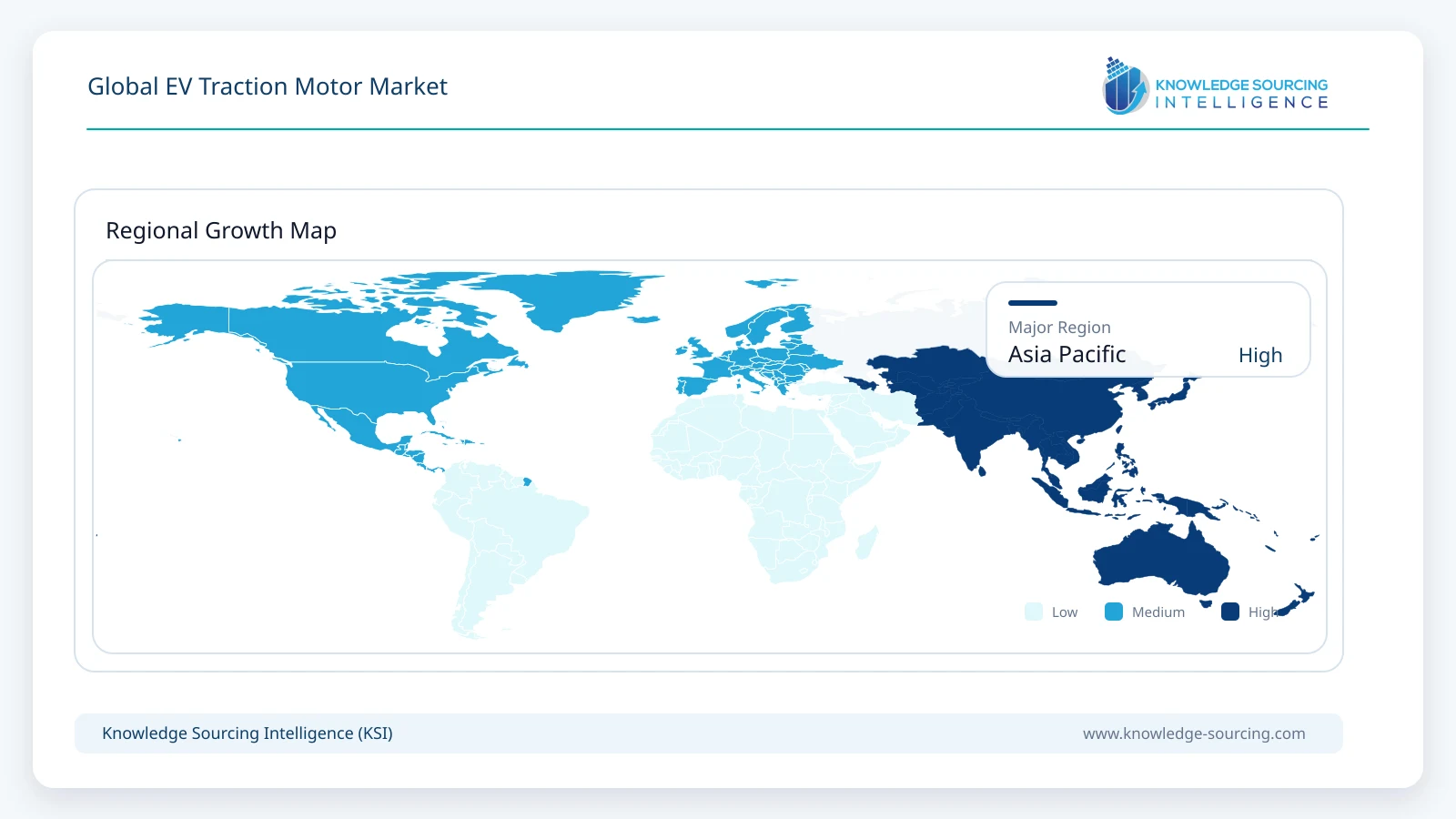
Asia Pacific is the largest manufacturing and demand region for EV traction motors because China accounts for the majority of global electric-vehicle production. Chinese OEMs operate at high annual platform volumes and increasingly source motors from both vertically integrated internal operations and specialist suppliers. Domestic suppliers such as Jing-Jin Electric compete alongside Nidec, Bosch, BorgWarner, ZF, Schaeffler and other multinational groups with localized engineering and manufacturing.
The region is also a proving ground for architecture diversity. BorgWarner's 2025 and 2026 awards span pure-electric, plug-in-hybrid and generator-motor applications in China and South Korea. ZF began mass production of its next-generation asynchronous motor in Hangzhou in June 2025, reflecting demand for magnet-free alternatives. Japan remains important through Nidec, Denso, Aisin and Hitachi Astemo, while South Korea combines global vehicle production with Hyundai Mobis and LG Magna e-Powertrain.
India is emerging as a localization opportunity as domestic EV production increases. Bosch and Tata AutoComp announced a joint venture focused on engineering, manufacturing and sales of e-axles and electric motors in India, reinforcing the shift from imported propulsion systems toward localized component production. Through 2031, regional competition is expected to center on cost, rare-earth exposure, manufacturing scale and integration with 800 V drive architectures.
Competitive Landscape
The competitive environment includes dedicated motor manufacturers, diversified Tier 1 suppliers and vertically integrated automakers. Nidec remains one of the most visible independent electric-motor specialists, while ZF, Bosch, BorgWarner, Valeo, Schaeffler, Magna and Dana compete through motor components and integrated electric-drive systems. Japanese suppliers including Denso, Aisin and Hitachi Astemo add deep automotive manufacturing capability, while Hyundai Mobis and LG Magna e-Powertrain are important in South Korea.
Competitive advantage increasingly depends on more than peak motor efficiency. Suppliers are differentiating through stator winding technology, rotor architecture, cooling, reduced rare-earth content, acoustic performance, manufacturing automation and software coordination with the inverter. Platform strategies that support multiple rotor types around common manufacturing assets can also reduce development time and protect suppliers against shifts in raw-material pricing.
Recent Developments
September 2026: Bosch said that one in three newly registered battery-electric trucks in Europe in 2026 was powered by a Bosch electric motor and inverter, while also announcing a new long-term electric-powertrain order from Daimler Truck.
September 2026: ZF Aftermarket introduced targeted EV repair solutions covering e-motors, hybrid modules, inverters and electric-drive reducers for independent workshops.
May 2026: ZF confirmed that it would continue developing and manufacturing electric motors and inverters internally rather than shifting the components to external sourcing.
April 2026: BorgWarner announced three electric-motor business awards in China and South Korea covering battery-electric and hybrid vehicle applications.
February 2026: Schaeffler launched repair solutions for Stellantis vehicles equipped with the EMR3 electric axle, including component-level electric-motor repair.
June 2025: ZF announced mass production of its next-generation asynchronous electric motor in Hangzhou, China, for upcoming EV models.
EV Traction Motor Market Scope
| Report Metric | Details |
|---|---|
| Total Market Size in 2026 | USD 10.9 billion |
| Total Market Size in 2031 | USD 20.6 billion |
| Forecast Unit | Billion |
| Growth Rate | 13.6% |
| Study Period | 2021 to 2031 |
| Historical Data | 2021 to 2024 |
| Base Year | 2025 |
| Forecast Period | 2026 – 2031 |
| Segmentation | Motor Type, Vehicle Type, Power Output, Drive Configuration, Voltage Architecture, Geography |
| Companies |
|
Market Segmentation
By Motor Type
Permanent Magnet Synchronous Motor
Asynchronous / Induction Motor
Externally Excited Synchronous Motor
Axial Flux Motor
Other Motor Types
By Vehicle Type
Passenger Battery Electric Vehicles
Plug-in Hybrid Electric Vehicles
Commercial Electric Vehicles
Electric Two- and Three-Wheelers
By Power Output
Below 100 kW
100-250 kW
Above 250 kW
By Drive Configuration
Single-Motor Drive
Dual-Motor Drive
Multi-Motor Drive
By Voltage Architecture
Below 400 V
400-799 V
800 V and Above
By Geography
North America
United States
Canada
Mexico
South America
Brazil
Argentina
Rest of South America
Europe
Germany
United Kingdom
France
Italy
Rest of Europe
Middle East and Africa
Saudi Arabia
United Arab Emirates
South Africa
Rest of Middle East and Africa
Asia Pacific
China
Japan
India
South Korea
Rest of Asia Pacific
Table of Contents
1. EXECUTIVE SUMMARY
2. MARKET SNAPSHOT
2.1. Market Overview
2.2. Market Segmentation
3. BUSINESS LANDSCAPE
3.1. Market Drivers
3.1.1. Electric Vehicle Production Expands the Core Motor Demand Base
3.1.2. Multiple-Motor Architectures Raise Motor Content per Vehicle
3.1.3. Rare-Earth Risk Is Accelerating Architecture Diversification
3.2. Market Restraints
3.2.1. Manufacturing Scale and Cost Reduction Pressure Motor Suppliers
3.3. Market Opportunities
3.4. Porter's Five Forces Analysis
3.5. Industry Value Chain Analysis
3.6. Automotive Safety, Efficiency and Homologation Requirements
4. TECHNOLOGICAL OUTLOOK
4.1. Hairpin and Advanced Winding
4.2. Direct Oil Cooling
4.3. Rare-Earth-Free and Reduced-Rare-Earth Motors
4.4. Higher-Speed Motor Designs
5. GLOBAL EV TRACTION MOTOR MARKET BY MOTOR TYPE
5.1. Permanent Magnet Synchronous Motor
5.2. Asynchronous / Induction Motor
5.3. Externally Excited Synchronous Motor
5.4. Axial Flux Motor
5.5. Other Motor Types
6. GLOBAL EV TRACTION MOTOR MARKET BY VEHICLE TYPE
6.1. Passenger Battery Electric Vehicles
6.2. Plug-in Hybrid Electric Vehicles
6.3. Commercial Electric Vehicles
6.4. Electric Two- and Three-Wheelers
7. GLOBAL EV TRACTION MOTOR MARKET BY POWER OUTPUT
7.1. Below 100 kW
7.2. 100-250 kW
7.3. Above 250 kW
8. GLOBAL EV TRACTION MOTOR MARKET BY DRIVE CONFIGURATION
8.1. Single-Motor Drive
8.2. Dual-Motor Drive
8.3. Multi-Motor Drive
9. GLOBAL EV TRACTION MOTOR MARKET BY VOLTAGE ARCHITECTURE
9.1. Below 400 V
9.2. 400-799 V
9.3. 800 V and Above
10. GLOBAL EV TRACTION MOTOR MARKET BY GEOGRAPHY
10.1. North America
10.1.1. United States
10.1.2. Canada
10.1.3. Mexico
10.2. South America
10.2.1. Brazil
10.2.2. Argentina
10.2.3. Rest of South America
10.3. Europe
10.3.1. Germany
10.3.2. United Kingdom
10.3.3. France
10.3.4. Italy
10.3.5. Rest of Europe
10.4. Middle East and Africa
10.4.1. Saudi Arabia
10.4.2. United Arab Emirates
10.4.3. South Africa
10.4.4. Rest of Middle East and Africa
10.5. Asia Pacific
10.5.1. China
10.5.2. Japan
10.5.3. India
10.5.4. South Korea
10.5.5. Rest of Asia Pacific
11. COMPETITIVE ENVIRONMENT AND ANALYSIS
11.1. Major Players and Strategy Analysis
11.2. Market Share Analysis
11.3. Product Development, Platform Awards and Partnerships
11.4. Competitive Dashboard
12. COMPANY PROFILES
12.1. Nidec Corporation
12.2. ZF Friedrichshafen AG
12.3. Robert Bosch GmbH
12.4. BorgWarner Inc.
12.5. Valeo SE
12.6. Schaeffler AG
12.7. Magna International Inc.
12.8. Dana Incorporated
12.9. Hitachi Astemo, Ltd.
12.10. DENSO Corporation
12.11. AISIN Corporation
12.12. Hyundai Mobis Co., Ltd.
12.13. LG Magna e-Powertrain Co., Ltd.
12.14. Jing-Jin Electric Technologies Co., Ltd.
12.15. MAHLE GmbH
12.16. YASA Limited
12.17. Tata AutoComp Systems Limited
12.18. Marelli Holdings Co., Ltd.
13. RECENT DEVELOPMENTS
14. APPENDIX
14.1. Currency
14.2. Assumptions
14.3. Base and Forecast Years Timeline
14.4. Abbreviations
Navigate
Trusted by the world's leading organizations











