
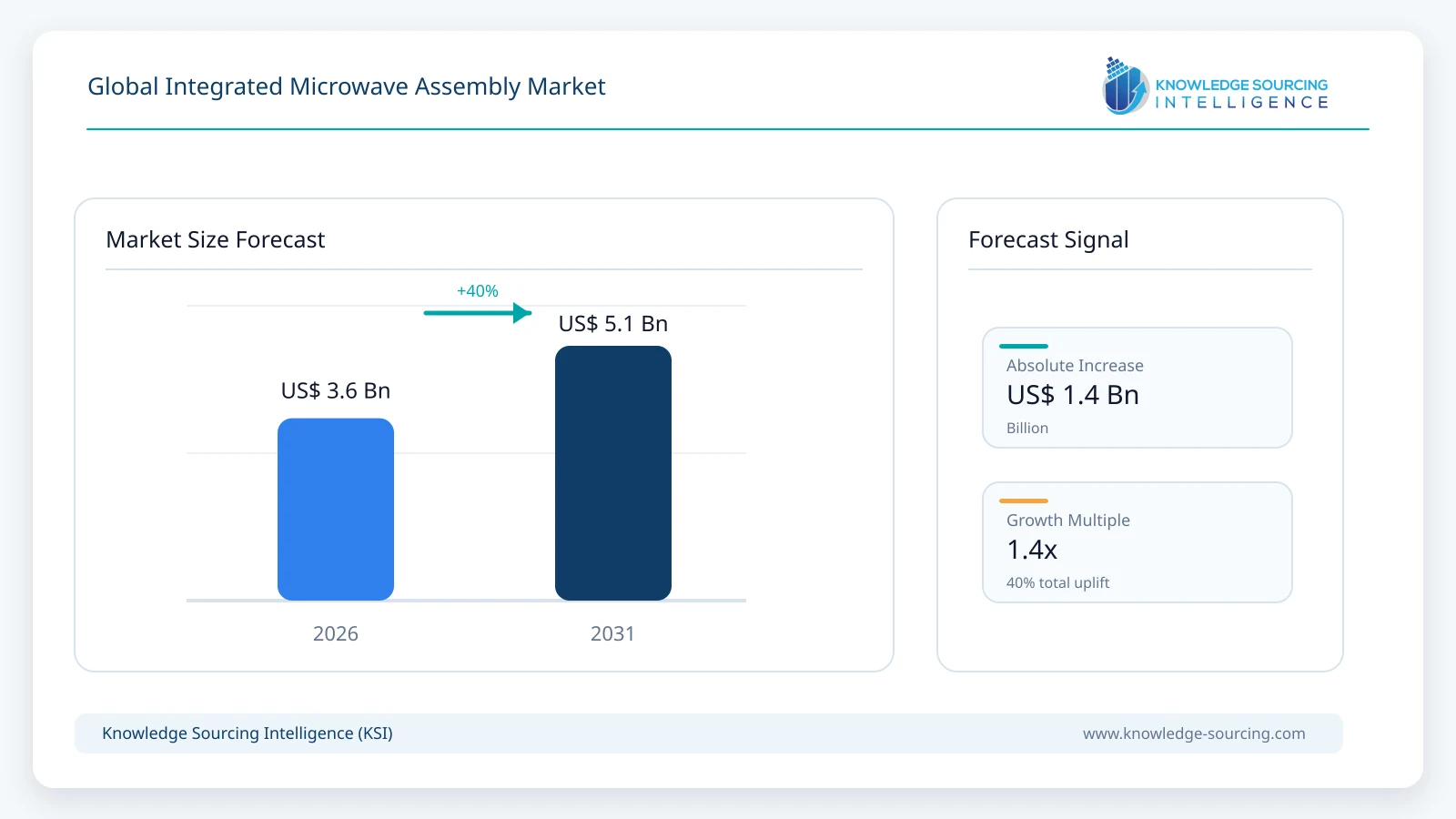
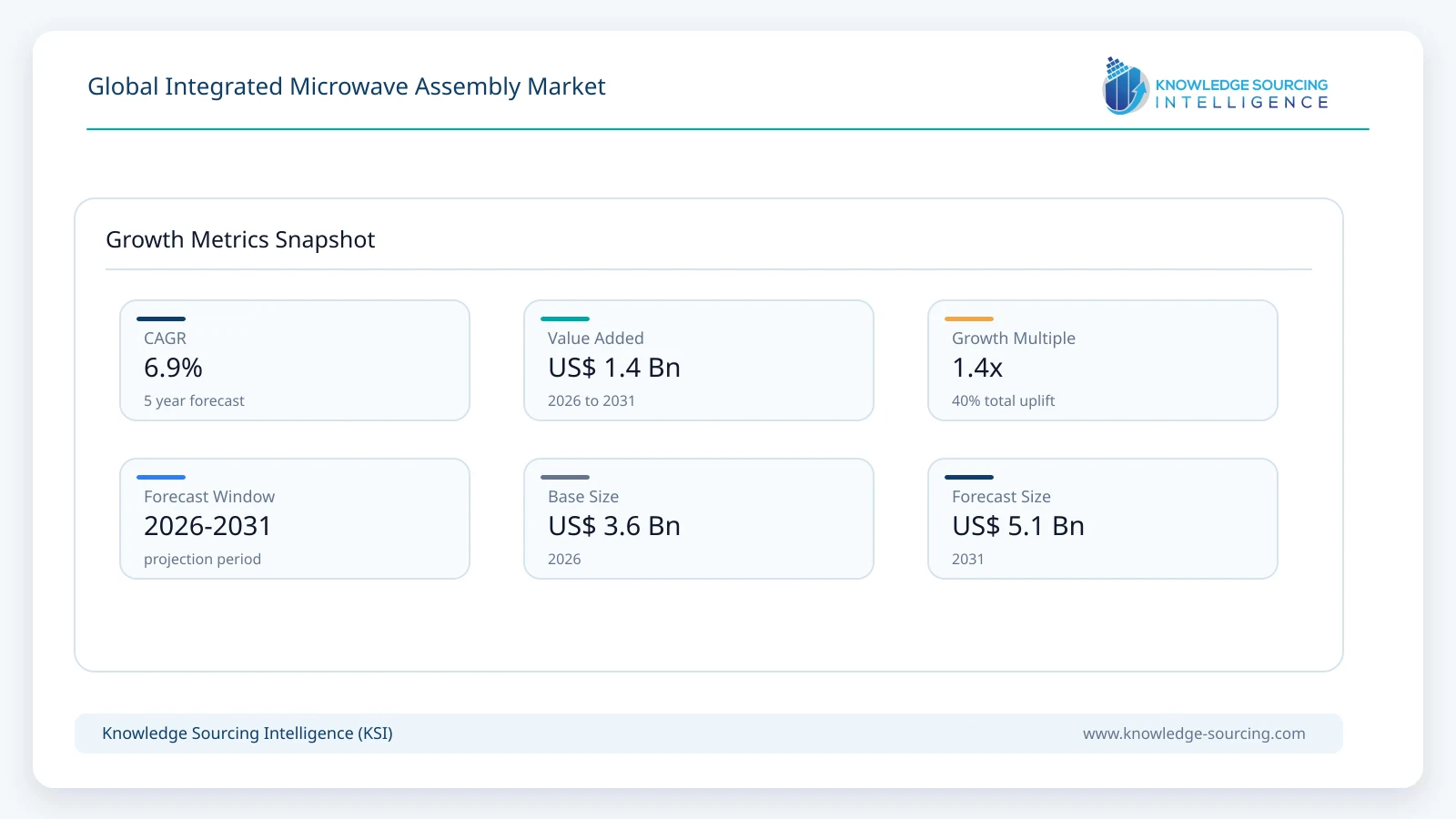
The Global Integrated Microwave Assembly Market is forecast to grow at a CAGR of 6.9%, reaching USD 5.10 billion in 2031 from USD 3.65 billion in 2026.
Highlights:
- 1Defense modernization programs are increasing demand for high-performance microwave signal assemblies.
- 2Satellite communication expansion is raising requirements for compact RF integrated solutions.
- 3Aerospace buyers prioritize reliability, thermal performance, and qualification compliance.
- 45G infrastructure upgrades continue supporting microwave component demand.
- 5Suppliers are expanding RF capabilities through integration and specialized product development.
Market Overview
Demand is concentrated among aerospace, defense, telecommunications, satellite communication, radar, electronic warfare, and specialized test equipment users where signal accuracy, low noise performance, and operational reliability influence purchasing decisions.
The market structure includes component manufacturers, RF subsystem suppliers, defense electronics contractors, and specialized microwave technology providers. Buyers typically evaluate suppliers based on frequency range, power handling capability, size and weight constraints, thermal management, lifecycle support, qualification records, and compliance with sector-specific standards. Defense and aerospace customers generally require longer validation cycles, while commercial communication customers focus more on performance-to-cost ratios and deployment timelines.
Procurement activity is being shaped by increased investment in secure communication networks, military sensing systems, satellite constellations, and next-generation wireless infrastructure. Integrated microwave assemblies help reduce system complexity by combining multiple RF functions into smaller packages, which is valuable for platforms where space, weight, and power consumption constraints affect design decisions.
The competitive environment is influenced by specialized engineering capability, manufacturing precision, supply-chain reliability, and the ability to customize assemblies for mission-specific requirements. Suppliers serving defense and space applications often compete through qualification expertise and long-term customer relationships, while commercial suppliers face greater pricing pressure and faster technology cycles.
Key Market Indicators
Indicator | Latest Evidence | Commercial Meaning |
Global defense spending | $2.7 trillion in 2024, according to SIPRI | Higher defense budgets support demand for radar, communication, and electronic warfare systems requiring microwave assemblies. |
Satellite activity | More than 2,800 satellites were launched globally in 2023, according to the United Nations Office for Outer Space Affairs (UNOOSA) | Expanding space activity increases demand for compact RF systems used in communication and sensing platforms. |
5G deployment | More than 2 billion 5G connections were projected globally by the end of 2024, according to GSMA | Wireless infrastructure upgrades continue creating demand for RF components and subsystems. |
U.S. aerospace and defense industry sales | $418 billion in 2023, according to Aerospace Industries Association (AIA) | Expanding aerospace production supports component suppliers across communication and electronic systems. |
Semiconductor and electronics supply-chain investment | Government-backed semiconductor programs in the U.S., Europe, and Asia are increasing domestic manufacturing capacity | Local sourcing strategies are influencing RF component supply decisions. |
Market Drivers
Expansion of defense electronics and electronic warfare systems.
Military modernization programs are increasing demand for microwave assemblies used in radar, secure communication, electronic intelligence, and electronic warfare platforms. Defense systems require RF modules that can operate across wide frequency ranges while maintaining signal integrity under harsh environmental conditions. The U.S. Department of Defense continues allocating funding toward advanced sensing, communications, and spectrum-related capabilities, while European and Asian defense agencies are increasing investments in domestic defense electronics capacity. Suppliers are responding by improving frequency coverage, reducing module size, and developing assemblies that meet military qualification standards.
Growth of satellite communication and space-based connectivity.
Commercial satellite operators and government space agencies are increasing demand for compact microwave assemblies used in satellite payloads, ground terminals, and communication networks. Low Earth orbit satellite deployments require lightweight RF solutions because payload limitations directly affect launch economics and system efficiency. Companies developing satellite communication systems are seeking suppliers capable of delivering high-frequency performance with lower power consumption and improved thermal control. Microwave assembly manufacturers are therefore investing in solutions designed for space qualification, radiation tolerance, and long operational lifecycles.
Rising complexity of wireless infrastructure and high-frequency networks.
Telecommunications operators are upgrading networks to support higher data capacity, low-latency applications, and dense connectivity requirements. These changes require RF components capable of handling higher frequencies and improving signal quality across base stations and network equipment. The expansion of millimeter-wave communication technologies is creating opportunities for integrated assemblies that combine multiple RF functions into smaller modules. Suppliers are focusing on improved integration levels because telecom customers increasingly prefer compact solutions that reduce installation complexity and equipment footprint.
Demand for compact and high-performance RF systems in aerospace platforms.
Aircraft, unmanned systems, and avionics platforms increasingly require smaller electronic systems without reducing performance. Space and weight limitations influence procurement decisions, particularly for airborne platforms where every component affects fuel efficiency, payload capacity, and mission capability. Integrated microwave assemblies help system designers reduce the number of separate RF components while improving reliability. Aerospace suppliers are responding with customized assemblies designed for specific aircraft requirements, environmental conditions, and certification processes.
Market Restraints and Challenges
Complex qualification requirements increase development timelines.
Microwave assemblies used in defense, aerospace, and space systems must meet strict performance, reliability, and environmental standards before entering service. Qualification processes often involve extensive testing for temperature variation, vibration resistance, electromagnetic compatibility, and long-term operational stability. These requirements increase engineering costs and extend product development cycles. Smaller suppliers may face difficulty investing in testing infrastructure and certification capabilities before securing volume contracts.
High manufacturing complexity limits supplier flexibility.
Integrated microwave assemblies require precision manufacturing, advanced packaging techniques, and specialized RF design expertise. Maintaining consistent performance at high frequencies can be challenging because minor variations in materials, assembly processes, or component quality can affect signal behavior. Manufacturers must balance customization requirements with production efficiency, particularly when serving defense customers that require specialized configurations. These factors can restrict scalability and increase production costs.
Supply-chain dependence for specialized RF materials and components.
Microwave assembly manufacturers rely on specialized semiconductors, substrates, connectors, and electronic materials that may have limited supplier availability. Disruptions in semiconductor supply chains and geopolitical restrictions on critical technologies have increased the focus on sourcing security. Defense and aerospace customers are placing greater emphasis on traceability and domestic supply options, requiring suppliers to diversify sourcing networks and invest in alternative production channels.
Pricing pressure in commercial communication applications.
Telecommunications customers often prioritize cost efficiency as network operators manage large-scale infrastructure investments. Unlike defense applications, where performance and reliability often receive greater weight, commercial buyers frequently compare suppliers based on pricing, delivery schedules, and integration support. This pressure can limit margins for microwave assembly manufacturers supplying telecom infrastructure, particularly when technology cycles shorten and customers demand frequent product upgrades.
Major Segment Analysis
Amplifiers
Amplifiers represent a commercially important segment within the integrated microwave assembly market because they directly influence signal strength, transmission range, and system performance across defense, telecommunications, satellite, and aerospace applications. Microwave amplifiers are required in systems where weak RF signals must be increased without introducing excessive noise or distortion. Buyers typically evaluate amplifier assemblies based on gain performance, frequency coverage, power efficiency, thermal management, and reliability under operating conditions.
Defense and aerospace applications continue to support demand for specialized amplifier assemblies used in radar, electronic warfare, communication links, and airborne systems. These customers often prioritize performance consistency and qualification history over initial purchase cost. Commercial communication operators, meanwhile, focus more on efficiency, scalability, and compatibility with evolving network architectures.
Manufacturers are competing through improvements in semiconductor integration, packaging techniques, and customized RF solutions. The segment faces pressure from rising design complexity and the need to support wider frequency ranges. Suppliers that can combine high performance with smaller form factors are better positioned to address requirements from space systems, defense platforms, and next-generation communication networks.
Regional Analysis
Region | Main Demand Signal | Principal Constraint |
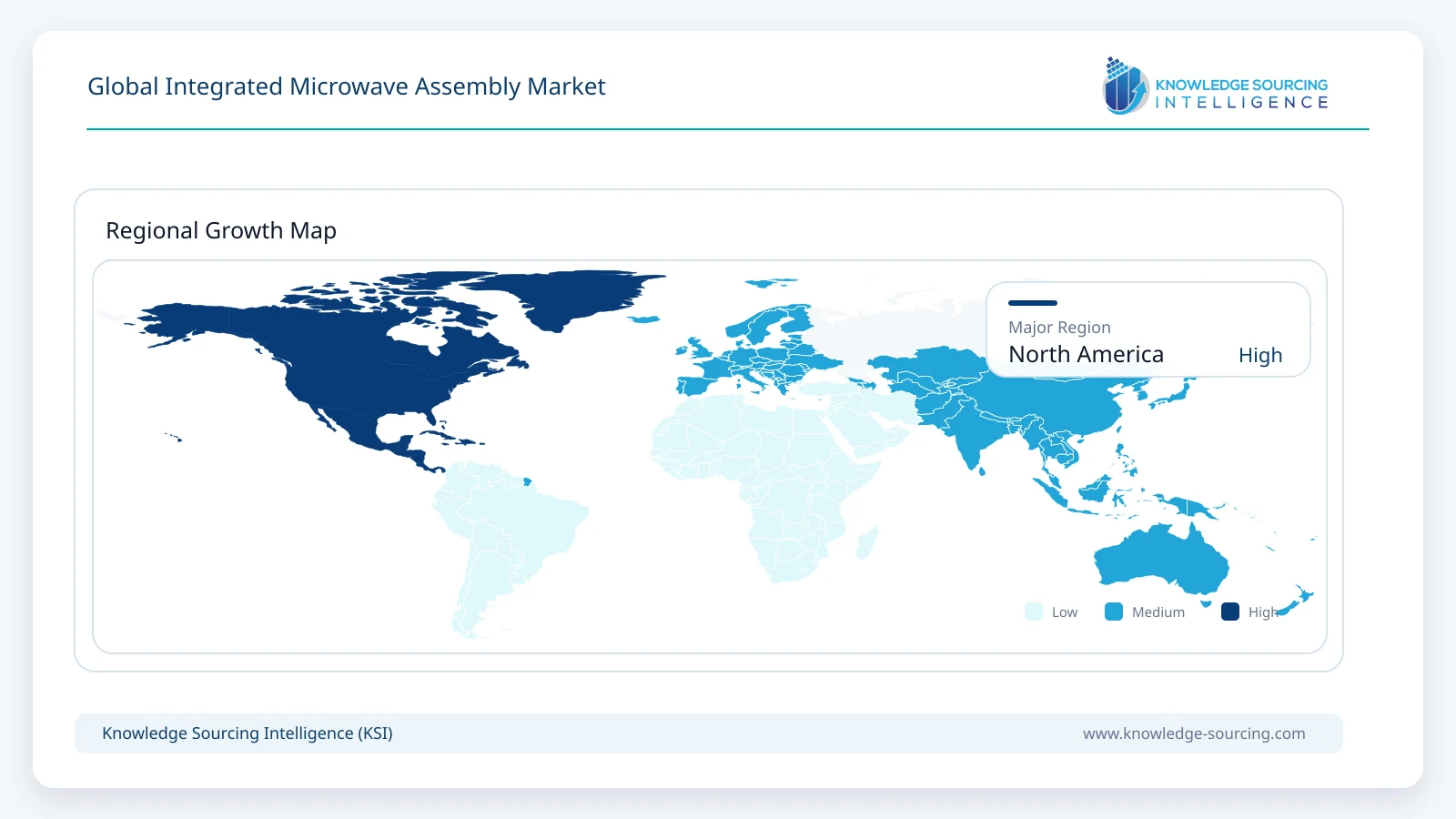
North America | Defense electronics programs, aerospace production, satellite communication investment | High qualification requirements and supply-chain security concerns |
Europe | Defense modernization, space programs, telecom infrastructure upgrades | Fragmented procurement processes across countries |
Asia Pacific | Semiconductor manufacturing, telecommunications expansion, defense technology development | Dependence on imported high-end RF technologies in several markets |
Middle East and Africa | Defense procurement and communication infrastructure projects | Limited local manufacturing capability |
North America
Defense procurement, aerospace manufacturing, and commercial satellite activity continue to create demand for integrated microwave assemblies across North America. The United States remains commercially important due to its large defense electronics ecosystem and extensive aerospace supply chain. Companies supplying radar, electronic warfare, military communications, and space systems benefit from sustained government investment in advanced RF capabilities.
The U.S. Department of Defense continues funding programs related to spectrum management, advanced sensing, and secure communications. These programs require microwave components capable of operating across complex frequency environments. Domestic manufacturing initiatives for semiconductor and electronic supply chains are also influencing sourcing decisions among defense contractors.
Canada contributes through aerospace manufacturing and communication infrastructure development, while Mexico is increasingly relevant as an electronics manufacturing location. However, regional suppliers continue facing challenges related to specialized component availability, export controls, and strict defense procurement requirements.
Europe
European demand is supported by defense spending increases, satellite programs, and efforts to strengthen regional electronics capabilities. Countries including Germany, France, and the United Kingdom maintain established aerospace and defense industries that require microwave assemblies for radar, communication, and surveillance systems.
Defense modernization efforts following increased security concerns have encouraged governments to expand investment in military communication and sensing technologies. The European Space Agency and national space programs also support demand for qualified RF systems used in satellite missions.
However, procurement remains fragmented because defense requirements, certification standards, and funding priorities differ among countries. Suppliers often need regional partnerships and local compliance expertise to access government-backed projects.
Asia Pacific
Asia Pacific demand is shaped by telecommunications expansion, semiconductor manufacturing capacity, satellite communication growth, and defense technology investment. China, Japan, South Korea, India, and Taiwan represent important markets due to their electronics manufacturing capabilities and increasing requirements for RF systems.
China’s electronics ecosystem supports domestic microwave component production, while Japan and South Korea maintain strong semiconductor and precision manufacturing capabilities. India is expanding defense electronics production and space capabilities through government-supported programs and domestic manufacturing initiatives.
The region offers manufacturing advantages, but some countries continue depending on imported high-performance microwave technologies. Trade restrictions, technology transfer controls, and supply-chain diversification efforts are influencing procurement strategies.
Middle East and Africa
Defense modernization programs and communication infrastructure projects are supporting demand in selected Middle Eastern markets. Countries such as Saudi Arabia, the United Arab Emirates, and Israel are investing in aerospace, defense electronics, surveillance, and secure communication systems that require RF technologies.
Israel maintains a strong defense electronics ecosystem, particularly in radar and electronic warfare applications. Gulf countries are expanding defense procurement and satellite communication capabilities through partnerships with international suppliers.
Africa remains an emerging market with demand concentrated around communication infrastructure and defense applications. Limited local manufacturing capacity and reliance on imported systems continue to restrict broader market development.
Competitive Landscape
The integrated microwave assembly market is characterized by specialized suppliers competing through engineering capability, application expertise, manufacturing precision, and customer qualification experience. The market includes RF component manufacturers, defense electronics suppliers, semiconductor companies, and test equipment providers.
Companies such as Keysight Technologies, Inc., Analog Devices, Inc., Qorvo, Inc., and Skyworks Solutions, Inc. compete through RF design expertise, semiconductor integration, and application-specific solutions. Specialized suppliers including Narda-MITEQ and CAES focus on high-reliability microwave assemblies for aerospace and defense applications.
Competition is influenced by long qualification cycles, customer relationships, and the ability to provide customized solutions. Suppliers serving defense and space markets often compete through reliability records and technical support, while commercial suppliers face greater pressure on cost, production scale, and product lifecycle management.
Recent Developments
October 2025 – Skyworks Solutions to acquire Qorvo: Skyworks announced a $22 billion cash-and-stock acquisition of Qorvo, strengthening RF, analog and microwave semiconductor capabilities for defense, SATCOM, aerospace and wireless infrastructure, expanding highly integrated microwave module portfolios.
July 2025 – JQL Technologies acquired AMT Microwave’s Spiral and Phased Array Antenna portfolio, strengthening its high-frequency defense-focused custom microwave front-end capabilities.
March 2025 – Qorvo launches next-generation Ku-band SATCOM beamformer ICs: Qorvo introduced new Ku-band transmit and receive beamformer ICs for phased-array satellite terminals, reducing power consumption while improving beam steering, integration and efficiency for compact microwave assembly-based SATCOM systems.
January 2025 – Micross acquires Integra Technologies: Micross completed the acquisition of Integra Technologies, enhancing its advanced semiconductor packaging, testing and high-reliability microelectronic assembly capabilities for aerospace, defense, RF and microwave integrated module applications.
Regulatory and Policy Environment
Government regulations influence the integrated microwave assembly market through export controls, defense procurement rules, spectrum management policies, and technology security requirements. Microwave technologies used in military and aerospace applications are frequently subject to export restrictions because they support sensitive communication, radar, and electronic warfare systems.
In the United States, export regulations under the International Traffic in Arms Regulations (ITAR) affect the movement of defense-related RF technologies and components. Suppliers serving military customers must maintain compliance systems that control manufacturing, documentation, and international transactions.
European countries are strengthening domestic defense and space capabilities through national programs and regional initiatives. These efforts encourage local supply chains but also increase requirements for certification and security compliance.
Telecommunications applications are influenced by spectrum allocation decisions and wireless infrastructure policies. Regulatory approvals for new frequency bands affect equipment design requirements and create demand for RF components capable of supporting evolving communication standards.
Supply-chain security has become a policy priority across major economies. Semiconductor localization programs in the United States, Europe, and Asia are encouraging domestic production of critical electronic components, which may influence future sourcing patterns for microwave assembly manufacturers.
Outlook and Strategic Implications
Demand for integrated microwave assemblies through 2026–2031 will be shaped by defense modernization, satellite communication expansion, wireless infrastructure upgrades, and the growing complexity of RF systems. Buyers are expected to place greater emphasis on compact designs, higher frequency performance, thermal efficiency, and supplier reliability as electronic systems become more integrated.
The market opportunity will depend less on standalone component supply and more on the ability to deliver application-specific assemblies that meet strict performance requirements. Defense and aerospace customers will continue valuing qualification capability, lifecycle support, and supply assurance, while telecommunications and commercial users will prioritize cost control, scalability, and faster product cycles.
Suppliers are likely to increase investment in semiconductor integration, automated manufacturing, and domestic supply networks. Companies with strong RF engineering capabilities and access to specialized manufacturing processes may gain advantages in high-value applications, particularly radar, electronic warfare, satellite communication, and advanced aerospace platforms.
Key strategic considerations include:
For manufacturers: Investment priorities will likely focus on improving RF integration, reducing assembly complexity, and securing specialized component supply chains. Companies will need to balance customization requirements with manufacturing efficiency.
For defense and aerospace suppliers: Long qualification cycles and strict reliability standards will continue shaping competitive advantage. Strong relationships with system integrators and government contractors will remain important for securing long-term programs.
For telecommunications suppliers: Cost efficiency and rapid product adaptation will influence competitiveness as operators upgrade networks and evaluate higher-frequency communication technologies.
For investors: Market opportunities are closely linked to defense spending trends, satellite deployment activity, semiconductor supply-chain strategies, and the ability of companies to maintain technical differentiation.
Global Integrated Microwave Assembly Market Scope:
| Report Metric | Details |
|---|---|
| Total Market Size in 2026 | USD 3.65 billion |
| Total Market Size in 2031 | USD 5.10 billion |
| Forecast Unit | USD Billion |
| Growth Rate | 6.9% |
| Study Period | 2021 to 2031 |
| Historical Data | 2021 to 2024 |
| Base Year | 2025 |
| Forecast Period | 2026 – 2031 |
| Segmentation | Type, Applications, Geography |
| Companies |
|
Market Segmentation
By Type
Amplifiers
Frequency Converters
Frequency Synthesizers
Oscillators
Mixers
Filters
Transceivers
RF Front-End Modules
By Applications
Avionics
Telecommunications and Satellite Communication
Military and Defense
Radar Systems
Electronic Warfare
Automotive
Space Systems
Test and Measurement
Others
By Geography
North America
United States
Canada
Mexico
South America
Brazil
Argentina
Others
Europe
Germany
France
United Kingdom
Spain
Others
Middle East and Africa
Saudi Arabia
UAE
Israel
Others
Asia Pacific
China
Japan
India
South Korea
Indonesia
Taiwan
Others
Table of Contents
1. INTRODUCTION
1.1. Market Overview
1.2. Market Definition
1.3. Scope of the Study
1.4. Market Segmentation
1.5. Currency
1.6. Assumptions
1.7. Base, and Forecast Years Timeline
1.8. Key benefits to the stakeholder
2. RESEARCH METHODOLOGY
2.1. Research Design
2.2. Research Process
3. EXECUTIVE SUMMARY
3.1. Key Findings
3.2. Analyst View
4. MARKET DYNAMICS
4.1. Market Drivers
4.2. Market Restraints
4.3. Porter’s Five Forces Analysis
4.3.1. Bargaining Power of Suppliers
4.3.2. Bargaining Power of Buyers
4.3.3. Threat of New Entrants
4.3.4. Threat of Substitutes
4.3.5. Competitive Rivalry in the Industry
4.4. Industry Value Chain Analysis
4.5. Analyst View
5. GLOBAL INTEGRATED MICROWAVE ASSEMBLY MARKET BY TYPE
5.1. Introduction
5.2. Amplifiers
5.2.1. Market opportunities and trends
5.2.2. Growth prospects
5.2.3. Geographic lucrativeness
5.3. Frequency Converters
5.3.1. Market opportunities and trends
5.3.2. Growth prospects
5.3.3. Geographic lucrativeness
5.4. Frequency Synthesizers
5.4.1. Market opportunities and trends
5.4.2. Growth prospects
5.4.3. Geographic lucrativeness
5.5. Oscillators
5.5.1. Market opportunities and trends
5.5.2. Growth prospects
5.5.3. Geographic lucrativeness
5.6. Mixers
5.6.1. Market opportunities and trends
5.6.2. Growth prospects
5.6.3. Geographic lucrativeness
5.7. Filters
5.7.1. Market opportunities and trends
5.7.2. Growth prospects
5.7.3. Geographic lucrativeness
5.8. Transceivers
5.8.1. Market opportunities and trends
5.8.2. Growth prospects
5.8.3. Geographic lucrativeness
5.9. RF Front-End Modules
5.9.1. Market opportunities and trends
5.9.2. Growth prospects
5.9.3. Geographic lucrativeness
6. GLOBAL INTEGRATED MICROWAVE ASSEMBLY MARKET BY APPLICATIONS
6.1. Introduction
6.2. Avionics
6.2.1. Market opportunities and trends
6.2.2. Growth prospects
6.2.3. Geographic lucrativeness
6.3. Telecommunications and Satellite Communication
6.3.1. Market opportunities and trends
6.3.2. Growth prospects
6.3.3. Geographic lucrativeness
6.4. Military and Defense
6.4.1. Market opportunities and trends
6.4.2. Growth prospects
6.4.3. Geographic lucrativeness
6.5. Radar Systems
6.5.1. Market opportunities and trends
6.5.2. Growth prospects
6.5.3. Geographic lucrativeness
6.6. Electronic Warfare
6.6.1. Market opportunities and trends
6.6.2. Growth prospects
6.6.3. Geographic lucrativeness
6.7. Automotive
6.7.1. Market opportunities and trends
6.7.2. Growth prospects
6.7.3. Geographic lucrativeness
6.8. Space Systems
6.8.1. Market opportunities and trends
6.8.2. Growth prospects
6.8.3. Geographic lucrativeness
6.9. Test and Measurement
6.9.1. Market opportunities and trends
6.9.2. Growth prospects
6.9.3. Geographic lucrativeness
6.10. Others
6.10.1. Market opportunities and trends
6.10.2. Growth prospects
6.10.3. Geographic lucrativeness
7. GLOBAL INTEGRATED MICROWAVE ASSEMBLY MARKET BY GEOGRAPHY
7.1. Introduction
7.2. North America
7.2.1. By Type
7.2.2. By Applications
7.2.3. By Country
7.2.3.1. United States
7.2.3.1.1. Market Trends and Opportunities
7.2.3.1.2. Growth Prospects
7.2.3.2. Canada
7.2.3.2.1. Market Trends and Opportunities
7.2.3.2.2. Growth Prospects
7.2.3.3. Mexico
7.2.3.3.1. Market Trends and Opportunities
7.2.3.3.2. Growth Prospects
7.3. South America
7.3.1. By Type
7.3.2. By Applications
7.3.3. By Country
7.3.3.1. Brazil
7.3.3.1.1. Market Trends and Opportunities
7.3.3.1.2. Growth Prospects
7.3.3.2. Argentina
7.3.3.2.1. Market Trends and Opportunities
7.3.3.2.2. Growth Prospects
7.3.3.3. Others
7.3.3.3.1. Market Trends and Opportunities
7.3.3.3.2. Growth Prospects
7.4. Europe
7.4.1. By Type
7.4.2. By Applications
7.4.3. By Country
7.4.3.1. Germany
7.4.3.1.1. Market Trends and Opportunities
7.4.3.1.2. Growth Prospects
7.4.3.2. France
7.4.3.2.1. Market Trends and Opportunities
7.4.3.2.2. Growth Prospects
7.4.3.3. United Kingdom
7.4.3.3.1. Market Trends and Opportunities
7.4.3.3.2. Growth Prospects
7.4.3.4. Spain
7.4.3.4.1. Market Trends and Opportunities
7.4.3.4.2. Growth Prospects
7.4.3.5. Others
7.4.3.5.1. Market Trends and Opportunities
7.4.3.5.2. Growth Prospects
7.5. Middle East and Africa
7.5.1. By Type
7.5.2. By Applications
7.5.3. By Country
7.5.3.1. Saudi Arabia
7.5.3.1.1. Market Trends and Opportunities
7.5.3.1.2. Growth Prospects
7.5.3.2. UAE
7.5.3.2.1. Market Trends and Opportunities
7.5.3.2.2. Growth Prospects
7.5.3.3. Israel
7.5.3.3.1. Market Trends and Opportunities
7.5.3.3.2. Growth Prospects
7.5.3.4. Others
7.5.3.4.1. Market Trends and Opportunities
7.5.3.4.2. Growth Prospects
7.6. Asia Pacific
7.6.1. By Type
7.6.2. By Applications
7.6.3. By Country
7.6.3.1. China
7.6.3.1.1. Market Trends and Opportunities
7.6.3.1.2. Growth Prospects
7.6.3.2. Japan
7.6.3.2.1. Market Trends and Opportunities
7.6.3.2.2. Growth Prospects
7.6.3.3. India
7.6.3.3.1. Market Trends and Opportunities
7.6.3.3.2. Growth Prospects
7.6.3.4. South Korea
7.6.3.4.1. Market Trends and Opportunities
7.6.3.4.2. Growth Prospects
7.6.3.5. Indonesia
7.6.3.5.1. Market Trends and Opportunities
7.6.3.5.2. Growth Prospects
7.6.3.6. Taiwan
7.6.3.6.1. Market Trends and Opportunities
7.6.3.6.2. Growth Prospects
7.6.3.7. Others
7.6.3.7.1. Market Trends and Opportunities
7.6.3.7.2. Growth Prospects
8. COMPETITIVE ENVIRONMENT AND ANALYSIS
8.1. Major Players and Strategy Analysis
8.2. Market Share Analysis
8.3. Mergers, Acquisition, Agreements, and Collaborations
8.4. Competitive Dashboard
9. COMPANY PROFILES
9.1. Narda-MITEQ
9.2. Keysight Technologies, Inc.
9.3. Analog Devices, Inc.
9.4. Qorvo, Inc
9.5. CAES
9.6. Teledyne Technologies
9.7. CPI International
9.8. Sumitomo Electric Industries, Ltd.
9.9. Skyworks Solutions, Inc.
9.10. Anritsu
LIST OF FIGURES
LIST OF TABLES
Navigate
Trusted by the world's leading organizations











